What can I tow at a glance
- The four numbers that decide it
- Your towing capacity, your GCWR, your payload, and the trailer's loaded weight (including its tongue weight)
- The limit that usually binds first
- Payload or GCWR, rarely the headline towing capacity
- Tongue weight rule of thumb
- The widely-used 10–15% of the loaded trailer weight, and it comes out of your payload
- Where to read your numbers
- Towing capacity in the owner's manual or towing guide; GVWR and GAWR on the door-jamb label; payload on the B-pillar label
- What a typical travel trailer weighs
- Often 1,500–3,000 lb empty for small trailers and 6,000–8,000 lb loaded for larger ones, confirm each model
- How to check your own rig
- Compare your vehicle and trailer ratings with their loaded weights, including passengers, cargo and tongue weight
"How much can I tow?" sounds like it should have one answer printed on a sticker. It does not. A tow rating tells you the most the vehicle can pull in ideal trim, but the trailer you actually hitch has to clear three limits at once: the tow rating, the combined weight ceiling, and your payload. This guide shows you the four numbers that decide it, what a given capacity is good for, and how to compare them for your own rig.
How much can my truck tow?
Your truck can tow whichever weight stays under all three of its limits at once (towing capacity, GCWR and payload), so the real answer is "the heaviest trailer that clears the limit that runs out first." For most trucks and SUVs loaded with people and gear, that limit is payload or GCWR, well below the tow rating on the brochure.
Start with the tow rating, then test it against the other two. Towing capacity is the maximum trailer weight the vehicle is rated to pull, set under the SAE J2807 test so ratings compare across brands. GCWR is the ceiling on the loaded truck plus the loaded trailer together. Payload is what the truck can carry, and the trailer's tongue weight lands on the hitch and counts against it. A trailer can sit under the tow rating and still push the combination over GCWR, or load the hitch past what payload allows. The tow rating answers "can it pull?"; it does not answer "is this loaded rig legal and stable?"
What can I tow with 3,500, 5,000 or 7,000 lb of capacity?
As a rough guide, 3,500 lb suits small and teardrop trailers, 5,000 lb opens up many single-axle and smaller dual-axle travel trailers, and 7,000 lb reaches mid-size travel trailers, but always subtract tongue weight from your payload before you commit. Capacity tiers are a useful shortlist, not a guarantee for your build.
| Towing capacity | What it typically covers | Watch out for |
|---|---|---|
| 3,500 lb | Teardrops, small utility and pop-up trailers | A small SUV at this tier often has little payload left for tongue weight |
| 5,000 lb | Many single-axle and smaller dual-axle travel trailers | Loaded weight creeps well above the dry weight on the brochure |
| 7,000 lb | Mid-size travel trailers, small toy haulers | GCWR and payload usually bind before the tow rating here |
The number that catches people is the gap between a trailer's dry weight and its loaded weight. A travel trailer advertised at 5,200 lb dry can leave the lot near 6,500 lb once water, batteries, gear and an awning are aboard, and its tongue weight rises with it. Match the tier to the trailer's loaded weight, not its sticker.
How much can popular trucks and SUVs tow?
Small SUVs and crossovers are generally rated around 1,500–3,500 lb, midsize SUVs around 5,000–6,600 lb, midsize trucks around 6,000–7,700 lb, and half-ton trucks around 8,000–13,000 lb when properly equipped, with the exact figure swinging by engine, drivetrain and tow package. Use the chart to compare specific models, then check your own.
These ranges are starting points. The same nameplate can vary by a few thousand pounds across trims, so the model name alone never settles it. The towing capacity chart puts specific vehicles side by side by curb weight, payload and maximum tow rating. For the ratings behind those numbers, the pillar guide on towing weight ratings explains GVWR, GCWR and payload and which one binds first.
What size travel trailer can I tow?
Match the trailer's loaded weight (not its dry weight) to the lowest of your towing capacity, your GCWR headroom and your payload-minus-tongue-weight, and stay under all three. The trailer you can tow is the one whose loaded weight and tongue weight both fit, with margin to spare.
Work it in order. First, the trailer's loaded weight must sit under your towing capacity. Second, your loaded truck plus that loaded trailer must stay under GCWR. Third, the trailer's tongue weight (figure 10–15% of its loaded weight) has to fit inside your payload alongside passengers and cargo. Leaving roughly 10–20% of headroom on the tightest of the three is a common margin, because real loads rarely match the brochure. If you are towing anything over about 5,000 lb, a weight-distribution hitch helps restore the front-axle weight a heavy tongue takes off.
How loadmate helps you stay under your truck's limits
The useful answer starts with the truck in your driveway: its accessories, the people in the cab and the trailer as you will load it. loadmate connects those recorded weights with the towing, vehicle and combined limits, so you can see what needs attention before the trip. Get the loadmate app. After installation, add your vehicle and trailer, then enter their ratings and the weights you know.
A measured baseline makes that picture more useful, especially once permanent accessories and trip loads have moved the truck away from its brochure weight.
loadmate provides decision support for towing safety, not legal weight certification. Score, compliance checks, and trip readiness are based on the data you enter and the regulator information current at the time of release. For legal weight evidence, use a certified truck scale / CAT scale. Towing remains the operator's responsibility. See /safety-disclaimer.
Related guides
These guides explain the numbers behind every answer above, and the per-vehicle spokes run the same three-way check on one truck at a time.
- How much can a Ford Ranger tow?: why one option code decides between a 3,500 lb and a 7,500 lb rating
- How much can a Toyota Tacoma tow?: the cab and engine that set your rating, and why the highest-rated Tacoma carries the least
- How much can a Jeep Wrangler tow?: 2,000 to 5,000 lb by body style, and the tongue-weight figure Jeep never publishes
- How much can a Ford F-150 tow?: four Ford-printed trailer ceilings, and the GVWR Ford leaves off the page
- How much can a Ram 1500 tow?: why the axle code on the door label moves the rating further than the engine does
- How much can a Toyota Tundra tow?: why grade moves the rating further than cab, bed or drivetrain do
- How much can a Nissan Frontier tow?: one engine across the whole lineup, and the trim still moves the rating by 880 lb
- How much can a Honda Ridgeline tow?: the unibody truck where the combined ceiling, not payload, decides the trip
- How much can a Subaru Forester tow?: 1,500 lb on nine trims and 3,500 lb on one, and the trailer figures that decide it
- How much can a Chevy Colorado tow?: 7,700 lb with the package, and the hitch Chevrolet requires 1,700 lb below it
- How much can a Ford Explorer tow?: 5,000 lb on every 2026 Explorer, and the 688 lb seven seats have to share
- How much can a Ford Maverick tow?: 2,000 lb as standard, 4,000 lb with the package, and 177 lb reaching the bed
- How much can a Honda Pilot tow?: 5,000 lb with two people aboard, 4,500 lb with four, and a tongue figure that falls twice as fast
- Towing capacity chart: compare SUVs and trucks by curb weight, payload and max tow
- Towing weight ratings explained: GVWR, GCWR, GAWR and payload, and which one binds first
- Payload vs towing capacity: why the two are different numbers and which actually limits your trip
- Tongue weight vs payload: how the trailer's tongue weight spends your truck's payload
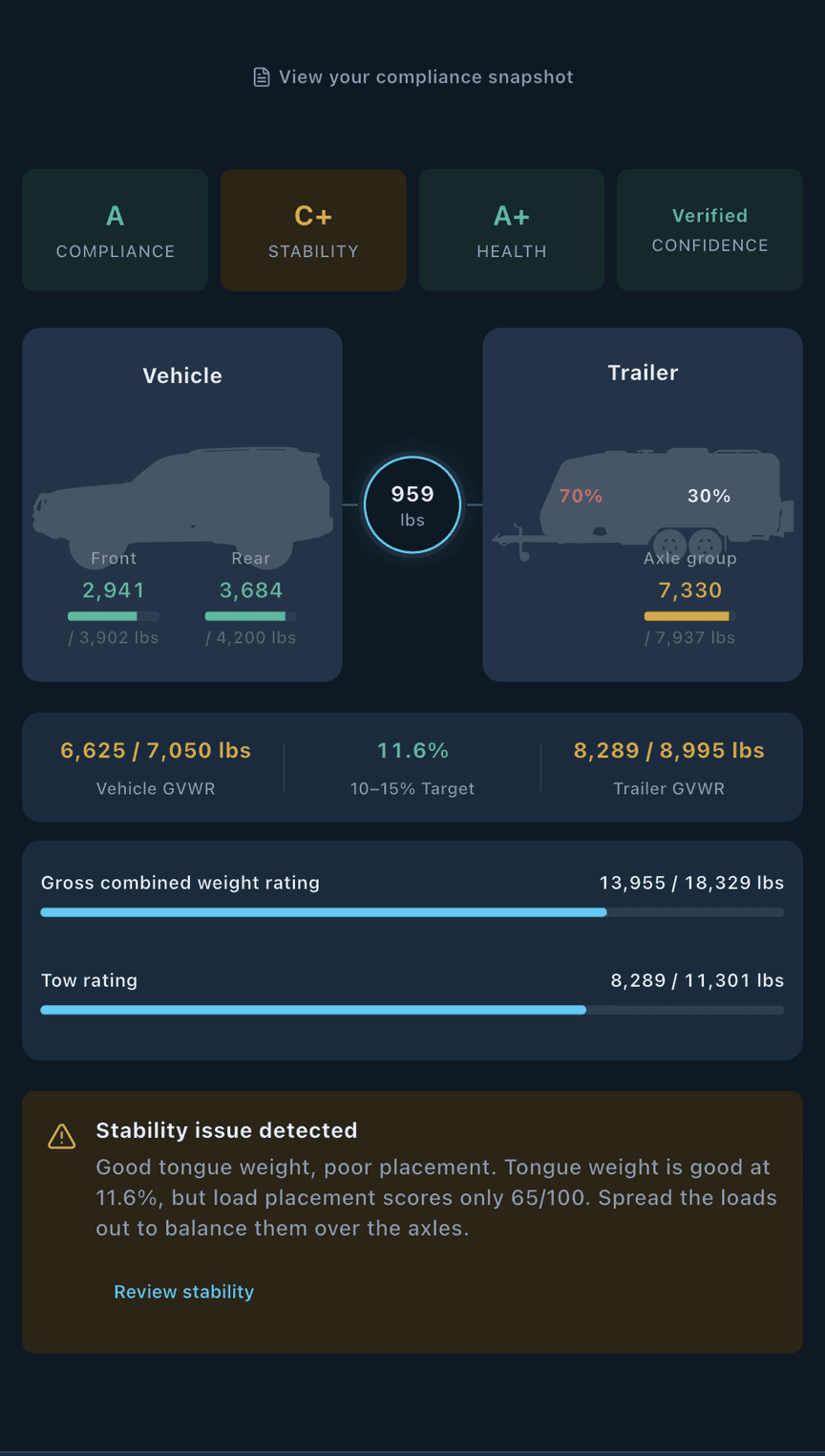
See what changes when you load the truck
The trailer's tongue weight shares the truck's carrying capacity with passengers and cargo. In loadmate, record your rig and the loads you plan to carry, then check how the remaining margins change before your next trip.
Example app screen. The values shown belong to the example rig.View the full-size app screen


Frequently asked questions
- How do I know how much my truck can tow?
Read your towing capacity in the owner's manual or the manufacturer's towing guide, then check it against your GCWR and your payload. Your real limit is whichever runs out first. Payload usually binds before the tow rating once passengers, cargo and the trailer's tongue weight are added, so confirm all three rather than trusting the headline number.
- What can I tow with 5,000 lb of towing capacity?
A 5,000 lb capacity covers many single-axle and smaller dual-axle travel trailers, but match it to the trailer's loaded weight, not its dry weight, which can be 1,000 lb or more lighter. Also confirm the trailer's tongue weight (around 10–15% of its loaded weight) fits inside your payload alongside people and cargo before you commit.
- Why is my payload lower than my towing capacity?
Towing capacity and payload measure different jobs: pulling versus carrying. Payload is GVWR minus curb weight (the room for people, cargo and the trailer's tongue weight), and it is often a fraction of the tow rating, which is why a heavy trailer's tongue weight can use up your payload long before the tow rating is in play.
- How much can I tow without a CDL?
For personal, non-commercial use, federal CDL rules generally apply only when the combination's GCWR is 26,001 lb or more with a towed unit over 10,000 lb GVWR and you are driving in commerce, so most personal RV rigs fall outside the federal CDL line. State non-commercial license rules vary, though, so confirm your state's weight and length thresholds before towing a large rig.
- What size travel trailer can I tow with an SUV?
It depends on the SUV's payload as much as its tow rating. A midsize SUV rated around 5,000 lb can often handle a smaller travel trailer, but a full family and cargo can spend most of its payload before the tongue weight is added, so check that the trailer's loaded weight and tongue weight both fit. Small crossovers are usually limited to teardrops and light trailers.
- Is the tow rating on the brochure what I can actually tow?
Not usually. The brochure figure is a best case for one configuration, often a basic trim with the tow package and a single occupant. Your real limit is the lowest of your towing capacity, your GCWR headroom and your payload minus tongue weight: check all three against the trailer's loaded weight rather than the dry weight.