Payload vs towing capacity at a glance
- Towing capacity
- What the truck can pull: the trailer behind it, set under the SAE J2807 test so ratings compare across brands
- Payload
- What the truck can carry: driver, passengers, cargo and the trailer's tongue weight pressing on the hitch
- Payload formula
- Payload = GVWR − curb weight (on the worked rig, 7,100 − 5,400 = 1,700 lb)
- Tongue weight
- The trailer's download on the hitch, conventionally 10–15% of the loaded trailer weight, and it counts as payload
- Where to read your payload
- The Tire and Loading Information label on the driver's-side B-pillar: "combined weight of occupants and cargo"
- Where to read the ratings
- GVWR and per-axle GAWR on the driver's-side door-jamb certification label; the tow rating in the owner's manual
- The one that usually binds first
- Payload: the tongue weight spends it before the trailer ever reaches the tow rating
You read the tow rating on the window sticker, picture the trailer you want, and the math seems to work. Then you load the family, the gear and a full cooler, hitch up, and the truck sits low at the back before you have hit anything close to that tow number. The rating was never wrong. It just measures a different thing than the one that runs out first.
Payload vs towing capacity: what's the difference?
Towing capacity is what your truck can pull; payload is what your truck can carry: two separate ratings that measure two different jobs. Pull and carry are not the same act, so the brochure gives you a number for each, and clearing one tells you nothing about the other.
Towing capacity looks behind the truck. It asks how heavy a trailer the truck can drag down the road and hold on a grade. Payload looks inside and on top of the truck. It asks how much weight the driver, the passengers, the bed cargo and the hitch download can add before the truck itself is overloaded. A truck can have a generous tow rating and a thin payload at the same time, which is exactly where people get caught.
| Question the number answers | The rating | What it covers |
|---|---|---|
| "What can the truck pull?" | Towing capacity | The trailer behind the truck, as a standalone weight rating |
| "What can the truck carry?" | Payload | Driver, passengers, bed cargo, and the trailer's tongue weight |
The link between the two is the tongue weight, and that link is the whole reason this gets confusing. More on it below.
What is payload? (and what counts against it)
Payload is everything the truck carries on top of its own empty weight, and it is set by the formula payload = GVWR − curb weight. GVWR is the manufacturer's loaded ceiling for the truck by itself; curb weight is that truck empty, with a full tank and fluids but no people or cargo. The gap between them is your payload, the carrying allowance.
The federal certification rule behind this is concrete: the manufacturer's GVWR must be at least the unloaded vehicle weight plus the rated cargo load plus 150 lb for each seating position. In plain terms, your payload is the headroom between the empty truck and its loaded ceiling. The widely-used consumer form of that is payload = GVWR − curb weight. (GVWR is the US term; Australia calls the same single-vehicle ceiling GVM. The pillar guide carries the full rating vocabulary.)
What counts against payload is broader than most people expect. Beyond the cargo in the bed, it covers the driver and every passenger, the tools and the firewood, the aftermarket bumper, the extra fuel beyond the base tank, and the trailer's tongue weight bearing down on the hitch. The tongue weight is the surprise in that list, because it comes from the trailer yet lands in the truck's payload column.
The number on the brochure is a best-case figure for a base truck. Your truck as built, with its options and trim, has its own payload, and it is printed where you can read it: the Tire and Loading Information label on the driver's-side B-pillar carries the line "The combined weight of occupants and cargo should never exceed XXX lbs." That figure is your real payload. Trust the label over the marketing number.
What is towing capacity? (the pulling number)
Towing capacity is the maximum trailer weight the truck is rated to pull, and on a modern light truck it is a standardized number set under the SAE J2807 test. Before that standard, manufacturers tested tow ratings their own way and the figures were hard to compare. J2807 sets common performance criteria: the same test, so a number on one brand means roughly what it means on another, for vehicles up to 14,000 lb GVWR.
The thing to hold onto is that this number describes pulling, not carrying. It does not include your passengers, your bed cargo or your hitch download. It is the trailer behind you, treated on its own. So a truck rated to pull 11,300 lb has not promised you 11,300 lb of usable trailer once a real load goes in the cab and on the ball; that is a separate calculation, governed by payload and by the combination ceiling. The pillar guide walks through how the combination ceiling, GCWR, fits the full picture; here the live story is payload.
Why payload usually runs out first
The trailer's tongue weight is carried on the hitch, not pulled behind it, so it comes out of payload, and that is what makes payload, not the tow rating, the number you hit first. This is the hinge of the whole topic, and it is the most common place a rig goes overweight.
Tongue weight is the downward force the loaded trailer puts on the hitch ball, conventionally 10–15% of the loaded trailer weight. Too little and the trailer can sway; too much and it lightens the truck's steering. Either way, that download is weight the truck is holding up, so it sits in the payload column alongside the people and the gear. A separate guide on how tongue weight spends payload, tongue weight vs payload, digs into that mechanism for US rigs; here it is just the link that ties the two numbers together.
Once you see that, the trap is obvious. Push the trailer up toward the headline tow rating and its tongue weight climbs with it. That growing tongue weight eats your payload, so the bigger the trailer you chase, the less room you have for the family and the gear that have to ride in the truck at the same time. This is why so many half-ton trucks have well under a ton of payload even with five-figure tow ratings, a widely-reported pattern across truck reviews. You can max the tow number and still be out of payload before the people are aboard.
A worked example: the tow rating says yes, the payload says no
On one illustrative half-ton rig, the truck is rated to pull 11,300 lb but has only 400 lb of payload left after the trailer's tongue weight, so payload, not the tow rating, decides the trip. Numbers make this land harder than words, so follow one rig the whole way.
The truck: GVWR 7,100 lb, curb weight 5,400 lb (illustrative, rounded, not a sourced OEM curb figure), so payload = 7,100 − 5,400 = 1,700 lb. Its max tow rating is 11,300 lb. The trailer is loaded to 10,500 lb, with 1,300 lb of tongue weight (12.4% of the loaded trailer, inside the 10–15% band).
Now spend the payload. That 1,700 lb has to cover the driver, the passengers, anything in the bed, extra fuel, and the tongue weight. The tongue weight alone takes 1,300 lb of it:
Payload left = 1,700 − 1,300 = 400 lb
Four hundred pounds for everyone and everything in the truck. Two adults and a cooler and it is gone, and the trailer is still under both its own 11,000 lb GVWR and the truck's 11,300 lb tow rating the whole time.
| The check | The number | The limit | The result |
|---|---|---|---|
| Trailer loaded weight vs tow rating | 10,500 lb | 11,300 lb | passes: under the pull rating |
| Tongue weight vs payload | 1,300 lb | 1,700 lb | passes, but leaves only 400 lb |
| People and gear that still need to ride | 400 lb left | n/a | this is the squeeze |
It gets tighter if you try to actually reach the 11,300 lb tow rating. A trailer loaded to 11,300 lb, balanced to the same 12.4%, would put about 1,401 lb of tongue weight on the hitch, which leaves roughly 1,700 − 1,401 = 299 lb of payload for the driver and everyone else. In practice the headline tow number is unreachable, because payload runs out before you get there. (A second ceiling, the combination rating GCWR, caps the trailer near 9,900 lb behind a truck at full GVWR on this rig. That is the pillar's "which limit binds" story; the pillar guide covers it in full.)
The 80% rule and leaving real-world margin
The 80% rule is a rule of thumb that says load to roughly 80% of your limits rather than right up to them, leaving a margin for handling, heat and the weight you forget. No regulation requires it and no placard prints it; it is a habit experienced towers use to keep a buffer.
The reason it helps is the same reason payload sneaks up on you: real loads are heavier and messier than the plan. The cooler fills, the firewood is wet, a passenger throws in one more bag, and the trip-day weight creeps past the spreadsheet figure. Leaving about 20% in hand on payload means those creeps do not put you over. On the worked rig, treating 1,700 lb of payload as if it were closer to 1,360 lb gives you a cushion for exactly the gear that always shows up late.
Margin matters most on the number that binds first, and on a loaded travel-trailer rig that is usually payload. Build the buffer there, weigh the rig once it is loaded the way you actually travel, and the 80% habit stops being a slogan and starts being the reason you are not the truck sitting low at the on-ramp.
How loadmate helps you stay under your payload
On this rig the trailer's 1,300 lb of tongue weight claims most of the 1,700 lb payload before a single passenger climbs in, leaving about 400 lb, while the 11,300 lb tow rating sits there looking untouched. The gap a single tow number cannot show you is the one that strands people at the ramp: which limit is actually about to give.
A bed cover, toolbox and full cab can use carrying room long before a trailer reaches the tow rating. loadmate brings the truck's recorded load and the trailer's hitch load into the same picture, showing how changes affect vehicle and combined limits. Explore loadmate in the app to see where your payload goes as the trip takes shape.
A weigh-in gives the picture a measured starting point. Recorded changes to passengers, water and equipment then show why yesterday's margin may need another look.
loadmate provides decision support for towing safety, not legal weight certification. Score, compliance checks, and trip readiness are based on the data you enter and the regulator information current at the time of release. For legal weight evidence, use a certified truck scale / CAT scale. Towing remains the operator's responsibility. See /safety-disclaimer.
Related guides
The rest of the Wave-1 guides are live; the US vehicle hub is publishing as the US set rolls out. This guide links up to the pillar and across to each sibling:
- Towing weight ratings explained: the full set of US ratings (GVWR, GCWR, GAWR, payload, trailer GVWR) and which one binds first
- Tongue weight vs payload: how the trailer's tongue weight spends your truck's payload, in depth
- How to weigh a travel trailer at a CAT scale: getting the real loaded weights to check your payload against
- How to read a CAT scale ticket: turning the CAT scale numbers into a pass or a fix
- Weight-distribution hitch and front-axle load: restoring the front-axle weight a heavy tongue takes off
- Towing capacity chart: compare popular SUVs and trucks by max tow rating, then check your own
- What can I tow?: match your truck or SUV to a trailer and get a plain verdict
- Where the payload runs out on a named truck: the Ford Ranger, the Toyota Tacoma and the Jeep Wrangler, each with its own arithmetic
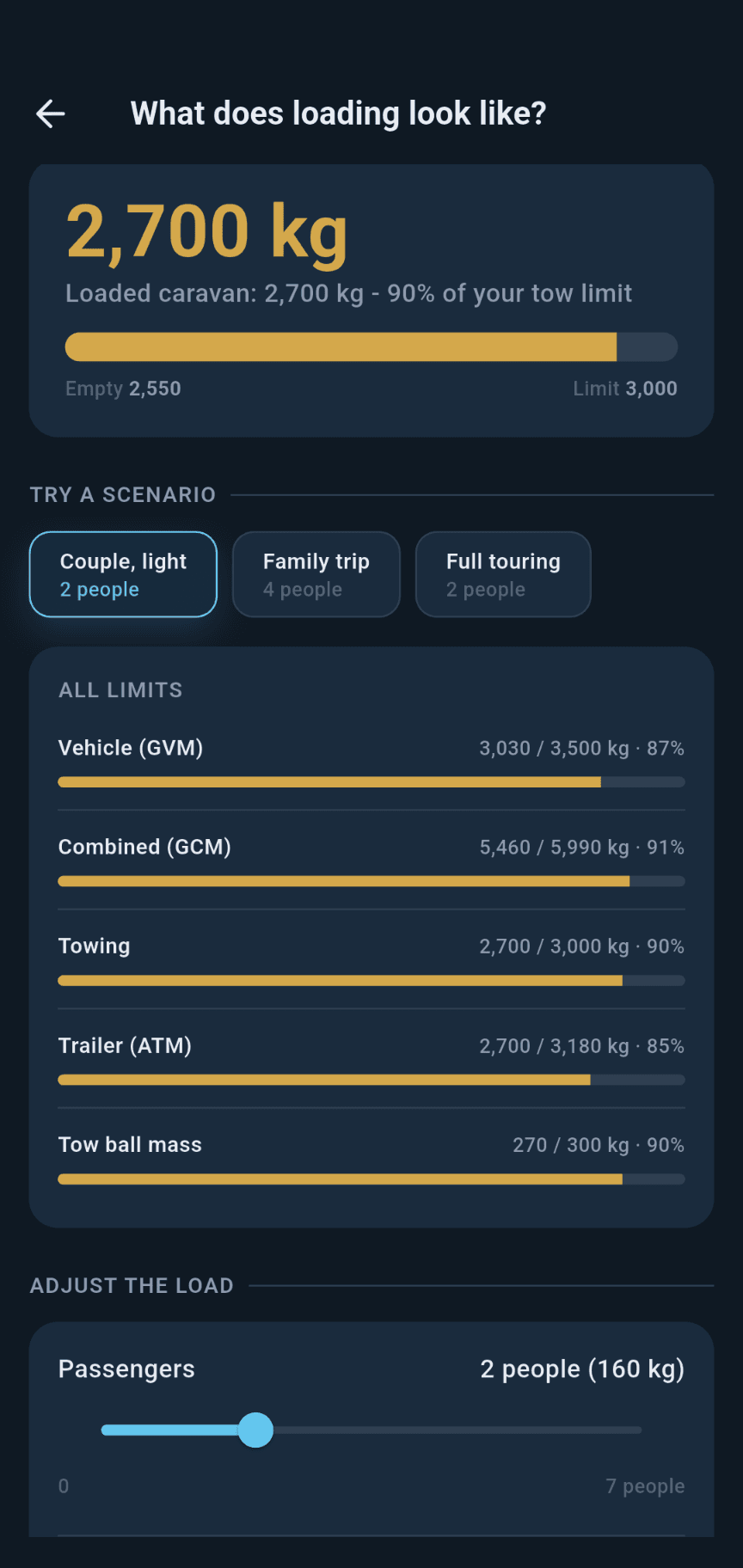
Feel the margin tighten as you load
Drag the sliders (passengers, water, gear) and watch each limit move in real time. The cheapest place to learn a rig runs heavy is before you buy it. Free in the app.


Frequently asked questions
- What's the difference between payload and towing capacity?
Towing capacity and payload measure two different jobs: towing capacity is what the truck can pull behind it, and payload is what the truck can carry in and on it. The brochure gives you a separate number for each, and clearing one says nothing about the other. The trailer's tongue weight is carried on the hitch, so it counts as payload, not towing capacity.
- Is payload more important than towing capacity?
Neither is more important; they answer different questions, and you have to stay under both. In practice, though, payload is the one that usually limits a real loaded trip first, because the trailer's tongue weight spends payload while the trailer can still be well under the tow rating. So on a travel-trailer rig, payload is the number to watch the closest.
- How do I calculate my truck's payload?
Payload = GVWR minus curb weight. GVWR is the truck's loaded ceiling and curb weight is the empty truck with fluids, so the gap is your carrying allowance. For your exact truck as built, read the "combined weight of occupants and cargo" line on the Tire and Loading Information label rather than the brochure figure.
- Where do I find my real payload number?
On the Tire and Loading Information label on the driver's-side B-pillar. It carries the line "The combined weight of occupants and cargo should never exceed XXX lbs", and that figure is the payload for your specific truck as built, including its options. The marketing payload number is a best case for a base truck, so trust the label.
- Does tongue weight count against payload or towing capacity?
Against payload. Tongue weight is the trailer's download on the hitch (weight the truck carries, not weight it pulls), so it comes out of your payload alongside the people and the gear. It is conventionally 10–15% of the loaded trailer weight, which means a heavy trailer can use up most of your payload before anyone gets in the truck.
- Can you tow at full payload?
No, not in any useful sense. The trailer's tongue weight is already part of payload, so a near-max trailer leaves little or no room for the driver, passengers and gear that also ride in the truck. If you are at full payload, you have already spent the allowance the people and cargo needed.
- Why does my truck run out of payload before it hits its tow rating?
Because the tongue weight grows with the trailer. The bigger the trailer you load toward the tow rating, the more tongue weight presses on the hitch, and that download eats payload. On the worked rig, a 1,300 lb tongue weight leaves only 400 lb of the 1,700 lb payload for people and gear, while the trailer is still under the 11,300 lb tow rating.
- What is the 80% rule for towing?
The 80% rule is a rule of thumb to load to about 80% of your limits instead of right up to them, leaving roughly 20% in hand for handling, heat and the weight you forget. It is a safety habit, not a regulation. On a travel-trailer rig the margin matters most on payload, since payload usually binds first.