Skip to content

United States / 61 vehicles / updated June 2026

Towing Capacity Chart: SUVs and Trucks by Max Tow Rating

Towing capacity chart at a glance

What the chart compares
Maximum towing capacity in pounds, with the trim range and the configuration each maximum needs, for popular US SUVs and trucks
What "max towing capacity" means
The most a properly-equipped version of that model can pull, usually one engine and tow package, often two-wheel drive
Why one number can mislead
Tow ratings vary by trim, engine, drivetrain and cab; the chart shows the top of the range, with the spread noted
The number that usually limits you
GCWR or payload once the truck is loaded, rarely the headline tow rating
Where the figures come from
Manufacturer towing guides and NHTSA, dated on each row, with a confidence rating shown when a figure is approximate
How to check your own rig
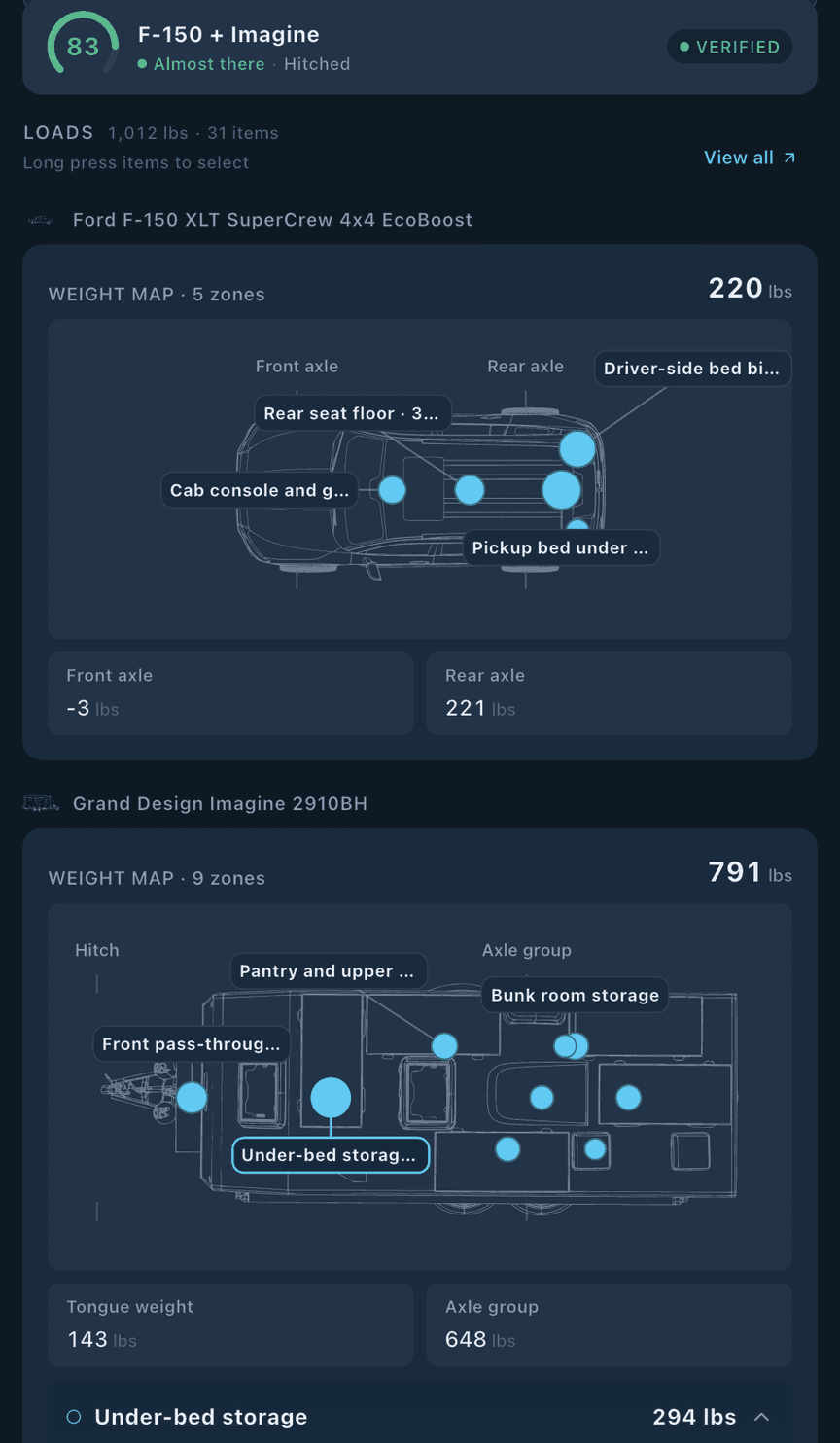
Enter your truck and trailer in the free Can I Tow It? check for a verdict on your real combination

A towing capacity chart is the fastest way to line up vehicles side by side and see which ones out-pull the rest. The catch is that every figure in one is a maximum: the most a specific trim, engine and tow package can pull under ideal conditions. Your truck or SUV (loaded with people, gear and a trailer pressing down on the hitch) sits below that number. This page gives you the chart, shows how to read each column, and then hands you a free way to check what your real combination can tow.

How to read this towing capacity chart

Read each row as two things: the most that model can pull at its best (its maximum towing capacity, with the spread across trims), and the exact configuration that maximum needs. A headline tow number almost never applies to the trim sitting in your driveway: it belongs to one engine, drivetrain and tow package. The range shows how far the rest of the lineup falls below it.

Manufacturers publish the maximum for one favorable build, typically a particular engine, a tow package, and often two-wheel drive with a single occupant. A four-wheel-drive, fully-optioned version of the same model can be rated several hundred to a couple of thousand pounds lower, which is why the configuration column matters as much as the number.

Column What it shows Why it matters
Max towing capacity The most that model can pull, with the trim range The ceiling, and how far other trims sit below it
Configuration for the max The engine, drivetrain and package the maximum needs A base or four-wheel-drive trim is usually rated lower

What the chart cannot show is your loaded rig. Tongue weight, passengers and cargo eat into payload, and payload usually runs out before the tow rating, which is the next section, and the reason the chart points you to a free check on your own combination.

Small, midsize and hybrid SUV towing capacity

Most small SUVs and crossovers are rated to tow between about 1,500 and 3,500 lb, midsize SUVs reach roughly 5,000 to 6,600 lb, and a hybrid version is often rated the same as or close to its gas sibling. Use the chart's body-type filters to narrow to small SUVs, midsize SUVs or hybrids and compare just that group.

If you drive a compact crossover, the question is usually whether it can tow at all, and the answer is a small trailer only: a teardrop, a small utility trailer, or a light pop-up. Midsize SUVs open up the larger travel-trailer range, but their payload is the constraint that bites: a three-row midsize SUV with a full family and a roof box can spend most of its payload before the hitch is loaded. A hybrid powertrain rarely changes the tow rating much, but it can change the curb weight and therefore the payload, so check the hybrid row on its own rather than assuming it matches the gas model.

Truck towing capacity

Half-ton trucks generally top out between about 8,000 and 13,500 lb, midsize trucks sit around 6,000 to 7,700 lb, and compact trucks like a unibody pickup are usually rated near 2,000 to 4,000 lb, or more with a tow package. Trucks have the widest spread of any group in the chart, because cab, bed, axle ratio and engine swing the rating dramatically.

A half-ton's headline tow rating almost always belongs to a regular-cab, two-wheel-drive work truck with the strongest available engine, not the crew-cab family hauler most buyers actually own. That is why the chart notes the configuration behind each maximum. For a real plan, the number you want is not the brochure ceiling; it is what your exact truck can pull once it is loaded the way you drive it.

The full towing capacity chart

Maximum towing capacity is a best case for the exact configuration shown — your loaded truck or SUV sits lower once people, gear and tongue weight are on board. Run your own numbers free with the rig check.

Showing 61 of 61 vehicles

  • 2026 Ford F-150

    Half-ton truck

    Max towing capacity
    7,400–13,500 lb

    Max tow 13,500 lb with 3.5L EcoBoost V6, 3.55 axle, SuperCrew 4x4 157.2-inch wheelbase, Tow/Haul Package (53T) and optional Max Tow Axle (GCWR 19,400 lb). Max tongue load 1,400 lb applies with a weight-distributing hitch; weight-carrying is capped at 5,000 lb trailer and 500 lb tongue. Payload 2,175 lb is the highest Ford publishes for any 3.5L EcoBoost 4x4 and is NOT the payload of the max-tow build; the lineup's 2,440 lb best is a 4x2 figure. Ford publishes no GVWR and no base curb weight for the F-150 - both live on the vehicle's Safety Compliance Certification Label - so gvwrLb and curbWeightLb are deliberately absent here. Consequence: a /us/tow-check deep link for this vehicle cannot carry vehicleGvm, so it opens the prefilled form instead of SSRing a verdict. Do not fill either field from an aggregator to make the verdict work.

  • 2026 Chevrolet Silverado 1500

    Half-ton truck

    Max towing capacity
    8,700–13,300 lb

    Max with 3.0L Duramax Turbo-Diesel I6, Max Trailering Package and required 20-inch wheels.

  • 2026 GMC Sierra 1500

    Half-ton truck

    Max towing capacity
    8,500–13,300 lb

    Max with 3.0L Duramax Turbo-Diesel I6, available Max Trailering Package and required 20-inch wheels.

  • 2026 Ford F-150 PowerBoost HybridHybrid

    Half-ton truck

    Max towing capacity
    10,800–12,400 lb

    Max tow 12,400 lb with 3.5L PowerBoost Full Hybrid V6, 3.73 axle, SuperCrew 4x2 145.4-inch wheelbase, Tow/Haul Package (53T) and optional Max Tow Axle (GCWR 18,400 lb) - a configuration Ford footnotes 'Available spring 2026.' Ford raised this from 11,600 lb in the 11-05-25 revision of the same guide when the 4x2 arrived; the 4x4 maximum is unchanged at 11,600 lb. Range floor 10,800 lb is a 4x4 figure (3.73 axle, GCWR 17,100 lb), so the range spans drivetrains. Ford requires the Tow/Haul Package and Max Tow Axle for hybrid trailers over 10,800 lb. CORRECTED 2026-07-27: this note previously read 'SuperCrew 4x2 157.2-inch wheelbase'; in the 03-10-26 revision that column is blank and 12,400 lb sits in the 145.4-inch column.

  • 2026 Toyota TundraHybrid

    Pickup

    Max towing capacity
    8,300–12,000 lb

    The 12,000 lb maximum belongs to one configuration and Toyota names it: SR5 grade, i-FORCE 3.4L twin-turbo V6 (gas, 389 hp / 479 lb-ft), Double Cab, 6.5-ft standard bed, 4x2, properly equipped. The 2026 Product Information grid puts 12,000 lb (SR5) in the cell where "3.4-liter TT V6 (6.5-ft. std. bed)" meets "4x2 Double Cab", and Toyota's owner's-manual tables give the same truck's model code (VXKA70L-CRUSZA: Double Cab / 2WD / Standard bed / SR5) a 12,000 lb trailer weight rating against a 7,035 lb GVWR. Grade moves this number more than any other axis: the SR is rated 8,300 lb in every cab, every bed and both drivetrains, while every grade above it moves with cab, bed and drivetrain (CrewMax 4x2 tops out at 11,450 lb, 4x4 Double Cab at 11,200 lb, 4x4 CrewMax at 11,170 lb, Capstone at 10,340 lb). GCWR is published by grade and powertrain, not by cab: SR 15,204-15,520 lb, SR5 17,250-17,700 lb, Limited/Platinum/1794 17,250 lb gas and 17,600-17,700 lb i-FORCE MAX, TRD Pro 17,600 lb, Capstone 16,525 lb. gcwrLb carries 17,700, the top of the SR5 band: NEEDS HUMAN REVIEW, because Toyota bands GCWR by grade rather than by cab and the bottom of the band (17,250) is arithmetically impossible against 12,000 + 5,095 + 300. Never set this field to 17,250. Maximum tongue weight is published per cab and drivetrain at exactly a tenth of that column's maximum rating: 1,200 lb (4x2 Double Cab), 1,145 lb (4x2 CrewMax), 1,120 lb (4x4 Double Cab), 1,117 lb (4x4 CrewMax). The lineup's lowest published payload, 1,485 lb, is the Capstone's and belongs to a different truck. All ratings are stated per SAE J2807 methodology.

  • 2026 Ram 1500

    Half-ton truck

    Max towing capacity
    6,340–11,610 lb

    Max tow 11,610 lb with the 3.0L Hurricane SO I6, 3.92 axle, Tradesman Quad Cab 4x2 6-foot-4-inch box (GCWR 17,000 lb). GVWR 6,900 lb and payload 1,930 lb are the published figures for that same 4x2 Hurricane SO row; the 4x4 version of the same truck is GVWR 7,100 lb, payload 1,910 lb, tow 11,370 lb. The lineup's best payload, 2,360 lb, belongs to a DIFFERENT truck - the 3.6L Pentastar Quad Cab 4x2 at GVWR 7,200 lb, rated to tow 8,130 lb - and is deliberately not carried here. Max tongue 1,100 lb is Ram's Class IV hitch receiver cap from the Payload & Towing brochure; the 2026 owner's manual states 1,161 lb for the same Class IV hitch, and the later brochure figure is used. Ram's brochure states these are Tradesman figures and that trailer weight capacities include a 300 lb passenger allowance; a weight-distributing system is recommended above 5,000 lb. Ram publishes no fifth-wheel or gooseneck rating for the 1500 and no frontal-area limit. Curb weight is deliberately absent: Ram publishes one curb weight publicly (4,836 lb for the 3.6L Pentastar base truck on ramtrucks.com/ram-1500/specs.html), not one for this configuration; 6,900 - 1,930 = 4,970 lb is a derivation and must not be entered as a published figure.

  • 2026 Jeep Grand Wagoneer

    full-size SUV

    Max towing capacity
    10,000 lb

    Properly equipped 2026 Grand Wagoneer with Hurricane Twin-Turbo engine.

  • 2026 Ford Expedition

    Full-size SUV

    Max towing capacity
    6,000–9,600 lb

    Max with 3.5L EcoBoost, 3.73 axle, short-wheelbase 4x4, Heavy-Duty Trailer Tow Package and weight-distributing hitch.

  • 2026 Toyota SequoiaHybrid

    Full-size SUV

    Max towing capacity
    9,520 lb

    Toyota states the standard i-FORCE MAX twin-turbo V6 hybrid Sequoia can tow up to 9,520 lb when properly equipped.

  • 2026 Lexus GX

    body-on-frame luxury SUV

    Max towing capacity
    9,063–9,096 lb

    GX 550 Overtrail with standard tow hitch receiver.

  • 2026 Dodge Durango

    three-row SUV

    Max towing capacity
    6,200–8,700 lb

    Durango HEMI V8 models with Tow 'N Go Package; Dodge also lists 8700 lb for SRT Hellcat and R/T 392 configurations.

  • 2026 Lincoln Navigator

    full-size luxury SUV

    Max towing capacity
    8,400–8,700 lb

    Navigator 4x4 or Navigator L 4x4 without the 24-inch wheel reduction.

  • 2026 Nissan Armada

    full-size SUV

    Max towing capacity
    8,500 lb

    Nissan specifications list up to 8500 lb towing capacity for shown 2026 Armada trims.

  • 2026 Chevrolet Tahoe

    Full-size SUV

    Max towing capacity
    7,600–8,400 lb

    Max with 5.3L EcoTec3 V8, 2WD, Max Trailering Package and weight-distributing hitch.

  • 2026 GMC Yukon

    Full-size SUV

    Max towing capacity
    7,500–8,400 lb

    Max with 5.3L V8, 2WD, Max Trailering Package and weight-distributing hitch.

  • 2026 Chevrolet Suburban

    Full-size SUV

    Max towing capacity
    7,300–8,200 lb

    Max with 5.3L EcoTec3 V8, 2WD, Max Trailering Package and weight-distributing hitch.

  • 2026 Land Rover Defender

    off-road SUV

    Max towing capacity
    8,200 lb

    Defender vehicle with Tow Assist; Land Rover USA publishes towing capacity up to 8200 lb.

  • 2026 Cadillac Escalade

    full-size luxury SUV

    Max towing capacity
    7,000–8,100 lb

    Escalade 2WD; Cadillac lists 8100 lb max available on 2WD models.

  • 2026 Lexus LXHybrid

    flagship luxury SUV

    Max towing capacity
    8,000 lb

    Lexus states both LX 600 and LX 700h can tow up to 8000 lb.

  • 2026 Chevrolet Colorado

    Midsize truck · figures approximate

    Max towing capacity
    3,500–7,700 lb

    7,700 lb requires the Trailering Package, and on 4WD also a limited-slip differential; without the package every 2026 Colorado is rated 3,500 lb with an accessory hitch and wiring harness. One engine line-wide for 2026 (2.7L TurboMax, 310 hp/430 lb-ft) at a 3.42 axle ratio, so the package is the axis, not the powertrain. ZR2 is rated 6,000 lb and ZR2 Bison 5,500 lb. Chevrolet's 2026 Trailer Towing Supplement makes a weight-distributing hitch REQUIRED above 6,000 lb of trailer weight, at 50% distribution, which is 1,700 lb below this row's headline figure. Maximum tongue weight varies by configuration: 770 lb with the Trailering Package, 600 lb ZR2, 550 lb ZR2 Bison, 350 lb without the package; the figure on this row is the Trailering Package value. GVWR and payload are the 4WD Trail Boss and Z71 figures from the GM Envolve Fleet Guide, whose Colorado page is headed 2025; NHTSA VPIC returns Class 2E (6,001 to 7,000 lb) for a 2026 Colorado, which brackets it. Chevrolet publishes no Colorado curb weight.

  • 2026 GMC Canyon

    Midsize truck

    Max towing capacity
    3,500–7,700 lb

    Max with 2.7L TurboMax in non-AT4X configurations; AT4X and AEV ratings are lower. Range floor corrected 2026-08-04 from 5,500 lb to 3,500 lb: the Canyon and the Colorado share one Trailer Towing Supplement whose rows are printed jointly, and it rates the 2.7L TurboMax without the Trailering Package at 3,500 lb (9,100 lb GCWR, 350 lb tongue). The 2026 one-page trailering charts omit that row, which is where the 5,500 lb floor (the AT4X AEV figure) came from.

  • 2026 Jeep Gladiator

    Pickup

    Max towing capacity
    6,000–7,700 lb

    The 2026 Jeep Gladiator Specifications sheet (Stellantis media, press kit doc id 27251) publishes a per-trim towing table with five trim-and-axle rows: Sport / Sport S on the 3.73 axle at 6,000 lb, Sport S on the 4.10 axle with the Max Tow Package at 7,700 lb, Willys 3.73 at 6,000 lb, Mojave 4.10 at 6,000 lb and Rubicon 4.10 at 7,000 lb. One powertrain runs the whole lineup (3.6L Pentastar V6, 285 hp / 260 lb-ft, 850RE 8-speed automatic, 4WD standard; no manual and no diesel for 2026). The 7,700 lb configuration is the Max Tow Package with 4.10 Axle Ratio (Dana M210 wide front / M220 wide rear axles, antispin rear differential, heavy-duty engine cooling, Class IV hitch receiver), which the 2026 Fleet Buyer's Guide describes as carrying a Gross Vehicle Weight Rating (GVWR) of 6,500 lb and requiring the automatic transmission; jeep.com attributes the 7,700 lb rating and the 1,720 lb maximum 4x4 payload to Sport S models. The specifications sheet prints NO GVWR column and NO tongue-weight column for any row, so the only Jeep-published GVWR for this truck is the fleet guide's 6,500 lb and no vehicle tongue-weight rating exists for MY2026. The 6,000 lb lower bound is a PACKAGED figure: the Sport 3.73 row's footnote reads "If equipped with ADH Tow Package" (the fleet guide spells ADH out as the Trailer Tow and Auxiliary Switch Group), and for 2026 there is no published trailer rating at all for a Sport with no tow package, so 6,000 lb must never be published for a Sport as a plain fact. Note also that 6,500 minus the 4,741 lb base weight is 1,759 lb against a printed 1,720 lb of payload: the two figures come from two Stellantis documents with different rounding rules and different curb-weight definitions, and the certification label on an individual truck's driver's door pillar is what governs that truck.

  • 2026 Ford Ranger

    Midsize truck

    Max towing capacity
    5,510–7,500 lb

    7,500 lb requires the Trailer Tow Package (option code 53R) on a non-Raptor SuperCrew with the 2.3L or 2.7L EcoBoost; without 53R Ford caps the trailer at 3,500 lb, and towing from the rear step bumper carries its own 3,500 lb / 350 lb tongue limit. The GVWR, curb weight, payload, GCWR and tongue figures on this row all describe ONE configuration - the 2026 SuperCrew 4x4 2.3L EcoBoost on the 3.73 axle - so the row, the chart and the /us/guides/how-much-can-a-ford-ranger-tow spoke state the same truck. Ford publishes maximum payload for that truck as 1,763 lb, which sits 45 lb below its own GVWR minus base curb weight (6,270 - 4,462 = 1,808); the published figure is carried here. The 2.7L V6 4x4 raises GCWR to 12,745 lb with the same 7,500 lb trailer rating; the Raptor is rated 5,510 lb with a 550 lb maximum tongue weight.

  • 2026 Nissan Frontier

    Midsize truck

    Max towing capacity
    6,270–7,150 lb

    2026 Frontier towing runs 6,270 lb to 7,150 lb across one engine (3.8L V6) and one transmission (9-speed automatic): there is no powertrain, axle-ratio or max-tow package that changes it, only cab, bed, drivetrain and trim. The 7,150 lb figure is the King Cab S 4x2, and from MY2026 the King Cab is built in S grade only. Crew Cab short bed runs 7,070 (S 4x2) / 6,960 (S 4x4) / 7,000 (SV 4x2) / 6,880 (SV 4x4) / 6,900 (PRO-X) / 6,680 (PRO-4X 4x4); Crew Cab long bed runs 6,920 (SV 4x2) / 6,760 (SV 4x4) / 6,270 (PRO-4X 4x4). GVWR is 6,012 lb and GCWR 11,960 lb on EVERY configuration, so the entire 1,100-1,590 lb payload spread is curb weight. The figures carried here are the King Cab S 4x2: curb 4,385 lb, payload 1,590 lb, tow 7,150 lb, max tongue load 715 lb. The owner's manual prints 1,620 lb payload for the same truck; 1,590 lb is the customer-facing figure the brochure and press kit both publish and is the conservative pair. Nissan sets max tongue load at exactly 10% of max trailer weight in every row of its own chart, which is why tongue load and payload bind before the tow rating does. Nissan's brochure footnotes quote only the highest figure per cab/drive row and omit the PRO-X and PRO-4X columns entirely; the trim grid on the same page is the complete truth. RANGE FLOOR CORRECTED 2026-07-27: minLb was 6,310, which is a genuine MY2025 figure (the 2025 press kit prints the Long Bed PRO-4X at 6,310 lb with a consistent 631 lb tongue load) carried over stale into the 2026 sheet. The 2026 brochure grid prints 6,270 lb and the 2026 press kit's own tongue row for that truck, 627 lb, is a tenth of 6,270. Ratings are SAE J2807. GVWR and GAWR are on the F.M.V.S.S. certification label; the vehicle load limit is on the Tire and Loading Information label.

  • 2026 Toyota TacomaHybrid

    Pickup

    Max towing capacity
    3,500–6,500 lb

    Toyota rates the 2026 Tacoma by CAB and POWERTRAIN, not by grade. The 6,500 lb maximum belongs to the XtraCab (4x2 or 4x4) with the i-FORCE 2.4L turbo (278 hp / 317 lb-ft) and the 8-speed automatic, properly equipped, per SAE J2807. Every Double Cab i-FORCE is rated 6,400 lb (the 2024-2025 owner's manual assigns 6,300 lb to some short-bed TRD Sport / TRD Off-Road / Limited model codes, so read the figure against your own model code); the i-FORCE MAX hybrid (326 hp / 465 lb-ft, 4x4 Double Cab only) is rated 5,950-6,000 lb; the SR grade is rated 3,500 lb in every cab. The GVWR, curb weight, payload and tongue figures on this row describe the max-tow truck itself - the 4x4 XtraCab i-FORCE - so they pair exactly (5,605 - 4,375 = 1,230 lb). The lineup's largest payload belongs to a different truck: up to 1,705 lb on a 4x4 Double Cab i-FORCE and 1,710 lb on the i-FORCE MAX. Tongue-weight ceilings run 650 lb (XtraCab), 640 lb (Double Cab) and 595-600 lb (i-FORCE MAX). Every truck's own payload is the figure on its tire and loading label. GCWR is not carried: Toyota's 2026 product information omits it.

  • 2026 Jeep Grand Cherokee

    Midsize SUV · figures approximate

    Max towing capacity
    3,500–6,200 lb

    The factory Trailer Tow Prep Group is the axis: 6,200 lb of gross trailer weight and 620 lb of tongue weight with it, 3,500 lb and 350 lb without it. The 6,200 lb rating applies to BOTH 2026 engines, the 3.6L Pentastar V6 (availability Standard) and the 2.0L Hurricane 4 Turbo (availability "Standard (Laredo Altitude)"), in 2WD and 4WD, on the single 3.45 axle ratio; jeep.com credits the figure to the Hurricane alone, which Jeep's own 2026 spec sheets contradict, and the Grand Cherokee L's trailer-towing table names the 3.6-liter V-6 and nothing else. Figures on this row are the two-row 4WD Limited with the tow package: GCWR 11,300 lb (11,200 lb RWD; 8,600 lb and 8,500 lb without the package), GVWR 6,050 lb, curb weight 4,413 lb. GVWR is flat at 6,050 lb across every two-row trim; curb weight runs 4,238 to 4,784 lb across the range. Trailer frontal area is capped at 55 sq ft with the package and 30 sq ft without, up from 40 sq ft in MY2024 and MY2025. Jeep's owner's manual requires a weight-distributing hitch at 5,000 lb of gross trailer weight or more (pp.190 and 191). The three-row Grand Cherokee L carries the same 6,200 lb and 620 lb on a GCWR of 11,700 lb and a GVWR of 6,500 lb (6,700 lb on the 4WD Summit). PROVENANCE: GVWR and curb weight come from a 2026 media spec sheet marked Preliminary whose weights table is headed WEIGHTS (ESTIMATES), which is why specConfidence is medium; the certification label in the vehicle's own door frame governs. No payload figure is carried: the spec sheet's printed payload column does not equal GVWR minus curb on any row (4WD Limited prints 1,260 lb against 6,050 - 4,413 = 1,637 lb) and is trim-indexed rather than curb-indexed, so payload belongs to the Tire and Loading Information Placard, which is where Jeep's own manual sends it.

  • 2026 Toyota 4RunnerHybrid

    Midsize SUV

    Max towing capacity
    6,000 lb

    Toyota's 2026 owner's manual prints a 6,000 lb Trailer Weight Rating on every published row, 2WD and 4WD, SR5 through Limited. Unbraked TWR 1,655 lb. GCWR runs 10,970-11,485 lb by drive and grade (10,970 lb on the 2WD SR5, the row carried here). Toyota's 2026 release states a 6,000 lb maximum for the 4Runner without differentiating powertrain; the manual's GCWR table does not list Platinum, TRD Pro or Trailhunter. Toyota publishes no GVWR, curb weight or pound-figure tongue rating for this vehicle; GVWR and GAWR are routed to the Certification Label.

  • 2026 Nissan Pathfinder

    three-row SUV

    Max towing capacity
    3,500–6,000 lb

    Rock Creek 4WD, Platinum 4WD, or SV/SL with Premium Package per Nissan specifications.

  • 2026 Toyota Land CruiserHybrid

    body-on-frame SUV

    Max towing capacity
    6,000 lb

    i-FORCE MAX Hybrid powertrain with full-time 4WD.

  • 2025 Jeep Grand Cherokee 4xeHybrid

    SUV · figures approximate

    Max towing capacity
    3,500–6,000 lb

    2.0L turbo I4 plug-in-hybrid (4xe) powertrain, 375 hp / 470 lb-ft peak combined, standard 4x4 (3.70 axle), when properly equipped. The 6,000 lb (2,722 kg) rating is uniform across all 2025 4xe trims (4xe, Trailhawk, Overland, Summit) since they share the single 2.0L PHEV powertrain and one trailer-towing line in the OEM spec. GVWR 6,900 lb, base curb weight 5,368 lb (5,368-5,521 lb across trims). CORRECTED 2026-08-07: GCWR and maximum trailer tongue weight ARE published, in the owner's manual - 12,125 lb and 600 lb with the Trailer Tow Prep Group, 9,625 lb and 350 lb without it (2026 manual p.194, and the same figures in the MY2025 handbook pp.85-86). ALSO CORRECTED: payloadLb 1,050 was dropped from this row. Jeep printed the same 1,050 lb for all four 2025 4xe trims across a 153 lb curb spread, and 6,900 - 5,368 = 1,532 lb, so the printed figure reconciles with nothing and cannot be graded against GVWR minus curb; payload belongs to the Tire and Loading Information Placard on the vehicle. Do not add it back. The gas two-row Grand Cherokee's higher 6,200 lb rating applies to the 3.6L Pentastar V6 and, from MY2026, to the 2.0L Hurricane 4 Turbo as well, not to the 4xe; the Hurricane does not appear in a two-row Grand Cherokee TOWING TABLE before MY2026 (the MY2024 handbook's 2.0L row is the 4xe's hybrid 2.0L at 6,000 lb / GCWR 12,125 lb, not the Hurricane). MODEL-YEAR STATUS, re-dated: Jeep announced a 2026 Grand Cherokee 4xe on 2025-10-28, the cancellation was reported in January 2026, the 2026 owner's manual still prints the 4xe towing table, and NHTSA campaigns 25V741000 and 25V576000 both list 2026 Grand Cherokee 4xe vehicles in their populations, so used listings and recall lookups may show a 2026 4xe.

  • 2025 Kia Telluride

    three-row SUV

    Max towing capacity
    5,000–5,500 lb

    X-Pro AWD trim.

  • 2026 Jeep Wrangler

    Midsize SUV

    Max towing capacity
    2,000–5,000 lb

    Jeep's 2026 Wrangler specifications rate every two-door at 2,000 lb and a standard four-door at 3,500 lb. The 5,000 lb maximum applies only to a four-door Rubicon with the 8-speed automatic and the 4.10 axle ratio, with either the 3.6L Pentastar V-6 or the 2.0L Turbo I-4 (the 2.0L row adds an LT285/70R17C tire condition); GCWR for that build is 10,300 lb. A four-door Rubicon automatic on the 4.56 axle is 3,500 lb with an 8,600 lb GCWR, the Rubicon 6-speed manual is 3,500 lb, and the 470 hp 6.4L V-8 is 3,500 lb with a 9,400 lb GCWR. The curb weight, payload and GCWR carried here are that 5,000 lb build (2.0L I-4 automatic, 4.10 axle, four-door Rubicon); gvwrLb 5,950 is DERIVED from Jeep's published base weight plus payload (4,640 + 1,310), not a Jeep-stated figure. No maxTongueWeightLb is carried because Jeep publishes no receiver tongue-weight rating for the Wrangler - the owner's manual directs owners to the figure stamped on the hitch. Jeep's towing grid carries four-door rows only, so two-door payload, GAWR and GCWR come off the door-jamb certification label.

  • 2026 Ford Explorer

    Midsize SUV

    Max towing capacity
    5,000 lb

    Every 2026 Explorer is rated 5,000 lb. Ford prints the same maximum loaded trailer weight for the 2.3L EcoBoost I4 and the 3.0L EcoBoost V6, rear-wheel and four-wheel drive, and the Class III Trailer Tow Package is standard with no option code. Curb weight and GCWR are the 2.3L rear-wheel-drive configuration; GCWR reaches 10,800 lb on the 3.0L V6 ST and Tremor.

  • 2026 Toyota Highlander

    Midsize SUV

    Max towing capacity
    5,000 lb

    Toyota's 2026 gas manual (OM0E310U) and Product Information sheet rate every 2.4L turbo grade at 5,000 lb, AWD standard for 2026. GVWR 5,970 lb on all four grades; curb 4,376 (XLE) to 4,453 lb (Limited/Platinum, the row carried here); GCWR 10,600 lb, which is 370 lb less than GVWR plus the rating, so both cannot be maxed at once. Unbraked rating 1,000 lb. Toyota publishes no pound tongue figure (9 to 11% of gross trailer weight). Sway control required above 2,000 lb; a weight-distributing hitch above 5,000 lb, which the rating never reaches.

  • 2026 Honda Pilot

    Midsize SUV

    Max towing capacity
    3,500–5,000 lb

    Every figure on this row describes ONE configuration, the 2026 Pilot TrailSport AWD, the only trim with an integrated Class III trailer hitch as standard equipment, so the row, the chart and the /us/guides/how-much-can-a-honda-pilot-tow spoke state the same vehicle. IMPORTANT: 5,000 lb and 500 lb are Honda's TWO-OCCUPANT figures. Honda's owner's manual publishes maximum trailer weight and maximum tongue load as tables indexed to the number of occupants: AWD 5,000/500 at two, 4,750/475 at three, 4,500/450 at four, 4,250/375 at five, 4,000/250 at six, 2,500/125 at seven, and towing not recommended at eight; 2WD runs 3,500/350, 3,250/325, 3,000/300, 2,750/275, 2,400/240, 1,150/115. Each row assumes 150 lb per occupant plus 17.6 lb of cargo each, seats filling front to back, and Honda states that any additional weight, cargo or accessories reduces both maximums. Every 2026 AWD trim is rated 5,000 lb and every 2WD trim 3,500 lb on one 3.5-liter V6; there is no hybrid Pilot for 2026. GVWR 6,195 lb, GCWR 10,141 lb, front GAWR 2,998 lb and rear GAWR 3,384 lb are the AWD-with-trailer-hitch column (an AWD Pilot without the hitch carries the same GVWR and GCWR and a 3,340 lb rear GAWR); the 2WD column is GVWR 5,963, GCWR 8,444, GAWR 2,976 front and 3,164 rear. Curb weight 4,722 lb is the TrailSport AWD; other AWD trims run 4,513 to 4,678 lb and 2WD trims 4,334 to 4,336 lb. payloadLb is DELIBERATELY ABSENT: Honda publishes a maximum load by seat configuration for the whole line-up, 1,173 lb for second-row captain-seat models and 1,340 lb for bench-seat models, including occupants, cargo, accessories and the tongue load, and that figure sits about 300 lb below this row's GVWR minus curb weight with no published explanation. Quote Honda's figure; never derive one. Through the 2022 model year Honda conditioned the AWD 5,000 lb rating on an accessory automatic transmission cooler; the 2023 to 2026 pages carry no such condition.

  • 2026 Subaru Ascent

    Midsize SUV

    Max towing capacity
    5,000 lb

    All listed 2026 Ascent trims show a 5,000-lb maximum towing capacity.

  • 2026 Mazda CX-90

    Midsize SUV

    Max towing capacity
    3,500–5,000 lb

    Max with 3.3 Turbo S or properly equipped higher-output 3.3 Turbo trims with towing-capable equipment; lower trims list 3,500 lb.

  • 2026 Honda Ridgeline

    Midsize truck

    Max towing capacity
    5,000 lb

    Every 2026 Ridgeline trim is rated at 5,000 lb with standard AWD; GVWR 6,019 lb and GCWR 9,986 lb are flat across the line-up. Payload and curb weight figures on this row are the Sport, the trim with the highest payload (1,583 lb, curb 4,420 lb); payload falls to 1,509 lb on Black Edition (curb 4,504 lb). maxTongueWeightLb is DELIBERATELY ABSENT: Honda publishes no maximum tongue weight rating for the Ridgeline. The 600 lb figure that circulates is specific to Honda's own worked towing example and must not be promoted to a ceiling. NOTE on payload arithmetic: Honda's published payload sits 3 to 16 lb away from GVWR minus published curb and the SIGN CHANGES between trims (RTL is 5 lb above the subtraction, the other three below), so no rounding rule explains it and no Honda document does either. Quote Honda's payload; never derive it.

  • 2026 Chevrolet Traverse

    three-row SUV

    Max towing capacity
    1,500–5,000 lb

    2.5L Turbo FWD or AWD with available Trailering Package (V92); the AWD V92 row publishes the 10250 lb GCWR.

  • 2026 Honda Passport

    two-row SUV

    Max towing capacity
    5,000 lb

    All listed 2026 Passport trims show a 5000 lb towing capacity.

  • 2026 Hyundai Palisade

    three-row SUV

    Max towing capacity
    5,000 lb

    3.5L V6 ICE; Hyundai towing guide lists 5000 lb with trailer brakes.

  • 2026 Volkswagen Atlas

    three-row SUV

    Max towing capacity
    2,000–5,000 lb

    2.0T FWD or AWD except SE; SE trims list 2000 lb braked trailer capacity.

  • 2025 Hyundai Santa Cruz

    unibody compact pickup

    Max towing capacity
    3,500–5,000 lb

    XRT AWD or Limited AWD with trailer brakes; Hyundai specifications show 3500 lb baseline and 5000 lb AWD max.

  • 2026 Ford Bronco

    Midsize SUV

    Max towing capacity
    3,460–4,500 lb

    Max with Bronco Raptor 3.0L EcoBoost V6 and Tow Package 2.

  • 2026 Hyundai Santa Fe

    three-row SUV

    Max towing capacity
    3,500–4,500 lb

    2.5T XRT AWD; Hyundai lists XRT at 4500 lb with trailer brakes versus 3500 lb for other 2.5T Santa Fe trims.

  • 2026 Kia Sorento

    three-row SUV

    Max towing capacity
    2,000–4,500 lb

    X-Pro SX Prestige AWD; Kia lists 4500 lb available towing capacity.

  • 2026 Ford MaverickHybrid

    Compact pickup

    Max towing capacity
    2,000–4,000 lb

    Every figure on this row is the 2026 SuperCrew 2.5L Hybrid AWD on the 3.37 final drive with the 4K Tow Package (53Q), which is the 2026 standard powertrain. The 2.0L EcoBoost AWD with 53Q reaches the same 4,000 lb on a lower 8,130 lb GCWR, with GVWR 5,240 lb, curb weight 3,652 lb and payload 1,500 lb. Front-wheel drive is 2,000 lb in both powertrains, and Ford publishes Tremor AWD (payload 1,140 lb) and Lobo AWD (payload 1,045 lb) at 2,000 lb. Ford's published payload of 1,400 lb sits 92 lb below its own GVWR minus curb weight (5,330 - 3,838 = 1,492 lb); the same 60 to 111 lb spread, always in the same direction, appears in all six 2026 columns, so Ford's printed payload is carried here rather than a derived one. Maximum trailer frontal area is 40 sq ft with 53Q and 29 sq ft without. Ratings calculated with SAE J2807.

  • 2026 Hyundai Palisade HybridHybrid

    three-row SUV

    Max towing capacity
    4,000 lb

    2.5T HEV; Hyundai towing guide lists 4000 lb with trailer brakes.

  • 2026 Subaru Outback

    Compact SUV

    Max towing capacity
    2,700–3,500 lb

    Not a graduated range: the 2026 Outback splits on engine alone. The three 2.4L turbo trims (Wilderness, Limited XT, Touring XT) are rated 3,500 lb with a 350 lb maximum tongue weight; the three 2.5L non-turbo trims (Premium, Limited, Touring) are rated 2,700 lb with a 270 lb maximum tongue weight. Both engines drop to 1,000 lb trailer and 100 lb tongue without trailer brakes; Subaru requires trailer brakes above 1,000 lb. The tongue figures appear only in the 2026 owner's manual (MSA5M2604A, February 2026, pp.424 and 427): Subaru's 2026 media spec sheet dropped towing entirely, and the trim comparison PDF prints no tongue weight. Subaru publishes no GVWR, GAWR, payload or GCWR for the Outback in any consumer or press document; those exist only on the certification label and tire and loading placard in each vehicle's door frame. Weight distribution hitches are prohibited (weight-carrying hitch only). Curb weight on this row is the Wilderness; the six 2026 trims run 3,741 to 3,982 lb. MY2026 is an all-new seventh generation, and the tow and tongue figures are unchanged from MY2025.

  • 2026 Subaru Forester

    Compact SUV

    Max towing capacity
    1,500–3,500 lb

    Not a graduated range: the Forester Wilderness is the only 2026 trim rated 3,500 lb, and the five other gas trims (Base, Premium, Sport, Limited, Touring) are all rated 1,500 lb. Curb weight on this row is the Wilderness, the trim the 3,500 lb figure belongs to; the four hybrid trims are charted on the Forester Hybrid row. Subaru publishes no GVWR, payload or GCWR for the Forester in any consumer or press document; those figures exist only on the certification label and tire and loading placard in each vehicle's door frame. MY2025 Wilderness was rated 3,000 lb; Subaru credits an uprated transmission cooler for the 2026 increase. The 350 lb maximum tongue weight is the Wilderness figure from the 2026 owner's manual's trailer-with-brakes table (MSA5M2602A); non-Wilderness trims carry 150 lb, charted on this row's 1,500 lb rating via the Forester Hybrid row's note.

  • 2026 Toyota RAV4Hybrid

    Compact SUV

    Max towing capacity
    1,750–3,500 lb

    Max with AWD RAV4 Hybrid or RAV4 Plug-in Hybrid grades rated 3,500 lb; FWD hybrid grades are lower.

  • 2026 Ford Escape

    Compact SUV

    Max towing capacity
    2,000–3,500 lb

    Max with 2.0L EcoBoost I4 and Class II Trailer Tow Package.

  • 2026 Toyota Highlander HybridHybrid

    Midsize SUV

    Max towing capacity
    3,500 lb

    All 2026 Highlander Hybrid AWD grades are rated 3,500 lb (Toyota Product Information). GVWR 6,000 lb; curb 4,515 (XLE) to 4,595 lb (Limited/Platinum, the row carried here). The hybrid runs on its own owner's manual (OM0E311U); its GCWR and unbraked figures are not carried here because only a third-party mirror of that manual was available at research time (batch-state, Highlander H1).

  • 2026 Mazda CX-90 PHEVHybrid

    Midsize SUV

    Max towing capacity
    3,500 lb

    CX-90 PHEV models are listed with a 3,500-lb towing capacity when properly equipped.

  • 2025 Jeep Wrangler 4xeHybrid

    Sport-utility vehicle

    Max towing capacity
    3,500 lb

    3,500 lb Max Gross Trailer Weight is the rating across ALL 2025 Wrangler 4xe trims (Sport S, Willys, Sahara, High Altitude, Rubicon) with the sole 2.0L turbo I-4 PHEV (375 hp combined) and 8P75PH 8-speed PHEV automatic, four-wheel drive, when properly equipped. Towing does not vary by trim. Curb weight, payload and GCWR shown are the Rubicon 4xe representative config (4.10 axle, GCWR 9,250 lb). Per OEM spec sheet, GCWR ranges 9,050-9,250 lb across trims; payload 1,188-1,398 lb; curb weight 5,049-5,265 lb depending on trim. No GVWR or tongue-weight figure is published on the OEM spec sheet, so both are omitted.

  • 2025 Mazda CX-5

    Compact SUV

    Max towing capacity
    2,000 lb

    Mazda owner's manual towing table lists 2,000 lb maximum trailer weight for CX-5.

  • 2026 Hyundai Santa Fe HybridHybrid

    three-row SUV

    Max towing capacity
    2,000 lb

    1.6T HEV; Hyundai publishes a 2000 lb rating with trailer brakes.

  • 2026 Subaru Forester HybridHybrid

    Compact SUV

    Max towing capacity
    1,500 lb

    Flat 1,500 lb across all four 2026 hybrid trims (Premium, Sport, Limited and Touring Hybrid), the same rating the five non-Wilderness gas trims carry on the Forester row. The hybrids are the heaviest Foresters, 3,873 lb to 3,946 lb curb; the figure on this row is the Premium Hybrid. Subaru publishes no GVWR, payload or GCWR for the Forester. The 150 lb maximum tongue weight is the figure Subaru prints for every Forester except the Wilderness in the 2025 Forester Wilderness Getting Started Guide (MSA5B2502C, issued November 2024, printed page 56); the 2026 owner's manual (MSA5M2602A) confirms the same 150 lb in its trailer-with-brakes table, closing the prior retailer-login caveat.

  • 2026 Honda CR-VHybrid

    Compact SUV

    Max towing capacity
    1,000–1,500 lb

    Max with gas 1.5L turbo CR-V LX, EX or EX-L trims; hybrid trims are rated 1,000 lb.

  • 2026 Ford Escape Hybrid/PHEVHybrid

    Compact SUV

    Max towing capacity
    1,500 lb

    Max with 2.5L Hybrid or Plug-in Hybrid and Class II Trailer Tow Package.

  • 2026 Chevrolet Equinox

    compact SUV

    Max towing capacity
    1,500 lb

    1.5L Turbo FWD or AWD; Chevrolet Trailering Guide publishes the 5467 lb GCWR for AWD.

Figures are sourced from manufacturer towing guides and NHTSA and dated on the chart hub. “Figures approximate” marks a medium or low confidence rating. A towing capacity number is a ceiling, not a yes for your specific loaded rig.

The interactive chart below lists each vehicle with its maximum towing capacity, the trim range, and the configuration that reaches it. Filter by body type or hybrids, and sort by vehicle or by capacity. To turn any of these into a verdict on your own rig, run your truck and trailer through the free check.

Why a max tow rating isn't a yes for your loaded rig

A maximum tow rating answers "can it pull this weight?" not "is my loaded combination legal and safe?" The second question is decided by payload and GCWR, and both shrink the moment you load the vehicle. This is the single most common towing mistake: trusting the tow column and ignoring the two limits that actually run out first.

Walk an illustrative midsize SUV through it. Say the chart shows it rated to tow 5,000 lb, with 1,600 lb of payload (illustrative round figures, not a specific model). Hitch a 4,200 lb trailer and its tongue weight (at the conventional 10–15% of loaded trailer weight) is roughly 420 to 630 lb, and it presses on the hitch, not the trailer's axles. Load the SUV the way a family does: four people and a packed cargo area is easily 1,100 lb. Add a tongue weight near the top of that band, about 600 lb, and that is 1,700 lb pressing against a 1,600 lb payload. The trailer sits well under the 5,000 lb tow ceiling, yet the SUV is already 100 lb over its payload, long before the tow rating is in play.

Question the number answers The rating The limit that usually binds first
"Can it pull the weight?" Max towing capacity n/a
"Can it carry the load?" n/a Payload (people + cargo + tongue weight)
"Is the whole rig legal?" n/a GCWR (loaded truck + loaded trailer together)

That is why the chart is a starting point, not an answer. To see which limit binds on your combination, work through payload vs towing capacity and the umbrella explainer on towing weight ratings, which walks a rig that passes every rating alone yet sits over GCWR once the loaded weights are added together.

How loadmate helps you stay under payload and GCWR

A chart tells you what a model can pull at its best. It cannot tell you whether your truck, loaded the way you load it, stays under payload and GCWR with the trailer you have in mind. That is the gap between a brochure number and a real trip.

Can I Tow It? closes it. Open the free check, enter your truck and trailer, and it runs the towing capacity, GCWR and payload checks together and returns a plain verdict: pass (well matched), caution (careful) or fail (no), with the limit that binds named, so you know which number ran out first. It works from the figures you enter, flagged as a spec-based estimate, and it is free with no account.

Saving your own truck and trailer, recording weigh-ins, and watching the margins move as you load is the loadmate Pro step.

loadmate provides decision support for towing safety, not legal weight certification. Score, compliance checks, and trip readiness are based on the data you enter and the regulator information current at the time of release. For legal weight evidence, use a certified truck scale / CAT scale. Towing remains the operator's responsibility. See /safety-disclaimer.

Related guides

The concept guides below explain the ratings behind every figure in the chart; the US vehicle hub is publishing as the US set rolls out.

Frequently asked questions

What SUV has the highest towing capacity?

Full-size SUVs lead the chart: body-on-frame models built on half-ton truck platforms are typically rated around 8,000 to 9,500 lb when properly equipped, well above midsize SUVs at roughly 5,000 to 6,600 lb and small crossovers at 1,500 to 3,500 lb. Sort the chart by the max towing column to see the current order, and check the configuration note, because the top rating usually needs a specific tow package.

Is towing capacity the same as payload?

No. Towing capacity is what the vehicle can pull behind it, while payload is what it can carry in and on it, including the trailer's tongue weight. They are separate numbers, and payload is usually the one that runs out first, because tongue weight plus passengers and cargo add up fast against a modest payload long before the tow rating is reached.

What does "max towing capacity" actually mean on a chart?

It means the most that a properly-equipped version of that model can tow, usually one engine, a tow package, and often two-wheel drive with a single occupant. A four-wheel-drive, fully-optioned, crew-cab version of the same model is frequently rated lower, so treat the chart figure as the top of a range and check your exact build.

How much can a small SUV or crossover tow?

Most small SUVs and crossovers are rated to tow between about 1,500 and 3,500 lb, which suits a teardrop, a small utility trailer or a light pop-up, but not a large travel trailer. The bigger limit is usually payload: a small SUV carrying a family has little left for tongue weight, so check both numbers, not just the tow rating.

Does a hybrid SUV tow less than the gas version?

Often the tow rating is the same or close, but the hybrid's extra weight can raise curb weight and lower payload, so the two models are not interchangeable on paper. Compare the hybrid row to the gas row directly using the chart's hybrid filter rather than assuming they match.

Can I trust a towing capacity chart for my exact vehicle?

Use it to compare models and narrow your shortlist, but confirm your own vehicle's figures on its door-jamb and Tire and Loading Information labels before you hitch up, because trim, engine and options change the numbers. A chart shows the model's best case; your build, and how you load it, decide what you can actually tow.