Forester towing at a glance
- Two ratings, no middle
- 1,500 lb on nine 2026 trims, 3,500 lb on the Wilderness alone. No 2026 Forester is rated anywhere between them
- The single choice that moves it
- Wilderness or not. One 2.5-liter BOXER and Symmetrical AWD across all ten trims, and the hybrid powertrain does not change the rating
- On the hitch ball
- 150 lb on every trim except the Wilderness and 350 lb on the Wilderness, in the 2026 owner's manual's trailer-with-brakes table (MSA5M2602A)
- On the roof, moving
- 176 lb on the 2026 roof rails, every trim; 150 lb on the cross bars a box, a rack or a tent mounts to, from that same 2025 guide
- On the roof, parked
- 700 lb, and 800 lb on the Wilderness rails
- GVWR, payload, GCWR
- Absent from Subaru's 2026 trim comparison, its Getting Started Guide and both 2026 press releases. Your own certification label and tire and loading placard carry them
- Subaru's one towing footnote
- "Maximum towing capacity varies by trim level. Trailer brakes may be needed. See your retailer for details."
- Standard on all ten trims
- Trailer Stability Assist
The same 150 pounds appears twice on one printed page of Subaru's 2025 Forester Wilderness Getting Started Guide, issued November 2024: once for the roof cross bars and once for the hitch ball, in two tables stacked directly on top of each other. The two places behave nothing alike, since one load rides over the middle of the car and the other hangs off the back behind the rear axle, where the rear springs take it.
That pairing is the whole shape of Subaru's towing record for this car. Every weight limit it publishes names a place and grants a permission for that place: 1,500 pounds behind the hitch on nine of the ten 2026 trims and 3,500 on the Wilderness, 176 pounds of moving load on the 2026 roof rails, and, in that 2025 guide, 150 on the cross bars and 150 on the ball. What Subaru never publishes is a figure for the loaded car itself.
So a Forester owner's question has to be answered from the trailer end. What the car adds up to is left to a label in your own door frame, while which trailers get through every one of these checks at once is answerable here, unit by unit, from figures the trailer makers print themselves.
How much can a Subaru Forester tow?
A 2026 Subaru Forester is rated at 1,500 lb on nine of its ten trims, and 3,500 lb on the Wilderness. Those two figures come from Subaru of America's 2026 Forester trim comparison sheet, and there is nothing between them. The lineup holds two values and no others: nine trims at one figure, a single trim at the other.
| 2026 trim | Towing capacity | Curb weight |
|---|---|---|
| Base | 1,500 lb | 3,510 lb |
| Premium | 1,500 lb | 3,569 lb |
| Premium Hybrid | 1,500 lb | 3,873 lb |
| Sport | 1,500 lb | 3,611 lb |
| Sport Hybrid | 1,500 lb | 3,913 lb |
| Wilderness | 3,500 lb | 3,675 lb |
| Limited | 1,500 lb | 3,613 lb |
| Limited Hybrid | 1,500 lb | 3,911 lb |
| Touring | 1,500 lb | 3,664 lb |
| Touring Hybrid | 1,500 lb | 3,946 lb |
The engine is the common ground across the 2026 range: a 2.5-liter BOXER four making 180 hp and 178 lb-ft, with Symmetrical AWD standard on all ten trims. The transmission and the output figure are not shared. Subaru's 2026 sheet lists three Lineartronic CVT variants across the range and quotes the hybrids at an estimated 194 hp of total system output, and none of that moves the tow rating. A Forester owner therefore already knows which of the two rows they are in, which is why this page spends its length on the trailer. Both rows sit on the towing capacity chart alongside the rest of the compact SUV class.
Trailer Stability Assist is listed on all ten 2026 trims, so the 1,500 lb rows get it as well as the Wilderness.
Which Subaru Forester can tow 3,000 lbs?
The 2025 Wilderness did. For 2026 Subaru raised that trim to 3,500 lb, and no other Forester moved at all. Subaru credits the increase to an uprated transmission cooler in its February 6, 2025 release for the 2026 Wilderness, which also lists a revised CVT with a shorter final drive ratio and a rear differential temperature sensor. The pricing release for the same model year calls 3,500 pounds the highest towing capacity ever offered on a Forester.
| Wilderness figure | 2025 | 2026 |
|---|---|---|
| Towing capacity | 3,000 lb | 3,500 lb |
| Curb weight | 3,620 lb | 3,675 lb |
| Ground clearance | 9.2 in | 9.3 in |
| Roof rails, moving load | 220 lb | 176 lb |
| Roof rails, parked | 800 lb | 800 lb |
Two of those rows moved in opposite directions in the same revision, and Subaru explains one of them. The 500 lb of extra trailer has a stated mechanism; the 44 lb that came off the copper-accent rails' moving load has none in any Subaru document, so it is recorded here as what it is, a dated change. For 2026 every Forester's rails read the same 176 lb.
For the other nine trims the two model years are identical: same ratings, same curb weights, same roof loads. That matters most to a used shopper. A 2025 Wilderness is a 3,000 lb vehicle, and it stays one no matter what the current brochure says about its replacement.
Which number stops a Forester first?
On most tow vehicles a total runs out first, either payload or the combined rating. On a Forester there is no total to run out of, because Subaru publishes none. Subaru's 2026 trim comparison sheet, its Getting Started Guide, its 2026 Wilderness capability release and its pricing release all omit GVWR, payload and GCWR alike. Those numbers exist for your specific car, on the certification label and the tire and loading placard in its door frame, and nowhere Subaru prints for the public. The general version of the three-way check lives on what can I tow; the Forester's own answer is that one of the three arrives only when you go and read it.
What Subaru does publish are the point loads. Two of them decide almost every real trailer question:
- The trailer's loaded weight against the rating. 1,500 lb, or 3,500 lb on the Wilderness. The figure to test against it is the trailer's own Trailer GVWR, because that is what the trailer weighs when it is loaded to the maximum its own maker allows.
- The trailer's hitch weight against 150 lb. That is Subaru's published maximum on every trim except the Wilderness, from the 2025 Forester Wilderness Getting Started Guide, MSA5B2502C, issued November 2024, on the same page as the roof figures. That guide carries the Wilderness name on its cover and prints the whole lineup's rows together, the Wilderness on one and the other nine trims on another, which is why the figure that excludes the Wilderness is found there. Subaru's footnote adds that the maximum towing figures assume a trailer with brakes, and the 2026 owner's manual (MSA5M2602A, issued June 2025) prints the same 150 lb in its own with-brakes table, so the figure is current rather than carried over.
The Wilderness has its own line in that 2026 table: 350 lb on the ball, raised alongside the trailer rating from the 300 lb it carried at the 2025 model year's 3,000 lb. Both figures sit in the owner's manual rather than on the trim sheet, so the manual is where a Wilderness plan starts. Every trailer maker prints its own hitch weight, so the comparison is available to you either way. What that weight costs the vehicle is worked through in tongue weight vs payload, and the bare figures are set out per rating on how much can a Ford Ranger tow.
There is a third check that Subaru's numbers point at and no spec sheet resolves: where the weight sits once it is aboard. The sway threads in the Forester communities land on the same two causes again and again, and neither is the car. One owner's trailer went unstable above 40 mph and settled down after tire pressures and a drop hitch were sorted out; a second traced his sway entirely to low tire pressure; a third, towing considerably heavier with no trouble at all, credited how he had placed the load fore and aft over the trailer axle. Lowering the hitch weight made the first case worse, and every owner in that set put the cause on the trailer's tires or its packing rather than on the Forester's wheelbase.
That same 2025 guide keeps these permissions on one page under Additional Specifications: trailer rating, ball load and roof loads. The Scamp 13 Lite example puts a 2,200 lb Trailer GVWR and 1,250 lb dry weight beside the Premium's 1,500 lb tow rating, 150 lb tongue limit and 3,569 lb curb weight. GVWR has to come from your driver's door label. A trailer that fits dry may leave little room to pack, especially with a loaded roof. Explore loadmate in the app to see how load placement and the weights you record change the picture.
Compare your trailer's loaded weight with the rating, its tongue load with the ball limit, and the loaded car with its own GVWR. Each limit needs room. In loadmate, the load view connects what you carry with where it sits, including how high it is stacked, so roof gear and camping equipment are part of the same setup.
loadmate provides decision support for towing safety, not legal weight certification. Score, compliance checks, and trip readiness are based on the data you enter and the regulator information current at the time of release. For legal weight evidence, use a certified truck scale / CAT scale. Towing remains the operator's responsibility. See /safety-disclaimer.
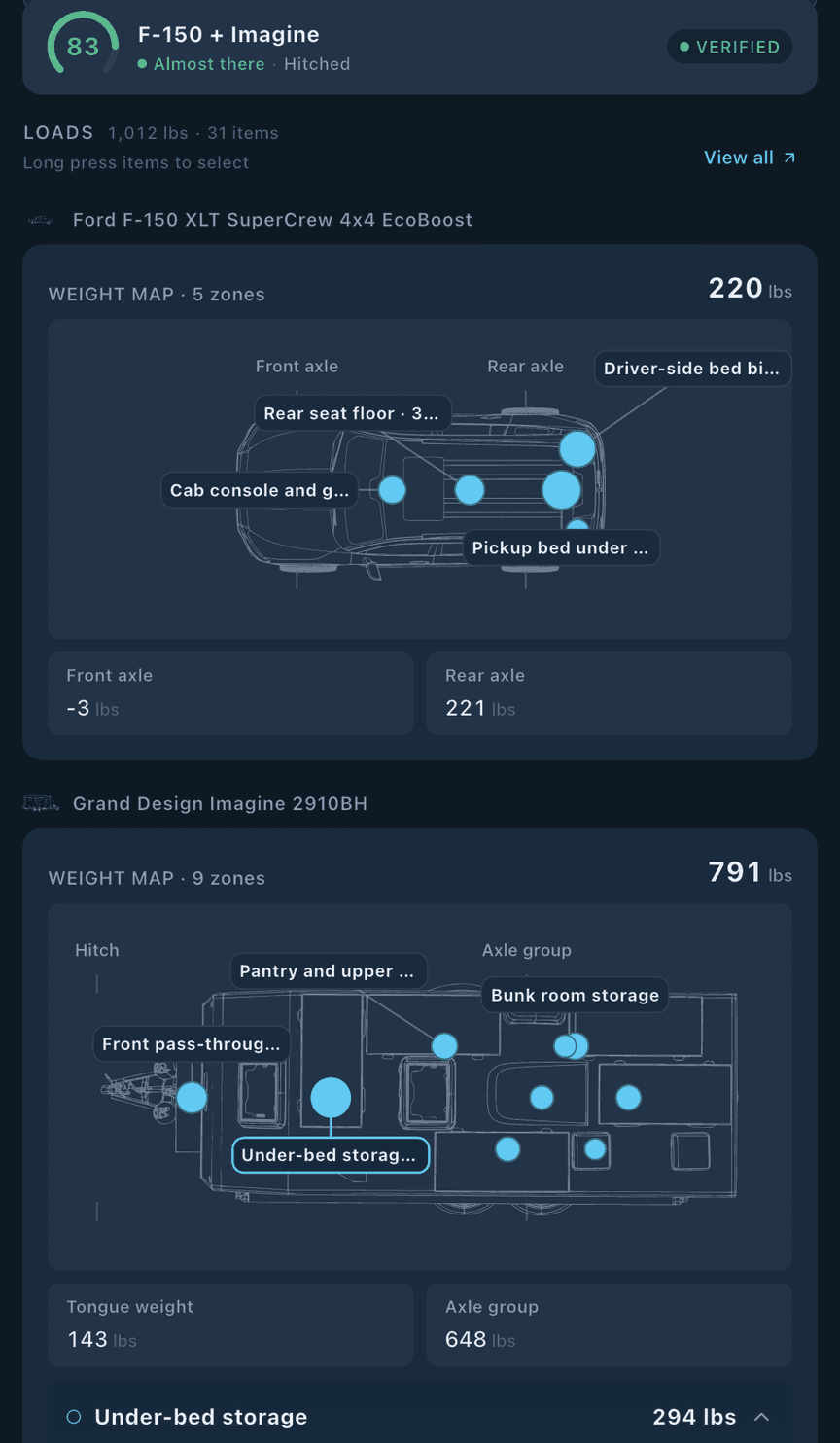
See where each pound is sitting
loadmate maps the load side to side, front to back and how high it stacks, alongside the weight on the hitch, so the places your car is rated for are places you can actually see. A hitch weight that fits the allowance on a spec page gets heavier the moment the front of the trailer is packed, and the loaded figure is the one your car has to be rated for. Free to explore on a demo rig in the app.


Can my Subaru Forester tow a camper?
Yes, and the elimination runs faster than most owners expect, because a small camper's own Trailer GVWR usually rules it out before its dry weight does. Here is the check run against a 1,500 lb Forester, with every figure in the term its own maker uses for it. Most publish a dry weight, meaning the trailer as it leaves the factory, alongside a Trailer GVWR, meaning the most it may weigh once you have packed it. Lund publishes one towing weight covering the boat, the motor and the trailer together, and TAXA calls its hitch figures tongue weight that depends on load.
| Trailer (published figures) | Published weight | Trailer GVWR | Published hitch weight | Against the 1,500 lb rating | Against the 150 lb ball figure |
|---|---|---|---|---|---|
| Lund Fury 1600 tiller, boat and motor | 1,004 lb towing weight | not stated | not stated | In, 496 lb unused | Lund publishes no figure |
| Scamp 13 Lite | 1,250 lb dry | 2,200 lb | 150 lb dry | In dry, over at its own Trailer GVWR | the entire allowance |
| TAXA TigerMoth Standard | 1,310 lb dry | 2,200 lb | 127 lb tongue, load-varying | In dry, over at its own Trailer GVWR | 23 lb of room |
| TAXA TigerMoth Overland | 1,458 lb dry | 2,400 lb | 195 lb tongue, load-varying | In dry by 42 lb | 45 lb over |
| Scamp 13 Standard | 1,600 lb dry | 2,200 lb | 180 lb dry | Over dry by 100 lb | 30 lb over, dry |
| Rockwood Tent 1640FT pop-up | 1,763 lb dry | 2,346 lb | 250 lb dry | Over dry by 263 lb | 100 lb over, dry |
| nuCamp TAB 320 S Classic | 1,994 lb dry | not stated | 126 lb dry | Over dry by 494 lb | inside, dry |
| Look ST DLX 5x8 enclosed cargo | not stated | 2,990 lb | not stated | Over at its own Trailer GVWR | Look publishes no figure |
Read the last two columns together and the same thing keeps happening. Four of these eight clear the 1,500 lb rating on their published weight. Of the three of those four that publish a hitch weight, exactly one still has room on the ball: the TigerMoth Standard, with 23 pounds of it. The Scamp 13 Lite's published hitch weight is 150 lb, the whole allowance. The TigerMoth Overland clears the rating by 42 lb and sits 45 lb over on the ball on the same day. And every unit here that publishes a Trailer GVWR publishes one above 1,500 lb, so none of them can travel loaded to its own maximum behind a 1,500 lb Forester.
Forest River states the Rockwood figures as unloaded weight plus cargo capacity, which is where the 2,346 lb comes from. nuCamp publishes an axle rating rather than a Trailer GVWR on its teardrops and sends owners to the plate on the trailer itself, so a TAB 320 S has to be checked against that plate, not against a spec page.
On a Wilderness the same units sort differently, and the two that the 1,500 lb rating ruled out come back in.
| Trailer (published figures) | Dry weight | Trailer GVWR | Dry hitch weight | Against the 3,500 lb rating |
|---|---|---|---|---|
| nuCamp TAB 320 S Classic | 1,994 lb | not stated | 126 lb | In, 1,506 lb of the rating unused dry |
| Look ST DLX 5x8 enclosed cargo | not stated | 2,990 lb | not stated | In at its full Trailer GVWR, 510 lb spare |
| Rockwood Geo Pro G15TB | 2,833 lb | 3,907 lb | 399 lb | In dry by 667 lb; over at its own Trailer GVWR, and over on the ball, 399 lb against 350 |
| Jayco Jay Feather Micro 171BH | 3,750 lb | 4,995 lb | 445 lb | Over dry by 250 lb, before water |
The Geo Pro's 3,907 lb comes out of the same Forest River arithmetic as the pop-up's 2,346 lb. Forest River's page for that floorplan publishes 2,833 lb unloaded, 1,074 lb of cargo capacity and a 399 lb hitch weight, and states its Trailer GVWR as the unloaded weight plus the cargo capacity.
For the Wilderness and Geo Pro pairing, compare the 3,907 lb Trailer GVWR, 2,833 lb unloaded weight and 399 lb dry hitch weight with Subaru's 3,500 lb tow rating and 350 lb ball limit. GVWR still comes from your own door label. This trailer already exceeds the ball limit on its published dry figure.
What owners actually put behind a Forester matches the shape of those tables. Teardrops around 1,000 lb come up constantly and get described as trivial. A 13 ft Scamp behind an older Forester crossed Wyoming grades at about 10 mpg. A Wilderness owner tows a 5x8 enclosed cargo trailer and a 16 ft aluminum boat in the 1,000 to 1,200 lb bracket, and reports a roughly 2,500 lb boat and trailer with surge brakes a couple of times a year, self-limiting to 60 mph. Two things recur across three separate forums: the heat and mileage complaints cluster on sustained grades in hot weather rather than on flat miles, and the trailer brake controller gets bought after the first trailer rather than before it.
How much can I tow with a Subaru Forester when the roof is loaded too?
The same 1,500 lb or 3,500 lb, because the roof has its own separate permission and does not come out of the trailer rating. Subaru publishes no total for the loaded car, so there is no shared pool for a roof box and a trailer to draw from. There are two independent limits, each of which has to hold on its own, and the roof half of it arrives as a pair of figures that owners routinely read as one.
| Where the load sits | Every trim except Wilderness | Wilderness |
|---|---|---|
| Roof rails, moving load (2026 trim sheet) | 176 lb | 176 lb |
| Cross bars, moving load (2025 guide) | 150 lb | 150 lb |
| Roof rails, parked (2026 trim sheet) | 700 lb | 800 lb |
The moving figure is what the roof may carry while the car is being driven, so it governs the bars, the rack and whatever is strapped to them. The parked figure is several times larger and applies standing still, which is the one a roof top tent's occupants sit inside. A tent whose own hardware stays under the moving limit can still hold two adults overnight, because the people are only ever aboard when the car is not.
The number that binds first up there is usually the smaller one, the 150 lb the 2025 guide gives the cross bars, because a box, a rack, a kayak or a tent mounts to the bars rather than to the rails. The 2026 owner's manual prints no cross-bar figure of its own; it caps the whole driving load at the rails' 176 lb and sends you to the rack maker for the bars' own limit, whichever is lower. That is the same 150 lb the same document grants the hitch ball, and it is the one place on the car where the two allowances meet: the bars carry a load that just sits there while the car drives, the ball carries the download of a trailer that is also pushing and pulling on it, and Subaru has priced them identically.
The owner communities are thin on this exact combination. Across a full sweep of Forester threads exactly one owner describes towing and a loaded roof rack at the same time, a 1,500 lb tent trailer with a full rack every summer. If that is your plan, the two checks are independent and both are yours to run: the trailer against the rating and the ball, and everything above your head against the 150 lb that 2025 guide allows on the bars while the car is moving.
Does Subaru publish a Forester's GVWR anywhere?
In one place only: the certification label in your own car's driver's door frame. That label carries the GVWR and both axle ratings for the vehicle it is stuck to. The tire and loading information placard next to it states the combined weight of occupants and cargo that build was released with. Every other figure on this page came out of a Subaru document written for the whole lineup; those two were printed for one car, and they are the only totals a Forester has.
One dated fact belongs alongside them. NHTSA campaign 26V436000, filed by Subaru on July 13, 2026, covers 2025 and 2026 Foresters built with an incorrect Gross Axle Weight Rating on that certification label, with a corrected label as the remedy and owner letters expected from August 25, 2026. The Toyota Tundra page covers what it means when a capacity label is reprinted.
An aftermarket receiver under the bumper often carries a higher stamped rating than Subaru allows the car, and the trim sheet figure is still the one that governs; the Jeep Wrangler page works through what a stamped hitch figure does and does not settle.
Every trailer ruled out on this page was ruled out by a number its own maker had already published, which means the whole sort can happen on a phone before anyone drives out to look at one. Two figures off a trailer's spec page, its Trailer GVWR and its hitch weight, held against the figures Subaru grants your trim, will settle most candidates in about a minute. What survives is a short list worth going to see, and the units that miss on dry weight alone will still miss on the day you pack them. The ones that clear are clearing on figures nobody has loaded yet, so a pass earned at the spec page holds only until the front locker is full. The answer that counts is the one you get from the weights the trailer will actually leave with.
Related guides
The concepts underneath this page, and the vehicles that reach a small rating from a different direction.
- What can I tow?: the three-way check in its general form, for whatever else is on the driveway
- Towing capacity chart: the Forester's two rows against the rest of the compact SUV class
- Towing weight ratings explained: what GVWR, GCWR and GAWR each govern, which is worth knowing before you read your label
- Payload vs towing capacity: the carrying side of the question, on a vehicle whose maker does publish a payload figure
- Tongue weight vs payload: what the weight on the ball costs the vehicle carrying it
- Weigh a travel trailer at a CAT scale: how to replace a published dry weight with a measured one
- How to read a CAT scale ticket: what the axle lines say about the back of the car
- How much can a Honda Ridgeline tow?: the other vehicle here with nothing to look up on the order sheet
- How much can a Ford Ranger tow?: where the tongue figures sit against each rating, set out in full
- How much can a Toyota Tundra tow?: what happens when the label in the door frame gets reprinted
- How much can a Jeep Wrangler tow?: the other page here where a stamped hitch figure enters the arithmetic
- How much can a Ford Maverick tow?: a small rating again, from a maker that prints every figure and footnotes them apart
Frequently asked questions
- How much can I tow with a Subaru Forester?
1,500 lb behind nine of the ten 2026 trims and 3,500 lb behind the Wilderness, and on those nine the trailer's hitch weight also has to fit inside the 150 lb Subaru's 2025 guide allows. In practice that puts teardrops, small fiberglass trailers, 5x8 enclosed cargo trailers and light boat packages inside the 1,500 lb rating, and it puts most travel trailers outside it once they are loaded to their own Trailer GVWR. The two tables above sort eight units against a 1,500 lb Forester, six of them with a published hitch weight to check, and put four against the Wilderness.
- Can I add a transmission cooler to increase my Forester's towing capacity?
No, and the reason is more interesting than the answer. A cooler is exactly what Subaru changed to lift the Wilderness from 3,000 lb to 3,500 lb for 2026, in Subaru's own words, and it arrived fitted to a trim alongside a revised CVT with a shorter final drive ratio and a rear differential temperature sensor. Owners in three separate 2025 threads on subaruforester.org each started from the assumption that the cooler was the whole difference and were corrected by other owners pointing at the Wilderness chassis, gearing and brakes. One owner asked his dealer to fit a cooler to a hybrid and was turned down. The rating belongs to the vehicle as Subaru built it.
- Is a Subaru Forester a good towing vehicle?
Inside its own figures, owners report it doing the job without drama. Teardrops around 1,000 lb get described as trivial, a 13 ft Scamp crossed Wyoming grades behind an older Forester at about 10 mpg, and a Wilderness owner tows a 5x8 enclosed cargo trailer and a 16 ft aluminum boat in the 1,000 to 1,200 lb bracket. Trailer Stability Assist is standard on all ten 2026 trims. Two limits show up in the same threads: heat and mileage complaints concentrate on sustained grades in hot weather, and frontal area matters as much as weight. One owner of an earlier turbo Forester called a 1,000 lb teardrop trivial and a 2,000 lb high-profile teardrop hard work, with higher temperatures and no warning lights.
- What is the 80/20 rule for towing?
It is a rule of thumb owners repeat, rather than a Subaru specification or a rule any state DOT sets: load the trailer to around 80% of the tow rating and keep the last 20% in reserve for grades, heat and headwind. On a 1,500 lb Forester that puts a working figure near 1,200 lb, and on a 3,500 lb Wilderness near 2,800 lb. Subaru's own published conditions are shorter: its towing footnote says maximum towing capacity varies by trim level, that trailer brakes may be needed, and to see your retailer for details, and the maximum figures assume a trailer with brakes. The owner threads arrive at a similar reserve from experience, since the heat complaints cluster on long climbs rather than on level ground.
- What Subaru will tow 5,000 lbs?
Not a Forester. The 2026 Forester range tops out at 3,500 lb on the Wilderness and sits at 1,500 lb on the other nine trims, from Subaru's 2026 trim comparison. In Subaru's current lineup the 5,000 lb figure belongs to the Ascent, which the towing capacity chart carries with the source and date on the row. Check the figure for the exact model year you are looking at rather than carrying one over, since the Wilderness itself moved 500 lb between 2025 and 2026.
- How much can a Subaru Forester Hybrid tow?
1,500 lb, on all four hybrid trims, which is the same rating as every non-Wilderness gas trim. The hybrids are the heaviest Foresters Subaru builds, with published curb weights from 3,873 lb on the Premium Hybrid to 3,946 lb on the Touring Hybrid. There is no hybrid Wilderness for 2026, so the 3,500 lb rating and the hybrid powertrain cannot be bought together.
- What is the tongue weight limit on a Subaru Forester?
150 lb on every trim except the Wilderness, and 350 lb on the Wilderness. Both sit in the 2026 owner's manual's trailer-with-brakes table (MSA5M2602A, issued June 2025). The 2025 Getting Started Guide printed the same 150 lb beside 300 lb for the Wilderness at its then-3,000 lb rating, so the Wilderness tongue figure moved up with the trailer rating for 2026. The manual also asks for a tongue load of 8% to 11% of the total trailer weight, so a trailer's own hitch figure still needs checking against both.
- Do I need trailer brakes to tow with a Subaru Forester?
Subaru's position is that its maximum towing figures assume a trailer with brakes, and its trim sheet footnote says trailer brakes may be needed and to see your retailer for details. The legal threshold is separate and it is set state by state, so read the rule for the state you live in and any state you plan to tow through rather than a single national figure. Owners on the teardrop, fiberglass and Forester forums independently reach the same practical advice: budget for a brake controller, because most people buy one after the first trailer rather than with it.
- Where do I find my Forester's GVWR?
On the certification label in the driver's door frame, which carries the GVWR and both axle ratings, alongside the tire and loading information placard that carries the combined weight of occupants and cargo for your specific car. Subaru publishes no GVWR for the Forester in its trim comparison sheets, its Getting Started Guide or its press releases, so the label is the only source. Note NHTSA campaign 26V436000, filed on July 13, 2026, which covers 2025 and 2026 Foresters built with an incorrect Gross Axle Weight Rating on that label; Subaru's remedy is a corrected label, with owner letters expected from August 25, 2026.