Explorer towing at a glance
- Every 2026 row, one figure
- 5,000 lb of maximum loaded trailer weight in all seven rows of Ford's selector: four engines, three axle ratios, rear-wheel drive and four-wheel drive
- The column that still moves
- GCWR, 10,000 lb on the 2.3L rear-wheel drive, 10,100 lb on 4WD, up to 10,800 lb on the 3.0L V6 ST and Tremor
- What is left inside at full trailer
- 688 lb on the 10,000 lb configuration, covering seven seats, the bags behind them and anything on the roof
- The occupant weight Ford assumes
- 150 lb each for a driver and one passenger, stated in the Explorer towing guide and again in the 2026 RV & Trailer Towing Guide
- Ford's tongue figure
- 500 lb maximum tongue load, weight-carrying, on the Explorer's Class III receiver
- The package, and its order code
- Class III Trailer Tow Package, standard for 2026, order code printed as "no option code assigned"
- Trailer frontal area
- 40 sq ft with the Trailer Tow Package, the same figure on every Explorer
- Who supplies the brake controller
- You do. Ford fits no integrated controller on any Explorer, and asks for a compatible aftermarket one before towing electric trailer brakes
- Payload, and where it is printed
- On the Tire and Loading Information label, on the B-pillar or the edge of the driver's door
- Recall on the hitch itself
- NHTSA campaign 25V687000, filed October 10, 2025: on 2024 to 2026 Explorers the trailer hitch assembly bolts may be loose
Ford writes out how to work out an Explorer's real trailer number, and the people in the car are the third and fourth things it tells you to subtract. Page 336 of the 2026 owner's manual starts at the gross combined weight rating, takes off the vehicle's curb weight, then the hitch hardware, then driver weight, then passenger weight, then payload, cargo and luggage. Whatever survives is the maximum loaded trailer weight for that combination. Driver and passenger are two separate line items in that list, and Ford prints no figure against any of them.
There is very little else left in Ford's 2026 Explorer paperwork that moves. The Trailer Towing Selector in Ford's Explorer towing guide runs to seven rows, covering four engines, three axle ratios, rear-wheel drive and four-wheel drive, and every cell of its Maximum Loaded Trailer Weight column reads 5,000 lb. The Class III Trailer Tow Package is standard, with its order code printed as "no option code assigned". The receiver allows 500 lb on the ball and the trailer frontal-area limit is 40 sq ft, identical on every Explorer. One column still moves: GCWR, from 10,000 lb to 10,800 lb, and GCWR is where the manual's subtraction begins.
Take the one configuration where Ford publishes both of those inputs for the same vehicle, the 2.3-liter EcoBoost with rear-wheel drive: a 10,000 lb combined rating against a 4,312 lb base curb weight. Hitch the full 5,000 lb trailer and 688 lb of that rating is left for everything and everyone inside a seven-seat car. Ford's published rating has already spent 300 of it, on a 150 lb driver and a 150 lb passenger.
How much can a Ford Explorer tow?
A 2026 Ford Explorer is rated to tow 5,000 lb, and that is the figure for every version of it Ford sells. The Trailer Towing Selector in Ford's 2026 Explorer towing guide is a single table, and one column of it never changes value.
| 2026 engine and scope | Axle ratio | GCWR | Maximum loaded trailer weight |
|---|---|---|---|
| 2.3L EcoBoost I4 | 3.58 | 10,000 lb RWD, 10,100 lb 4WD | 5,000 lb |
| 2.3L EcoBoost I4, Tremor | 3.58 | 10,100 lb | 5,000 lb |
| 3.0L EcoBoost V6, Tremor | 3.58 | 10,800 lb | 5,000 lb |
| 3.0L EcoBoost V6, ST | 3.58 | 10,800 lb, RWD and 4WD | 5,000 lb |
| 3.0L EcoBoost V6, Police Interceptor Utility only | 3.31 | 10,200 lb | 5,000 lb |
| 3.3L Ti-VCT V6, Police Interceptor Utility only | 3.73 | 10,100 lb | 5,000 lb |
| 3.3L HEV V6, Police Interceptor Utility only | 3.73 | 10,500 lb | 5,000 lb |
Three of those rows are footnoted to the Police Interceptor Utility, a fleet-only five-seat car with no third row, so a retail shopper is choosing between the top four. The hybrid row belongs to that fleet car too; there is no retail Explorer Hybrid for the 2026 model year, which is worth knowing before a hybrid figure gets carried across from another model year. Ford states that Explorer ratings are calculated with the SAE J2807 method.
The 2026 series line-up runs Active, ST-Line, ST, Platinum and Tremor, with the Active offered in a new base trim. None of those badges appears as an axis in the towing column. Where the Explorer sits against the rest of the three-row field is a job for the towing capacity chart; what matters from here is the 5,000 lb figure and what it costs inside the car.
Does the 4-cylinder Explorer tow less than the V6?
No. Ford rates the 2.3-liter EcoBoost four and the 3.0-liter EcoBoost V6 at the same 5,000 lb, in either drivetrain. The V6 is worth 385 hp and 415 lb-ft against the four's 300 hp and 310 lb-ft, and it will do the work with more in reserve on a grade. What it does not do is raise the number Ford permits behind it.
What the V6 does move is the combined rating. An ST or a Tremor with the 3.0-liter carries a 10,800 lb GCWR against the 10,000 lb of a rear-wheel-drive 2.3-liter, an 800 lb difference. Since the trailer figure is held at 5,000 lb on both, all 800 lb of that difference lands on the vehicle side of the subtraction, which is where the people and the luggage are counted.
One thing to settle before anyone plans a family trip around it. Ford publishes exactly one Explorer weight, and it is a base curb weight of 4,312 lb for the 2.3-liter two-wheel-drive car. "Base" is doing work in that phrase: it describes the lightest way Ford builds the 2.3-liter, so an ST-Line on 21-inch wheels starts with less headroom than the ladder below shows even before the drivetrain changes. An ST or a Tremor is heavier again and Ford does not say by how much, so an owner of one cannot run the same arithmetic from Ford's public record and cannot assume all 800 lb is free. The ladder below is scoped to the configuration where both of Ford's figures describe the same vehicle, and it is the optimistic end of it.
How do you tell whether an Explorer has the trailer tow package?
On a 2025 or newer Explorer, it has one. Ford made the Class III Trailer Tow Package standard equipment for 2025 and prints its order code as "no option code assigned" for 2026, which is Ford's way of saying there is no box to have missed. The contents listed against it are a 7-wire harness with a 4-pin and 7-pin connector, the Class III hitch receiver, Tow/Haul mode, Trailer Sway Control and Lane Keeping Alert.
On a 2024 or older Explorer the question is real, and three places answer it. The receiver under the rear bumper carries its own capacity label, which Ford's guide says may read higher than the vehicle's own maximum loaded trailer weight, in which case the vehicle figure governs. The 4-pin and 7-pin connector is either there or it is not. And on a 2024 Explorer the window sticker lists the Class IV Trailer Tow Package as option code 52T; one ordered without it was rated 3,000 lb rather than 5,300 lb, because Ford offered no factory towing equipment for that application at all. Earlier model years used their own package names and codes, so read the towing guide for the year printed on the door, rather than assuming 52T is the code to hunt for.
The package has never included the item owners most often assume is in it: an integrated trailer brake controller. Ford's 2026 RV & Trailer Towing Guide names the F-150, the F-Series Super Duty, the Transit and the Expedition as the vehicles that offer one. Ford also asks that a trailer with electric brakes is towed only behind a compatible aftermarket controller, so on an Explorer that is a purchase and an install.
How much can a Ford Explorer tow with a full car of people?
The 5,000 lb rating survives four people and then starts giving ground: at Ford's own 150 lb an occupant, the fifth costs 62 lb of trailer, and a full seven-seat car costs 362 lb. The method is Ford's, from page 336 of the 2026 owner's manual, and the occupant weight is Ford's too, the 150 lb per person its footnotes use for a driver and a passenger.
Start with the combined rating and take the car off it: 10,000 minus 4,312 leaves 5,688 lb to be shared between the people, their gear and the trailer. The 5,000 lb rating sits below that, so for the first few seats it is the rating that answers, not the arithmetic.
| Seats filled | Who is aboard | Occupants | Left after base curb weight and occupants | Trailer that still fits | Against the 5,000 lb rating |
|---|---|---|---|---|---|
| 1 | the driver | 150 lb | 5,538 lb | 5,000 lb | unchanged, 538 lb unused |
| 2 | the front row full, which is the state Ford's rating describes | 300 lb | 5,388 lb | 5,000 lb | unchanged, 388 lb unused |
| 3 | one more, in the second row | 450 lb | 5,238 lb | 5,000 lb | unchanged, 238 lb unused |
| 4 | two in the second row | 600 lb | 5,088 lb | 5,000 lb | unchanged, 88 lb unused |
| 5 | the second row full | 750 lb | 4,938 lb | 4,938 lb | 62 lb of trailer given up |
| 6 | one in the third row | 900 lb | 4,788 lb | 4,788 lb | 212 lb given up |
| 7 | every seat taken | 1,050 lb | 4,638 lb | 4,638 lb | 362 lb given up |
| 7, plus bags | every seat taken, 100 lb behind the third row | 1,150 lb | 4,538 lb | 4,538 lb | 462 lb given up |
Turn the same two figures around and it comes down to one number. With the full 5,000 lb trailer coupled, 10,000 minus 4,312 minus 5,000 leaves 688 lb inside the car. Divide that by the seat count Ford also publishes and the Explorer's real family figure is 98 lb a seat. Ford's published rating has already committed 300 of the 688 to two people, which leaves 388 lb for the other five seats, or 78 lb each, and that is before a bag goes in behind the third row.
The hinge moves with how much people actually weigh. At Ford's 150 lb the fifth occupant is the first one to cost trailer weight. At a more ordinary 190 lb it is the fourth. That is why an owner asking whether an Explorer can tow 5,000 lb usually gets a different answer from an owner asking whether it can tow 5,000 lb on a family holiday.
Three things sit outside that table on purpose, each of which takes more out of the same allowance. Ford lists hitch hardware, a draw bar, a ball and locks, as its own line in the subtraction and publishes no weight for it. The tongue load is counted a second time against payload, which Ford's manual states plainly. And Ford asks for gross vehicle weight and gross combined weight to be reduced by 2% per 1,000 ft of elevation, so a mountain trip shortens every row above. The roof is separate again, with its own allowance: 165 lb on a car without the glass roof and 75 lb with it, so the Panoramic Fixed Glass Roof option costs 90 lb of roof load before a box goes up there. The Subaru Forester page works through how a roof limit behaves next to a trailer rating.
Payload is the other half of this and it cannot be run from Ford's record. A retail Explorer's GVWR and payload appear in none of Ford's public documents, and its own specifications page says instead to see the label on the doorjamb for the carrying capacity of a specific vehicle. NHTSA's vPIC database puts the retail 2026 Explorer VIN patterns that decode cleanly into GVWR Class 1D, 5,001 to 6,000 lb, which brackets the figure without giving it. One 4WD Active pattern decodes a band higher than the rest, so read the bracket as the common case rather than as the whole lineup. What that means for the reader is covered under payload vs towing capacity, and the general three-way version of the check lives on what can I tow.
Owners reach the same place from the other direction. A 2018 thread on ExplorerForum, discussing a 5,000 lb load against a roughly 10,400 lb combined rating, landed on the line that it is going to be hard to tow 5,000 lb with anything more than a driver aboard. When Cars.com towed a roughly 5,000 lb loaded travel trailer behind a 2020 Explorer ST in August 2020, with 525 lb on the ball, the driver and his gear were the only load inside the car. That 525 lb is 25 lb above the tongue figure Ford prints for a 2026 Explorer, so read it as what one 2020 car was carrying rather than as a setup to copy on a current one.
What Ford and NHTSA have already put on your pre-trip list
Six of the seven checks worth making before an Explorer tows anything are already written down, and two of them are safety recalls filed against this exact car. Two of the six arrived in owners' mail as recall letters, three come out of Ford's towing documents, and one is a line in the owner's manual that catches new buyers.
- The hitch bolts. NHTSA campaign 25V687000, filed on October 10, 2025, covers 2024 to 2026 Ford Explorers and Lincoln Aviators, and the defect line reads that the trailer hitch assembly bolts may be loose. The consequence NHTSA records is a loss of vehicle handling and control while towing, or the trailer detaching. Dealers inspect and tighten or replace at no charge, Ford mailed owner letters on October 29, 2025, and affected VINs were searchable from October 15. A VIN lookup is the cheapest item on this list.
- The trailer lights. Campaign 25V543000, filed on August 22, 2025, covers 2025 Explorers whose body control module can leave the trailer's tail lights dark when a trailer is attached, an FMVSS 108 non-compliance. Ford mailed Explorer owner letters on November 25, 2025. Ford's own road list asks you to check lights and electrical connections anyway.
- A brake controller you supply yourself. Ford recommends separate functioning brake systems for trailers weighing more than 1,500 lb loaded, and fits no integrated controller on the Explorer, so the controller is an owner-fitted item and therefore a pre-trip item. Ford's manual also notes that the vehicle's anti-lock brake system does not control the trailer brakes. Your state sets its own trailer-brake threshold, so read the rule for the state you live in and any state you are driving through.
- The spare. Ford's guide asks for a conventional, identical full-size spare tire for trailer towing, and rules out mini, compact and dissimilar full-size spares.
- The stop at 50 miles. Ford asks you to pull over somewhere protected after about 50 miles and re-check four things: the trailer hitch attachment, the lights and electrical connections, the trailer wheel lug nuts for tightness, and the engine oil.
- The first 1,000 miles of the car's life. Ford's manual says not to tow a trailer until the vehicle has been driven at least 1,000 mi, which catches more new Explorer buyers than it sounds like it would.
The seventh item is the one no document prints, and it is the weight of the people you are about to put in the car.
688 lb is the only entry on that list you cannot look at. The hitch bolts are a torque wrench and a VIN lookup, the lug nuts are visible, the spare is either the right tire or it is not, and the brake controller is either wired to the dash or it is missing. The load inside the car is a number somebody has to work out. For the Rockwood Tent 2270FT example, compare its 3,800 lb loaded weight and 2,478 lb unloaded weight with Ford's 5,000 lb tow rating, 500 lb tongue limit and 10,000 lb combined rating. At an illustrative 12.5% tongue share, that loaded pop-up puts about 475 lb on a hitch limited to 500 lb. The share is an estimate within Ford's 10 to 15% guidance, so measure the real tongue load. The remaining vehicle check needs the GVWR on your own Safety Compliance Certification label and the Explorer's loaded weight. Seven seats, luggage and the hitch load all have to fit together. Explore loadmate in the app to see how loads, measured weights and trip readiness connect before the family climbs aboard.
loadmate provides decision support for towing safety, not legal weight certification. Score, compliance checks, and trip readiness are based on the data you enter and the regulator information current at the time of release. For legal weight evidence, use a certified truck scale / CAT scale. Towing remains the operator's responsibility. See /safety-disclaimer.
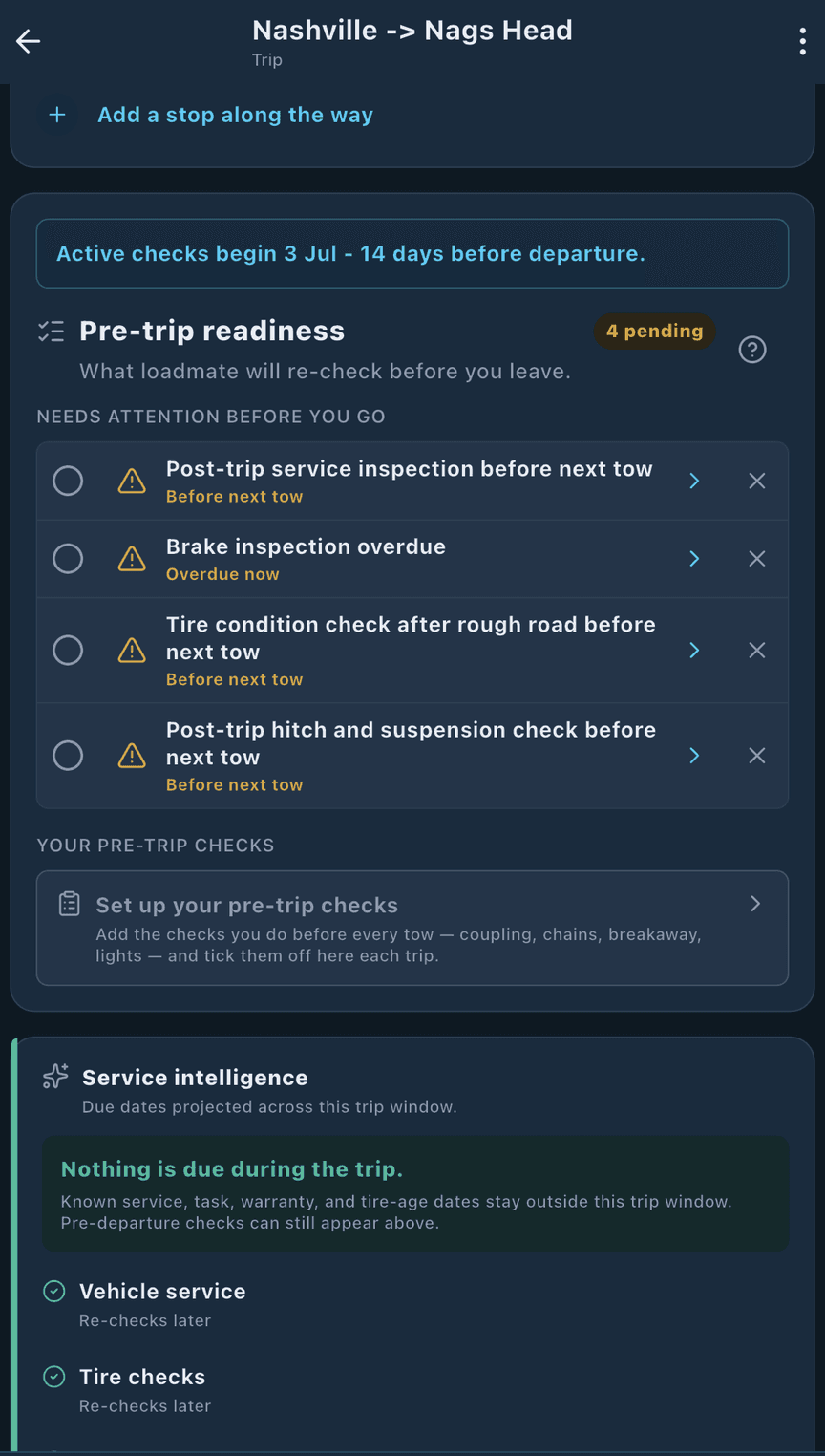
Leave with nothing falling due mid-trip
loadmate projects service intervals, tire age, the hitch check and your last weigh-in forward across the dates and the miles of the trip you are planning, so anything coming due surfaces while you can still book it, and a sweep that cleared with four aboard is worth running again when a fifth joins. Free to work through on a demo rig in the app.


Can a Ford Explorer pull a travel trailer or a pop-up camper?
A pop-up, with every seat taken, though its tongue is what gets close to a limit; a full-height hard-side travel trailer, usually not, and what rules the hard-side out is the frontal-area limit rather than the weight rating. Ford caps trailer frontal area for an Explorer at 40 sq ft with the Trailer Tow Package, and that figure is the same on every Explorer with no option code behind it.
Two 2027 Forest River units make the point, both chosen because their maker publishes weight and dimensions on the same page.
| Figure, published unless the row says otherwise | 2027 Rockwood Tent 2270FT, folding camper | 2027 Rockwood Roo 233S, expandable |
|---|---|---|
| Hitch weight, dry | 300 lb | 678 lb |
| Unloaded vehicle weight | 2,478 lb | 4,976 lb |
| Cargo carrying capacity | 1,322 lb | 1,702 lb |
| Trailer GVWR, added back from UVW plus cargo capacity | 3,800 lb | 6,678 lb |
| Tongue weight at Ford's 10 to 15%, our arithmetic on that Trailer GVWR | 380 to 570 lb | 668 to 1,002 lb |
| Exterior width | 7.0 ft | 8.0 ft |
| Height for the frontal-area check | 5.08 ft closed | 10.5 ft |
| Frontal area, our arithmetic on those two dimensions | about 35.6 sq ft | about 84 sq ft |
| Against the 5,000 lb rating | 1,200 lb inside | 1,678 lb over |
| Against Ford's 500 lb on the ball | 475 lb at 12.5%, 25 lb inside; 570 lb at Ford's 15%, over it | 178 lb over on the dry figure alone, before it is packed |
| Against the 40 sq ft frontal-area rule | inside it on those dimensions | more than double the limit |
Three rows in that table are worked out here rather than printed by Forest River, and each deserves its label. Forest River publishes an unloaded vehicle weight and a cargo carrying capacity rather than a Trailer GVWR, and defines the cargo figure as Trailer GVWR minus UVW, so 3,800 lb and 6,678 lb are those two published numbers added back together. The tongue ranges are Ford's own 10 to 15% applied to those two Trailer GVWRs, and they are on the table because Forest River's hitch weight is a dry figure: 300 lb is 12.1% of the Tent unloaded and 7.9% of what it weighs at 3,800 lb, which is under the share Ford asks for rather than a tongue weight to plan around. The two frontal areas are width multiplied by height off the same spec block, and Ford's guide prints no method for measuring frontal area to check that against. Use them as an indication of shape, and get the frontal area of the trailer you are actually buying from the people who built it rather than from a tape measure or from arithmetic on a brochure.
Put the pop-up on the ladder and it works with the family aboard on Ford's combined rating: 3,800 lb of trailer plus 4,312 lb of car is 8,112 lb, which leaves 1,888 lb of the 10,000 lb combined rating for people and gear, or seven people at 150 lb with 838 lb to spare. Where the room runs thin is the ball. Load that pop-up to 12.5% of its 3,800 lb and the ball takes 475 lb against a 500 lb rating, 25 lb of margin; take it to the 15% Ford's window also allows and the ball takes 570 lb, which the receiver is not rated for. Loaded to 3,800 lb it is well over Ford's 1,500 lb trailer-brake recommendation, so brakes on the trailer and a controller in the car are part of the plan.
The Roo is over on all three counts: 1,678 lb past the rating, 178 lb past the tongue figure before anyone loads it, and more than twice the frontal area. That last one is the interesting failure, because it is a shape problem rather than a weight problem. The Roo travels as an 8 ft wide, 10 ft 6 in tall box, which puts roughly twice as much air in front of an Explorer as Ford's 40 sq ft allows, and it is an expandable, so a full-height hard-side on the same footprint stands at least as tall. Nothing the scale says changes that.
Owners find the same wall from the retail end. One hunting a lightweight hard-side in 2021 reported that it is very challenging to find a travel trailer under 3,500 lb, and that most of what does exist is overlanding-niche and priced accordingly. A 2018 thread talked an owner down from a 4,200 lb dry trailer to roughly 3,000 to 3,250 lb dry, citing the 40 sq ft rule as the reason rather than the tow rating. Lower and squarer loads behave: a 2.3-liter owner took a UTV and its trailer, about 2,600 lb together, roughly 800 miles in December 2023 and reported that it handled it well at 8 mpg into a headwind and 9 to 10 mpg on the way home. The Ford Ranger page sets out how a frontal-area limit sits alongside the rest of a Ford towing chart.
What Ford leaves for your Explorer's door frame to answer
Ford answers the payload question by pointing at the car itself. Its 2026 specifications page carries no payload figure at all, and says instead that maximum payload varies with accessories and vehicle configuration and to see the label on the doorjamb for the carrying capacity of a specific vehicle. Two stickers are waiting in that door frame. The Safety Compliance Certification label states the gross vehicle weight rating that appears in none of Ford's retail Explorer documents, with a front and a rear axle rating printed next to it. The Tire and Loading Information label states the payload one particular build left the factory with, options and all. Between them they close every figure Ford would not print.
The tongue load is counted against that second label as well, which is why the arithmetic keeps returning to it. Ford's manual is explicit that when towing, the trailer tongue weight is part of the vehicle's payload, so the pop-up's 475 lb, its tongue at the middle of Ford's window, comes off the label figure before anybody sits down. What that trade costs is worked through on tongue weight vs payload, and the definitions behind GVWR, GCWR and GAWR sit on towing weight ratings explained.
Ford does publish a full set of Explorer GVWRs in one place, on the Ford Pro spec sheet for the 2026 Police Interceptor Utility: 6,465 lb, 6,500 lb and 6,840 lb depending on engine, with 1,500 lb of payload. That car has five seats, no third row and police-duty content, so those figures describe a different vehicle from the one in a retail driveway and should not be borrowed for one.
Did the Ford Explorer's towing capacity go down?
The top figure came down and the bottom figure came up, in the same revision. Ford's own Explorer towing guides for the three model years say it plainly.
| Model year | 2.3L EcoBoost I4 | 3.0L EcoBoost V6 | The package |
|---|---|---|---|
| 2024 | 3,000 lb with no factory towing equipment; 5,300 lb with the Class IV Trailer Tow Package | 5,600 lb on King Ranch, Platinum and ST | Optional, ordered as code 52T |
| 2025 | 5,000 lb | 5,000 lb | Class III, standard |
| 2026 | 5,000 lb | 5,000 lb | Class III, standard, order code "no option code assigned" |
A 2024 Explorer ordered without 52T was a 3,000 lb car, and Ford's note for that row said the equipment was available only as a dealer accessory. Every 2025 and later Explorer is a 5,000 lb car with nothing to order. The lineup's spread went from 3,000 to 5,600 lb down to a single number, and Ford's stated reason for the top of it moving, relayed by TFLcar in July 2024 from Ford's team, is that Explorer customers did not prioritize towing heavy trailers.
Two consequences follow for anyone shopping. If you are looking at a 2021 or 2022 Explorer, it is the earlier version of this generation with its own ratings and its own package structure, so read the towing guide for that model year rather than carrying a current figure backwards; the towing capacity chart is where the year-by-year comparison belongs. And 5,600 lb is a 2024-and-earlier V6 figure, worth pinning to its model year before anyone buys a 5,400 lb trailer on the strength of it.
For 2026 the interesting question has moved off the order sheet entirely. Everything on that sheet now returns the same trailer figure: one number for both engines, one for either drivetrain, and a package that arrives fitted. What is left of the decision is who gets in.
Related guides
Every rating named above has a guide of its own, and the five vehicle pages at the end of this list reached their own answers out of very different paperwork.
- What can I tow?: the three-way check in its general form, for whatever else is on the driveway
- Towing capacity chart: the Explorer's row against the rest of the three-row SUV field
- Towing weight ratings explained: what GVWR, GCWR and GAWR each govern before you read your own label
- Payload vs towing capacity: the carrying half of the question, on a vehicle whose maker does publish a payload figure
- Tongue weight vs payload: what the weight on the ball costs the vehicle carrying it
- Weigh a travel trailer at a CAT scale: how to replace a published dry weight with a measured one
- How to read a CAT scale ticket: what the axle lines say about the back of the car
- How much can a Honda Ridgeline tow?: the other 5,000 lb vehicle here, where the maker did publish a worked example
- How much can a Ford F-150 tow?: the Ford with four printed trailer figures instead of one
- How much can a Ford Ranger tow?: where an option code moves the frontal-area limit as well as the weight
- How much can a Subaru Forester tow?: the roof and the hitch as separate permissions
- How much can a Ford Maverick tow?: the same combined-rating subtraction, landing on a cargo box instead of a third row
Frequently asked questions
- Can a Ford Explorer tow 5000 lbs?
Yes, and every 2026 Explorer is rated for it, in either drivetrain and on both engines. What decides whether your Explorer can tow 5,000 lb on the day is the load inside it. On the 2.3-liter rear-wheel-drive configuration, Ford's 10,000 lb combined rating minus a 4,312 lb base curb weight minus a 5,000 lb trailer leaves 688 lb for seven seats, their bags and the roof, which is 98 lb a seat. At Ford's own 150 lb an occupant, the fifth person aboard is the first one that starts costing trailer weight.
- Is a Ford Explorer good for towing?
Inside its own figures owners report it doing the job without fuss, and outside them it runs into a shape limit before a power limit. A 2020 test towed a roughly 5,000 lb loaded travel trailer behind a 2020 Explorer ST with 525 lb on the ball, 25 lb above the tongue figure Ford prints for a 2026 Explorer, and reported that the engine never ran out of steam on 5 to 6% grades, at 12.8 mpg over about 900 towing miles, with a slight wiggle in crosswind. A 2.3-liter owner moved a UTV and trailer about 800 miles at 8 to 10 mpg. The constraint that catches people is Ford's 40 sq ft trailer frontal-area limit, which rules out most full-height hard-side travel trailers regardless of what they weigh.
- How to tell if a Ford Explorer has a tow package?
On a 2025 or newer Explorer it has one, because Ford made the Class III Trailer Tow Package standard and prints its order code for 2026 as "no option code assigned". On a 2024 or older car, look at the receiver under the rear bumper and its capacity label, look for the 4-pin and 7-pin connector, and check the window sticker: on a 2024 Explorer the Class IV Trailer Tow Package is option code 52T, and one without it was rated 3,000 lb rather than 5,300 lb. Earlier years used their own codes, so check the towing guide for the year on the door. No Explorer package since the 2011 generation has included an integrated trailer brake controller.
- How much can a Ford Explorer tow with a full car of people?
On the 2.3-liter rear-wheel-drive configuration, 4,638 lb with seven people aboard at Ford's own 150 lb each, and 4,538 lb once 100 lb of bags goes in behind the third row. The arithmetic is Ford's, from page 336 of the 2026 owner's manual: start at the 10,000 lb combined rating, subtract the 4,312 lb base curb weight, then subtract driver weight, passenger weight and cargo. The rating holds at 5,000 lb through four occupants and gives ground from the fifth. At 190 lb a person it gives ground from the fourth.
- Can a Ford Explorer pull a travel trailer or a pop-up camper?
A pop-up, yes, and the ball is the figure to size it by. A 2027 Rockwood Tent 2270FT is 3,800 lb at its Trailer GVWR, and closed it measures 7.0 ft by 5.08 ft, which works out at roughly 35.6 sq ft of frontal area. Weight and frontal area both sit well inside Ford's figures, and the pairing still leaves 1,888 lb of the combined rating for people and gear. Forest River's 300 lb hitch weight is the dry one, though. Packed to 12.5% of its Trailer GVWR that trailer carries 475 lb on the ball, 25 lb inside Ford's 500 lb; packed to the 15% at the top of Ford's instruction it carries 570 lb, which is over. A full-height hard-side is a different story: a 2027 Rockwood Roo 233S at 6,678 lb with 678 lb of dry hitch weight is over the weight rating and over the 500 lb tongue figure, and at 8.0 ft by 10.5 ft it works out at more than twice Ford's 40 sq ft frontal-area limit. Those two area figures are arithmetic on published dimensions rather than numbers Forest River prints, and Ford's guide gives no measuring method, so ask the manufacturer for the frontal area of the trailer you are actually looking at.
- How much tongue weight can a Ford Explorer handle?
500 lb. That is the maximum tongue load Ford prints against the Explorer's Class III receiver, weight-carrying, and it is the same figure across the lineup. Ford's owner's manual asks that the final trailer tongue weight stays between 10 and 15% of the loaded trailer weight, and adds that the tongue load counts as part of the vehicle's payload, so those pounds are charged to the Tire and Loading Information label as well as to the receiver.
- Do I need a trailer brake controller for a Ford Explorer, and does Ford fit one?
Ford fits none to the Explorer. Its 2026 RV & Trailer Towing Guide lists the Integrated Trailer Brake Controller for the F-150, the F-Series Super Duty, the Transit and the Expedition, and Ford's Explorer documents ask that a trailer with electric brakes is towed only behind a compatible aftermarket controller. Ford separately recommends separate functioning brake systems for trailers weighing more than 1,500 lb loaded. The legal threshold is set state by state, so check your own state's figure alongside Ford's.
- Did the Ford Explorer's towing capacity go down?
At the top of the range, yes. Ford's 2024 guide rated the 3.0-liter V6 at 5,600 lb and the 2.3-liter at 5,300 lb with the Class IV Trailer Tow Package; the 2025 and 2026 guides rate every Explorer at 5,000 lb. At the bottom of the range it went up by a long way, because a 2024 Explorer ordered without that package was rated 3,000 lb, and the package is now standard with no option code. Ford's stated reason for the change, relayed by TFLcar in July 2024, is that Explorer customers did not prioritize towing heavy trailers.