Ram 1500 towing at a glance
- What Ram prints for 2026
- 6,340 lb to 11,610 lb across the published table, every figure measured to the SAE J2807 method
- Whose truck the table describes
- Ram heads it "Ram Tradesman 1500"; the rows annotated Limited and RHO are the stated exceptions
- What the axle ratio is worth
- 3,100 lb. Same Hurricane engine, same Quad Cab: 8,510 lb on the 3.21, 11,610 lb on the 3.92
- Tongue weight, two documents
- 1,100 lb, Ram's Class IV receiver cap in the 2026 payload and towing brochure; the 2026 owner's manual states 1,161 lb for the same Class IV hitch
- What the air suspension does
- Holds ride height full time, and switches its own load leveling off when the suspension is overloaded until the load comes back down
- A line from Ram's own manual
- Heavier axles, or suspension components specified for durability, "do not necessarily increase the vehicle's GVWR"
- The certification label and the placard
- The certification label on the driver's door or B-pillar (GVWR, front and rear GAWR) and the tire and loading placard's occupant-and-cargo line
- Trailer brakes, per Ram
- Recommended above 1,000 lb, required above 2,000 lb; Arizona's own statute sets its line at 3,000 lb
- Fifth wheels and frontal area
- Ram's single trailer table covers conventional trailers only; fifth-wheel, gooseneck and frontal-area figures are absent from the 2026 documents
Hitch a trailer to a Ram 1500 with the four-corner air suspension and watch the back of the truck for a few seconds. It settles. Then it comes back up. The compressor runs, the height sensors report, and the truck returns to the stance it had before the trailer arrived.
That is the system doing exactly what Ram says it does. The 2026 owner's manual describes full-time load-leveling capability, plus the ability to change ride height from a toggle switch. It is also the reason a Ram 1500 is the hardest half-ton to read by eye, because the stance most people use to judge a load is the one thing this truck corrects.
There is a measured price for that on the hitch setup. Equal-i-zer, which builds weight-distribution hitches, published what happens when four-corner auto-leveling engages after the bars are tensioned: a setup made at 50 percent read 25 percent afterward, and the rear axle finished carrying 1,225 lb more than it did with no trailer on it, 150 lb of that arriving once the truck leveled itself. Cars.com ran Ram's own procedure with Equal-i-zer's engineers on a Ram 1500 with four-corner air in March 2019 and lost 20 to 25 percent of the distribution: Ram's fender-height target, which Cars.com measured at about 66 percent, finished at around 40.
None of that changes what Ram rates the truck to pull. It changes what you can tell by looking at it, so "how much can a Ram 1500 tow" gets answered here from the table first and from your own truck second, because on this truck the second half will not announce itself.
How much can a Ram 1500 tow?
Ram's 2026 table runs from 6,340 lb to 11,610 lb, and the axle ratio moves your number further than the engine choice does. Four gas engines are offered for 2026 on the truck plenty of owners still call the Dodge Ram 1500, and Ram publishes these as each one's best, properly equipped.
| 2026 engine | Ram's published maximum trailer weight | Ram's published maximum payload |
|---|---|---|
| 3.0L Hurricane I6, standard output | 11,610 lb | 1,930 lb |
| 5.7L HEMI V8 eTorque | 11,320 lb | 1,650 lb |
| 3.0L Hurricane I6, High Output | 10,000 lb | 1,490 lb |
| 3.6L Pentastar V6 eTorque | 8,130 lb | 2,360 lb |
Each pair of figures is that engine's best in its own column, and the two are rarely the same truck. The 2,360 lb payload on the bottom row belongs to a Pentastar Quad Cab 4x2 with a 7,200 lb GVWR, and that truck is rated to pull 8,130 lb, not 11,610 lb.
Now hold the engine still and change one thing at a time. This is the 3.0-liter Hurricane standard output in a Quad Cab with the 6-foot-4 box, which is where Ram's headline figure lives.
| Hurricane standard output, Quad Cab 6-foot-4 | GCWR | Maximum trailer weight |
|---|---|---|
| 3.92 axle, 4x2 | 17,000 lb | 11,610 lb |
| 3.92 axle, 4x4 | 17,000 lb | 11,370 lb |
| 3.21 axle, 4x2 | 13,900 lb | 8,510 lb |
| 3.55 axle, 4x4 | 13,900 lb | 8,270 lb |
The axle ratio holds 3,100 lb of the headline on its own, and GCWR moves with it, 13,900 lb to 17,000 lb. Nothing else on the order sheet comes close. Cab and box are worth 120 lb to 190 lb on the same 3.92 4x2, walking 11,610 lb down to 11,490 lb in a Crew Cab 5-foot-7 and 11,420 lb in a Crew Cab 6-foot-4. Four-wheel drive costs 200 lb to 290 lb of trailer rating while adding 200 lb of GVWR.
The floor of the published set is 6,340 lb: a 3.6-liter Pentastar on the 3.21 axle, Crew Cab 5-foot-7 4x4, with an 11,900 lb GCWR. That is the same nameplate, in the same 2026 document, rated to pull barely more than half of what the top row pulls.
One condition sits above the whole table. The 2026 sheet is headed "Ram Tradesman 1500", and the 2025 edition footnoted the identical table as Tradesman towing and payload information. The rows carrying Limited and RHO annotations are the explicit exceptions. Half-ton advertised maximums generally belong to a build most buyers never order, which is what the F-150 spoke takes apart; on a Ram it is stated in the table's own heading. Ram also states that the trailer figures include a 300 lb allowance for people on board, and that the chart's tongue weights are calculated at 10 percent.
Every other half-ton sits beside the Ram 1500 on the towing capacity chart, worth a look once you have found your own row above.
Does the Hemi or the Hurricane tow more in the 2026 Ram 1500?
The Hurricane, by 290 lb at the top of each engine's range and by 170 lb in the same cab. The 3.0-liter Hurricane standard output tops out at 11,610 lb for 2026, in a Quad Cab 6-foot-4 4x2 with the 3.92 axle. The 5.7-liter HEMI V8 eTorque tops out at 11,320 lb, in a Crew Cab 5-foot-7 4x2 with the same axle and the same 17,000 lb GCWR. Put both engines in that Crew Cab and Ram publishes 11,490 lb and 11,320 lb.
That comparison did not exist a year ago, and it is why so much of what you will read about this truck is a model year out of date. Stellantis unveiled the 2025 Ram 1500 on November 7, 2023 with three engines listed, the two Hurricanes and the Pentastar V6, and the 5.7-liter V8 absent. The 2025 payload and towing brochure, built the following September, has no HEMI row anywhere in it. On June 5, 2025 Stellantis reinstated the engine, ordering opened the same day, dealer arrival that summer, and Ram made it a no-charge upgrade on Limited and Longhorn. The 2026 brochure, built October 16, 2025 and published November 25, carries the HEMI row again.
So a 2025-dated statement that the Ram 1500 no longer offers a V8 was true when it was written and is wrong now, and a HEMI towing figure higher than 11,320 lb belongs to a model year before the gap. Ram's 2026 payload and towing document has no diesel row at all.
The rest of the table moved too, and not all in the same direction.
| 2026 versus 2025, Hurricane standard output on the 3.92 axle | 2025 | 2026 |
|---|---|---|
| Quad Cab 6-foot-4, 4x2 (the headline) | 11,550 lb | 11,610 lb |
| Quad Cab 6-foot-4, 4x4 | 11,450 lb | 11,370 lb |
| Crew Cab 5-foot-7, 4x4 | 11,340 lb | 11,200 lb |
| Lineup maximum payload (3.6L Pentastar Quad Cab 4x2) | 2,370 lb | 2,360 lb |
The one figure a reader would notice went up by 60 lb. All five of the other cells for the same engine and axle went down, the worst of them by 140 lb, and the lineup's best payload went down by 10 lb. A towing figure written before Ram published the 2026 document in November 2025 is describing the 2025 table, not this one.
Does a Ram 1500 with air suspension still need a weight-distribution hitch?
Yes, and Ram's own procedure has you switch the leveling off before you can set one. This is the argument that runs on every Ram forum, and both sides of it are describing something real.
The case that the suspension handles it is not thin. Owners on 5thGenRams report 8,000 lb trailers with 900 lb on the hitch, the truck leveling out and riding well, and years of towing without trouble. The system is not silent about being overloaded either. Ram's manual describes a protection strategy: the vehicle "will disable load leveling as required (suspension overloaded, battery charge low, etc.). Load leveling will automatically resume as soon as system operation requirements are met." The manual also notes that Off-Road 2, Off-Road 1 and Entry/Exit heights may not be available due to vehicle payload, and owners describe exactly that, a message on the cluster and the truck held at normal height until weight comes off.
The case on the other side is measured rather than felt. Equal-i-zer's own test data has a hitch set to 50 percent weight distribution reading 25 percent once four-corner auto-leveling engages. In that run the rear axle ended up 1,225 lb above its unhitched weight, 150 lb of which arrived after the truck leveled, and the company's published guidance for auto-leveling trucks is to set 75 to 100 percent rather than the usual half. Cars.com's Matt Barnes ran Ram's own procedure with Equal-i-zer's engineers on a Ram 1500 with four-corner air on March 27, 2019 and measured a 20 to 25 percent loss. An owner on the RAM 1500 Diesel Forum set his hitch by the book in July 2021, weighed 3,300 lb on the front axle and 4,400 lb on the rear behind a 6,300 lb trailer, and spent the next year re-setting the bars against the truck's unleveled fender height instead of its leveled one. His post a year later reports that with the hitch set that way, the suspension switched on after hookup and "didn't even try to level". The same word turns up on three separate Ram forums independently, including this one from March 2020: raising the rear with air suspension "only masks the problem".
Ram's manual settles the practical half, and its procedure for towing with air suspension is the standard three fender measurements with one Ram-specific step in front of them: freeze the suspension first. Verify normal ride height, enable tire service mode through the instrument cluster or the touchscreen, then measure from the top of the front wheel opening to the ground unhitched, attach the trailer without the bars and measure again, tension the bars until the front fender sits about a third of that difference above the unhitched figure, and switch service mode off. Ram's own worked example is 925 mm unhitched (36.4 in), 946 mm hitched (37.2 in), a 21 mm difference, a third of which is 7 mm, so the target is 932 mm (36.7 in). Cars.com measured that target as about 66 percent weight distribution before the truck levels itself. None of those pounds leave the truck; what a weight-distributing hitch does with them is a subject of its own.
Both camps are watching instruments that answer different questions. The air suspension is a height controller, and it is good at the job it has: it tells you whether the truck is level. Those ratings are all written in pounds, and ride height is not one of them. The overload message reports the air system's own limit, not the number stamped inside your door frame and not the rear GAWR. A Ram 1500 can sit dead level, show nothing on the cluster, and still be past the figure printed on its own certification label.
A measured figure sits alongside that. TFLtruck ran a 2026 Ram 1500 Crew Cab 4x4 with the Hurricane standard output and the 3.92 axle up the Ike Gauntlet behind 9,500 lb on November 29, 2025, and measured 4 inches of rear suspension squat, more than the Ford or the GMC alongside it. TFL does not record which rear suspension that truck carried, and the Crew Cab is the one cab Ram offers the air system on, so read the 4 inches as what a loaded Ram 1500 did on that day rather than as evidence about either setup.
For 2026 the Active-Level Four Corner Air Suspension is available on Crew Cab models only, and Ram's 11,610 lb figure belongs to a Quad Cab. The highest published towing figure on any Crew Cab, the only cab Ram offers the suspension on, is 11,490 lb, with the same Hurricane and the same 3.92 axle. The truck at the top of the table cannot have the feature this whole argument is about.
What runs out first when a Ram 1500 tows?
Payload, and it binds well before the tow rating gets close. Ram publishes 1,930 lb for the 11,610 lb Hurricane Quad Cab 4x2. Almost nobody's door label says that.
The gap has a clean example. In June 2022 an owner posted a Ram 1500 Limited Crew Cab 5-foot-7 4x4 with the 3.92 axle: the Mopar chart gave 1,530 lb for that configuration, and the door sticker read 1,103 lb. A 427 lb difference on one truck. The reply in the thread put it as well as anyone: the chart number is a general number, and the sticker number is your specific truck with your options on it. Ram's manual is on the same page, noting that heavier axles or suspension components specified for durability do not necessarily increase the vehicle's GVWR.
Owners post those labels, and the spread they cover is wide.
| What an owner's own Ram says on its door | Pounds |
|---|---|
| The stickers collected in one 5thGenRams thread that only takes 1,700-plus trucks | 1,720 to 1,880 lb |
| 2022 Ram 1500 (December 2022) | 1,655 lb |
| 2017 Big Horn Crew Cab 6-foot-4 HEMI, 3.92 axle, RamBox | 1,450 lb |
| 2021 Limited towing a Rockwood Mini Lite 2511S (May 2025) | 1,341 lb |
| 2013 Laramie with air suspension, previous generation, placard line (October 2023) | 1,278 lb |
| A Laramie, found after purchase (October 2020) | 1,165 lb |
| 2021 Limited (March 2021) | 1,156 lb |
| A Limited Crew Cab 5-foot-7 4x4, 3.92 axle (June 2022) | 1,103 lb |
Sort that list by trim rather than by pounds and it inverts. Every truck under 1,350 lb is a Limited or a Laramie. The ones that clear 1,700 lb are mostly Big Horns, and the thread collecting them runs to Quad Cabs, Crew Cabs and at least one truck with the air suspension fitted. Trim content is payload and so is the air-suspension hardware, but the option is not on its own what separates an 1,100 lb sticker from an 1,800 lb one.
Work it from your own sticker down. Subtract the people and the gear that ride in the truck on every trip, and treat what is left as the whole budget for the ball, the hitch hardware included.
Ram publishes exactly one curb weight publicly, 4,836 lb, and only for the base 3.6-liter Pentastar Quad Cab 4x2. Against that truck's 7,200 lb GVWR the subtraction gives 2,364 lb, and Ram prints 2,360 lb, which is its own footnote about rounding to the nearest 10 pounds doing its work, so the arithmetic closes. For every other configuration you cannot run it, because Ram does not publish the curb weight, which leaves the label on the door as the only place the number exists. GVWR is different: the same brochure table prints one per configuration, 6,900 lb for the 11,610 lb Hurricane Quad Cab 4x2 this page keeps returning to, 7,200 lb for the Pentastar above.
A dated scale ticket shows what that leaves. In a RamForum thread an owner drove an empty 2017 Big Horn Crew Cab 6-foot-4, HEMI, 3.92 axle, with a RamBox, a bedliner and a tonneau, onto a CAT scale in Ontario with a full tank. GVWR 6,900 lb, GAWR 3,900 lb front and rear, door sticker payload 1,450 lb, tire placard line 1,116 lb. The scale read 5,880 lb, split 3,300 lb steer and 2,580 lb drive, so 1,020 lb of real capacity. His family accounts for 550 lb of it, leaving 470 lb, and a Sherline scale under his Jayco 17Z tongue read 550 lb. He titled the thread himself, and the title is the whole argument: 1500s are really this useless, hit the CAT scale today.
Not everyone in that thread agreed with him. One recurring counter-position is to work to the axle ratings instead of GVWR, which is a different claim about which rating counts what and worth settling before you rely on it. A moderator on 5thGenRams put the general case in a sentence: on a 1500, your trailering is completely payload limited. He was answering an owner whose 2021 Limited had a 1,156 lb sticker against an 11,056 lb tow rating, and who worked out he was about 90 lb over before the trailer had done much. A rating that size and a payload that size do not describe the same trip, and payload versus towing capacity separates the two.
If your trailer is already picked out, bring its loaded and dry weights into the comparison with your Ram's tow rating, tongue limit and combined rating. Explore loadmate in the app to see how that trailer shares the truck's carrying room with passengers, a bed cover and the rest of your gear.
Can a Ram 1500 pull a half-ton fifth wheel?
Ram publishes no fifth-wheel or gooseneck rating for the 1500 at all, and the pin weights on the trailers marketed for the job land on payload that is already spoken for. The 2026 payload and towing brochure carries one trailer table, and it is a conventional one. Across all 397 pages of the 2026 owner's manual, "fifth wheel" and "gooseneck" appear once, and only to say those trailers are not supported by Trailer Merge Assist. The manual's single hitch row is a Class IV receiver: 11,610 lb of trailer and 1,161 lb of tongue weight, against the brochure's 1,100 lb cap on the same receiver. A pin does not sit on the receiver, so neither figure answers the question.
Where the weight sits is the part that changes.
| Conventional tongue | Fifth-wheel pin | |
|---|---|---|
| Where it sits | On a receiver behind the rear axle, bolted to the frame | In the bed, over or ahead of the rear axle, on a plate through the floor |
| Typical share of loaded trailer weight | 10 to 15 percent | 15 to 25 percent |
| What Ram publishes for it | A 1,100 lb Class IV receiver cap | No fifth-wheel or gooseneck rating for the 1500 |
Payload counts both the same way, and the axles count them by where they land. Those percentage bands are the industry's convention and illustrative only; Ram publishes no pin guidance for the 1500.
Keystone's Cougar Half-Ton range is where this decision usually gets made, because it is sold to exactly this truck. Two floorplans from the same range, one of each kind:
| Keystone's published figures, Cougar Half-Ton | 22MLS travel trailer | 26RKE fifth wheel |
|---|---|---|
| Shipping weight (dry) | 6,335 lb | 9,062 lb |
| Carrying capacity | 1,565 lb | 1,938 lb |
| Loaded weight, dry plus carrying capacity | 7,900 lb | 11,000 lb |
| Hitch weight, dry | 700 lb on the ball | 1,715 lb on the pin |
| Length | 26 ft 5 in | 30 ft 10 in |
| Height | 11 ft 5 in | 12 ft 7 in |
The loaded figures above are Keystone's own dry weight plus its own carrying capacity, added here. Keystone publishes no Trailer GVWR for any floorplan in this range, so the figure on your own trailer's federal label is the one to plan against. Run the 26RKE against the 11,610 lb Ram and the trailer side looks fine.
| The Ram's published figure | The 26RKE against it | What is left |
|---|---|---|
| Towing capacity, 11,610 lb | 11,000 lb loaded | 610 lb spare, 95 percent used |
| GCWR, 17,000 lb | 11,000 lb of trailer | 6,000 lb for the loaded truck, 900 lb less than its own 6,900 lb GVWR would allow |
| Payload, 1,930 lb | 1,715 lb of dry pin | 215 lb, before the hitch hardware, water, gear or a driver |
| Payload, 1,930 lb | 2,200 lb at a 20 percent pin | 270 lb past it, with nobody in the truck |
At 15 percent the pin is 1,650 lb and 280 lb remains for everyone in the truck and everything in the bed. And the best payload Ram publishes for any 2026 Ram 1500, 2,360 lb, is on the Pentastar truck rated to pull 8,130 lb, so it is not available to a rig this size. RV owners reach the same place from their own end. In a Forest River Forums thread about a Rockwood 2881S at roughly 11,308 lb loaded with an estimated 2,261 lb of pin, the answer was that no Ram 1500 has the payload capacity for that pin weight, and the one owner in the thread running a fifth wheel on a 1500, a 2016 Express Quad Cab with 1,820 lb of payload behind a 1,430 lb pin, described himself as right at his limit.
The conventional half of the same range is where this truck's figures sit comfortably. Ram recommends a weight-distributing system for any trailer over 5,000 lb, which the 22MLS clears. Compare the Cougar's 7,900 lb Trailer GVWR and 6,335 lb dry weight with the Ram's 11,610 lb tow rating, 1,100 lb tongue ceiling and 17,000 lb GCWR. Keystone's 700 lb hitch figure is dry, so it does not settle the loaded tongue weight. The vehicle and combined checks also need what your truck actually weighs; Ram publishes a curb figure only for the base Pentastar. A scale visit supplies that baseline. loadmate connects it with the loads you record afterwards, so the next trip starts from your truck's figures. Explore loadmate in the app.
That leaves the part of a rig that no rating describes. Ram's payload is fixed and Keystone's dry weight is fixed; the arrangement is not. Which end of the trailer the fresh water sits toward, which side the generator rides on and how high the bikes go on the rack all move the load without moving a single published figure. loadmate holds that arrangement next to the weights, so a heavy item moved at home shows its effect before the trip rather than after it, and it is the same arrangement that decides whether a tongue weight inside its band stays there once the trailer is packed for real. The recorded layout keeps the generator, water and bike rack connected to the weight picture when you review the next trip.
loadmate provides decision support for towing safety, not legal weight certification. Score, compliance checks, and trip readiness are based on the data you enter and the regulator information current at the time of release. For legal weight evidence, use a certified truck scale / CAT scale. Towing remains the operator's responsibility. See /safety-disclaimer.
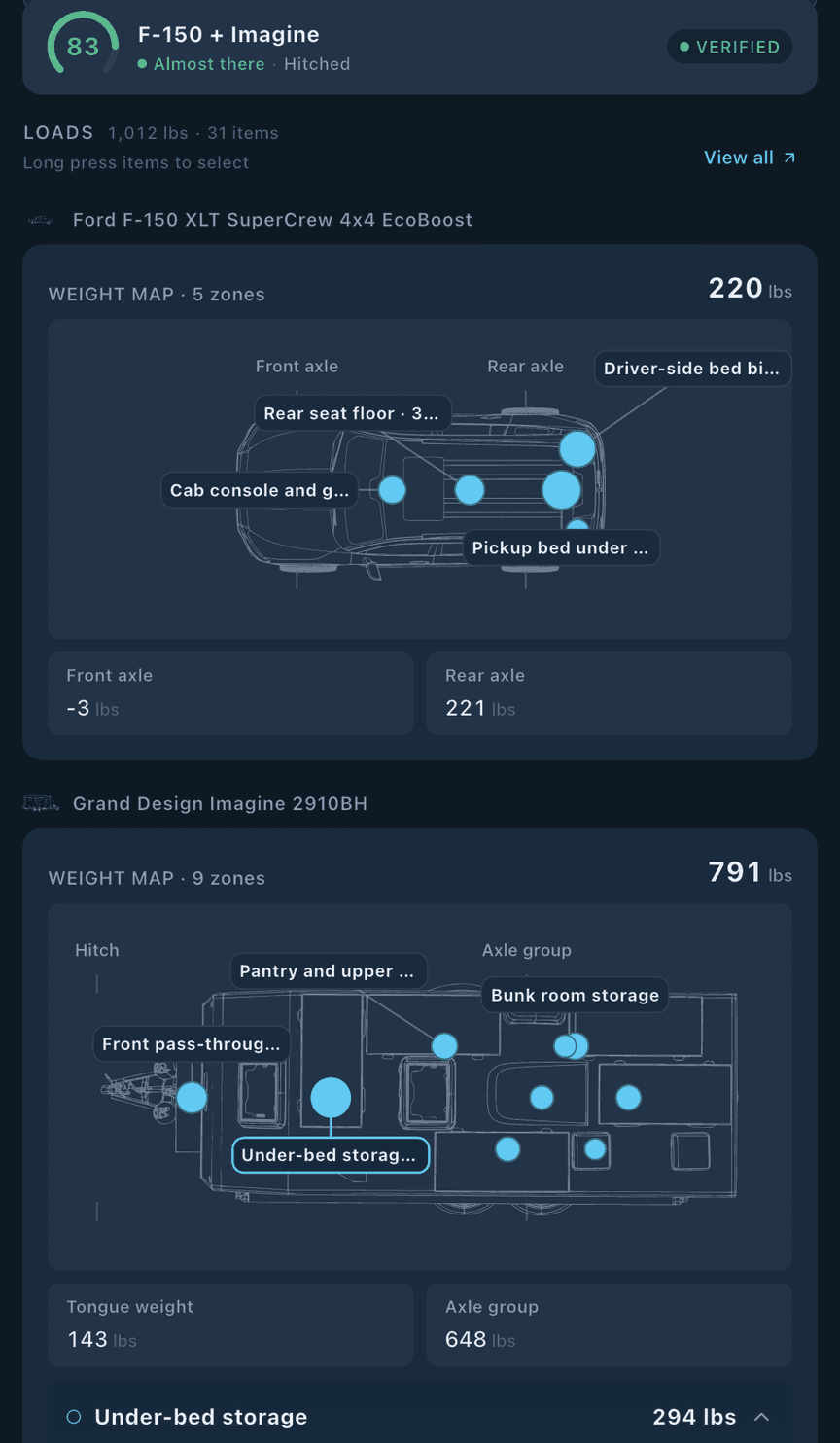
See where the weight really sits
loadmate maps the load zone by zone across the truck and the trailer, front to back and side to side, and shows what each zone does to the front axle, the rear axle and the tongue. Create a free account to explore it on a populated demo rig in the app.


Is there an open Ram 1500 recall that affects towing?
Yes. NHTSA campaign 26V059000 replaces the module that runs the trailer's lights and brakes. Ram's own recall 03D was filed on February 2, 2026 and covers certain 2025 and 2026 Ram 1500 pickups along with several other Ram, Jeep and cab-chassis models.
The defect is stated plainly in the filing: because of an improperly designed trailer tow module, the trailer lights may not illuminate and the trailer brakes may stop working. NHTSA's consequence statement covers both halves, the visibility loss from dark brake lights and turn signals and the crash risk from trailer brakes that stop working. Dealers replace the trailer tow module at no charge. Owner letters went out from March 17, 2026, and VINs became searchable on NHTSA.gov on February 10.
A second campaign reaches towing by a longer route. NHTSA 24V794000, Ram's 97B, covers 2025 Ram 1500s whose front wheel hub encoder rings can be damaged and disable the electronic stability control system, which NHTSA records as a noncompliance with Federal Motor Vehicle Safety Standard 126. Ram's own manual puts trailer sway control inside that same stability control system, enabled when the truck is switched to Tow mode, so a truck that has lost ESC has lost its factory sway control with it. Dealers inspect and replace the front wheel bearing hub assembly as needed at no charge, and owner letters were mailed December 19, 2024.
A third campaign, 26V421000, was filed on July 1, 2026 for headlight wiring that can make the parking lights and daytime running lights flicker or stop working. Interim owner letters were expected from July 30, 2026 and the final remedy was not yet available as of July 27, 2026. Nothing open across those model years touches the frame, the hitch, the transmission or the air suspension. Every campaign is searchable by VIN.
The trailer's own brakes have two separate thresholds worth knowing. Ram recommends trailer brakes above 1,000 lb and requires them above 2,000 lb, and requires an electronically actuated brake controller for a trailer with electric brakes. States set their own line and the lines are thousands of pounds apart: Arizona Revised Statutes section 28-952 requires brakes on any trailer or semitrailer of 3,000 lb or more, adequate to control, stop and hold it, operable by the driver from the cab or automatic, and applied automatically if the trailer breaks away. Check the states you actually tow in, because Ram's threshold and your state's are not the same number.
Where should the weight sit in the trailer?
Ram's answer is 60 percent of it forward of the trailer's axles, and the manual attaches a consequence to getting it wrong. The instruction reads: "Always load a trailer with 60% of the weight in the front of the trailer. This places 10% of the GTW on the tow hitch of your vehicle. Loads balanced over the wheels or heavier in the rear can cause the trailer to sway severely side to side which will cause loss of control of the vehicle and trailer. Failure to load trailers heavier in front is the cause of many trailer collisions."
The same page tells you never to exceed the maximum tongue weight stamped on your fascia, bumper or trailer hitch, which is a figure on the hardware rather than in a brochure, and worth a look before you trust either published number.
The trailer is the half of this rig that nothing re-levels. A Ram 1500 will correct its own stance after you load it, and the message that says it has stopped correcting arrives at the air system's limit rather than your door label's. Where the weight sits inside the trailer stays exactly where you put it, and of everything on this page it is the one thing you can change before the next trip without buying anything.
Related guides
The guides behind the numbers above.
- What can I tow?: the same question with no badge attached to it
- Towing capacity chart: the Ram 1500's row, and the half-tons either side of it
- Towing weight ratings explained: what GVWR, GAWR and GCWR each count, and why the axle ratings are not a substitute for the first one
- Payload vs towing capacity: why a tow rating and a payload figure never describe the same trip
- Tongue weight vs payload: the band that keeps a trailer straight, and the allowance it is paid from
- Weight distribution hitch and front axle load: what the bars actually do with the pounds they cannot remove
- Read a CAT scale ticket: what a scale ticket says that a door sticker cannot
- How much can a Ford F-150 tow?: the other full-size half-ton, where the advertised maximum belongs to one build
Frequently asked questions
- How much can a Ram 1500 5.7 Hemi pull?
11,320 lb, on a Tradesman Crew Cab 5-foot-7 4x2 with the 3.92 axle and a 17,000 lb GCWR, which is Ram's 2026 maximum for the 5.7-liter HEMI V8 eTorque. That is 290 lb below the 3.0-liter Hurricane standard output's best figure of 11,610 lb, which is a Quad Cab; put the Hurricane in the same Crew Cab and Ram publishes 11,490 lb, so the same-cab gap is 170 lb. The same HEMI on the 3.21 axle is published at 8,220 lb, so the axle ratio moves the V8's number a long way further than the badge does. Higher HEMI figures still circulating for this nameplate come from model years before the engine's one-year absence from the lineup.
- Can a Ram 1500 pull 10,000 lbs?
Several 2026 configurations clear it on paper. Every Hurricane standard output row with the 3.92 axle is published between 11,200 lb and 11,610 lb, the 5.7-liter HEMI with the same axle reaches 11,320 lb, and the Hurricane High Output in a Limited Crew Cab 6-foot-4 is published at exactly 10,000 lb. What the hitch sees is the harder half. Ram caps its Class IV receiver at 1,100 lb, which a 10,000 lb trailer passes at anything over 11 percent, and Ram's chart figures are calculated at 10 percent rather than at what a packed trailer delivers. Behind that sits payload: 1,930 lb on Ram's highest-rated 2026 truck, and owner-posted door stickers on nicer trims between 1,103 lb and 1,450 lb, which is the whole allowance before anyone gets in.
- Can a Ram 1500 pull a 30 foot camper?
Length does not settle it, and Keystone's own Cougar Half-Ton range shows why. The 22MLS is 26 feet 5 inches long and its dry weight plus carrying capacity comes to 7,900 lb; the 26RKE is 30 feet 10 inches and comes to 11,000 lb. Both are sold to half-ton owners. Read the trailer's loaded weight and what it puts on the hitch when packed, then check those two against your truck's published towing figure and the payload printed on your door label. On a Ram 1500 the payload line is usually the one that runs out first.
- Do I still need a weight distribution hitch if my Ram has air suspension?
Yes, and Ram's own manual has you switch the leveling off to set one up. Its procedure is to put the truck in tire service mode, measure the front fender height unhitched, hitch the trailer without the bars, measure again, tension the bars until the front fender sits at about a third of that difference above the unhitched height, then take service mode off. Equal-i-zer, which builds weight-distribution hitches, measured a setup made at 50 percent reading 25 percent once four-corner auto-leveling engaged, and recommends 75 to 100 percent on trucks that level themselves. Ram separately recommends a weight-distributing system for any trailer over 5,000 lb.
- Why is the payload on my door sticker lower than Ram's chart?
Because the chart figure describes a configuration and the sticker describes your truck with its options fitted. An owner posting in June 2022 had a Ram 1500 Limited Crew Cab 5-foot-7 4x4 with the 3.92 axle where the Mopar chart gave 1,530 lb and the door sticker read 1,103 lb, a gap of 427 lb. Everything fitted at the factory comes out of payload, air suspension hardware included, and Ram's manual states that heavier axles or suspension components specified for durability do not necessarily increase the vehicle's GVWR. The certification label on the driver's door or B-pillar and the tire and loading placard are the two that describe your truck. On the placard, the line to find is the combined weight of occupants and cargo, and the figure printed after it is yours.
- Can a Ram 1500 pull a fifth wheel?
Ram publishes no fifth-wheel or gooseneck rating for the 1500. Its 2026 payload and towing brochure carries one trailer table, for conventional trailers, and the owner's manual carries one hitch row, a Class IV receiver rated 11,610 lb of trailer and 1,161 lb of tongue weight, which the same brochure caps at 1,100 lb. Fifth-wheel pin weight runs higher as a share of the trailer than a conventional tongue, commonly quoted at 15 to 25 percent against 10 to 15 percent. On Keystone's Cougar Half-Ton 26RKE at 11,000 lb loaded that is 1,650 lb to 2,200 lb of pin against 1,930 lb of published payload. In a Forest River Forums thread about a Rockwood 2881S at roughly 11,308 lb loaded with an estimated 2,261 lb pin, the answer was that no Ram 1500 has the payload capacity for that pin weight.
- Should I get a 1500 or a 2500 for towing?
Ram owners answering that on their own forums tend to land on the 2500 once the trailer is heavy and the nose is loaded, and the case for staying with a 1500 is conditional on payload rather than on the rating. In a 5thGenRams thread about a CAT-verified 7,160 lb trailer carrying a 400 lb generator on the nose, the consensus favored the 2500, and the owners arguing for the 1500 tied it to keeping everything the truck carries inside roughly 1,300 lb to 1,800 lb. If your loaded tongue weight plus people and gear fits inside the figure on your door label, a 1500 is doing the job it was built for. If it does not, no engine or axle option changes that.
- What year to avoid on a Ram 1500?
The recall record is the answerable part of that question, and it points at campaigns rather than a model year. NHTSA 26V059000, filed February 2, 2026, covers certain 2025 and 2026 Ram 1500 pickups among other models, where an improperly designed trailer tow module can leave the trailer lights dark and the trailer brakes inoperative. Dealers replace the module at no charge and owner letters went out from March 17, 2026. NHTSA 24V794000 covers 2025 trucks whose front wheel hub encoder rings can disable electronic stability control, and Ram's manual puts trailer sway control inside that system. A 2026 campaign, 26V421000, covers headlight wiring, and its final remedy was not yet available as of July 27, 2026. Nothing open across those model years touches the frame, the hitch, the transmission or the air suspension, and every campaign is searchable by VIN on NHTSA.gov.
- Which Ram 1500 is best for towing?
By Ram's own 2026 table it is the 3.0-liter Hurricane standard output with the 3.92 axle, in a Tradesman Quad Cab 4x2 with the 6-foot-4 box, at 11,610 lb against a 17,000 lb GCWR. The axle is doing the work: the same engine and cab on the 3.21 axle is published at 8,510 lb. For a trailer that puts real weight on the hitch the answer moves, because payload rather than the rating is what runs out on this truck, and owner-posted door stickers run from 1,103 lb to about 1,880 lb whatever the tow rating says. Read the tow rating off Ram's table for your engine, axle and cab, then read the payload off your own door label.