Ranger towing at a glance
- The range (2026 model year)
- 3,500 lb without the Trailer Tow Package, 7,500 lb with it, 5,510 lb on the Raptor (all rated under SAE J2807)
- What moves the ceiling
- Option code 53R first, then which Ranger you bought. Every non-Raptor runs the same 3.73 axle, so the axle is not the variable
- What is in 53R
- A Class IV hitch receiver and a 4-/7-pin connector
- What 53R moves
- Maximum loaded trailer 3,500 to 7,500 lb, trailer frontal area 30 to 55 sq ft, and Ford's stated warranty position on towing above 3,500 lb
- Where the brake controller is
- Package 67P, one code up, alongside Pro Trailer Backup Assist
- Maximum tongue load
- 750 lb at the hitch receiver, 550 lb on the Raptor, 350 lb from the rear step bumper
- GCWR
- 12,370 lb (2.3L SuperCrew 4x2), 12,590 lb (2.3L 4x4), 12,745 lb (2.7L 4x4), 11,465 lb (Raptor)
- Where your own numbers live
- The Safety Compliance Certification Label on the driver's door pillar: your ratings, and a two-digit AXLE code under the bar code
The tow package settles the first question. Your camper's loaded tongue weight and the people and gear in the truck settle the next one. This guide uses the 2026 US Ranger and a real travel-trailer example, with the package details below if you need to identify your truck's equipment.
How much can a Ford Ranger tow?
A 2026 Ford Ranger is rated to tow 7,500 lb with the Trailer Tow Package and 3,500 lb without it, and the Raptor sits on its own at 5,510 lb. Engine choice does not move the trailer column at all; the package does.
| 2026 configuration | Maximum loaded trailer | Maximum tongue load | GCWR |
|---|---|---|---|
| SuperCrew 4x2, 2.3L EcoBoost, 3.73 axle, with 53R | 7,500 lb | 750 lb | 12,370 lb |
| SuperCrew 4x4, 2.3L EcoBoost, 3.73 axle, with 53R | 7,500 lb | 750 lb | 12,590 lb |
| SuperCrew 4x4, 2.7L EcoBoost V6, 3.73 axle, with 53R | 7,500 lb | 750 lb | 12,745 lb |
| Any Ranger without 53R (Ford's required-equipment threshold) | 3,500 lb | n/a | 12,370 to 12,745 lb, unchanged |
| Rear step bumper instead of a hitch receiver, any Ranger | 3,500 lb | 350 lb | 12,370 to 12,745 lb, unchanged |
| Raptor, 3.0L EcoBoost V6, 4.27 axle, tow equipment standard | 5,510 lb | 550 lb | 11,465 lb |
Those figures come from the 2026 Ford Ranger Towing Guide, and they are the same figures the 2024 and 2025 guides carried. The US Ranger arrived for 2024 as a SuperCrew-only truck built in Wayne, Michigan, and nothing in the towing column has moved since. Ford's 2026 specification sheet holds the 128.7-inch wheelbase, the 3.73 final drive and both engine outputs steady as well. What did change for 2026 is on the weights page (GVWR, curb weight and payload all moved on the 4x4), and that is the part of the sheet the arithmetic below runs on.
Two footnotes come with the headline. Ford calculates these ratings under SAE J2807, and says so on the same page as the table. The more useful one is the note underneath it: the rating assumes a properly equipped vehicle with a 150-lb driver and passenger, and varies with cargo, configuration, accessories and passengers. The arithmetic further down spends that second sentence.
The towing capacity chart carries the Ranger's row alongside the other midsize trucks, if what you want next is how 7,500 lb reads against a Tacoma, a Colorado or a half-ton.
How big of a camper can a Ford Ranger tow?
A camper can fit the 2026 US Ranger's tow rating and still exceed its 750 lb receiver tongue limit. At an illustrative 12.5% tongue share, a 6,000 lb loaded camper reaches that limit. Your truck's payload, GCWR and the camper's frontal area still need checking; this is one constraint, not a recommended trailer size.
What is the Ford Ranger tongue weight limit?
Ford's 2026 Ranger towing guide gives the non-Raptor receiver a 750 lb tongue limit. Here is how that fixed limit compares with three loaded camper weights, using the same 12.5% planning assumption throughout.
| Loaded camper weight | Estimated tongue weight at 12.5% | Against the 750 lb receiver limit |
|---|---|---|
| 5,000 lb | 625 lb | 125 lb remaining |
| 6,000 lb | 750 lb | At the limit |
| 7,500 lb | About 938 lb | About 188 lb over |
These are arithmetic examples. Use measured tongue weight for your loaded trailer, and check the receiver label and your Ranger's own ratings. The Raptor has a separate 550 lb tongue limit.
A Ranger and Salem FSX camper example
Start with a compact travel trailer. A Ranger6G member who tows a Forest River Salem FSX 178BHSK behind a Ranger summed the match up in January 2025: "My Ranger does the job but I would not go any larger than this, and I don't think I would pull it through the mountains." Forest River publishes the 178BHSK at 4,194 lb unloaded with 1,451 lb of cargo carrying capacity. Add the two, which is Forest River's own definition of the pair, and you get 5,645 lb of Trailer GVWR. Its published hitch weight is 545 lb at that unloaded weight, and the box is 22 ft 11 in long.
Watch what the 545 lb does as a percentage. Against the 4,194 lb unloaded weight it is 13.0%. Against the 5,645 lb Trailer GVWR it is 9.7%. The trailer has not changed; the denominator has. Load it toward its rating and the tongue weight climbs with the load, so the number to plan against is the loaded one, at something like 12.5% of Trailer GVWR: around 706 lb against a 750 lb ceiling, which clears with 44 lb in hand and is the narrowest margin anywhere on this pairing.
Meanwhile the tow rating is barely engaged. A 5,645 lb Trailer GVWR against a 7,500 lb rating leaves 1,855 lb of towing capacity unused, and the combination sits about 2,480 lb under GCWR. On a Ranger, the trailer that fits leaves the tongue rating as the tight line and everything else with room to spare.
Push one size up and the arithmetic turns over. In the same January 2025 thread, an owner asked about a 33-foot travel trailer at 6,635 lb dry with an 840 lb hitch weight, behind a 2024 Ranger 2.7-liter, with about 300 lb of payload left afterward. That trailer sits inside the 7,500 lb rating, and its dry hitch weight alone is already 90 lb over Ford's 750 lb ceiling. The replies converged fast: the hitch weight by itself would eat most of the payload, and a 33-foot box is enough sail area to move the truck around in a crosswind.
Two practical notes come out of the tongue-weight threads. Owners report dry tongue figures growing several hundred pounds once batteries, propane and water are aboard: one 410 lb dry tongue was expected to reach about 600 lb loaded. And whatever a weight-distribution hitch moves around, the pounds still belong to your payload. Choose hitch hardware using the truck, trailer and hitch manufacturers’ requirements and the measured loaded tongue weight.
A bed cover, passengers and camping gear also use the truck’s carrying room. See your changing load in loadmate to keep recorded vehicle and trailer loads connected to their limits.
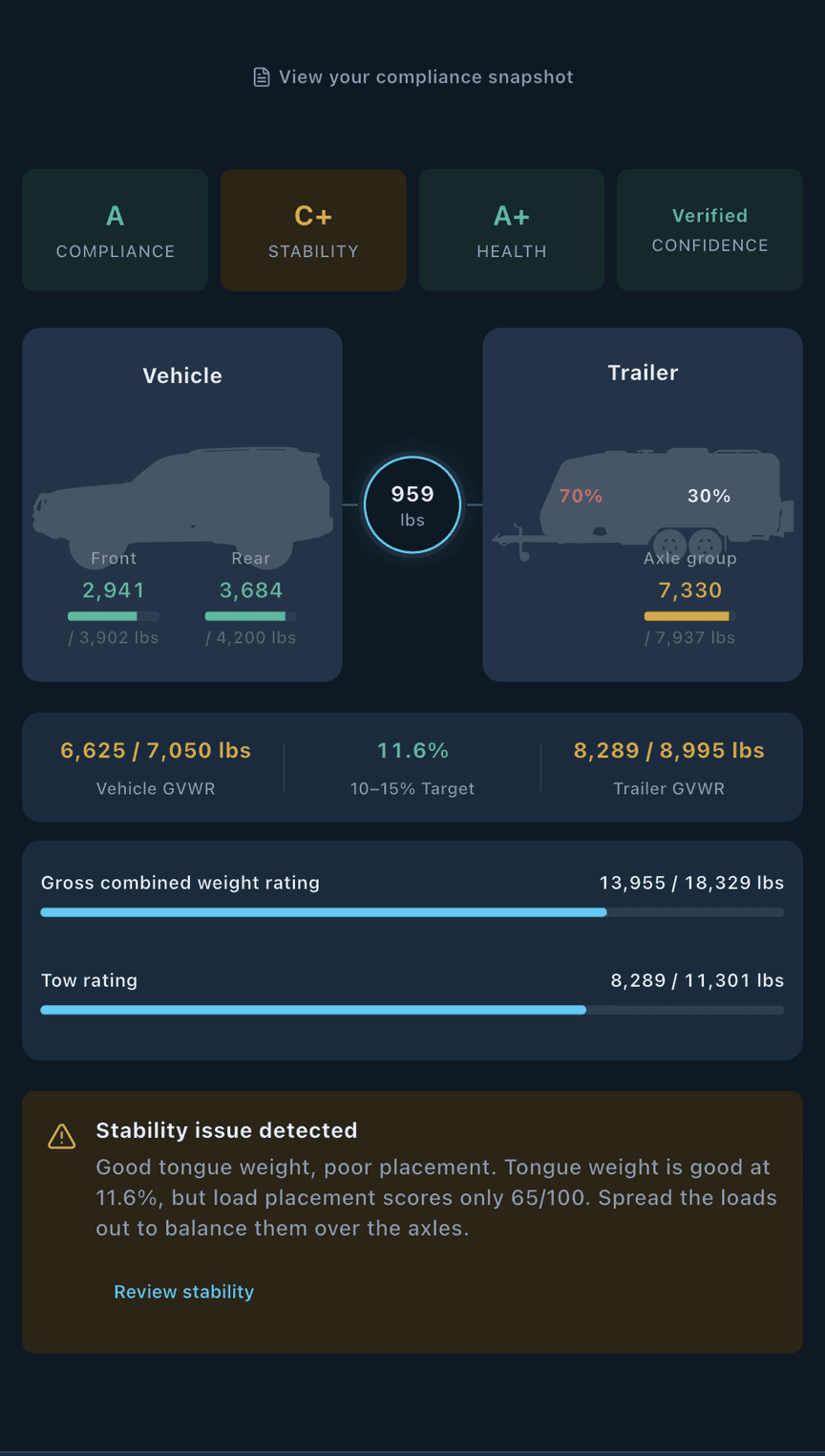
Your Ranger's tow package stays the same. Its load changes.
A bed cover, tools and extra passengers all change the margin your Ranger has left. Record those changes in loadmate to see your estimated GVWR, GCWR and rear-axle margins together before the next trip.


What is inside the Trailer Tow Package (53R)?
53R contains a Class IV hitch receiver and a 4-/7-pin connector, and that is the whole list. Everything else people associate with a factory tow setup is either standard on every Ranger or lives in a higher option code.
| Equipment | 53R | 67P | 67G | Raptor |
|---|---|---|---|---|
| Class IV hitch receiver | Yes | Yes | Yes | Standard |
| 4-/7-pin connector | Yes | Yes | Yes | Standard |
| Integrated trailer brake controller | n/a | Yes | Yes | Standard |
| Pro Trailer Backup Assist | n/a | Yes | Yes | Standard |
| Reverse parking sensors with trailer guidance | n/a | n/a | Yes | Standard |
| 360-degree camera | n/a | n/a | Yes | Standard |
| Tow/haul mode, trailer sway control | Standard | Standard | Standard | Standard |
| Lane keeping alert, front tow hooks (4x4) | Standard | Standard | Standard | Standard |
The codes have churned across the generation, which matters if you are shopping used. 53R has always been the base package required above 3,500 lb and 67P has always been the code that adds the brake controller and Pro Trailer Backup Assist, but the top package moved from 67S, 67E and 67X in 2024 to 67G and 67W in 2025 and to 67G alone in 2026. A 2024 window sticker lists different codes for the same content.
What three ceilings does 53R move?
It raises the maximum loaded trailer from 3,500 to 7,500 lb, raises the maximum trailer frontal area from 30 to 55 sq ft, and it is the equipment Ford names when it talks about warranty coverage for towing above 3,500 lb. Only the first of those three shows up in the brochure.
The weight ceiling is the one everybody quotes. Ford's required-equipment block is short: for trailers over 3,500 pounds, the Trailer Tow Package (53R), and the warranty note attached to it. The rear step bumper carries its own separate cap of 3,500 lb with a 350 lb maximum tongue load, which is the ceiling a Ranger without a receiver is living under.
The frontal-area ceiling is the one that surprises people, and it is a hard number in the same document: 30 sq ft without the Trailer Tow Package and 55 sq ft with it, with Ford noting that exceeding it may significantly reduce the vehicle's towing performance. A tall, square travel trailer can reach that ceiling on shape while it is still well inside every weight limit. Ford does not define in the towing guide how the frontal area should be measured, so get the figure from your trailer's manufacturer instead of working it out with a tape measure. One owner planning 1,200 miles behind a 20-foot Forest River No Boundaries, with a 2024 XLT and the 2.7-liter, did the sum himself in April 2026 and posted that the "frontal area computes to be 60 sf," which tells you the question is live at ordinary trailer sizes, and that it is worth asking the people who built the trailer.
The third ceiling is contractual. A receiver bought from a parts catalog can carry the weight perfectly well; what it cannot do is change the equipment Ford names in its own guide when it talks about warranty coverage above 3,500 lb. That part of the package does not come out of a toolbox.
Why the trailer brake controller sits one code higher
The factory integrated trailer brake controller is in package 67P, not in 53R, so a Ranger ordered with the base tow package has the 7-pin socket but no controller behind the dash. Owners found the split the year the truck launched, and found the second half of it two years later.
The mechanism is clean once you see the parts list. 53R adds the hardware that carries and connects the load: a receiver rated for 7,500 lb and 750 lb of tongue, and a 7-pin socket that includes a brake feed. That is why Ford will raise the weight and frontal-area ceilings behind it. The cab-side module and dash harness that modulate a trailer's electric brakes are a different part of the truck, and they arrive with 67P.
On a Ranger6G thread in August 2024, one owner summed up how it lands: "I can't think of anything else that you order from the factory that's incomplete." The thread's answer was an aftermarket controller (the Bronco-compatible Redarc and Tekonsha units plug into the factory connector), and that is still the standard fix.
The follow-up came in May 2026, when an owner with a 2025 XL on the standard tow package priced out the factory controller and its dash bezel and was told the retrofit was closed: "the wiring is not there for the factory tbc only for aftermarket hook up." The factory controller needs a different dash harness and module integration, so on a 53R truck it is not a part-number purchase. If you want the factory unit, tick 67P at order time.
Trailer brakes themselves are a state rule for non-commercial towing. Each state DOT sets the trailer weight at which brakes become mandatory, and FMCSA rules take over once the towing is commercial. The state thresholds are low enough that Ranger owners meet them at ordinary travel-trailer weights, so check yours before you decide the trailer's brakes are optional.
One live item belongs next to this. NHTSA campaign 26V104000 (Ford recall 26C10), filed February 20, 2026, covers certain 2024 through 2026 Rangers along with several other Ford models: when towing a trailer, the integrated trailer module may lose communication with the vehicle, possibly causing a loss of brake and turn signal lights, or a loss of brake function. NHTSA records it as noncompliant with FMVSS 108. The remedy is a software update to the module, at a dealer or over the air, and owner letters went out on March 25, 2026. Running your VIN through NHTSA's recall lookup takes a minute and settles whether yours is on the list.
How to tell what your own Ranger left the factory with
Three checks answer it: look under the rear bumper for a receiver, look at the lower dash for a brake-controller gain knob, and read the Safety Compliance Certification Label on the driver's door pillar. Ford points you at that label itself for the axle code.
The label sits on the left front door lock facing or the door latch post pillar, and below the bar code you will find the word AXLE and a two-digit code. On a Ranger it is a short list: 71 or 73 for the 3.73 axle (71 without the electronic locking differential, 73 with it) and 4L for the Raptor's 4.27. Every non-Raptor Ranger leaves Wayne with 3.73 gears, so that code confirms what you already have. The box that set your rating was ticked on the order sheet.
The same label carries your GVWR and your front and rear GAWR. Those numbers describe the truck you actually own, option by option, which no published maximum does.
One caveat applies to the printed label itself, and it is recent. NHTSA campaign 26V335000 (Ford recall 26C24), filed May 26, 2026, covers certain 2026 Rangers and Broncos whose tire placard and safety certification labels may carry incorrect specifications, including the VIN, capacity weight, seating capacity, front and rear GAWR, tire and rim dimensions and recommended cold tire pressure. NHTSA records it as noncompliant with FMVSS 110 and 49 CFR Part 567, and the remedy is a dealer inspection and label replacement, with owner letters mailed June 3, 2026. If your Ranger is a 2026, check the VIN against that campaign before you build a trip around the numbers in the door frame.
Which limit runs out first once 53R is fitted?
Two limits, at two different points: the 750 lb tongue rating decides which trailer you can actually load, and GCWR is what runs out at the very top of the tow rating. Payload, which is the binding limit on plenty of midsize trucks, is not the tight one here.
Start with the tongue rating. Ford's maximum tongue load at the hitch receiver is 750 lb, which is exactly 10% of the 7,500 lb tow rating, and Ford holds the same tenth across its other two Ranger pairs, 550 lb against the Raptor's 5,510 lb and 350 lb against the bumper's 3,500 lb. So the ceiling is a flat tenth of whatever you are allowed to pull, and trailers do not pack at a tenth. Load one the way trailers actually load, at something nearer 12.5%, and the 750 lb ceiling stops you at roughly a 6,000 lb Trailer GVWR (about 1,500 lb below the headline number). The 7,500 lb figure is real, and reaching it takes a trailer riding at the bottom edge of the usual 10–15% band.
Now run the top of the rating through the rest of the numbers. Take a SuperCrew 4x4 with the 2.3-liter: Ford's 2026 specification sheet puts it at 6,270 lb GVWR and 4,462 lb of base curb weight, and both the sheet and the 2026 towing guide give it 12,590 lb of GCWR.
| The check at a 7,500 lb trailer, before anyone gets in | The arithmetic | What is left |
|---|---|---|
| Towing capacity | 7,500 lb against a 7,500 lb rating | 0 lb |
| Tongue weight at 10% | 750 lb against a 750 lb rating | 0 lb |
| Tongue weight at 12.5% | 938 lb against a 750 lb rating | 188 lb over |
| GCWR | 4,462 lb base curb plus a 7,500 lb trailer = 11,962 lb, against 12,590 lb | 628 lb |
| Payload, Ford's best-case published maximum | 750 lb of tongue against 1,763 lb | 1,013 lb |
| Payload, a real 2025 XLT 4x4 door sticker | 750 lb of tongue against 1,422 lb | 672 lb |
Every row there is computed before anyone sits down, and Ford's rating already assumes a 150-lb driver and passenger. Charge that 300 lb to both and GCWR sits 328 lb away, while payload still shows 713 lb on Ford's best case and 372 lb on that real door sticker. GCWR is what gives out first on a Ranger, which is a different answer from the payload-first story most midsize trucks tell.
Payload is worth reading carefully all the same, because Ford's published maximum belongs to a build nobody orders, and for 2026 it moved. The figure for the 2.3-liter SuperCrew 4x4 is 1,763 lb on the 2026 sheet, 79 lb up on the 1,684 lb the 2025 sheet carried, because Ford raised that configuration's GVWR from 6,170 lb to 6,270 lb. The combined rating stayed at 12,590 lb through both years. Subtract the 4,462 lb base curb weight from the 6,270 lb GVWR and you get 1,808 lb, so Ford's own two published figures sit 45 lb apart before a single option is fitted.
Real door labels land lower again. Ranger owners posting their stickers through 2025 read 1,444 lb on a 2.7-liter XLT with the Chrome and 301A packages, the Advanced Tow package and a locker; 1,495 lb on a 2024 XLT 2.7 Sport; 1,422 lb on a 2025 XLT 4x4 with the Advanced Tow package; and just under 1,400 lb on a heavily optioned 2024 Lariat. Those are 2024 and 2025 trucks, and each sits a couple of hundred pounds under the published maximum for its model year, because every option fitted at the factory weighs something and comes out of the same allowance. That is why the published payload figure and the one in your door frame rarely agree.
The margin no option code moves
53R raises what Ford permits behind the truck. The 12,590 lb GCWR is the number it leaves alone: the same figure with the package and without it, the same figure in 2025 and 2026 even in the year Ford raised the 4x4's GVWR by 100 lb. Once the package question is settled, that untouched ceiling is what decides a specific trip, and at the top of the rating it is 628 lb wide before anyone sits down, 328 lb with Ford's own two 150-lb occupants aboard.
For the Salem pairing, the 2026 SuperCrew 4x4 2.3-liter has a 6,270 lb GVWR, 4,462 lb base curb weight, 12,590 lb GCWR, 7,500 lb tow rating and 750 lb tongue ceiling. The Salem FSX has a 5,645 lb Trailer GVWR and weighs 4,194 lb unloaded. At an illustrative 12.5% tongue share, the hitch is at about 94% of its 750 lb limit even though the trailer is well below the tow rating. Measure the real tongue load, then account for the people and gear in the truck. Explore loadmate in the app to see where your combination's carrying room goes.
If your Ranger has no factory receiver, the rear step bumper is what is left, and Ford rates that at 3,500 lb with a 350 lb tongue load. The same trailer misses both limits: its 4,194 lb unloaded weight already exceeds 3,500 lb before packing, and the illustrative loaded tongue weight is more than double the bumper's allowance.
The five vehicle figures behind those comparisons describe a Ranger that left Michigan with nothing in the bed; what yours weighs today is what a CAT scale ticket reports. A bed cover, toolbox and camping gear each use some of the combined headroom: about 2,480 lb behind the Salem example, and 328 lb at the full 7,500 lb once Ford's assumed occupants are aboard. The same additions count against GVWR too. loadmate keeps the recorded build and trip loads connected to those limits, so the weight picture can move with the truck. Explore loadmate in the app.
loadmate provides decision support for towing safety, not legal weight certification. Score, compliance checks, and trip readiness are based on the data you enter and the regulator information current at the time of release. For legal weight evidence, use a certified truck scale / CAT scale. Towing remains the operator's responsibility. See /safety-disclaimer.
How much can a Ranger Raptor tow?
5,510 lb, with a 550 lb maximum tongue load and 11,465 lb of GCWR, and the tow equipment is standard, so there is no option code to look for. Both figures are round metric numbers wearing pounds: 5,510 lb (2,500 kg) and 550 lb (250 kg).
The Raptor's ratings follow its mass. Its Fox-damped desert hardware puts curb weight at 5,363 lb for 2026, 901 lb above a 2.3-liter SuperCrew 4x4, and GVWR rises to 6,790 lb to cover it. Hitch the full 5,510 lb trailer and the combination leaves 592 lb under GCWR, with the 550 lb tongue ceiling sitting inside that. Maximum payload is 1,373 lb, and subtracting that curb weight from that GVWR gives 1,427 lb, so Ford's two published figures sit 54 lb apart here: the same kind of gap as the 45 lb on the 2.3-liter 4x4, and the published payload is the one to plan on.
Pair a Raptor with the Salem FSX above and the check comes back fail (no) on two counts: the 5,645 lb Trailer GVWR is past the 5,510 lb rating, and the same estimated 706 lb loaded tongue weight is well past 550 lb. That is what 901 lb of desert hardware on the vehicle side of the hitch costs. It is spent before you hook anything up, and the ratings are written around what it leaves.
What Ranger owners run into on the road
The complaints cluster around stability and wheelbase rather than power, which matches where the numbers say the truck is working hardest. The forums are full of people towing regularly and reporting back on how it goes.
Cars.com ran a dated tow test in December 2024, pulling about 4,400 lb of U-Haul auto transport with surge brakes over a 140-mile highway route behind a 2024 Ranger 2.3-liter. Their finding was about behavior, not capability: "The trailer had a tendency to wag the dog" on rougher surfaces, with the short wheelbase magnifying what the trailer did and producing a choppy ride on concrete. Full-size trucks handled the same load more calmly. The 270 hp 2.3-liter, notably, did not feel especially burdened. The engine was never the constraint. Their conclusion was that the Ranger suits occasional towing better than a hauling routine.
Owner reports run the same direction, and wind comes up more often than power does. The owner heading out on that 1,200-mile No Boundaries trip in April 2026 fitted a Redarc controller and was pushed by a longer-serving member to get the rig on a CAT scale loaded as he intended to travel: steer axle, drive axle and trailer, hitched and unhitched. That is the right instinct, because a scale answers the question a spec sheet cannot. If you have not done it, our guide to weighing a travel trailer at a CAT scale covers the sequence and the numbers to write down.
On the comfortable side of the range, owners describe 3,500 lb campers at around 450 lb of loaded tongue weight and 18-foot trailers running near 600 lb, which is inside the ceiling and inside the payload of a lightly optioned truck. The pattern across the threads is consistent: a Ranger tows a midsize trailer well and asks you to be deliberate about the weight sitting on the ball.
Related guides
The concept guides behind every number above, plus the hub and the chart.
- What can I tow?: the four numbers that decide any truck or SUV, and what each capacity tier covers
- How much can a Ford F-150 tow?: the half-ton Ford, where six variables rather than one option code set the ceiling
- How much can a Nissan Frontier tow?: the midsize truck with no package to tick, where cab and bed do all the work
- How much can a Ford Maverick tow?: the compact Ford below this one, where the package doubles the rating and the bed pays for it
- Towing capacity chart: compare the Ranger against other trucks and SUVs by curb weight, payload and max tow
- Towing weight ratings explained: what the 12,590 lb GCWR is counting, and why it is the figure 53R leaves alone
- Payload vs towing capacity: why Ford's 1,763 lb maximum and the 1,422 lb on a real door sticker are both true
- Tongue weight vs payload: where the 750 lb ceiling sits inside the allowance the rest of your load is drawn from
- Weigh a travel trailer at a CAT scale: the sequence, the weights to take, and what to do with them
Frequently asked questions
- Can a Ford Ranger really tow 7,500 pounds?
Yes, with the Trailer Tow Package (option code 53R) on a non-Raptor SuperCrew with either the 2.3-liter or the 2.7-liter EcoBoost and the 3.73 axle, rated under SAE J2807. The catch is what fills that number: Ford's maximum tongue load is 750 lb, exactly 10% of 7,500 lb, so a 7,500 lb trailer only works if it is loaded to the very bottom of the ordinary tongue-weight band. Ford's rating also assumes a 150-lb driver and passenger.
- How much can I tow with a Ford Ranger without the tow package?
3,500 lb. The 2026 Ford Ranger Towing Guide lists the Trailer Tow Package (53R) as required equipment for trailers over 3,500 pounds and states that the New Vehicle Limited Warranty may be voided if you tow without it. Towing from the rear step bumper carries the same 3,500 lb cap with a 350 lb maximum tongue load, and the trailer frontal-area ceiling is 30 sq ft rather than the 55 sq ft the package allows.
- Does the Ford Ranger tow package come with a trailer brake controller?
Not the base package. 53R contains a Class IV hitch receiver and a 4-/7-pin connector. The integrated trailer brake controller sits in package 67P alongside Pro Trailer Backup Assist, and owners who tried to add the factory controller to a 53R truck report the dash wiring for it was never run, so the practical fix is an aftermarket controller wired into the factory connector. Tow/haul mode and trailer sway control are standard on every Ranger.
- What is the tongue weight limit on a Ford Ranger?
750 lb at the hitch receiver on a non-Raptor Ranger, 550 lb on the Raptor, and 350 lb when towing from the rear step bumper. Because 750 lb is exactly 10% of the 7,500 lb tow rating, a trailer loaded to a more typical 12.5% tongue weight meets the tongue ceiling at roughly a 6,000 lb Trailer GVWR, about 1,500 lb below the headline figure. Those pounds stay on the truck with a weight-distribution hitch fitted.
- How big of a camper can I pull with a Ford Ranger?
Work from the camper's Trailer GVWR and its loaded tongue weight, not its length or its dry weight. The worked Salem FSX 178BHSK example uses 5,645 lb of Trailer GVWR and an estimated 706 lb tongue load at 12.5%, leaving about 44 lb below the non-Raptor receiver limit. Confirm the actual loaded tongue weight, the truck’s payload and GCWR before treating that as a match. Campers in the low 30-foot range routinely put more than 750 lb on the ball once loaded, which ends the pairing well before the 7,500 lb rating does. Check the camper's frontal area with its manufacturer against Ford's 55 sq ft ceiling as well.
- How much can a V6 Ford Ranger pull?
The same 7,500 lb as the 2.3-liter, with the Trailer Tow Package. The 2.7-liter EcoBoost V6 makes 315 hp and 400 lb-ft against the 2.3-liter's 270 hp and 310 lb-ft, and it raises GCWR on a SuperCrew 4x4 from 12,590 lb to 12,745 lb: 155 lb of extra combined headroom and no extra trailer rating. What the V6 buys is how the truck feels doing the work, not how much it is allowed to pull.
- What is the GVWR of a Ford Ranger?
On Ford's 2026 technical specification sheet: 6,050 lb for a 2.3-liter SuperCrew 4x2, 6,270 lb for a 2.3-liter SuperCrew 4x4, 6,170 lb for a 2.7-liter V6 4x4 and 6,790 lb for the Raptor. Check the model year before you reuse a figure you read somewhere, because the 2.3-liter 4x4 was 6,170 lb on the 2025 sheet and gained 100 lb for 2026. Your own truck's GVWR is printed on the Safety Compliance Certification Label on the driver's door pillar, and that is the one that counts.
- How much can a Ranger Raptor tow?
5,510 lb, with a 550 lb maximum tongue load and 11,465 lb of GCWR. Tow equipment is standard on the Raptor, so there is no package to add. Both figures are round metric numbers wearing pounds: 5,510 lb (2,500 kg) and 550 lb (250 kg). The Raptor's desert hardware puts 2026 curb weight at 5,363 lb, 901 lb above a 2.3-liter SuperCrew 4x4, and at the full 5,510 lb trailer the combination leaves 592 lb under GCWR.
- Can a Ford Ranger pull a horse trailer?
That depends on the trailer's own numbers rather than the category. Read the Trailer GVWR and the loaded tongue weight from the trailer's certification label and check both against 7,500 lb and 750 lb, and confirm its frontal area with the manufacturer against Ford's 55 sq ft ceiling, because a tall trailer can meet that limit before it meets a weight one. Live load shifts as you drive, so weigh the loaded tongue rather than estimating it.