Frontier towing at a glance
- Top and bottom of the 2026 grid
- 7,150 lb on a King Cab 4x2, down to 6,270 lb on a Crew Cab Long Bed 4x4 PRO-4X, every figure calculated with the SAE J2807 test method
- What actually varies
- Cab, bed length, 4x2 or 4x4, and trim. No other choice on the truck moves a tow figure
- What does not vary
- One 3.8-liter V6 and one 9-speed automatic across the range, a 6,012 lb GVWR on every configuration, and an 11,960 lb GCWR on every configuration
- Ceiling at the hitch ball
- 715 lb on a King Cab 2WD down to 627 lb on a Crew Cab Long Bed 4x4 PRO-4X, printed per configuration in the owner's manual, per trim in the press kit, and in the brochure nowhere at all
- What the 2025 model year added
- Around 500 pounds of trailer on all grades, from a combined rating 533 lb higher. GVWR did not move and the payload figures barely did
- Where the hitch comes from
- A Class IV receiver and its wiring harness are content of the SV Convenience Package (7-pin) or the PRO Convenience Package (4-pin/7-pin), both listed for Crew Cab and Crew Cab Long Bed
- Conditions attached to the rating
- Trailer brakes at 3,500 lb and above, a frame-reinforced hitch above 2,000 lb, a weight-distributing hitch over 5,000 lb, and no towing at all on the temporary spare
- The placard that governs the load
- The Tire and Loading Information label's vehicle load limit, which Nissan says the trailer's tongue weight comes out of
The same 22-foot Rockwood Mini Lite behind the same Crew Cab Frontier gets two answers out of Nissan's own figures, and they point opposite ways. The trailer's 5,837 lb rating sits 1,043 lb inside what Nissan says that Frontier may pull. The weight the same trailer puts on the hitch ball, loaded the way it balances, sits 42 lb outside what Nissan says the same truck may carry there.
Both numbers are Nissan's, and the distance between them has a date on it. For the 2025 model year Nissan raised every Frontier's towing capacity by around 500 pounds, with the 3.8-liter V6 and the 9-speed automatic carried over unchanged. What moved on the specification sheets was the gross combined weight rating, up 533 lb to 11,960 lb. The gross vehicle weight rating stayed at 6,012 lb and the published payload figures barely shifted. All of that extra permission arrived on the pulling side of the hitch, and a trailer's tongue is carried rather than pulled.
That leaves the 2026 answer as a range, and behind it two numbers that end the conversation before the range ever does.
How much can a Nissan Frontier tow?
A 2026 Nissan Frontier is rated between 6,270 lb and 7,150 lb. The cab, the bed length, the drivetrain and the trim pick your cell in Nissan's grid; no engine choice exists to move it. Nissan publishes eleven combinations and they run in a single 880 lb band. Each cell below reads maximum towing capacity first, then Nissan's published maximum payload for the same truck, because the two columns do not fall at the same rate.
| 2026 configuration | S | SV | PRO-X | PRO-4X |
|---|---|---|---|---|
| King Cab 4x2 | 7,150 lb / 1,590 lb | n/a | n/a | n/a |
| King Cab 4x4 | 7,000 lb / 1,430 lb | n/a | n/a | n/a |
| Crew Cab 4x2 | 7,070 lb / 1,490 lb | 7,000 lb / 1,480 lb | 6,900 lb / 1,430 lb | n/a |
| Crew Cab 4x4 | 6,960 lb / 1,330 lb | 6,880 lb / 1,310 lb | n/a | 6,680 lb / 1,220 lb |
| Crew Cab Long Bed 4x2 | n/a | 6,920 lb / 1,400 lb | n/a | n/a |
| Crew Cab Long Bed 4x4 | n/a | 6,760 lb / 1,200 lb | n/a | 6,270 lb / 1,100 lb |
Those are the figures from Nissan's own 2026 brochure grid, and Nissan calculates the towing side of them with the SAE J2807 test method, which standardizes how a rating is measured so figures compare between brands. J2807 says nothing about any particular trailer, and it does not promise the truck can carry the tongue weight of a trailer at its rating, which is the whole subject of the arithmetic further down.
The 7,150 lb at the top belongs to a King Cab 4x2, and from the 2026 model year Nissan builds the King Cab in S grade only. The best-towing Frontier in the lineup is the base-grade, two-wheel-drive one. That top figure is worth reading against the field rather than on its own. The towing capacity chart puts the Frontier's row beside the other midsize trucks with curb weight and payload next to every rating, which is where 7,150 lb starts to mean something.
Two conditions travel with every figure in that grid. Nissan requires trailer brakes at 3,500 lb and above, in capitals in the owner's manual, and requires a frame-reinforced hitch for anything over 2,000 lb.
How much can I tow with a Nissan Frontier?
The same 6,270 to 7,150 lb, and your figure is whichever row of the grid above matches your truck, because on a Frontier there is nothing under the hood to option up. Every 2026 Frontier is the same 3.8-liter V6 making 310 hp and 281 lb-ft, through the same 9-speed automatic. Nissan publishes one powertrain for the whole lineup, with no axle-ratio choice behind it.
That is unusual for a midsize truck, and it changes what the question means. On a Frontier the four axes that move your number are all about the shape of the truck:
- Drivetrain. A Crew Cab SV drops from 7,000 lb in 4x2 to 6,880 lb in 4x4, and its published payload from 1,480 lb to 1,310 lb.
- Bed length. The same SV 4x4 goes from 6,880 lb on the short bed to 6,760 lb on the long bed, adding 13.8 inches of wheelbase and losing 110 lb of published payload with it.
- Trim. Within one cab and one drivetrain, a Crew Cab 4x4 runs 6,960 lb as an S, 6,880 lb as an SV and 6,680 lb as a PRO-4X. The PRO-4X's Bilstein dampers, skid plates, over-fenders and all-terrain tires put 137 lb of curb weight on the same truck.
- Cab. The full spread, King Cab 4x2 to Crew Cab Long Bed 4x4 PRO-4X, is 880 lb of trailer and 490 lb of payload.
The reason the payload column falls so much faster than the towing column is that Nissan gives every 2026 Frontier the same 6,012 lb GVWR. One value, both spec sheets in the press kit, every cab and every trim. So every pound of payload difference across the lineup is curb weight and nothing else: the Crew Cab long bed PRO-4X weighs 480 lb more than the King Cab S 4x2, and Nissan publishes it 490 lb lower on payload.
The fifth axis is whether the truck has a hitch at all, and it is a yes or no rather than a number. The Class IV tow hitch receiver and its wiring are content of the SV Convenience Package, which pairs it with a 7-pin harness, and the PRO Convenience Package, which pairs it with a 4-pin/7-pin harness. The brochure lists both as available on Crew Cab and Crew Cab Long Bed, alongside heated seats and, on the SV package, dual-zone climate and a locking glove box. The packages the brochure offers on the S trims do not include a receiver: the S Utility Package is a spray-in bedliner and two 120-volt outlets. Nissan also sells the receiver and the harness as dealer-fitted accessories, and its owner's manual, which calls that equipment the trailer tow package, says the receiver is rated for the truck's full towing capacity when the proper towing equipment is used.
All of that is what makes towing physically possible, and none of it moves a rating, which is why the answer is on the window sticker rather than the trim badge. One owner posted in April 2024 that his new 2023 SV 4x4 had arrived with neither a hitch nor a trailer-light connector; another wrote in April 2026 that he negotiated the towing package into the deal on a 2025 SV Long Bed specifically so the tow button would be there. Trailer Sway Control is standard on every 2026 Frontier. No Frontier trim carries an integrated trailer brake controller, though on tow-package trucks a 7-pin connector is pre-wired for one.
What Nissan changed for 2025, and what it left alone
Every grade gained around 500 pounds of towing capacity for the 2025 model year, and none of it came with anything extra to carry it. Nissan's own announcement, dated August 5, 2024, puts it plainly: towing capacities increase by around 500 pounds on all grades and configurations compared to the 2024 Frontier.
| Figure | 2024 Frontier | 2026 Frontier | Change |
|---|---|---|---|
| Gross combined weight rating | 11,427 lb | 11,960 lb | up 533 lb |
| Gross vehicle weight rating | 6,012 lb | 6,012 lb | unchanged |
| King Cab S 4x2 maximum towing | 6,640 lb | 7,150 lb | up 510 lb |
| Crew Cab short bed S 4x2 towing | 6,510 lb | 7,070 lb | up 560 lb |
| Crew Cab short bed S 4x2 payload | 1,460 lb | 1,490 lb | up 30 lb |
| Crew Cab short bed PRO-4X payload | 1,220 lb | 1,220 lb | unchanged |
| Curb weight, King Cab S 4x2 | 4,367 lb | 4,385 lb | up 18 lb |
The pattern in that table is one rating moving while the truck's own ratings stay put. The combined rating moved 533 lb for the 2025 model year and the King Cab's trailer column moved 510 lb with it in the same year. The Crew Cab's went most of the way in 2025 too and picked up its last 30 lb for 2026, which is also the year its published payload finally moved. The rating that governs what the truck itself may weigh has not changed at all. For a conventional trailer owner, whose tongue weight is spent out of payload, the re-rate reprinted the combined number and left the rest of the sheet where 2024 had it.
Nissan has published no engineering explanation for the increase, and neither has anyone else. A thread on the Frontier owners' forum asking what changed ran to 79 replies across nine months from September 2024 and never produced a documented answer; one member phoned Nissan Consumer Affairs and was referred back to a dealer whose service department had none either. What the owners in that thread did settle, repeatedly, is which limit they actually meet. One of them, in October 2024: "You'll run out of payload well before the trailer bumps the tow limit."
The used-buyer consequence is blunt. An otherwise identical 2024 Frontier is not a 7,150 lb truck, and any Frontier towing figure written before the 2025 model year is roughly 500 lb low for the truck this page is about.
Walking one real travel trailer through a Crew Cab SV 4x4
A Rockwood Mini Lite 2109S at its 5,837 lb Trailer GVWR sits 1,043 lb inside a Crew Cab SV 4x4's 6,880 lb towing capacity and 42 lb outside the same truck's 688 lb maximum tongue load. At 22 ft 4 in it is an ordinary unit, the kind sitting on dealer lots now. The Ford Ranger answers a camper of the same class the other way round at a similar loaded tongue share: its ceiling clears with room in hand, and the Frontier's does not.
| Forest River's published figures, 2027 Rockwood Mini Lite 2109S | Value |
|---|---|
| Hitch weight, dry | 557 lb |
| Unloaded vehicle weight | 4,472 lb |
| Cargo carrying capacity | 1,365 lb |
| Trailer GVWR, the maximum permissible loaded weight | 5,837 lb |
| Exterior length | 22 ft 4 in |
| Fresh water tank | 53 gal |
Two of Forest River's own definitions matter before the arithmetic starts. Its unloaded weight excludes cargo, fresh potable water and dealer-installed accessories, and its cargo carrying capacity is the difference between that and the Trailer GVWR. At the 8.3 lb per gallon Forest River itself quotes, filling the 53-gallon fresh tank spends about 440 lb of the 1,365 lb allowance before a single item is packed.
The truck: a 2026 Crew Cab short wheelbase SV 4x4, curb weight 4,657 lb, GVWR 6,012 lb, towing capacity 6,880 lb, GCWR 11,960 lb, and a maximum tongue load of 688 lb. That last figure is the SV column on Nissan's press-kit specification sheet, where the owner's manual chart groups every Crew Cab short wheelbase 4WD together at 696 lb.
The towing capacity clears it comfortably. 5,837 lb of Trailer GVWR against a 6,880 lb rating leaves 1,043 lb unused, which is the number most people look up and the reason this pairing gets bought.
The combined rating clears it too. The truck at curb weight plus the trailer at its full rating is 10,494 lb against an 11,960 lb GCWR, so there is about 1,466 lb of combined headroom before anyone climbs in. Nissan's own footnote to those ratings says they assume a base vehicle with a driver, and that passengers, cargo and options reduce both the towing capacity and the tongue load available.
The hitch ball does not clear it. The 557 lb dry hitch weight is 12.5% of the trailer's 4,472 lb unloaded weight, in the middle of the 10 to 15% band Nissan asks a conventional trailer to load to, and where this trailer balances. Hold that same share as it loads toward its rating and 730 lb arrives on the ball, against a ceiling of 688 lb.
| Loaded trailer weight | Tongue weight at 12.5% | Crew Cab SV 4x4 ceiling | Result |
|---|---|---|---|
| 4,472 lb, unloaded | 557 lb, as published | 688 lb | inside, by 131 lb |
| 5,000 lb | 625 lb | 688 lb | inside, by 63 lb |
| 5,504 lb | 688 lb | 688 lb | exactly at the ceiling |
| 5,837 lb, Trailer GVWR | 730 lb | 688 lb | over, by 42 lb |
And payload is the second jaw of the same problem. Nissan's published maximum for that truck is 1,310 lb, so a 730 lb tongue weight leaves 580 lb for the people in the cab, whatever is in the bed and the hitch hardware itself. That is the mechanism the payload and towing capacity guide works through in full, and on a Frontier it arrives early.
Because the loaded trailer is over 5,000 lb, a weight-distributing hitch is in the picture: Nissan's owner's-manual footnote recommends one above that weight and the towing guide's own specification-table footnote words the same threshold as required. It changes where the load sits, and the pounds stay on the truck either way, so the maximum tongue load still applies exactly as printed. The weight-distribution hitch guide covers what it moves and what it does not.
Nissan prints the first half of the way out immediately above its Towing Load/Specification chart: the maximum tongue weight is not to be exceeded whatever the percentage arithmetic says. Run it backwards at 12.5% and a 688 lb ceiling means a loaded trailer of about 5,500 lb. A Crew Cab SV 4x4 can fit this camper within that example by leaving roughly 330 lb of its cargo allowance unused. At 5,504 lb loaded, the illustrative tongue weight is exactly 688 lb. Traveling with the fresh tank low accounts for most of the reduction, but the real tongue load needs measuring. Explore loadmate in the app to see how loading choices affect the room left on the hitch and in the truck.
So on a Frontier the order is the tongue ceiling, then payload, then the towing capacity and GCWR a long way back. A pairing that clears the tow rating by 1,043 lb is decided at the ball by 42.
Which numbers on your own Frontier settle it?
Two labels, and neither of them is in the brochure. The certification label in the driver's-side door area carries the GVWR and both axle ratings. The Tire and Loading Information label carries the vehicle load limit, and Nissan states that a trailer's tongue weight comes out of it as part of the cargo load.
Nissan's towing guide gives the procedure in one sentence: weigh the vehicle on a scale with the passengers and cargo that are normally aboard when you tow, subtract that from the GVWR, and what remains is the tongue load available to you. That figure belongs to your truck, on the day you weigh it.
The certification label is also the only place a 2026 Frontier's GVWR is written for one specific truck. The brochure, the towing guide and the owner's manual all leave both the GVWR and the curb weight off the page. The manual has the rows for them: its dimensions-and-weights block lists a gross vehicle weight rating and a gross axle weight rating, and both of them say the same thing, refer to the certification label. The 6,012 lb figure comes from the specification sheets in Nissan's 2026 press kit.
The published payload figures are conservative against the underlying subtraction: across the range they sit 20 to 60 lb below GVWR minus curb weight, and no Nissan document explains the difference. Real placards read lower again, because everything the factory bolted on comes out of the same allowance. Frontier owners posting their own stickers between July 2023 and October 2024 read 1,059 lb on a PRO-4X, 1,110 lb on another PRO-4X, and 1,160 lb on a third.
One thing those labels do not do is move with the trim. GVWR is 6,012 lb on every 2026 Frontier regardless of cab, bed, drivetrain, grade or which of the three factory tire sizes is fitted, so the whole 1,590 lb to 1,100 lb payload spread is curb weight. A PRO-4X carries less because it weighs more.
What every rating in that door frame is standing on
The tires. Nissan prints each axle rating on the certification label together with the tires and rims it assumes and the cold pressure they are assumed to be at: the field reads GAWR FR. WITH, then the tire, the rim and the pressure, and again for the rear.
Three factory sizes cover the whole 2026 range: 265/70R16 all-season on the S, 265/65R17 all-season on the SV, and 265/70R17 all-terrain on the PRO grades. All three run 35 psi front and rear. Towing does not change that, and Nissan says so directly: when towing a trailer, inflate to the recommended cold tire pressure on the Tire and Loading Information label. That runs against the common habit of airing up the rear tires before a trip.
The sidewall carries its own maximum load rating, and Nissan's replacement rule is to always use a tire with the same load rating as the factory-installed one. That rule earns its place on this truck because Frontier owners change tires early. A PRO-4X sizing thread running from May to December 2025 has owners on 32-inch and 33-inch tires, with the largest sizes conditional on keeping the factory 30 mm offset and 7.5-inch wheels, and on removing mudflaps or trimming.
Then there is the tire nobody plans around. Nissan classifies the Frontier's spare as FULL SIZE TEMPORARY USE ONLY, notes it may be a different size or brand than the road tires, and on an SV it is exactly that: a P265/70R16 on a 16-inch steel wheel against 265/65R17 road tires. The owner's manual prints the same instruction twice, once in the tire chapter and again at the top of the towing chapter: do not tow a trailer when the temporary full size spare tire is installed. The rest of that warning caps the truck at 50 mph, says the tire pressure monitoring system will not function, and says automatic emergency braking may not work correctly. A Frontier that picks up a flat on the way to the campground is a Frontier that stops towing until the road tire is back on.
Ratings get argued about at the top of the truck, and every one is written against what is underneath it. The Crew Cab SV 4x4 pairs a 6,012 lb GVWR, 4,657 lb curb weight, 11,960 lb GCWR, 6,880 lb tow rating and 688 lb tongue ceiling with the Mini Lite's 5,837 lb Trailer GVWR and 4,472 lb unloaded weight. Those are separate limits to check as the camper is packed. loadmate brings the recorded trailer load, truck load and their limits together so a comfortable tow-rating margin does not hide a tight hitch.
This pairing comes back fail (no), on the tongue weight at 106% of the ceiling, while the towing capacity is only 85% used. The check fills a blank loaded tongue weight at the US band midpoint, 12.5% of Trailer GVWR, which is where this trailer balances anyway. Change the two trailer weights to your own and the tongue line either keeps deciding it or hands the job to the payload figure sitting just behind it.
The top of the grid does not rescue it either. The King Cab S 4x2 has a 7,150 lb rating and a 715 lb tongue ceiling. With the same trailer at its full rating, about 1,310 lb of towing capacity is unused while an illustrative 12.5% tongue load sits about 15 lb beyond the ceiling. The 510 lb the 2025 re-rate added is spent behind the hitch rather than on it.
The tire half of that picture is the part no specification sheet holds. loadmate keeps the fitted tire size and its date next to what the rig actually weighs loaded, so a set of 33-inch tires or a spare that has quietly aged out is read against the load it is under rather than at the next inspection. The recorded tire details stay connected to the Frontier's weight picture when you change the tires or pack for a heavier trip.
loadmate provides decision support for towing safety, not legal weight certification. Score, compliance checks, and trip readiness are based on the data you enter and the regulator information current at the time of release. For legal weight evidence, use a certified truck scale / CAT scale. Towing remains the operator's responsibility. See /safety-disclaimer.
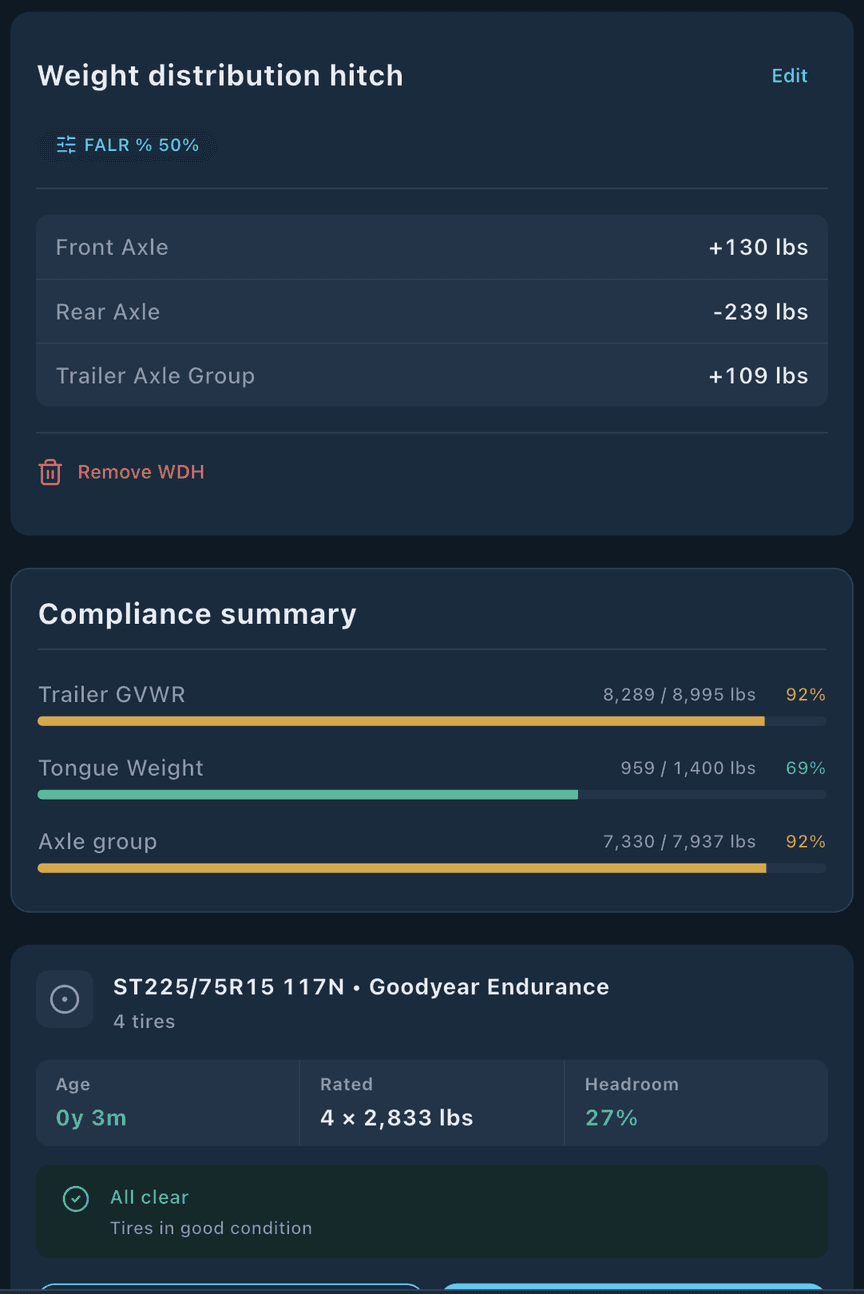
Check the one rating off the plate
loadmate cross-references your tires' load rating against what the rig actually weighs loaded, and watches tire age alongside it, because tires age out by date, not tread. Free to explore on a demo rig in the app.


Can a Nissan Frontier pull a camper?
Yes, and on a Crew Cab 4x4 the workable band is a loaded trailer of roughly 3,500 lb to 5,000 lb rather than the 6,680 lb to 6,960 lb printed against it. The tow rating is not what draws that line; the tongue ceiling and the placard are. The 688 lb tongue ceiling on its own allows about 5,500 lb, and the load limit on your own door label is what pulls the practical figure back to around 5,000 lb once people and gear are aboard.
The trailers Frontier owners actually name in dated threads cluster well below the rating. nuCamp T@B 320 and 320S Boondock trailers come up most often, including a 2022 PRO-4X that ran Tennessee to Bar Harbor and back over 15 days in August 2024. A 17-foot Casita at a bit under 3,500 lb comes up twice, once from an owner who calls it the limit of what he considers rational behind a Frontier. R-Pod 193 and 202 trailers at 3,800 lb dry, Escape 17B and 19 fiberglass trailers, and a shortlist of 3,300 to 3,500 lb dry bunkhouses fill in the rest.
The argued band starts around 21 feet. A 26-foot Grand Design Imagine at about 6,200 lb gross has been towed behind a PRO grade with a weight-distributing hitch at 13 mpg holding 55. A 30-foot Heartland at about 5,800 lb loaded gets towed all over Texas by an owner who will not take it into the Colorado mountains. A U-Haul auto transport with a car on it, about 5,000 lb all in, was written up in April 2026 by a 2025 SV Long Bed owner who rated the Frontier better than his previous half-ton on squat and braking.
Escape trailer owners answering a 2024 Frontier owner in September 2024 split on the same trailer. One listed the compromises as limited payload capacity, limited fuel range and slower going in mountainous areas, and drew the line at the model: "I might tow a E19 but not a E21." Another, who tows an E19 over the same passes, told him the Frontier would be fine.
The two sides are each right about a different limit, and the sharpest data point in any of those threads settles which one. In September 2024 a 2024 PRO-4X owner towed a nuCamp T@B 320S Boondock, one of the lightest trailers sold, from Pittsburgh to Indianapolis at 15 mpg with no trouble at all. Then he added his wife, the dog, the camp chairs, the truck topper, the cooler and the tongue weight against a cargo capacity of about 1,059 lb, and finished 100 lb over. The tow rating was never remotely in play, and the truck was still overloaded. Where the tongue weight lands inside that allowance is the subject of the tongue weight and payload guide.
What actually gives trouble when a Frontier tows
Braking on long descents and fuel range, not power. Both come up in the long-haul threads far more often than the engine does.
TFLtruck ran a 2025 PRO-4X with a 5,500 lb trailer up and down an 8-mile 7 percent grade in January 2025. The truck held the 60 mph speed limit without issue, the climb was slow, and the descent needed fewer brake applications than the 2024 truck they had tested the year before, which they put down to a more aggressive Tow mode. The same piece notes what the Frontier does not have next to a Ranger: an integrated trailer brake controller.
Owners find the same edge from the other direction. Brake fade on big hills comes up repeatedly in the travel-trailer thread from August 2024 onward, one owner locked the truck up on the drive home before fitting a controller, and a reply in November 2025 put it plainly: "Sure you can pull it, but you can't stop it." Every Frontier tow build in those threads adds an aftermarket brake controller into the factory 7-pin connector.
Transmission heat has better data behind it than the folklore suggests. An owner logging his own numbers between November 2025 and March 2026, towing 3,500 to 4,000 lb, watches torque-converter temperature rather than pan temperature: 180 to 220 °F on low grades and long inclines, easily 230 °F if he stops paying attention, one brief 249 °F spike on flat ground into a headwind, with the pan sitting at 154 to 190 °F throughout. He posted a fluid lab report at 231,000 miles showing the fluid had not degraded. His read on the number to watch: "the TC temps is def an early warning sign that you're pushing the truck too hard."
Fuel is the constraint people underestimate. Both cabs carry a 21.0-gallon tank, and owners report 10 to 12 mpg while towing, which puts roughly 200 miles between fills. Two more conditions belong on the same list: Nissan asks for no towing at all in a new truck's first 500 miles, then a 50 mph cap and no full-throttle starts for the first 500 miles you do tow, and recommends against using cruise control while towing.
Related guides
Where each of the numbers above is defined, plus the hub, the chart row and the two midsize trucks this page argues against.
- What can I tow?: the same four numbers with no badge attached, and what each capacity tier actually covers
- How much can a Honda Ridgeline tow?: the other midsize truck with a flat rating, where Honda's own example tows less than it advertises
- Towing capacity chart: the Frontier's row next to the other midsize trucks and half-tons
- Towing weight ratings explained: what an 11,960 lb GCWR is actually counting, and how it differs from the tow rating
- Payload vs towing capacity: why a 1,310 lb published figure and a 1,059 lb door sticker are both real
- Tongue weight vs payload: where a 730 lb tongue weight sits inside the allowance everything else is drawn from
- Weight distribution hitch and front axle load: what a weight-distributing hitch moves once you are over 5,000 lb
- Weigh a travel trailer at a CAT scale: how to replace the estimated 730 lb above with a measured one
- How much can a Ford Ranger tow?: the other midsize truck, where an option code rather than the body shape sets the ceiling
- How much can a Toyota Tacoma tow?: the third midsize truck, where the cab and the engine you happened to buy decide the rating
Frequently asked questions
- Can a Nissan Frontier pull a camper?
Yes, within a band narrower than the rating suggests. On a 2026 Crew Cab 4x4 the workable pairing is a loaded trailer of roughly 3,500 lb to 5,000 lb rather than the 6,680 lb to 6,960 lb printed against it, because the maximum tongue load and the payload on your door label run out before the towing capacity does. The 688 lb tongue ceiling on that truck allows about 5,500 lb on its own, and the load limit on your door label is what pulls the practical figure back to around 5,000 lb. Owners in dated threads pull nuCamp T@B trailers, 17-foot Casitas and R-Pods without argument, and the debate starts around 21-foot fiberglass trailers and above.
- What size camper can you pull with a Nissan Frontier?
Length is the wrong axis. Take the camper's Trailer GVWR and the tongue weight it carries loaded, and check the second one first. A Rockwood Mini Lite 2109S at 22 ft 4 in has a 5,837 lb Trailer GVWR and a 557 lb dry hitch weight, which is 12.5% of its unloaded weight. Hold that share at its full rating and 730 lb lands on the ball, against a 688 lb ceiling on a Crew Cab SV 4x4. Loaded to about 5,500 lb instead, the same trailer fits, with roughly 330 lb of its own 1,365 lb cargo allowance left unused.
- Is the Nissan Frontier a good truck for towing?
The powertrain is not what limits it. TFLtruck ran a 2025 PRO-4X with a 5,500 lb trailer up and down an 8-mile 7 percent grade in January 2025 and it held the 60 mph limit, though the climb was slow. What owners run into is braking on long descents, since no Frontier trim carries an integrated trailer brake controller, and a 21.0-gallon tank against an owner-reported 10 to 12 mpg while towing. The weight limit that binds first is the maximum tongue load.
- What is the towing capacity of the Nissan Frontier 3.8 L V6?
Every 2026 Frontier has the same 3.8-liter V6 at 310 hp and 281 lb-ft and the same 9-speed automatic, so the engine does not set the number. The range is 6,270 lb to 7,150 lb, decided by cab, bed length, drivetrain and trim: 7,150 lb for a King Cab 4x2 down to 6,270 lb for a Crew Cab Long Bed 4x4 PRO-4X. Nissan rates all of them with the SAE J2807 test method.
- Do I need to buy a Frontier with the tow package?
No package raises a Frontier's tow rating, because there is one engine, one transmission and no published axle-ratio option. What the packages carry is hardware: the Class IV tow hitch receiver is content of the SV Convenience Package, with a 7-pin wiring harness, or the PRO Convenience Package, with a 4-pin/7-pin harness, both listed for Crew Cab and Crew Cab Long Bed, and Nissan also sells the receiver and harness as dealer-fitted accessories. Read the window sticker rather than the trim badge. One owner took delivery of a new 2023 SV 4x4 with neither a hitch nor a trailer-light connector.
- How much does it cost to add a tow package to a Nissan Frontier?
What you are paying for is content, not capability. Factory content is a Class IV receiver rated for the truck's full towing capacity, a 7-pin harness on the SV Convenience Package or a 4-pin/7-pin harness on the PRO Convenience Package, and on the SV package a Tow-Haul Mode switch, and none of it changes a rating. The retrofit route is the same receiver and harness as dealer-fitted accessories, priced as parts plus fitting. Budget for one more part on either route: the 7-pin connector is pre-wired for a trailer brake controller, but no Frontier trim includes the controller itself, and Nissan requires trailer brakes at 3,500 lb and above.
- What changed in the 2025 Frontier to increase towing capacity by 510 lbs?
Nissan's announcement of August 5, 2024 says towing capacities increase by around 500 pounds on all grades and configurations against the 2024 Frontier. What the specification sheets show moving is the gross combined weight rating, from 11,427 lb to 11,960 lb, while the 6,012 lb GVWR stayed put and the payload figures barely moved. The 3.8-liter V6 and the 9-speed automatic carried over. Nissan has published no engineering explanation, and a 79-reply owner thread running nine months never found one.
- My towing capacity is 6,400 lb, so what is the best limit to avoid problems?
A 6,400 lb figure is a pre-2025 Frontier, and the method is the same on any of them: set your limit from the maximum tongue load rather than the tow rating. Divide the tongue ceiling for your configuration by the share your trailer carries on the ball, so at 12.5% the 688 lb the press kit prints against a Crew Cab SV 4x4 is a loaded trailer of about 5,500 lb, and the 696 lb the owner's manual gives every Crew Cab short wheelbase 4WD is about 5,570 lb. On a PRO-4X the ceiling is lower again, 668 lb on the short bed and 627 lb on the long bed. Then check that the tongue weight still fits inside the load limit on your Tire and Loading Information label once the people and the gear are aboard, because that is usually the tighter of the two. Explore loadmate in the app to see how your recorded truck and trailer loads fit those limits.