Towing weight ratings at a glance
- What GVWR is
- The manufacturer's maximum loaded weight for the single vehicle: the truck plus passengers, fuel, cargo and the trailer's tongue weight
- What GCWR is
- The manufacturer's maximum loaded weight for the combination: loaded truck plus loaded trailer together
- What GAWR is
- The load-carrying limit for one axle (there is a front GAWR and a rear GAWR), measured at the tire-ground interfaces
- Payload formula
- Payload = GVWR − curb weight (on the worked rig, 7,100 − 5,400 = 1,700 lb)
- Tongue weight band
- The widely-used 10–15% of the loaded trailer weight
- Where to find them
- GVWR and per-axle GAWR on the driver's-side door-jamb certification label; payload on the B-pillar Tire and Loading Information label
- The rating that usually binds first
- GCWR or payload, rarely the headline tow number
- If you exceed a rating
- You are over a manufacturer ceiling and a legal weight limit; handling, braking and component life all suffer
Most towing trouble starts with one rating treated as the answer. You read the tow number on the brochure, hitch up, and assume you are clear. Your truck and trailer carry five separate weight limits, though, and your rig has to stay under every one of them at the same time. This guide explains what each rating means in plain US terms, where to read it on your own vehicle, and how to tell which limit runs out first.
What does GVWR mean?
GVWR (Gross Vehicle Weight Rating) is the manufacturer's maximum loaded weight for the single vehicle itself, the truck plus everyone and everything in it, rather than how much the truck can tow. The federal definition is plain: GVWR is the value the manufacturer specifies as the loaded weight of a single vehicle. That word "loaded" is the whole point. It covers the curb weight of the empty truck, then the driver, the passengers, the fuel, the cargo in the bed, and the trailer's tongue weight pressing down on the hitch.
GVWR is the US term. Australia calls the same idea GVM. Across the rest of this guide the figure stays in pounds, and every number reconciles to one illustrative half-ton rig you can follow start to finish.
GVWR vs GCWR vs GAWR: how the three ratings fit together
These three ratings cover different things (one vehicle, the combination, and each axle), and you have to stay under all three at once. Each is set by the manufacturer, and clearing one tells you nothing about the other two.
| Rating | What it limits | What it covers |
|---|---|---|
| GVWR | The single vehicle | The loaded truck on its own: curb weight, passengers, fuel, cargo, and the tongue weight on the hitch |
| GCWR | The combination | The loaded truck plus the loaded trailer, weighed together as one rig |
| GAWR (front / rear) | One axle | The load one axle system can carry, measured at the tire-ground interfaces; the front and rear axles have separate ratings |
A quick note on GCWR's name. The dominant federal expansion is "Gross Combination Weight Rating." OEM towing charts often print "Gross Combined Weight Rating" instead: same rating, same number, just a different word.
One identity is worth holding onto: the front and rear GAWR usually add up to more than the GVWR. On the worked rig the front GAWR is 3,900 lb and the rear GAWR is 4,100 lb, which sum to 8,000 lb against a GVWR of 7,100 lb. The axles can each carry their share, but the whole-vehicle rating still caps the total below what the two axles could theoretically hold.
Is GVWR the same as towing capacity?
No. GVWR is the ceiling on the loaded weight of the truck by itself. Towing capacity (the trailer weight rating) is a separate number for what the truck can pull, set under the SAE J2807 test procedure so ratings compare across manufacturers. The two are governed at the same time, alongside GCWR, so a rig can sit under its tow rating and still be over GVWR or GCWR.
| Term | What it answers | What it limits |
|---|---|---|
| GVWR | "How much can the loaded truck weigh?" | The truck and everything in or on it, tongue weight included |
| Towing capacity | "How much can the truck pull?" | The trailer behind it, as a standalone rating |
The tow number answers "can it pull?" It does not answer "can this loaded combination be legal?" That second question is the one that decides your trip, and it is settled by GCWR, payload and the axle ratings working together.
Payload, curb weight, and the formula that ties them to GVWR
Payload is GVWR minus curb weight: the room left for people, cargo and tongue weight once the empty truck is accounted for. Curb weight is the truck with standard equipment and a full load of fuel, oil and coolant (plus air conditioning if equipped), but no occupants and no cargo.
On the worked rig, the GVWR is 7,100 lb and the curb weight is 5,400 lb (illustrative, rounded, not a sourced OEM curb figure). That leaves:
Payload = 7,100 − 5,400 = 1,700 lb
So this truck can carry 1,700 lb of people, gear, fuel beyond the base tank, and tongue weight before it hits its GVWR. How fast that 1,700 lb disappears is the next problem, and a dedicated payload vs towing capacity guide for US rigs walks through it.
How tongue weight quietly eats your payload
The trailer's tongue weight comes straight out of your truck's payload, so a heavy trailer can use up most of it before a single passenger climbs in. Tongue weight is the download the loaded trailer puts on the hitch ball. The widely-used safe band is 10–15% of the loaded trailer weight: too little and the trailer sways, too much and it lightens the truck's front wheels.
The worked trailer is loaded to 10,500 lb with 1,300 lb of tongue weight: 12.4% of the loaded trailer, inside the band. That 1,300 lb does not sit on the trailer's axles. It presses down on the hitch, counts toward the truck's GVWR, and loads the rear axle harder than the bed cargo alone would.
Here is the squeeze. The truck's payload is 1,700 lb. The tongue weight takes 1,300 lb of it. That leaves only 400 lb for the driver, passengers, gear and any extra fuel in the truck. Two adults and a cooler and you are out of room, and you have not touched the trailer's own weight yet. The dedicated guide, tongue weight vs payload, works this mechanism in depth: the 10–15% band, the share of payload the ball spends, and how to measure and adjust it.
Which rating binds first? One worked rig
Every individual rating on this rig passes, and the combination is still 600 lb over GCWR, which is why GCWR binds first, not the tow number. This is the lesson the whole page exists to make concrete, so walk it slowly. (A 10,500 lb trailer behind a half-ton assumes a weight-distribution hitch, recommended for trailers over about 5,000 lb; the tongue-weight band stays the conventional 10–15%.)
Check each rating on its own:
| Rating | This rig's number | Its limit | Result |
|---|---|---|---|
| Trailer loaded weight vs trailer GVWR | 10,500 lb | 11,000 lb | passes |
| Trailer loaded weight vs truck max tow | 10,500 lb | 11,300 lb | passes |
| Tongue weight vs truck payload | 1,300 lb | 1,700 lb | passes |
| Truck + trailer vs GCWR | 17,600 lb | 17,000 lb | binds: over by 600 lb |
Read alone, the rig looks fine. The trailer's 10,500 lb sits under both its own 11,000 lb GVWR and the truck's 11,300 lb tow rating. The 1,300 lb tongue weight sits under the 1,700 lb payload. Every box is green.
Now add the two loaded weights together. Load the truck to its 7,100 lb GVWR, hitch the 10,500 lb trailer, and the combination weighs 17,600 lb against a GCWR of 17,000 lb. The rig is 600 lb over the combination ceiling even though no single rating was broken.
Work it the other way and the trap is clearer. Behind a truck sitting at its full 7,100 lb GVWR, the GCWR allows only 17,000 − 7,100 = 9,900 lb of trailer. So GCWR caps the trailer at 9,900 lb here, well below the 11,300 lb tow rating. GCWR binds first. You cannot max out payload and max out the trailer at the same time; spend one and you have less of the other.
How loadmate helps you stay under every towing rating
You now know which rating binds, but does your own truck and trailer clear all five at once? A definition can tell you what each rating means; it cannot tell you whether your loaded rig stays under all five. That is where a worked example on paper turns into a question about your own truck.
A truck can clear its tow rating while running out of room for people, equipment or hitch load. loadmate brings the recorded vehicle and trailer weights together with GVWR, axle limits and GCWR, showing which margin needs attention as you pack. Explore loadmate in the app to see the ratings applied to one connected rig.
Recorded weigh-ins give that picture a measured baseline, and later load changes show what needs another look before towing.
loadmate provides decision support for towing safety, not legal weight certification. Score, compliance checks, and trip readiness are based on the data you enter and the regulator information current at the time of release. For legal weight evidence, use a certified truck scale / CAT scale. Towing remains the operator's responsibility. See /safety-disclaimer.
Where to find your truck and trailer ratings
Your GVWR and per-axle GAWR are on the Safety Compliance Certification Label in the driver's-side door jamb; your vehicle-specific payload figure is on the Tire and Loading Information label on the driver's-side B-pillar. Two labels, two jobs.
The certification label (49 CFR 567.4) sits on the hinge pillar, the door-latch post, or the door edge next to the driver's seat. It states "Gross Vehicle Weight Rating" with its value in pounds, and "Gross Axle Weight Rating" with a value in pounds for each axle, listed front to rear. That is where the GVWR and the two GAWR numbers live.
The Tire and Loading Information label (FMVSS No. 110, 49 CFR 571.110) is on the driver's-side B-pillar. It carries the line "The combined weight of occupants and cargo should never exceed XXX lbs," the vehicle-specific payload number for your exact truck as built. The trailer carries its own GVWR on its own certification label. When you want measured weights to check against all of this, that is the job of a CAT scale: our guide on how to weigh a travel trailer at a CAT scale walks the drive-through that produces the numbers, and how to read a CAT scale ticket turns those numbers into a pass or a fix against the ratings on this page.
Do you need a CDL? FMCSA and the personal-use line
Federal CDL rules turn on a GCWR of 26,001 lb or more with a towed unit over 10,000 lb GVWR, and on driving in commerce. So a non-commercial personal RV combination is generally outside the federal CDL line. It helps to keep two federal jobs separate. NHTSA and the FMVSS set the ratings and the labels on your truck. The FMCSA sets the commercial CDL line.
Under 49 CFR 383.5 and 383.91, a combination is a commercial Group A vehicle when its GCWR is 26,001 lb or more and the towed unit's GVWR is over 10,000 lb, and the rules attach to operating "in commerce." A personal travel-trailer rig towed for your own use generally falls below or outside that federal line.
State non-commercial license rules are a separate matter and vary. Some states set their own weight or length thresholds for a non-commercial towing endorsement. Check your state before you assume a standard license covers a large rig. This page does not certify or approve any combination; it explains where the federal line sits so you can ask the right question locally.
Related guides
The Wave-1 deep-dive guides are live; the US vehicle hub is publishing as the US set rolls out. This pillar links down to each spoke:
- Towing capacity chart: compare popular SUVs and trucks by max tow rating, then check your own
- What can I tow?: match your truck or SUV to a trailer and get a plain verdict
- Every rating on this page, worked through one truck at a time: Ford Ranger, Toyota Tacoma, Jeep Wrangler
- Payload vs towing capacity: why the two are different numbers and which one actually limits your trip
- Tongue weight vs payload: how the trailer's tongue weight spends your truck's payload
- How to weigh a travel trailer at a CAT scale: getting the real loaded weights to check against your ratings
- How to read a CAT scale ticket: turning the CAT scale numbers into a pass or a fix
- Weight-distribution hitch and front-axle load: restoring the front-axle weight a heavy tongue takes off
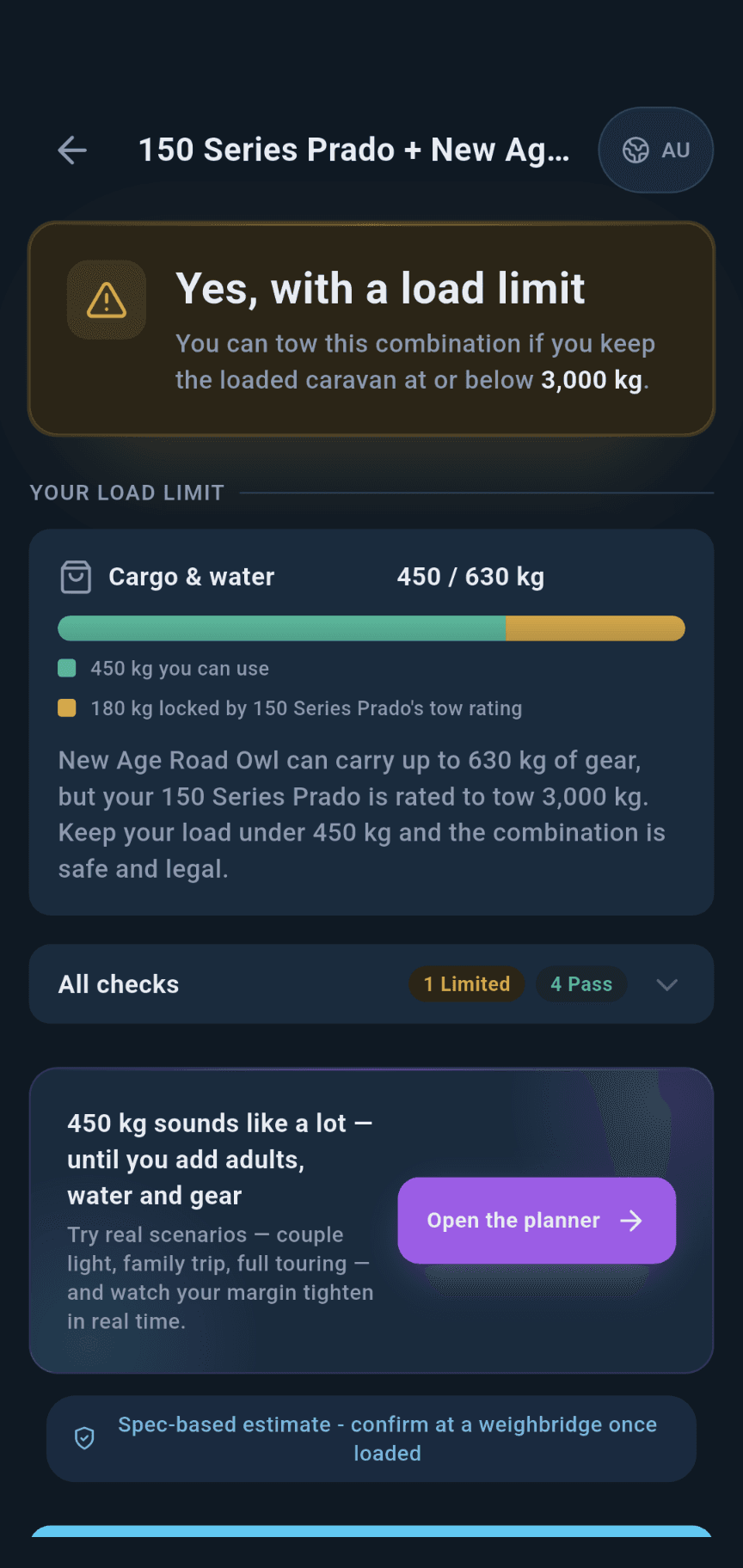
Know which limit stops you first
loadmate names the one limit that bites first and the margin left before it does, then lets you load the rig up and watch that margin tighten. No account needed.


Frequently asked questions
- What does GVWR mean?
GVWR (Gross Vehicle Weight Rating) is the manufacturer's maximum loaded weight for the single vehicle itself, the truck plus everyone and everything in it, not how much it can tow. It covers curb weight, passengers, fuel, cargo and the trailer's tongue weight, and it is set by the manufacturer and printed on the driver's-side door-jamb certification label.
- Is GVWR the same as towing capacity?
No. GVWR is the ceiling on the loaded weight of the truck alone, while towing capacity (the trailer weight rating) is a separate number, and the two are governed simultaneously along with GCWR, so a rig can be under its tow rating yet still over GVWR or GCWR. The tow number answers "can it pull?", not "can this loaded combination be legal?".
- What does 7000 GVWR mean on a trailer?
A 7000 GVWR on a trailer means the manufacturer rates the fully loaded trailer (its own empty weight plus all cargo, water and gear) at no more than 7,000 lb, so your cargo allowance is 7,000 lb minus the trailer's empty weight. It is the trailer's own loaded-weight ceiling, separate from your truck's GVWR.
- What does 10,000 GVWR mean on a truck?
A 10,000 GVWR on a truck means the loaded truck (curb weight plus passengers, fuel, cargo and the trailer's tongue weight) must never exceed 10,000 lb, and your payload is that 10,000 lb minus the truck's curb weight. It is the limit on the truck by itself, not the combination weight and not the tow rating.
- Can my 2500 pickup tow a 16000 lb trailer?
Maybe on the tow rating alone, but the deciding numbers are GCWR and payload: add the loaded truck to the loaded trailer and the total must stay under GCWR, and the trailer's tongue weight (10–15% of the trailer) must fit inside the truck's payload. Check both before trusting the headline tow figure. A rig can pass each rating on its own and still be over GCWR once the two loaded weights are added together.
- Do I need a CDL to pull a 20,000 lb trailer for personal use?
Federal CDL rules (FMCSA) hinge on a Gross Combination Weight Rating of 26,001 lb or more with a towed unit over 10,000 lb GVWR and on driving "in commerce", so a non-commercial personal rig is generally outside the federal CDL line. But your state's non-commercial license rules can still apply, so confirm locally. NHTSA and the FMVSS set the ratings; the FMCSA sets the commercial line.
- Does GVWR include passengers, fuel and tongue weight?
Yes. GVWR is the loaded weight of the vehicle, so passengers, fuel, cargo and the trailer's tongue weight all count toward it, which is why hitching a trailer eats into your truck's payload. On the worked rig, 1,300 lb of tongue weight leaves only 400 lb of the 1,700 lb payload for people and gear.
- What is the difference between GVWR, GCWR and GAWR?
GVWR caps the loaded single vehicle, GCWR caps the loaded truck-plus-trailer combination, and GAWR caps each individual axle (front and rear): three separate ceilings the manufacturer sets, and your rig must clear all of them at once. Clearing one says nothing about the other two, which is how a rig passes every rating alone yet fails as a combination.