F-150 towing at a glance
- Ford's 2026 span
- 7,400 lb at the bottom of the published tables to 13,500 lb at the top, every figure calculated with the SAE J2807 method
- What the top number requires
- 3.5-liter EcoBoost V6, 3.55 axle, SuperCrew 4x4, 157.2-inch wheelbase, Tow/Haul Package (53T) and the optional Max Tow Axle, running a 19,400 lb GCWR
- The four hitch ceilings
- 14,000 lb reinforced receiver, 13,500 lb truck rating, 11,600 lb standard receiver, 5,000 lb with no weight-distributing hitch
- The biggest single mover
- The Tow/Haul Package together with the Max Tow Axle. The same 3.5-liter SuperCrew 4x4 without them is rated 10,500 to 11,000 lb
- Tongue load, two ways
- 1,400 lb with a weight-distributing hitch, 500 lb weight-carrying
- What Ford does not publish
- A GVWR or a base curb weight for the F-150; the guide routes one to the certification label and the other to a dealer
- The label that settles it
- The Safety Compliance Certification Label on the driver's door pillar: GVWR, front and rear GAWR, and a rear-axle code printed under the bar code
- When the trailer needs its own brakes
- Ford asks for separate functional brake systems above 1,500 lb loaded, and California sets the same 1,500 lb line for a trailer coach
The trailer is picked out, the truck is already in the driveway, and the only question left is whether one covers the other. Ford does not publish the number that answers it. Its 2026 RV & Trailer Towing Guide carries GVWR tables for the medium-duty chassis and the E-Series vans, then stops short of the F-150: GVWR goes to the Safety Compliance Certification Label on your own truck, and base curb weight goes to a dealership sales consultant.
What Ford does print, four times over, is a trailer ceiling: 14,000 lb, 13,500 lb, 11,600 lb and 5,000 lb, all in the same 2026 documents. Each figure describes a different part of the vehicle, and none of them describes yours.
Ford's answer is a staircase: the engine table sets the top of it, the cab and the option boxes walk you down, the hitch you are actually using walks you down again, and the last step is printed in your own door frame.
How much can a Ford F-150 tow?
Ford's published 2026 figures run from 7,400 lb to 13,500 lb, and the engine decides which half of that span you are in before any option box does.
| 2026 engine | Maximum conventional trailer | Maximum payload Ford publishes |
|---|---|---|
| 3.5L EcoBoost V6 | 13,500 lb | 2,440 lb |
| 5.0L Ti-VCT V8 | 12,800 lb | 2,235 lb |
| 3.5L PowerBoost Full Hybrid V6 | 12,400 lb | 2,045 lb |
| 5.2L Supercharged V8 (Raptor R) | 8,700 lb | 1,410 lb |
| 2.7L EcoBoost V6 | 8,400 lb | 1,775 lb |
| 3.5L EcoBoost High Output (Raptor) | 8,200 lb | 1,405 lb |
The top three rows all carry the same condition: the Tow/Haul Package and the optional Max Tow Axle upgrade. The Raptor's payload figure is footnoted to 37-inch tires, and Ford's guide states that fifth-wheel towing is not recommended for it.
That table is in trailer-weight order, and in that order the lineup stops behaving the way a spec sheet implies. The Raptor is rated below the 2.7-liter base engine (8,200 lb against 8,400 lb), and the Raptor R clears that base engine by only 300 lb, at 8,700 lb. The Tremor is capped at 10,600 lb on the 3.73 axle with a 17,100 lb GCWR, and the floor of the whole published set is 7,400 lb, a 2.7-liter on the 3.15 or 3.55 axle with a 12,300 lb GCWR. Output and trailer rating are separate axes on this truck, and Ford's own tables are where that becomes obvious.
One row of the towing capacity chart holds the F-150 against the rest of the half-ton field, which is the comparison to make once you know which of these six figures is yours.
How much can I tow with a Ford F-150 that has the max tow package?
13,500 lb, on exactly one build: a 3.5-liter EcoBoost SuperCrew 4x4 on the 157.2-inch wheelbase, with the 3.55 rear axle, the Tow/Haul Package (option code 53T) and the optional Max Tow Axle upgrade, running a 19,400 lb GCWR. Change any one of those and Ford publishes a different number.
| Change one thing about that truck | Maximum conventional trailer |
|---|---|
| The full build: 3.5L EcoBoost, SuperCrew 4x4, 157.2-in wheelbase | 13,500 lb |
| Same engine and package, SuperCrew 4x2, 145.4-in wheelbase | 13,300 lb (GCWR 19,300 lb) |
| Same 4x4 truck, 145.4-in wheelbase (the 5.5-ft box) | 13,100 lb |
| Same 3.5L SuperCrew 4x4, without the package | 10,500 to 11,000 lb |
| Tremor | 10,600 lb |
| Raptor | 8,200 lb |
The package is doing most of the work. A 3.5-liter EcoBoost SuperCrew 4x4 without the Tow/Haul Package and Max Tow Axle sits on a trailer ceiling between 10,500 and 11,000 lb. Add both and GCWR reaches 19,400 lb and the ceiling 13,500 lb. That is 2,500 lb or more of the headline living inside two boxes on an order sheet. Ford lists both boxes as required equipment for gas F-150s pulling more than 11,600 lb, and adds that your New Vehicle Limited Warranty may be voided if you tow without them. On the PowerBoost the same requirement starts at 10,800 lb.
So six things have to line up before Ford's advertised number describes the truck in your driveway: engine, axle, cab, box length, drivetrain, and the pair of option boxes that only come as a set. All six have to be true at once, and the F-150 sharpens the point, because the payload column moves the other way while you satisfy them. Ford's best published payload for the 3.5-liter EcoBoost, 2,440 lb, is the 4x2 figure; the 4x4 that earns the 13,500 lb rating is published at 2,175 lb.
Ford footnotes the same split on the V8 row. The engine table gives the 5.0-liter a maximum payload of 2,235 lb, and the footnote attached to that cell reads: "Max payload of 2,225 lbs. on SuperCrew 4x2 with 5.0L gas engine and Tow/Haul Package and Max Tow Axle upgrade." Ten pounds, printed on the same page, marking the difference between the best 5.0-liter payload in the lineup and the best 5.0-liter payload you can have on a truck configured to tow.
Does a higher axle ratio make an F-150 tow more?
Not on its own. In Ford's 2026 conventional-towing tables for the 3.5-liter EcoBoost, the 3.31 and 3.55 sub-blocks carry identical figures row for row where they overlap: the same GCWR values against the same trailer weights, 16,200 lb paired with 10,900 lb, 16,500 lb with 11,000 lb and 10,600 lb, 16,800 lb with 10,500 lb and 10,900 lb. The 3.55 block then carries three rows the 3.31 block has no equivalent of, and every one of them is a Tow/Haul Package row.
What moves the number is the Max Tow Axle upgrade, a 3.55 electronic-locking unit, bought alongside the Tow/Haul Package. The ratio on its own is not the variable; the upgrade is, and it is worth 2,500 lb or more where the bare ratio is worth nothing.
You can read which one you have without lifting the truck. Ford prints a rear-axle code on the Safety Compliance Certification Label, under the bar code, after the word AXLE: 15 for 3.15, 27 or L3 for 3.31, 19 or L9 for 3.55, L6 for 3.73 and L4 for 4.10. L9 is the electronic-locking 3.55 that comes with the Max Tow Axle upgrade.
Why does Ford print four hitch ratings for one truck?
Because three of the four describe hardware and only one describes the truck. Receiver hitches are rated twice (once weight-carrying, once weight-distributing), and Ford prints both pairs for the F-150 alongside the truck's own rating. The standard 2-inch receiver is rated 11,600 lb, the reinforced receiver that arrives with the Max Tow Axle is rated 14,000 lb, the truck itself tops out at 13,500 lb, and any F-150 towing without a weight-distributing hitch is capped at 5,000 lb.
| Ford's 2026 figure | What the figure belongs to | Maximum trailer | Maximum tongue load |
|---|---|---|---|
| Reinforced 2-inch receiver (with Max Tow Axle) | The reinforced receiver, part of the Max Tow Axle upgrade | 14,000 lb | n/a |
| The vehicle rating, weight-distributing | The truck, properly equipped | 13,500 lb | 1,400 lb |
| Standard 2-inch receiver | The receiver fitted to every other F-150 | 11,600 lb | n/a |
| Any F-150 towing weight-carrying | The hitch setup, with no weight-distribution system | 5,000 lb | 500 lb |
Two of those numbers do more than one job. The 14,000 lb receiver is why a search result can quote 14,000 lb for an F-150 and still be describing a part, not a truck. And 11,600 lb is both the standard receiver's rating and the exact threshold above which Ford calls the Tow/Haul Package and Max Tow Axle required equipment on a gas F-150, a number that arrives twice from two different directions.
The 5,000 lb line appears on no spec sheet and in no comparison chart. Ford's note under the tables is short: do not exceed a trailer weight of 5,000 lb when towing without a weight-distribution system. Nothing about the truck has changed at that point: 8,500 lb of the rating is gone because the bars are off. Fitting a weight-distribution hitch changes where that load sits across the axles rather than how many pounds the truck is carrying, but the rating Ford permits behind the hitch moves with it.
Ford's tongue figures follow the same split: 1,400 lb weight-distributing, 500 lb weight-carrying. The loading guidance printed alongside them asks for tongue load at 10% of total loaded trailer weight, with trailers up to 2,000 lb capped at 200 lb on the ball.
What size travel trailer does an F-150 have payload for?
Work it from payload rather than from the tow rating. A 7,900 lb travel trailer leaves 5,600 lb of the 13,500 lb rating unused and 11,500 lb of GCWR unused, and still asks for close to a thousand pounds of the truck's payload before a single person climbs in.
Take the 2026 Jayco Jay Flight SLX 262RLS, using Jayco's own published figures.
| The trailer, as Jayco publishes it | Figure |
|---|---|
| Unloaded Vehicle Weight (dry) | 6,160 lb |
| Cargo Carrying Capacity | 1,740 lb |
| Trailer GVWR (the loaded ceiling) | 7,900 lb |
| Dry hitch weight | 780 lb |
| Length, width, height with A/C | 31 ft 1 in, 8 ft 0 in, 11 ft 1 in |
Jayco's own arithmetic checks out: 7,900 lb minus 6,160 lb is 1,740 lb, exactly the cargo capacity it publishes. Now run the loaded trailer against the 13,500 lb F-150.
| Ford's ceiling | The 262RLS against it | How much of the ceiling it uses |
|---|---|---|
| Towing capacity, 13,500 lb | 7,900 lb of Trailer GVWR | 59%, leaving 5,600 lb unused |
| GCWR, 19,400 lb | the same 7,900 lb of trailer | 41%, leaving 11,500 lb for the loaded truck |
| Tongue load, 1,400 lb weight-distributing | 988 lb estimated at 12.5% of Trailer GVWR | 71%, and about double the 500 lb weight-carrying ceiling |
| Payload, the figure on your door label | the same 988 lb, before anyone gets in | Ford publishes a lineup maximum, never yours. Go and read it |
The 988 lb figure is derived, not measured: it is 12.5% of Trailer GVWR, the middle of the band a loaded travel trailer usually lands in, and it is the number to plan against. Ford's own loading guidance puts 790 lb on the ball at 10% of the same 7,900 lb, and Jayco's published 780 lb is a dry figure; both sit under what a packed trailer delivers.
Here is where the F-150's arithmetic turns. Subtract the 13,500 lb rating from the 19,400 lb GCWR and 5,900 lb is left for the truck, and Ford's own statement of what the rating assumes is a tow vehicle with mandatory options, no cargo, a 10% tongue load, and a driver and passenger at 150 lb each, with the weight of additional options, passengers, cargo and hitch deducted from that figure. The headline is written around an empty truck. Everything you add lands on the same allowance the tongue weight is already spending, which is the argument payload versus towing capacity works through in full.
If your trailer is not the Jay Flight, compare its own two weights with the F-150's 13,500 lb tow rating, 19,400 lb GCWR and 1,400 lb tongue ceiling for this configuration. Read the GVWR off your door pillar as well. Explore loadmate in the app to see how the trailer, the truck and the gear you carry fit into one weight picture.
Two other ceilings sit near this trailer, and neither one is a weight rating on the truck. The 262RLS is 8 ft 0 in wide and 11 ft 1 in tall with the air conditioner. Ford allows 65 sq ft of trailer frontal area for an F-150 rated 7,701 lb or more and prints no measurement method, so the frontal-area figure has to come from Jayco; it is not a number to derive from those two dimensions.
Trailer brakes arrive far earlier than the rating suggests. California Vehicle Code section 26303 requires brakes on at least two wheels of any trailer coach with a gross weight of 1,500 lb or more, and Ford's own guide independently asks for separate functional brake systems on anything over 1,500 lb loaded, roughly a ninth of what this truck is rated to pull. Every state writes its own version, so check the one you tow in.
Why do real F-150 payload stickers land so far under 2,440 lb?
Because payload is whatever is left after the truck itself is built, and an F-150 is built in a wide range of ways. Owners post their door labels on the 14th-generation F-150 forum regularly, and those figures land a long way below Ford's published maximum. The same pattern turns up in the Airstream and Grand Design owner communities, which is enough consistency to plan against.
| Owner-posted door sticker (year, build) | Payload |
|---|---|
| 2024 Platinum Plus, 703A | 1,195 lb |
| 2021 Lariat FX4 crew, PowerBoost, max tow | ~1,300 lb |
| 2021 XLT PowerBoost 302A 4x4, 157-inch | 1,523 lb |
| 2024 Lariat 502A FX4, 5.0-liter, moonroof, 3.31 diff | 1,600 lb |
| 2022 3.5-liter EcoBoost SuperCrew 5.5-ft box, max tow | 1,697 lb |
| 2023 SuperCrew XLT 5.0-liter 4x4, max tow | 1,823 lb |
| 2023 PowerBoost XLT 4x2, GVWR 7,350 lb | 2,034 lb |
| Ford's published maximum, 3.5-liter EcoBoost 4x2 | 2,440 lb |
Trim is the biggest single lever in that list, and it runs backwards from what a buyer expects. The highest trim on it carries the least. The owner of the 1,195 lb Platinum Plus attributed his number to factory content (the tonneau, the spray-in liner, the 703A option stack) and summed up what it left him with: with two adults, a child and 200 lb of gear, "we can tow a 5,000lb trailer and that is it."
The tow package itself takes a little back. One owner compared two otherwise identically equipped 2022 SuperCabs in July 2024, one with Max Tow (53C) at 1,848 lb and one with the standard trailer tow package (53A) at 1,904 lb, and put the 56 lb difference down to the heavier hardware on those 2022 trucks: "So yes, a bit of a weight penalty for the Max Tow, but apparently not much, all other things being equal." On Ford's 2026 specification sheet the Tow/Haul Package's rear rotors are the same size as the standard ones, so on a current truck the penalty is the package's total content, not any single part. Two other threads landed near the same place, one before that comparison and one after: an owner who put the penalty at about 40 to 50 lb, and an owner who read the package's added hardware, the beefier 9.75-inch rear axle included, as making payload a wash. The box that raises the trailer ceiling lowers the payload sticker, because the hardware it adds has to weigh something and the certified ceiling above it does not move to pay for it.
Put the trailer back on top of those stickers and the descent finishes itself. A 988 lb loaded tongue against the 1,195 lb Platinum Plus leaves 207 lb for people, gear and the hitch. Against the 1,823 lb XLT it leaves 835 lb. The trailer did not change between those two lines. The truck under it did.
Run it the other way and the window is plain. Take a 1,500 lb sticker, seat two people at Ford's own 150 lb each, add 200 lb of gear and allow 100 lb for a weight-distributing hitch: 900 lb is left for the ball, which at 12.5% of Trailer GVWR is a trailer of roughly 7,200 lb. Do the same subtraction on the 1,195 lb Platinum Plus and 595 lb is left, or about 4,760 lb of trailer, within a few hundred pounds of the 5,000 lb its owner arrived at by feel. Those three allowances are assumptions, so swap in your own; the shape of the answer does not change.
Owners get there by measurement too. In January 2022 a 2021 XLT PowerBoost 4x4 with a 1,523 lb sticker took a Grand Design Imagine 2250RK across a CAT scale and came back with 3,500 lb on the steer axle against a 3,900 lb front GAWR, 3,900 lb on the drive axle against a 4,150 lb rear GAWR, 5,660 lb on the trailer and 13,060 lb gross. Both axles inside their ratings, the truck sitting level, and nothing left to load, which is the moment a CAT scale ticket tends to explain more than a spec sheet. Another owner, posting that same month, running a PowerBoost with roughly 1,140 lb of payload behind a boat trailer over 9,000 lb, reported his rig came out "legal by about 30 pounds" on half a tank.
Where is the number Ford leaves off the page?
On the Safety Compliance Certification Label on your driver's door pillar. Ford publishes no GVWR and no base curb weight for the 2026 F-150 in its towing guide, its technical specification sheet or its RV guide. Its RV guide instead states where each one lives: GVWR on the certification label, base curb weight from a dealership sales consultant. NHTSA's VIN decoder returns a class band for a 4x4 F-150 (7,001 to 8,000 lb), a band, not a figure.
The federal rule behind that label is worth reading once, because it explains why an F-150's numbers arrive in pieces. 49 CFR section 567.4 sets out what a manufacturer must certify on the label, and it requires the ratings to be listed one at a time. Paragraph (g)(3) calls for "Gross Vehicle Weight Rating" or "GVWR" followed by the appropriate value in pounds, "which shall not be less than the sum of the unloaded vehicle weight, rated cargo load, and 150 pounds times the number of the vehicle's designated seating positions."
Paragraph (g)(4) calls for "Gross Axle Weight Rating" or "GAWR" followed by the appropriate value in pounds "for each axle, identified in order from front to rear." Nothing on that label is an average. GVWR gets its own line and each axle's GAWR gets its own, front to rear. The rule lets a manufacturer collapse consecutive axles into a single value only where their ratings are identical, which on the F-150 whose scale ticket appears above (3,900 lb front, 4,150 lb rear), they are not. What each of those ratings actually counts is a separate question, and the ratings guide works through it.
The (g)(3) formula also explains why the lineup payload figure was never going to be yours: your GVWR was certified against your truck's unloaded weight and its seat count, not against the lightest configuration Ford builds.
The truck's own instruments only get you part way. F-150s fitted with onboard scales show payload against your capacity, and the default screen is a bar with no figures on it. One owner put it plainly after his first scale run: "I tried both the onboard scales and the hitch tool and neither give you any numbers, it's just a floating level between two lines." He later found a second screen on the same system that does show numbers. Neither screen reports what is sitting on the ball, and neither one knows your trailer.
Part 567's one-line-per-rating discipline is also the right way to read a rig once it is loaded. Every rating stands alone, so a truck can be comfortable on four lines and up against the fifth, and an average across them would hide exactly that. California writes its trailer-brake rule on the same principle: a 1,500 lb threshold standing on its own, which does not move because the truck happens to have 5,600 lb of tow rating unused behind the Jay Flight.
loadmate's compliance snapshot keeps that shape: GVWR, both GAWRs, the combined rating and the tongue load each get their own row, with the pounds left on each one printed beside it and graded. The door-label GVWR and recorded loads give those rows the figures for the F-150 in your driveway, so a toolbox or extra passenger is part of the next review.
The one figure a brochure cannot supply is what your own truck weighs today. This example pairs a 13,500 lb tow rating, 19,400 lb GCWR and 1,400 lb tongue ceiling with the Jay Flight's 7,900 lb Trailer GVWR and 6,160 lb dry weight. The vehicle check still needs the GVWR off your door pillar and a measured truck weight; the combined check needs that truck weight too. A bed cover, toolbox, passengers and camping gear each use some of the room left. loadmate brings your recorded weights and loads together so the answer can keep up with the truck you have built. Explore loadmate in the app.
loadmate provides decision support for towing safety, not legal weight certification. Score, compliance checks, and trip readiness are based on the data you enter and the regulator information current at the time of release. For legal weight evidence, use a certified truck scale / CAT scale. Towing remains the operator's responsibility. See /safety-disclaimer.
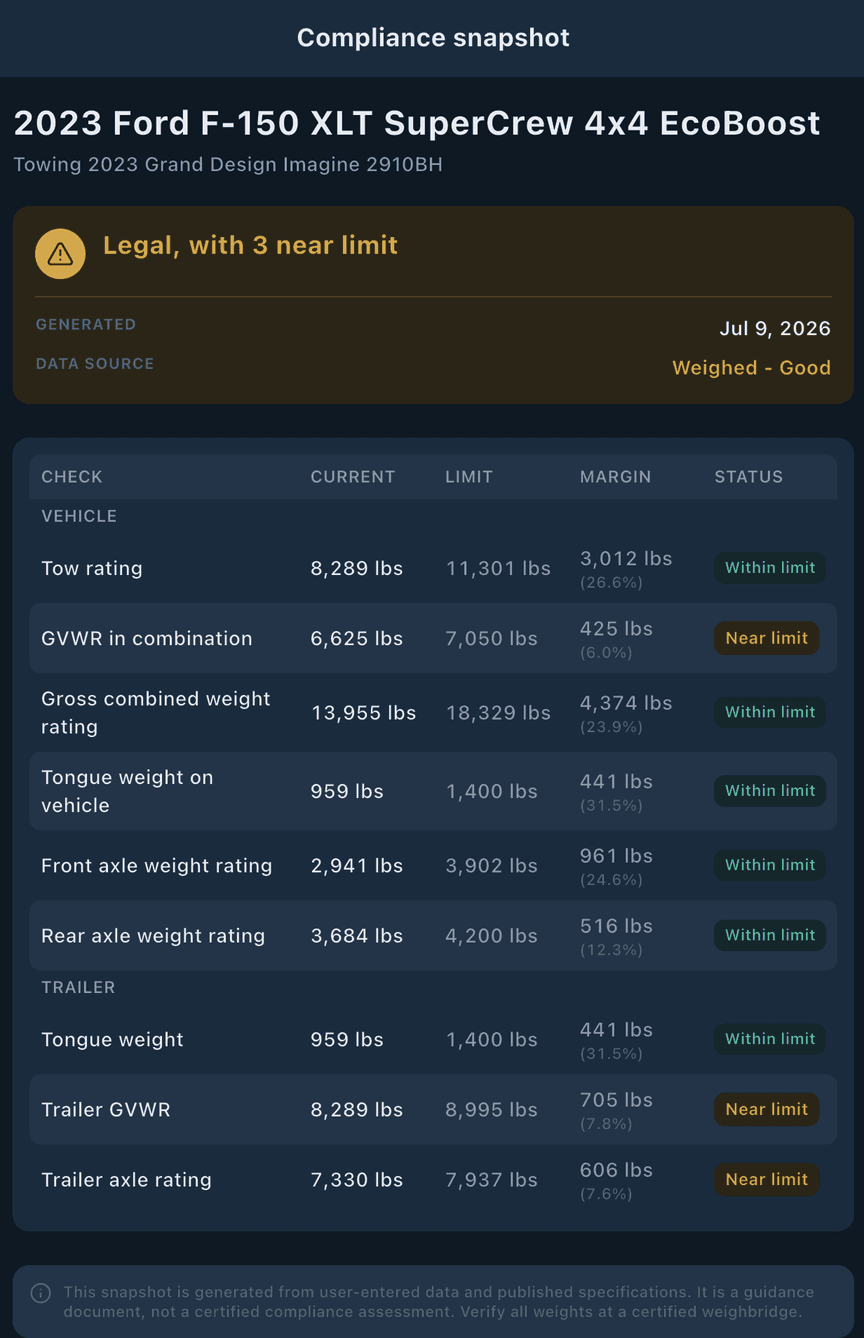
See what is left at every limit
loadmate lays out the full legal breakdown: GVWR, GCWR, Trailer GVWR, each axle's GAWR and tongue weight, every one graded against the margin it has left. Create a free account to explore it on a populated demo rig in the app.


Did the PowerBoost hybrid's rating change during 2026?
Yes, inside the model year and inside the same document. The November 2025 revision of Ford's 2026 F-150 towing information topped the PowerBoost out at 11,600 lb, with 4x4 columns only, on the 3.73 axle and an 18,400 lb GCWR. The March 2026 revision raised the headline to 12,400 lb, and that figure belongs to a SuperCrew 4x2 on the 145.4-inch wheelbase that Ford footnotes "Available spring 2026."
| PowerBoost figure | November 2025 revision | March 2026 revision |
|---|---|---|
| Headline maximum trailer | 11,600 lb | 12,400 lb |
| 4x4 maximum | 11,600 lb | 11,600 lb |
| Drivetrain columns published | 4x4 only | 4x4 and 4x2 |
The 4x4 hybrid did not change; a configuration was added above it. The hybrid's published span runs from 10,800 lb to 12,400 lb, its maximum payload is 2,045 lb on the 4x2 and 1,740 lb on the 4x4, and Ford's required-equipment threshold for the hybrid starts at 10,800 lb, not the 11,600 lb it uses on the gas engines.
Model-year to model-year, the moves were on the same rows. Between Ford's 2025 and 2026 guides the PowerBoost maximum went from 11,200 lb to 12,400 lb while its maximum payload dropped 75 lb, and the 5.0-liter V8 lost 100 lb of trailer rating. The 3.5-liter EcoBoost's 13,500 lb, the 19,400 lb GCWR and the receiver ratings all held steady through both years and both 2026 revisions. The weight-distributing tongue ceiling did move: 1,350 lb in the 2025 guide, 1,400 lb in both 2026 revisions. Anything written before March 2026 carries the older hybrid number, so check which revision a figure came from before you plan around it.
Which open Ford recalls touch an F-150 that tows?
Two, and one of them is specific to the max-tow hardware.
NHTSA campaign 26V104000, Ford's 26C10, was filed on February 20, 2026. It reaches back to the 2021 model year on the F-150, six model years of one nameplate in a single campaign, because the integrated trailer module is shared across the line, and it covers several other Ford and Lincoln models as well.
With a trailer hooked up, the module may lose communication with the vehicle, and NHTSA's filing describes the possible results as a loss of brake and turn signal lights or a loss of brake function, recorded as a noncompliance with Federal Motor Vehicle Safety Standard 108. The remedy is a module software update, at a dealer or over the air, at no charge; owner letters were mailed on March 25, 2026, and the campaign is searchable by VIN on NHTSA.gov.
NHTSA campaign 25V512000, Ford's 25S82, was filed on August 8, 2025 and covers certain 2023 through 2025 F-150s built with the Trailer Tow Max Duty package and the 9.75-inch heavy-duty axle in its three-quarter-float design. The rear axle hub bolt may fatigue and break and damage the axle hub splines, which NHTSA says can cause a rollaway in park without the parking brake applied, or a loss of drive power. Dealers replace both rear axle shaft assemblies at no charge. The campaign is phased by model year, it expands earlier recall 23V896, and it does not reach the 2026 model year. Worth noting how it is defined: by max-tow hardware, not by trim.
One more thing lives at the back of the truck, and it is not a campaign. Ford notes that the hitch capacities also appear on a label affixed to the receiver itself. So an F-150 carries the two figures that bracket this whole question in two places nobody photographs for a listing: the certified ratings at the driver's door, and the receiver's own rating at the hitch. Between them they settle which of Ford's four printed ceilings is actually yours.
Related guides
Everything the descent above rests on, in one place.
- What can I tow?: the same descent run generically, for whatever else is in the driveway
- Towing capacity chart: where the F-150's 13,500 lb sits against the other half-tons and the midsize trucks
- Towing weight ratings explained: why a GVWR and a pair of GAWRs are three separate ceilings and never a sum
- Payload vs towing capacity: where the 5,600 lb of unused tow rating goes, and why it cannot be spent
- Tongue weight vs payload: why 988 lb on the ball spends payload before anyone has climbed in
- Read a CAT scale ticket: how to read the ticket that showed both axles legal and the payload spent
- How much can a Ford Ranger tow?: the midsize Ford, where a single option code sets the ceiling instead of six variables
- How much can a Ram 1500 tow?: the other half-ton, where the axle ratio rather than a printed ceiling sets the number
- How much can a Toyota Tundra tow?: the other half-ton with a published GCWR, banded by grade rather than by cab
Frequently asked questions
- Can a Ford F-150 tow 8,000 lbs?
Most versions, but not all of them. Every engine's best 2026 configuration clears 8,000 lb: the lowest of those maximums are 8,200 lb on the Raptor and 8,400 lb on the 2.7-liter EcoBoost. The floor of the whole published set sits under it, at 7,400 lb for a 2.7-liter on the 3.15 or 3.55 axle with a 12,300 lb GCWR. Find the towing-guide row for your engine, axle, cab and wheelbase before you trust the lineup maximum, and remember an 8,000 lb trailer puts roughly 1,000 lb on the ball once it is loaded.
- Can a F-150 really tow 10,000 lbs?
Yes, on several builds. A 3.5-liter EcoBoost SuperCrew 4x4 reaches 10,500 to 11,000 lb even without the Tow/Haul Package and Max Tow Axle, and the 5.0-liter V8 and PowerBoost both go higher with them. Two conditions come with it. A weight-distributing hitch is not optional at that weight, because Ford caps weight-carrying towing at 5,000 lb. And a 10,000 lb trailer loaded to a normal 12.5% puts about 1,250 lb on the hitch, which is inside the 1,400 lb tongue ceiling but well past the payload on a heavily optioned crew cab.
- How much can a Ford F-150 3.5 L V6 tow?
13,500 lb on a SuperCrew 4x4 with the 157.2-inch wheelbase, 3.55 axle, Tow/Haul Package and optional Max Tow Axle, and 13,300 lb on the closest 4x2, a SuperCrew on the shorter 145.4-inch wheelbase with a 19,300 lb GCWR, because Ford publishes no 4x2 157.2-inch figure at all. Without the package that same 3.5-liter SuperCrew 4x4 is rated 10,500 to 11,000 lb. Note that Ford builds two different 3.5-liter V6s for this truck: the PowerBoost Full Hybrid is also a 3.5-liter and is rated 12,400 lb on the 4x2 and 11,600 lb on the 4x4.
- What size camper can a F-150 pull?
Smaller than the 13,500 lb rating implies, because the tongue weight is what runs out. A 2026 Jayco Jay Flight SLX 262RLS at 6,160 lb dry, 1,740 lb of cargo capacity and a 7,900 lb Trailer GVWR sits 5,600 lb inside a 13,500 lb rating and 11,500 lb inside the 19,400 lb GCWR, and still puts roughly 988 lb on the hitch once loaded to 12.5%. Owner-posted payload stickers run from 1,195 lb to 2,034 lb, so on the lower half of that range that one figure takes most of what is left. Size any camper by those two figures, the Trailer GVWR and the weight it puts on the ball when packed, and ask its manufacturer for the frontal area.
- Does the max tow package increase payload?
It raises the trailer rating and moves the payload sticker slightly the other way. An owner comparing two otherwise identically equipped 2022 SuperCabs in July 2024 read 1,848 lb on the Max Tow truck and 1,904 lb on the one with the standard trailer tow package, a difference of 56 lb. One other owner put the penalty at about 40 to 50 lb; another read the package's added hardware, its beefier 9.75-inch rear axle included, as making payload a wash. The hardware that lifts the ceiling has weight, and the certified GVWR above it does not rise to cover it.
- How do I know if my F-150 has the max tow package?
Three checks settle it. The window sticker names the Tow/Haul Package, which is option code 53T on current trucks. The Safety Compliance Certification Label on the driver's door pillar carries a rear-axle code under the bar code, where L9 is the electronic-locking 3.55 that comes with the Max Tow Axle upgrade. And the receiver itself carries a label with its own capacity: 11,600 lb on the standard 2-inch receiver, 14,000 lb on the reinforced one.
- Why is my F-150's GVWR less than its two axle ratings added together?
Because they are separate ceilings rather than parts of a sum. The 2021 PowerBoost 4x4 whose scale ticket appears above carries a 3,900 lb front GAWR and a 4,150 lb rear GAWR, an 8,050 lb sum, on a truck NHTSA's decoder places in the 7,001 to 8,000 lb GVWR class: the sum clears the top of the class before the certified figure is even read off the label. 49 CFR section 567.4 requires the manufacturer to certify GVWR on its own line and each axle's GAWR on its own line, front to rear, and none of them is derived from the others. In practice you can be inside both axle ratings and over GVWR at the same time, which is why a scale ticket gets read line by line.
- Can an F-150 tow a fifth wheel?
Ford publishes a separate fifth-wheel and gooseneck table for the F-150 with its own ratings, and allows 75 sq ft of trailer frontal area for those hitches against 65 sq ft for a conventional trailer. The arithmetic changes shape: a fifth wheel's pin weight lands in the bed, ahead of the rear axle, and it still comes out of the same payload. Ford's guide states that fifth-wheel towing is not recommended for the Raptor. Read the fifth-wheel row for your own cab, box and axle before sizing anything.
- Does the PowerBoost hybrid tow and carry less than the EcoBoost?
Yes, on both counts. The PowerBoost is rated 12,400 lb on a SuperCrew 4x2 and 11,600 lb on the 4x4, against 13,300 lb and 13,500 lb for the 3.5-liter EcoBoost, and its published maximum payload is 2,045 lb on the 4x2 and 1,740 lb on the 4x4 against 2,440 lb and 2,175 lb. Ford also starts requiring the Tow/Haul Package and Max Tow Axle on the hybrid at 10,800 lb, not 11,600 lb. Owner-posted PowerBoost stickers cluster between about 1,300 lb and 2,034 lb depending on trim and drivetrain.