Wrangler towing at a glance
- The lever
- The hitch sits behind a 40.8-inch rear overhang on a wheelbase of 96.8 in (two-door) or 118.4 in (four-door)
- The spare over the coupler
- 2.5 inches between the top of a 2-inch ball and the Rubicon's tailgate spare, in Car and Driver's November 2023 measurement
- The tongue-weight number
- Jeep publishes no receiver tongue-weight rating for the Wrangler; the manual tells you to read the figure stamped on your hitch
- The range
- 2,000 lb for any two-door, up to 5,000 lb for one specific four-door build (2026 model year)
- The order it is decided in
- Body length first, then transmission and axle ratio; horsepower comes last
- The 5,000 lb catch
- Four-door Rubicon, 8-speed automatic, 4.10 axle. The 4.56 off-road gears drop the same truck to 3,500 lb and cut GCWR from 10,300 to 8,600 lb
- The V-8
- The 470 hp 6.4-liter is rated 3,500 lb, where the 270 hp turbo four in a four-door Rubicon on the 4.10 automatic reaches 5,000 lb
- Trailer brakes
- Recommended above 1,000 lb and required above 2,000 lb, so a two-door's entire rating lands on that threshold
- The only source on a two-door
- The door-jamb certification label. Jeep's towing grid carries four-door rows only, so on a two-door the label is the whole reference
Before any rating matters, a Wrangler puts a physical object between you and a hooked-up trailer. The full-size spare bolted to the tailgate hangs over the same air the coupler needs. When Car and Driver towed with one in November 2023, they measured the gap on a Rubicon: 2.5 inches between the top of a 2-inch hitch ball and the spare.
Geometry is what limits a Wrangler: how far back the load sits, and what that does to a vehicle this short. The same geometry splits Jeep's own rating grid straight down the middle of the lineup.
How much can a Jeep Wrangler tow?
A 2026 Jeep Wrangler is rated to tow 2,000 lb as a two-door and 3,500 lb as a four-door, and only one build in the lineup reaches 5,000 lb: the four-door Rubicon with the 8-speed automatic on the 4.10 axle. Jeep's own specification document for the model year prints the fork in a single line (2,000 lb for two-door, 3,500 lb for four-door, 5,000 lb for the four-door Rubicon on the 4.10 automatic), and the towing grid underneath it adds the conditions.
The first split is body length, and it is settled before any engine question: two doors or four. Two things narrow the branch you land on from there: which gears went into the axles, and which gearbox is in front of them. The spare on the tailgate narrows nothing in the grid; it decides separately whether you can couple up at all. The headline 5,000 lb figure sits at the end of one branch out of the six below.
| Your 2026 Wrangler | Max trailer weight | What else that configuration carries |
|---|---|---|
| Two-door, any trim, either gas engine | 2,000 lb | The towing grid holds four-door rows only; a two-door's GVWR and axle ratings live on its door-jamb label |
| Four-door Sport, Sport S, Sahara, Willys | 3,500 lb | Sport with the 2.0-liter automatic: GCWR 8,400 lb, payload 1,203 lb |
| Four-door Rubicon, 6-speed manual (4.10 or 4.88 gears) | 3,500 lb | The manual gearbox does not reach the top rating in any axle |
| Four-door Rubicon, 8-speed automatic, 4.56 axle | 3,500 lb | GCWR 8,600 lb: the crawl-ready gearing costs 1,500 lb of rating and 1,700 lb of combined weight |
| Four-door Rubicon, 8-speed automatic, 4.10 axle | 5,000 lb | GCWR 10,300 lb; 3.6-liter V-6 or 2.0-liter turbo four, the turbo row on LT285/70R17C tires |
| Four-door 6.4-liter V-8, 470 hp, 4.56 axle | 3,500 lb | GCWR 9,400 lb, payload 1,088 lb, base weight 5,268 lb |
Two doors or four: where the rating splits
The two-door and the four-door share their engines and their frame design, and the two-door is rated to pull 1,500 lb less, because it is 21.6 inches shorter between the axles. A two-door Wrangler rides on a 96.8-inch wheelbase, a four-door on 118.4 inches, and both hang their hitch off the same 40.8-inch rear overhang.
Wheelbase is doing two jobs in that rating. It decides how much of the trailer's tongue load the front axle gives up, and it decides how quickly a trailer that starts to move sideways can push the tow vehicle around. A short vehicle with a long tail is the least forgiving shape in that argument: a trailer that starts to yaw gets a longer arm to push with, and the Jeep has less wheelbase to resist it.
The 2,000 lb rating also lands on an awkward line. Jeep's owner's manual recommends trailer brakes above 1,000 lb and requires them above 2,000 lb. A two-door owner is therefore towing at, or immediately under, the point where the manual stops recommending and starts requiring, with nothing above it. In hitch terms the same rating sits at the top of Class I, whose industry limit Jeep prints in the manual as 2,000 lb, while a standard four-door sits at the top of Class II at 3,500 lb, and the 5,000 lb Rubicon needs Class III hardware behind it.
Which four-door Wranglers actually get 5,000 lb
The 5,000 lb rating is fenced by four conditions (four doors, the Rubicon trim, the 8-speed automatic and the 4.10 axle), and short summaries of this question routinely drop the last one. A four-door Rubicon automatic with the 4.56 axle is a 3,500 lb tow vehicle with an 8,600 lb GCWR, and it looks identical in the driveway.
That is a live trap, because 4.56 gears are what a lot of Rubicon buyers deliberately order. They are the better crawl ratio on 35-inch tires. They also cost 1,500 lb of trailer rating and 1,700 lb of combined weight against the 4.10 car. The two builds are separated by one line on the window sticker, so the axle code, not the trim badge, is what you check. If the sticker went in the trash with the plastic (which on a two-year-old Jeep it usually did), a dealer can pull the build sheet for your VIN, and the axle code sits on it with the rest of the factory equipment.
The rating is recent, too, and that matters if you are shopping used. Through the 2023 model year, no Wrangler of any body style was rated above 3,500 lb; Car and Driver attributed that to a suspension tuned for articulation rather than trailer rigidity. For 2024 the Rubicon's new full-floating rear axle let Jeep raise certain four-door powertrains to 5,000 lb. In the 2025 grid exactly one row reached 5,000 lb: the four-door Rubicon with the 2.0-liter turbo four, the automatic and the 4.10 axle, at a 9,950 lb GCWR. For 2026 the same rating covers both gas engines in that configuration and the combined rating rises to 10,300 lb.
| Model year | Wranglers rated 5,000 lb | GCWR for that build |
|---|---|---|
| Through 2023 | None: 3,500 lb was the ceiling for the whole lineup | n/a |
| 2024 | The first ones: four-door Rubicon powertrains, on the new full-floating rear axle | n/a |
| 2025 | Four-door Rubicon, 2.0-liter turbo, automatic, 4.10 axle only | 9,950 lb |
| 2026 | Four-door Rubicon, automatic, 4.10 axle, V-6 or turbo four | 10,300 lb |
Plug-in hybrid owners read a different document for all of this. Jeep keeps the 4xe's specifications in a release of their own rather than in the Wrangler specification grid (the 2025 grid says as much on its first page), so the fork above never had a 4xe row in it. When the 5,000 lb rating first appeared for 2024, Car and Driver reported that the 4xe held at 3,500 lb. If you own one, that separate release and your door-jamb label are where your figures are.
Why the 470 hp V-8 is rated 3,500 lb
The 6.4-liter V-8 is rated at 3,500 lb because what caps a tow rating is heat, brakes and stability, not horsepower. Jeep's 2026 engine section prints one figure for the 470 hp V-8 (3,500 lb), and the towing grid backs it with a 9,400 lb GCWR, a 5,268 lb base weight and 1,088 lb of payload.
Start with the gearing: the V-8 comes with the 4.56 axle, the same ratio that costs the Rubicon its top rating. Then add mass. At 5,268 lb it carries the heaviest base weight in Jeep's 2026 towing grid (971 lb more than a four-door Sport on the 2.0-liter automatic), so more of the combined rating is spent before a trailer is attached at all. A 392 owner on a JL Wrangler forum, writing in January 2022 as someone who also runs an F-250 diesel, put the case as brakes first (the 392 is under-braked for its own weight before you add 4,000 lb behind it), then wheelbase and suspension, and expected fuel economy around 8 to 9 mpg while towing.
What the rating has to survive works the same way. An owner on a JL Wrangler forum in December 2024, comparing American ratings against the higher figures the same vehicles carry overseas, put the gap down to the test rather than the hardware: a grade climb of roughly 11.5 miles in ambient heat of 100 F or more with the trailer attached, which he read as leaving the American numbers limited by what the cooling system can hold. That is the shape of the thing being rated (what a whole vehicle can repeat on a long hot climb), and it is why horsepower on its own does not buy a bigger number.
One thing worth knowing before you shop a 392: several 2026 dealer research pages list the Willys 392 and the Moab 392 at 5,000 lb. Jeep's own 2026 specification document rates every 6.4-liter row at 3,500 lb, with a 9,400 lb GCWR. That is the figure to plan a trailer around.
Can you even get a trailer past the spare tire?
On most Wranglers the tailgate-mounted spare hangs directly over the hitch ball, and the coupler has to fit into whatever is left. Car and Driver's 2023 measurement on a Rubicon (2.5 inches between the top of a 2-inch ball and the spare) is the number to picture. Their read on what fits in it: a sliding coupler has a chance of sneaking through, while a flip-up coupler hits the tire well short of connecting.
The workarounds are all geometry. A drop hitch takes the ball down and away from the tire; an extender takes it rearward; a sliding or offset coupler shifts the connection sideways until the tongue clears. There is a second reason owners reach for extenders, and it has nothing to do with clearance: with a trailer connected the swing gate cannot open, so a long extender is the tempting way to keep the back of the vehicle usable on a trip.
Every one of those moves lengthens the arm the trailer hangs on, which is the next section's problem. An owner posting in March 2025 on a JL Wrangler forum named it directly: the temptation with a Jeep is a long extender so the trailer clears the spare, or worse, so the tailgate still opens, and doing that cuts the tongue load the vehicle can safely carry. Buy the shortest hardware that gives you the clearance.
The lever behind the tailgate: the load that runs out first
The number that decides a Wrangler tow is the load on the hitch ball and how far behind the rear axle it sits, not the trailer's total weight. The hitch hangs off a 40.8-inch rear overhang. Weight placed there does not simply add to the rear axle; it pivots on it, pressing the back down and lifting the front, where the steering and most of the braking live.
Jeep's published dimensions size the effect. Divide the 40.8-inch overhang by the wheelbase and you get about 0.42 on a two-door against about 0.34 on a four-door, an approximation of how much of each pound on the ball is lifted off the front axle and added to the rear. Those are arithmetic on two published dimensions, and the ball sits near the end of the overhang without being exactly at it, so read them as a direction of travel: the same trailer, hitched to the shorter Wrangler, works a stronger lever. What a weight-distribution hitch hands back to the front axle against that lever is its own walkthrough: weight-distribution hitch and front-axle load.
| Dimension (2026 Wrangler) | Two-door | Four-door |
|---|---|---|
| Wheelbase | 96.8 in | 118.4 in |
| Rear overhang, axle to tail | 40.8 in | 40.8 in |
| Overhang divided by wheelbase (derived, approximate) | ~0.42 | ~0.34 |
| Max trailer weight | 2,000 lb | 3,500 lb, or 5,000 lb on the Rubicon 4.10 automatic |
On a 2022 tongue-weight thread, a Utah Rubicon owner made the same point without the arithmetic: a Wrangler carries that kind of weight in its back seat without complaint, and hanging the same weight off the hitch and bouncing it down the road is a different proposition entirely. At the conventional 10% of loaded trailer weight, a 2,000 lb trailer lands 200 lb on a two-door's ball (about what two rear-seat passengers weigh, moved to the worst place on the vehicle to put them).
Jeep leaves one number out of the Wrangler's paperwork: the maximum tongue weight for the receiver hitch. It is absent from the 2026 specification document, and the 2026 owner's manual prints no trailer weight table at all. That section sends owners to jeep.com. What the manual does print is an instruction: "Never exceed the maximum tongue weight stamped on your bumper or trailer hitch." Its one tongue figure, 350 lb, belongs to a narrow case: a ball mounted on the fascia or bumper instead of in the receiver, which the manual caps at 3,500 lb of trailer, 30 square feet of frontal area and that 350 lb on the ball.
So the tongue-weight limit on your Wrangler is a stamp on a physical part, and it is the one limit here you cannot look up. An owner posting in May 2026 about his 2025 four-door Rubicon had read a 500 lb figure for his configuration, worked out that it implied a Class III hitch, and then found nothing stamped on the hitch itself to confirm it. Take a flashlight to yours before you start shopping for a trailer, and treat whatever is stamped there as the number that governs; the manual says so in as many words.
The limit you have to go outside and read
That stamp is the last input, and it is the one the check is waiting on. Every other limit here can be typed in off a document; the coupling limit has to be read off a piece of steel under the back of your Jeep. It matters most on the setups that lengthened the arm to get connected in the first place.
Here is what the rest of the arithmetic looks like while you go and find that number. The trailer is a 2027 Rockwood Geo Pro G15TLE, 15 feet 7 inches long. Forest River publishes 2,389 lb unloaded, 1,451 lb of cargo capacity and 340 lb of hitch weight; on their own definition (cargo capacity is Trailer GVWR minus unloaded weight), that makes its Trailer GVWR 3,840 lb. It is a close sibling of the Rockwood E-Pro 15TB that one Michigan owner has towed roughly 34,000 miles behind a four-door Rubicon.
Read the 340 lb carefully. It is the as-manufactured hitch weight, measured with the trailer empty, which puts it at 8.9% of that 3,840 lb Trailer GVWR. Pack the trailer to 3,840 lb and the conventional 10 to 15% range means 384 to 576 lb on the ball. The examples below use an illustrative 12.5%, or 480 lb, which needs replacing with a measured tongue weight. Every pound still comes out of the Wrangler's payload. The two-door comparison needs the GVWR off your own label before its vehicle margin can be calculated.
- Four-door Rubicon, automatic, 4.10 axle. 5,000 lb rating, 10,300 lb GCWR, 4,640 lb base weight and 1,310 lb of payload against a derived GVWR of 5,950 lb. Verdict: pass (well matched). GVWR is the tightest of the four lines, with about 830 lb still under it, and that is with the seats empty.
- Four-door Sport, 2.0-liter automatic. 3,500 lb rating, 8,400 lb GCWR, 4,297 lb curb weight, derived GVWR 5,500 lb. Verdict: caution (careful). Loaded to its 3,840 lb Trailer GVWR the trailer is 340 lb past the rating, so this floorplan only works behind a Sport if you keep its road weight under 3,500 lb, and the combination is about 260 lb under GCWR before anyone gets in. Shopping one size down (a Trailer GVWR nearer 3,200 lb) puts around 400 lb on the ball inside a 1,203 lb payload.
- Two-door, any trim. a 2,000 lb rating and a 4,050 lb curb weight for the 2.0-liter automatic. The remaining comparison needs GVWR, because Jeep publishes no two-door row. Read that number from your door-jamb label, then compare it with your loaded Jeep including tongue weight.
Type that stamped figure in and the last field is filled. Two questions then get asked of the same 480 lb at once: whether the coupling is rated to hold it, and whether the payload it comes out of has room for it (the pair a drop hitch or an extender quietly changes when it lengthens the arm). Where a weight-distribution hitch is fitted, the free check models the transfer it makes: how much of that load moves forward onto the front axle, and how much the Wrangler is carrying either way. Whether you land on pass (well matched), caution (careful) or fail (no) can turn on that stamped number alone.
loadmate provides decision support for towing safety, not legal weight certification. Score, compliance checks, and trip readiness are based on the data you enter and the regulator information current at the time of release. For legal weight evidence, use a certified truck scale / CAT scale. Towing remains the operator's responsibility. See /safety-disclaimer.
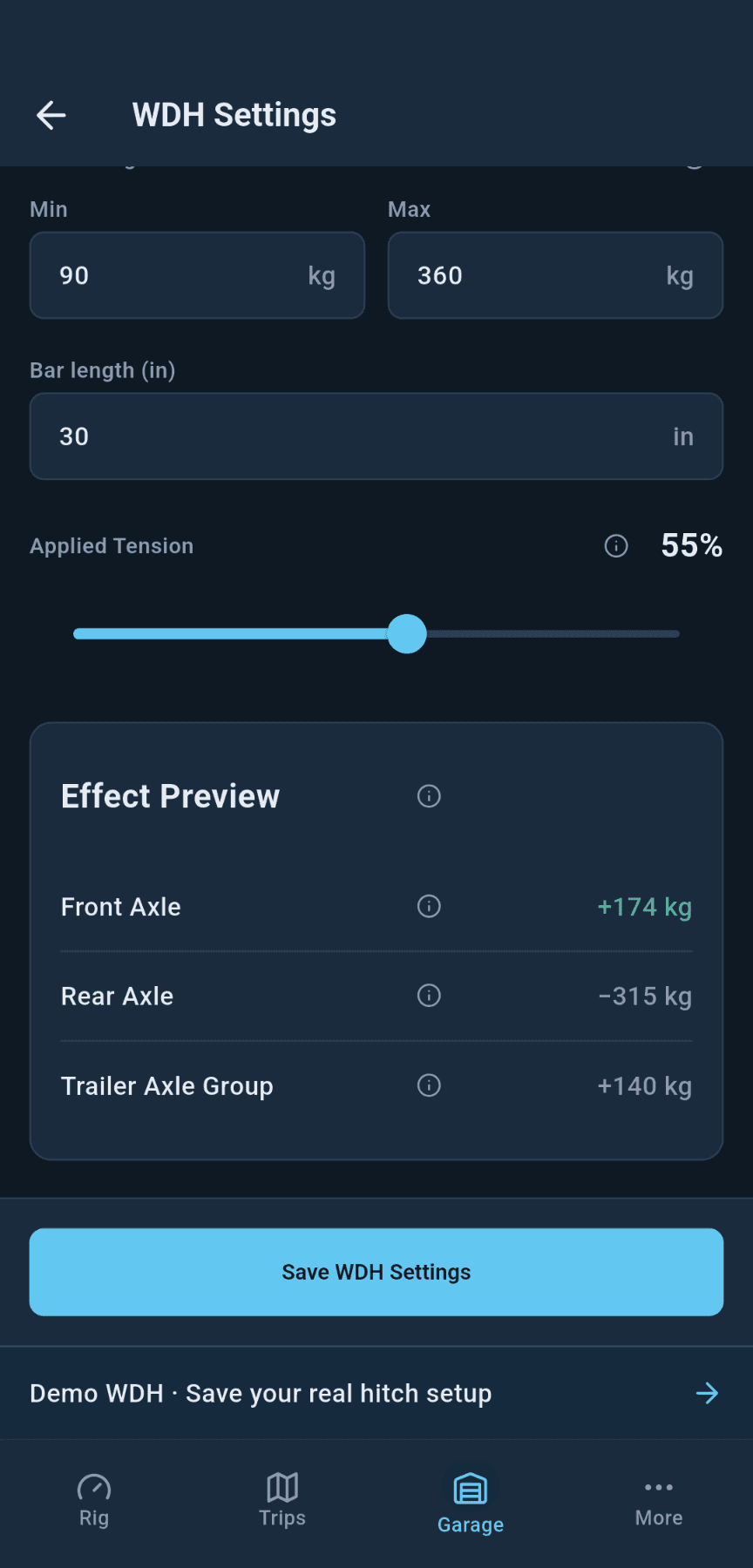
Tune the hitch for this load
loadmate models your weight distribution hitch, spring-bar or FALR, and shows the load coming back onto the steer axle. A tension set for one load is wrong for the next, so the model moves when the load does. Create a free account to explore it on a populated demo rig in the app.


How much can I tow with a Jeep Wrangler?
Up to your branch of the rating once the trailer is actually loaded: 2,000 lb behind a two-door, 3,500 lb behind most four-doors, 5,000 lb behind the 4.10 automatic Rubicon, all measured against loaded weight rather than brochure weight. The gap between those two numbers is where most of the trouble starts, and Wrangler owners hit it early because their headroom is small to begin with.
One owner running a Rove Lite gave his own two numbers in March 2025: 2,020 lb unloaded on the sticker, 2,506 lb once water and a small amount of gear were aboard. That is 486 lb of ordinary packing on one of the smallest trailers you can buy, 24% added to its own dry weight. A two-door's entire rating is 2,000 lb, so a trailer shopped on its dry-weight figure can be over the line before it leaves the driveway, and the 10 to 15% landing on the ball climbs with it.
At the other end of the range, a Michigan owner posting in May 2026 has put roughly 88,000 miles on one 2019 four-door Rubicon, about 34,000 of them towing (most recently the Rockwood E-Pro 15TB he runs at 3,200 to 3,300 lb loaded). How he does it is the useful part: a weight-distribution hitch on all the time, long mountain grades taken at 45 to 50 mph with the coolant temperature watched and held near or under 230 F, 62 to 67 mph the rest of the time, about 10.9 mpg. That is a Wrangler towing well within itself (a smaller trailer, driven more deliberately, than the same weight behind a midsize truck would ask for).
Weight is not the only rating in the manual, and the second one has the same hole in it as the tongue rating. Jeep defines frontal area (a trailer's maximum height multiplied by its maximum width) and then prints exactly one number for it: 30 square feet, in the note covering a ball mounted on the fascia or bumper, alongside that case's 3,500 lb and 350 lb limits. For receiver towing the manual sets no frontal-area figure at all. So a Wrangler owner shopping a tall trailer has a real constraint and nothing published to measure it against. If what you are looking at is taller and wider than the Jeep, that is a reason to keep its loaded weight well inside the branch you are on and to build up to highway speed carefully on the first trip.
On a two-door the door-jamb label is the only source
The door-jamb certification label is the authority for your GVWR and your axle ratings, and for a two-door it is the only place those numbers exist at all. Jeep's towing grid publishes four-door rows only, in both the 2025 and the 2026 specification documents, which is why a two-door owner cannot look up a payload or a combined weight rating the way a four-door owner can.
Your figures sit in three places. GVWR and the front and rear axle ratings are on the door-jamb certification label. The combined weight of occupants and cargo your build allows is on the tire and loading placard. The tongue-weight limit is stamped on the hitch. Nothing carries GCWR on a two-door, so the working rule there is to stay well inside the 2,000 lb trailer figure and keep the load on the ball light.
None of them tell you what your Wrangler weighs today. A Minnesota owner with a 2025 four-door Rubicon on the 2.0-liter automatic put his on a scale and read 4,760 lb with a full tank, about 158 lb above the 4,602 lb base weight Jeep published for that configuration in 2025. Accessories, armor, a heavier spare, a winch: all of it lives in that gap, and every pound comes out of the payload the tongue load has to fit inside. A CAT scale run costs a few dollars and settles it.
Two of this page's numbers came off physical objects rather than documents: the figure stamped on your hitch, and the 158 lb the Minnesota owner's scale found above his Jeep's published base weight. Both belong to one Wrangler. Change the hitch and the coupling limit may change; add armor, a winch or a heavier spare and the carrying room shrinks. loadmate connects the recorded hardware limits, measured baseline and load changes, so the next trip uses the Jeep you have built. Explore loadmate in the app.
Related guides
Every branch of the fork runs on the same handful of concepts. These guides work them through:
- What can I tow?: the hub this page sits under, and the starting point for any other vehicle in the driveway
- Towing weight ratings explained: what GCWR is actually counting, and why the 4.10 and 4.56 Rubicons differ by 1,700 lb of it
- Payload vs towing capacity: the 1,203 lb a four-door Sport has to fit the tongue load, the passengers and the gear inside
- Tongue weight vs payload: why the 480 lb on the ball is a weight the Wrangler carries, not one it pulls
- Weight-distribution hitch and front-axle load: what a WDH gives back to the front axle that a 40.8-inch overhang took off it
- How to weigh a travel trailer at a CAT scale: how to find the loaded tongue weight instead of estimating it at 12.5%
- How to read a CAT scale ticket: what to do with the 158 lb the Minnesota owner's scale found above his published base weight
- Towing capacity chart: where the Wrangler's 5,000 lb sits against other SUVs and trucks
Frequently asked questions
- Can a Jeep Wrangler tow 5,000 lbs?
One configuration can. On the 2026 Wrangler the 5,000 lb rating applies only to a four-door Rubicon with the 8-speed automatic and the 4.10 axle ratio, with either the 3.6-liter V-6 or the 2.0-liter turbo four, and Jeep gives that build a 10,300 lb GCWR. A four-door Rubicon automatic on the 4.56 axle is rated 3,500 lb with an 8,600 lb GCWR, and the Rubicon manual is 3,500 lb. Read the axle ratio off the window sticker, or have a dealer pull the build sheet for your VIN; the trim badge will not tell you.
- Why is the Wrangler's tow capacity so low?
Because what caps a tow rating is heat, braking and stability on a long climb, and horsepower is only one of the things feeding into that. The Wrangler is short between the axles, hangs its hitch off a 40.8-inch rear overhang, and rides on suspension tuned for wheel travel, so the load on the ball pivots harder on it than on a longer vehicle. That is also why the 470 hp 6.4-liter V-8 is rated 3,500 lb while the 2.0-liter turbo four in the right four-door Rubicon is rated 5,000 lb.
- Can a Jeep Wrangler pull a camper?
Yes, within the branch of the lineup you are on and with the loaded weight checked in place of the brochure weight. A four-door at 3,500 lb suits small single-axle travel trailers and teardrops; the 5,000 lb Rubicon build reaches a little further. A two-door at 2,000 lb is teardrop and pop-up territory, and trailer brakes are required above that figure. One owner's own numbers show why dry weight misleads: his trailer listed at 2,020 lb unloaded and weighed 2,506 lb with water and a small amount of gear aboard.
- How much can a 2-door Jeep Wrangler tow?
2,000 lb, on every two-door in the 2026 lineup, with both gas engines and every trim. Jeep's towing grid carries four-door rows only, so a two-door's GVWR and axle ratings come off the door-jamb certification label and its cargo-and-occupant allowance off the tire and loading placard. Trailer brakes are required above 2,000 lb, so a two-door tows right at that threshold.
- How much can a Jeep Wrangler Unlimited tow?
The four-door Wrangler is rated 3,500 lb across Sport, Sport S, Sahara and Willys, and 5,000 lb only as a Rubicon with the 8-speed automatic on the 4.10 axle. A four-door Sport with the 2.0-liter automatic carries an 8,400 lb GCWR and 1,203 lb of payload, so a 3,500 lb trailer putting 350 to 525 lb on the ball spends roughly 29 to 44 percent of that payload before anyone gets in.
- My Wrangler is rated 3,500 lb, so why does everyone say only a pop-up or a tiny camper is safe?
Because the rating is a ceiling on trailer weight and the practical limits are the load on the ball, the frontal area and the wheelbase. A 3,500 lb trailer puts 350 to 525 lb on the hitch at the conventional 10 to 15%, sitting 40.8 inches behind the rear axle on a vehicle with a short wheelbase. Frontal area is the other constraint, and the manual's only number for it (30 square feet) covers a bumper-mounted ball, which leaves receiver towing with nothing published to check a tall trailer against. Owners who tow at that weight successfully tend to run a weight-distribution hitch and drive grades slowly.
- How do I hook a trailer up past the Wrangler's spare tire?
With hardware that moves the ball out of the spare's way: a drop hitch, an offset or sliding coupler, or an extender. Car and Driver measured 2.5 inches between a 2-inch ball and a Rubicon's spare in 2023 and reported that a sliding coupler might sneak through it while a flip-up coupler meets rubber first. Choose the shortest solution that gives you clearance, because every inch that moves the ball rearward lengthens the lever the tongue load acts on and reduces what the hitch can safely carry.
- Does a Wrangler need a weight-distribution hitch?
Not for every trailer, but owners running near the top of the four-door range generally do, and the reason has more to do with the Wrangler's geometry than with the trailer's weight. A weight-distribution hitch pushes load the tongue lifted off the front axle back onto it, which restores steering and braking feel. It redistributes those pounds across the Wrangler's two axles, and the payload arithmetic behind them is unchanged.
- Are Jeep Wranglers good for towing?
They are good for towing what they are rated for, driven the way the shape asks. One owner with roughly 34,000 towing miles on a single 2019 four-door Rubicon, out of about 88,000 on its odometer, describes the working recipe: a trailer in the 3,000 lb range, a weight-distribution hitch fitted permanently, long grades at 45 to 50 mph with an eye on coolant temperature, and around 10.9 mpg. The margin for a loading mistake is thinner than on a longer vehicle, because a short wheelbase gives sway less to work against.