Tundra towing at a glance
- The two ends of the 2026 lineup
- 8,300 lb on every SR, 12,000 lb on one properly equipped SR5, every figure rated per SAE J2807 methodology
- The badge that moves it most
- Grade. The SR is 8,300 lb in every configuration Toyota sells it in; the SR5 in the same Double Cab 4x2 on the 6.5-foot bed is 12,000 lb
- The 12,000 lb build, named
- SR5, i-FORCE 3.4-liter twin-turbo V6, Double Cab, 6.5-foot standard bed, 4x2, on a 7,035 lb GVWR
- Combined rating, published by grade
- SR 15,204 to 15,520 lb, SR5 17,250 to 17,700 lb, Limited, Platinum and 1794 17,250 lb on gas and 17,600 to 17,700 lb on the hybrid, Capstone 16,525 lb
- Tongue ceilings, by cab and drive
- 1,200 lb (4x2 Double Cab), 1,145 lb (4x2 CrewMax), 1,120 lb (4x4 Double Cab), 1,117 lb (4x4 CrewMax)
- Payload on paper and on doors
- Toyota publishes 1,940 lb at the top and 1,485 lb at the bottom; CrewMax labels owners post run 1,290 to 1,390 lb
- The sticker printed after the truck was built
- The load carrying capacity modification label, added after assembly when accessories go on, replacing the figure on the tire and loading label
- Reissued by recall
- Six NHTSA campaigns against that label since November 2022, the most recent in July 2026 on a single 2026 truck
- What the SR grade gets for towing
- A hitch receiver and a 7-/4-pin connector. The integrated Trailer Brake Control system and TOW/HAUL mode start at SR5
- Toyota's own trailer conditions (2022 manual)
- Trailer brakes above 1,000 lb, a sway control device above 2,000 lb, two or more axles recommended above 3,000 lb, a weight distributing hitch above 5,000 lb
On a third-generation Tundra that reached the lot with a spray-in bed liner, running boards or a rack already fitted, a sticker sits in the door frame that was printed after the truck was built and reads lower than the two beside it. It is a load carrying capacity modification label, and it is the one that governs. The certification label on the door latch post sets the GVWR and the front and rear GAWRs; the tire and loading information label carries the line a trailer actually spends, the combined weight of occupants and cargo; and the modification label supersedes that second figure.
Toyota and two of its distributors have replaced that third label under safety recall six separate times since November 2022, always for the same reason: the figure printed on it did not match what the accessories had taken. The remedy in every one of those campaigns was a new sticker, because the sticker was the defect.
The tow rating, meanwhile, has not moved a pound in five model years. The stable figure and the reprinted one are both true answers, and this page holds them apart: Toyota's number, unchanged since 2022, and the label that governs yours, which has been rewritten more than once.
How much can a Toyota Tundra tow?
Between 8,300 lb and 12,000 lb for 2026, and the spread belongs almost entirely to grade: cab, bed and drivetrain swaps reshuffle hundreds of pounds, while stepping off the SR grade moves 3,700. Toyota's 2026 Tundra Product Information prints one maximum for each cab-and-drivetrain column, each of them properly equipped and each measured per SAE J2807 methodology.
| 2026 Tundra, properly equipped | Maximum towing capacity | Maximum tongue weight |
|---|---|---|
| 4x2 Double Cab | 12,000 lb | 1,200 lb |
| 4x2 CrewMax | 11,450 lb | 1,145 lb |
| 4x4 Double Cab | 11,200 lb | 1,120 lb |
| 4x4 CrewMax | 11,170 lb | 1,117 lb |
Those four figures describe the best build in each column. Underneath them sits a fifth number that behaves differently from all of them: the SR grade is rated 8,300 lb in every configuration Toyota sells it in, both cabs, both drivetrains and every bed it comes with. It does not move. Above the SR, the detail grid runs from 12,000 lb down to 10,340 lb on the Capstone, which also carries the lineup's smallest published payload at 1,485 lb.
One row in that grid disagrees with Toyota's own summary. The 4x4 CrewMax column tops out at 11,170 lb in the summary row, while the detail grid lists 11,175 lb for the TRD Pro with the i-FORCE MAX and the 5.5-foot bed, 5 lb higher than the column's stated maximum. Quote the summary figure and treat the TRD Pro cell as its own line.
The towing capacity chart puts this truck's 8,300 to 12,000 lb range beside every other half-ton. The rest of this page is about which figure inside that range is yours.
Which Tundra can tow 12,000 lb?
One build: SR5 grade, the i-FORCE 3.4-liter twin-turbo V6, Double Cab, 6.5-foot standard bed, 4x2, properly equipped. Toyota states it twice, in documents four model years apart, so this is not a deduction from a spec grid.
The 2026 Product Information puts 12,000 lb, annotated SR5, in the cell where the row "3.4-liter TT V6 (6.5-ft. std. bed)" meets the column "4x2 Double Cab". Toyota's owner's-manual tables key the gross combined weight rating and the trailer weight rating to the model code stamped on the certification label, and the 2022 manual gives model code VXKA70L-CRUSZA a 12,000 lb trailer weight rating. Its own decoder table reads that code as Double Cab, 2WD, standard bed, SR5 grade, with a GVWR of 7,035 lb and axle ratings of 4,080 lb front and 3,860 lb rear. Both documents agree on the cab, the bed, the drivetrain, the grade and the GVWR.
Take that exact build and swap one item at a time.
| One swap from the 12,000 lb build | Toyota's published 2026 maximum |
|---|---|
| Nothing (SR5, Double Cab, 6.5-foot bed, 4x2) | 12,000 lb |
| Limited grade instead of SR5 | 11,400 lb |
| The 8.1-foot long bed | 11,370 lb |
| CrewMax instead of Double Cab | 11,270 lb |
| 4x4 instead of 4x2 | 11,200 lb |
| SR grade instead of SR5 | 8,300 lb |
Four of those five changes cost between 600 lb and 800 lb. The fifth costs 3,700 lb. On this truck the headline build is also a two-wheel-drive Double Cab, which is not the Tundra most lots carry. The F-150 page works through what that gap costs a half-ton shopper; the useful part here is that Toyota names the build, so a look at the tailgate badge and a tape measure on the bed settles whether the headline is yours.
What has changed since the third generation arrived in 2022?
The ratings have not: 12,000 lb at the top, 8,300 lb on the SR and 1,940 lb of maximum payload, unchanged across five model years. The label that tells you what your own truck may carry has been replaced under safety recall six times in the same period.
| When | What happened to a Tundra owner's capacity figure |
|---|---|
| Late 2021 | Toyota announces the third generation for 2022. The 5.7-liter V8 gives way to a twin-turbo V6 and a hybrid twin-turbo V6, the rear leaf springs give way to coils, and the release puts maximum towing up 17.6 percent to 12,000 pounds with maximum payload at 1,940 pounds |
| November 2022 | NHTSA 22V854000: Gulf States Toyota recalls certain 2023 Tundras fitted with non-skid spray-on bed liners over the load carrying capacity modification label |
| September 2023 | NHTSA 23V633000: Toyota recalls 21,781 2023 Tundras and Tundra Hybrids with the spray-on bed liner accessory, because the label "states the incorrect load carrying capacity, which can result in an overloaded vehicle" |
| November 2023 | NHTSA 23V757000: Southeast Toyota Distributors recalls 534 2022 to 2024 Tundras for the same non-compliance |
| July 2024 | NHTSA 24V548000: Gulf States Toyota recalls vehicles across 22 Toyota model lines, Tundra and Tundra Hybrid among them, where the label may display inaccurate added weight values |
| July 2025 | Model year 2026 is announced with the ratings carried over. The 32.2-gallon fuel tank becomes standard on every grade, and the tow hitch and 7-/4-pin connector are stated standard across the lineup |
| March 2026 | NHTSA 26V179000: Toyota recalls 2024 to 2025 Tundras and 2024 to 2026 Tundra Hybrids for the same defect; owner letters mailed May 26, 2026 |
| July 2026 | NHTSA 26V433000: Southeast Toyota Distributors recalls one 2026 Tundra; owner letter expected September 4, 2026 |
All six of those campaigns are non-compliances with Federal Motor Vehicle Safety Standard 110, "Tire Selection and Rims", and NHTSA's consequence statement on the March 2026 filing is that a vehicle with an incorrect maximum capacity weight value may be overloaded. Read the pattern rather than the count. The load carrying capacity modification label exists because a truck's as-built weight keeps changing after the certification label is printed, and a liner, a step or a distributor accessory pack takes pounds out of payload before the owner ever sees the truck. That subtraction is a calculation performed on one specific vehicle, and calculations get corrected.
Precision matters on two of them. The July 2024 campaign covers 22 Toyota model lines fitted with that distributor's accessories, and the March 2026 campaign covers 14 Toyota and Lexus lines and 8,230 vehicles in total. Neither is a Tundra-only defect; both are the same label going wrong wherever accessories go on. Whether any of the six reached your truck is a VIN lookup: every one of these campaigns is searchable by VIN on NHTSA.gov.
Two other campaign families sit on this generation and neither is a towing one. Three separate campaigns, in May 2024, November 2025 and May 2026, cover 2022 to 2024 Tundras with the V35A engine, where manufacturing debris may contaminate the engine and lead to a main bearing failure; the remedy is inspection of the number one main bearing and engine replacement where needed. A February 2024 campaign covers transmission control software on 2022 to 2024 trucks. For model year 2026 there is no engine, transmission, axle, hitch, brake or tire campaign at all. The only campaigns reaching a 2026 truck are label ones: one on the Tundra Hybrid, and one on a single gas Tundra.
Why is every SR rated 8,300 lb?
Because the rating tracks the grade's whole towing system, not just its engine, and on the SR that system stops short in ways Toyota prints on its own equipment page. The SR runs the same 3.4-liter twin-turbo V6 block as the SR5, in a lower-output tune, so the engine is not what caps it.
The 2026 Product Information's equipment grid shows what does. Across the seven grade columns, the Trailer Brake Control system and TOW/HAUL Mode Select are marked as not offered on the SR and standard on SR5, Limited, Platinum, 1794, TRD Pro and Capstone. Trailer Sway Control is standard on all seven. The hitch receiver and the 7-/4-pin connector are the only towing hardware the SR gets, and Toyota lists them there as an SR Tow Package rather than as standard equipment.
The combined rating tells the same story in pounds. Toyota publishes gross combined weight tow ratings of 15,204 to 15,520 lb for the SR and 17,250 to 17,700 lb for the SR5, roughly 2,000 lb of difference on the same engine block. The 2022 owner's manual makes the split explicit on a single model code: VXKA70L-CRUSZA is rated 8,300 lb with the SR Package fitted and 12,000 lb without it, against combined ratings of 15,320 lb and 17,770 lb respectively.
Owners meet that gap as a missing part before they meet it as a missing number. A 2026 Tundra SR owner who opened a thread in November 2025 found the truck had no integrated trailer brake controller, bought the plug-in unit the forums recommend first, and by December had been stopped by the truck itself: "REDARC Tow-Pro Link WILL NOT work on the 2026 Tundra SR. The part is not compatible with the Tundra software." His dealer then declined to fit the factory part, because the truck had not left the factory with one. Days later a second SR owner opened the same complaint, noting that SR5 and above get the controller with the tow package.
That matters earlier than the 8,300 lb rating does. Toyota's 2022 manual puts the unbraked trailer weight rating at 1,000 lb for the whole lineup, so anything past a small utility trailer needs its own brakes, and electric trailer brakes need something in the truck to run them.
One MY2026 change is worth reading slowly. Toyota's July 2025 launch release says the tow hitch and the 7-/4-pin connector are now standard on all models including the SR, and the January 2026 eBrochure marks the Class-IV receiver standard across all ten grade columns, while the Product Information from the same launch still prints the SR Tow Package as an SR-only package. Two of the three current documents say standard. All three leave the 8,300 lb rating exactly where it is, and the brake controller still starts at SR5.
Where does Toyota publish a Tundra's GCWR and tongue weight?
On page 7 of the 2026 Tundra Product Information, with GCWR broken out by grade and powertrain and maximum tongue weight broken out by cab and drivetrain. The features and specs grid on toyota.com carries neither, so a spec-sheet search for either one comes up empty.
| 2026 gross combined weight tow rating | i-FORCE (gas) | i-FORCE MAX (hybrid) |
|---|---|---|
| SR | 15,204 to 15,520 lb | n/a |
| SR5 | 17,250 to 17,700 lb | n/a |
| Limited, Platinum, 1794 Edition | 17,250 lb | 17,600 to 17,700 lb |
| TRD Pro | n/a | 17,600 lb |
| Capstone | n/a | 16,525 lb |
Read that table the way Toyota wrote it. GCWR is keyed to grade and powertrain, not to your cab or your bed, so most grades get a band where you would expect one figure, and the band is where the arithmetic has to be done. On the 12,000 lb truck only the top of the SR5 band survives it: 12,000 lb of trailer plus the 5,095 lb that truck weighs empty is already 17,095 lb, and Toyota's rating assumes a driver and a front passenger on board as well. The bottom of the band, 17,250 lb, leaves 155 lb for the two of them. The top of the band, 17,700 lb, leaves 605 lb. The 2022 owner's manual gives this same model code a combined rating of 17,770 lb, which reads as the same end of the same band.
The tongue figures in the first table are published the same way, per cab and drivetrain, on the same page. Alongside them, Toyota's 2022 manual sets the working conditions: 9 to 11 percent of gross trailer weight on the ball for a conventional hitch, a sway control device required above 2,000 lb, a weight distributing hitch required above 5,000 lb, two or more axles recommended above 3,000 lb, and a 65 mph cap. Neither document publishes a frontal-area, trailer-height or trailer-width limit anywhere in it, so there is no Tundra figure to look up for a tall trailer.
Which capacity label sets your Tundra's payload?
The newest one. The certification label sets GVWR and the two GAWRs. The tire and loading information label carries the combined weight of occupants and cargo. A load carrying capacity modification label added after assembly supersedes that figure, and it is the one to plan from. On a truck caught by one of the campaigns above, that newest label was printed months or years after the truck was, which is why its date is worth reading alongside its number.
One thread collects the third sticker directly: a 2023 Platinum hybrid carrying a 65 lb reduction, a 2024 Limited carrying a 46 lb supplemental label, and reductions in the 46 to 79 lb range showing up across several trucks, all applied after assembly for accessories.
The gap between a brochure figure and a door figure is wider than that, and it is a different gap. Toyota publishes 1,820 to 1,830 lb as the CrewMax maximum payload on the gas engine. Real CrewMax door labels posted between January 2023 and August 2024 run 1,290 to 1,390 lb, hybrids at the bottom of that band and gas trucks at the top. A 2022 SR5 Double Cab in the same thread reads 1,500 lb, and the extra room there belongs to the cab. An owner in a second thread put the confusion plainly: "website it says 1800 lbs but your door sticker says 1350 lbs."
A scale reading closes the loop. In February 2022 a 2022 Limited CrewMax 4x4 owner posted a 7,230 lb GVWR and a 1,400 lb payload label, then drove the truck onto a CAT scale: "says payload is 1400 before running boards and cover but….. CAT scale weight was 5980." Against his own GVWR that leaves 1,250 lb of capacity, 150 lb under what his label said, and the running boards and tonneau are the difference. Other owners find the opposite, 90 to 260 lb more available at the scale than the label allows, and one found the label exact. The label is still the figure that governs, which is why the recalls were issued against it rather than against the trucks.
That is where the difference between a payload figure and a tow rating stops being an abstraction, and what a scale ticket says that a sticker cannot is a separate skill worth having.
Which number does a Tundra run out of first?
The tongue load, which lands on the published tongue ceiling and on payload at the same time, and both of those close long before the tow rating does.
Take the best case Toyota sells. A trailer at the top of the 4x2 Double Cab's 12,000 lb rating, loaded to Toyota's own 9 to 11 percent, puts between 1,080 lb and 1,320 lb on the ball. Every one of those pounds comes out of the same 1,940 lb of published payload that has to cover everyone in the cab, everything in the bed and the hitch hardware, and what a tongue weight costs a payload is its own arithmetic. The published tongue ceiling for that cab is 1,200 lb, and the top of Toyota's own band is 120 lb above it.
Then take the truck most owners actually bought. A 4x4 CrewMax gets a 1,117 lb tongue ceiling and 1,820 lb of published payload, against real labels several hundred pounds under that. In May 2026 an owner finished an 800-mile trip behind a 27-foot travel trailer at roughly 7,000 lb loaded and reported: "I'm pretty much maxed out on payload with nothing in the bed." His trailer sat thousands of pounds inside every 2026 Tundra rating except the SR's, and his payload was gone anyway.
The tow rating is a ceiling the CrewMax owner rarely reaches, and the two numbers that stop the trip are printed a few inches apart, one in a Toyota document and one on the door.
With a trailer already chosen, compare its dry weight and GVWR with the figures for your Tundra configuration. The 12,000 lb SR5 example uses a 7,035 lb GVWR, 5,095 lb curb weight, 17,700 lb combined rating and 1,200 lb tongue ceiling. Explore loadmate in the app to see how your trailer, passengers and bed load draw on those limits together.
What does a 9,800 lb travel trailer leave on a Tundra?
Most of the tow rating untouched and the tongue ceiling already spent, on the highest-rated Tundra Toyota sells. Jayco's 2026 Jay Feather 32QBH is the size of trailer this argument keeps landing on, and Jayco publishes every figure needed to run it.
| Jayco's published figures, 2026 Jay Feather 32QBH | Value |
|---|---|
| Unloaded vehicle weight, dry | 7,855 lb |
| Cargo carrying capacity | 1,945 lb |
| Trailer GVWR, the loaded ceiling | 9,800 lb |
| Dry hitch weight | 1,015 lb |
| Overall length | 37 ft 8 in |
The dry weight and the ceiling are 1,945 lb apart, and that gap is the trailer's whole cargo allowance. Jayco's 1,015 lb hitch figure is 12.9 percent of that dry weight, and it is the only hitch figure Jayco publishes.
Set the loaded trailer beside the 12,000 lb truck's own numbers.
| Toyota's figure | Where the 32QBH lands | Margin after the trailer |
|---|---|---|
| Published payload, 1,940 lb | 1,078 lb to 1,265 lb of tongue | 675 lb to 862 lb on paper |
| Maximum tongue weight, 1,200 lb | about 1,265 lb, holding the trailer's own 12.9 percent ratio | 65 lb past the ceiling |
| Maximum tongue weight, 1,200 lb | 1,078 lb at 11 percent, the top of Toyota's band | 122 lb of ceiling left |
| Towing capacity, 12,000 lb | 9,800 lb at the trailer's own GVWR | 2,200 lb unused |
That 1,265 lb is arithmetic, the trailer's own published dry hitch ratio held at its loaded ceiling. Loading moves that ratio in both directions depending on where the weight goes, which is why the loaded tongue is a figure to weigh instead of a figure to assume.
The top row is the brochure figure doing the subtracting. Toyota's 2022 manual prints a vehicle capacity weight, occupants plus cargo, of 1,555 lb against this truck's own model code, and on that number the same tongue leaves 290 lb to 477 lb. Your label is the one that settles it.
Two more readings of the same trailer are worth having. Behind the SR, 9,800 lb loaded is 1,500 lb past the 8,300 lb rating, while 7,855 lb dry sits 445 lb under it: one trailer, two answers, decided by the badge. Behind a 4x4 CrewMax the same calculated tongue meets a 1,117 lb ceiling and is 148 lb over it before anyone gets in the truck. And Toyota's 2022 conditions all fire at this size: sway control required above 2,000 lb, two or more axles above 3,000 lb, and a weight distributing hitch above 5,000 lb, which changes how that ball load is spread without removing any of it from the truck, covered in what a weight distributing hitch actually does.
So what does 9,800 lb mean on the day you leave? It is the loaded ceiling, and the 7,855 lb dry figure sits 1,945 lb below it. That 1,945 lb is fresh water, batteries, bedding and whatever a bunkhouse floorplan gets packed with, and a share of every pound arrives on the ball. At an illustrative 12.5% share, the loaded trailer would put 1,225 lb on a hitch limited to 1,200 lb. Toyota's 9 to 11% band puts the ball inside that ceiling, but the real figure needs measuring. Then the truck still has its payload margin to satisfy: 675 lb on the brochure example, and potentially less on your door label. The second row of passengers, hitch head and generator all use it. loadmate shows how those recorded loads change the margins, so a trailer that fits the tow rating gets checked as part of the whole loaded rig. Explore loadmate in the app.
loadmate provides decision support for towing safety, not legal weight certification. Score, compliance checks, and trip readiness are based on the data you enter and the regulator information current at the time of release. For legal weight evidence, use a certified truck scale / CAT scale. Towing remains the operator's responsibility. See /safety-disclaimer.
Your own Tundra's recorded figures become the baseline for later reviews in the app, so a corrected label can stay connected to the load you take away.
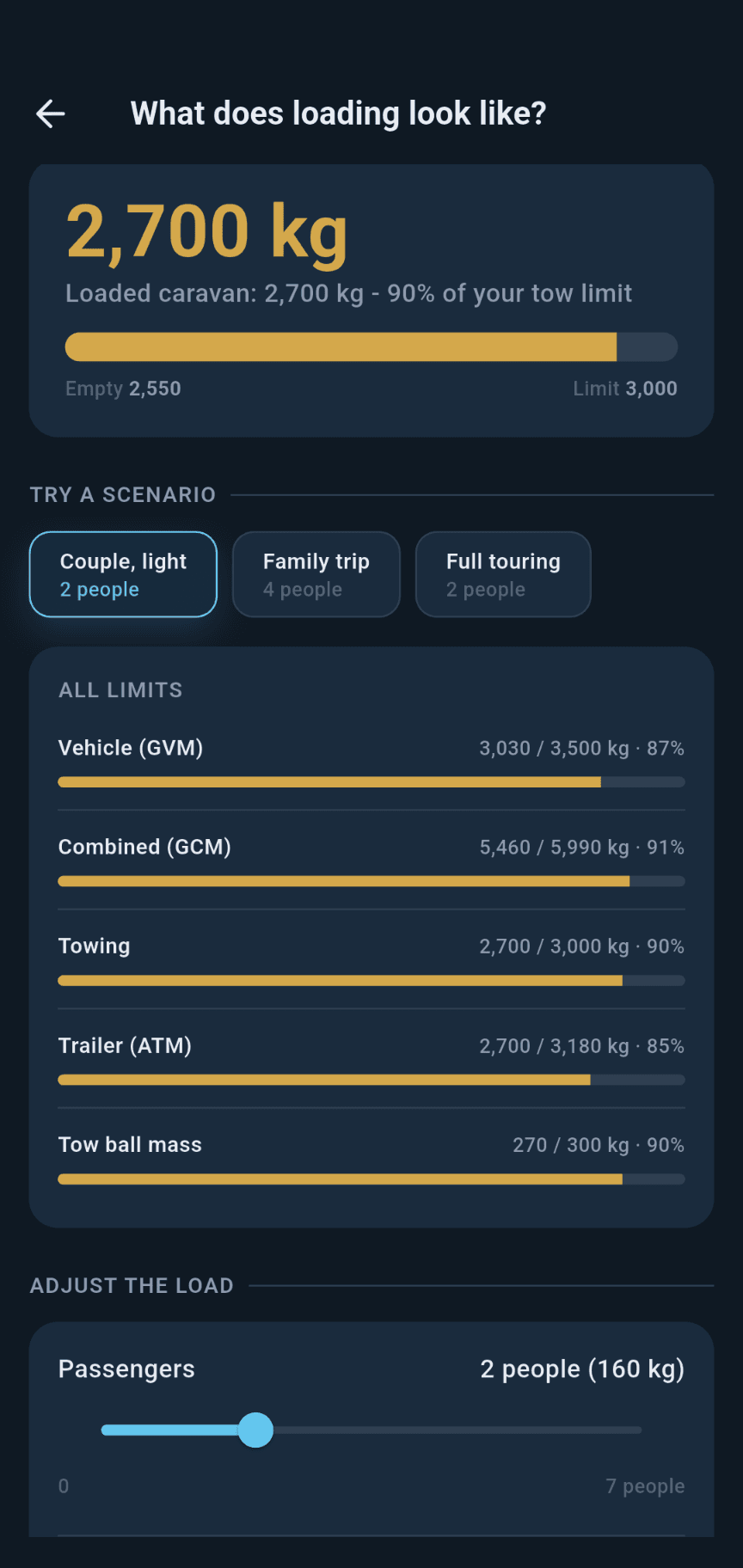
Feel the margin tighten as you load
Drag the sliders (passengers, water, gear) and watch each limit move in real time. The cheapest place to learn a rig runs heavy is before you buy it. Free in the app.


What do Tundra owners actually tow?
25 to 29 feet and 5,500 to 7,500 lb loaded, behind a weight distributing hitch. That envelope is consistent across three separate owner threads between 2023 and 2026, which makes it a pattern rather than one person's habit.
The rigs owners describe cluster tightly: a 29-foot trailer at roughly 7,000 lb loaded from a 5,850 lb dry weight, a 25-footer at about 6,000 lb, a 25-foot Grand Design Imagine 21BHE at roughly 5,500 lb with two adults and four children aboard, and one owner's self-imposed line of "around 7500# and 28' max". Economy in the same threads runs 8 to 12 mpg over 800 miles at 7,000 lb, 9 to 12 mpg over 2,400 miles at 7,500 lb, and about 10 mpg across more than 20,000 towing miles on a hybrid behind 7,000 lb.
What the top of the rating feels like is on record too. TFLtruck ran a Tundra i-FORCE MAX up the Ike Gauntlet in October 2022 with a 10,000 lb trailer, finishing the climb in 7 minutes 58 seconds against an 8 minute benchmark, at 3.5 mpg.
Whether the 12,000 lb figure means anything is an argument that runs on every Tundra board. One side points at the SAE J2807 test behind it. The other calls the maximum "a marketing gimmick" and says most Tundras are not rated close to it, then applies a rule of thumb: 80 percent of the rating, or "stay around 2/3 of max tow rating or less". Both sides are managing the wrong number. On the CrewMax that most Tundra owners bought, a percentage haircut off the tow rating discounts a ceiling the trip was never going to reach and leaves the tongue and payload lines exactly where they were. Work from the label instead, and the arithmetic is subtraction: the driver, the passengers, whatever is riding in the bed and the hitch hardware come off first, and what is left is what may sit on the ball.
Above that envelope the conversation turns to a three-quarter-ton, because there is nothing above this truck in Toyota's lineup.
One thing is worth doing before the next trip, and it happens in the door frame. Go and read the newest capacity label there, and note which of the three stickers it is, because six times since November 2022 the fix for a Tundra safety campaign has been to print that label again. The label the truck carried in 2022 is not necessarily the one on it now. The most recent campaign covers a single 2026 truck and its owner letter is due on September 4, 2026, and if one of those letters turns up with a new sticker in it, the number you have been planning from has just changed.
Related guides
Where the label, the tongue figure and the combined rating are each worked through in full.
- What can I tow?: the same three checks with no door frame attached
- Towing capacity chart: where an 8,300 to 12,000 lb range sits against the rest of the half-ton field
- Payload vs towing capacity: where the 2,200 lb of tow rating the Jay Feather never touches goes, and why it cannot be spent
- Tongue weight vs payload: why a 1,265 lb tongue is 65 lb past the ball figure Toyota prints for the same truck
- Towing weight ratings explained: what GVWR, GAWR and GCWR each count, and which of them Toyota keys to your grade
- Read a CAT scale ticket: how to read the ticket that put a 1,400 lb door label 150 lb out
- Weight distribution hitch and front axle load: what the bars do above the 5,000 lb line Toyota sets
- How much can a Ram 1500 tow?: the half-ton whose axle code moves the rating 3,100 lb, where a Tundra's grade badge moves it 3,700 lb
- How much can a Toyota Tacoma tow?: the midsize Toyota, where the tow rating and the payload figure move in opposite directions
- How much can a Ford F-150 tow?: the half-ton whose advertised maximum belongs to a build you have to go looking for, where Toyota names this one twice
Frequently asked questions
- Why is my Tundra's payload sticker lower than Toyota's figure?
Because Toyota's published figure belongs to the lightest-equipped truck in that column and the label belongs to the one in your driveway, with its trim, its options and any accessories fitted after assembly. On a third-generation CrewMax the door label usually says between 1,290 lb and 1,390 lb, against the 1,820 lb to 1,830 lb Toyota publishes as the CrewMax maximum for the gas engine. Owner-posted labels between January 2023 and August 2024 include a 2023 Limited L at 1,390 lb, a 2024 SR5 at 1,390 lb and a 2024 1794 hybrid at 1,290 lb, with i-FORCE MAX hybrids running roughly 45 lb to 100 lb below their gas equivalents. The line to find is the combined weight of occupants and cargo on the tire and loading information label. If a load carrying capacity modification label was added after assembly, that one supersedes it.
- Can a Tundra tow a 7,000 lb trailer?
Every 2026 Tundra above the SR grade is rated well past 7,000 lb, so the answer turns on what the trailer puts on the ball, and its total weight is the easy half. At Toyota's 9 to 11 percent a 7,000 lb trailer puts 630 lb to 770 lb on the ball, which fits the published tongue ceilings of 1,117 lb to 1,200 lb comfortably and then comes out of a payload allowance that real CrewMax labels put at 1,290 lb to 1,390 lb. An owner towing a 27-foot trailer at roughly 7,000 lb loaded in May 2026 reported being maxed out on payload with nothing in the bed. Subtract the people and the gear from your own label first, and what is left is the ball budget.
- What is my actual max tongue weight?
Toyota publishes one per cab and drivetrain for 2026: 1,200 lb on the 4x2 Double Cab, 1,145 lb on the 4x2 CrewMax, 1,120 lb on the 4x4 Double Cab and 1,117 lb on the 4x4 CrewMax. Your working figure is whichever of those applies, or whatever payload has left after people and gear, whichever is smaller. Toyota's 2022 owner's manual asks for 9 to 11 percent of gross trailer weight on a conventional hitch and warns separately that the maximum rating specified for the hitch assembly itself must never be exceeded, even where the truck could physically pull more.
- Does the 2026 Tundra SR come with a trailer brake controller?
No. In Toyota's 2026 Product Information the Trailer Brake Control system and TOW/HAUL Mode Select are marked as not offered on the SR and standard on every grade above it. Two SR owners posting in November and December 2025 describe the consequences: the plug-in aftermarket unit most owners try first was rejected by the truck's software, and the dealer declined to retrofit the factory part because the truck had not left the factory with one. The SR's tow rating is 8,300 lb either way, and Toyota's 2022 manual puts the unbraked trailer weight rating at 1,000 lb, so a trailer needs its own brakes long before that rating is in play.
- Is the hybrid or the gas engine better for towing?
It depends on which limit you are near, and the popular version of this comparison is wrong in both directions. The gas i-FORCE holds the lineup's highest figure at 12,000 lb, but the i-FORCE MAX holds the second highest at 11,450 lb and beats the gas engine in three of the four columns where both are offered at the same grade, such as the 4x2 CrewMax Limited at 11,350 lb against 11,230 lb. What the hybrid costs is payload: its curb weights run several hundred pounds higher and owner labels roughly 45 lb to 100 lb lower. If payload is your tight line, the gas truck gives you more of it. On the TRD Pro and Capstone the hybrid is the only powertrain, so the question does not arise.
- Are Toyota Tundras good for towing?
By the numbers they are rated between 8,300 lb and 12,000 lb for 2026 under the SAE J2807 method, with combined ratings up to 17,700 lb and published tongue ceilings between 1,117 lb and 1,200 lb. What owners run into is not the rating. Three separate threads between 2023 and 2026 put the comfortable envelope at 25 to 29 feet and 5,500 lb to 7,500 lb loaded behind a weight distributing hitch, at 8 to 12 mpg. The constraint they name is payload, and nobody in those threads complains about pulling power. Owners who want more than that talk about moving to a three-quarter-ton, because Toyota does not build a Tundra above this one.
- How much could the old 5.7 V8 Tundra tow?
Toyota's own third-generation launch release states that maximum towing increased 17.6 percent to 12,000 pounds, which works back to about 10,200 lb for the second-generation truck. The 5.7-liter V8 ended with that generation, and for 2022 onward the Tundra is the 3.4-liter twin-turbo V6 or the i-FORCE MAX hybrid version of it, with coil springs at the rear instead of leaves. If you are reading a page that quotes 10,200 lb for a current Tundra, it is describing the previous truck.