A weight distribution hitch at a glance
- What it does
- Levers some of the tongue weight off the rear axle and shares it onto the front axle and trailer axles
- The goal (FALR)
- Front axle load restoration: return 50–100% of the weight the tongue levered off the front axle
- What it changes
- Where the load sits, axle by axle (and with it the front-axle weight, steering and braking)
- What it does NOT change
- Any weight rating: GVWR, GCWR, GAWR, payload or trailer GVWR (see the full table below)
- Required by law?
- No. It is optional equipment; your owner's manual governs whether one is recommended, required, or barred
- Before you fit one
- Read the owner's manual and the hitch label; confirm your hitch is rated for the load when distributing
- The legal frame
- Your loaded rig must still sit under the lowest-rated component. The hitch never moves that ceiling
Look at the rating plate riveted to your receiver hitch and you will often find two numbers, not one: a lower weight-carrying figure and a higher weight-distributing figure. The second number is real, but you only get to use it when a weight distribution hitch is fitted. This guide explains what one actually does, the front-axle weight it hands back, how you set it up, and the line that trips most people: a hitch lets you reach its higher rated potential without raising a single weight rating on your truck or trailer.
How does a weight distribution hitch work?
A weight distribution hitch leans on a pair of spring bars to take a share of the tongue's download off the rear axle and spread it onto the front axle and the trailer's own axles; the total load is rearranged, never reduced. Each bar links the hitch head to a bracket on the trailer's A-frame; tighten them and the coupling levers steer-axle weight back where it belongs.
Picture the coupling as a seesaw with the rear axle as its fulcrum. The hitch ball sits on the long arm, well behind the rear axle, so a heavy tongue does what any load on a long lever does: it pushes the rear of the truck down and lifts the front. etrailer describes the mechanism plainly: the spring bars "transfer some weight to your tow vehicle's front axle, as well as your rear axle and trailer axles." Tension the bars and the seesaw rebalances, putting steer-axle weight back where the suspension expects it.
The part people get wrong is that word, transfer. A weight distribution hitch does not lighten your tongue weight. The download the trailer puts on the ball is the same before and after; what changes is which axles carry it. That distinction is also why a distributing setup behaves so differently from a plain ball mount: a regular hitch leaves the whole tongue load pressing on the rear axle, while a distributing hitch spreads it, which is the difference between a vague nose and a truck that still steers.
The two ratings on your hitch: weight-carrying vs weight-distributing
A US receiver hitch carries two ratings: a lower weight-carrying number used with just the hitch, ball mount and ball, and a higher weight-distributing number you reach only when a weight distribution hitch is fitted. The hitch unlocks its own higher rating. It does not hand your truck or trailer any extra capacity. Read those two stamped numbers as "more capacity" and you have made the mistake this page is built to undo.
CURT's hitch-class chart shows the gap in pounds. A Class 3 hitch is rated up to 8,000 lb gross trailer weight with 800 lb of tongue weight when weight-carrying, but up to 12,000 lb with 1,200 lb of tongue weight when weight-distributing:
| Hitch class | Weight-carrying (no WDH) | Weight-distributing (with WDH) |
|---|---|---|
| Class 3 | Up to 8,000 lb GTW / 800 lb tongue | Up to 12,000 lb GTW / 1,200 lb tongue |
| Class 4 | Up to 10,000 lb GTW / 1,000 lb tongue | Up to 12,000 lb GTW / 1,200 lb tongue |
Here is the guard that keeps the claim in bounds. The higher number is the hitch's own rated potential, not extra vehicle capacity. etrailer puts it directly: a weight distribution hitch "doesn't boost your hitch's towing capacity; it just allows you to use your hitch to its full, rated potential," and "won't increase your vehicle's towing capacity." On a Draw-Tite Class V example etrailer makes the same point: fitting a distribution system leaves the hitch at 1,200 lb tongue and 12,000 lb trailer, and "will not increase the towing capacity of your vehicle." Your towing setup is only as strong as its lowest-rated component, so the ceiling stays wherever the lowest number sits.
Do you need a weight distribution hitch?
Most manufacturers recommend one once the trailer passes about 5,000 lb or the tongue weight passes about 500 lb on a half-ton, and the signal on the road is a light, vague front end under a heavy tongue. It is optional equipment, not a legal mandate. The instrument that decides is your owner's manual.
Cars.com, summarizing the major makers' recommendations, puts the common half-ton threshold at about 5,000 lb of trailer or 500 lb of tongue weight, and is blunt about the limit of the device: "a weight-distribution hitch will not increase the overall towing capacity of a vehicle." Some platforms go the other way and prohibit one outright. etrailer notes that certain unibody vehicles, such as some Audi models, are not permitted to run a weight distribution hitch because the frame cannot safely take the distributed forces. So the manual, and the hitch's own label, have the final word: some rigs recommend one earlier, some bar one entirely, and a well-matched truck under a light tongue may never raise the question.
Tongue weight wants to sit in the 10–15% band of the loaded trailer weight: below 10% the trailer is prone to sway, above 15% the truck's front end lightens and the rig grows less responsive when turning and braking (CURT). A weight distribution hitch does nothing to change that download. It only changes which axles feel it. That download is also the weight a heavy tongue lifts off the front axle in the first place, the front-end relief a hitch is fitted to restore; our tongue weight vs payload guide walks how that ball load is spent and where it lands.
How much front-axle weight should a weight distribution hitch restore?
Front axle load restoration (FALR) is the goal you tune a weight distribution hitch toward: returning 50 to 100% of the weight the tongue levered off the front axle. Cars.com states the convention directly: "the idea behind the FALR method is to return 50–100% of the weight that was lost from the front axle back to it." The major makers each specify a target; commonly that target is about 50%, with Ram nearer two-thirds. You set it as a measured front-fender height or a steer-axle scale reading, not as maximum tension.
Follow one illustrative rig to see the ladder. Take a half-ton pickup (GVWR 7,100 lb, curb weight 5,400 lb, payload 1,700 lb, front GAWR 3,900 lb, rear GAWR 4,100 lb, GCWR 17,000 lb, 145-inch wheelbase) pulling a large travel trailer loaded to 10,500 lb with 1,300 lb of tongue weight (12.4% of the loaded trailer, inside the band). The hitch ball hangs about 50 inches behind the rear axle, so it acts on a lever of 50 ÷ 145, or 0.34. Coupling up therefore lifts about:
1,300 lb × (50 ÷ 145) = about 450 lb off the front axle
So the front axle drops from roughly 3,650 lb solo to about 3,200 lb hitched: the light-nose symptom, in pounds. A weight distribution hitch puts some of that back:
| Setting | Front axle (illustrative) | What it means |
|---|---|---|
| 0% (bars off) | ~3,200 lb | The full ~450 lb loss: nose light, steering and braking degraded |
| ~50% FALR | ~3,425 lb | About 225 lb handed back, the common target |
| 100% FALR | ~3,650 lb | The full ~450 lb back, front at its unhitched scale weight |
Aim the steer-axle reading somewhere in that 3,200-to-3,650 lb window. Set the bars too loose and the front sits short of 3,200 lb with the nose still light; crank them too hard and you push past the solo 3,650 lb figure, levering the rear higher than it should ride. Across every setting in the ladder the front axle stays under its 3,900 lb GAWR. Full restoration only returns the front to the weight it carried solo, never beyond it. The hitch is handing back lost load, not adding new load.
How do you set up a weight distribution hitch?
You set a weight distribution hitch against three height measurements on the tow vehicle: with no trailer, with the loaded trailer coupled but the spring bars off, and with the trailer coupled and the bars tensioned. The Equal-i-zer setup method is exactly this sequence: measure without the trailer coupled, then coupled with no distribution, then coupled with the bars tensioned.
The working target follows from those three readings. Camping World's how-to puts the floor and the ceiling in plain terms: adjusting the hitch should "at the least" cut the difference between your unloaded and your hitched-no-bars measurement in half, and in some cases you can level the setup back to the unloaded figure. So you tension the bars until the front of the truck has settled roughly halfway back toward where it sat unhitched, up to full restoration if your target is 100% FALR.
Counting chain links gets you close; a number confirms it. One independent tow test walked the three passes on a CAT scale: the truck alone, then hitched with no distribution (the steer axle dropping over 300 lb), then with the bars set, watching the front steer axle regain weight and the truck move back toward its factory stance. A certified truck scale reading on the steer axle is the cleanest confirmation that your fender measurement actually landed where you wanted it.
Does a weight distribution hitch raise your towing limits?
No. A weight distribution hitch changes where the load sits, not how much you are allowed to carry. It raises your GVWR, GCWR, GAWR, payload and trailer GVWR by exactly zero pounds. Each of those numbers is stamped by the manufacturer and stays put; shuffling load from one axle to another has no way to lift a figure the factory set.
The federal definitions make the reason concrete. GVWR is "the value specified by the manufacturer as the loaded weight of a single vehicle"; GCWR the same for the combination; GAWR "the load-carrying capacity of a single axle system, as measured at the tire-ground interfaces" (49 CFR 571.3). A hitch shifts load between the front and rear axle, but it does not raise either axle's rating, and it cannot touch the whole-vehicle or combination numbers at all.
| What a weight distribution hitch changes | What it does NOT change |
|---|---|
| Front axle load (restored) | GVWR: the truck's loaded limit |
| Rear axle load (reduced) | GCWR: the combination limit |
| The trailer's axle load (shared up) | GAWR: front and rear, unchanged |
| Steering, braking and stance | Payload: GVWR minus curb weight |
| Trailer GVWR and the tow rating |
On the worked rig nothing in that right-hand column moves when you fit or tighten the hitch: GVWR stays 7,100 lb, GCWR stays 17,000 lb, the front and rear GAWR stay 3,900 and 4,100 lb, payload stays 1,700 lb. So a truck-plus-trailer that already tops its GCWR, or a truck that already tops its payload, is just as over with the bars cinched tight: the same total weight is now parked across more axles, which is balance, not permission. The full set of ceilings you have to clear is laid out in our towing weight ratings guide, which runs the same axle lever through GVWR, GCWR, GAWR and payload one at a time.
Weight distribution versus sway control
A weight distribution hitch and sway control solve two different axes of the same problem. The hitch works the vertical axis (the up-and-down balance of weight across your axles), while sway control works the horizontal one, fighting the side-to-side snake a trailer can fall into behind you. Lippert states the split directly: a weight distribution hitch "addresses vertical weight concerns," a sway control bar "manages horizontal instability," and "they don't replace each other. They complement one another."
The practical reading is that one will not do the other's work. A weight distribution hitch alone will not fully stop trailer sway, and a sway bar will not fix the leveling and balance problems a heavy tongue causes. Some integrated units fold both functions into a single head (Lippert cites the CURT TruTrack, which combines distribution and sway management), but even when the hardware is shared, the two jobs stay separate. You fit weight distribution for the vertical balance this guide is about, and add sway control on top of it when the side-to-side story calls for it.
How loadmate helps you stay under your weight ratings when you fit a hitch
A fender tape and a CAT-scale ticket give you the front-axle weight for the load you set the bars against. The WDH Effect Preview in loadmate models the distribution setting you enter and shows the pounds coming back to the steer axle, leaving the rear and shifting onto the trailer axles. That gives the setting a weight picture to compare with your measurements and the hitch manufacturer's instructions.
Any tension you settle on belongs to one load. More water, heavier camping gear or bikes on the back can change the tongue weight since the hitch was set. loadmate keeps recorded load changes connected to the saved hitch assumptions and flags when the tongue weight needs review. Explore loadmate in the app to see how repacking can affect the axle picture.
loadmate provides decision support for towing safety, not legal weight certification. Score, compliance checks, and trip readiness are based on the data you enter and the regulator information current at the time of release. For legal weight evidence, use a certified truck scale / CAT scale. Towing remains the operator's responsibility. See /safety-disclaimer.
Related guides
The Wave-1 deep-dive guides are live; the US vehicle hub is publishing as the US set rolls out. This guide links up to the pillar and across to each sibling:
- Towing weight ratings explained: GVWR, GCWR, GAWR & payload: the five limits a weight distribution hitch never changes (start here)
- Payload vs towing capacity: why the two are different numbers and which one limits your trip
- Tongue weight vs payload: how the trailer's tongue weight spends your truck's payload
- How to weigh a travel trailer at a CAT scale: getting the real steer-axle and loaded weights a hitch acts on
- How to read a CAT scale ticket: turning the CAT scale numbers into a pass or a fix
- Towing capacity chart: compare popular SUVs and trucks by max tow rating, then check your own
- What can I tow?: match your truck or SUV to a trailer and get a plain verdict
- Vehicles where owners reach for one: Ford Ranger, Toyota Tacoma and Jeep Wrangler, each at a different weight
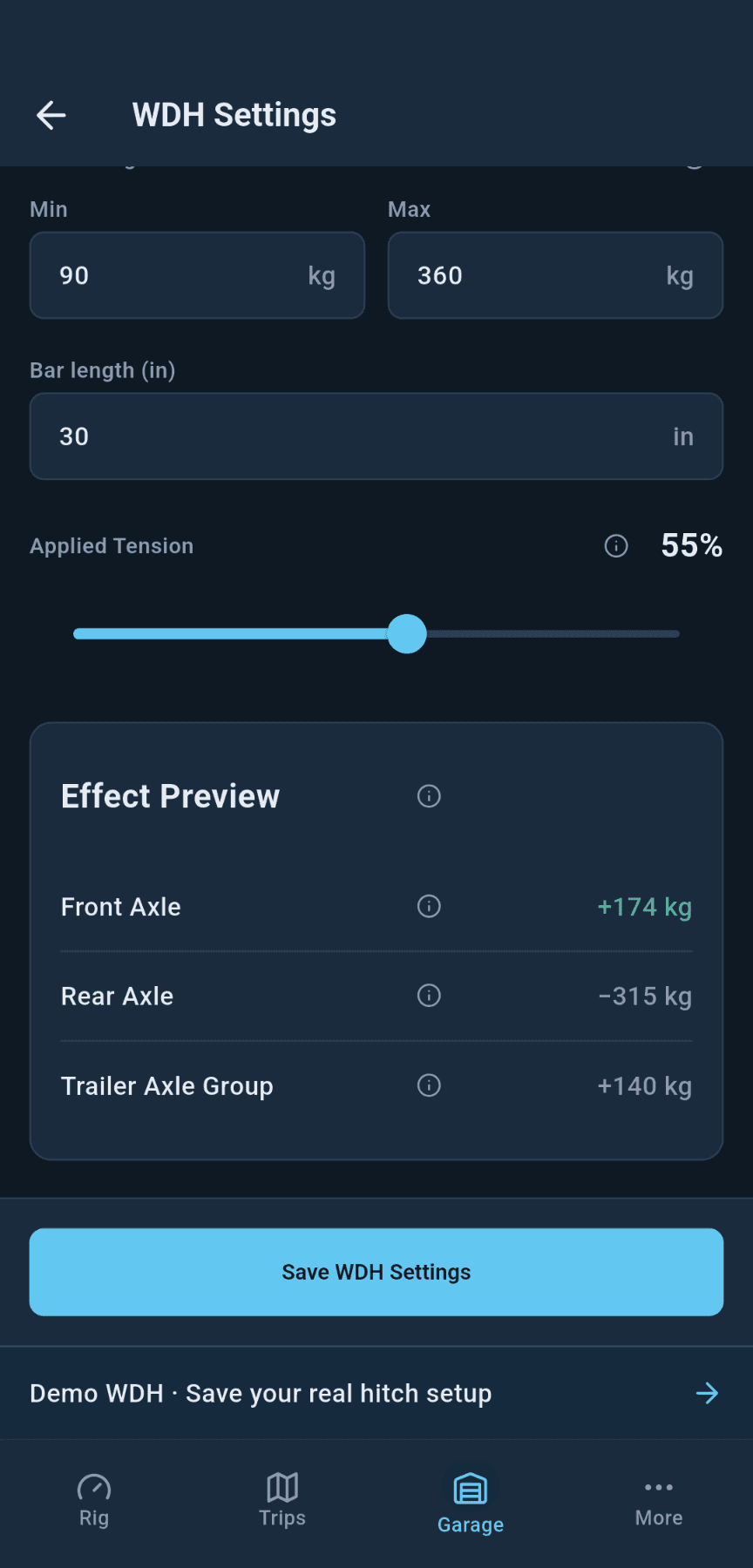
Tune the hitch for this load
loadmate models your weight distribution hitch, spring-bar or FALR, and shows the load coming back onto the steer axle. A tension set for one load is wrong for the next, so the model moves when the load does. Create a free account to explore it on a populated demo rig in the app.


Frequently asked questions
- How does a weight distribution hitch work?
A weight distribution hitch uses spring bars as a lever to transfer some of the trailer's tongue weight off the tow vehicle's rear axle and share it forward to the front axle and back to the trailer's own axles, which restores the steering and braking a heavy tongue takes away. It moves load between axles; it does not remove any weight, so your tongue weight and every weight rating stay exactly the same.
- At what point do I need a weight distribution hitch?
Most manufacturers recommend one once the trailer passes about 5,000 lb or the tongue weight passes about 500 lb on a half-ton, and the signal on the road is a light, vague front end under a heavy tongue. It is optional equipment, not a legal mandate. Check your owner's manual, because some vehicles recommend one earlier and some prohibit one entirely.
- Does a weight distribution hitch increase my towing capacity, GVWR or GCWR?
No. A weight distribution hitch lets your hitch reach its higher weight-distributing rating, but it will not increase your vehicle's towing capacity and cannot raise your GVWR, GCWR, GAWR or payload. Those are fixed manufacturer ratings. If a rig already tops one of those limits, fitting a hitch leaves it just as over: the load is spread across more axles, but the total has not changed and neither has the ceiling.
- What is the difference between a hitch's weight-carrying and weight-distributing rating?
A receiver hitch is rated twice: a lower weight-carrying number used with just the hitch, ball mount and ball, and a higher weight-distributing number reached only when a weight distribution hitch is fitted; for example CURT rates a Class 3 hitch up to 8,000 lb weight-carrying but up to 12,000 lb weight-distributing. The higher number is the hitch's own rated potential; it is not extra vehicle capacity.
- How do you set up a weight distribution hitch?
You take three height measurements on the tow vehicle: with no trailer, with the loaded trailer coupled but the spring bars off, and with the trailer coupled and the bars tensioned. The working target is to bring the front of the vehicle back toward its unloaded height (at least cutting the difference in half, up to full restoration), then confirm it with the front fender measurement or a CAT-scale steer-axle weight.
- How much front-axle weight should a weight distribution hitch restore?
Front axle load restoration (FALR) is the goal: returning 50–100% of the weight the tongue levered off the front axle. The major makers commonly target about 50%, with Ram nearer two-thirds: set as a measured front-fender height or a steer-axle CAT-scale reading, not maximum tension. On the illustrative rig, the front drops from about 3,650 lb solo to 3,200 lb hitched, and a 50% setting hands back roughly 225 lb.
- Is a weight distribution hitch the same as sway control?
No. The two address different problems: a weight distribution hitch handles the vertical weight concerns between your axles, while sway control tackles the horizontal instability of a trailer wandering side to side (Lippert). They complement each other rather than substitute, so one will not do the other's work. Some integrated units combine both in a single head, yet the vertical and lateral jobs stay distinct.
- Can any vehicle use a weight distribution hitch?
No. Some platforms restrict or prohibit one. For example, certain unibody vehicles such as some Audi models prohibit a weight distribution hitch because the frame cannot safely take the distributed forces. Your owner's manual and the hitch's own label govern; your towing setup is only as strong as its lowest-rated component, so go by the lowest number, never assume approval.