Colorado towing at a glance
- Four ratings, one powertrain
- 7,700 lb with the Trailering Package, 6,000 lb ZR2, 5,500 lb ZR2 Bison, 3,500 lb with no package. Every 2026 row runs the same 2.7L TurboMax at the same 3.42 axle ratio
- Where Chevrolet stops saying optional
- 6,000 lb of trailer weight. Below it the 2026 Trailer Towing Supplement calls a weight-distributing hitch Optional, above it Required
- The setting the requirement names
- 50% distribution, printed on both rows of the supplement's hitch table, and 2026 is the first edition to print it on the Optional row as well
- Two boxes behind the top figure
- The Trailering Package, and on 2026 4WD a limited-slip differential as well. Both are order-sheet decisions
- Before the odometer reads 500
- No trailer at all, an oil change brought forward, then a 50 mph cap and no starts at full acceleration through the first 500 miles of towing
- Brakes, two GM numbers
- The 2026 supplement puts trailer brakes above 2,000 lb; the 2025 Chevrolet Trailering Guide puts them above 1,500 lb on every model outside the Silverado, Suburban and Tahoe group. Your state sets its own figure
- Tongue figures, all four rows
- 770 lb with the Trailering Package, 600 lb ZR2, 550 lb ZR2 Bison, 350 lb without the package
- Carrying figures, from GM's fleet guide
- GVWR 6,250 lb on 4WD and 6,049 lb on 2WD, from a fleet-guide page GM heads 2025; payload 1,710 lb on a Work Truck, 1,580 lb on a Trail Boss or Z71, 1,280 lb on a ZR2
- Mirrors, and where they come from
- Chevrolet tells you to fit extended side view mirrors where visibility is restricted, and lists trailering mirrors for the Silverado 1500 and Silverado HD only
- Where the document trail ends
- The supplement sends you to the owner's manual for GVWR, and the manual sends you to the certification label and the tire and loading information label in your own door frame
Chevrolet's towing rules for a 2026 Colorado open with three instructions, and the third one is do not tow. Follow state and local law, fit extended side view mirrors if your visibility is restricted while towing, and then leave the trailer off entirely for the first 500 miles of the truck's life. A towing document that opens by telling you not to tow is a fair warning about how the rest of it reads.
The 7,700 lb figure everyone quotes arrives well after that, at the end of a list of conditions, and one condition on the list binds 1,700 lb below it. The 2026 Colorado/Canyon Trailer Towing Supplement, GM part 19451455A, carries a two-row table on printed page 10 headed "Weight-Distributing Hitch and Adjustment". Up to 6,000 lb of trailer weight the entry reads Optional. Over 6,000 lb it reads Required, at 50% distribution.
Chevrolet therefore rates this truck 1,700 lb past its own line, and only one of its four Colorado ratings clears that line at all. The ZR2 stops at 6,000 lb, exactly on it, the ZR2 Bison at 5,500 lb and the truck without the package at 3,500 lb. The Trailering Package truck's rating runs 1,700 lb past it, 22% of the number printed on the chart, on the same engine, the same 3.42 axle ratio and the same crew cab. No GM document opened for this page lists a weight-distributing hitch inside the package that unlocks the higher figure.
How much can a Chevy Colorado tow?
A 2026 Chevy Colorado is rated to tow 7,700 lb with the Trailering Package, 6,000 lb as a ZR2, 5,500 lb as a ZR2 Bison, and 3,500 lb in the configuration with no package fitted. Those four figures come from the 2026 Colorado/Canyon Trailer Towing Supplement, GM part 19451455A, printed June 2025, which is the only 2026 document that carries all four configurations together with their tongue weights.
| 2026 configuration | Maximum trailer weight | GCWR | Maximum tongue weight |
|---|---|---|---|
| 2.7L TurboMax with the Trailering Package | 7,700 lb | 13,250 lb | 770 lb |
| 2.7L TurboMax, no Trailering Package | 3,500 lb | 9,100 lb | 350 lb |
| ZR2 | 6,000 lb | 11,600 lb | 600 lb |
| ZR2 Bison | 5,500 lb | 11,600 lb | 550 lb |
What separates those rows is worth being exact about, because it is easy to assume it is the engine. For 2026 the Colorado line has one engine in one state of tune, the 2.7-liter TurboMax at 310 hp and 430 lb-ft, and Chevrolet's table lists that engine at a 3.42 axle ratio on every single row. Cab, bed and wheelbase are fixed too: crew cab, 5 ft box, 131.3 in between the axles, across the whole 2026 range. So the split between 3,500 lb and 7,700 lb is equipment, and the same equipment moves GCWR from 9,100 lb to 13,250 lb. Engine output does not appear as an axis in Chevrolet's table anywhere.
Chevrolet's one-page 2026 trailering chart, the sheet a dealer is most likely to show you, prints only two of those four rows. The base 3,500 lb configuration is missing from it and so is the ZR2 Bison. If your Colorado left the factory without the Trailering Package, the current chart has no row for your truck, and the figure you need is in the supplement instead. Both ends of the range sit on the towing capacity chart alongside the other midsize trucks.
A pair of footnotes travels with the top figure. Chevrolet calculates these ratings under SAE J2807, and states in the same document that the process assumes a driver, a front-seat passenger and all required trailering equipment already aboard. The word "required" in that sentence is doing more work than most readers expect, because Chevrolet uses it again further on, about equipment nobody has bought yet.
What does a Colorado's tow rating oblige you to fit or do?
Thirteen separate things, and Chevrolet prints all of them. They are set out below in the order they bind rather than the order they appear in Chevrolet's documents, they each have their own threshold, and the one that costs the most is number eight of the thirteen rather than the figure at the top.
Five of them are settled before a trailer is ever attached, and one of those was settled before you owned the truck.
| Step | When it binds | What Chevrolet's document requires | What it costs an owner |
|---|---|---|---|
| 1 | The truck's first 500 mi | No trailer at all for the first 500 mi of vehicle use, "to prevent damage to the vehicle" | A wait. For 500 miles the answer to this page's question is nothing |
| 2 | Before heavy towing | "Perform the first oil change before heavy towing." | A service visit, ahead of schedule |
| 3 | The first 500 mi of towing | No more than 50 mph, and no starts at full acceleration, through the first 500 mi of trailer towing | 50 mph for your first towing trip |
| 4 | Any published rating at all | The 3,500 lb row "Requires available accessory trailer hitch and trailer wiring harness." | An accessory purchase before a number applies to your truck |
| 5 | The 7,700 lb rating | "Available only with Trailering Package", and on 2026 4WD, "Requires available Trailering Package and limited-slip differential." | Two order-sheet decisions, both taken before you owned the truck |
The rest are conditions on the trip in front of you.
| Step | When it binds | What Chevrolet's document requires | What it costs an owner |
|---|---|---|---|
| 6 | Trailer weight above 1,500 or 2,000 lb | The supplement says over 2,000 lb; the 2025 Trailering Guide says over 1,500 lb on models outside the Silverado, Suburban and Tahoe group | Brakes on the trailer, plus whichever figure your state sets |
| 7 | Whenever the trailer has electric brakes | "The vehicle may have an Integrated Trailer Brake Control system for use with electric trailer brakes." | An option box, or an aftermarket controller if the box went unticked |
| 8 | Trailer weight above 6,000 lb | A weight-distributing hitch, Optional up to 6,000 lb and Required over it, at 50% distribution on both rows | A hitch head and spring bars, on top of the package that granted the rating |
| 9 | Whenever the bars are on | Set the front fender to "H2-[(H2-H1)/2]", halfway between the unhitched and hitched ride heights | Three measurements and an adjustment, again whenever the loaded weight changes |
| 10 | Where visibility is restricted | "Install extended side view mirrors on your vehicle if your visibility is limited or restricted while towing." | A dealer or aftermarket item, since the 2025 guide's mirror listings run to the Silverados |
| 11 | Whenever a trailer is attached | Park Assist, Reverse Automatic Braking, Rear Cross Traffic Alert, Lane Change Alert and Super Cruise are listed as off or self-disabling | Driver-assistance features you paid for, switched off |
| 12 | Every trip | Tongue weight "must not cause vehicle weights to exceed Rear Gross Axle Weight Rating (RGAWR) or Gross Vehicle Weight Rating (GVWR)" | The weight on the ball, drawn from the same allowance as your passengers |
| 13 | Always | GVWR and both axle ratings on the certification label; capacity weight on the tire and loading information label in the door frame | A walk to the door frame, for the only per-truck figure in the whole chain |
One entry in the "what it costs" column behaves unlike the others. Everything else is either free, already fitted, or a box that was ticked or not ticked in 2025. Step 8 is a purchase, and it lands after the rating was already granted. Step 13 is the only figure in the chain that belongs to your truck rather than to the model line, and every document above it eventually points at it.
Do you need a weight distribution hitch with a Chevy Colorado?
Chevrolet answers that with a table, and above 6,000 lb of trailer weight the table says Required. The section it sits in opens with the line "Use the following guidelines to determine if a weight-distributing hitch is required", and then prints two rows.
| Trailer weight | Weight-distributing hitch | Hitch distribution |
|---|---|---|
| Up to 6,000 lb | Optional | 50% |
| Over 6,000 lb | Required | 50% |
Two details in that table matter more than the threshold itself. The first is that the requirement comes with a specified setting, 50%, printed on both rows, and the supplement turns that setting into a fender-height formula rather than a judgement call, which is step 9 of the chain above. The second is that it has to be redone whenever the loaded weight changes, because the heights that formula reads move with the load. The pounds themselves stay on the combination whatever the bars are set to, and what the bars actually do with them is a subject of its own.
Two model years tightened this table, one at a time. The MY2024 manual introduced it with "to determine if a weight-distributing hitch should be used", and the MY2025 manual already reads "is required", so the verb moved a model year before the supplement existed. Both of those manuals left the Optional row's distribution column reading "Refer to the trailer manufacturer's recommendation", and the 2026 supplement prints 50% there instead. The 6,000 lb threshold itself has not moved in three model years.
Now put a real trailer against it. The worked example on this page is a 2026 Forest River Salem Cruise Lite 261BHXL, 4,953 lb dry and 7,545 lb at its own Trailer GVWR, with 2,592 lb of cargo capacity in between. Hitched empty it sits 1,047 lb below Chevrolet's line, so the bars are optional. Pack 1,047 lb into it, which is about 40% of what the trailer is rated to carry, and the same trailer crosses into the row that says Required. All that moved is which row of Chevrolet's table the combination is standing on, and it moved while somebody was loading bedding and firewood.
This is where a lot of Colorado owners are working without knowing it. Across fourteen owner sources read for this page and six dated social posts from the two months to August 2026, the 6,000 lb requirement does not come up once. One dated tow test ran a 6,800 lb trailer over the Ike Gauntlet behind a 2023 Trail Boss, and another owner hauled roughly 7,000 lb of enclosed race trailer through Blue Ridge grades of 4 to 5%. Both sit above the line, and the written account of the first one covers the trailer, the tongue weight and the brake controller without arriving at a weight-distributing hitch.
That instruction arrives on a driveway, with the trailer coupled and the spring bars in somebody's hands, as a percentage and a measurement nobody has taken yet. Settle whether the pairing fits the truck's weights first. The Salem's 7,545 lb loaded weight sits 155 lb below the Trail Boss's 7,700 lb tow rating, but at an illustrative 12.5% tongue share it puts about 940 lb on a hitch limited to 770 lb. That share sits within Chevrolet's 10% to 15% guidance; it is an estimate to replace with a measured tongue weight. The tow rating alone misses the problem. Chevrolet's hitch setting also needs review when the load changes. Explore loadmate in the app to see how recorded tongue weight, load placement and a weight-distributing hitch setting affect the axle picture.
loadmate provides decision support for towing safety, not legal weight certification. Score, compliance checks, and trip readiness are based on the data you enter and the regulator information current at the time of release. For legal weight evidence, use a certified truck scale / CAT scale. Towing remains the operator's responsibility. See /safety-disclaimer.
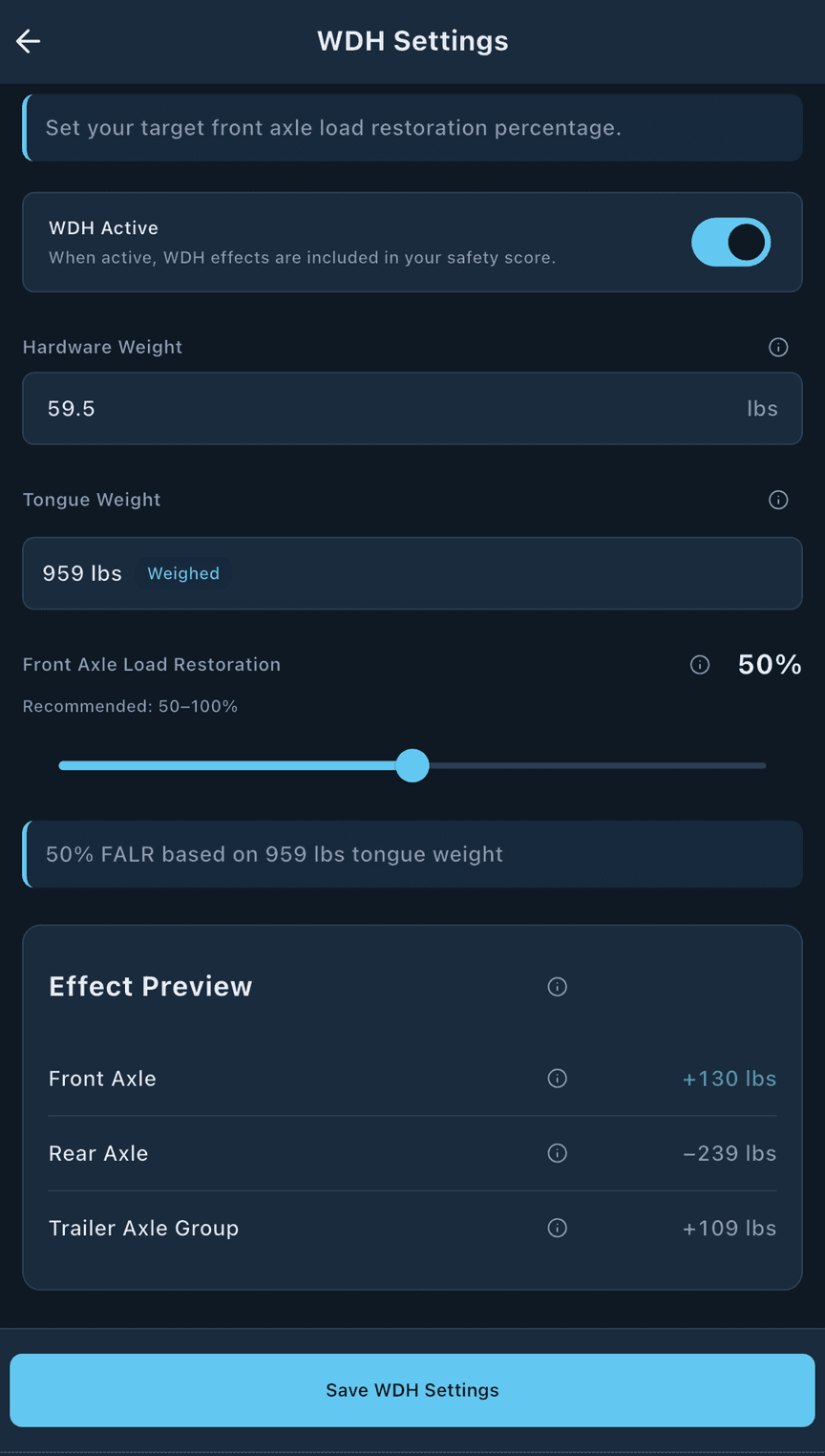
Set the hitch, then see where the load went
loadmate models a weight-distributing hitch from the percentage you set it to and reports the effect at the front axle, the rear axle and the trailer axle group, alongside the tongue weight you measured. That percentage describes one driveway and one loaded trailer. Repack, and the effect at each axle changes while the setting stays where you left it. Free to explore on a demo rig in the app.


Why does the ZR2 stop at 6,000 lb?
Because Chevrolet rates it to 6,000 lb and the Bison to 5,500 lb regardless of what else is fitted, and the ZR2's figure lands exactly on the hitch threshold. Its GCWR is 11,600 lb against the Trailering Package truck's 13,250 lb, and its maximum tongue weight is 600 lb against 770 lb.
That coincidence has a useful consequence for anyone shopping a ZR2 for a trailer. A trailer loaded to the top of the ZR2's rating is a trailer sitting on the last pound of Chevrolet's optional row, so across the whole of that trim's rated range the bars never become a requirement. It is the only Colorado configuration where that is true.
ZR2 owners ask about the gap constantly and usually ask it the same way. One 2023 owner put it plainly on a Colorado forum in February 2025: the 6,000 lb figure is respectable, but are there modifications that would bring it closer to the 7,700 lb the other trims carry? The replies pointed at the trim's suspension rather than its drivetrain, and at the fact that a published rating is not something an owner can revise upward. A prospective 2026 ZR2 buyer asked a near-identical question in an owners' group in July 2026. Chevrolet's answer, in both cases, is that the ZR2's rating is issued to the trim and the bars stay optional inside it.
One caution on the Bison. Chevrolet's model page lists the ZR2 Bison for 2026 and the supplement gives it 5,500 lb, 11,600 lb of GCWR and 550 lb of tongue weight, but neither the 2026 US trailering chart nor the 2026 Canadian edition prints a Bison row at all, and no GVWR or payload figure for it appears in any document opened for this page. Treat the 5,500 lb as the supplement's figure and check the order sheet before planning around it. There is a stray number in circulation too: the MY2025 owner's manual printed 5,900 lb for the Bison, while the MY2025 trailering guide printed 5,500 lb in the same year, and the 2024 and 2026 documents both say 5,500 lb.
How big of a camper can a Chevy Colorado pull?
Most of the way up the travel-trailer catalog, and the useful question is not whether a camper fits the rating but where in its own cargo capacity it crosses Chevrolet's 6,000 lb line. Six units, each dated to the model year its figures belong to, sorted by that crossing rather than by size.
| Trailer | Dry weight or UVW | Trailer GVWR | Where it crosses the 6,000 lb line |
|---|---|---|---|
| Aliner Expedition, 18 ft, no model year published | 1,985 lb | 3,500 lb | Never. Its own maximum is 3,500 lb |
| 2026 Rockwood Geo Pro G20BH, 21 ft 2 in | 3,843 lb | 4,998 lb (UVW plus cargo capacity) | Stays under the line at any load |
| 2026 Winnebago Micro Minnie 2108TB, 22 ft 5 in | 4,332 lb | 5,500 lb | Tops out 500 lb short of the line |
| 2026 Forest River Salem Cruise Lite 261BHXL, 28 ft 8 in | 4,953 lb | 7,545 lb (UVW plus cargo capacity) | At 1,047 lb of cargo, about 40% of the 2,592 lb it may carry |
| 2025 Jayco Jay Flight SLX 261BHS, 30 ft 4 in | 5,750 lb | 7,500 lb | At 250 lb of cargo, out of 1,750 lb |
| 2025 Jayco Jay Flight 267BHS, 30 ft 4 in | 6,075 lb | 7,600 lb | Before you pack it |
Anything whose own Trailer GVWR is 6,000 lb or under can never put a Colorado in the Required row, however you load it, which covers a large slice of the single-axle and small tandem-axle market. Above that, the crossing point is set by the dry weight rather than by the cargo capacity. The Salem starts 1,047 lb under the line with 2,592 lb of capacity, so it crosses 40% of the way through its own allowance. The Jay Flight SLX starts 250 lb under with 1,750 lb of capacity and crosses at 14% of it. The 267BHS is already over before any cargo goes in. Of the three that cross, the one with the most cargo capacity is the one that holds out longest.
Owner reports land on both sides of the line and read differently on each. Under it, a journalist towed a 4,650 lb trailer behind a 2023 Trail Boss on the earlier 310 hp Turbo Plus tune, held the engine at or below 3,000 rpm on a steep climb, saw slight trailer sway at 70 mph and recorded 11.9 mpg. Over it, the two runs mentioned earlier, at 6,800 lb and about 7,000 lb. And a Forest River forum thread about a 5,000 lb trailer behind a Colorado Z71 collects the recurring worry from the other direction: one owner treats payload rather than the tow rating as the figure that runs out first, another puts a personal cap at about 4,000 lb, and a Canyon owner added airbags after wind-sway trouble with a trailer of 5,300 lb dry.
Sorting candidates in advance takes two figures, the dry weight and the Trailer GVWR, and where a maker publishes both you can do it off the spec page. Forest River publishes unloaded vehicle weight and cargo capacity instead, so the Salem's 7,545 lb and the Geo Pro's 4,998 lb above are those two numbers added together. The gap between dry and loaded is the part you control, and on a Colorado it is also the part that decides which of Chevrolet's two rows you are towing under.
Does a Chevy Colorado need trailer brakes?
Above 2,000 lb according to the 2026 supplement, above 1,500 lb according to the 2025 Chevrolet Trailering Guide, and above whatever figure your state sets, whichever comes first. Two GM documents give two numbers for the same truck, so the safe reading is the lower one.
The supplement's wording is the stricter of the two on equipment: loaded trailers over 2,000 lb "must be equipped with brake systems and with brakes for each axle", meeting or exceeding CSA standard CAN3-D313. The 2025 Trailering Guide's brake line sets 2,000 lb for the Silverado, Suburban and Tahoe and 1,500 lb "on all other models", which puts the Colorado in the lower group. GM defers twice to state law in the same breath: "brake requirements vary by state, consult state laws for actual requirements", and state or local regulations may require a trailer's own brakes above a maximum value. Look up the rule for your own state DOT and for any state you plan to tow through, rather than carrying one national figure around.
The controller is a separate purchase from the brakes. Chevrolet's supplement says the vehicle "may have" an Integrated Trailer Brake Control system, the 2025 guide lists that controller as "available on Colorado" rather than standard, and a reviewer towing behind a 2023 Trail Boss described his as factory-optioned. So on a Colorado the integrated controller is a box that was ticked at order time or was not. If it was not, an aftermarket controller wires to the same connector, and that is the standard fix.
How much tongue weight can a Chevy Colorado handle?
770 lb with the Trailering Package, 600 lb on a ZR2, 550 lb on a ZR2 Bison and 350 lb with no package fitted. Those are the maximums Chevrolet prints beside each rating in the 2026 supplement, and each one belongs to its own configuration rather than to the truck as a whole.
Chevrolet attaches one condition to all four. Adding tongue weight "must not cause vehicle weights to exceed Rear Gross Axle Weight Rating (RGAWR) or Gross Vehicle Weight Rating (GVWR)", which means the weight on the ball is drawn from the same allowance as your passengers and everything in the bed. What that trade actually costs is worked through on tongue weight vs payload, and the bare tongue figures for each rating on a midsize truck are set out in full on how much can a Ford Ranger tow.
In practice that figure is reached faster than it reads. The 2025 Jayco Jay Flight 267BHS above carries a published dry hitch weight of 770 lb, the same figure Chevrolet prints for the Trailering Package truck, before anything is loaded into it. And the 6,800 lb Ike Gauntlet run put "nearly 800 lbs of tongue weight" on a 2023 Trail Boss with three people in the cab, at a trailer weight 800 lb past the row where Chevrolet stops calling the bars optional.
A hitch-mounted accessory carries its own limit alongside these. A cargo carrier in the receiver, plus whatever is loaded onto it, may be no more than half the vehicle's maximum allowable tongue weight or 500 lb, whichever is less.
What else does Chevrolet ask you to fit or switch off?
Extended side view mirrors, and about eight driver-assistance features. Both instructions sit on page two of the supplement, next to the break-in rules.
The mirror line reads: "Install extended side view mirrors on your vehicle if your visibility is limited or restricted while towing. State laws may require the use of extended side view mirrors." That instruction has an awkward companion fact. A full-text search of the 48-page 2025 Chevrolet Trailering Guide finds trailering mirrors offered in two levels on the Silverado 1500 and four levels on the Silverado HD, and the Colorado in none of them. So where a Colorado owner gets them is a question for a dealer or a parts counter rather than for that guide.
The driver-assistance list is longer than most owners expect: Park Assist, Automatic Parking Assist, Reverse Automatic Braking, Rear Cross Traffic Alert, Rear Cross Traffic Braking and Lane Change Alert are all named as features that should be turned off when towing or that turn off automatically once a trailer is detected, and Super Cruise and Adaptive Cruise Control join them unless the vehicle is equipped with trailering functionality. It is worth knowing before the first trip rather than at the first parking lot.
Where is a Chevy Colorado's payload printed?
On the tire and loading information label in your own door frame, and the route to it runs through three documents. The Trailer Towing Supplement carries every rating on this page and no GVWR at all; under Gross Vehicle Weight Rating it says "see your owner's manual". The 2026 owner's manual has had its towing section removed and replaced with a pointer back to the supplement, and it sends you to the labels for the load figures. The certification label carries GVWR and both axle ratings, and the tire and loading information label, attached to the B-pillar or the forward edge of the rear door, carries the combined weight of occupants and cargo that your specific truck was released with.
GM does publish payload by trim, in its Envolve fleet guide, and those figures are the ones to plan from until you have read your own label.
| Configuration | GVWR | Published payload |
|---|---|---|
| Work Truck Crew Cab 2WD | 6,049 lb | 1,710 lb, or 1,670 lb with the LT Package |
| Work Truck Crew Cab 4WD | 6,250 lb | 1,710 lb, or 1,670 lb with the LT Package |
| Trail Boss 4WD | 6,250 lb | 1,580 lb |
| Z71 4WD | 6,250 lb | 1,580 lb |
| ZR2 4WD | 6,250 lb | 1,280 lb |
That table needs two caveats attached. The Colorado page inside GM's fleet guide is internally headed 2025, even though the file covers the 2026 range, so read these as MY2025-labelled figures that every cross-checkable 2026 rating agrees with. And NHTSA's VPIC database decodes a 2026 Colorado into Class 2E, 6,001 to 7,000 lb of GVWR, which brackets both published values independently. Chevrolet publishes no Colorado curb weight anywhere, so any curb figure you see for this truck has been worked out by subtraction rather than printed.
Real door labels sit under the published numbers. Owners posting stickers read 1,507 lb on a 2023 Trail Boss and 1,375 lb on a GMC Canyon, both below the 1,580 lb Chevrolet publishes for a Trail Boss. A tow test of a 2023 Trail Boss separately described running close to that truck's own 1,500 lb maximum payload with three people in the cab. Options fitted at the factory are where the difference goes, and payload vs towing capacity works through what to do with a label that reads lower than the brochure.
What has changed on the Colorado's towing sheet since 2024?
Five things, and the 6,000 lb hitch threshold is not one of them. The third-generation truck launched for 2024 and its towing paperwork has been rearranged twice since.
| Figure | 2024 | 2025 | 2026 |
|---|---|---|---|
| Engine tunes offered | Two, including a 237 hp base tune | One | One, 310 hp and 430 lb-ft |
| Middle rung in the ratings | 6,000 lb with the Z82 trailer hitch alone | Gone | Gone |
| ZR2 Bison | 5,500 lb | 5,900 lb in the owner's manual, 5,500 lb in the trailering guide | 5,500 lb, with no Bison row on either 2026 chart |
| Where towing content lives | Inside the owner's manual | Inside the owner's manual | A separate 28-page Trailer Towing Supplement |
| Hitch table wording | "should be used", Optional row pointing at the trailer maker | "is required", Optional row still pointing at the trailer maker | "is required", 50% printed on both rows |
The middle rung is the one worth knowing if you are shopping used. A 2024 Colorado could be rated 6,000 lb on the trailer hitch alone, or 7,700 lb with the hitch and a limited-slip differential, and Chevrolet named those as RPO codes Z82 and G80 in the 2024 owner's manual. Neither code appears in the 2025 or 2026 documents, which name the Trailering Package instead, so a 2024 window sticker and a 2026 one describe the same equipment in different vocabulary.
Older searches for this truck usually mean a different one. A 2021 or 2022 Colorado is the second-generation truck with a 3.6-liter V6, its own rating structure and its own tongue figures, and its rows belong on the towing capacity chart rather than in this page's tables.
The chain itself has held still. The 6,000 lb threshold has not moved in three model years, the Required row has carried 50% throughout, and the last link still sends you to the label in your own door frame. The 2026 edition adds one figure, on the Optional row, which used to point at the trailer manufacturer's recommendation and now prints the same 50% as the row above it.
Related guides
The concepts underneath these figures, and the trucks that reach a similar rating by another route.
- What can I tow?: the three-way check in its general form, for whatever else is on the driveway
- Towing capacity chart: the Colorado's rows against the rest of the midsize truck class
- Towing weight ratings explained: what GVWR, GCWR and GAWR each govern before you go and read your label
- Payload vs towing capacity: why a published payload and a door sticker rarely agree
- Tongue weight vs payload: what the weight on the ball costs the truck carrying it
- Weight distribution hitch and front axle load: what the bars actually do once Chevrolet requires them
- Weigh a travel trailer at a CAT scale: how to replace a published dry weight with a measured one
- How to read a CAT scale ticket: what the axle lines say about the back of the truck
- How much can a Ford Ranger tow?: the midsize truck where one option code moves three ceilings at once
- How much can a Nissan Frontier tow?: the midsize truck with no package to tick, and its own hitch threshold
- How much can a Toyota Tacoma tow?: where the combined budget, not the tow rating, decides the trip
Frequently asked questions
- Can a Chevy Colorado tow 7000 lbs?
Yes, with the Trailering Package fitted, and Chevrolet requires a weight-distributing hitch to do it. The 7,700 lb rating belongs to the 2.7L TurboMax with that package, and on 2026 4WD it also requires a limited-slip differential. A 7,000 lb trailer sits 1,000 lb above the 6,000 lb line at which the 2026 Colorado/Canyon Trailer Towing Supplement changes the hitch entry from Optional to Required, at 50% distribution. Without the package the same truck is rated 3,500 lb.
- Do I need a weight distribution hitch with a Chevy Colorado?
Above 6,000 lb of trailer weight, yes. Chevrolet prints a two-row table in the 2026 Colorado/Canyon Trailer Towing Supplement, GM part 19451455A: up to 6,000 lb a weight-distributing hitch is Optional, over 6,000 lb it is Required, and both rows specify 50% distribution. The verb moved a model year before that supplement existed, since the 2024 manual said "should be used" and the 2025 manual already said "is required". The 2026 edition added the 50% figure to the Optional row, which both earlier manuals left pointing at the trailer manufacturer's recommendation.
- Does the Trailering Package include a weight distribution hitch?
No GM document opened for this page lists one as part of it. Chevrolet describes the package in terms of a hitch platform and trailering equipment and ties it to the ratings rather than to a published parts list, and no Colorado-specific contents list appears in the 2026 supplement, the 2026 trailering chart or the 2025 Chevrolet Trailering Guide. What the package demonstrably does is move the rating from 3,500 lb to 7,700 lb and GCWR from 9,100 lb to 13,250 lb. The spring bars that Chevrolet requires above 6,000 lb are a separate purchase.
- Can a Chevy Colorado pull a camper?
Yes, across most of the travel-trailer catalog, and the figure that decides which row of Chevrolet's hitch table you are in is the trailer's own Trailer GVWR rather than its dry weight. A 2026 Winnebago Micro Minnie 2108TB at 5,500 lb Trailer GVWR cannot cross the 6,000 lb line however you pack it. A 2026 Forest River Salem Cruise Lite 261BHXL at 4,953 lb dry crosses it after 1,047 lb of cargo, about 40% of the 2,592 lb it is rated to carry. A 2025 Jayco Jay Flight 267BHS is already past it at 6,075 lb dry.
- What is a Chevy Colorado's payload capacity?
GM's Envolve fleet guide publishes 1,710 lb on a Work Truck Crew Cab, 1,580 lb on a Trail Boss or Z71 and 1,280 lb on a ZR2, against a GVWR of 6,250 lb on 4WD and 6,049 lb on 2WD. The Colorado page inside that guide is internally headed 2025, and NHTSA's VPIC database independently returns Class 2E, 6,001 to 7,000 lb, for a 2026 Colorado, which brackets both GVWR figures. Your own truck's figure is on the tire and loading information label attached to the B-pillar or the forward edge of the rear door, and real owner stickers read lower than the published maximums.
- How much can a Chevy Colorado tow without the Trailering Package?
3,500 lb, with 9,100 lb of GCWR and 350 lb of maximum tongue weight, and that row still requires an accessory trailer hitch and trailer wiring harness before it applies. It is worth knowing that Chevrolet's one-page 2026 trailering chart prints no row for this configuration at all, so an owner checking the current chart for a truck without the package finds nothing that describes it. The figure is in the 2026 Trailer Towing Supplement and in the Canadian edition of the 2026 trailering guide.
- Are Chevy Colorados good for towing?
Inside its ratings the truck does the work, and the conditions Chevrolet attaches are a longer list than most owners have seen. Dated tow tests have run a 2023 Trail Boss over the Ike Gauntlet at 6,800 lb and a 2024 Z71 through Blue Ridge grades of 4 to 5% with about 7,000 lb of enclosed trailer behind it. The conditions are the part worth reading: 500 miles before the first trailer, an early oil change, trailer brakes from 1,500 or 2,000 lb, a brake controller that may or may not have been ordered, extended mirrors the 2025 trailering guide lists for Silverados and not for this truck, and a weight-distributing hitch above 6,000 lb.
- What is the 80% rule for towing?
It is an owners' convention rather than a published figure: plan the trailer at about four-fifths of what the truck is rated to pull, and treat the remainder as working room for long climbs and hot weather. No Chevrolet document sets it and no state DOT enforces it. On a 7,700 lb Colorado that puts a working figure near 6,160 lb, which is already past the 6,000 lb at which Chevrolet's own table requires a weight-distributing hitch, so the convention does not keep you inside the truck's optional row. The figures Chevrolet does publish are the four ratings, their tongue weights and that threshold, and they are the ones to plan against.