Maverick towing at a glance
- The standard figure and the optional one
- 2,000 lb on every 2026 Maverick, 4,000 lb with all-wheel drive and the 4K Tow Package (option code 53Q). Ford calculates Maverick ratings with the SAE J2807 method
- Who gets the higher figure
- The 2.5L hybrid AWD and the 2.0L EcoBoost AWD. No front-wheel-drive Maverick reaches it in either powertrain, and Ford publishes the Tremor AWD and the Lobo AWD at 2,000 lb
- The two combined ratings behind 4,000 lb
- 8,315 lb on the 2.5L hybrid AWD, 8,130 lb on the 2.0L EcoBoost AWD, both with the package fitted
- What reaches the cargo box
- 177 lb on the hybrid AWD, 178 lb on the EcoBoost AWD, once a full 4,000 lb trailer and Ford's two assumed occupants are counted. The box is 33.3 cu ft
- Who is already in the rating
- Two occupants at 150 lb each, an assumption Ford states in its 2026 RV & Trailer Towing Guide
- The one tongue figure Ford prints
- 400 lb, weight-carrying, on the Class III receiver that arrives with the 4K Tow Package. Ford publishes no weight-distributing row for a Maverick
- The trailer shape limit, both ways
- 40 sq ft of maximum trailer frontal area with the 4K Tow Package, 29 sq ft without it
- Ford's brake threshold
- A separate functional brake system on any trailer weighing more than 1,500 lb loaded, which sits below even the standard 2,000 lb rating
- The ten-second check at the receiver
- Two electrical connectors beside the hitch with one of them 7-pin means the package is fitted. A single 4-pin connector means it is not
- Whose payload the door label prints
- Ford publishes 1,400 lb for the hybrid AWD and 1,500 lb for the EcoBoost AWD; the yellow Tire and Loading Information label on your own truck prints the figure that belongs to it
Ford's 2026 Maverick specification sheet, dated July 20, 2026, lists two numbers on adjacent rows of its engine table: available maximum conventional towing, 4,000, and available maximum payload, 1,500. Footnote 1, printed under that whole table, cancels the pairing: "Horsepower, torque, payload, towing and EPA-estimated fuel economy ratings are independent attributes and may not be achieved simultaneously." Both rows are real. They belong to different trips.
A Maverick's reason to exist is the box behind the cab, 33.3 cu ft of it, and that box is the currency the higher rating is bought with. Ford's combined rating for the 2026 hybrid all-wheel drive is 8,315 lb. Subtract the 3,838 lb the truck weighs empty and the 4,000 lb trailer it may pull, and the remainder is 477 lb. Ford did not hand that remainder over whole, because the rating was quoted with two occupants already aboard at 150 lb each, and what is left for the cargo box after them is 177 lb.
Run the same three figures on the other Maverick that can reach 4,000 lb, the 2.0L EcoBoost all-wheel drive, and the box gets 178 lb. Two engines 186 lb apart at the curb, with 185 lb between their combined ratings, land one pound apart on what the bed is left holding.
How much can a Ford Maverick tow?
A 2026 Ford Maverick tows 2,000 lb the way Ford builds it as standard, and 4,000 lb on the two all-wheel-drive configurations that can carry the 4K Tow Package. Ford publishes six weight columns for the 2026 truck and the 4,000 lb footnote appears on two of them, so the hybrid all-wheel-drive column is split in two below to show what the package does to it.
| 2026 configuration | Base curb | GVWR | Ford's max payload | Max trailer | Max tongue |
|---|---|---|---|---|---|
| 2.5L Hybrid FWD (standard for 2026) | 3,667 lb | 5,230 lb | 1,500 lb | 2,000 lb | not published |
| 2.5L Hybrid AWD, without the package | 3,838 lb | 5,330 lb | 1,400 lb | 2,000 lb | not published |
| 2.5L Hybrid AWD with 53Q | 3,838 lb | 5,330 lb | 1,400 lb | 4,000 lb | 400 lb |
| 2.0L EcoBoost FWD | 3,517 lb | 5,100 lb | 1,500 lb | 2,000 lb | not published |
| 2.0L EcoBoost AWD with 53Q | 3,652 lb | 5,240 lb | 1,500 lb | 4,000 lb | 400 lb |
| Tremor AWD (2.0L EcoBoost) | 3,890 lb | 5,090 lb | 1,140 lb | 2,000 lb | not published |
| Lobo AWD (2.0L EcoBoost) | 3,814 lb | 4,970 lb | 1,045 lb | 2,000 lb | not published |
Ford's payload column is its own published figure and not GVWR minus curb weight; why the two do not reconcile is taken up further down, under the door-frame label.
Three things decide which row is yours, and the drivetrain is the first of them. Front-wheel drive is a 2,000 lb truck in either engine, with nothing on any order sheet to change that. The two capability-badged trims run the same way: Ford publishes the Tremor AWD and the Lobo AWD at 2,000 lb, and those two also carry the lineup's smallest payload figures, 1,140 lb and 1,045 lb. What is left is the package, which doubles the published trailer figure from 2,000 lb to 4,000 lb.
Ford calculates all of it with the SAE J2807 method, an industry test procedure that puts one maker's tow rating on the same basis as another's. The towing capacity chart sets the Maverick's row beside the midsize and half-ton trucks, where 4,000 lb reads less like a small number and more like a specific one.
What can a 2,000 lb Maverick tow?
Four of Ford's six 2026 configurations top out at 2,000 lb, and that is a genuinely useful trailer rather than a consolation prize. It covers a small single-axle utility trailer with a mower or a couple of dirt bikes on it, a personal watercraft or a small aluminum boat on its trailer, a light teardrop, and a Saturday run for mulch or gravel. What it does not cover is anything that sleeps people, because the empty weight of the smallest hard-sided campers already spends most of it.
Three conditions travel with the lower figure and each stands on its own. Ford asks for a separate functional brake system once a trailer's loaded weight passes 1,500 lb, which lands 500 lb under the 2,000 lb rating rather than above it, and the integrated brake controller is package content. Maximum trailer frontal area without the 4K Tow Package is 29 sq ft, so a tall boxy trailer can be ruled out on shape while still being fine on weight. And Ford publishes its Maverick tongue figure against the Class III receiver that arrives with the package, so a truck without it has no Ford tongue number of its own to work to.
Ford settles the retrofit question in print rather than by implication. A trailer over 2,000 lb puts the 4K Tow Package among the equipment Ford requires, and Ford adds that towing without it may void the New Vehicle Limited Warranty. That is a position on a factory option, not a rating on a bolt-on receiver, and the two are easy to confuse because an aftermarket hitch carries a stamped number of its own.
Does the Maverick hybrid tow less than the EcoBoost?
No, and it has not since the 2025 model year. Both all-wheel-drive configurations are published at 4,000 lb with the package, and the hybrid carries the higher combined rating of the two, 8,315 lb against the EcoBoost's 8,130 lb. For 2026 Ford made the 2.5L hybrid the standard powertrain and the 2.0L EcoBoost the option, reversing how the Maverick launched.
The trade runs the other way on the carrying side. Ford publishes maximum payload of 1,400 lb for the hybrid all-wheel drive against 1,500 lb for the EcoBoost all-wheel drive, so the hybrid buys 185 lb of combined rating with 100 lb off the figure it may carry. Whether that is a good trade depends entirely on whether the trailer or the bed is the thing you are short of.
The 2024 truck is where the confusion comes from. A 2024 Maverick hybrid was front-wheel drive only, published at 2,000 lb, and Ford did not offer the 4K package on it at any price. Hybrid all-wheel drive arrived for 2025, and the package arrived with it.
What the 4,000 lb rating costs a Maverick, line by line
Start at the Maverick Ford sells as standard for 2026, a 2.5L hybrid with front-wheel drive, and every step toward 4,000 lb is paid for in pounds the truck can no longer carry. The bill below is one line per thing the rating takes, in the truck's own currency rather than the order sheet's.
| Line item | What it costs, in the truck |
|---|---|
| All-wheel drive | 171 lb of curb weight on the hybrid (3,667 lb to 3,838 lb) and 100 lb of published payload (1,500 lb to 1,400 lb). On the EcoBoost, 135 lb of curb weight and no change to payload |
| A trim that qualifies | The Tremor and the Lobo are all-wheel drive and neither is published above 2,000 lb, and both carry the lineup's smallest payload figures |
| The coupling | 400 lb of tongue load, weight-carrying, sitting on the truck and drawn from payload before a person gets in |
| Ford's two occupants | 300 lb, already inside the number Ford advertises |
| The combined rating | On the hybrid AWD, 8,315 lb of combined rating less a 3,838 lb truck and a 4,000 lb trailer comes to 477 lb. Run the EcoBoost AWD's own three figures, 8,130 and 3,652 and 4,000, and it comes to 478 lb |
| The cargo box | 177 lb and 178 lb respectively, once Ford's two occupants are counted, in a 33.3 cu ft box |
The coupling row and the combined row are separate ledgers, the 400 lb charged against the door label's payload and the 477 lb against the combined rating, and the bed's figure is set by whichever ledger closes first; here that is the combined one. The bottom two rows are the part worth sitting with. A hybrid and a turbocharged gas engine, 186 lb apart at the curb and 185 lb apart on combined rating, arrive one pound apart on what is left for the box. Ford did not print that anywhere. It falls straight out of three figures Ford did print, and it means the hybrid-versus-EcoBoost argument Maverick owners have most often barely touches the question they actually run into.
Both remainders sit against a payload figure printed as 1,400 lb and 1,500 lb on the same page of the same document. Neither figure is wrong. They describe a Maverick with nothing behind it, which is the one configuration a person shopping for a trailer does not have. How far a printed payload figure actually gets you against a tow rating is worked through in full at payload vs towing capacity, and on a truck this size the answer arrives early.
Every figure on that bill was printed for a truck nobody has loaded yet. The 4,000 lb is quoted with two 150 lb people aboard and an empty box, and the same badge on a 2024 hybrid meant 2,000 lb, because Ford did not put the package on a hybrid until the year after. The number moved once on Ford's side. After that it moves on yours, every time something goes in the back.
The hybrid AWD Maverick with the 4K package has a 5,330 lb GVWR, 3,838 lb curb weight, 8,315 lb GCWR, 4,000 lb tow rating and 400 lb tongue limit. The Big Tex 35SA-12 utility trailer is rated to 2,995 lb and weighs 983 lb empty. At an illustrative 12.5% tongue share, about 375 lb sits on the ball, leaving just 25 lb against Ford's limit. Big Tex publishes no tongue figure for this trailer, so measure it loaded. That small margin is easy to spend when equipment shifts on the deck. Explore loadmate in the app to see how a trailer's load and the weight in the truck affect different limits.
What that verdict describes is a truck as Ford weighed it. A Maverick picks up a bed cover, a set of rails, a toolbox and whatever ends up living behind the seats, and every one of those pounds comes off the 477. The 4,000 lb is fixed. The 477 lb behind it is a figure with a date on it, and the date is whenever the truck was last empty.
loadmate provides decision support for towing safety, not legal weight certification. Score, compliance checks, and trip readiness are based on the data you enter and the regulator information current at the time of release. For legal weight evidence, use a certified truck scale / CAT scale. Towing remains the operator's responsibility. See /safety-disclaimer.
Can a Maverick pull a camper?
Yes, and the campers that work behind one are a class smaller than 4,000 lb implies, because the tongue and the combined rating are reached before the trailer weight is. Three published trailers show the shape of it. Every figure below belongs to the current production build as its maker lists it, read on August 4, 2026, and Big Tex prints no model year against the 35SA at all.
| Trailer, current production | Trailer GVWR | Empty or dry weight | Published dry tongue | Why it is here |
|---|---|---|---|---|
| Big Tex 35SA-12 single-axle utility trailer | 2,995 lb | 983 lb | not published | 2,012 lb of cargo capacity, and the pairing that clears |
| Casita 17 ft Spirit | 3,500 lb | 1,950 lb | not published | The molded-fiberglass class Maverick owners actually tow |
| Prime Time Avenger LT 17FQS | 4,795 lb | 3,884 lb | 395 lb, dry | A conventional travel trailer, 795 lb above the rating |
The Avenger is the instructive one because a real owner tried it. A 2025 Maverick Lariat hybrid all-wheel drive with the 4K package towed one on 55 mph roads, with about 450 lb of cargo and fresh water in the trailer, 200 lb in the truck's bed and two adults in the cab. His own trailer weighed 3,014 lb dry and carried a 355 lb dry hitch weight. That 3,014 lb is 870 lb under the unloaded weight on the current sheet, and the difference is between two build years of one floorplan rather than between an empty trailer and a packed one. He looked at a weight-distributing anti-sway hitch that would have added about 90 lb of hardware, saw that 355 plus 90 is 445 before anything else went on the ball, and bought a sway-bar kit instead. Both of those coupling figures, his 355 lb and the current sheet's 395 lb, are dry ones.
The Avenger LT 17FQS has a 4,795 lb loaded ceiling and 3,884 lb unloaded weight. At its full rating, truck plus trailer is about 320 lb above the Maverick's 8,315 lb combined limit. A 12.5% illustrative tongue share is near 600 lb, half again over the receiver's 400 lb limit. The dry trailer fits the 4,000 lb tow rating, but packing it to its own maximum does not. loadmate brings these different limits into one view as you record the weights for your own combination.
Ford lists the Maverick as Not Required in its weight-distribution correction-factor table, and Maverick owners fit one anyway. What a set of spring bars buys them is the same pounds arranged differently between the axles, and the weight distribution hitch guide shows where they land.
The trailers that come back with good reports are the small ones. A 2026 hybrid XLT with the package ran an 18 ft utility trailer of roughly 1,800 lb plus a 700 lb four-wheeler from mid-Michigan to Wisconsin and back, showing 21.6 mpg at 728.5 miles and 20.9 mpg at 884.7 miles; the owner said he could not really tell it was back there, and noted the temperature gauge reading one bar higher on the way home with no message and no loss of power. A 13 ft Casita, a size below the Spirit in the table above, went from Texas to Raleigh behind another 2026 hybrid at 19 to 22 mpg, and a 16 ft Scamp behind an EcoBoost Maverick returned over 19 mpg. A working owner tows a 6x10 v-nose enclosed trailer that scales at 3,500 lb and says it tows well with the package. The one class that keeps producing arguments is the conventional travel trailer, and an R-Pod 171C owner explained why in a sentence: 2,400 lb dry, and once you load it up you approach the 4,000 lb limit quickly.
What a Maverick does with a real trailer behind it
The temperatures and the fuel numbers hold up; the weights are what get tight. The clearest evidence anyone has posted is a scale ticket. A 2025 Maverick hybrid with the 4K package ran 521 miles from Michigan to Ohio at around 70 mph pulling a Karavan 5.5 by 9 utility trailer, brakes added, on a weight-distributing hitch, and returned 20.2 mpg across three tanks. The ticket read 2,420 lb on the steer axle, 2,800 lb on the drive axle and 2,200 lb on the trailer.
That truck weighed 5,220 lb against the 5,320 lb its own certification label allows. One hundred pounds of room. The trailer axle read 2,200 lb, and because the tongue weight sits on the truck rather than on that pad, the owner put the loaded trailer at 2,600 to 2,700 lb, or about two thirds of what his Maverick was rated to pull. He also read the axle ratings off his own label, 2,710 lb front and 2,800 lb rear, and posted them; on that one 2025 truck, in that one load, the rear axle was sitting on its number exactly, and he thought it would have been a few hundred pounds over without the hitch.
A second owner replied with the correction that matters. Axle ratings do not add together into a vehicle total, he wrote, and the vehicle total was the 5,320 lb already printed on the label. Ford sets the tongue limit at 400 lb, he added, and the first poster's was well past it. Two owners, one scale ticket, and the disagreement settled on the door frame rather than on either opinion.
Owners without the package make the brake argument themselves. One wrote that he would be hesitant to tow anything over about half the truck's own weight at highway speed without electric trailer brakes on the trailer, and offered his own theory that the missing brake controller is half the reason a Maverick without the package stops at 2,000 lb. That is an owner's inference rather than a Ford statement, but the underlying fact is Ford's: the controller is package content, and the brake threshold is 1,500 lb of loaded trailer.
One more effect is worth knowing before you shop for hardware. Every all-wheel-drive Maverick has an independent multi-link rear suspension rather than a beam axle, and the contractor-trailer owner above fitted his weight-distributing hitch specifically because towing all the time on independent rear suspension without distribution was eating his rear tires.
Find the rating that ran out first
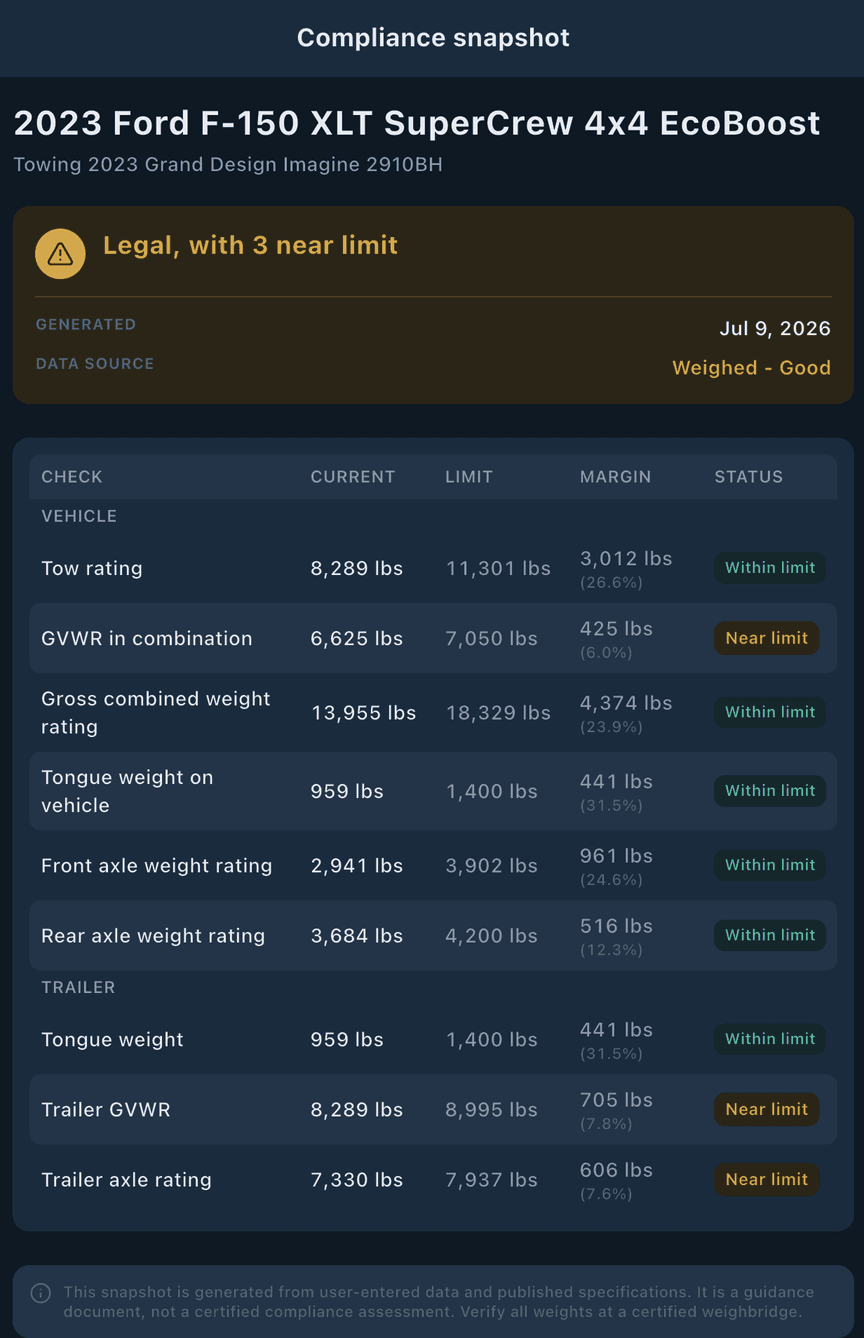
Three loadings behind one Maverick can be stopped by three different ratings, so loadmate grades each rating on a line of its own: the combined rating, GVWR, both axle ratings and the load sitting on the tongue, every one showing the pounds it still has spare. Record a different load and see which of those margins changes.


How do you know if your Maverick has the 4K Tow Package?
Look at the hitch receiver, and count the connectors. An owner on MaverickTruckClub put the test in one line: if there are two electrical connectors to the left and one of them has 7 pins, the package is there; if there is a single 4-pin connector, it is not. He added the part that catches people out, which is that the owner's manual covers every flavor of Maverick and will not tell you which one you bought. The window sticker names it for your specific truck.
What Ford lists inside the 2026 package is a 4-pin and 7-pin connector, the Class III hitch receiver, an auxiliary automatic transmission oil cooler on the hybrid or a radiator upgrade on the gas engine, an upgraded cooling fan, a trailer brake controller, and the all-terrain spare. Ford lists tow/haul mode and trailer sway control as standard equipment rather than package content.
Two of Ford's towing conditions move with that list. Maximum trailer frontal area is 40 sq ft with the package fitted and 29 sq ft without it. Ford also asks for a conventional, identical, full-size spare on any Maverick that tows, which the package's 215/70R17 all-terrain wheel and tire is there to satisfy.
Two open NHTSA campaigns are worth a VIN check before a trip. Campaign 26V104000, received February 20, 2026, covers the integrated trailer brake module on certain 2021 to 2026 Ford vehicles including the Maverick, where the module may lose communication with the vehicle while towing; Ford's own number for it is 26C10 and the remedy is a free software update. Campaign 26V340000, received May 27, 2026, covers the front lower ball joint on certain 2022 to 2026 Mavericks, and its interim owner letters tell owners not to drive the vehicle until the remedy is complete.
Does Ford's payload figure belong to your Maverick?
No, and Ford says so on the same page it prints the figure. All six 2026 weight columns carry a maximum payload, and the line beneath them redirects the reader to a door jamb label for one specific vehicle's carrying capacity. One specific vehicle is what a trailer gets hitched to.
Nothing in that door frame is a number Ford declined to print. The 2026 technical specifications sheet gives the hybrid all-wheel drive its 5,330 lb GVWR outright, and NHTSA's VIN decoder files a 2026 XLT all-wheel-drive hybrid in the Class 1D band that figure belongs to. What the frame settles is narrower: which of the six columns built your truck, and what that particular truck may carry once its options were on it. Start with the yellow Tire and Loading Information label, because the combined weight of occupants and cargo printed on it is the one figure the six-column table cannot supply; the Safety Compliance Certification label in the same frame confirms the build, repeating the GVWR and adding an axle rating front and rear. Read them in that order and Ford's table narrows to the single row your VIN came out of.
There is one quirk to know before comparing the printed figures. Ford's published maximum payload lands below its own GVWR minus base curb weight in every one of the six 2026 columns, by 60 to 111 lb and always in the same direction. Take Ford's printed figure as Ford's, rather than deriving one of your own from the other two, and take the label in your door frame over both of them.
Ask which number stops a Maverick and 4,000 lb is the obvious candidate, and across the three loadings above it was never once the figure that ran out. At a full trailer the combined rating goes first, 477 lb from the end. Behind a conventional travel trailer it is the coupling: a 355 lb dry hitch weight with roughly 90 lb of anti-sway hardware under it, past Ford's 400 lb before a cooler goes in. On the Michigan scale ticket it was the rear axle, on its printed rating to the pound, while the truck as a whole still had 100 lb in hand and the trailer was around two thirds of what Ford allows.
Which of the three closes first is a question about your loading rather than about the Maverick. loadmate's compliance view reads one rating at a time: GVWR, each axle rating, the combined rating and the tongue load, each carrying the margin it has left in pounds and a grade against it, so whichever one ran out is the row you are already looking at. Your recorded door-label figures and bed load give those rows the information for the Maverick you actually tow with.
Never had a Maverick across a scale? Weighing a travel trailer at a CAT scale walks the order you pull on in, and how to read a CAT scale ticket explains which rating each printed line is testing.
The used-buyer question: which model years reach 4,000 lb?
Ford's 2024 towing guide already carried a 4,000 lb Maverick, and every model year since has carried one too; what has changed twice is which Mavericks are allowed to have it. A used hybrid in particular is not interchangeable across model years.
| Model year | What Ford published |
|---|---|
| 2024 | The 2.5L hybrid was front-wheel drive only at 2,000 lb, with no 4K option on it at all. The 4,000 lb rating existed on the 2.0L EcoBoost all-wheel drive alone, on an 8,085 lb combined rating. Ford called the box the Trailer Tow Package and listed five items in it. Maximum trailer frontal area was 20 sq ft without the package, 40 sq ft with it |
| 2025 | Hybrid all-wheel drive arrived, and the tow package became available on a hybrid for the first time, taking that truck from 2,000 lb to 4,000 lb. The Lobo trim joined the lineup, and the package excluded the Tremor |
| 2026 | The hybrid became the standard powertrain and the EcoBoost the option. The EcoBoost's combined rating with the package moved from 8,085 lb to 8,130 lb, and the hybrid all-wheel drive's is 8,315 lb. Frontal area without the package rose from 20 sq ft to 29 sq ft and stayed at 40 sq ft with it. Ford renamed the box the 4K Tow Package and grew its content list to eight rows, splitting the cooler by powertrain, adding the upgraded cooling fan, and listing tow/haul mode and trailer sway control as standard |
The practical version for anyone shopping used: a 2024 Maverick hybrid is a 2,000 lb truck, and no amount of retrofitting makes it a published 4,000 lb one. A 2024 and a 2025 hybrid are hard to tell apart across a parking lot, and only one of them has a 4,000 lb figure printed against it.
Related guides
The first eight go deeper on a figure this page had to use. The last three are vehicles on which the same subtraction lands somewhere other than a cargo box.
- What can I tow?: the four figures with no badge on them, and which trailers each capacity tier reaches
- Towing weight ratings explained: what a combined rating counts that a tow rating does not
- Payload vs towing capacity: the two figures owners mix up most often, and which of them runs out first
- Tongue weight vs payload: why the pounds on the ball get counted twice
- Weight distribution hitch and front axle load: what the spring bars change, and what they leave exactly where it was
- Weigh a travel trailer at a CAT scale: the pull-on order that turns an estimate into a measurement
- How to read a CAT scale ticket: steer, drive and trailer, and the rating sitting behind each line
- Towing capacity chart: the Maverick's row among the trucks people cross-shop it against
- How much can a Ford Ranger tow?: the next Ford up, where an option code moves a great deal more trailer
- How much can a Ford Explorer tow?: the same combined-rating subtraction landing on a third row of seats
- How much can a Subaru Forester tow?: a smaller rating again, from a maker that prints no vehicle total at all
Frequently asked questions
- Can a Ford Maverick tow 4000 pounds?
Yes, on a 2026 Maverick with all-wheel drive and the 4K Tow Package (option code 53Q), in either the 2.5L hybrid or the 2.0L EcoBoost. Front-wheel-drive Mavericks are 2,000 lb trucks in both powertrains, and Ford publishes the Tremor and the Lobo at 2,000 lb as well. What decides how much of that 4,000 lb you can use is Ford's combined rating: 8,315 lb on the hybrid all-wheel drive, which has 477 lb spare for the people and the cargo box once a full trailer is behind it.
- Can a Maverick pull a camper?
Yes, within a class smaller than the rating implies. Two limits decide it before the trailer weight does: the loaded tongue against Ford's 400 lb, and the truck plus the loaded trailer against the 8,315 lb combined rating. Molded-fiberglass campers such as a 13 ft Casita or a 16 ft Scamp, and utility trailers around 1,800 to 3,500 lb, come back with good owner reports. A conventional travel trailer is where owners run into trouble: one 3,014 lb camper carried a 355 lb dry hitch weight, and a weight-distributing anti-sway hitch would have added about 90 lb on top of it.
- Are Ford Mavericks good for towing?
Judge it on what the rating leaves rather than on the rating itself. A 2026 Maverick with all-wheel drive and the 4K Tow Package pulls 4,000 lb, holds 40 sq ft of trailer frontal area, and carries 400 lb on the ball. Behind a full trailer the combined rating has 477 lb spare for everything in the cab and the box, and Ford has already assumed 300 lb of that as two people. Owners towing 1,800 to 3,500 lb report 15 to 22 mpg while towing; owners reaching for a conventional travel trailer report running out of tongue and payload well before they run out of tow rating.
- How do I know if my Maverick has the 4K Tow Package?
Look at the hitch receiver. Two electrical connectors beside it with one of them 7-pin means the package is fitted. A single 4-pin connector means it is not, and the truck is a 2,000 lb truck. The window sticker for your specific vehicle names the package as well. The owner's manual will not settle it, because one manual covers every version of the Maverick.
- Does the Maverick hybrid tow less than the EcoBoost?
No. Since the 2025 model year both all-wheel-drive powertrains are published at 4,000 lb with the 4K Tow Package, and the 2.5L hybrid carries the higher combined rating of the two, 8,315 lb against the EcoBoost's 8,130 lb. The difference runs the other way on payload, where Ford publishes 1,400 lb for the hybrid all-wheel drive and 1,500 lb for the EcoBoost all-wheel drive. On a 2024 Maverick the hybrid genuinely could not reach 4,000 lb, because it was front-wheel drive only and the package was not offered on it.
- What is the Ford Maverick's tongue weight limit?
400 lb, weight-carrying, on the Class III receiver that comes with the 4K Tow Package. That is the only tongue figure Ford publishes for a Maverick, and Ford prints no weight-distributing row for the truck. The tongue load rides on the truck rather than behind it, so the same pounds are charged to payload and checked against the 400 lb. The tongue figures printed on a trailer's own spec sheet are usually dry figures, and a loaded coupling reads higher.
- Do I need a weight-distributing hitch on a Maverick?
Ford lists the Maverick as Not Required in its weight-distribution correction-factor table, alongside the Ranger and the Explorer. Owners fit one anyway, and the reasons they give are real ones: one contractor-trailer owner fitted his because towing constantly on the all-wheel-drive Maverick's independent rear suspension without distribution was wearing his rear tires. The hardware itself weighs something, roughly 90 lb on the anti-sway hitch one owner considered, and that weight lands on the ball with the tongue.