Caravan weight terms at a glance
- GVM — Gross Vehicle Mass
- Tow vehicle
- Kerb weight
- Tow vehicle
- Tare weight
- Vehicle or van
- Payload
- Both
- ATM — Aggregate Trailer Mass
- Caravan
- GTM — Gross Trailer Mass
- Caravan
- TBM — Tow ball mass
- The coupling
- BTC — Braked towing capacity
- Tow vehicle
- GCM — Gross Combination Mass
- The whole rig
This page is the reference for the whole vocabulary — caravan weights explained once, in one place. Every term gets a plain-English definition, the formula behind it where one exists, and a link to a deeper guide where the detail lives. One worked rig runs through every number on the page, so the arithmetic always reconciles. Start here, then follow the links down.
Every one of these is a ceiling set by a manufacturer, not a target to load up to. The sections below take them side by side: vehicle, caravan, the ball between them, and the combination.
The worked rig used on this page
Every figure below comes from one illustrative rig, so the numbers always add up — the same dual-cab ute as our Gross Vehicle Mass guide, now with a van behind it. The figures are illustrative; your compliance plates and owner's manual are the real authority.
| Figure | Tow vehicle (dual-cab ute) | Caravan (tandem-axle van) |
|---|---|---|
| Empty | Kerb 2,130 kg | Tare 2,400 kg |
| Loaded ceiling | GVM 3,050 kg | ATM 3,000 kg |
| Other ratings | GCM 5,950 kg · braked tow 3,500 kg · ball max 300 kg | GTM 2,700 kg at full load |
| Geometry | Wheelbase 3,000 mm · rear overhang 1,250 mm | Tow ball mass 300 kg (10%) |
For the trip that runs through this page, the ute carries 520 kg of people, accessories and gear, and the van is packed to its plate: 3,000 kg all-up with 300 kg on the ball.
Which weights belong to the tow vehicle?
Three numbers cover the vehicle's side: its empty weight (kerb or tare), its loaded ceiling (GVM), and the payload between them. Kerb weight is the empty vehicle with all fluids and a full tank; tare is the leaner factory figure with about 10 L of fuel aboard. Know which one a spec sheet is quoting before you do any arithmetic — the difference is mostly fuel, and diesel runs about 0.85 kg per litre, so a full 80 L tank against tare's 10 L is roughly 60 kg of phantom payload if you mix them up.
GVM is the ceiling for everything the vehicle carries: occupants, accessories, cargo — and, when towing, the ball mass pressing down on the back. The deep dive on what counts towards it, where to find it and when a GVM upgrade makes sense is in the Gross Vehicle Mass guide.
One usage note that clears up half the confusion online: GVM belongs to the vehicle. Forum shorthand for a van's "GVM" is really its ATM.
What is the payload formula?
Payload = GVM − kerb (or tare) weight — it's the number you actually manage, because the GVM itself is fixed by the manufacturer. On the worked ute: 3,050 − 2,130 = 920 kg for people, accessories, gear and ball mass combined.
Towing reshapes it. Hitch a van that puts 300 kg on the ball and the working version becomes:
Payload once hitched = GVM − kerb − tow ball mass 3,050 − 2,130 − 300 = 620 kg for everything and everyone else.
The van has its own version: van payload = ATM − tare. This van: 3,000 − 2,400 = 600 kg — and it goes faster than it sounds, because water is payload at 1 kg per litre, and gas, bedding, the awning, tools and the second battery all queue ahead of your luggage.
Which weights belong to the caravan?
Three numbers again: tare (empty), ATM (the loaded ceiling) and GTM (the share on its wheels) — joined by the tow ball mass. ATM, the Aggregate Trailer Mass, is the most the van may weigh fully loaded and unhitched — everything aboard, including the weight that will rest on the ball. It's stamped on the van's compliance (VIN) plate, usually on the drawbar. GTM, the Gross Trailer Mass, is the most that may sit on the van's wheels once hitched, after the ball mass has moved across to the vehicle.
One formula joins them: ATM = GTM + TBM.
| ATM | GTM | |
|---|---|---|
| State of the van | Unhitched, on its own | Hitched to the vehicle |
| Includes tow ball mass | Yes | No |
| What it limits | The whole loaded van | The load on the van's wheels |
| On the worked van | 3,000 kg | 2,700 kg |
Two details worth keeping: axle, suspension and tyre ratings on a van are typically specified against GTM, not ATM; and GTM moves as you load — shift weight forward of the axles and the ball takes more while the wheels take less, with the ATM unchanged. For ATM upgrades and the rest of the trailer-side story, see the Aggregate Trailer Mass guide.
Where does tow ball mass fit?
Tow ball mass (TBM) is the share of the van's weight pressing down on the vehicle's tow ball — and it counts on both sides of the rig. Unhitched, it's part of the van's ATM. Hitched, it transfers to the vehicle and counts towards the GVM. That double life is why it's the most common blind spot in the whole vocabulary.
Two rules govern it. First, the guidance band: 8–12% of the van's loaded weight, with about 10% a common target — enough on the nose to keep the van stable, not so much that it crushes the vehicle's rear. Second, the vehicle's maximum ball loading, listed in the owner's manual: on the worked ute it's 300 kg, and this rig's 300 kg ball sits exactly on it.
The ball also works a lever. The hitch sits behind the rear axle — the rear overhang plus roughly 150 mm of hitch — so ball weight multiplies through it like the long end of a seesaw. On the worked ute (1,250 mm overhang, 3,000 mm wheelbase) the factor is 1 + (1,250 + 150) ÷ 3,000 ≈ 1.47: the 300 kg ball puts about 440 kg on the rear axle and lifts roughly 140 kg off the front. The axle-by-axle detail is in the GVM guide linked above.
How does GCM cap the whole combination?
Gross Combination Mass (GCM) is the most your tow vehicle and van may weigh together — set by the vehicle manufacturer, and usually less than GVM and ATM added together. On the worked rig: GVM 3,050 + ATM 3,000 = 6,050 kg, but the GCM is 5,950 kg. Max both plates at once and you're over, with neither individual limit broken.
Adding up the combination has one trap: the ball. On the road, the combination's weight is the vehicle on its axles plus the van on its axles. Count it either way — unhitched vehicle plus full van (2,650 + 3,000), or hitched vehicle plus GTM (2,950 + 2,700) — and this rig comes to 5,650 kg both times. Add the full ATM to the hitched vehicle's weight instead and you've counted the 300 kg ball twice, inventing an overweight problem you don't have.
GCM is also where the brochure tow rating quietly shrinks. At full GVM (3,050 kg), the ute can put at most 5,950 − 3,050 = 2,900 kg on the van's axles — with a 300 kg ball, that's a van of about 3,200 kg all-up, well short of the 3,500 kg headline. You usually can't max the GVM and the tow rating on the same trip. The full combined-ceiling walk-through — including how to run the check on your own four numbers — is in our gross combination mass guide.
Is braked towing capacity the number that matters most?
No — it's the biggest number on the brochure, and on this rig it's the limit with the most spare room. Braked towing capacity is the heaviest trailer the vehicle is rated to tow with trailer brakes fitted, measured against the van's actual loaded weight. The worked ute is rated to 3,500 kg and tows a 3,000 kg van — 500 kg of headroom — while the ball and the van's own ATM sit at zero margin.
One buying note from the compliance side: if a van's plated ATM exceeds the vehicle's braked rating, you can still tow it legally while its actual weight stays under the rating — but after an incident, proving that falls on you. Matching the plated ATM to the rating is the cleaner buy. The full story, including what you should tow rather than what you can, is in the braked towing capacity guide, and the model-by-model numbers — braked rating, GVM, GCM and payload at full tow — live in towing capacity by vehicle.
Does your rig clear every limit at once?
A legal tow is five checks cleared at the same time, not one number obeyed. Here's the worked rig against all five:
| Check | The limit | This trip | Margin |
|---|---|---|---|
| Vehicle under its GVM | 3,050 kg | 2,950 kg (hitched, ball on board) | 100 kg |
| Ball under the vehicle's ball maximum | 300 kg | 300 kg | 0 kg — at the limit |
| Van under its ATM | 3,000 kg | 3,000 kg | 0 kg — at the plate |
| Van under braked towing capacity | 3,500 kg | 3,000 kg actual | 500 kg |
| Combination under GCM | 5,950 kg | 5,650 kg | 300 kg |
Two margins on this rig are zero. That's legal — but it means one extra jerry can on the drawbar, or a water tank topped up at the last servo, tips a limit. Axle ratings are a sixth check on top of these, and the lever effect above is why the rear one usually matters most. The difference between a rig that's legal at the weighbridge and one that's legal for the whole trip is margin.
What happens if you tow over a limit?
An over-limit combination is unroadworthy, and the consequences scale with the outcome. At the roadside, weights for light combinations are enforced by state and territory road authorities and police: fines vary by jurisdiction, and a defect notice can park the van until it's fixed. After an incident, your insurer can examine whether the rig was legal — overloading gives a Product Disclosure Statement plenty to work with.
When it goes properly wrong, it becomes criminal. In January 2019, a driver who'd left Tamworth was towing a caravan later found to be more than 800 kg over its maximum weight. On a descent on the Oxley Highway near Walcha, the van began to sway, jack-knifed, and the tow vehicle hit a tree; two passengers died. The driver was convicted of dangerous driving occasioning death, and in 2022 an appeal court increased the sentence, finding the original "patently insufficient" (per court reporting in The Northern Daily Leader). Overweight is not a technicality on a long descent — brakes fade and sway builds exactly when you have the least room to correct either.
Where do you find your rig's real numbers?
The limits live on the plates; the actuals only come off a scale. The tow vehicle's GVM is stamped on its compliance plate (driver's door jamb or engine bay), with GCM, braked capacity and the ball maximum in the owner's manual. The van's ATM and GTM are on its compliance (VIN) plate. If a rating has been changed — a GVM or ATM upgrade — the new figure sits on a modification plate.
Actual weights are a different exercise. A public weighbridge gives you honest totals; a mobile weigh service breaks the rig down properly. A professional weigh report also introduces two terms worth recognising: GVM (your vehicle's actual weight, unhitched) and GVM in combination (its actual weight hitched, ball mass aboard). The in-combination figure is the one that's usually over, because the ball arrives after everything else is packed.
Loading does the rest: heavy items low and over the axles, ball mass held in the 8–12% band, and remember that water and gas are payload too — a full 180 L tank is 180 kg, and two of them spend 360 kg of the worked van's 600 kg allowance (our caravan water tanks guide runs those numbers). The loading habits that quietly wreck good rigs are collected in our common caravanning mistakes guide.
See all five limits in one place
Five ceilings, one rig: that's the shape of the problem this page leaves you with. None of the limits above can be checked on its own — the same 300 kg of ball mass sits inside three of the five sums at the same time, so a change on one side of the coupling moves the arithmetic on the other.
The tow vehicle carries the accessories, passengers and the caravan's tow ball mass. The caravan carries the water and gear. loadmate brings those recorded loads into one weight and stability picture, so you can see which limit needs attention as you pack. Explore loadmate in the app to understand how changing one part of the load affects the whole rig.
Related guides
- Gross Vehicle Mass (GVM) Explained — the vehicle-side deep dive: what counts, the rear-axle lever effect, and when an upgrade makes sense
- Aggregate Trailer Mass (ATM) Explained — the van-side deep dive, including ATM upgrades
- Braked Towing Capacity Explained: A Legal Ceiling, Not a Target — why the brochure number isn't the plan
- Gross Combination Mass (GCM) Explained — the combined ceiling in depth: the plate-sum trap, and checking the pair against your manual
- Caravan water tanks — how much water to carry, and what it does to your payload
- Common caravanning mistakes — the loading and weight habits that catch people out
- How to Weigh a Caravan and Tow Vehicle at a Weighbridge — the step-by-step that turns these terms into your own measured numbers
- How to Read a Mobile Caravan Weighing Report — making sense of the figures a weigh-in hands back
- When to Reweigh a Caravan: What's Changed Since Your Last Weigh-In — the changes that mean last year's numbers no longer hold
- Weight Distribution Hitch Setup & Front-Axle Restoration — how a hitch shifts load back onto the tow vehicle's front axle
- Why Your Caravan Needs Its Own Odometer and Service Log — tracking the van's own distance and history alongside its weights
- Towing capacity by vehicle — your model's real numbers: braked rating, GVM, GCM and payload at full tow
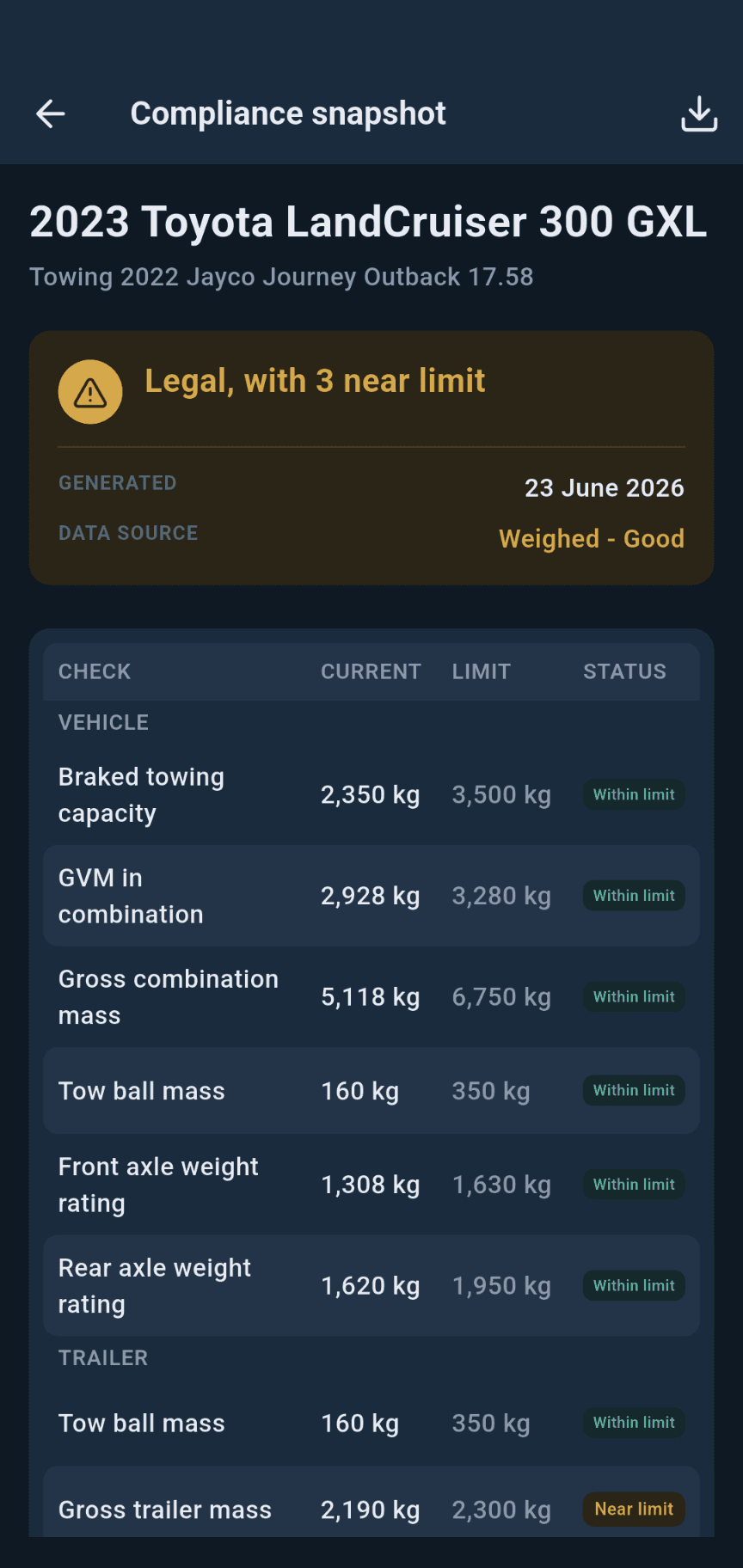
See what is left at every limit
loadmate lays out the full legal breakdown: GVM, GCM, ATM, axle and tow-ball mass, each graded against its margin. Create a free account to explore it on a populated demo rig in the app.


Frequently asked questions
- What's the difference between ATM and GTM?
ATM (Aggregate Trailer Mass) is the most your caravan may weigh fully loaded and unhitched — everything aboard, including the weight that will sit on the tow ball. GTM (Gross Trailer Mass) is the most that may rest on the van's wheels once hitched, because the ball mass has transferred to the vehicle. GTM = ATM − tow ball mass: on this page's worked rig, a 3,000 kg ATM with a 300 kg ball gives a 2,700 kg GTM.
- What's the difference between tare weight and kerb weight?
Both describe an empty rig. Tare is the vehicle or van as delivered — for vehicles, with about 10 L of fuel; for caravans, before water, gas and gear. Kerb weight applies to vehicles and includes all fluids and a full fuel tank, so it's the more realistic starting point for payload sums.
- How do you calculate a caravan's payload?
Payload = ATM − tare weight. The worked van on this page has a 3,000 kg ATM and a 2,400 kg tare, leaving 600 kg for water, gas, luggage and accessories — and water alone uses it fast, at 1 kg per litre.
- How much tow ball mass should a caravan have?
Around 8–12% of the van's loaded weight is the widely used guidance, with about 10% a common target — provided it also stays under the tow vehicle's maximum ball loading. The worked rig runs 300 kg on a 3,000 kg van: exactly 10%, and exactly at the ute's 300 kg ball limit.
- Is there a caravan weight calculator?
The arithmetic is three short formulas: payload = GVM − kerb, ATM = GTM + TBM, and vehicle plus van under GCM. In the loadmate app, recorded vehicle and caravan loads bring those limits into one picture as you pack.
- Where do I find my caravan's weights?
ATM and GTM are on the caravan's compliance (VIN) plate, usually on the drawbar. The tow vehicle's GVM is on its compliance plate in the door jamb or engine bay; GCM, braked towing capacity and the ball limit are in the owner's manual. Actual weights only come from a weighbridge or a mobile weigh service.
- Can I be over a limit even if I'm under my towing capacity?
Yes — easily. Towing capacity is one of at least five limits, and on most rigs the tow ball maximum, GVM or GCM bites before the braked rating does. The worked rig on this page tows 500 kg under its 3,500 kg rating yet has zero margin left on the ball.
- What happens if I get caught towing overweight?
The combination is unroadworthy: expect state or territory fines and possibly a defect notice, and your insurer may scrutinise any claim. In a serious crash it can become criminal — in the 2019 Oxley Highway case, towing a caravan more than 800 kg over its limit ended in two deaths and a dangerous-driving conviction.