A weight distribution hitch at a glance
- What it does
- Levers tow ball download from the rear axle back onto the front axle and the caravan's axles
- The goal (FALR)
- Restore the front axle toward its unhitched ride height — measured, not guessed
- What it changes
- Where the load sits (axle by axle) — and your ride height, steering and braking
- What it does NOT change
- Any of your weight limits — see the full list below
- Required by law?
- No. It is optional kit; some vehicles or couplings restrict or even prohibit one
- Before you fit one
- Read the vehicle owner's manual, the tow bar maker's advice and the coupling's specs
- The legal frame
- Your loaded mass must still sit under the lesser of your tow bar, tow capacity, ATM and tyre ratings
Hitch up a heavy van and the back of the tow vehicle squats while the nose rises — the headlights point at the trees and the steering goes vague. A weight distribution hitch is the tool that levers that weight back where it belongs. This guide explains what one actually does, how you set it up, how much front-axle weight it should restore, and the one thing it cannot do: change a single one of your weight limits.
How does a weight distribution hitch work?
A weight distribution hitch transfers some of the tow ball's download off the tow vehicle's rear axle and shares it forward to the front axle and back to the caravan's own axles — it moves load around, it does not take any away. Spring bars run from the hitch head to brackets on the caravan's A-frame; tensioning them turns the coupling into a lever that pries weight back onto the steer axle.
Queensland's transport authority describes it plainly: the device "transfers some of the load on the tow bar ball to the towing vehicle's front and rear suspension," which "maintains the vehicle's ride height and steering control." Transport for NSW says the same of load equalisers — they "help the vehicle retain normal suspension height and effective steering control" by transferring "some of the weight from the towbar to the front and rear suspension."
The part people get wrong is the word "transfer." A weight distribution hitch does not lighten your tow ball mass. The download the van puts on the coupling is the same before and after — Truck Friendly is blunt about it: the bars "DO NOT reduce the tow ball weight." What changes is which axles carry that download, not the total. Hayman Reese frames the action as redistributing the weight across all axles, much like the lifting action of a wheelbarrow.
Do you need a weight distribution hitch?
Not every rig needs one. You need to consider a weight distribution hitch when a heavy tow ball mass has left the front of the tow vehicle light — the nose riding high, the steering and headlights affected — and the vehicle and coupling both permit one. It is a fix for a specific symptom, not a default fitting.
Transport for NSW treats it as optional: your loaded trailer mass must not exceed the lesser of your tow bar rating, your vehicle's towing capacity, the trailer's ATM and your tyre ratings, and a weight distribution hitch "can be used" within that — it is not on the mandatory list. So the decision is about the symptom and the hardware, not a legal box to tick.
Three checks decide it for your rig:
- The symptom. A light, vague front end under a heavy van is the signal. A well-matched rig with a modest tow ball mass may never raise it.
- The vehicle. Some manufacturers restrict or prohibit a weight distribution hitch — Truck Friendly notes makers citing chassis damage, interference with stability control, and air suspension as reasons. Others go the other way: it flags a 200-Series LandCruiser that requires one.
- The coupling. An articulating coupling has its own rules (see the setup section). Read the vehicle owner's manual, the tow bar maker's advice and the coupling's specs before you buy a single spring bar.
One hard line, from both Queensland's authority and Truck Friendly: never use a weight distribution hitch to compensate for a badly loaded or overloaded trailer. As Truck Friendly puts it, a hitch "WILL NOT FIX THAT" — fix the loading or the overload first, then fit the hitch to a rig that is already legal.
How do you set up a weight distribution hitch?
Ride height is the measurement you set a weight distribution hitch against. Record the tow vehicle's front and rear ride height unhitched, hitch the loaded van, then tension the spring bars until the front of the combination has settled back toward that unhitched mark. The Australian benchmark is the ride height itself, not a torque figure.
The order that works:
- Measure unhitched. With the van off, measure the height of the tow vehicle's front and rear wheel arches and write both down. This is the target the hitch is trying to restore.
- Hitch the loaded van. Couple up the van loaded the way you actually travel. The rear will squat and the front will lift.
- Tension the spring bars. Set the bars up — chain links or the maker's adjustment — until the combination has settled. Caravan Parts puts the practical target as the whole combination settling by an equal amount of roughly 15 mm, front and rear, relative to the unhitched figures.
- Re-measure and adjust. Check the front arch against your unhitched note and fine-tune. Counting chain links gets you close; the measurement is what confirms it.
A few cautions sit alongside the steps. Queensland's authority warns that a weight distribution hitch can overload the tow bar and its components, so it advises heavy-duty tow bars and getting advice from the tow bar maker or caravan dealer first. And on an articulating coupling, compatibility is a separate question: Cruisemaster says its DO35 V3Plus is "designed and tested with the most popular WDH" and is checked with named systems (Hayman Reese Classic and Standard, Milford, EZ-lift), but stresses that "Compatibility of WDH and Drawbar is a separate consideration" and to "always check WDH specs for compatibility." When you do not run a hitch the chain-link method describes — a hydraulic unit, for instance — you set it to a front-axle restoration target instead, which is the next section.
How much front-axle weight should it restore?
Front-axle load restoration (FALR) is the goal a weight distribution hitch is tuned for: putting back the steer-axle weight the tow ball levered off. In Australia the working target is the unhitched ride height — restore the front toward where it sat before you coupled up, checked with a tape, not a percentage. This is the figure the whole setup turns on.
To see why, follow one worked rig. Take a dual-cab ute (GVM 3,050 kg, kerb 2,130 kg, GCM 5,950 kg, braked tow 3,500 kg, 3,000 mm wheelbase, 1,250 mm rear overhang, 300 kg tow ball maximum) towing a tandem-axle van (ATM 3,000 kg, GTM 2,700 kg, 300 kg tow ball mass). The ball hangs on a hitch about 150 mm behind the rear overhang, so it acts on a lever:
300 kg × (1,400 ÷ 3,000) = +140 kg on the rear axle
So coupling up adds roughly 140 kg to the rear axle on top of the ball's own weight, and lifts about 140 kg off the front axle. On a mobile weigh that shows up as a front axle dropping from about 1,520 kg unhitched to around 1,380 kg hitched — the light-nose symptom a weighing report shows up, measured, with the fix set here. A weight distribution hitch puts some of that back:
| FALR achieved | Front axle restored to | What it means |
|---|---|---|
| 0% (no hitch) | ~1,380 kg | The full ~140 kg loss, nose light |
| ~50% FALR | ~1,450 kg | About 70 kg returned — a common conservative setting |
| 100% FALR | ~1,520 kg | The full ~140 kg back, front at its unhitched height |
Aim to restore the front toward that unhitched figure. Tighten too little and the nose stays light; over-tension and you lever the rear up past where it should sit. Through every one of these settings, the rig's limits do not move: GVM stays 3,050 kg, GCM stays 5,950 kg, ATM stays 3,000 kg and the 300 kg tow ball maximum is unchanged. (You may see US guidance quote FALR as returning 50–100% of the lost front-axle weight — pickups nearer 50%, lighter vehicles up to 100%, with figures like a Ford "Weight Distribution Correction Factor" or a Ram target near 67%. That is overseas convention, shown here only for contrast; the Australian rule is the ride-height measurement above.)
Does a weight distribution hitch raise your towing limits?
No. A weight distribution hitch changes where load sits, not how much you are allowed to carry — it does not raise your GVM, GCM, ATM, tow ball limit or towing capacity by a single kilogram. This is the misunderstanding the whole page exists to correct.
The reasoning is simple: every one of those limits is a fixed manufacturer or coupling rating, and moving load between axles cannot change a rating. etrailer puts the towing-capacity case directly — a weight distribution hitch "doesn't boost your hitch's towing capacity, it just allows you to use your hitch to its full, rated potential," and "won't increase your vehicle's towing capacity." The same logic holds for your other limits.
| What a weight distribution hitch changes | What it does NOT change |
|---|---|
| Front axle load (restored) ✓ | GVM (the vehicle's loaded limit) ✗ |
| Rear axle load (reduced) ✓ | GCM (the combined limit) ✗ |
| The caravan's axle load (shared up) ✓ | ATM (the trailer's loaded limit) ✗ |
| Ride height, steering, braking ✓ | Tow ball mass (the actual download) ✗ |
| Towing capacity (the braked rating) ✗ |
So a rig that is over its GCM, ATM or tow ball limit is still over after you fit a hitch — you have rearranged the same total weight, not licensed more of it. The figures you have to stay under live in our gross vehicle mass guide, which works the same tow-ball lever, and the aggregate trailer mass guide for the trailer side.
What are the limits and downsides of a weight distribution hitch?
A weight distribution hitch can overload the tow bar, can be ruled out by your vehicle or coupling, and does nothing for a rig that is loaded wrong in the first place — it corrects axle balance, not packing or matching. It is a precise tool with a narrow job.
- It can overload the tow bar. Queensland's authority warns the device may overload the tow bar and its components, which is why it advises heavy-duty tow bars and maker advice before fitting.
- Some vehicles say no. Manufacturers cite chassis damage, stability-control interference and air suspension as reasons not to fit one (Truck Friendly). In an overseas illustration of the same "read your manual" point, etrailer notes Audi specifically says not to use a weight distribution hitch on its unibody platform because it could torque the frame — a US example, shown for contrast, not an AU rule.
- Articulating couplings need confirmation. A DO35-type articulating coupling has its own compatibility list and movement clearances; check the coupling specs, not just the hitch's.
- It will not fix a bad rig. Over-tensioning to mask an overloaded or badly balanced van trades one problem for another. Correct the load first.
Coupling note: Cruisemaster's own DO35 V3Plus page states the coupling may be used with load-distribution hitches "providing the coupling movement is not obstructed and the maximum downward load of 350kg (772lb) prior to tightening of bars is not exceeded." An etrailer Q&A corroborates the same 350 kg ceiling and the use of a Hayman Reese adaptor. Confirm the movement clearance and the 350 kg ceiling against your coupling's current specs before relying on either.
Weight distribution and sway — what it does and doesn't fix
A weight distribution hitch is not a sway control device — it manages the up-and-down balance between your axles, while sway control resists the side-to-side snaking of the van behind you. They are different jobs, often run together. Mixing the two up is common, and the makers are explicit about the distinction.
Truck Friendly states it in capitals: weight distribution bars "ARE NOT ANTI-SWAY BARS." Hayman Reese describes sway control systems as "designed to complement weight distribution systems" — a partner, not the same part. Some integrated units fold both functions into one head (etrailer notes four-point sway-and-distribution hitches), but the functions remain separate even when the hardware is combined.
One practical point follows from the hardware. With friction or some spring-bar setups you disengage the bars (and any friction sway control) when manoeuvring into and out of driveways or reversing, then re-engage to tow (Caravan Parts; etrailer). That step is normal maintenance of the setup rather than a sign anything is wrong, and it is one more reason a weight distribution hitch is a measured routine rather than a fit-and-forget.
How loadmate helps you stay under your limits when you fit a hitch
A hitch setting needs to match the loaded rig and the manufacturer's instructions. For rigs using a weight distribution hitch, loadmate's Effect Preview models the distribution setting you enter and shows the load returned to the steer axle, lifted off the rear and added to the caravan's axles. Compare that picture with measured axle weights when reviewing the setup.
The catch with a dialled-in hitch is that its setting belongs to the load it was set against. Shift water or add bikes and the tow ball mass can change. loadmate connects recorded load changes with the saved hitch assumptions, helping you spot when they need review. Explore loadmate in the app to see how repacking can affect the axle picture. A weight distribution hitch is optional kit and loadmate is decision support for towing safety, not a fitment or torque tool or legal weight certification. See the safety disclaimer.
Related guides
- Caravan & Towing Weights Explained — every weight term in one place (the best starting point)
- Gross Vehicle Mass (GVM) Explained — the tow-ball lever and the front-axle weight a hitch restores
- Aggregate Trailer Mass (ATM) Explained — the trailer-side limit a hitch never changes
- How to Weigh a Caravan and Tow Vehicle at a Weighbridge — measuring the front-axle and tow ball figures a hitch acts on
- How to Read a Mobile Caravan Weighing Report — the light-front-axle symptom this hitch is set to correct
- When to Reweigh a Caravan: What's Changed Since Your Last Weigh-In — when a change to the setup means it's time to re-measure
- Towing capacity by vehicle — your model's real numbers: braked rating, GVM, GCM and payload
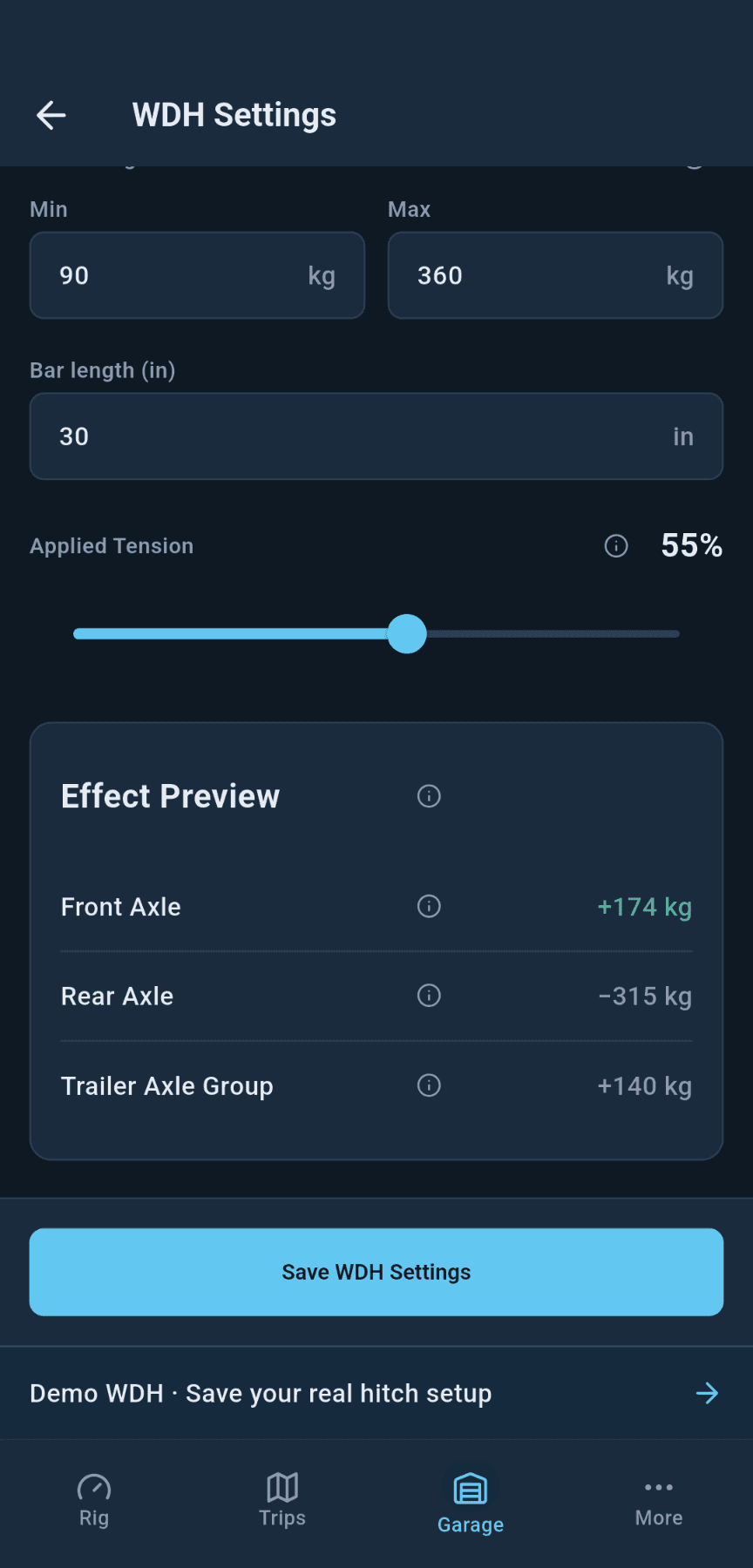
Tune the hitch for this load
loadmate models your weight distribution hitch, spring-bar or FALR, and shows the load coming back onto the steer axle. A tension set for one load is wrong for the next, so the model moves when the load does. Create a free account to explore it on a populated demo rig in the app.


Frequently asked questions
- Do weight distribution hitches really work?
Yes, within their job: the spring bars lever some of the tow ball's download off the rear axle and back onto the front axle and the caravan's axles, restoring ride height, steering and braking. They redistribute load rather than removing it, so they do not reduce your tow ball mass or change any weight limit.
- At what point do I need a weight distribution hitch?
Consider one when a heavy tow ball mass has left the front of the tow vehicle light and both the vehicle and coupling permit it; a well-matched rig with a modest tow ball mass may never need one. Check the owner's manual, tow bar maker's advice and coupling specs first, and never use a hitch to mask a badly loaded or overloaded trailer.
- What are the disadvantages of a weight distribution hitch?
It can overload the tow bar, so a heavy-duty tow bar and maker advice are recommended, and some vehicles or couplings restrict or prohibit one. It also does nothing for a rig that is loaded wrong — it corrects axle balance, not bad packing or a poor vehicle-to-van match.
- Is it okay to back up with a weight distribution hitch?
With friction or some spring-bar setups, disengage the spring bars and any friction sway control before reversing or manoeuvring, then re-engage to tow. As long as you are not jackknifing the rig reversing is generally fine; follow your hitch maker's instructions.
- Does a weight distribution hitch increase my towing capacity, GVM or GCM?
No — it changes where load sits, not how much you may carry, and cannot raise your GVM, GCM, ATM, tow ball limit or braked towing capacity by a single kilogram. Those are fixed manufacturer and coupling ratings, so a rig over one of them is still over after you fit a hitch.
- How much front-axle weight should a weight distribution hitch restore?
In Australia the working target is the unhitched ride height: restore the front toward where it sat before you coupled up, measured with a tape rather than a percentage. On a rig where coupling lifts about 140 kg off the front, restoring around 50 per cent puts roughly 70 kg back and 100 per cent returns the full amount.
- Is a weight distribution hitch the same as sway control?
No. A weight distribution hitch manages the up-and-down balance between your axles, while sway control resists the side-to-side snaking of the van; they are different jobs often run together, and some integrated hitches combine both in one head while the functions stay separate.
- Is a weight distribution hitch required by law in Australia?
No — it is optional equipment, and Transport for NSW lists it as something that can be used while your loaded trailer mass still sits under the lesser of your tow bar rating, towing capacity, ATM and tyre ratings. Some vehicles and couplings restrict or prohibit one, so the owner's manual and coupling specs have the final word.
- Can I use a weight distribution hitch with a DO35 or articulating coupling?
Sometimes, but it is a separate check. Cruisemaster says its DO35 V3Plus is designed and tested with the most popular hitches and lists named compatible systems, but stresses that compatibility is a separate consideration; confirm movement clearances and the 350 kg downward-load ceiling against the coupling maker's current specs before fitting.