GVM at a glance
- What it is
- The manufacturer's maximum legal loaded weight for the vehicle
- Also called
- Gross Vehicle Weight Rating (GVWR) internationally
- What's included
- Kerb/tare weight + accessories + passengers + cargo + tow ball mass
- Payload formula
- Payload = GVM − Kerb (or Tare) weight
- Where to find it
- Compliance plate (door jamb) and owner's manual
- Australian licence note
- Up to 4,500 kg on a standard car licence; above that needs a Light Rigid licence or higher
- If you exceed it
- Unroadworthy; fines (state-based); possible insurance and warranty consequences
Whether you're towing a caravan, kitting out a 4WD or just packing the family wagon for a big trip, your GVM is the number that decides how much you can safely and legally carry. This guide explains what it means, what counts towards it, how to work out yours, and when (and whether) a GVM upgrade makes sense.
What does GVM mean?
Gross Vehicle Mass (GVM) is the maximum permissible weight of your vehicle when fully loaded, as specified by the manufacturer. It's the ceiling for everything the vehicle carries — not the empty weight, and not just the cargo, but the whole lot combined.
GVM is the term used in Australia. Internationally, the same idea is called the Gross Vehicle Weight Rating (GVWR). Two quick points of confusion worth clearing up:
- GVM is for the vehicle, not the trailer. Caravans and trailers have their own equivalent limit — Aggregate Trailer Mass (ATM). If someone uses "GVM" about a caravan, they almost always mean its ATM.
- GVM describes a limit, not your actual weight. Australia uses the one term for both the manufacturer's rating and the figure on the scales, so context matters. Internationally these are split into GVWR (the limit) and GVW (the measured weight).
| Term | What it means | Used for |
|---|---|---|
| GVM (Australia) | The maximum loaded weight limit | The rating on your compliance plate |
| GVWR (international) | Same as GVM — the maximum limit | Manufacturers' rating overseas |
| GVW (international) | The actual measured loaded weight | What the vehicle weighs right now |
Australian licence note: Australia is one of the few countries that lets you drive a vehicle with a GVM up to 4,500 kg on a standard car licence. Above 4.5 tonnes you need a Light Rigid (LR) licence (to 8 t), then Medium Rigid and up. This guide focuses on vehicles at or under 4.5 t.
What's included in your GVM?
Your GVM has to cover everything that's in, on or pressing down on the vehicle. Start from the empty vehicle and add it all up:
- Kerb or tare weight — the empty vehicle (see the difference below).
- Accessories and fit-out — bull bar, tow hitch, roof racks, drawers, dual battery, UHF, spotlights, fridge, canopy, even floor mats. Every one eats into your payload.
- Passengers and pets — driver, everyone else, and the dog.
- Luggage and gear — clothes, food, water, camping and recovery gear, jerry cans. Water is 1 kg per litre, and it adds up fast — our caravan water tanks guide runs those numbers.
- Tow ball mass — when you're towing, the download from the trailer's tow ball sits on your vehicle and counts towards its GVM. This is the one people most often forget.
On this guide's worked dual-cab ute (GVM 3,050 kg, kerb 2,130 kg — a 920 kg payload), say that comes to 220 kg of accessories, 300 kg of occupants and 100 kg of cargo, plus a 300 kg tow ball mass: the full 920 kg payload, used. (Figures illustrative — your own list will differ, but it fills just as quickly.)
Kerb vs tare weight — what's the difference?
These two "empty" weights trip people up because manufacturers use them differently. Both are starting points for your GVM sum, so know which one you've been quoted.
| Term | What it includes | Use it for |
|---|---|---|
| Tare weight | Empty vehicle with ~10 L of fuel and no accessories | The manufacturer's baseline figure |
| Kerb weight | Empty vehicle with all fluids and a full tank of fuel | A more realistic "ready to drive" starting point |
For planning, kerb weight is the safer starting point — but remember it still excludes anything you've bolted on since purchase.
How do you calculate your GVM (and payload)?
You don't calculate GVM itself — the manufacturer sets it. What you calculate is your payload: how much you can add before you hit that limit. The formula is simple:
Payload = GVM − Kerb (or Tare) weight
For example, say a dual-cab ute has a GVM of 3,050 kg and a kerb weight of 2,130 kg. That leaves a payload of 920 kg — and that 920 kg has to cover passengers, accessories, gear and the tow ball mass of whatever you're towing. It disappears faster than most people expect. (Figures are illustrative — always check your own compliance plate.)
There are a few ways to keep track of where you actually sit:
- Back-of-the-envelope. A quick tally of the big items. Better than nothing, but it misses the small stuff and the tow ball effect.
- Weighbridge. A certified public weighbridge gives you your real, total weight (and front/rear axle weights). Accurate, but only a snapshot and not very granular.
- Mobile weigh service. A professional comes to you, breaks down your GVM and axle weights, and explains where you stand. The gold standard for a baseline.
- The loadmate app. Build a profile of your vehicle and rig once, and the app keeps a live tally as you add or move gear — accessories, occupants, luggage and the tow ball mass included — so you always know your current weight against the limit. It works best when started from a professional weigh-in (links below).
Whichever method you use, build in a safety buffer. Travel changes your load constantly, and a margin protects you against both a roadside check and the wear that comes from running at the very edge.
Where do you find your vehicle's GVM?
Your GVM is stamped on the compliance (build) plate — usually in the driver's door jamb, under the bonnet, or in the engine bay — and listed in your owner's manual. It's quoted in kilograms. If you've had any rating changed (for example, a GVM upgrade), the revised figure appears on a modification plate.
Why does GVM matter?
Going over your GVM isn't a technicality — it has real legal, financial and safety consequences.
Legal
By law your vehicle must not exceed its registered GVM (or the other limits the manufacturer specifies). Light-vehicle weights are enforced at the roadside by state and territory road authorities and police: overloading is an offence, with fines that vary by state and territory, and an overloaded vehicle is deemed unroadworthy. In a serious crash where a formal investigation finds overloading contributed to the cause, you can face far more than a fine.
Insurance
If your vehicle is found to be unroadworthy because it was overloaded, an insurer may decline a claim. The relevant clauses sit in almost every Product Disclosure Statement. Common sense applies — an unrelated incident usually won't be voided — but overloading gives an insurer a reason to look closely.
Vehicle warranty
Manufacturers can decline warranty claims on components damaged by overloading — typically the chassis, drivetrain, engine and suspension. Unrelated faults (a dud radio) stay covered. Bolt-on modifications can also draw extra scrutiny.
Safety
This is the one that matters most. Overloading degrades the things that keep you and everyone around you alive:
- Reduced handling and stability — harder to control, especially in corners and sudden manoeuvres, with a higher rollover risk.
- Longer braking distances — the brakes simply have more to stop.
- Tyre overload — heat build-up, faster wear and a higher risk of blowouts.
- Suspension and frame stress — components loaded beyond design, leading to failures and damage.
- Worse fuel economy — the engine works harder for every kilometre.
- Transmission strain — premature wear on the driveline.
- A higher overall crash risk — every factor above stacks up.
How do tow ball mass and axle limits affect your GVM?
When you hitch up, the trailer's tow ball mass presses down on your vehicle and counts towards your GVM — and it loads your rear axle harder than the raw number suggests. This is where a lot of otherwise-careful setups quietly go over.
Your vehicle also has Gross Axle Weight Ratings (GAWR) for the front and rear axles. Many people exceed a rear axle limit before they hit their overall GVM, because of the lever effect:
Additional rear-axle load = Tow Ball Mass × ((rear overhang + 150 mm hitch) ÷ wheelbase)
The ball sits on a hitch that extends about 150 mm behind the rear overhang. Take a 300 kg tow ball mass on a vehicle with a 1,250 mm overhang and a 3,000 mm wheelbase:
300 kg × (1,400 ÷ 3,000) = +140 kg
So the rear axle carries roughly the 300 kg tow ball mass plus about 140 kg from the lever effect — around 440 kg in total — before you've added passengers or cargo (and the same lever takes roughly 140 kg off the front axle). Aim to keep tow ball mass to about 8–12% of the trailer's weight (the "10% rule"), and weigh the rear axle, not just the whole vehicle.
For how this ties into your caravan's weights, see our guides to caravan weights, gross combination mass and braked towing capacity.
GVM vs GCM vs ATM — how the limits relate
These three limits cover different things, and you have to stay under all of them at once.
| Limit | Applies to | Covers |
|---|---|---|
| GVM | The tow vehicle | The vehicle plus everything in or on it, including tow ball mass |
| ATM | The trailer/caravan | The fully loaded trailer, unhitched, including its tow ball mass |
| GCM | Vehicle + trailer combined | The whole rig — usually less than GVM + ATM added together |
A quick example, using the same dual-cab ute as earlier: GVM 3,050 kg, rated to tow 3,500 kg, with a GCM of 5,950 kg. At full GVM, the most it can put on the van's axles is 5,950 − 3,050 = 2,900 kg — with a 300 kg ball that's a van of about 3,200 kg all-up, since its ball weight already sits inside the ute's GVM. Load the ute to its limit and hitch a 3,500 kg van, and the combination is 600 kg over its GCM — even though neither individual limit is broken. That's why you usually can't max out both at once. (Figures illustrative — and a few manufacturers quote different limits when towing, so always read your model's fine print.)
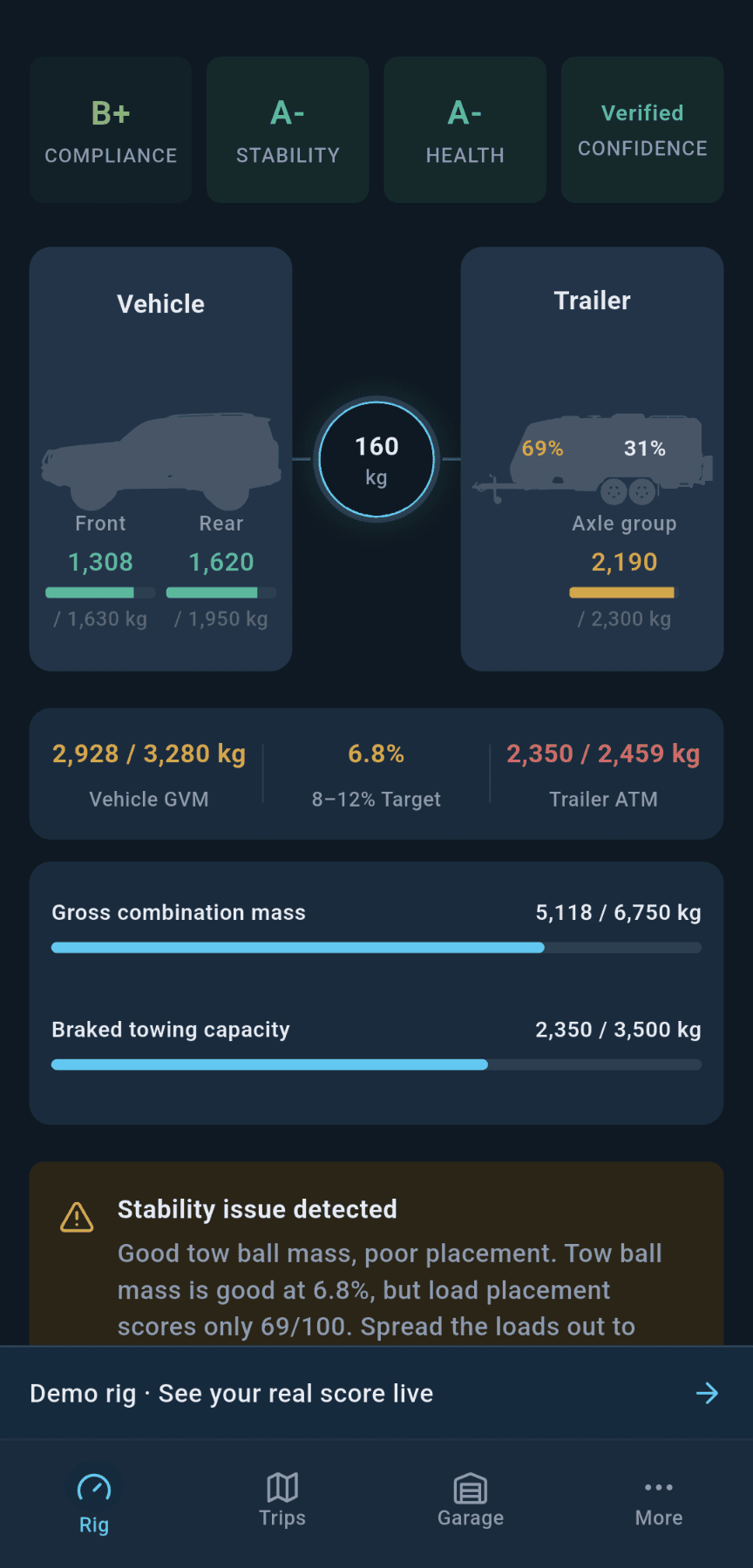
Watch the limit that bites first
Accessories use payload before the trip gear goes in. As you record what you carry, loadmate tracks GCM, GVM and the rear axle together so you can see which limit tightens first. Free to explore on a demo rig in the app.


Over your GVM? Do this first
A GVM upgrade is the last resort, not the first move. Work through the cheaper fixes in order:
- Confirm it. Reweigh (weighbridge or mobile service) before changing anything — estimates miss in surprising places.
- Strip non-essential accessories. Every bolt-on you remove comes straight back as payload.
- Carry less. Audit the gear: what hasn't been used in the last three trips?
- Rethink the split. Some load may belong in the van rather than on the vehicle — watching the van's ATM as you go.
- Reassess the vehicle. If you're over for what you do most of the time, the vehicle is the wrong tool — no spring kit fixes that.
Only if the load genuinely can't come down should you look at re-rating the vehicle.
What is a GVM upgrade?
A GVM upgrade re-rates your vehicle to a higher legal loaded weight, usually by fitting heavier-duty suspension (springs and shocks) supplied by an approved Second Stage Manufacturer (SSM). Some vehicles need additional components. Once the kit is fitted and the vehicle inspected, it's re-plated to the new GVM and your registration is updated.
There's an important distinction in how that approval is recognised:
| Type | When it's done | Recognised |
|---|---|---|
| State (post-registration) | After the vehicle is registered | In your state/territory; not automatically recognised if the vehicle is sold and re-registered interstate |
| Federal (pre-registration) | On a new vehicle before its first registration | Nationally — fewer issues with interstate sale or re-registration |
Driving interstate on a state-approved upgrade is fine; the limitation only bites on sale or transfer of registration.
Does a GVM upgrade void your warranty?
Generally, yes — for the affected components. Vehicle manufacturers' warranties typically exclude failures caused by loading or modifying the vehicle beyond factory limits, which covers the drivetrain, engine, suspension and chassis. Toyota's warranty guidance is explicit, listing GVM upgrades among its common examples of accessories voiding a car's warranty: "Suspension upgrades, also known as Gross Vehicle Mass (GVM) upgrades… where there are changes made to the vehicle's suspension to increase the carrying capacity of the vehicle above what is stipulated."
SSMs often advertise that their kit "won't void your warranty." Read the fine print. What they actually provide is a warranty on their work and components, under conditions — for example:
"Vehicle warranty is not affected when a GVM Upgrade is fitted… should an original equipment component fail and be directly attributed to the vehicle carrying loads to the revised GVM, (SSM) will cover warranty of the component after written proof and testing by an independent body has been lodged."
"The above warranty does not cover any components that have failed due to what is deemed 'standard' wear and tear on a vehicle with increased ride height and weight carrying abilities."
In practice that means an independent engineering assessment, not your local mechanic, decides — and the burden of proof can land on you. Under the Australian Consumer Law, consumer guarantees still apply, but they have exclusions for misuse and for modifications that contribute to a failure. Know exactly what's covered before you commit.
When does a GVM upgrade make sense — and when doesn't it?
A good reason to upgrade:
- It lets you load more weight into the tow vehicle, improving your vehicle-to-trailer weight ratio (a heavier tow vehicle relative to the van is safer). A common guideline is to keep the laden trailer to no more than ~90% of the laden vehicle.
- You only occasionally need the extra capacity and otherwise sit within spec.
A reason to reconsider:
- You need the upgrade just to do what you do most of the time — that's a sign the vehicle isn't the right tool for the job. New springs don't strengthen the chassis, driveline or brakes; a GVM upgrade is largely an administrative re-rating, not a mechanical one.
- Wear and tear. Loading a vehicle harder accelerates wear on driveline and suspension components — as a rough rule of thumb, the harder you load it, the faster those parts age, and the higher your running costs.
If you're routinely near your limits, weigh an upgrade against simply choosing a vehicle built for the load.
If you do upgrade: choosing a Second Stage Manufacturer
- Track record first. Established SSMs with a long history in your state are less likely to leave you with compliance headaches.
- Check the accreditation. Confirm the SSM holds the relevant state or federal approval for your exact year, model and variant — not just the nameplate.
- Get it in writing. Scope of work, who performs it, the approval held, and what their warranty covers (and excludes) — before any work starts.
Know your real GVM on every trip
Knowing what GVM means is the easy part. The hard part is knowing your actual number on any given trip, once you've added the bull bar, the kids, the camping gear and the tow ball mass — and that number changes every time you repack.
loadmate is your towing co-pilot. Build your vehicle and caravan profile once, ideally from a professional weigh-in, and the app keeps a live tally of your GVM, axle weights and tow ball mass against your limits — no spreadsheets, no guesswork.
Related guides
- Caravan & Towing Weights Explained — every weight term explained in one place (the best starting point)
- Aggregate Trailer Mass (ATM) Explained — the trailer-side equivalent of GVM
- Braked Towing Capacity Explained: A Legal Ceiling, Not a Target — how GVM, GCM and towing capacity fit together
- Gross Combination Mass (GCM) Explained — the combined ceiling over the whole rig: why you can't run full GVM and a full van at once
- Caravan water tanks — water and bladder weight counts towards your GVM; what a full tank does to your payload
- Common caravanning mistakes — the beginner checklist: the loading habits that quietly tip rigs over their limits
- Weight Distribution Hitch Setup & Front-Axle Restoration — restoring the front-axle weight the tow ball levers off, without changing your GVM
- When to Reweigh a Caravan: What's Changed Since Your Last Weigh-In — the gear and fit-out that quietly push you back towards your GVM limit
- Towing capacity by vehicle — your model's real numbers: braked rating, GVM, GCM and payload at full tow
Frequently asked questions
- What does GVM mean?
Gross Vehicle Mass (GVM) is the maximum total weight your vehicle is allowed to weigh when fully loaded — including the vehicle, passengers, fuel, accessories, cargo and any tow ball mass — as set by the manufacturer and stamped on the compliance plate.
- How do I calculate my GVM?
You don't set GVM; you calculate your payload against it: Payload = GVM − kerb (or tare) weight. Add up your accessories, passengers, gear and tow ball mass to see how much of that payload you've used. A weighbridge or mobile weigh service confirms your real figure.
- What's the difference between GVM, GCM and ATM?
GVM is the loaded weight limit of the vehicle. ATM (Aggregate Trailer Mass) is the loaded weight limit of the trailer/caravan. GCM (Gross Combination Mass) is the limit for the vehicle and trailer combined — and it's usually less than GVM + ATM added together, so you can't always max out both at once.
- Does tow ball mass count towards GVM?
Yes. When you're towing, the tow ball download sits on your vehicle and counts towards its GVM — and because of the lever effect it loads the rear axle even more heavily. It's the most commonly overlooked contributor.
- Where do I find my vehicle's GVM?
On the compliance (build) plate — usually in the driver's door jamb or engine bay — and in your owner's manual, quoted in kilograms.
- What happens if I exceed my GVM?
Your vehicle is unroadworthy. You risk state-based fines, your insurer may decline a claim, your warranty can be affected, and your braking, handling and stability all degrade.
- Can I increase my GVM?
Sometimes — through a GVM upgrade fitted by an approved Second Stage Manufacturer, which re-plates the vehicle to a higher rating. It's recognised state-wide (post-registration) or nationally (pre-registration), and it generally affects your manufacturer's warranty on the related components.
- Is GVM the same as towing capacity?
No. GVM is how much the vehicle can weigh; towing (braked) capacity is how much it can pull. They're separate limits, and you have to stay within both at the same time — along with GCM and your axle limits.
- What should I do if I'm over my GVM?
Reweigh first to confirm it, then work through the cheap fixes: remove non-essential accessories, carry less gear, and rebalance what goes in the van. If you only occasionally need more capacity, a GVM upgrade can make sense; if you need one for what you do most of the time, the vehicle is probably the wrong tool for the job.