Caravan water at a glance
- Water weight
- 1 litre = 1 kg — a full 180 L of tanks is 180 kg of payload
- Typical setup
- One to three fresh tanks, commonly around 80–95 L each
- How long it lasts
- Family of four: about 4 days on 180 L (roughly 45 L a day); 5+ with careful use
- Per person
- Roughly 9–11 L per person per day with sensible habits
- Travelling
- Tanks full or empty — never part-full (sloshing water unsettles the van)
- Weight limits
- Tank water counts towards the van's ATM; water in the car counts towards GVM
- Grey water
- Rules vary by state and site — many free camps require self-containment
Water sets the length of your stay — and a fair chunk of your towing weight. This guide covers how long a tank actually lasts, what the water weighs, what size to fit, how to stretch every drop when free camping, the grey water rules to check, and how to travel with it all safely.
The worked figures on this page use one illustrative rig: a dual-cab ute (GVM 3,050 kg, kerb 2,130 kg, GCM 5,950 kg) towing a tandem-axle family van (ATM 2,800 kg, tare 2,400 kg, two 90 L fresh tanks, 280 kg tow ball mass). Swap in the numbers from your own compliance plates.
How long does a caravan water tank last?
A family of four (two adults, two kids) typically gets about four days from a 180 L caravan water tank — roughly 45 L a day — and five or more days with careful use. That works out to about 11 L per person per day with sensible habits; frugal free campers get it under 9 L. A couple at the same per-person rate stretches the same 180 L to roughly eight days.
Showers are the swing factor. Even a short one uses many litres, which is why most free campers shower every second day and use wipes in between. Dishes, drinking and cooking are surprisingly steady by comparison — it's the hot-water habits that decide whether the tank lasts the weekend or the week.
To stay out longer, many travellers carry a water bladder in the tow vehicle — commonly around 200 L — with a 12 V transfer pump to top up the van's tanks. Just be honest about the weight: a full 200 L bladder is 200 kg sitting in your car. On our worked ute, that's nearly a third of its 640 kg towing payload (GVM 3,050 − kerb 2,130 − tow ball 280) gone before anyone climbs in.
How much does caravan water weigh?
Water weighs exactly 1 kg per litre, so a full 180 L of fresh water adds 180 kg to your caravan — before you count the tanks, pump and plumbing that carry it. It's the heaviest single thing most vans carry, and the only one that never appears in the packing pile.
On our worked van, that 180 kg uses 45% of the 400 kg payload (ATM 2,800 − tare 2,400) before food, clothes, chairs or the second gas bottle go in.
| Total fresh water | Weight when full | Days for a family of four (about 45 L/day) | Share of the worked van's 400 kg payload |
|---|---|---|---|
| 80 L (one tank) | 80 kg | 1–2 days | 20% |
| 120 L | 120 kg | 2–3 days | 30% |
| 180 L (2 × 90 L — worked van) | 180 kg | about 4 days | 45% |
| 240 L (2 × 120 L) | 240 kg | just over 5 days | 60% |
Where the weight lands matters for your legal limits, too. Water in the van's tanks counts towards its Aggregate Trailer Mass (ATM), exactly like any other payload. Water carried in the tow vehicle — bladders, jerry cans — counts towards the vehicle's Gross Vehicle Mass (GVM) instead. Both feed the combination: our worked ute at full GVM can legally pull 2,900 kg of van (GCM 5,950 − GVM 3,050), so the 2,800 kg van clears it by 100 kg on that simple check — a deliberately conservative sum, because it counts the 280 kg ball weight twice, once in the ute's GVM and again in the van's ATM. Strict axle accounting — the ute's full 3,050 kg plus the 2,520 kg the hitched van puts on its own wheels — totals 5,570 kg, which is 380 kg inside the GCM. Either way, the margin only holds while the ute itself stays under its GVM, bladder included.
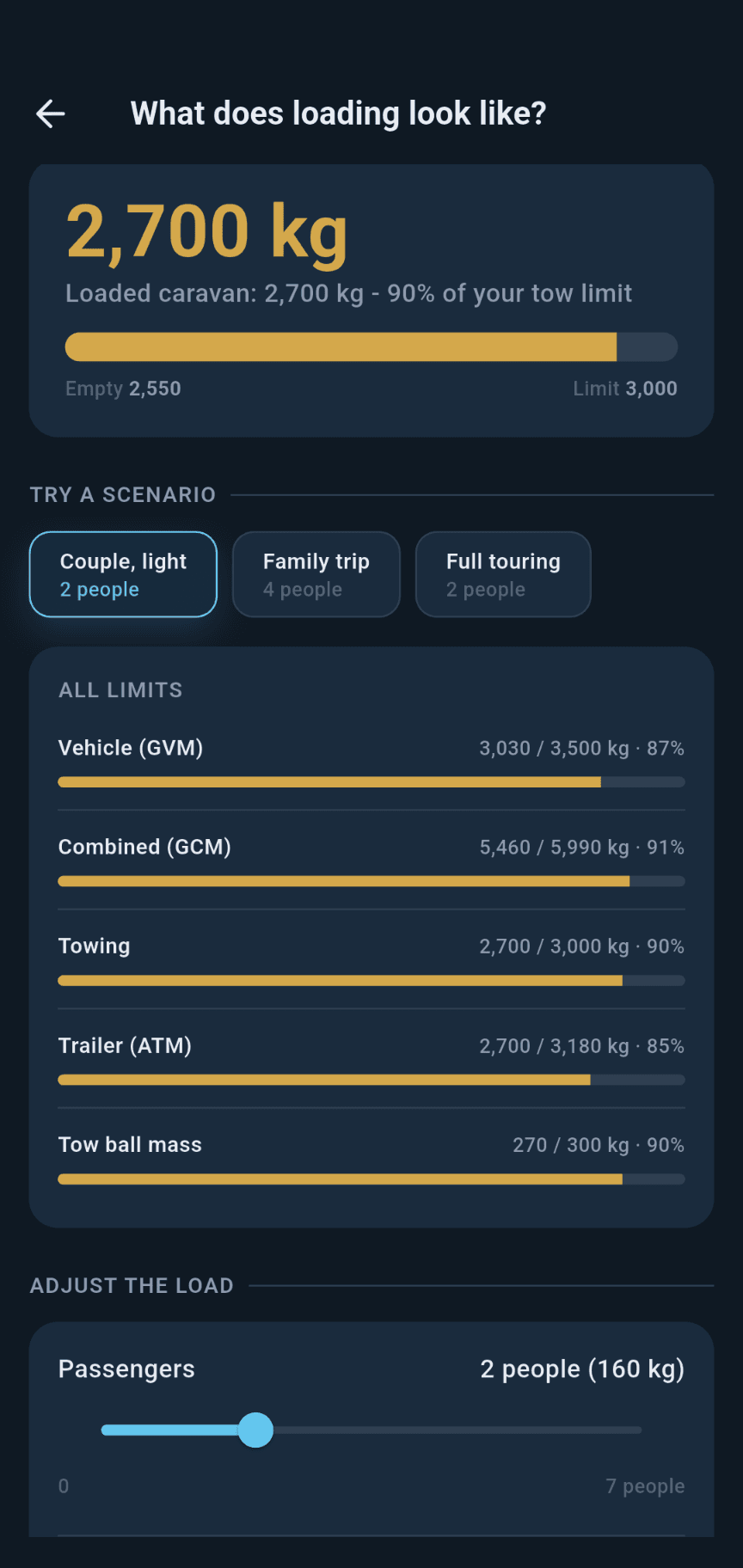
Feel the margin tighten as you load
Drag the sliders (passengers, water, gear) and watch each limit move in real time. The cheapest place to learn a rig runs heavy is before you buy it. Free in the app.


What size caravan water tank do I need?
For powered-site touring, one 80–95 L tank is usually plenty; for regular free camping, plan on 180 L or more for a family — provided your van's payload can carry it. Most Australian vans run one to three fresh tanks of around 80–95 L each, so the practical question is how many days off-grid you actually camp, multiplied by your daily use, plus a margin.
Work it from the table above rather than the brochure: a couple doing long weekends lives comfortably on 80–120 L with care, while a family planning four or more days between taps wants 180 L plus a backup like the bladder. Going bigger isn't free — every extra litre of capacity you fill is a kilogram off the gear you can carry.
If you're retrofitting a tank, position matters as much as size: water forward of the axles adds tow ball mass, water behind them takes it away. Worth knowing before you bolt one in and change how the van sits on the ball.
How do you make water last when free camping?
Most families can halve their water use with habits alone — no hardware required. The old rule still holds: make every drop count.
In the kitchen
Scrape plates with a spatula before washing, and wipe greasy pans with a paper towel first — most dishwater goes to fighting residue you could have binned. Boil a kettle for the washing-up instead of running the hot tap until the system warms, and catch that cold first-run in a jug for drinking or the kettle rather than sending it down the drain.
Personal hygiene
Taps half-open wash hands just as well. Wipes substitute for a shower between proper ones, and the loo doesn't need a full flush every visit — especially for wees. With those habits, a family can comfortably do five days off-grid on a 180 L tank, showering sparingly every second day.
Cooking techniques
One-pot meals and pre-cooked dinners that only need reheating cut the biggest hidden water cost of cooking: the washing-up afterwards. The fewer pots you dirty, the further the tank goes.
Clothes and cleaning
Wear clothes longer between washes and save machine loads for town laundries — a washing machine drinks more in one cycle than your family does in a day. For wipe-downs and freshen-ups, no-rinse soaps and disinfectant wipes handle the in-between days without touching the tanks.
Upgrades that save water
In the longer term: a composting toilet removes flush water from the budget entirely, a separate drinking-water tank lets you keep potable and non-potable supplies apart, and a rainwater catchment off the awning tops up your non-drinking supply for nothing. Each one buys days, not hours.
What are the grey water rules?
There's no single national grey water rule — requirements vary by state, territory, council and individual site, so check where you're staying before you drain anything. Letting grey water run onto the grass at camp is increasingly restricted, and it's poor form even where it's allowed.
| Where you're staying | What to expect |
|---|---|
| Caravan park (powered site) | Usually a sullage point or on-site drainage — confirm at the office before connecting |
| Free camp | Increasingly self-contained only: catch your grey water and carry it out |
| National park | Commonly requires fully self-contained setups — check the state parks service for the park you're visiting |
If your van has no plumbed grey tank, a 40 L portable grey water tank is a cheap retrofit that opens up self-contained-only sites. Remember it obeys the same arithmetic as the fresh side: 40 L of grey water is 40 kg, and it still counts towards the van's ATM on the drive out.
Should you travel with tanks full or empty?
Travel with tanks either full or empty — never part-full. A part-filled tank sloshes, and that moving mass is something the van has to manage at highway speed, right when you least want surprises.
| Tank state | The call |
|---|---|
| Empty (or near it) | Best when you're tight on ATM, GVM or GCM, on long highway legs (less weight, less fuel), or when water is available near camp |
| Full | Makes sense heading into a dry camp — and if the loaded van is comfortably lighter than the loaded tow vehicle, low-mounted water can help |
| Part-full | Avoid it — sloshing water works against the van's stability |
There's a genuine stability case for full tanks on the right rig: a common guideline says that if the loaded van comes in under about 90% of the loaded tow vehicle's weight, travelling with full low-mounted tanks lowers the van's centre of gravity and settles it. Our worked rig sits at about 92% (a 2,800 kg van behind a 3,050 kg loaded ute) — just over the line — so for this rig the safer bias is to run light and refill near camp. The vehicle side of that equation is covered in our braked towing capacity guide, and every term in it is defined in the caravan weights pillar.
How do you keep tank water fresh?
Store the tanks full when the van is parked up, then empty and clean them with a water tank cleaner before the next trip — fresh water into clean tanks, every trip. Stale water is far easier to prevent than to fix.
Storage and cleaning
The pre-trip flush is the habit that matters: drain, run a tank cleaner through per its directions, and refill from a source you trust. An inline filter on the fill hose catches sediment and taste problems before they reach the tanks at all.
Sourcing water on the road
Apps like WikiCamps list water fill points along your route, which turns "where's the next tap?" into a planning detail instead of a crisis. Treat unfamiliar sources with respect: a simple water testing kit weighs nothing, and it's the difference between confident drinking water and a gamble — filter or boil anything you're unsure of.
Leaks, insulation and an emergency reserve
Check for leaks whenever you check the van over — a slow drip under a free camp is range quietly draining away. If you travel cold climates (alpine areas, Tasmanian winters), insulating tanks and lines stops a frozen morning with no water at all. And keep a separate sealed drinking-water reserve you never plan to touch — enough for a day or two for everyone on board.
See what a full tank does to your limits
loadmate treats water as what it is — payload that changes daily — so you can see what filling the tanks does to your limits before you put the hose in. Water never sits in the pile by the door, so it never gets weighed with the gear: 180 L reads as range on a brochure, but it's 180 kg on a weighbridge, and it comes and goes with every fill and every camp. That makes it the easiest weight on the whole rig to lose track of.
In the app, your rig's running total moves when the tanks do — topping up for three nights off-grid shows you how close the van moves to its ATM, and what the extra weight does to the tow vehicle's side of the ledger, before you commit to carrying it.
If the combination only clears its limits with the tanks empty, that matters before you plan a week around 240 L of water. loadmate connects the water and gear you record with the vehicle and caravan's limits, showing how a fill changes the available margins and load distribution. Explore loadmate in the app to see what that extra water means for the whole rig.
loadmate provides decision support for towing safety, not legal weight certification — for legal weight evidence, use a certified weighbridge. See our safety disclaimer.
Related guides
- Caravan & Towing Weights Explained — every weight term explained in one place (the best starting point)
- Gross Vehicle Mass (GVM) Explained — the tow vehicle's loaded limit, where your bladder and jerry cans count
- Aggregate Trailer Mass (ATM) Explained — the van-side limit your tank water counts towards
- Braked Towing Capacity Explained: A Legal Ceiling, Not a Target — how much your vehicle can actually pull
- Caravanning mistakes to avoid — the common errors that catch new vanners, water weight included
- Towing capacity by vehicle — your model's real numbers: braked rating, GVM, GCM and payload at full tow
Frequently asked questions
- How long does a 180 L caravan water tank last?
A family of four typically gets about four days from 180 L — around 45 L a day — and five or more with careful use. A couple at the same per-person rate gets roughly eight days. Showers are the biggest variable.
- How much does a full caravan water tank weigh?
Water weighs 1 kg per litre, so a full 180 L of tanks adds 180 kg before you count the tanks and plumbing themselves. That weight counts towards your caravan's ATM, the same as any other payload.
- How many litres of water do you need per person per day in a caravan?
About 11 L per person per day covers drinking, cooking, dishes and basic hygiene with sensible habits. Frugal free campers get under 9 L. Showers are the swing factor, which is why most people off-grid shower every second day.
- What size water tank do I need for free camping?
With care, 80–120 L covers a couple for a long weekend, while a family planning four or more days off-grid wants 180 L plus a backup such as a water bladder in the tow vehicle. Balance capacity against your van's payload — every litre is a kilogram.
- Can you let caravan grey water drain onto the ground?
Sometimes, but the rules vary by state, council and site. Many free camps and national parks only allow self-contained rigs that carry grey water out, and caravan parks usually provide a sullage point. Check with the site operator or local council before you drain anything.
- Should caravan water tanks be full or empty when towing?
Either full or empty — never part-full, because sloshing water can unsettle the van. Empty saves weight and fuel; full can help stability on a van that is well inside its limits and comfortably lighter than the tow vehicle, since low-mounted water lowers the centre of gravity.
- Does water in the tanks count towards the caravan's ATM?
Yes. Everything the caravan carries, water included, counts towards its Aggregate Trailer Mass. Water carried in the tow vehicle — bladders or jerry cans — counts towards the vehicle's GVM instead. Both feed into the combination's GCM.