When to reweigh a caravan, at a glance
- The trigger
- A material change to what you carry or where you carry it — not a calendar interval
- Why a date won't do
- A weigh-in measures one loaded day; nothing about it expires on a fixed date
- What counts as a change
- A drawer fit-out, a second battery, solar, a long-range tank, a second spare, a WDH, or a heavy repack
- What drifts
- Your measured ATM creeps up while the compliance plate stays unchanged — added gear is unweighed payload
- The legal frame
- No Australian law sets a reweigh interval; the duty is to stay under your limits whenever you tow
- Tow ball mass
- Aim for roughly 10% of loaded ATM, capped by your tow bar's plated rating — and it shifts as you repack
- What a reweigh is not
- A certificate you keep — it is a fresh baseline, decision support for a load you control and can change
You paid for a professional weigh, the figures came back inside your limits, and the ticket went in the glovebox. A year and a few projects later, that ticket still says you are legal — but it is describing a rig you no longer own. This guide is about the decision the ticket cannot make for you: when the changes since your last weigh-in are enough to go back to the scales. For how the figures are produced, see our weighbridge guide; for how to read them once you have them, the mobile weighing report guide.
When should you reweigh a caravan?
Reweigh when something material has changed about the rig — what you carry, or where you carry it — rather than on a fixed schedule. A weigh-in is a snapshot of the rig as it sat on the scales that day. The day you bolt on a drawer system, wire in a second battery or fill a tank that was empty when you weighed, the snapshot stops matching the rig, and the only way to know your real numbers again is to measure them again.
RACQ frames the trigger the same way: weigh your caravan when any significant change is made to what is carried or where it is carried. FindMyVan puts it as weighing after adding new accessories or modifications, and notes that factory weights exclude items like air-conditioners, batteries and accessories in the first place. The common thread is that a change — not the passage of time — is what makes the old figure unreliable.
That is the distinction this guide owns. Our weighbridge guide covers how to produce the numbers, and the mobile weighing report guide covers how to read them. This page is about the decision in between: knowing your baseline has moved, and deciding it has moved enough to act.
How often should you weigh a caravan?
There is no fixed interval — no Australian law sets one, and no figure on a weigh-in expires on a date. A weighbridge ticket or mobile report is evidence of what your rig weighed on one loaded day; it does not carry a use-by stamp, and it does not lose its meaning at six months or twelve. What ages it is the rig changing underneath it.
So the honest answer to "how often" is: whenever the rig is meaningfully different from the rig you last measured, plus a sense check before any big trip where the load is heavier or packed differently than usual. If nothing has changed since your last weigh — same gear, same placement, same tanks — the old figures still describe the rig. If the rig has gathered a fit-out, a battery bank and a season of additions, a date on the calendar tells you nothing useful, and a fresh weigh tells you everything.
| Reweigh trigger | What it relies on | How reliable it is |
|---|---|---|
| A change | Something was added, removed, or moved on the rig | Reliable — it tracks the thing that actually moves weight |
| A calendar interval | A set number of months since the last weigh | Weak — time does not add or remove weight; modifications do |
What changes since your last weigh-in actually move the numbers?
Anything you add, remove or shift moves a number — and most of it is gear fitted after the van left the line, so none of it was on the original ticket. The mechanism is simple: your tare and your compliance plate were set with the van as built, before your accessories existed. Every bolt-on since is unweighed payload, so your measured weight drifts up while the plate reads exactly as it always did. myNRMA describes this weight creep directly: after-market mods, dealer-fitted accessories and personal effects push a once-legal van over its limits, and the accessories are often fitted after the weigh-in.
Trace one illustrative rig forward to see how far that drift goes. (Every figure here is illustrative — your own list and your own plates will differ; the point is the direction of travel, not the exact kilograms.)
On day zero the van was weighed fully loaded at a mobile weigh: roughly a 2,700 kg load on its axles plus a 300 kg tow ball mass, giving a measured ATM of about 3,000 kg against a manufacturer ATM rating of 3,200 kg. That left about 200 kg of spare capacity, and the 300 kg tow ball mass sat at close to 10% of the loaded ATM — healthy, with the tow bar's own plated rating as the real ceiling. On the tow-vehicle side, for cross-reference, the ute carries a GVM of 3,050 kg, a kerb of 2,130 kg, a GCM of 5,950 kg and a braked tow rating of 3,500 kg.
Now run a year of ordinary ownership through it, each item illustrative and presented as a range rather than a false-precise figure:
| Change since the weigh-in | Illustrative added mass | Where it tends to sit |
|---|---|---|
| Drawer / storage fit-out | Tens of kilograms (the kit plus what fills it) | Often forward, near the front boot |
| Second battery | About 11 kg lithium, or roughly 30–40 kg AGM | Usually in the front locker |
| Solar install (200 W) | About 10 kg per panel before brackets and cabling | On the roof, spread along the van |
| Second spare wheel | About 27 kg before the carrier | Usually on a rear carrier |
| Water (per litre) | About 1 kg per litre — tanks weigh empty at tare | Wherever the tanks are mounted |
| Weight distribution hitch | About 30 kg for the head and bars | At the coupling |
Add a drawer fit-out, a second battery, a solar array and a second spare, and you have put roughly 150 kg onto a van that was 200 kg under its ATM rating. The measured ATM climbs from about 3,000 kg toward 3,150 kg, and that 200 kg of spare capacity shrinks toward 50 kg — none of it visible on the plate, none of it on the ticket in the glovebox. The trailer-side limit those numbers run against is explained in our aggregate trailer mass guide; how the same gear eats your tow vehicle's payload is in the gross vehicle mass guide.
Placement drifts too, which the ATM total alone hides. Drawers and batteries fitted ahead of the axle push the ball weight up, so the ball weight creeps up as the front boot fills. Weight carried behind the axle works the other way — a second spare on the back, or water in a rear tank, claws some of that ball weight back through the same lever effect. The total has moved, and where it is carried has moved with it, so even a rig that is still under its ATM can be sitting on a different tow ball figure than the one you measured.
Do modifications make it a legal problem, or just a number?
Both — because exceeding a mass limit is the offence, and unweighed modifications are the most common way a once-legal van quietly creeps over one. The law does not punish a missed reweigh; it punishes being over a limit while you tow. The reweigh is simply how you find out where you stand before a roadside check does it for you.
A typical car-plus-caravan rig under 4.5 tonnes is policed by state and territory road authorities and police, not the National Heavy Vehicle Regulator, which governs vehicles over 4.5 tonnes. The duty is continuous — you must meet your loaded mass limits whenever you tow, with no schedule attached. In Queensland, the Transport Operations (Road Use Management — Vehicle Standards and Safety) Regulation 2021 makes driving a trailer that does not comply with a mass requirement the offence, carrying a maximum of 20 penalty units — an over-limit offence, not a paperwork one. In New South Wales, the loaded trailer mass must not exceed the lesser of your tow bar rating, your vehicle's tow capacity, the van's ATM and your tyre ratings, with a fine and demerit points for towing illegally.
How easily a once-legal van slips over shows up in the field. A mobile weigher writing for RV Daily reported that around half of the vans he weighs exceed their ATM — a weigher's field observation, not an official statistic, but a telling one given how many of those vans were presumably legal the day they were bought. The margin erosion on the worked rig above is the same story in miniature: 200 kg of headroom spent down to about 50 kg by ordinary additions, with nothing on the plate to warn you.
Does a caravan weigh-in expire?
No — a weigh-in does not expire on a date; it goes stale when the rig drifts away from the figure it recorded. "Stale" here is plain English for a measurement that no longer matches the rig, not a status anyone stamps on your ticket. The figure was true the day it was taken. It stays true for exactly as long as the rig stays the same, and it starts ageing the moment you add, remove or move something.
This is why a reweigh is better understood as resetting a baseline than as renewing a certificate. The first weigh gives you a known starting point; every change since pulls your real weight away from it. When the gap between what you last measured and what you are actually carrying gets wide enough — a fit-out, a battery bank, a season of additions — the baseline has drifted far enough that only a fresh measurement tells you the truth. RAC WA makes a related point about trusting figures you did not measure: specified tare and tow ball figures for trailers are much less reliable than people assume, and if you are unsure, get it weighed.
For where the weigh-in sits among all your other limits, start at the pillar guide, caravan & towing weights, or check your own model's real figures on the towing capacity hub.
How loadmate helps you stay under your limits as the rig changes
The glovebox ticket from the worked rig above still reads as legal, yet the van under it now sits on roughly 50 kg of headroom where it once had 200 kg — and nothing on the page tells you the gap opened. loadmate is built to make that gap visible while the rig is parked, not at a roadside check. The free 180-day score-history sparkline plots your trend month by month so the slow climb has a shape you can see. Alongside it, the "Changes since" log is its own surface, listing each load that moved the baseline — the drawer fit-out, the battery, the panel, the second spare — with the date it went on. As that distance grows, the confidence badge eases from Verified toward Estimated, marking the point where the measured numbers stop describing the van you actually tow.
Those signals help you see how far the recorded setup has moved from its measured baseline. A new accessory, extra water or a different packing arrangement can be a reason to review the weights before towing. loadmate keeps that change visible so you have evidence for deciding when to book another weigh. Explore loadmate in the app to see what has changed since the last ticket.
loadmate provides decision support for towing safety, not legal weight certification. Score, compliance checks, and trip readiness are based on the data you enter and the regulator information current at the time of release. For legal weight evidence, use a certified weighbridge. Towing remains the operator's responsibility. The full safety disclaimer sets out what a tracked baseline can and cannot stand in for.
Related guides
- Caravan & Towing Weights Explained — every weight term in one place (the best starting point)
- How to Weigh a Caravan and Tow Vehicle at a Weighbridge — how to produce the numbers a reweigh needs
- How to Read a Mobile Caravan Weighing Report — how to read the figures once you have them
- Gross Vehicle Mass (GVM) Explained — how added gear eats your tow vehicle's payload
- Aggregate Trailer Mass (ATM) Explained — the caravan's loaded limit a reweigh is read against
- Weight Distribution Hitch Setup & Front-Axle Restoration — fitting a hitch is one of the changes that warrants a fresh weigh-in
- Towing capacity by vehicle — your model's real numbers: braked rating, GVM, GCM and payload
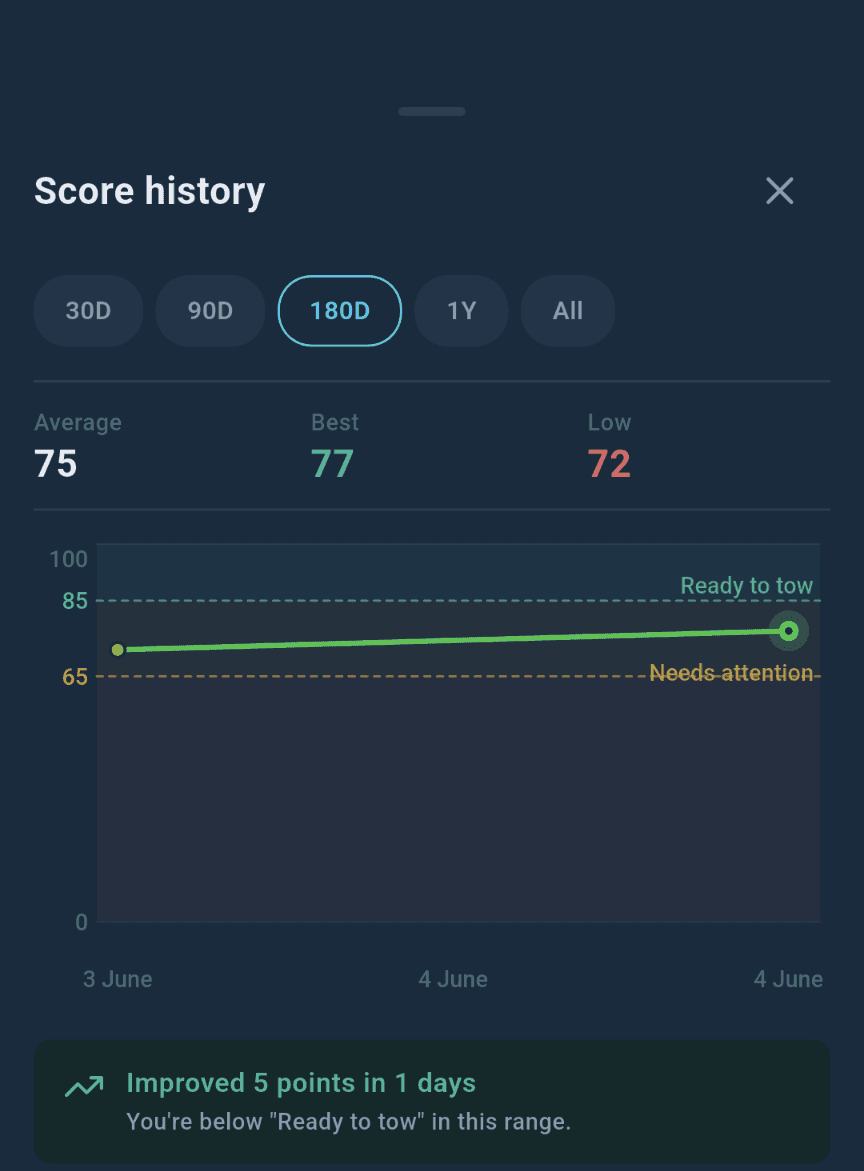
See when a weigh-in goes stale
loadmate marks every load and change since your last weigh-in and eases the confidence badge from Verified toward Estimated as the baseline ages. See which recorded changes need another look before you leave.


Frequently asked questions
- How often should you weigh a caravan?
There is no fixed interval, and no Australian law sets one. Weigh again whenever the rig has materially changed — after a fit-out, a battery or solar install, a long-range tank, a second spare, or a heavy repack — plus a sense check before a big trip where the load is heavier or packed differently than usual. Time alone does not add weight, so a calendar date is a poor trigger; a change is the real one.
- When should you reweigh your caravan?
Reweigh when something material has changed about what you carry or where you carry it, rather than on a schedule. A weigh-in measures the rig as it sat that day, so adding a drawer system, wiring in a battery, fitting solar or filling a tank that was empty when you weighed all pull your real weight away from the recorded figure. RACQ frames it as weighing whenever a significant change is made to the load.
- Do you need to reweigh after fitting solar, batteries or a drawer system?
Yes — each of those adds unweighed payload that was not on your original ticket. As an illustrative guide, a 200 W solar panel is around 10 kg before brackets and cabling, a second battery is roughly 11 kg as lithium or 30 to 40 kg as AGM, and a drawer fit-out adds tens of kilograms once it is loaded. Fitted together they can move your measured ATM by a hundred kilograms or more, none of which shows on the compliance plate.
- Does a caravan weigh-in or weighbridge ticket expire?
No. A ticket or report is evidence of what your rig weighed on one loaded day, and nothing about it expires on a date. What ages it is the rig changing underneath it, so it stays accurate for exactly as long as the load and its placement stay the same. Treat it as a baseline to act on, not a certificate to file and forget.
- Is it a legal requirement to reweigh a caravan after modifications?
No Australian law requires a reweigh on a schedule or after a modification. The legal duty is to stay under your mass limits whenever you tow — in Queensland, driving a trailer that does not comply with a mass requirement is the offence, up to 20 penalty units, and New South Wales applies a lesser-of limit with a fine and demerit points. A reweigh is simply the practical way to confirm you still meet those limits after the rig has changed.
- Does caravan tare weight include a full water tank?
No. Tare is measured with the water tanks empty, so a full tank is added weight that sits entirely outside the tare figure. Water is about 1 kg per litre, so a 100-litre tank brimmed for a week off-grid is about 100 kg of payload that was not in your tare and may not have been in your weigh-in either. Where you mount it also shifts your tow ball figure, which is why both the total and the balance can move once you fill up.
- Do you need to reweigh after fitting a weight distribution hitch?
Reweighing is worth it, because a weight distribution hitch changes how your existing weight is carried even though its own mass is modest — roughly 30 kg for the head and bars as an illustrative figure. It transfers load off the tow vehicle's rear axle and restores some to the front, which our weight distribution hitch guide covers in full, so your axle figures move even when your totals barely do. A fresh weigh confirms the hitch is set the way you actually run it, rather than to a guess.