How to weigh your caravan and car at a weighbridge, at a glance
- What it is
- A certified weight of your loaded rig on a public platform, recorded on a measurement ticket
- Why it takes passes
- One deck reads one configuration, so GVM, GTM, ATM and the combination each need a different drive-on
- Must you unhitch?
- Yes — ATM is only readable with the van uncoupled, its jockey wheel down on the same deck, the vehicle clear of it
- Tow ball mass
- Worked out as ATM minus GTM, or as the hitched-minus-unhitched difference, not read off a single line
- Typical cost
- Roughly 30 to 45 dollars for a single certified weigh (varies by operator)
- The legal instrument
- Public weighbridges operate under the National Measurement Act 1960; the ticket is an NMI measurement record
- What it is not
- A compliance certificate — it is one loaded day's evidence to act on, and your weight changes every time you repack
You roll your rig onto the weighbridge expecting one number to tell you the whole story, and it cannot — a weighbridge weighs whatever is resting on the deck at that moment, no more. The legal figures that matter live in different configurations: van hitched, van unhitched, vehicle on, vehicle off. This guide walks the drive-on passes that pull each one out of a single platform, what each drive-on relies on, and roughly what the trip costs. Reading the figures once you have them is a separate job, covered in our mobile weighing report guide.
Why can't a weighbridge give you every weight in one drive-on?
A weighbridge measures only what is pressing on the platform at that instant, so a single drive-on gives you one combined total and nothing else useful. The figures that decide whether your rig is legal — GVM, GTM, ATM, the combination, the tow ball mass — describe different things, and most of them need the load arranged differently before the platform can read them.
Think about what each one is. GVM is the loaded tow vehicle on its own. The combination is the vehicle and van together. GTM is what the van's axles carry while it is still hitched. ATM is the whole van standing unhitched on its own legs. You cannot capture all of those at once, because in any single moment the van is either hitched or unhitched, and the vehicle is either on the deck or off it — which is the whole reason a proper weigh is a short sequence rather than one stop.
Throughout this guide we use one illustrative rig — a dual-cab ute (GVM 3,050 kg, GCM 5,950 kg) and a tandem-axle van (ATM 3,000 kg, GTM 2,700 kg, 300 kg tow ball mass). It is an example, not a real vehicle, and the numbers are here so every figure reconciles. Your own plates will read differently; always weigh against yours.
| Weight | What sits on the platform | What it tells you |
|---|---|---|
| GVM | The loaded tow vehicle's wheels, van off | The vehicle against its own loaded limit |
| Combination | Every wheel — vehicle and hitched van | The whole rig against GCM |
| GTM | The van's wheels only, while still hitched | The van's axle load against its GTM rating |
| ATM | The van's wheels only, unhitched, jockey wheel down | The whole van's loaded mass against ATM |
| Tow ball mass | Derived, not weighed directly | The download the van puts on the tow bar |
The passes also tell you something the brochure cannot: whether the rig as you have packed it actually fits under its combined limit. On the illustrative rig the combination weigh reads about 5,650 kg — the loaded ute at roughly 2,950 kg hitched, plus the van's 2,700 kg GTM — which sits inside the 5,950 kg GCM. The tow ball mass is not added on top, because it already sits inside the vehicle's figure once the van is hitched. This is also why you usually cannot run both the ute and the van at their own ceilings: a full 3,050 kg GVM plus a full 3,000 kg ATM comes to 6,050 kg, which is over the 5,950 kg GCM, so something has to give.
Do you need to unhitch the caravan to weigh it?
Yes — at least once. Your ATM, the caravan's full loaded mass and its legal ceiling, can only be read with the van uncoupled and standing on its own jockey wheel on the same platform, with the tow vehicle clear of the deck. While the van is hitched, part of its weight is carried through the coupling onto the tow vehicle, so the platform never sees the full figure.
The detail that makes or breaks this reading: when you take the ATM drive-on, the jockey wheel must be down on the same metal deck as the caravan's wheels, with the tow vehicle driven completely off that platform (AL-KO / Without a Hitch). If the jockey wheel is sitting on the approach or on a separate slab, the deck is not carrying the whole van, and the ATM you write down is meaningless. Get the van fully aboard, on its own, before you read that line.
Hitched and unhitched are not interchangeable. The Western Australia Department of Transport puts it as a definition: ATM equals GTM plus the tow hitch download. So the same loaded van reads as two different platform figures depending on whether it is coupled — GTM while the ball is still carried by the vehicle, ATM once it is standing alone — and the gap between them is the tow ball mass.
| Configuration | What the platform reads | On the illustrative rig |
|---|---|---|
| Van hitched (vehicle off the deck) | GTM — the van's axle load only | 2,700 kg |
| Van unhitched (jockey wheel down, on the same deck) | ATM — the whole van | 3,000 kg |
| The difference | Tow ball mass, carried by the vehicle when hitched | 300 kg |
What is the order of passes to weigh a caravan at a weighbridge?
Regulators define each weight and tell you to use a public weighbridge, but none of them publishes one official order of passes — providers sequence the drive-ons differently. What stays constant is the logic each drive-on relies on; the order is a matter of which figure you want to read first and how few times you want to uncouple. Below are two real sequences from Australian weighing providers, attributed so you can see they vary.
Sequence A (RV Service Centre). Start with the whole rig.
- Drive the whole rig onto the platform, hitched, every wheel on — that reads the combination against GCM.
- Drive the tow vehicle forward off the platform while the van stays hitched and its wheels stay on the deck — that reads GTM (the ball is still carried by the vehicle).
- Lower the jockey wheel and fully uncouple, vehicle clear of the deck — that reads ATM.
- Work out tow ball mass as ATM minus GTM.
A useful by-product of this order: the combination from step 1 minus the GTM from step 2 leaves the loaded tow vehicle's own figure, which you read against GVM.
Sequence B (Margie and Tim, mirroring GoWeigh). Start with the vehicle alone.
- Put the tow vehicle's wheels on the platform with the van uncoupled and off the deck — that reads GVM.
- Lower the jockey, unhitch with the jockey wheel off the platform; the difference from step 1 is the tow ball mass.
- Re-hitch and drive the whole rig on — that reads the combination against GCM.
- Drive the vehicle off, leaving the van's wheels on with the ball level at the platform edge — that reads GTM.
- Move the jockey wheel onto the platform and unhitch — that reads ATM.
Both arrive at the same five figures; they simply choose a different first stop and uncouple a different number of times. If your operator runs a third order, check it against the configuration table above — as long as each figure is read in the configuration that line describes, the order is yours to pick.
How do you work out your tow ball weight at the weighbridge?
Tow ball mass is not a line you drive onto and read — you derive it. The cleanest way is ATM minus GTM: the van's full unhitched mass minus its hitched axle load is the part the coupling transfers to the tow vehicle. On the illustrative rig that is 3,000 kg minus 2,700 kg, which gives a 300 kg tow ball mass.
There is more than one route to the same number, and a weighbridge supports two of them:
- ATM minus GTM. Take both van passes — unhitched for ATM, hitched for GTM — and subtract. This is the method Caravan Council of Australia describes, and it falls straight out of Sequence A.
- Hitched minus unhitched vehicle. Weigh the tow vehicle with the van coupled, then again with it uncoupled; the drop is the download the ball was adding. This is the method Sequence B uses at step 2.
- A ball scale. A dedicated tow ball scale reads the download directly, away from the weighbridge — handy at home, but not part of the platform passes.
That 300 kg does not simply sit on the back bumper, either. Because the ball hangs on a hitch behind the rear axle, it acts on a lever: on this rig the rear axle gains roughly 140 kg on top of the ball's own weight, and about 140 kg comes off the front. The arithmetic behind that, and why it matters for your GVM, is worked through in our gross vehicle mass guide.
Should you weigh the caravan empty or fully loaded?
Fully loaded, the way you actually travel — full water tanks, gas bottles, food, clothes, recovery gear, everyone aboard the tow vehicle. An empty or tare weigh tells you almost nothing about whether your loaded rig is legal. ATM and GVM are limits on the rig as it sits on the road, so the only weigh worth paying for is the one that matches a real trip.
Two traps catch people here. The first is weighing with the tanks drained and the cupboards empty to get a flattering number — that figure is not the one a roadside check measures against. The second is trusting the tare figure on the compliance plate as your starting weight: dealer-fitted accessories often go on after the van leaves the line, so the plate tare can already be wrong before you load a thing. Weigh the rig loaded and you sidestep both. The trailer-side detail behind ATM and tare is in our aggregate trailer mass guide.
Can a public weighbridge give you front and rear axle weights?
Sometimes, with extra positioning — but a single-deck public weighbridge cannot split left-versus-right wheel weights at all. To read an axle on its own you reposition the rig so only that axle's wheels rest on the plate; some operators have you reverse onto the plate to isolate the rear axle (Active Scales), and a multi-deck bridge lets you straddle two decks and read front and rear at once.
What no single platform can do is tell you how your load sits side to side, because the whole axle is on one deck and the deck reports one number. Individual wheel weights — the left-versus-right detail that reveals a lopsided pack — need a mobile weigh that puts a pad under each wheel. That is a different service with a different job; our mobile weighing report guide covers what those per-wheel figures show and how to read them. If side-to-side balance is your worry, a public weighbridge is the wrong tool; if certified totals and axle figures are what you need, it is the right one.
| Public weighbridge | Mobile weigh | |
|---|---|---|
| Comes to you | No — you drive to it | Yes |
| Certified ticket | Yes — an NMI measurement ticket | Provider report (not an NMI ticket) |
| GVM, GTM, ATM, combination | Yes, via the passes | Yes |
| Axle weights | With repositioning or a multi-deck | Yes, directly |
| Left-versus-right (per wheel) | No | Yes |
Where do you find a public weighbridge, and what does it cost?
A public weighbridge is the cheapest certified record of your weights — roughly 30 to 45 dollars for a single weigh — and you find one through the National Measurement Institute's public-weighbridge finder or publicweighbridge.com.au. The figure you pay for is a measurement ticket showing gross, tare and net, issued under the National Measurement Act 1960.
Single-weigh prices sit in a tight band across operators: AL-KO around 30 dollars, Netweigh around 30 dollars, Kettridges around 40 dollars, GoWeigh around 45 dollars. Prices and locations change, so confirm with the site before you drive out. Two finders cover most of the country:
- The NMI public-weighbridge finder at industry.gov.au lists licensed public weighbridges.
- publicweighbridge.com.au is an industry directory of sites by location.
One caveat worth knowing: the NMI notes that public weighbridges are set up to weigh loads over 3 tonnes, so a very light single-axle rig may sit near the bottom of a bridge's working range. For most car-plus-caravan combinations that is not an issue, but it is worth a call ahead if your rig is small.
Is a weighbridge ticket proof your rig is legal?
No. A weighbridge ticket is certified evidence of what your rig weighed on one loaded day — it is not a compliance certificate, and it does not stay true once you repack. Your weight changes the moment you fill a tank, add gear or move the load, so the ticket is a snapshot to act on, not a certificate to file and forget.
It helps to know who actually enforces these limits. A typical car-plus-caravan rig under 4.5 tonnes GVM is policed by state and territory road authorities and police, not the National Heavy Vehicle Regulator — the NHVR and the Heavy Vehicle National Law govern vehicles over 4.5 tonnes GVM, which most caravan rigs are not. Transport for NSW frames the test simply: your caravan's loaded mass must not exceed the lesser of your towbar rating, your vehicle's tow capacity, the van's ATM and your tyre ratings — and, separately, the whole rig must stay under your GCM. A ticket helps you check each of those; it does not waive any of them.
How seriously this is taken shows up in the numbers. When Victoria Police weighed 71 caravans and camper trailers in January 2017, 41 of them — 57 per cent — were overweight, and only 2 of the 71 owners knew their actual weights (reported by NRMA / Australian Caravan + RV, 22 October 2022). A ticket turns you into one of the people who knows.
A weighbridge ticket, like loadmate, is decision support — it prepares you for a roadside check, it does not stand in for the regulator's judgement. Read the full safety disclaimer before relying on any figure for a compliance decision.
How loadmate helps you stay under your limits after a weigh-in
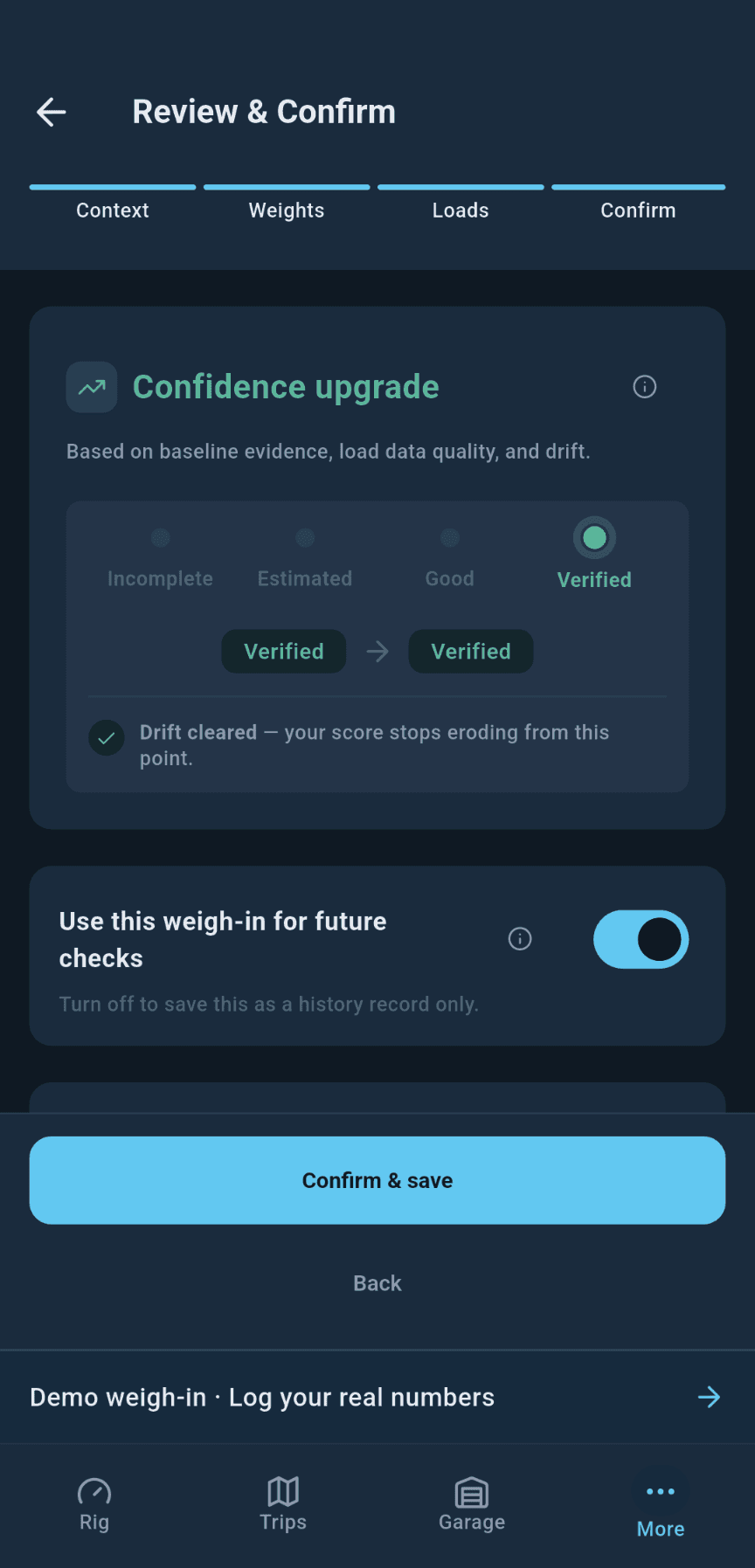
A weighbridge ticket is only as good as your trust in it the next time you load — and a paper ticket in the glovebox cannot tell you whether today's pack still sits where the scales said it did. The live question on this page is whether you can trust this rig's margins, and a recorded weigh-in is what settles it. Enter the measured figures from your ticket and loadmate moves the rig's confidence from Estimated to Verified — you watch the badge climb that ladder on the rig screen — and the drift resets to zero, so the figures you just paid for stay honest as you fill a tank or shift the load. The weigh-in record screen keeps the measured values on hand, ATM, GTM and tow ball mass as the deck read them, against the limits each one answers to.
A weighbridge visit gives you a measured baseline. loadmate connects the recorded weigh-in with the water, gear and accessories added afterwards, so the next trip can start with a review of what changed. Explore loadmate in the app to see how the ticket stays useful between weighs.
Related guides
- Caravan & Towing Weights Explained — every weight term in one place (the best starting point)
- How to Read a Mobile Caravan Weighing Report — how to read the figures these passes produce
- Gross Vehicle Mass (GVM) Explained — the GVM line, axle limits and the tow ball lever
- Aggregate Trailer Mass (ATM) Explained — the unhitched ATM drive-on and the tare trap
- Braked Towing Capacity Explained — how the combination line and GCM fit together
- Gross Combination Mass (GCM) Explained — the combination line you measure here, and why the ball is only counted once
- When to Reweigh a Caravan: What's Changed Since Your Last Weigh-In — when these numbers go stale and it's time to drive back on
- Weight Distribution Hitch Setup & Front-Axle Restoration — the front-axle and tow ball figures this weigh-in captures for hitch setup
- Towing capacity by vehicle — your model's real numbers: braked rating, GVM, GCM and payload
Turn an estimate into a measured number
Log a weighbridge ticket and loadmate recalculates from your measured weights. The ticket is a snapshot; loadmate tracks what changes after it, so the verified baseline stays useful between weighs. Create a free account to explore it on a populated demo rig in the app.


Frequently asked questions
- How do I weigh my caravan and car at a weighbridge?
You take a short series of drive-on passes, because one platform reads only one configuration at a time. Weigh the loaded tow vehicle for GVM, the whole hitched rig for the combination, the van's wheels while still hitched for GTM, and the van unhitched on its own jockey wheel for ATM. Providers order these passes differently, but each figure must be read in the configuration that defines it.
- Do I need to unhitch the caravan to weigh it?
Yes, at least once. Your ATM — the caravan's full loaded mass and legal ceiling — can only be read with the van uncoupled and standing on its own jockey wheel on the same platform, with the tow vehicle off the deck. While the van is hitched, part of its weight transfers through the coupling to the vehicle, so the platform never sees the full ATM.
- How much does it cost to weigh a caravan at a weighbridge?
A single certified weigh at a public weighbridge is roughly 30 to 45 dollars, depending on the operator. It is the cheapest certified record of your weights and produces a measurement ticket showing gross, tare and net. Prices and locations change, so confirm with the site before you drive out.
- Where do I find a public weighbridge?
Use the National Measurement Institute's public-weighbridge finder at industry.gov.au, or the industry directory publicweighbridge.com.au, to find a licensed public weighbridge near you. Public weighbridges operate under the National Measurement Act 1960 and issue a certified measurement ticket.
- How do I work out my tow ball weight at the weighbridge?
Subtract the van's hitched axle load (GTM) from its full unhitched mass (ATM); the difference is the tow ball mass transferred to the tow vehicle. On a van with a 2,700 kg GTM and a 3,000 kg ATM, that is 300 kg. You can also weigh the tow vehicle hitched and then unhitched and take the difference, or use a dedicated tow ball scale.
- Should I weigh my caravan empty or fully loaded?
Fully loaded, the way you actually travel — full water and gas, food, gear and everyone aboard. ATM and GVM are limits on the rig as it sits on the road, so an empty weigh does not tell you whether your loaded rig is legal. Do not trust the plate tare as your starting weight either, because dealer accessories are often fitted after the van leaves the line.
- Can a weighbridge give me front and rear axle weights?
Sometimes, with extra positioning — you reposition so only one axle rests on the plate, or straddle a multi-deck bridge to read both at once. But a single-platform public weighbridge cannot split left-versus-right wheel weights; that side-to-side detail needs a mobile weigh with a pad under each wheel.
- Is a weighbridge ticket proof that my rig is legal?
No. A ticket is certified evidence of what your rig weighed on one loaded day, not a compliance certificate, and your weight changes every time you repack. A typical rig under 4.5 tonnes is policed by state and territory road authorities and police, who judge your loaded mass against the lesser of your towbar rating, tow capacity, ATM and tyre ratings, with your GCM capping the combined rig. Use the ticket to check those; it does not waive them.