A weighing report at a glance
- What it is
- A professional, wheel-by-wheel weight measurement of your loaded tow vehicle and caravan
- What it shows
- Each wheel and axle, the tow ball mass, and your GVM, GTM, ATM and GCM figures
- Read against
- Your manufacturer limits — GVM, axle capacities (GAWR), GTM, ATM — and the tow bar download limit
- Check first
- Tow ball mass (aim ~8–12% of ATM), the rear-axle line, and side-to-side balance
- Headline source
- The definitions trace to your state road authority's towing guidance and your compliance plates
- What it is not
- A compliance certificate — it is decision support for a load you control and can change
You have had the rig professionally weighed and a report has landed in your inbox: a page or two of figures, acronyms and per-wheel numbers. This guide walks that report top to bottom — what each line measures, which manufacturer limit it is read against, and the three numbers worth checking first (tow ball mass, rear-axle load and side-to-side balance). It is about reading the numbers; for how they are produced on the scales, that is a separate job covered in our weighbridge guide.
How do you read a mobile caravan weighing report?
Read it as a set of measured weights paired with the limit each one has to stay under — start with the totals, then the axles, then the individual wheels. Most providers print the figures in roughly that order, so work down the page:
- The totals — your loaded tow vehicle against its GVM, the caravan against its ATM, and the two together against the GCM.
- The axles — the front and rear axle of the vehicle against their capacities, and the caravan's axle group against its GTM rating.
- The individual wheels — each wheel left and right, which is the detail a public weighbridge usually cannot give you.
- The tow ball mass — the download the van puts on your tow bar, checked as a percentage and against the tow bar's own limit.
Throughout this guide we use one illustrative rig — a dual-cab ute (GVM 3,050 kg, GCM 5,950 kg) and a tandem-axle van (ATM 3,000 kg, GTM 2,700 kg, 300 kg tow ball mass) — so every number reconciles. Your own figures will differ; always read them against your own plates.
What's on the report, line by line — and what each line is read against
Every measured line on the report has a matching manufacturer limit; the report's job is to put the two side by side. Here is the same illustrative rig as a worked report (the wheel and axle splits are illustrative; the totals are the rig):
| Report line | Reading (illustrative) | Read against | Note |
|---|---|---|---|
| Front axle (vehicle) | 1,380 kg | Front axle capacity (GAWR) | within |
| Rear axle (vehicle) | 1,570 kg | Rear axle capacity (GAWR) | within — the line to watch |
| Tow vehicle, hitched | 2,950 kg | GVM 3,050 kg | within |
| Caravan left wheel | 1,410 kg | judged vs the right wheel + tyre | the heavy side |
| Caravan right wheel | 1,290 kg | judged vs the left wheel + tyre | ~120 kg lighter |
| Caravan axle group (GTM) | 2,700 kg | GTM rating | within |
| Tow ball mass (TBM) | 300 kg | tow bar limit + ~8–12% of ATM | 10.0% of ATM |
| Aggregate Trailer Mass (ATM) | 3,000 kg | ATM rating | at the limit |
| Combination (vehicle + van) | 5,650 kg | GCM 5,950 kg | within |
Provider report templates differ, and so do the words they use for the same figure. The underlying terms come from your state road authority — the definitions below follow the WA Safe Towing Guide (retrieved 24 June 2026), and they hold across Australia even where the enforcing agency differs. The bracketed labels are what you may actually see printed:
| Canonical term (regulator) | What it measures | Labels you may see on a report |
|---|---|---|
| Gross Vehicle Mass (GVM) | The vehicle's loaded weight limit | "GVM", "Gross Vehicle Mass" |
| Axle capacity (front / rear) | The most each axle may carry | "Axle Capacity", "GAWR", "Gross Axle Weight Rating" |
| Gross Combination Mass (GCM) | The vehicle-plus-van limit | "GCM", "Gross Combined Mass" (a provider variant) |
| Gross Trailer Mass (GTM) | The van's axle load while hitched | "GTM", "Gross Trailer Mass" |
| Aggregate Trailer Mass (ATM) | The van's loaded weight, unhitched | "ATM", "Aggregate Trailer Mass" |
| Tow ball mass (TBM) | The download the van puts on your tow bar | "TBM", "Tow Ball Mass", "tow ball weight", "tow hitch download" |
| Individual wheel weights | Each wheel, left versus right | "Individual Wheel Weights", "Axle Balancing", "side to side" |
Two label traps worth knowing: "Gross Combined Mass" on some reports is the same figure as the regulator's Gross Combination Mass, and "Axle Balancing" is a provider's framing for the left-versus-right wheel weights rather than a separate legal term. If a label is unfamiliar, map it back to one of the rows above before you act on it.
What is GTM versus ATM on your report?
ATM is your caravan weighed unhitched with everything aboard; GTM is what its own wheels carry once it is hitched and the tow ball has taken its share. The WA Safe Towing Guide defines ATM as the sum of GTM plus the tow hitch download, which is why the two lines on your report differ by exactly the tow ball mass.
| On your report | What it is | On the illustrative rig |
|---|---|---|
| ATM | The van's full loaded mass, standing on its own | 3,000 kg |
| GTM | The part of that carried by the van's axles, hitched | 2,700 kg |
| Difference | The tow ball mass transferred to the tow vehicle | 300 kg |
So on this rig, GTM 2,700 kg plus a 300 kg tow ball mass returns the 3,000 kg ATM. If your report's ATM and GTM lines do not differ by your tow ball mass figure, query it. The trailer-side detail behind these limits is in our Aggregate Trailer Mass guide.
What should the tow ball mass line read?
As a guide, the WA Safe Towing Guide puts tow hitch download at 8–10% of the caravan's ATM, up to your tow bar's load limit — so on a 3,000 kg ATM that is roughly 240–300 kg. Our illustrative rig's 300 kg sits at the top of that band: 300 ÷ 3,000 is 10.0% of ATM.
A few cautions before you treat one number as the target:
- Name the basis. The WA figure is a percentage of ATM. Some sources quote the band against GTM instead, and a few quote up to 12% — the percentage moves with which figure it is measured against, so check what your provider used.
- The cap is real. Your tow bar and the vehicle's compliance plate state a maximum tow ball download. That ceiling overrides the percentage: a healthy percentage that exceeds the tow bar limit is still too much.
- Too little is a problem too. The WA guidance notes that variation above or below the recommended download reduces the stability of the combination, and that some vans (European-style couplings, for instance) are designed for a lower figure — your caravan's manual has the last word.
What do the individual wheel weights tell you?
The per-wheel figures are the reason a mobile weigh exists — they show how your load sits left versus right, which a single-platform public weighbridge cannot. Australian providers such as Check Weight and Mobile Vehicle Weighing WA print each wheel, then group them into axle and total figures.
Read them as pairs. On the illustrative van, the left wheels read 1,410 kg and the right 1,290 kg: together they make the 2,700 kg GTM, but the left side is carrying about 120 kg more than the right. Each individual wheel also has to sit within the load rating of the tyre fitted to it, so a heavily loaded corner can quietly push one tyre past its rating even when the axle total looks fine.
What does side-to-side weight mean, and when is it a problem?
Side-to-side weight is the difference between the left and right wheels; there is no Australian legal threshold for it, so it is judged against your tyre load ratings, your per-side axle share, and your caravan's manual — not a single number. We checked: no AU road authority publishes a kilogram or percentage limit for left-right imbalance (verified 24 June 2026). Australian weighing services frame it qualitatively — uneven left-to-right loading affects handling and stability — and point you to the van's manual.
On the illustrative rig the ~120 kg gap is about 4.4% of the van's axle load. That is worth understanding and correcting where you can, not an automatic failure. What raises the concern is when the heavy side approaches a tyre's load rating, or when the manufacturer's manual sets a tighter expectation. (You may see overseas forums quote figures like a "60/40 split" as severe — those are UK and US discussions using UK terms, shown here only for contrast; they are not an Australian rule.)
Why is my rear axle high, and my front axle light?
A heavy tow ball does not just add weight to the back of your vehicle — it levers weight off the front axle, so the rear line on your report reads higher and the front lower than the raw tow ball figure suggests. The ball sits on a hitch behind the rear axle, so it acts on a lever: the rear axle gains the ball's weight plus extra, and the steer axle loses some.
On the illustrative rig a 300 kg tow ball mass adds its own weight plus roughly 140 kg of lever load to the rear axle — about 440 kg of added rear-axle load in total — and takes roughly 140 kg off the front. That is why a report can show a high rear-axle line and a light front axle even when the tow ball percentage looks healthy. The lever maths and what it does to your GVM are worked through in our gross vehicle mass guide; restoring the lost front-axle weight is what a weight distribution hitch is for, covered in the front-axle restoration guide.
Reading the numbers versus producing them
This guide is about interpreting a report you already have; producing the numbers — the drive-on passes on a weighbridge, or the mobile service's measurement — is a separate job. A mobile weigh comes to you and gives the per-wheel and side-to-side detail; a public weighbridge gives you a certified ticket of total and axle weights but rarely individual wheels. Whichever you used, the report is a snapshot of one loaded day, and your weight changes every time you repack. For where the figures fit alongside the rest of your limits, start at the pillar guide, caravan & towing weights, or see your model's real numbers on the towing capacity hub.
A report, like loadmate, is decision support — it prepares you for a roadside check or a weighbridge, it does not replace one. Read loadmate's safety disclaimer before you treat any single line on the report as a compliance decision.
How loadmate helps you stay under your limits after a weigh-in
A weighing report captures one loaded day in detail, then starts ageing as soon as you repack the boot or change the water load. loadmate connects its recorded measured figures with those later changes, so your GVM, axle and tow ball margins can be reviewed before the next trip.
Explore loadmate in the app to see how your weighing report can support the next trip, with a measured baseline and the load changes recorded since it.
Related guides
- Caravan & Towing Weights Explained — every weight term in one place (the best starting point)
- Aggregate Trailer Mass (ATM) Explained — the GTM, ATM and tow ball figures on your report
- Gross Vehicle Mass (GVM) Explained — the GVM line, axle limits and the lever effect
- Braked Towing Capacity Explained — how the GCM and combination line fit together
- Common caravanning mistakes — the loading habits a report tends to expose
- How to Weigh a Caravan and Tow Vehicle at a Weighbridge — how the figures on this report were produced in the first place
- When to Reweigh a Caravan: What's Changed Since Your Last Weigh-In — when a report stops describing the rig you actually run
- Weight Distribution Hitch Setup & Front-Axle Restoration — the light-front-axle reading a report flags, and how a hitch corrects it
- Why Your Caravan Needs Its Own Odometer and Service Log — the dated baseline a measured report becomes in the van's own log
- Towing capacity by vehicle — your model's real numbers: braked rating, GVM, GCM and payload
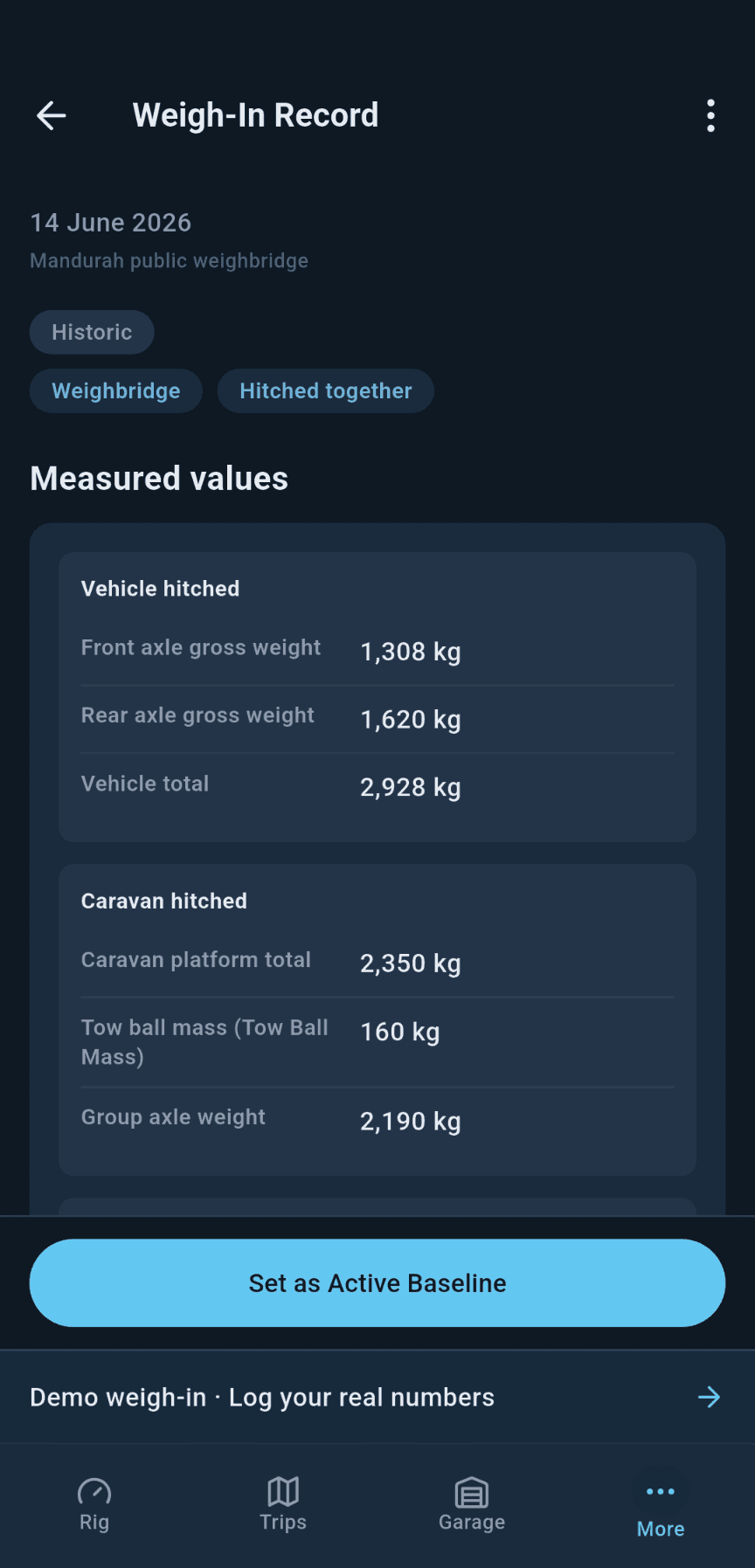
Build on what it really weighs
loadmate links a weighbridge or mobile-weigher result straight into your rig, so every margin sits on measured weight, not a decade-old plate. Free to explore in the app.


Frequently asked questions
- How do you read a mobile caravan weighing report?
Read each measured weight next to the manufacturer limit it has to stay under. Start with the totals — the vehicle against its GVM, the caravan against its ATM, and the two combined against the GCM — then the front and rear axles against their capacities, then the individual left and right wheel weights, and finally the tow ball mass as a percentage of ATM and against your tow bar limit.
- What should the tow ball mass be on my caravan weighing report?
As a guide, around 8 to 10 per cent of the caravan's ATM, up to your tow bar's load limit, with some sources quoting up to about 12 per cent. The percentage depends on whether it is measured against ATM or GTM, so check the basis, and remember the tow bar and compliance plate limit can cap it. Too little download is also a problem, and your caravan's manual has the final say.
- What do the individual wheel weights on the report mean?
They show how much each wheel is carrying, left versus right, which is detail a single-platform public weighbridge cannot give you. Each wheel also has to stay within the load rating of its tyre, so the per-wheel figures can reveal an overloaded corner even when the axle total looks acceptable.
- What does side-to-side weight mean, and how much imbalance is too much?
Side-to-side weight is the difference between the left and right wheels. No Australian road authority publishes a set limit for it, so it is judged against your tyre load ratings, the per-side axle share, and your caravan's manual rather than a single figure. Reduce a noticeable imbalance where you can, and treat a side that approaches a tyre's load rating as the real warning.
- What is the difference between GTM and ATM on my report?
ATM is the caravan's full loaded weight measured unhitched; GTM is the part of that weight carried by the van's own axles once it is hitched. They differ by the tow ball mass, which transfers to the tow vehicle when you couple up. On a van with a 2,700 kg GTM and a 300 kg tow ball mass, the ATM is 3,000 kg.
- My rear axle reading is high — what does that mean?
A high rear-axle line usually reflects the tow ball download plus the lever effect: because the ball sits behind the rear axle, it adds more to that axle than its own weight. Check the rear axle reading against its capacity, check the tow ball mass against its percentage band and your tow bar limit, and consider whether load can move forward in the vehicle or into the van.
- Why does my front axle weight drop after I hitch up the caravan?
The tow ball acts on a lever behind the rear axle, so coupling up rotates weight onto the rear axle and lifts some off the front. A lighter steer axle means less steering and braking grip at the front, which is the problem a weight distribution hitch is designed to correct by restoring some of that lost front-axle weight.
- Is a mobile weighing report proof that my rig is legal?
No. A report is a professional measurement of your weights against your limits at one point in time; it is decision support, not a compliance certificate, and your load changes every time you repack. Use it to correct your setup and to set a baseline, and treat staying within your limits as your ongoing responsibility.