Braked towing capacity at a glance
- What it is
- The manufacturer's maximum trailer weight your vehicle may tow when the trailer has its own brakes
- Unbraked rating
- A separate, much lower figure for trailers without brakes — typically capped at 750 kg
- Trailer brake law (AU)
- Over 750 kg GTM the trailer needs its own brakes; over 2,000 kg GTM, brakes on all wheels plus a breakaway system (ADR 38)
- The other limits
- GVM, GCM, tow ball maximum and axle ratings all still apply — the first one you hit wins
- Two formulas
- Max trailer at full GVM = GCM − GVM · Payload at full tow = GVM − kerb − tow ball (GCM − tow rating − kerb if GCM bites first)
- Where to find it
- Owner's manual towing section and your exact variant's spec sheet; the towbar carries its own rated plate
- If you exceed it
- Unroadworthy; state-based fines; possible insurance and warranty consequences
Caravan ads and vehicle brochures trade on one number — usually 3,500 kg — and on its own it's the least useful figure in the deal. This guide explains what the braked rating actually promises, why GCM and payload usually run out first, and what the current crop of 3,500 kg-rated vehicles can really pull. One rig carries every worked figure on this page: a Ford Ranger XLT V6 (MY26.50) — braked tow 3,500 kg, tow ball max 350 kg, GVM 3,350 kg, GCM 6,400 kg, kerb 2,251 kg. The arithmetic transfers to any vehicle; the numbers are the Ranger's, current at June 2026 — check your own compliance plate and owner's manual before acting on any of them.
What is braked towing capacity?
Braked towing capacity is the maximum weight your vehicle is rated to tow when the trailer has its own braking system — a limit set by the manufacturer, not a recommendation to load up to. It's the headline number on every ute and 4WD spec sheet, and it assumes near-ideal conditions: the ratings rarely account for trailer length, crosswinds, hitch setup or the loads the vehicle itself is carrying.
Every vehicle actually carries two tow ratings:
| Rating | Applies to | Typical figure |
|---|---|---|
| Braked | Trailers fitted with their own braking system | Up to 3,500 kg on popular utes and 4WD wagons |
| Unbraked | Trailers with no brakes (small box and garden trailers) | Usually 750 kg, sometimes lower on small cars |
The split isn't arbitrary. Under the Australian Design Rules (ADR 38), a trailer over 750 kg GTM must have brakes of its own, and over 2,000 kg GTM it needs brakes on every wheel plus a breakaway system that applies them if the trailer separates. Any caravan worth the name sits well above 750 kg, so the braked figure is the one that matters for towing a van.
You'll find your braked rating in the owner's manual's towing section and on the manufacturer's spec sheet for your exact variant, engine and model year — ratings change within a single range. Check the towbar too: it has its own rated capacity stamped on a plate, and the lowest number anywhere in the chain — vehicle, towbar, ball — is the one that legally applies.
Why a 3,500 kg rating rarely means you can tow 3,500 kg
Because three other limits — GCM, tow ball maximum and payload — almost always run out before the brochure figure does.
Start with Gross Combination Mass (GCM): the manufacturer's ceiling for vehicle and trailer weighed together. On most current vehicles, GCM is less than GVM plus the tow rating, which means you cannot max out both at once. The Ranger makes the point plainly:
The Ranger XLT V6 has a GCM of 6,400 kg. Loaded to its full 3,350 kg GVM, the heaviest van it can legally pull is 6,400 − 3,350 = 3,050 kg — 450 kg under its 3,500 kg rating. Hitch a 3,500 kg van to that fully loaded ute and the combination is 450 kg over its GCM, even though neither individual limit is broken.
Run it the other way and the cost shows up as payload. Hitch a full 3,500 kg van and the GCM budget leaves 6,400 − 3,500 − 2,251 = 649 kg for the driver, passengers and gear — 100 kg less than the ute carries at full GVM, and the brochure never mentions it.
Then there's payload at full tow, the number nobody advertises:
Payload at full tow = GVM − kerb − tow ball mass, capped at GCM − tow rating − kerb when GCM bites first. The ball load already counts inside the van's loaded weight, so it isn't deducted again on the GCM side.
For the Ranger the GVM side allows 3,350 − 2,251 − 350 = 749 kg, but at the full 3,500 kg rating GCM bites first: 6,400 − 3,500 − 2,251 = 649 kg for everything and everyone in the vehicle — still one of the better results in the class, before a bull bar, canopy or drawers eat into it. It's the same definition behind the payload figures on our vehicle pages.
The tow ball maximum is its own ceiling again. The Ranger's is 350 kg; a 3,500 kg van loaded to the common 10% ball figure puts 350 kg on the ball — at the limit on day one, with nowhere to go when you shift weight forward to tame sway.
Very few current vehicles can tow their full rating at full GVM. The exact-zero-shortfall club is small — the Patrol Y62 and the LandCruiser 79 and 76 — and the LandCruiser 300 misses it by 30 kg. For the vehicle-side limit that eats your margin, see our guide to Gross Vehicle Mass; for the van-side number you're matching against, see Aggregate Trailer Mass.
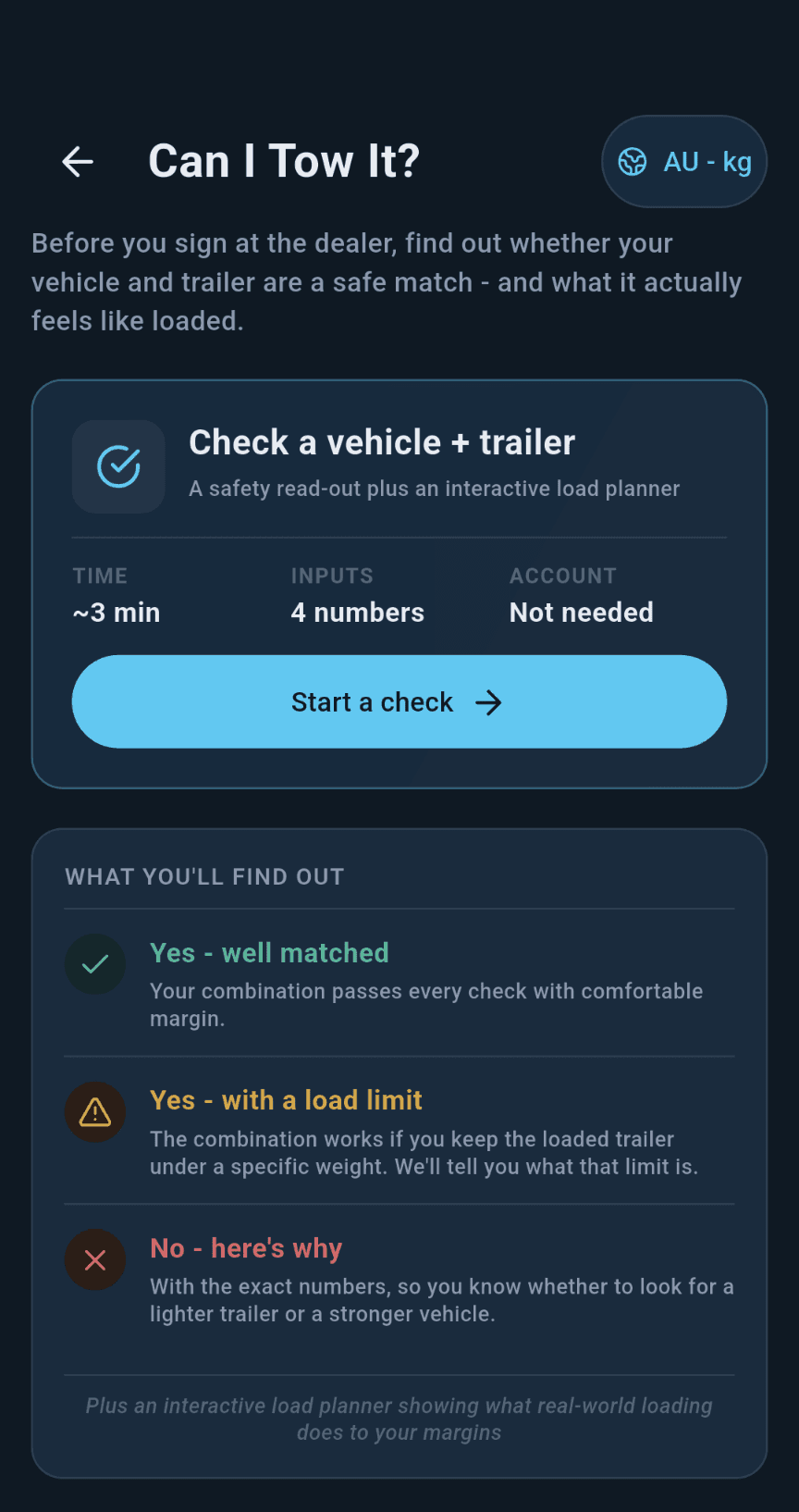
Get the answer before you commit
Choose a tow vehicle and a van; loadmate returns a clear verdict (pass, caution or fail) with the reasons behind it. Load it up and the margins move with you. Free in the app.


Towing capacity chart: 3,500 kg-rated vehicles compared
Here's what the popular 3,500 kg-rated utes and 4WD wagons can actually tow and carry, using one representative current variant per model. This is the chart behind the "SUV towing capacity chart" search: every figure comes from our June 2026 manufacturer-sourced spec workbook, kerb weights are brochure figures, and payload at full tow assumes the trailer is at the full rating with the maximum ball download — where GCM bites before GVM, the GCM-capped figure is shown, matching the definition on our vehicle pages.
| Vehicle (representative variant) | Braked tow | Tow ball max | GVM | Kerb | GCM | Max trailer at full GVM | Payload at full tow |
|---|---|---|---|---|---|---|---|
| Ford Everest Sport 3.0 V6 (MY26.50) | 3,500 kg | 350 kg | 3,150 kg | 2,416 kg | 6,250 kg | 3,100 kg | 334 kg |
| Ford Ranger XLT V6 (MY26.50) | 3,500 kg | 350 kg | 3,350 kg | 2,251 kg | 6,400 kg | 3,050 kg | 649 kg |
| Mitsubishi Triton GLS (MY25) | 3,500 kg | 350 kg | 3,200 kg | 2,117 kg | 6,250 kg | 3,050 kg | 633 kg |
| Nissan Patrol Ti (MY25) | 3,500 kg | 350 kg | 3,500 kg | 2,786 kg | 7,000 kg | 3,500 kg | 364 kg |
| Toyota HiLux SR5 2.8 48V (MY26) | 3,500 kg | 350 kg | 3,120 kg | 2,020 kg | 6,300 kg | 3,180 kg | 750 kg |
| Toyota LandCruiser 300 GXL (MY25) | 3,500 kg | 350 kg | 3,280 kg | 2,545 kg | 6,750 kg | 3,470 kg | 385 kg |
| Toyota Prado GXL (MY25) | 3,500 kg | 350 kg | 3,150 kg | 2,535 kg | 6,600 kg | 3,450 kg | 265 kg |
Three things jump out of the chart. Only the Patrol can tow its full 3,500 kg at full GVM — every other row gives something up to GCM. The Prado's 265 kg payload at full tow is the squeeze story of the class: a driver and one passenger can use most of it. And within a single range the engine choice moves the maths — the Everest's 2.0 bi-turbo carries 446 kg at full tow against the V6's 334 kg, because the lighter engine takes less of the same GCM budget.
Not everything that looks the part is rated to 3,500 kg:
| Vehicle (representative variant) | Braked tow | Tow ball max | GVM | Kerb | GCM | Max trailer at full GVM | Payload at full tow |
|---|---|---|---|---|---|---|---|
| Ford Ranger Raptor 3.0 V6 petrol (MY26) | 2,500 kg | 350 kg | 3,130 kg | 2,413 kg | 5,370 kg | 2,240 kg | 367 kg |
| Mitsubishi Pajero Sport GLS (25MY, run-out) | 3,100 kg | 310 kg | 2,775 kg | 2,130 kg | 5,565 kg | 2,790 kg | 335 kg |
| Mitsubishi Outlander Aspire AWD 2.5 (MY25) | 1,600 kg | 160 kg | 2,405 kg | 1,695 kg | 4,005 kg | 1,600 kg | 550 kg |
The Raptor tows a full 1,000 kg less than the Ranger it's built from — long-travel desert suspension trades away towbar duty. Pajero Sport production ended in March 2025, so its row is the final 25MY spec for run-out and used stock. The Outlander's 1,600 kg ceiling and 160 kg ball limit are typical of the midsize SUV class: a camper trailer proposition, not a caravan one.
On hybrids: the Ranger PHEV keeps the full 3,500 kg braked rating with a 3,500 kg GVM (payload at full tow 465 kg), and the all-new HiLux arrives with its 48-volt system and the full 3,500 kg rating. The Outlander PHEV is the one to double-check — published figures vary between 1,500 and 1,600 kg braked depending on model year and source, so treat your placard as the authority. We've left it out of the chart for that reason.
Every nameplate above has a full breakdown — variants, axle limits and the GCM maths — at towing capacity by vehicle.
What should I tow vs what can I tow?
"Can I tow it" is a legal question answered by your limits; "should I tow it" is a stability question answered by the weight ratio between vehicle and van. Passing the first test doesn't mean passing the second.
A widely used industry guideline says the loaded caravan should weigh no more than about 85% of the tow vehicle's kerb weight. A heavier tug resists crosswinds and sudden manoeuvres, its inertia damps the oscillations that become sway, and under brakes it holds the van back instead of being pushed by it. Hills cut both ways: weight up front means traction on the climb and engine braking worth having on the descent.
| The question | Which number answers it | Ranger XLT V6 |
|---|---|---|
| What does the brochure say it can tow? | Braked towing capacity | 3,500 kg |
| What can it legally tow when fully loaded? | GCM − GVM | 3,050 kg |
| What should it tow for a stable, easy trip? | ~85% of kerb weight (guideline, not law) | ~1,900 kg |
That spread — 3,500 kg down to roughly 1,900 kg — is why the brochure number is a ceiling and not a shopping figure.
Australia is the outlier here. European practice keeps vans to roughly 80–85% of the tow car's weight, so vehicles rarely work near their limits. American rigs tow heavy, but behind long-wheelbase full-size trucks running 10–15% of the trailer's weight on the ball. Australians tow American-sized vans behind European-sized vehicles: a generation ago a typical local van was around 1,500 kg and 16 feet, and plenty now run to 3,500 kg and over 22 feet, behind utes and wagons that weigh less than the van does. That's the gap the 85% guideline exists to close.
How does tow ball mass multiply on the rear axle?
The tow ball doesn't just press down on the vehicle — it hangs off a lever behind the rear axle, so the axle feels far more than the ball weight alone. Picture a seesaw with the rear axle as the pivot: the further the ball sits behind the axle, the harder it pushes the back down and lifts the front.
The lever arm is the rear overhang plus roughly 150 mm of towbar extension behind the body:
Effective rear-axle load = tow ball mass × (1 + (rear overhang + 150) ÷ wheelbase)
On the Ranger — 1,215 mm rear overhang, 3,270 mm wheelbase — the factor is 1 + (1,215 + 150) ÷ 3,270 ≈ 1.42. A full 350 kg ball load becomes just under 500 kg of effective load on the rear axle, while around 145 kg lifts off the front axle, lightening the steering exactly when you want it planted. That's a quarter of the Ranger's 1,959 kg rear axle rating consumed before a single item goes in the tray, which is why rear axle limits are routinely the first thing careful setups break.
Two working rules follow. Keep tow ball mass in the healthy band — around 8–12% of the van's loaded weight, with about 10% the usual aim — because too little is the classic trigger for sway, and a negative ball weight is worse again. And watch your hitch ride height: if it changes between trips, your load has moved, and the lever above is telling you where.
What makes a good tow vehicle beyond the rating?
Two vehicles with identical 3,500 kg ratings can behave completely differently with a van on the back — the differences live in the wheelbase, overhang, chassis, driveline and tyres.
Wheelbase
A longer wheelbase resists the seesaw effect and holds a steadier line. JD Gallant of the RV Consumer Group, in his book How to Select, Inspect, and Buy an RV, distilled accident research into a practical rule: the first 2,800 mm of wheelbase covers a 20-foot trailer, and every additional 100 mm allows about one more foot.
| Wheelbase | Suggested max trailer length |
|---|---|
| 2,800 mm | 20 ft |
| 3,000 mm | 22 ft |
| 3,270 mm (Ranger XLT V6) | ~25 ft |
It's a guideline rather than a law, but it explains why long-wheelbase utes feel more settled than short SUVs behind the same van — and why a full-size American pickup, with a wheelbase far longer than anything in our chart, makes an easy tug for a heavy trailer.
Rear overhang
The shorter the distance from rear axle to ball, the smaller the lever multiplier from the section above. Purpose-built tow vehicles put the hitch as close to (or over) the rear axle as the design allows; extended-chassis utes and long towbar tongues push the other way and pay for it in rear-axle load and sway sensitivity.
Chassis
Ladder-frame (body-on-frame) vehicles — most utes and large 4WD wagons — bolt the hitch and both axles to a steel frame, which is why heavy-duty tow ratings cluster there. Monocoque vehicles spread loads through the body shell; they tow with a lower centre of gravity and less rollover risk, but the structure limits how much lever load the rear can carry. Mitsubishi's last Pajero made the cost concrete: a monocoque 4WD whose tow ball limit dropped to 180 kg once the trailer exceeded 2,500 kg.
Drive system
With a laden van pressing on the rear axle, rear-wheel drive puts the engine's effort through the wheels carrying the weight. Front-wheel drive does the opposite — drive on the lightened end — which is part of why serious tow ratings and FWD rarely mix. AWD and 4WD both help traction; just remember a raised 4WD also raises the hitch, which may need a deeper drop shank to keep the van level.
Tyres
Sidewall stiffness matters more than tread when towing near the top of your limits: soft passenger-rated sidewalls flex laterally and feed instability, which is why light-truck tyres in higher load ranges are the usual recommendation for heavy towing. When the van's hitched, add air to the rear tyres per your placard or manual to carry the extra load, and leave the fronts at standard pressure unless the manufacturer says otherwise.
Do you need a GVM or GCM upgrade to tow more?
A GCM upgrade only makes sense if it ends with a heavier, more capable tow vehicle relative to the van — if the goal is simply hanging a bigger trailer off the same vehicle, the result is usually a less stable rig, not a more capable one.
The test is what the upgrade does to your weight ratio. If raising GCM (usually alongside a GVM upgrade) restores payload to the tow vehicle — so the tug gets heavier relative to the van — that's the upgrade working in your favour. If the extra headroom goes straight into a heavier caravan behind an unchanged vehicle, you've moved the rig away from the 85% guideline, not towards it.
Be clear about what an upgrade is: a re-rating, mostly suspension hardware and paperwork. The drivetrain, brakes and chassis stay exactly as built, no more suited to harder work than they were, and manufacturer warranty on those components is generally affected. The full picture — second-stage manufacturers, state versus federal approval, and what upgrade warranties actually cover — is in our Gross Vehicle Mass guide.
See the pairing before you commit
Everything above is arithmetic you can do on paper — once. The trouble is that the inputs move: a different van, a canopy, two more passengers, a heavier ball setting, and the margin you worked out last month is fiction.
A 3,500 kg badge does not account for the bullbar, winch, canopy or people already aboard. loadmate connects your recorded vehicle and caravan loads with the tow rating, GCM, GVM and axle limits, so the carrying room is visible as the trip takes shape. Explore loadmate in the app to see what your setup leaves for the gear you still want to take.
Related guides
- Caravan & Towing Weights Explained — every weight term explained in one place (the best starting point)
- Gross Vehicle Mass (GVM) Explained — the vehicle-side limit that quietly eats your towing margin
- Aggregate Trailer Mass (ATM) Explained — the van-side number to match against your rating
- Gross Combination Mass (GCM) Explained — the combined ceiling that caps the pair, and why a GCM upgrade only helps if it makes the tug heavier
- Common caravanning mistakes — the loading errors that undo a well-matched rig
- Caravan water tanks — at 1 kg a litre, water is the payload item that erodes your full-tow margin fastest
- Why Your Caravan Needs Its Own Odometer and Service Log — tracking the van's own distance so brake and bearing service keeps the rating honest
- Towing capacity by vehicle — your model's real numbers: braked rating, GVM, GCM and payload at full tow
Frequently asked questions
- What does braked towing capacity mean?
Braked towing capacity is the maximum weight your vehicle is rated to tow when the trailer has its own braking system, as set by the manufacturer. It's a legal ceiling, not a recommendation — and it applies alongside your GVM, GCM, tow ball and axle limits.
- What is the difference between braked and unbraked towing capacity?
The braked figure applies when the trailer has its own brakes; the unbraked figure applies when it doesn't, and is typically capped at 750 kg. In Australia any trailer over 750 kg GTM must have brakes of its own (ADR 38), so the braked figure is the one that matters for caravans.
- Can my vehicle tow 3,500 kg if that's its braked rating?
Usually not while it's fully loaded. Most 3,500 kg-rated vehicles have a GCM lower than GVM plus tow rating — a Ranger XLT V6 at its full 3,350 kg GVM can pull 3,050 kg before its 6,400 kg GCM runs out. Hitch a full 3,500 kg van and the GCM budget caps the ute at 649 kg for the driver, passengers and gear — 100 kg less than it carries at full GVM.
- Is towing capacity measured against ATM or GTM?
Match your van's ATM — its maximum loaded weight — against the braked rating when you shop. The rating limits the trailer's actual laden weight, but a van whose ATM exceeds the rating can put you over the limit the day you load it fully, so ATM is the safe comparison.
- What happens if I tow over my braked towing capacity?
The combination is unroadworthy. You risk state-based fines, your insurer can decline a claim arising from the overload, and in a serious crash a formal investigation can escalate well beyond a fine. The same applies to exceeding GVM, GCM, tow ball or axle limits.
- How do I find my vehicle's braked towing capacity?
In the owner's manual towing section and on the manufacturer's spec sheet for your exact variant, engine and model year — ratings differ within a single range. Check the towbar too: it carries its own rated capacity on a plate, and the lowest number in the chain is the one that applies.
- What is a GCM upgrade, and will it let me tow more?
A GCM upgrade re-rates the combined weight limit of vehicle and trailer through an approved engineering process. It can be worthwhile when it restores payload to the tow vehicle, but if the only goal is a heavier van behind the same vehicle, the result is usually a less stable rig — and drivetrain and chassis warranty coverage is generally affected.
- What is the 85% rule for towing?
An industry guideline, not a law: keep the loaded caravan to about 85% of the tow vehicle's kerb weight for a stable, forgiving combination. For a 2,251 kg Ranger XLT that's roughly 1,900 kg of van — well under the 3,500 kg the brochure advertises.