ATM at a glance
- What it is
- The manufacturer's maximum legal loaded weight for a caravan or trailer, uncoupled
- The formula
- ATM = GTM (weight on the trailer's axles) + tow ball mass (TBM)
- Also called
- Gross Vehicle Weight Rating (GVWR) for trailers internationally
- Payload formula
- Caravan payload = ATM − Tare weight
- Where to find it
- The trailer plate, usually riveted to the drawbar or A-frame
- Tow ball mass guide
- Roughly 8–12% of the van's loaded weight — the "10% rule"
- If you exceed it
- Unroadworthy; fines (state-based); possible insurance and warranty consequences
Every caravan has one number that decides whether it's legal on the road, and ATM is it. This guide explains what the term means, how the weight splits between the axles and the tow ball, why the tare figure on your plate deserves a healthy dose of scepticism, and what an ATM upgrade actually involves. One illustrative rig runs through every example on this page: a tandem-axle caravan with a 2,800 kg ATM and 2,200 kg tare, towed by a dual-cab ute (GVM 3,050 kg, GCM 5,950 kg, rated to tow 3,500 kg).
What does aggregate trailer mass (ATM) mean?
Aggregate Trailer Mass (ATM) is the maximum permissible weight of your caravan or trailer when fully loaded and uncoupled from the tow vehicle, as specified by the manufacturer. It covers the trailer itself plus everything in or on it — water, gas, gear, accessories — including the share of that weight that will press down on the tow ball once you hitch up.
You'll find it on the trailer plate, usually riveted to the drawbar or A-frame, quoted in kilograms alongside the tare, GTM and maximum ball-weight figures. Think of it as the van-side twin of your tow vehicle's Gross Vehicle Mass (GVM): one loaded limit for the car, one for the van, and the law expects you under both at once.
The term is an Australian and New Zealand one. For trailer manufacturers it's defined in Vehicle Standards Bulletin 1 (VSB1) — the national code of practice for building light trailers up to 4.5 tonnes ATM — under Australia's Road Vehicle Standards legislation.
One term, two meanings: the rating and the scales
Australia uses ATM for both the rating on the plate and the actual weight of the loaded van on a scale, so context matters every time you hear it. Internationally the two ideas get separate names, which is genuinely clearer:
| Term | What it means | Limit or measured? |
|---|---|---|
| ATM (Australia/NZ) | The trailer's maximum loaded weight, uncoupled | Both — the plated rating and the weighed figure |
| GVWR (international) | The trailer's maximum loaded limit | The rating |
| GVW / GTW (international) | The trailer's actual measured loaded weight | What it weighs right now |
The United States has no direct equivalent for GTM; Gross Trailer Weight (GTW) is the closest cousin to our ATM. If a spec sheet or forum thread mixes these terms, work out whether each number is a ceiling or a measurement before you compare anything.
How do you calculate ATM?
The ATM limit isn't something you calculate — the manufacturer sets it. What you calculate is where your van actually sits against that limit, and how the weight splits between the axles and the ball. The split is the part worth memorising:
ATM = GTM + tow ball mass (TBM)
Uncoupled, the van's entire weight stands on its own wheels and jockey wheel — that total is your actual ATM. Hitch up and the same weight divides: most of it stays on the trailer's axles (the GTM), and the rest transfers to the car through the coupling (the TBM).
Here's our worked rig on a weighbridge, loaded right to its limit (figures illustrative — always read your own plate):
| Measurement | Figure | How it's taken |
|---|---|---|
| Actual ATM | 2,800 kg | The loaded van weighed uncoupled |
| GTM | 2,520 kg | The loaded van's axles weighed while hitched |
| Tow ball mass | 280 kg | Ball scale under the coupling, van level |
| Tare | 2,200 kg | The plated empty weight |
| Payload | 600 kg | ATM − tare |
The arithmetic closes: 2,520 kg on the axles plus 280 kg on the ball is exactly the 2,800 kg ATM. Which leads to the second formula worth memorising:
Caravan payload = ATM − Tare
Six hundred kilograms of payload sounds generous until you start subtracting. Water weighs 1 kg per litre, so filling two 90 L tanks takes 180 kg — nearly a third of the budget — before food, chairs, the annexe or the toolbox go anywhere (our caravan water tanks guide covers that trade-off in detail). A certified weighbridge gives you the uncoupled total; a ball scale gives you the TBM; together they tell you exactly how the load is split.
ATM vs GTM vs tow ball mass — what's the difference?
GTM is the weight on the van's wheels while it's hitched, tow ball mass is the weight pressing on the car's ball, and ATM is the two added together. Picture the van as a see-saw balanced over its axles: everything you load tips weight either onto the wheels or onto the coupling, and the two shares always sum to the van's total.
Gross Trailer Mass (GTM) is, like ATM, used for both a rating and a measurement. The plated GTM is the most weight the trailer's axle group is allowed to carry while coupled; the measured GTM is what the scales read under the wheels with the van hitched. Because some of the van's weight is on the car, GTM is always lower than ATM.
Tow Ball Mass (TBM) — also called tow ball download, tongue weight or nose weight — is the share the coupling puts on the tow vehicle. You measure it with a ball scale under the coupling while the van is unhitched and level; an unlevel van skews the reading.
The three tow ball mass limits
TBM has to clear three separate ratings, and the lowest one wins:
- The van's coupling. The coupling carries its own stamped rating — many standard 50 mm couplings are stamped at 350 kg. It's usually the most generous of the three, which makes it the least likely to be the one that bites.
- The tow vehicle. Your car's maximum ball download lives in the owner's manual and on the towbar placard, and it's commonly the limit to watch. Our worked ute allows 300 kg on the ball, so the van's 280 kg fits with 20 kg in hand.
- The hitch. Towbars and hitches carry their own rated capacities, and budget aftermarket units can be rated lower than you'd expect. Check the label, and remember a hitch's rating can change if it's inverted or modified.
How does ATM relate to GVM and GCM?
They're three separate ceilings — one for the van, one for the car, one for the pair — and a legal rig stays under all of them at once. Is ATM the same as GVM? No: GVM is the tow vehicle's loaded limit, ATM is the caravan's. The mix-up is understandable because they're the same idea applied to different halves of the rig — a caravan "GVM" is, in practice, its ATM. The full picture, in one table (the caravan weights guide unpacks every term):
| Term | Applies to | What it limits | The relationship |
|---|---|---|---|
| ATM | The caravan/trailer | Total loaded weight, uncoupled | ATM = GTM + TBM |
| GTM | The caravan/trailer | Weight on the trailer's axles when hitched | GTM = ATM − TBM |
| TBM | The coupling | Weight the van presses onto the tow ball | Aim for ~8–12% of loaded weight |
| GVM | The tow vehicle | The vehicle's total loaded weight — including TBM | Payload = GVM − kerb |
| GCM | The combination | Car and van together, as rated by the vehicle maker | Usually less than GVM + ATM |
Two consequences follow, and both catch experienced caravanners out.
First, your van's ball weight belongs to the car's budget. The moment you hitch up, the 280 kg our van puts on the ball counts towards the ute's GVM. Hitched to this van, the ute has 3,050 − 2,130 − 280 = 640 kg left for occupants, accessories and cargo. The ball weight also works the rear axle harder than its raw figure suggests, because it acts on a lever behind the wheels — the GVM guide walks through that worked example.
Second, GCM is a fixed limit set by the vehicle manufacturer — not GVM and ATM added together, and usually less than that sum. Our ute's GCM is 5,950 kg. At its full 3,050 kg GVM (ball weight included), the most the combination can carry on the van's wheels is 5,950 − 3,050 = 2,900 kg — so a brochure-maximum 3,500 kg van would put the rig 600 kg over its GCM even though no single limit looks broken. Our worked van puts 2,520 kg on its wheels fully loaded, so the combination totals 5,570 kg — 380 kg inside the GCM. Run these sums before you buy, not after — our gross combination mass guide walks the whole-combination check in full, and braked towing capacity explains why the headline tow rating, the GCM and the ball limit rarely peak together.
Why does tow ball mass matter so much?
Because the same total weight can make a van stable or dangerous depending on how much of it reaches the ball. The widely used guideline is to keep TBM at roughly 8–12% of the van's loaded weight — the "10% rule". On our 2,800 kg van that's a band of about 224–336 kg, and its 280 kg sits right on the 10% mark.
- Too much ball weight unloads the car's steer axle and overloads the rear one. Steering goes light, the headlights point at the trees, and the rear axle and tyres run beyond their design loads.
- Too little ball weight is the more dangerous mistake: the van becomes prone to swaying and fishtailing, especially at highway speed, in crosswinds or when a road train overtakes. Sway that builds unchecked is how vans end up on their side.
Length raises the stakes. Shorter, lighter vans and camper trailers tolerate an imperfect split; once a van runs past roughly 6–7 metres, its longer body is more sensitive to yaw, and the 10% guideline hardens from suggestion to requirement.
There's a catch worth knowing: some manufacturers advertise a ball weight measured at tare that sits well below the 8–12% band. The van only reaches a safe split once you've loaded it deliberately — and the answer is never simply stacking weight on the A-frame, which fixes the percentage while wrecking the balance.
Why does load placement matter as much as the total?
A van sitting exactly on its ATM can still tow badly — balance works in three dimensions, and a weighbridge only shows you one of them.
- Front to back. Heavy items belong over or just ahead of the axles. Spare wheels, jerry cans and toolboxes hung on the rear bar — or piled on the drawbar — work the van like a see-saw and feed sway.
- Side to side. A common rule of thumb keeps the difference between the two sides within about 3%. Standard weighbridges don't measure it and not every professional weigh-in reports it, yet a lopsided van wears tyres unevenly, brakes unevenly and sways more readily. On a tandem-axle van, that means checking the left and right wheel pairs, not just the total.
- Low over high. The lower the centre of gravity, the more stable the van. Heavy items live on the floor; overhead lockers are for the light stuff.
Don't assume a brand-new van left the factory perfectly balanced, either. Production pressure being what it is, it pays to check the balance yourself rather than trust the showroom.
Can you trust the tare weight on the plate?
Not blindly. Two structural quirks of how tare figures are produced mean the plate can flatter your van:
- Model averages. Tare is often quoted as an average for the model, not a weight taken from your specific build, so your van can leave the factory heavier than its own plate suggests.
- Options that never made the plate. Factory-fitted extras — air conditioners, second batteries, bigger water tanks — aren't always reflected in the plated tare.
The consequence lands straight on your payload. Say our van's plate reads 2,200 kg but the van as built actually weighs 2,300 kg empty. The ATM hasn't moved, so the real payload is 500 kg, not 600 kg — a sixth of the budget gone before you've loaded a single item.
Two habits protect you. Weigh before you take delivery: a professional weigh ahead of handover tells you exactly what you're buying while you still have room to negotiate. And weigh again when buying second-hand: previous owners' add-ons — bike racks, awnings, solar panels — quietly ate payload for years, and in a quick sale nobody mentions it.
Can you upgrade your caravan's ATM?
Yes — many caravans can be re-rated to a higher ATM, but it's an engineering certification process, not a paperwork swap. It tends to make sense when the van's factory payload was slim and accessories (batteries, solar, bigger tanks, toolboxes) have eaten it; when you've upgraded the tow vehicle and want the van's allowance to match the way you actually travel; or when you'd rather carry what you genuinely carry legally than gamble on a roadside check — or an insurance assessor after a crash.
The typical process (schemes vary by state and territory):
- Initial assessment. A licensed engineer — an approved examiner under your state or territory's vehicle modification scheme — inspects the van and confirms whether the chassis can take the higher rating without structural work.
- Component check. Every part in the load path is verified against the new rating: tyres and rims (load index), suspension, axles, brakes, coupling and safety chains.
- Upgrades where needed. Any component that can't carry the new rating is replaced or reinforced first — commonly suspension, axles or brakes, sometimes the drawbar.
- Certification. The engineer certifies the completed upgrade.
- Re-plating and registration. A modification plate showing the new ATM goes on the van, and the revised rating is lodged with your state or territory transport authority so the registration matches.
- Final weigh. A post-upgrade professional weigh confirms where the van now sits against its new limits.
Worth knowing before you start:
- Leave headroom. A common engineering rule of thumb is to run components at no more than about 80% of their rated capacity — especially brakes and suspension.
- Your car doesn't get the memo. An ATM upgrade changes nothing on the tow vehicle: its braked rating, GVM, GCM and rear-axle limit all stand. Re-run the combination sums first — an upgraded van your car can't legally tow is an expensive plate. Your model's real numbers are in towing capacity by vehicle.
- Ask the van's manufacturer in writing. Some manufacturers treat an unapproved ATM upgrade as grounds to refuse warranty claims; get their position before work starts.
- An upgrade raises the limit, not the van's manners. The 10% rule and load placement matter exactly as much at the new ATM as they did at the old one. (The vehicle-side equivalent, the GVM upgrade, is covered in the GVM guide.)
Know your van's real weight, not the plate
The plate on the drawbar tells you what your van may weigh. What it actually weighs this morning — after the second battery, the annexe, full tanks and three weeks of food went in — is a different number, and plenty of owners meet it for the first time on a public weighbridge with the van already packed and the trip already booked. It's cheaper to learn your real figure before the weighbridge tells you.
Water, batteries and the gear in the front boot all use the caravan's carrying room, and where they sit changes the load on the ball. loadmate connects recorded loads with ATM, GTM and tow ball limits, so you can review the whole picture as you pack. Explore loadmate in the app to see how the next addition affects the room left. loadmate is decision support, not a weight certificate; your compliance plates and a certified weighbridge remain the legal references. See our safety disclaimer.
Related guides
- Caravan & Towing Weights Explained — every weight term explained in one place (the best starting point)
- Gross Vehicle Mass (GVM) Explained — the tow-vehicle side of the same story, including where your ball weight ends up
- Gross Combination Mass (GCM) Explained — the combined ceiling your loaded van and car share, and why adding the two plates overstates it
- Braked Towing Capacity Explained: A Legal Ceiling, Not a Target — what your car can pull, and why the headline figure misleads
- Caravan Water Tanks — the heaviest payload decision you'll make, at 1 kg per litre
- Common caravanning mistakes — the loading and tare habits that put vans over their ATM
- Weight Distribution Hitch Setup & Front-Axle Restoration — why a hitch moves load around the rig but never lowers the ATM the van must meet
- When to Reweigh a Caravan: What's Changed Since Your Last Weigh-In — the fit-out and packing changes that creep the van back towards its ATM
- Why Your Caravan Needs Its Own Odometer and Service Log — keeping the van's own distance and history so loaded weights stay honest over time
- Towing capacity by vehicle — your model's real numbers: braked rating, GVM, GCM and payload at full tow
Turn an estimate into a measured number
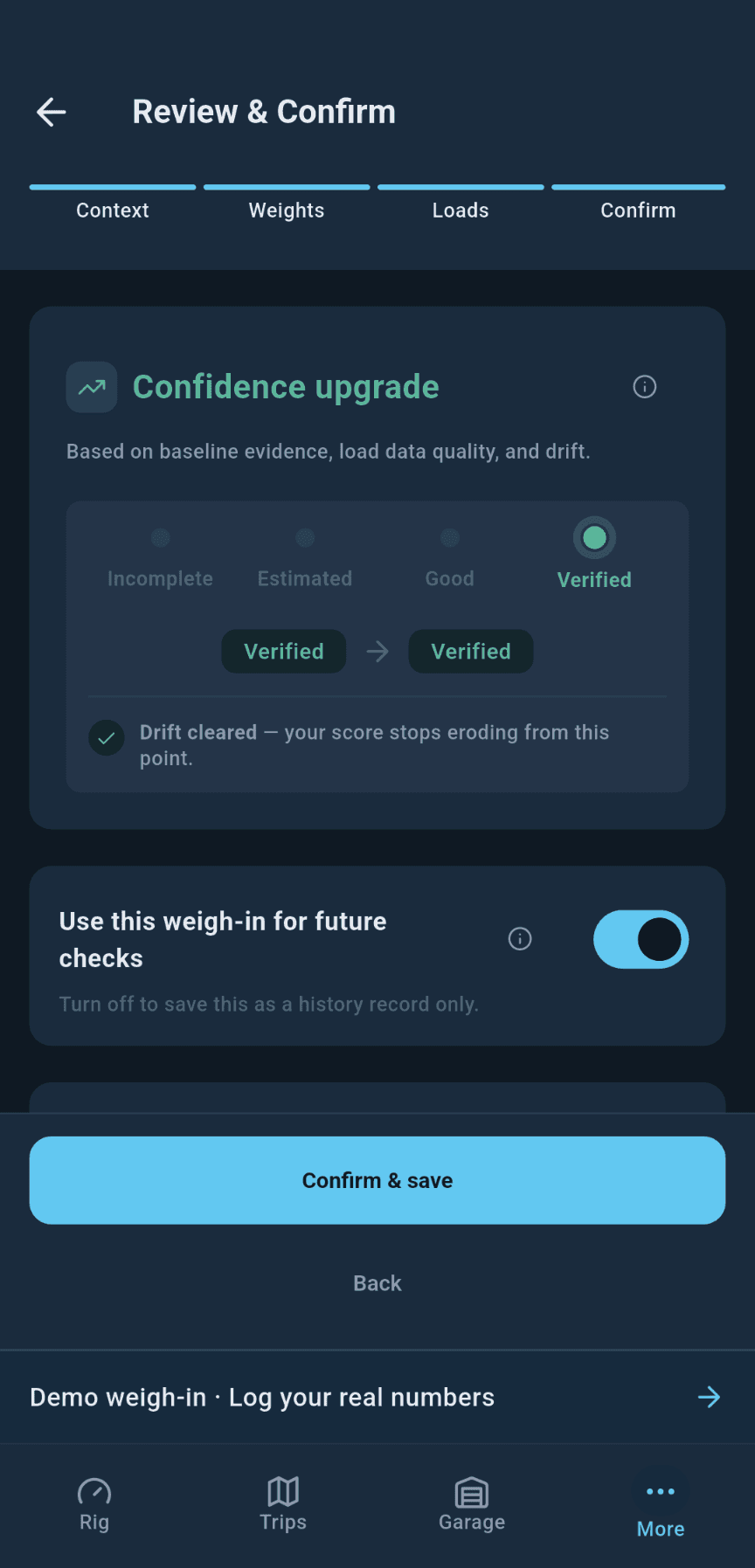
Log a weighbridge ticket and loadmate recalculates from your measured weights. The ticket is a snapshot; loadmate tracks what changes after it, so the verified baseline stays useful between weighs. Create a free account to explore it on a populated demo rig in the app.


Frequently asked questions
- What does ATM mean on a caravan?
Aggregate Trailer Mass (ATM) is the maximum the caravan is allowed to weigh fully loaded and uncoupled — everything on board plus the tow ball mass — as set by the manufacturer and shown on the trailer plate. Exceed it and the van is no longer roadworthy.
- Is ATM the same as GVM?
No. ATM is the loaded weight limit of the caravan or trailer; GVM (Gross Vehicle Mass) is the loaded weight limit of the tow vehicle. They're the same idea applied to different halves of the rig — when someone quotes a "GVM" for a caravan, they almost always mean its ATM.
- What is the difference between ATM and GTM?
The tow ball mass. ATM is the van's total loaded weight uncoupled; GTM (Gross Trailer Mass) is the weight on the van's wheels once it's hitched, after the ball weight has transferred to the tow vehicle. ATM = GTM + tow ball mass.
- How do you calculate ATM?
The ATM limit is set by the manufacturer — what you calculate is your actual weight against it. Weigh the loaded van uncoupled, or add the weight on the trailer's wheels to the tow ball mass, and compare the result to the plate. Your payload is ATM minus tare weight.
- Can you upgrade the ATM on a caravan?
Often, yes. A licensed engineer assesses the chassis, axles, suspension, brakes, tyres and coupling, upgrades any component that can't carry the higher rating, then certifies the van, fits a modification plate and lodges the new rating with the state transport authority. It only works if the running gear can support the new figure.
- Does an ATM upgrade increase my car's towing capacity?
No. An ATM upgrade raises what the van may legally weigh; your vehicle's braked towing capacity, GVM and GCM are unchanged. If the upgraded ATM exceeds what the car is rated to tow, you can't legally tow the van fully loaded.
- What happens if my caravan is over its ATM?
The van is no longer roadworthy: you risk state-based fines, an insurer can decline a claim after an incident, and the brakes, bearings, tyres and chassis are all working beyond their design load. Sway risk climbs with the extra mass too.
- Where do I find my caravan's ATM?
On the trailer plate — usually riveted to the drawbar or A-frame, sometimes inside a front boot or tunnel — alongside the tare, GTM and maximum ball-weight figures. If the van has had an ATM upgrade, the revised figure appears on a modification plate.