A caravan's odometer and log at a glance
- Does it have an odometer
- No — caravans are not fitted with one at manufacture, so the van records none of its own distance
- What times a service
- Distance and time together — most jobs are due at a set distance OR a set period, whichever comes first
- The distance-based jobs
- Wheel bearings and brakes — the safety-critical items that wear by kilometres travelled
- The time-based jobs
- Tyres age out by date (the sidewall date code), and the time clock runs even when the van is parked
- What a dated log proves
- The service history a buyer asks for and a warranty claim requires — dates, distances and receipts
- Whose km do you count
- The van's own distance, not the tow vehicle's — the car does trips the van never sees
Your tow vehicle has counted every kilometre it has ever turned. There is a dial on the dash that has never stopped totting them up, and the service book in the glovebox is keyed to that number. The caravan hitched behind it has counted nothing. There is no dashboard back there, no dial, no running total — and yet the bearings, the brakes and the tyres on that van wear and age on their own clocks regardless. The uncounted half of the rig is the half whose service cadence has always been a guess. This guide explains why that gap exists, which jobs run on distance and which run on time, and why your van needs both a number and a dated log of its own.
Does your caravan have its own odometer?
No. Caravans are not fitted with an odometer at manufacture, so your van keeps no record of how far it has travelled. A tow vehicle has an instrument cluster that counts every kilometre; a caravan has no dashboard and no counter, so the distance it has rolled is simply never written down anywhere on the van.
This is a quiet gap that owners notice the first time a service is due. As one AU caravan service workshop puts it, "caravans have no odometers, and people can lose track of the distances they've travelled." The trade magazine RV Daily makes the same point from the owner's side: "I have always found it odd that something like this isn't installed on all caravans at manufacture." The van you tow could have done two thousand kilometres or twenty thousand since its last service, and nothing on it will tell you which.
There are purpose-built GPS trailer odometers you can bolt on that measure the distance a trailer travels and count programmable service intervals against it, so the problem is real enough that a market exists to solve it. But out of the factory, the number does not exist — and every distance-based maintenance job on the van has to be timed against a figure nobody is keeping.
Why your tow vehicle's odometer isn't your caravan's distance
Your tow car's odometer counts every kilometre the car turns, including all the trips the van never comes on — so it always overstates how far the caravan has actually travelled. Reading the van's wear off the car's dial is reading the wrong number.
The car does the school run, the shopping and the weekday commute with no van behind it. RV Daily frames the trap directly: "you can't rely on your tow vehicle's odometer, considering all the day trips and shopping excursions away from the van." The only honest way to know the van's distance is to count the towing legs and nothing else.
A worked example shows how far apart the two numbers drift. Say your van's bearings were repacked and its brakes adjusted on 6 March 2025, recorded in its log at a fresh zero-kilometre mark — the kind of dated, measured starting point that a mobile caravan weighing report gives you to count from. Since then the tow vehicle's odometer shows 9,000 km of towing. But across a logged trip the van ran 1,909 km while the tow vehicle ran 2,290 km — a ratio of about 0.834 van-kilometres for every tow-vehicle kilometre. Apply that to the 9,000 km and the van's own estimated distance is roughly 9,000 × 0.834 ≈ 7,500 km. That figure is an estimate, not a measurement — but it is far closer to the truth than the 9,000 km on the car, and the difference is the 1,500 km of day trips the van sat at home for.
Which caravan jobs run on distance, and which run on time
Caravan servicing runs on two clocks at once: most major jobs are due at a set distance OR a set period of time, whichever comes first — so a van that barely moves still falls due on the calendar, and a van that travels hard falls due on the kilometres. Neither clock is optional, and a caravan that records its own distance can read both.
The figures vary by axle, bearing and brake maker, so treat any single number as that maker's example rather than a universal rule. As one published example, the axle maker AL-KO/G&S sets major services "at intervals of 12 months or 10,000 km, whichever occurs first" for normal road use, with a more frequent off-road schedule of 6 months or 5,000 km, and a first service at 3 months or 100 km. The same handbook adds a note that matters for a van that lives in storage: vans "stored for extended periods with little or no use" should follow the more frequent off-road schedule, because the time clock keeps running even when the wheels do not. The depth of which job falls due when belongs in a dedicated caravan service guide; what matters here is the mechanic of the two clocks.
| Clock | Times these jobs | What surfaces the due date |
|---|---|---|
| Distance | Wheel bearings, brakes — wear by kilometres rolled | The van's own distance count |
| Time | Tyres (sidewall date), and any job stored idle | The calendar — runs even when parked |
| Whichever first | Most major services are due on whichever arrives | Both clocks, read side by side |
The reason this matters is that the two clocks disagree more often than people expect, and the one your van can't read for itself is usually the distance clock.
The distance jobs your van can't count for itself
Wheel bearings and brakes are the safety-critical jobs timed by distance, and they are exactly the ones your van has no way to count — so the kilometres they are due against have to come from somewhere other than the van itself. Get the count wrong and you are servicing the most important parts of the van against a number you made up.
Wheel bearings are the clearest case. The AL-KO/G&S handbook schedules a bearing service every 12 months or 10,000 km on normal roads (6 months or 5,000 km off-road), where the work is to remove, clean and check the bearing, then repack it with grease. The handbook's warning is blunt about why the cadence matters: poorly lubricated or adjusted bearings "may result in failure of bearings, seals, axles, brakes and/or hubs." A bearing that fails at highway speed can take a wheel with it. Independent workshops corroborate the same interval — bearings "every 12 months or 10,000 km, whichever occurs first." One nuance before you assume yours are due: check whether your hubs are the serviceable kind that get repacked or a sealed-for-life design, because not every van's bearings are serviced the same way.
Electric brakes run on the same dual clock. AL-KO's electric-brake manual lists checks "every 5,000 km or 6 months" and "every 10,000 km or 12 months," with the brakes adjusted and de-dusted after the first 300 to 1,000 km and then at intervals, and the brake magnets inspected for uneven wear. Magnet replacement is condition-based rather than on a fixed kilometre figure — you replace a magnet "until the white plastic under the friction element is barely visible," not at a set distance.
Now run the worked rig through both clocks at once. The van's bearings and brakes were done on 6 March 2025. Against the 10,000 km / 12 months example, the van's estimated 7,500 km of towing leaves roughly 2,500 km on the distance clock. But the time clock reads 6 March 2025 to 6 March 2026 — a full 12 months — so on an illustrative "today" of 6 March 2026 the time clock has run out while the distance clock still shows about 2,500 km to go. The service is due on time, even though the van is short on kilometres. And here is the trap the missing odometer sets: trust the tow vehicle's 9,000 km instead of the van's estimated 7,500 km and the van looks closer to its distance limit than it really is — you would be reading the wrong clock against the wrong number.
A tyre cross-check makes the time clock concrete. Continental Tyres Australia advises that tyres "over 10 years old (as shown on the tyre's date stamp) should be replaced," and that the four-digit code on the sidewall is the week and year of manufacture — so a code of 1419 means week 14 of 2019. By 2026 that tyre is about seven years old: still inside the 10-year window, but ageing on a clock no kilometre count would ever surface. A van parked in the sun can perish a tyre that has barely turned a wheel, which is why the time clock is not optional.
Do you need a service history for your caravan?
Yes. A dated service history is what proves the work was done — it underpins resale value and it is what a warranty claim and your consumer-guarantee rights rest on. A dated log is the evidence a buyer asks for and a warranty claim leans on.
Take warranty first. The AL-KO/G&S handbook is explicit that a warranty claim must include "a log book of dates, distances and routes travelled, locations visited, receipts of servicing and repair work performed." The dated log is not a nicety there — it is a condition of the claim. The same handbook prints a Service & Maintenance Record with dated, dealer-signed rows keyed to distance milestones — the second inspection at 10,000 km, the third at 20,000 km — which the service schedule pairs with 12- and 24-month equivalents, so the dated log is a real artifact the maker expects you to keep filled in.
Consumer rights sit alongside the manufacturer's warranty. The ACCC explains that consumer guarantees "can't be taken away by anything a business says or does," that goods must be "safe, durable and free from defects," and that "after the warranty expires, the consumer guarantee of acceptable quality usually still applies" — and for a major problem you, the consumer, choose a refund or a replacement. None of that requires a logbook on its face. But a dated record of how the van was maintained is what lets you stand on those rights when a part fails earlier than it should, because it shows the failure was the product's, not neglect — and missing a distance-based service entirely is one of the loading-and-maintenance lapses that turn up in common caravanning mistakes.
Resale is the everyday case. Caravan-owner guides and used-van dealers are consistent that a documented history "instils confidence in potential buyers," and that anyone buying used should "insist on a complete set of documents" including "a thorough service history." A van with a dated log sells for more and sells faster, because the buyer can see what was done and when rather than taking a verbal account on trust.
| What a dated log proves | Why it matters |
|---|---|
| Dates and distances | The two clocks each job was serviced against — the warranty condition |
| Receipts of work | That the service actually happened, by whom, at what milestone |
| An unbroken history | The provenance a used buyer asks for, and the value it adds at resale |
A roadworthy or safety inspection is never triggered by the van's distance, because the van has no odometer to trigger it. The triggers are age, weight, transfer or lapsed registration instead. In NSW a caravan or trailer over five years old with an ATM of 4,500 kg or under needs a yearly safety check (an age trigger). In Queensland a safety certificate is required to register a trailer or caravan over 750 kg ATM (a weight trigger). Western Australia requires a roadworthiness inspection before licensing (a pre-registration trigger), and the ACT requires an inspection if the van is more than six years old, coming from interstate, or has lapsed registration. Distance never appears anywhere on that list.
How loadmate gives your caravan its own odometer and service log
The glovebox guess is the thing loadmate replaces. Instead of a figure scrawled on the back of a receipt, the app keeps a trip-distance ledger of every leg you log and projects the van's running total from it, then sets the bearing and brake intervals to count against that total. Every screen labels the reading "estimated" — the number is worked out from the distance you record, not read off a hub, so you are looking at a projection rather than a measurement and the label keeps that honest. The ledger and the estimated reading both open on the demo van for free, including for anyone whose subscription has lapsed, so you can walk through the whole maintenance cadence before any of the figures belong to your own rig.
Where a projection slips is the logging itself: skip a short run or double up a leg and the estimate drifts from what the hub would show. The update sheet asks whether the reading is still right. Entering the actual hub reading or your own confirmed count gives the service intervals a firmer starting point. Explore loadmate in the app to see how recorded distance connects with what falls due before the next trip.
loadmate is decision support for keeping your caravan's maintenance on schedule — it is not a workshop and it does not certify that the work was done. For the wider picture of how the van's weights fit the rest of your rig, the caravan weights pillar is the place to start, and your model's real numbers live on towing capacity by vehicle.
Related guides
- Caravan & Towing Weights Explained — every weight term in one place, and the best starting point for the cluster
- Common caravanning mistakes — the habits that catch new owners out, service cadence among them
- How to Read a Mobile Caravan Weighing Report — the measured baseline a dated log starts from
- Aggregate Trailer Mass (ATM) Explained — the trailer's own loaded limit, the figure inspections are weight-triggered against
- Braked Towing Capacity Explained — how the van's weight fits the tow vehicle's rating
- Towing capacity by vehicle — your model's real numbers: braked rating, GVM, GCM and payload
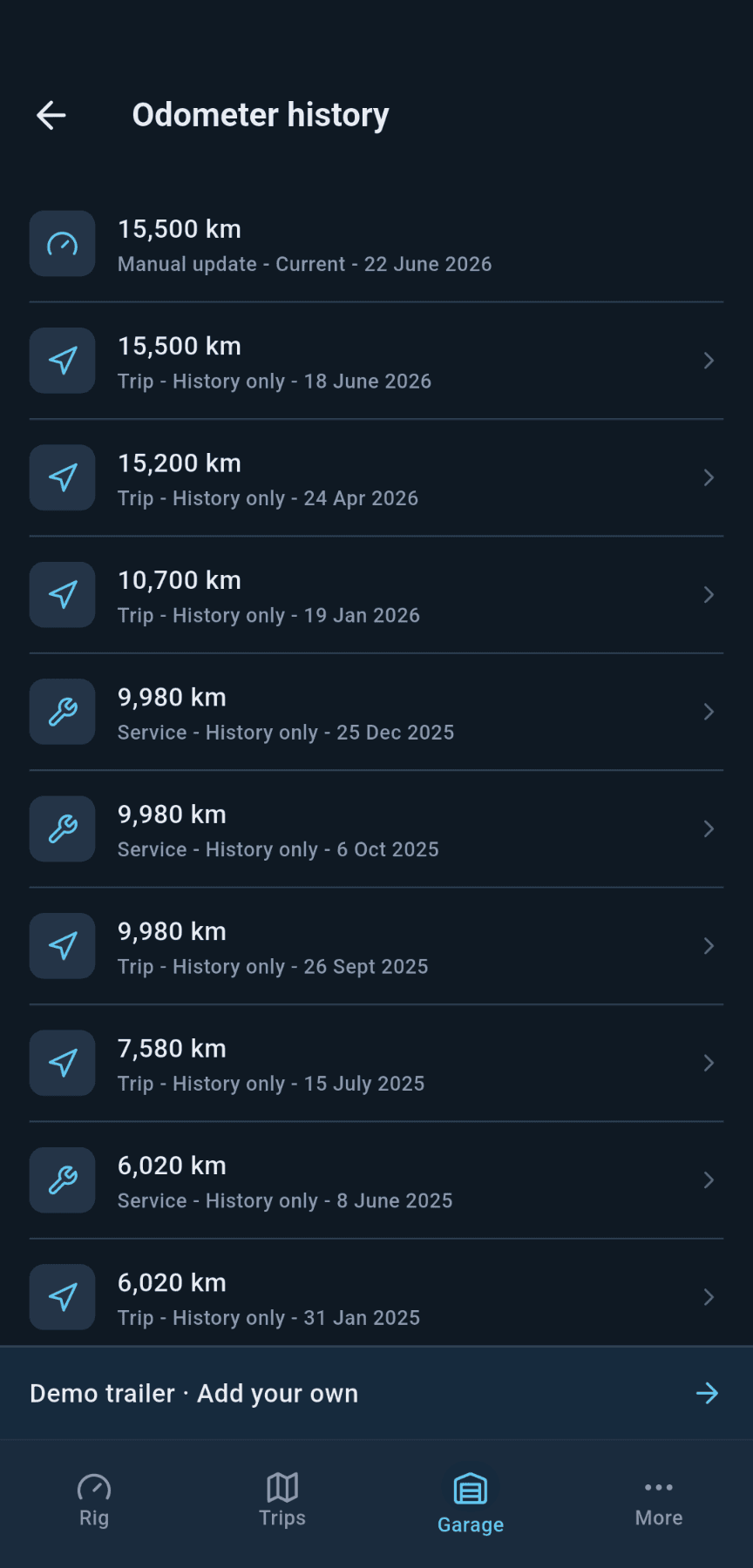
Give your caravan its own odometer
A caravan counts none of its own kilometres, so loadmate builds it an estimated odometer from the trips you log. The bearing and brake intervals finally have the van's own distance to count against. Create a free account to explore it on a populated demo rig in the app.


Frequently asked questions
- Does my caravan have its own odometer?
No. Caravans are not fitted with an odometer at manufacture, so your van keeps no record of its own distance. The car towing it counts every kilometre on its dash, but nothing on the van does — which is why the distance its bearings and brakes are serviced against has to be tracked some other way.
- Does the tow car's odometer tell me how far the caravan has travelled?
No, it overstates it. The car's odometer counts every trip the car makes, including the day trips and shopping runs the van never comes on, so the van has always travelled fewer kilometres than the car's dial shows. The only accurate figure is the van's own towing distance, counted on its own.
- How do I track my caravan's kilometres if it has no odometer?
You count the towing legs and nothing else — either by logging each trip's distance, or by fitting a GPS trailer odometer that measures the trailer's own travel. loadmate builds the van an estimated odometer from the trips you log and counts the distance-based service intervals down against it, with the reading labelled "estimated" until you commit the real number.
- How often should I have my caravan serviced?
Most major services are due at a set distance or a set time, whichever comes first, and the exact figures vary by axle and brake maker. As one published example, the axle maker AL-KO/G&S quotes 12 months or 10,000 km for normal road use, with a more frequent 6-month or 5,000 km schedule off-road. A van stored idle should follow the more frequent schedule, because the time clock runs even when the wheels do not.
- What should be done in a caravan service?
The distance-based safety items are the wheels, brakes and wheel bearings: bearings are removed, cleaned, checked and repacked with grease, and electric brakes are adjusted, de-dusted and have their magnets inspected for wear. A service also covers the time-based checks a dated log captures, such as tyre age read off the sidewall date code. The exact scope varies by maker, so follow your van's handbook.
- Do you need a service history for a caravan?
Yes. A dated service history underpins resale value, and a warranty claim can require a log book of dates, distances and receipts of work done. A documented history also supports your consumer-guarantee rights if a part fails earlier than it should, because it shows the van was maintained rather than neglected. Buyers consistently pay more for a van with a complete, dated record.
- How often should caravan wheel bearings be serviced?
It depends on the axle and bearing maker, but as a common published example AL-KO/G&S quotes wheel bearings every 12 months or 10,000 km, whichever comes first, on normal roads, and every 6 months or 5,000 km off-road. The work is to remove, clean and check the bearing, then repack it with grease. Treat any single figure as that maker's example and confirm yours against your own handbook.
- How do I check the history of a used caravan before buying it?
Insist on a complete, dated service history — the log book of dates and distances, the receipts of work done, and the maker's stamped service record. A van with an unbroken history gives you something to verify; one without leaves you taking the seller's word for how its bearings, brakes and tyres were maintained. Cross-check the tyre date codes on the sidewalls while you are at it, since tyres age out by date regardless of distance.