GCM at a glance
- What it is
- The manufacturer's single maximum loaded weight for the tow vehicle and trailer combined
- Also called
- Gross Combined Mass (GCM); Gross Combined Weight (GCW); GCWR overseas
- What it covers
- The loaded vehicle on its axles (tow ball included) plus the loaded trailer on its axles
- What it does not equal
- GVM + ATM added together — that double-counts the tow ball mass
- Where to find it
- The owner's manual or the maker's towing/specs page — not on either compliance plate
- The combination check
- Loaded vehicle (ball aboard) + the trailer's GTM ≤ GCM
- If you exceed it
- The combination is unroadworthy; state-based fines, possible insurance and warranty fallout
You can be inside every number stamped on your vehicle's compliance plate and every number stamped on your van's, and still be illegal the moment you hitch up. There is a limit that caps the two of you as a pair, and it sits on neither plate. To read your gross combination mass, you open the owner's manual.
What is gross combination mass (GCM)?
Gross combination mass (GCM) is the most your loaded tow vehicle and loaded trailer are allowed to weigh together, hitched up, as a single figure the vehicle's manufacturer sets. Transport for NSW puts it plainly: it is "the maximum allowable combined mass of your loaded tow vehicle and your loaded caravan hitched together specified by your tow vehicle's manufacturer." South Australia's heavy-vehicle licensing guidance frames the same idea — "the maximum loaded weight of the towing vehicle and any trailer, or trailers, being towed while driving on the road."
Think of GCM as one shared budget that the vehicle and the van both spend from. Every kilogram you load into the ute, and every kilogram you load into the caravan, draws on the same total. There is one wallet and two spenders, and the manufacturer decided how much was in it before either of you packed a bag.
The spelling moves around. The AU road authorities, the engineering standards and Ford Australia all write "Gross Combination Mass"; Isuzu UTE labels its version "Gross Combined Weight (GCW)"; the variant "Gross Combined Mass" is also in common industry use among weighers and hire firms. Overseas you will see GCWR. They name the same combined ceiling, so do not let a different word convince you it is a different rule.
GCM vs GVM vs ATM: three limits, all binding at once
GVM caps the vehicle, ATM caps the trailer, and GCM caps the two together — they are separate limits, and a legal rig clears every one of them on the same trip. Clearing your GVM tells you nothing about your GCM, and vice versa. You do not get to pick the limit you like.
| Limit | Applies to | What it caps | Where it lives |
|---|---|---|---|
| GVM | The tow vehicle | The loaded vehicle, tow ball mass included | Vehicle compliance plate + owner's manual |
| ATM | The trailer / caravan | The fully loaded trailer, unhitched, its tow ball mass included | Trailer compliance (VIN) plate |
| GCM | Vehicle + trailer together | The whole rig's combined loaded mass — a single manufacturer ceiling | Owner's manual only (no plate) |
Each lives in a different place and answers a different question. Your GVM tells you how heavy the vehicle alone may be; your ATM tells you how heavy the van alone may be. GCM is the only one of the three that asks about the pair, and it is the only one you will not find by walking around either vehicle reading plates.
The piece that trips people is what GCM caps versus what it equals. It caps the loaded vehicle plus the trailer's axle load. It does not equal the two plate maximums summed.
| GCM caps this | GCM does not equal this |
|---|---|
| The loaded vehicle on its axles (with the ball aboard) plus the trailer's GTM | GVM + ATM — adding the two plates counts the tow ball mass twice |
| One combined figure the maker validated for the pair | A sum you work out yourself from the two compliance plates |
The authoritative engineering definition spells the cap out. The Australian Automotive Aftermarket Association defines GCM as "the maximum of the sum of the Gross Vehicle Mass of the tow-vehicle plus the sum of the Axle Loads of any vehicle capable of being drawn as a trailer." The trailer's contribution is its axle load — its GTM — not its whole ATM. That single word is why the plate sum is wrong, and it is the heart of the trap below.
The GCM trap: why the plate sum reads over when the rig is fine
Add your GVM and your ATM together and the answer will often look over your GCM — but that sum double-counts your tow ball mass, so the real combined weight is lower. This is the calculation that sends people to a forum convinced they have an overweight rig they do not have.
Work it on one illustrative rig and watch the trap spring. Take a dual-cab ute rated to GVM 3,050 kg with a 5,950 kg GCM, hitched to a tandem-axle van with an ATM of 3,000 kg (its GTM is 2,700 kg, its tow ball mass 300 kg). These are illustrative figures, not a specific model — your own plates and manual carry the real ones.
Act one — the plate sum that looks over. You read 3,050 kg off the vehicle and 3,000 kg off the van, add them, and get 6,050 kg. Against a 5,950 kg GCM that is 100 kg over. The rig looks illegal before it has moved.
Act two — the honest accounting that reconciles. On the road the combination's weight is the vehicle on its axles plus the van on its axles. Once hitched, the 300 kg tow ball mass has left the van's drawbar and is sitting on the vehicle — it is inside the vehicle's loaded weight now, and it is inside the van's ATM as well. Count it on both sides and you have invented 300 kg that does not exist twice over. Account for it once and the figures close:
| What you're adding | Arithmetic | Result | Verdict |
|---|---|---|---|
| Naive plate sum (the trap) | GVM 3,050 + ATM 3,000 | 6,050 kg | Looks 100 kg over GCM |
| Honest combination, sensibly loaded | hitched ute ≈ 2,950 + GTM 2,700 | 5,650 kg | 300 kg inside GCM 5,950 |
| Honest combination, vehicle at full GVM | GVM 3,050 + GTM 2,700 | 5,750 kg | 200 kg inside GCM 5,950 |
| The gap | 6,050 − 5,750 | 300 kg | Exactly the ball, counted twice |
The 300 kg difference between the scary number and the real one is the tow ball mass, to the kilogram. Add the loaded vehicle's weight to the trailer's GTM and you count the ball once, where it belongs. Add a full GVM to a full ATM and you count it twice.
There is a real shortfall hiding in here, but it is not the one the plate sum points at. At full GVM, the GCM budget leaves at most 5,950 − 3,050 = 2,900 kg for the van's axles. A van advertised to a 3,500 kg ATM overshoots the 2,900 kg the GCM budget allows on its axles — so behind a fully loaded vehicle, that brochure-max van puts you over GCM even though both individual plates check out. That is the genuine "you can't max both at once" lesson, and it lives on the GCM line, not in the plate sum.
You can confirm any of this on a scale rather than trusting the manual maths — the weighbridge guide walks through weighing the vehicle and the combination so the ball gets counted once.
How do you check your rig against GCM?
You don't calculate GCM — the manufacturer sets it. What you do is check your loaded combination against it. Weigh the vehicle loaded with the van hitched (the tow ball mass is aboard at that point, sitting on the vehicle's axles), add the trailer's GTM, and keep that total under the GCM figure from the manual.
Stated as a check, never as a definition:
loaded vehicle (ball included, on its axles) + the trailer's GTM ≤ GCM
A common public version of this check runs kerb + payload + ATM ≤ GCM. It is a deliberate over-estimate by exactly one ball mass — it counts the ball inside the ATM and again inside the vehicle's load — so clearing it puts you comfortably inside GCM. Come up short by a slim margin and the strict accounting above is what tells you whether you are actually over. Either way, GCM is not the only limit you clear: Transport for NSW lists it alongside the towbar and coupling rating, the vehicle's towing capacity, the van's ATM and the tyre ratings. You stay under each of them individually and under GCM as the combination — that is what "lesser of" means in practice. You usually can't run your GVM and your ATM at their maximums at the same time.
Where do you find your GCM?
Your GCM is in the owner's manual, and on the manufacturer's towing or specifications page — it is not stamped on the vehicle's compliance plate, and it is not on the van's plate at all. This is the one weight figure you cannot read by walking around the rig. GVM is on the vehicle's plate; ATM and GTM are on the van's. GCM lives only where the maker published it.
A couple of things follow from that. Not every manufacturer publishes a GCM — Transport for NSW notes the combined limit applies "if this figure is supplied by the tow vehicle manufacturer." And if a GCM upgrade has been done to your vehicle, the re-rated figure is documented with that modification, not on the factory plate. When you want a real number to plan against, the manual is the source; a third-party spec listing is a starting point to confirm against the maker, not the final word.
Do you need a GCM upgrade?
A GCM rating can be obtained or re-rated by an aftermarket or second-stage manufacturer, but it earns its place only when it restores payload to a heavier tow vehicle — not when it is bought to hang a bigger van off a light one. The Australian Automotive Aftermarket Association publishes a procedure for rating the GCM and braked towing capacity of light-duty vehicles, validating startability, braking, handling, thermal and structural performance against the Australian Design Rules and the Vehicle Standards Bulletins. It applies to light vehicles up to 4.5 tonnes GVM, and the upgrade can lift GCM with a GVM increase, with a braked-towing increase, or with both.
The catch is the one most people miss: a GVM upgrade does not automatically raise your GCM. Add carrying capacity to the vehicle without lifting the combined ceiling and you can end up with less towing headroom, not more — the bigger vehicle eats further into the same fixed combination budget. The sound reason to re-rate GCM is to give a capable tow vehicle the load capacity to match what it can already pull, improving the balance between the two. If the question is really "should I be towing more?", that is a braked-rating decision — the braked towing capacity guide covers what you should tow rather than what you can.
For a typical car-plus-caravan rig under 4.5 tonnes GVM, GCM is a manufacturer rating set under the Australian Design Rules, and roadside mass compliance is enforced by state and territory road authorities and police — not the National Heavy Vehicle Regulator, whose Heavy Vehicle National Law governs vehicles over 4.5 tonnes GVM or ATM. Most caravan rigs sit under that line.
How loadmate helps you stay under your GCM
GCM is the one limit that tightens whichever side you add weight to. Load the ute and it draws on the combined budget; load the van and it draws on the same budget from the other end. The number you most need to watch is the one that moves every time you touch either vehicle, and it is the one that lives on no plate to remind you.
A canopy, drawers and recovery gear use part of the same combined allowance as the caravan. loadmate brings recorded loads together with GCM, GVM and axle limits, showing which margin tightens when you add water or pack the tray. Explore loadmate in the app to see how your touring build changes the room left for the trip.
loadmate is decision support for towing safety, not legal weight certification; for legal weight evidence, use a certified weighbridge — see /safety-disclaimer.
Related guides
- Caravan & Towing Weights Explained — every weight term in one place, with the combination explained at a glance (the best starting point)
- Gross Vehicle Mass (GVM) — the vehicle's own loaded ceiling, and how a GVM upgrade differs from a GCM one
- Aggregate Trailer Mass (ATM) — the trailer's loaded ceiling, and how ATM and GTM relate to the ball
- Braked Towing Capacity — what you should tow rather than what you can, and how the rating sits beside GCM
- How to weigh a caravan and tow vehicle at a weighbridge — confirming your combination on a scale so the ball is counted once
- Towing capacity by vehicle — your model's real numbers: braked rating, GVM, GCM and payload at full tow
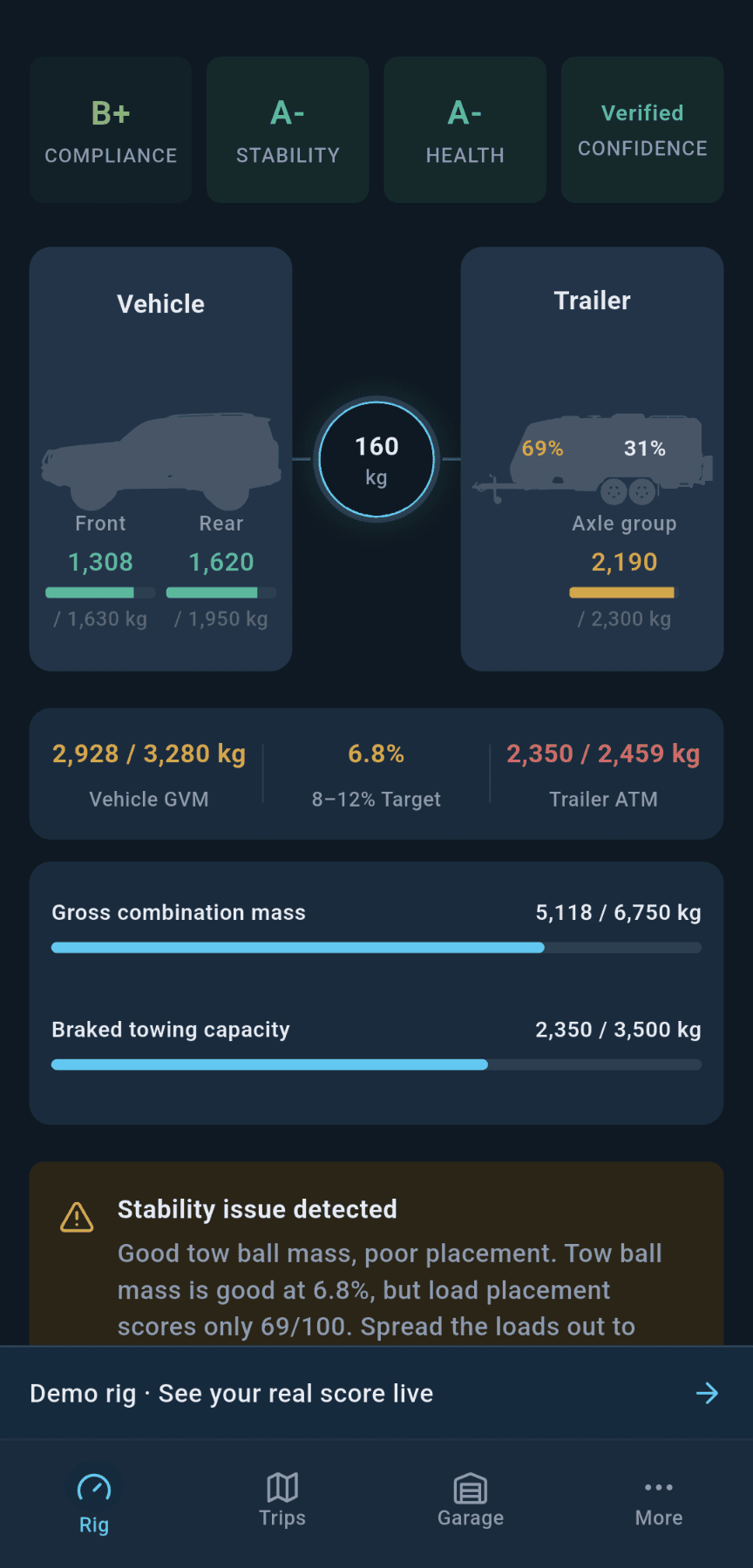
Watch the limit that bites first
Accessories use payload before the trip gear goes in. As you record what you carry, loadmate tracks GCM, GVM and the rear axle together so you can see which limit tightens first. Free to explore on a demo rig in the app.


Frequently asked questions
- What does GCM mean?
GCM means gross combination mass: the maximum loaded weight of your tow vehicle and trailer together, hitched up, as a single figure set by the vehicle's manufacturer. It is one combined ceiling, not a sum you calculate from the two compliance plates.
- What's the difference between GVM and GCM?
GVM caps the vehicle loaded on its own; GCM caps the vehicle and trailer loaded together. They are separate limits and you must clear both at once. GVM is on the vehicle's compliance plate, while GCM is in the owner's manual and on neither plate.
- How do you calculate gross combination mass?
You don't calculate GCM — the manufacturer sets it. You check your combination against it: weigh the loaded vehicle with the trailer hitched (the tow ball mass is aboard), add the trailer's GTM, and keep that total under GCM. Never add GVM and ATM together, because that double-counts the tow ball mass.
- Can you tow at full GVM and full ATM at once?
Usually no. Adding the two plate maximums overshoots GCM and double-counts the tow ball mass, which sits inside the van's ATM and inside the vehicle's loaded weight once hitched. The honest combined weight is lower, but on many vehicles even a full GVM plus the trailer's GTM exceeds GCM — so you give up load somewhere.
- Where do I find my GCM?
In the owner's manual, and on the manufacturer's towing or specifications page. It is not stamped on the vehicle's compliance plate the way GVM is, and it is not on the van's plate at all. If a GCM upgrade has been done, the re-rated figure is documented with that modification.
- What is a GCM upgrade?
A GCM rating can be obtained or re-rated by an aftermarket or second-stage manufacturer under an engineering procedure that validates braking, handling, thermal and structural performance, referencing the Australian Design Rules and Vehicle Standards Bulletins, for vehicles up to 4.5 tonnes GVM. A GVM upgrade on its own does not raise GCM, so it can leave less towing headroom rather than more.
- Is GCM the same as towing capacity or GCW?
GCM is not towing capacity: braked towing capacity is the heaviest trailer you may pull, while GCM caps the whole rig's combined weight, and GCM usually bites before you reach the braked rating. Gross Combined Weight (GCW) and GCWR are synonyms for the combined ceiling; GCWR is the term used overseas.