The checklist at a glance
- 1. Heavy gear at the van's ends
- Move spares, jerry cans and toolboxes low and over the axles; treat the bars as a last resort
- 2. Tow ball mass off target
- Aim for 8–12% of the loaded van — 224–336 kg on a 2,800 kg van — under the vehicle's ball maximum
- 3. One side heavier than the other
- Keep the sides within about 3% of each other (roughly 40 kg on our worked van); weigh wheel by wheel
- 4. Rear axle limit ignored
- Find the axle rating in the manual; ball mass arrives multiplied (×1.5 on our worked rig)
- 5. Trusting how stable it feels
- Set up for the worst five seconds of the trip — speed, wind, descents — not the easiest hour
- 6. Water as an afterthought
- Travel full or empty by choice, never half by default; 190 L is 190 kg of payload
- 7. Plated tare taken on faith
- Weigh the van before handover, and again after buying used
- 8. Experience instead of checks
- Years towing don't update your numbers — reweigh after every change to the rig
- 9. Van maintenance deferred
- Bearings, sealant and chassis welds on a schedule, not on failure
- 10. One weigh-in, never again
- A weigh-in is a snapshot; the numbers expire as soon as the load changes
Every caravanner learns these the hard way or the cheap way, and the cheap way is a checklist. Every figure in this guide comes from one illustrative worked rig: a large 4WD wagon (kerb 2,350 kg, GVM 3,100 kg, GCM 6,250 kg, braked rating 3,500 kg, maximum ball download 350 kg, wheelbase 2,850 mm, rear overhang 1,275 mm) towing a tandem-axle caravan (ATM 2,800 kg, tare 2,300 kg, 190 L of water across two tanks). Your numbers will differ — always work from your own compliance plates.
What are the most common caravanning mistakes?
The most common caravanning mistakes are weight mistakes — and most of them are about where the weight sits rather than how much of it there is. A van can be under every plated limit and still be unstable, and a careful owner can drift over a limit one accessory at a time without ever feeling it. The ten below are the ones that surface again and again at weigh-ins and in sway incidents, each with the check that catches it.
1. Loading the ends of the van
The mistake is treating the van as one big box: staying under the weight limit but stacking heavy gear at the extremities. Front and rear bars are convenient homes for jerry cans, spare wheels and toolboxes — and they're the worst places on the van for them. Mass at the ends works like the plates on a dumbbell: the total doesn't change, but once the van starts to swing, that distant weight keeps it swinging. The effect grows with length, and vans beyond about 7 m feel it most.
Keep heavy items low and over (or near) the axle group. Automotive journalist Robert Pepper (L2SFBC) demonstrates the physics on video in "Why trailer weight distribution causes loss of control" — worth watching before your next pack.
2. Tow ball mass outside the 8–12% band
Aim for a tow ball mass of roughly 8–12% of the van's loaded weight — 224–336 kg on our 2,800 kg worked van. Too little and the van is prone to sway; too much and you lighten the tow vehicle's steering and work its rear axle hard. Check the result against two ceilings at once: the van's own coupling rating and the tow vehicle's maximum ball download (350 kg on our worked wagon).
Two traps hide inside the rule. First, many vans are advertised with a ball weight at tare well below the band, so the balance is something you build with load placement — not by piling weight onto the A-frame. Second, the rule tightens as vans get longer: a small camper can run lighter percentages without drama, but a van past 6–7 m is far more prone to sway and needs the band respected. And the ball mass belongs to the tow vehicle once you hitch: on our rig, the 280 kg ball takes the wagon's 750 kg payload down to 470 kg before anyone gets in. The terms behind all of this — ATM, GTM, tow ball mass — are explained in our caravan weights guide.
3. Balanced front-to-back, lopsided side-to-side
A van can hit the right total and the right ball mass and still handle badly, because balance is three-dimensional: front-to-back, side-to-side, and as low as possible. The side-to-side split is the one almost nobody measures — a standard weighbridge won't show it, and not every professional weigh covers it. As a guide, keep the two sides within about 3% of each other; on our 2,800 kg van that's a side-to-side difference of no more than roughly 40 kg. On a tandem-axle van, match the corners: front-left against front-right, rear-left against rear-right. And don't assume the van left the factory evenly balanced — check it.
4. Ignoring the rear axle
Your tow vehicle's rear axle has its own rating, and it's often the first limit you reach — before GVM, before GCM. It hides in the owner's manual or on a placard rather than the brochure, and tow ball mass loads it harder than the raw number suggests, because the ball hangs well behind the axle and acts through a lever. On our wagon the ball sits about 1,425 mm behind the rear axle (1,275 mm of body overhang plus around 150 mm of hitch), against a 2,850 mm wheelbase — geometry that multiplies ball load by 1.5. The 280 kg on the ball arrives as roughly 420 kg on the rear axle, while lifting about 140 kg off the front. Add rear-seat passengers and a loaded boot, and a rig that looks legal on paper can be over its axle rating with the GVM untouched. The full worked explanation is in our gross vehicle mass guide; the cure is a wheel-by-wheel weigh, not guesswork.
5. Trusting how stable it feels
"It always felt so stable" is the line that comes up again and again after sway incidents — felt stability is not measured stability. A van that tows beautifully at 90 km/h in still air is a different van at 110 km/h with a road train passing and a crosswind on the nose. Caravans are pig trailers — the axle group sits near the middle — and they become less forgiving as they get heavier and longer. Electronic stability control is a safety net, not a setup tool: it intervenes after sway has started, and its job gets harder as speed rises. Set the rig up for the worst five seconds of the trip, not the easiest hour — and match the van to the vehicle honestly, which is exactly what our braked towing capacity guide covers.
6. Treating water as an afterthought
Water is the biggest variable load on most vans: our worked van carries 190 L across two tanks, and that's 190 kg — 38% of its 500 kg payload. Full tanks ride low and actually steady the van; the cost is payload and fuel. The state to avoid is half-full: many tanks are baffled against fore-aft surge, fewer against side-to-side slosh, and some have no baffles at all — on a bend, that moving water works against you.
| Tank state | Stability | Payload used (worked van) | Watch for |
|---|---|---|---|
| Full | Best — the mass sits low | 190 kg | Payload and fuel cost of carrying it |
| Half-full | Worst — water sloshes side to side | ~95 kg | Baffles rarely stop lateral slosh |
| Empty | Light and predictable | 0 kg | Ball mass and balance shift versus the loaded state |
Plan water like cargo: decide full or empty before you leave, and remember that draining 190 kg mid-trip moves your ball mass and balance too. Tank sizes, days of water and the payload trade-off are covered in our caravan water tanks guide.
7. Taking the plated tare at face value
The tare on a van's compliance plate is often a model figure, not your van's figure — and the gap comes straight out of your payload. Options fitted at the factory, or by a previous owner — solar panels, bike racks, a second awning, a toolbox — don't always make it onto the plate. Run the arithmetic on our worked van: payload is ATM minus tare, 2,800 − 2,300 = 500 kg. If the real tare runs 100 kg over the plate, you're down to 400 kg — a fifth of your payload gone before you've packed a thing. The fix is cheap relative to the van: a weighbridge visit before handover, while you still hold negotiating power, and a fresh weigh on any used purchase. What ATM covers and how a van's payload is set is in our aggregate trailer mass guide.
8. Letting experience stand in for checks
Years of towing don't keep your numbers current — only weighing does. "She'll be right" has evidence against it: in a two-day Victoria Police roadside operation at Newmerella in January 2017, 41 of the 71 caravans and camper trailers weighed — 58% — were over at least one of their plated limits (as reported by RV Daily, 2017, and the NRMA, 2022). Only two of the drivers stopped knew all of their rig’s ratings, and only three knew what it actually weighed — experience hadn't kept the figures current while the rigs drifted, a new accessory here and heavier gear there. Confidence is earned per setup, not per decade: when the van, the vehicle or the loading plan changes, the checks start again.
9. Putting off van maintenance
Caravans fail at the points most owners never inspect: sealant, bearings and chassis welds. Wheel bearings get the attention; the quieter failures cost more. Sealant protects the body from water for years, not forever — lifting edges or discolouration underneath mean water is already getting in, and slow leaks do structural damage long before anything shows inside. Chassis fatigue concentrates at stress points and welds, and turns up earlier on off-road vans run at highway tyre pressures over corrugations. Some of this is visible to a careful eye; some needs a professional inspection. Put the van on a service schedule the way the tow vehicle already is — by calendar and kilometres, not by failure.
10. Treating one weigh-in as the final word
A weigh-in is a snapshot, and your rig stops matching it almost immediately. A diesel heater, a new awning, a different water plan, a change of season's gear — every one moves your numbers, and a reading from last year tells you what you weighed, not what you weigh. The weigh-in is still the anchor: get a proper baseline, then track changes against it instead of re-guessing from scratch.
| Method | What it gives you | The gap |
|---|---|---|
| Public weighbridge | Certified total and axle-group weights | No side-to-side split, no item-level detail |
| Mobile weigh service | Wheel-by-wheel weights, ball mass and balance, explained on the spot | Still a snapshot, like any weigh |
| Running tally between weighs | Numbers that stay current as gear, water and loading change | Only as good as the baseline weigh it starts from |
Caravan towing tips: the pre-departure routine that catches all 10
The most useful caravan towing tip is a routine, not a trick — the same short list before every trip, because every mistake above is catchable in the driveway. Here it is, distilled:
- Confirm the pairing on paper. Braked rating, ball maximum, GCM — from the plates and the manual, not the brochure. Our worked rig fits: the wagon at its full 3,100 kg GVM plus the 2,800 kg van is 5,900 kg against a 6,250 kg GCM. Many rigs don't — your model's real numbers are in towing capacity by vehicle.
- Get a baseline weigh, loaded for travel. Wheel-by-wheel if you can; it's the only way to see the side-to-side split and the true ball mass.
- Set ball mass in the band. 8–12% of the loaded van — 224–336 kg on the worked van — and under the vehicle's 350 kg ceiling.
- Load low, central and even. Heavy items over the axles, the two sides within about 3% of each other, nothing big on the bars.
- Decide the water before you roll. Full or empty by design — 190 kg is in play on the worked van — never half by default.
- Walk the van. Coupling, bearing service date, tyre pressures for the surface, sealant edges, a look along the chassis.
- Re-run the numbers after any change. New gear, new layout, new season — the old figures are expired.
Catch these before the driveway
Almost everything on this list gets discovered in the wrong place: at a roadside intercept, halfway through a sway event, or at the first weigh-in of the trip. The habit that prevents all of it is pre-departure — run the numbers before you hitch, every time.
The bullbar, drawers and extra battery have already used some payload before the bags go in. Add passengers, water and the caravan's tow ball mass and the remaining room can look very different from the brochure. loadmate connects the loads you record with the rig's limits and stability picture, so you can see what needs attention before leaving. Explore loadmate in the app. loadmate is decision support, not legal weight certification; for legal weight evidence, use a certified weighbridge. See our safety disclaimer.
Related guides
- Caravan & Towing Weights Explained — every weight term explained in one place (the best starting point)
- Gross Vehicle Mass (GVM) Explained — the vehicle-side limit, with the rear-axle lever worked example
- Aggregate Trailer Mass (ATM) Explained — the van's own limit and where your payload really comes from
- Braked Towing Capacity Explained: A Legal Ceiling, Not a Target — why the brochure pairing often isn't the safe one
- Caravan Water Tanks — tank sizes, days of water and what water does to your payload
- When to Reweigh a Caravan: What's Changed Since Your Last Weigh-In — skipping a reweigh after changes is its own classic mistake
- Why Your Caravan Needs Its Own Odometer and Service Log — letting the van's distance and service history go untracked is one of the quiet ones
- Towing capacity by vehicle — your model's real numbers: braked rating, GVM, GCM and payload at full tow
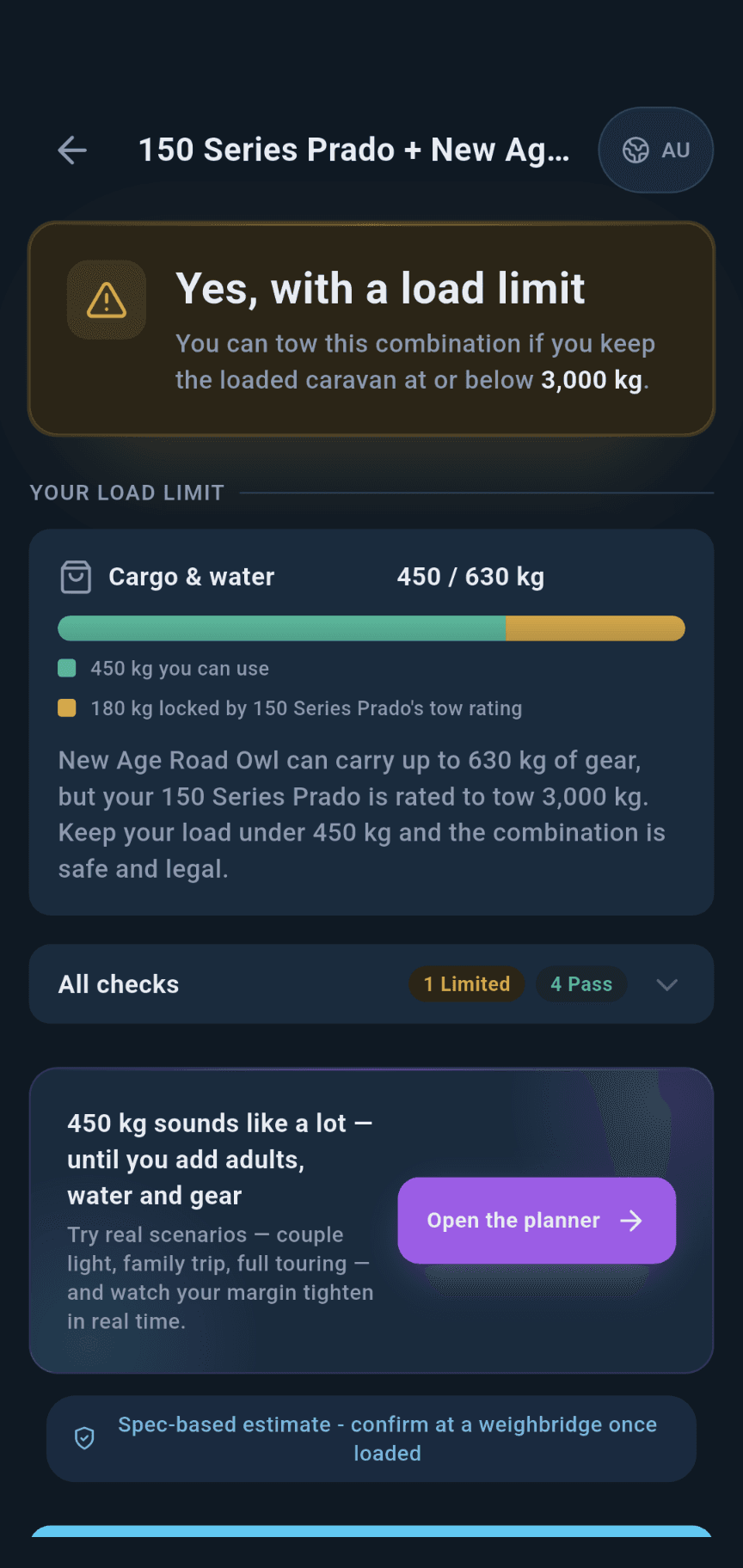
Know which limit stops you first
loadmate names the one limit that bites first and the margin left before it does, then lets you load the rig up and watch that margin tighten. No account needed.


Frequently asked questions
- What is the most common mistake when towing a caravan?
Weight mistakes top the list — exceeding a limit, running tow ball mass outside the 8–12% band, or stacking heavy gear at the van's extremities. Most stay invisible until a weigh-in or a sway event, which is why a pre-departure routine matters more than experience.
- What is the 10% tow ball rule?
A guideline that tow ball mass should sit at roughly 8–12% of the caravan's loaded weight — about 224–336 kg on a 2,800 kg van. Too little invites sway; too much overloads the tow vehicle's rear axle and lightens the steering. Check it against the vehicle's maximum ball download as well as the van's coupling rating.
- Should I travel with caravan water tanks full or empty?
Full or empty by choice — not half-full by default. Full water rides low and adds stability at the cost of payload (190 L is 190 kg); half-filled tanks let water slosh side to side, which can unsettle the van on bends. Plan tanks around where you can next fill, and count the weight as payload.
- How do I know if my caravan is overloaded?
Weigh it, loaded for travel. A public weighbridge gives the total and axle-group weights; a mobile weigh service adds wheel-by-wheel figures, side-to-side balance and tow ball mass. Compare the results against the ATM and axle ratings on the van's compliance plate, not the brochure.
- Does caravan sway mean my van is overloaded?
Not necessarily — sway is usually a distribution problem: too little tow ball mass, heavy items at the van's ends, or a load that sits too high. Being overweight makes all of it worse, and longer, heavier vans are more susceptible to begin with.
- How often should I weigh my caravan?
After any meaningful change — new accessories, a different loading plan, the start of a big trip — and at least before each season of travel. A weigh-in is a snapshot; once the load changes, treat the old figures as expired.
- Can I rely on electronic stability control to prevent sway?
No. ESC is a safety net that reacts after sway has started, and its job gets harder as speed rises. Correct loading — ball mass in the band, heavy gear over the axles, sides balanced — is what keeps the van stable in the first place.