A CAT scale ticket at a glance
- Steer axle
- Load on the truck's front axle
- Drive axle
- Load on the truck's rear axle
- Trailer axle
- Load supported by the trailer's axle group in that hitch condition
- Gross weight
- Steer + drive + trailer axle loads
- Truck's measured weight
- Steer + drive; compare with truck GVWR
- Tongue weight
- Requires a controlled measurement; it is not printed separately
- WDH distinction
- A tensioned weight-distribution hitch redistributes axle loads; truck weight change alone is then not raw tongue weight
In the inactive-WDH example below, the ticket shows 16,500 lb below a 17,000 lb combination rating while the truck's own axle readings add to 7,600 lb against a 7,100 lb GVWR. The lower total does not resolve the truck's 500 lb excess. You need to read the parts as well as the sum.
This guide follows those illustrative readings through the checks. It also separates a tongue-weight measurement from a weighing with the hitch configured for travel, because the two can put different loads on the scale platforms.
How do you read a CAT scale ticket?
Start with the hitch and loading conditions on the ticket, then match each reading to its rating. A ticket from a different tank level, cargo load or hitch setting may be useful history, but it is not a measurement of today's setup.
Read in this order:
- Compare the steer reading with the front Gross Axle Weight Rating, or GAWR.
- Compare the drive reading with the rear GAWR.
- Add steer and drive, then compare that sum with the truck's Gross Vehicle Weight Rating, or GVWR.
- Compare gross with the truck's Gross Combined Weight Rating, or GCWR.
- Establish the complete trailer weight and tongue weight using the appropriate measurements, then check trailer, vehicle and hitch requirements.
Keep the truck's certification label, trailer label and manufacturer's towing guide with you. The US towing-capacity chart can help identify a model and its rating sources. Your own configuration, labels and manufacturer documents supply the limits for the ticket in your hand.
The four lines: steer, drive, trailer and gross
For a conventional truck and travel trailer, the three platforms separate the truck's front axle, rear axle and trailer axle group. CAT's weighing instructions show their placement. Keep the complete combination on the scale and follow the operator's positioning directions. A platform reading is not an individual wheel weight.
The following is an illustrative measurement with weight distribution inactive, not a real customer's ticket. The truck has a 7,100 lb GVWR, 3,900 lb front GAWR, 4,100 lb rear GAWR and 17,000 lb GCWR. The trailer has an 11,000 lb GVWR.
| Ticket line | Illustrative reading |
|---|---|
| STEER AXLE | 3,560 lb |
| DRIVE AXLE | 4,040 lb |
| TRAILER AXLE | 8,900 lb |
| GROSS WEIGHT | 16,500 lb |
The arithmetic is 3,560 + 4,040 + 8,900 = 16,500 lb. If your copy of the ticket does not add up, check the transcription before using it in another calculation.
The trailer line is the load reaching the ground through its wheels under this hitch condition. With weight distribution inactive, adding the separately established tongue weight gives the complete loaded trailer. With a distribution hitch tensioned, some load is redistributed to the trailer platform, so keep that reading associated with its hitch setting.
Our companion CAT scale weighing procedure covers preparing and positioning the rig. Ask the operator about a safe designated area for any adjustments. Do not unhitch on the scale or attempt a wheel-by-wheel weighing by putting wheels off the platforms.
Map each line to a rating: GAWR, GVWR and GCWR
Each rating needs its own check. The combined total can be below GCWR while the truck, an axle or a hitch exceeds another limit. The towing weight ratings guide explains the terms together.
| Measured figure | Compare with | Find the rating in |
|---|---|---|
| Steer axle | Front GAWR | Truck certification label |
| Drive axle | Rear GAWR | Truck certification label |
| Steer + drive | Truck GVWR | Truck certification label |
| Complete loaded trailer | Trailer GVWR and applicable vehicle towing limit | Trailer label and truck towing documentation |
| Gross | GCWR | Manufacturer's towing documentation for the configuration |
| Raw tongue load | Applicable vehicle, receiver and hitch limits | Their labels and instructions |
Also follow tire and other component requirements. Axle-group readings do not reveal how much each individual wheel carries, and adding the front and rear GAWR does not create a higher truck GVWR.
In the example, the axle ratings sum to 3,900 + 4,100 = 8,000 lb, while GVWR is 7,100 lb. The truck must still meet the lower whole-vehicle rating as well as each axle rating.
The number the ticket never prints: backing out your tongue weight
The truck-side weight difference gives raw tongue weight only when weight distribution is inactive and the comparison loads match. Equal-i-zer's weight-distribution explanation describes how a tensioned hitch transfers load back to the front axle and trailer axles. That transfer changes the result you get from subtracting the truck's axle totals.
Before using subtraction, check these conditions:
- The hitched measurement has weight distribution inactive.
- People, cargo and fuel are unchanged between the hitched and truck-only readings.
- Hitch hardware is accounted for consistently. Removing bars or other equipment from the truck between readings changes the difference.
- Tank volumes and trailer cargo remain unchanged when comparing the trailer's mass and tongue load.
Arrange any controlled measurement with the scale operator or a competent weighing service. Do not drive with required weight distribution disabled to obtain a number. If the necessary setup cannot be measured safely, use suitable tongue-weight equipment or professional weighing instead. Follow the vehicle, trailer and hitch instructions for adjustments in a safe area.
For our illustrative rig, the two readings are:
| Measurement | Truck axle total |
|---|---|
| Hitched, weight distribution inactive | 3,560 + 4,040 = 7,600 lb |
| Same loaded truck, unhitched, hardware accounted for | 6,300 lb |
| Difference | 1,300 lb |
So raw tongue weight = 7,600 − 6,300 = 1,300 lb.
The complete trailer weighs 16,500 − 6,300 = 10,200 lb. This also equals 8,900 + 1,300 = 10,200 lb under the stated inactive-WDH condition. Do not call gross minus truck-only “tongue weight”; that subtraction includes the complete trailer.
The tongue share is 1,300 ÷ 10,200 = approximately 12.7%. Equal-i-zer's loading guidance gives 10–15% for bumper-pull trailers while requiring owners to verify actual tongue load and all vehicle and hitch ratings. A percentage inside that band does not prove the 1,300 lb load fits your hitch or truck.
If you tow with a weight-distribution hitch, a further weighing with its correct travel setting supplies the axle readings needed for the travel-condition checks. Keep that ticket separate from the inactive-WDH tongue measurement. The front-axle restoration guide explains why the setting matters.
When gross is below GCWR but the truck is over GVWR
The example's 16,500 lb gross is 500 lb below GCWR, while its 7,600 lb truck axle total is 500 lb above GVWR. These results describe the illustrated inactive-WDH measurement condition. They do not establish what the axle loads will be with a correctly configured distribution hitch.
| Check | Measured figure | Rating | Difference |
|---|---|---|---|
| Combined mass against GCWR | 16,500 lb | 17,000 lb | 500 lb below |
| Truck axle total against GVWR | 7,600 lb | 7,100 lb | 500 lb above |
| Steer axle against front GAWR | 3,560 lb | 3,900 lb | 340 lb below |
| Drive axle against rear GAWR | 4,040 lb | 4,100 lb | 60 lb below |
| Complete trailer against trailer GVWR | 10,200 lb | 11,000 lb | 800 lb below |
The truck figure needs attention even though both individual axles are below their ratings. Check the actual travel condition and all applicable hitch limits before towing. A distribution hitch can change axle loading; it does not raise any manufacturer's rating.
If the loaded travel setup exceeds a limit, reduce or remove load, or use a combination with suitable capacity. Then reweigh. Do not treat moving cargo within the trailer as an automatic cure: forward placement generally increases tongue load, while deliberately shifting too much rearward can reduce stability. Equal-i-zer's loading instructions explain that trade-off. Get help with a load plan if you cannot meet the vehicle, trailer and hitch requirements together.
Which limits should you use with the ticket?
Use the ratings for your own truck, trailer and towing equipment. A number quoted for a commercial truck or a different vehicle configuration is not an allowance for your RV.
Write the rating beside each relevant scale line. If you cannot find the exact GCWR or towing configuration, resolve that with the manufacturer before calling the result acceptable. A chart maximum may depend on equipment your vehicle does not have, which is why the chart links back to its configuration and sources.
How much does it cost to weigh at a CAT scale, and what is a reweigh?
CAT's published standard US first-weigh price is $15.25, with a qualifying reweigh at $5.25, checked September 24, 2026. Confirm the current charge when arranging your passes. CAT's FAQ sets out the price and reweigh policy.
The policy requires the same vehicle, including tractor and trailer, the same scale, a full-price original ticket and a reweigh within 24 hours. Ask the operator how your truck-only and different hitch-condition passes will be charged; do not assume an uncoupled truck automatically meets the stated reweigh conditions.
Keep every ticket with a note of the load and hitch setting. That makes the measurements usable even if the order of the passes differs from an example.
Is a CAT scale ticket proof that my rig is legal?
The ticket records measured weights; you still need to check the applicable ratings and requirements. CAT's guarantee covers the accuracy of both axle and gross weights. It does not assess every requirement of your particular rig.
CAT states that it will check its scale after a qualifying state overweight fine. If the scale is wrong, it reimburses the fine; if the scale is correct, a representative appears in court as a witness. Read the current guarantee for the claim conditions.
A useful record includes the original ticket, which configuration it represents and the ratings you compared with it. Keep conclusions specific: “500 lb below GCWR” tells you exactly which comparison was made. It does not mean every other check is complete.
How loadmate helps you stay under your ratings after a weigh-in
Keep the axle readings with the cargo, tank levels and hitch condition that produced them. When the next trip adds equipment or carries water differently, those details explain why an old ticket may no longer describe the load.
loadmate connects your recorded weigh-in baseline with later load changes. You can keep the original ticket alongside the entered figures, then review the next packing change against that baseline. Explore loadmate in the app to see how a scale visit supports the checks between trips.
Enter the readings and attach the ticket yourself. The app link does not import this example or retrieve a CAT ticket. loadmate provides decision support, not legal weight certification; see the safety disclaimer.
Related guides
- US towing-capacity chart: find model configurations and the source documents behind their ratings
- Towing weight ratings: GVWR, GCWR, GAWR and payload explained together
- How to weigh a travel trailer at a CAT scale: prepare for the actual weighing procedure
- Payload vs towing capacity: separate carrying capacity from the tow rating
- Tongue weight vs payload: understand the load transferred through the hitch
- Weight-distribution hitch and front-axle load: check the travel hitch setting against its instructions
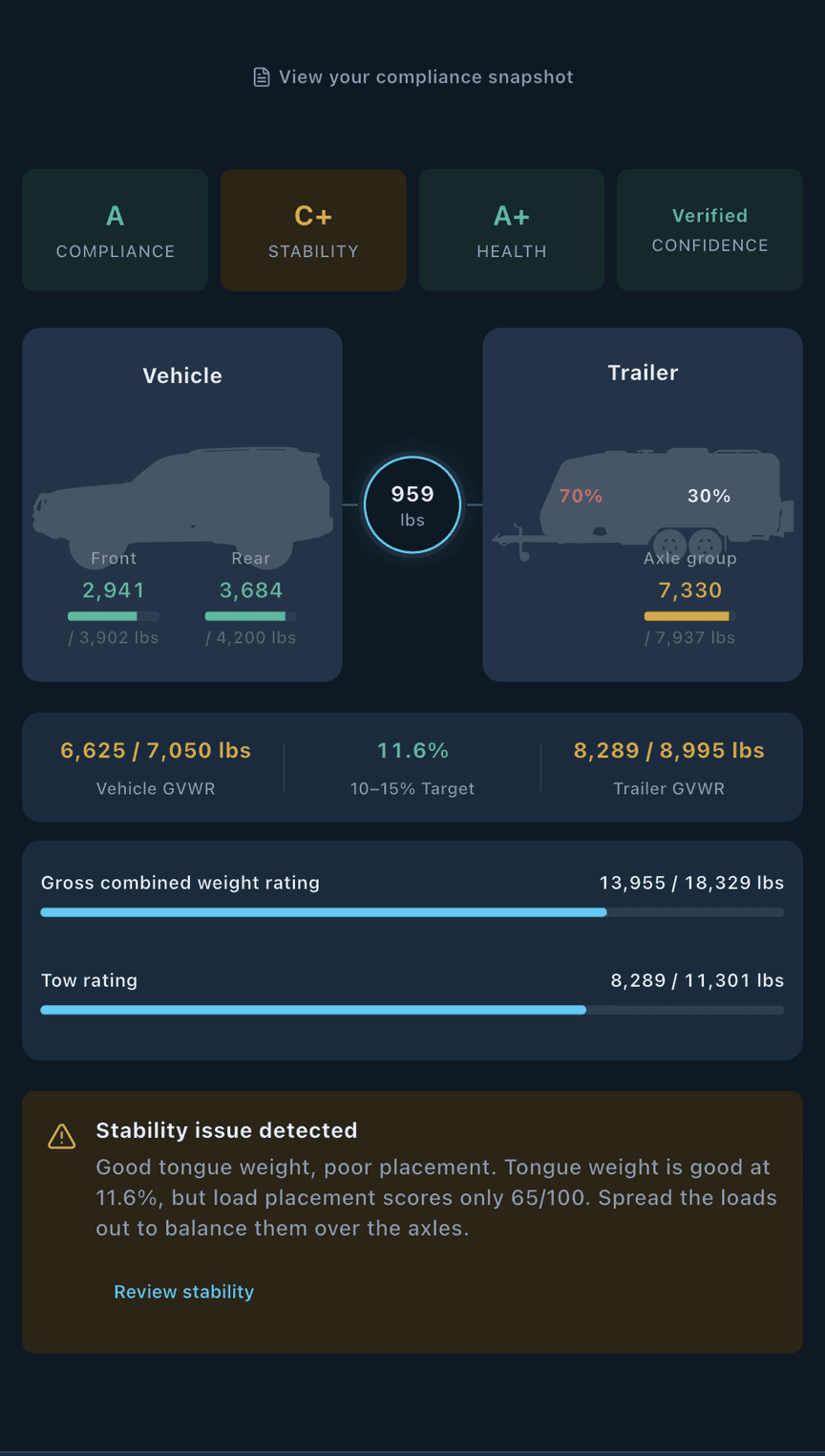
Keep the readings with your rig
Enter the measured axle weights and your vehicle’s ratings in loadmate. Record the people, water and cargo present at the scale, so later changes start from a known load.
Example app screen. The values shown belong to the example rig.View the full-size app screen


Frequently asked questions
- How do you read a CAT scale ticket?
Compare steer with front GAWR, drive with rear GAWR, steer plus drive with truck GVWR, and gross with GCWR. Establish complete trailer and tongue weights separately. Record the hitch setting because weight distribution changes the axle loads.
- What do steer, drive and trailer mean?
Steer is the truck's front axle, drive is its rear axle, and trailer is the load on the trailer axle group in that hitch condition. Gross is their sum. These are group readings, not individual wheel weights.
- How do I calculate tongue weight from a CAT scale?
With weight distribution inactive, subtract the same loaded truck's unhitched axle total from its hitched axle total. Keep people, fuel, cargo and relevant hitch hardware consistent. If you cannot make those measurements safely, use suitable tongue-weight equipment or professional weighing.
- Does the subtraction work with a weight-distribution hitch tensioned?
It gives the net load retained on the truck after redistribution, not raw tongue weight. Use the correct controlled conditions for the tongue measurement and a separate properly configured travel-condition weighing to check axle loads.
- Does a ticket below GCWR mean my rig is within every limit?
No. In the illustrative inactive-WDH condition, gross is 500 lb below GCWR while the truck axle total is 500 lb above GVWR. Check the truck, trailer, axles and hitch requirements for the actual travel configuration.
- How much does a CAT scale weigh cost?
CAT lists a standard US first weigh at $15.25 and a qualifying reweigh at $5.25, checked September 24, 2026. The reweigh policy requires the same vehicle including trailer, the same scale, the original full-price ticket and a 24-hour window. Ask about truck-only passes.
- Is a CAT scale ticket proof that the rig is legal?
It is a record of measured weights. CAT guarantees axle and gross accuracy under its published terms, but the ticket does not assess all vehicle ratings and legal requirements for your combination.
- Can a CAT scale weigh an RV or travel trailer?
Yes. CAT publishes positioning instructions for motorhomes and truck-and-trailer combinations. Follow the operator's directions and use the appropriate platforms. Do not try to obtain individual wheel weights by moving wheels off the scale.