Weighing a travel trailer at a CAT scale, at a glance
- What a CAT scale is
- A certified, multi-platform truck scale at truck stops; steer axle reads on platform 1, drive on 2, trailer on 3
- The two passes
- Pass 1: the whole rig coupled, one drive-through for every axle group. Pass 2: the truck alone, unhitched off the scale
- Tongue weight formula
- Tongue weight = truck-axles-hitched − truck-alone (on the worked rig, 6,920 − 6,100 = 820 lb)
- Cost
- Approximately $15 for the first weigh, around $5 for a qualifying reweigh; check catscale.com for current pricing
- Tongue weight target
- A travel trailer usually wants 10–15% of its loaded weight on the tongue
- Where the ratings are printed
- Truck GVWR and per-axle GAWR on the driver's-side door-jamb label; payload on the B-pillar Tire and Loading label; the trailer's GVWR on its own label
A CAT scale is where your truck's and trailer's printed ratings turn into measured pounds. The brochure tells you a GVWR, a payload and a tow rating; the scale tells you what your rig actually weighs once the water tank is full and the gear is aboard. The whole job is two drive-throughs and one subtraction, and this guide walks each step on one illustrative rig so every figure reconciles. Reading the printed ticket line by line is a separate skill, and tuning a weight-distribution hitch is another again. Both are named where they come up, and both are covered in their own US guide: reading the printed ticket and tuning a weight-distribution hitch.
How do you weigh a travel trailer at a CAT scale?
You make two weighs: one drive-through with the trailer coupled that reads every axle group at once, then a second weigh of the truck on its own after you have unhitched off the scale. The difference between the two truck weights is your tongue weight. A CAT scale has three side-by-side platforms, so unlike a single-pad scale it captures the steer axle, the drive axle and the trailer axle in one motion. That is the step people search for, so here it is as a list you can follow at the pump island.
- Load the rig travel-ready (full fuel, water as you carry it, gear, passengers and pets aboard) because an empty weigh hides the numbers that matter.
- Pull onto the scale coupled, with your steer (front) axle on platform 1, your drive (rear) axle on platform 2 and your trailer axle on platform 3.
- Start the weigh: push the button on the intercom sign and a cashier takes your information, or do it from your phone with the Weigh My Truck app.
- Pull forward off the scale and park in a trailer space. Drop the trailer there. Never unhitch on the scale.
- Drive the truck back on alone and weigh it a second time.
- Subtract the truck-alone weight from the truck's coupled weight to get tongue weight, then add tongue weight to the trailer-axle reading for the trailer's full loaded weight.
Throughout this guide one illustrative rig carries every number: a half-ton crew-cab truck towing a travel trailer with a weight-distribution hitch engaged, all figures in pounds. It is a composite example, not a real vehicle, and the figures are here so each step reconciles against the next. Your own labels will read differently, so always weigh against yours. The truck's ratings are GVWR 7,000, front GAWR 3,650, rear GAWR 3,950, payload 1,600 (GVWR 7,000 minus a curb weight near 5,400), a max tow rating of 9,000 under SAE J2807, and a GCWR of 14,500. The trailer's GVWR is 7,700.
Which axle goes on which platform?
Platform 1 reads your steer axle, platform 2 reads your drive axle, and platform 3 reads your trailer axle: three groups, three plates, one drive-through. CAT puts it plainly: position the steer axle on platform 1, the drive axle on platform 2, and the trailer will normally show up on platform 3. A truck and travel trailer line up to that mapping without any fuss, because the truck's two axles take the first two plates and the trailer's axle group lands on the third.
| Platform | What rests on it | On the worked rig (coupled) |
|---|---|---|
| Platform 1 | Truck steer (front) axle | 3,210 lb |
| Platform 2 | Truck drive (rear) axle | 3,710 lb |
| Platform 3 | Trailer axle group | 5,980 lb |
Two positioning rules keep the reading accurate. No tire may straddle the gap between two platforms, or the weight lands on the wrong group. And a long spread-axle or multi-axle trailer that will not fit on a single platform needs a second pull-forward pass so each axle group gets read cleanly. The scale itself reports axle-group weights and a total gross. It cannot weigh each corner of the rig, which is exactly why tongue weight has to be derived rather than read off a line.
The two passes: the whole rig, then the truck alone
The first pass weighs the coupled rig in one drive-through; the second weighs the truck by itself after you have unhitched in a parking space. You never drop the trailer on the scale deck. On the worked rig the coupled pass reads steer 3,210, drive 3,710 and trailer axle 5,980, for a combined gross of 12,900 lb. Those are the numbers the scale hands you in pass one.
For pass two, pull off, park, and unhitch the trailer in a trailer space, then drive the truck back onto platforms 1 and 2 alone. Trip-loaded but unhitched, the worked truck reads steer 3,200 and drive 2,900: a truck gross alone of 6,100 lb. Disconnecting a trailer on the scale platform is prohibited, holds up the line behind you, and is unsafe, so the drop always happens off the deck. With both weighs done you hold two truck figures: 6,920 lb of truck on its axles while coupled (3,210 + 3,710), and 6,100 lb of truck on its own. The gap between them is the whole point of the second pass.
How do you get tongue weight from your CAT scale numbers?
Tongue weight is the truck's coupled axle weight minus its solo weight (on the worked rig, 6,920 − 6,100 = 820 lb), because the part of the trailer that is not sitting on its own axles is pressing down on the truck through the hitch. The scale never reads the tongue directly; you back it out by subtraction. Once you have the 820 lb, the trailer's full loaded weight, its gross trailer weight, is the trailer-axle reading plus the tongue: 5,980 + 820 = 6,800 lb. And the tongue as a share of that gross is 820 ÷ 6,800 = 12.06%, which sits inside the 10–15% band a travel trailer wants.
| Step | Computation | Result |
|---|---|---|
| Truck on its axles, coupled | 3,210 + 3,710 | 6,920 lb |
| Truck alone | steer 3,200 + drive 2,900 | 6,100 lb |
| Tongue weight | 6,920 − 6,100 | 820 lb |
| Gross trailer weight | trailer axle 5,980 + 820 | 6,800 lb |
| Tongue percentage | 820 ÷ 6,800 | 12.06% |
The 10–15% target is the figure trailer makers, hitch manufacturers and RV authorities all converge on: CURT, Weigh Safe, eTrailer and the RV Geeks each state the loaded tongue should be roughly 10–15% of the gross trailer weight, with too little inviting sway and too much squatting the rear and lightening the steering. One caution if you run a weight-distribution hitch: the spring bars shift load around, so to read a true, raw tongue weight you disconnect the bars before the truck-alone pass. How the hitch moves that load (and how to read the steer axle to confirm it is doing its job) is its own subject, handed off to the US weight-distribution-hitch guide.
Does comparing the steer axle solo and coupled tell you anything?
Yes: line up the truck-alone steer reading against the coupled steer reading and you can see whether a weight-distribution hitch has put back the front-axle weight a heavy tongue takes off. On the worked rig the steer axle reads 3,200 lb solo and 3,210 lb coupled with the bars engaged, so the front axle came back almost exactly to its no-trailer figure, and both sit well under the 3,650 lb front GAWR. That near-match is the quick at-the-scale check that the hitch is tuned. Without a hitch, hanging 820 lb on the back of the truck would lever weight off the front axle instead. Reading that comparison closely, and adjusting the bars to hit it, is weight-distribution-hitch territory and is covered in the dedicated US weight-distribution hitch and front-axle-load guide; here it is only the one-line confirmation your numbers are sound.
What does it cost, and how do you pay?
A CAT scale weigh runs around $15 for the first ticket, with a qualifying reweigh near $5. But prices change, so check catscale.com for current pricing rather than treating any figure as fixed. You pay one of two ways. In person, you push the intercom button on the scale, the cashier records your details, you pull off, and you collect the printed ticket inside. Or you use the Weigh My Truck app: it confirms the scale location and your truck details, the guaranteed weight appears on the screen once the weighmaster has it, and a PDF is emailed to you, a service CAT offers at no additional charge from CAT Scale itself.
A reweigh qualifies for the lower price only under set conditions: the same vehicle, the original full-price ticket presented and recorded, the same scale, and within 24 hours. That matters for the two-pass method, because the truck-alone pass can land at the reweigh rate if you keep the first ticket and stay at the same scale. The scale handles your whole rig comfortably: CAT scales are certified in the state they sit in and weigh vehicles from 2,000 to 200,000 lb, so the worked rig's 6,100 to 12,900 lb sits well inside the range.
Why pay for a weigh instead of trusting the spec sheet?
A spec sheet gives you a manufacturer's estimate; a CAT scale gives you a guaranteed, court-defensible weight of your rig as it actually sits loaded. Overloaded RVs are a documented safety problem, not a hypothetical. CAT guarantees both the axle weights and the gross weight: if the scale is wrong and you get a fine, CAT reimburses it, and if the scale is right, a representative appears in court. That guarantee is why a CAT weight settles an argument a brochure number cannot.
The reason to bother is on the federal record. In its 2007 final rule adding cargo-carrying-capacity labels to recreation vehicles (72 FR 68442, effective June 2 2008), NHTSA cited data from the RV Industry Association and the Recreation Vehicle Safety Education Foundation showing the scope of the overloading problem. A large share of the rigs that get weighed come in over one rating or another, which is exactly why producing real numbers, rather than assuming the brochure figures, is worth the $15. To turn the measured pounds into a pass or a fix you read them against your ratings, and the towing weight ratings guide explains what each rating means and which one tends to bind first.
Reading your CAT numbers against your ratings
Once you have the measured weights, check each one against the matching rating on your labels. On the worked rig every combination, trailer and axle check clears, but the truck itself is the one that runs out of room. Your truck's GVWR and per-axle GAWR are on the Safety Compliance Certification Label in the driver's-side door jamb, your vehicle-specific payload is on the Tire and Loading Information label on the B-pillar, and the trailer carries its own GVWR on its own label. Line the measured pounds up against them:
| Check | Measured | Rating | Margin |
|---|---|---|---|
| Truck gross (coupled) vs GVWR | 6,920 lb | 7,000 lb | 80 lb |
| Drive axle vs rear GAWR | 3,710 lb | 3,950 lb | 240 lb |
| Steer axle vs front GAWR | 3,210 lb | 3,650 lb | 440 lb |
| Combination (GCW) vs GCWR | 12,900 lb | 14,500 lb | 1,600 lb |
| Gross trailer weight vs trailer GVWR | 6,800 lb | 7,700 lb | 900 lb |
Here is the finding this rig produces. The combination has 1,600 lb of headroom, the trailer 900 lb, and each axle clears its GAWR with room to spare (240 lb on the drive axle, 440 lb on the steer), yet the truck sits at 6,920 lb against a 7,000 lb GVWR, with just 80 lb left. The payload is effectively spent: curb weight near 5,400, plus roughly 700 lb of occupants and gear, plus the 820 lb tongue, adds back to the 6,920 lb the scale read on the truck's axles. So the limit that bites first on this rig is the truck's own loaded weight, not the trailer rating or the tow number. Where that payload goes, and how to claw room back, is the job of the payload vs towing capacity guide; decoding the printed ticket line by line belongs to how to read a CAT scale ticket; and tuning the hitch belongs to the weight-distribution hitch and front-axle-load guide.
How loadmate turns your CAT weights into a verified check
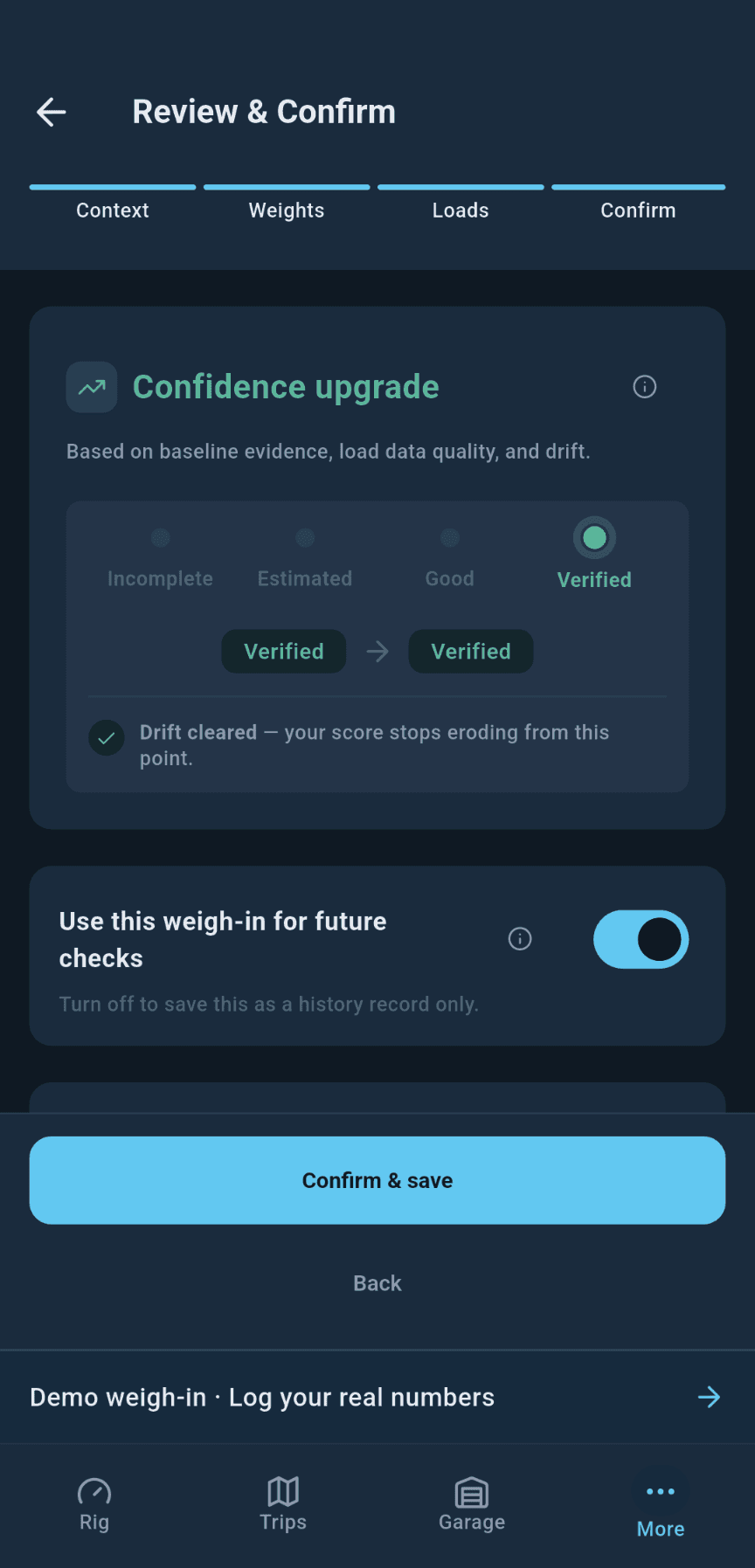
You have just produced real pounds (a truck near its GVWR, an 820 lb tongue, a 6,800 lb trailer), and a printout on the dashboard recalculates none of it the next time you load. The live question is whether your own rig clears its limits on those measured numbers rather than on a spec-sheet guess, and that is the gap between reading the scale and acting on it. Enter the figures from your weigh into loadmate and the check runs on what the rig actually showed: the measured per-axle and gross values, kept with the source context of where the reading came from, with the confidence badge moving from Estimated to Verified as the baseline shifts off a typed-in estimate.
The ticket is the start of a useful baseline. In loadmate, recorded weigh-ins and the loads you add afterwards stay connected, so extra water, a generator or a different packing arrangement can be reviewed against the rig's limits. Explore loadmate in the app to see how a measured day stays useful between scale visits.
loadmate gets you ready for the truck scale, it does not stand in for it. For legal weight evidence, use a certified truck scale. See /safety-disclaimer.
Related guides
The rest of the Wave-1 guides are live; the US vehicle hub is publishing as the US set rolls out. This guide links up to the pillar and across to each sibling:
- Towing weight ratings explained: GVWR, GCWR, GAWR and payload, and which rating binds first (the pillar; start here)
- How to read a CAT scale ticket: turning the printed CAT scale numbers into a pass or a fix, the read half of this pair
- Weight-distribution hitch and front-axle load: reading and restoring the front-axle weight a heavy tongue takes off
- Tongue weight vs payload: how the trailer's tongue weight spends your truck's payload
- Payload vs towing capacity: why the two are different numbers and which one limits your trip
- Trucks whose margins turn on a measured weight: Ford Ranger, Toyota Tacoma, Jeep Wrangler
Turn an estimate into a measured number
Log a CAT scale ticket and loadmate recalculates from your measured weights. The ticket is a snapshot; loadmate tracks what changes after it, so the verified baseline stays useful between weighs. Create a free account to explore it on a populated demo rig in the app.


Frequently asked questions
- How do you weigh a travel trailer at a CAT scale?
Drive on coupled with your steer axle on platform 1, your drive axle on platform 2 and your trailer axle on platform 3, and record the weigh. One drive-through reads all three axle groups. Then pull off, park, unhitch off the scale, and weigh the truck alone. Subtracting the truck-alone weight from the truck's coupled weight gives tongue weight, and the trailer-axle reading plus tongue weight is your full loaded trailer weight.
- How do you get tongue weight at a CAT scale?
Weigh the rig coupled, then weigh the truck by itself after unhitching off the scale, and subtract: the truck's coupled axle weight minus its solo weight is the tongue weight, because that is the part of the trailer carried through the hitch rather than on its own axles. On the worked rig, 6,920 minus 6,100 is 820 lb. If you tow with a weight-distribution hitch, disconnect the spring bars before the truck-alone pass or the reading is off.
- How much does it cost to weigh at a CAT scale?
A first weigh is around $15 and a qualifying reweigh around $5, but prices change, so check catscale.com for the current figure rather than treating these as fixed. A reweigh earns the lower price only with the same vehicle at the same scale within 24 hours and the original ticket presented. The Weigh My Truck app lets you weigh and pay from your phone at no additional charge from CAT Scale.
- Do I need to disconnect the trailer to weigh it?
You weigh the rig coupled first, then unhitch to weigh the truck alone so you can split out trailer weight and tongue weight, but never unhitch on the scale itself. Disconnecting a trailer on a CAT scale platform is prohibited. Pull forward into a trailer space, drop the trailer there, then drive the truck back onto the scale for the second weigh.
- What is a good tongue weight percentage for a travel trailer?
For a travel trailer, tongue weight is generally 10–15% of the total loaded trailer weight. Below about 10% the trailer is prone to sway and fishtailing; much above 15% squats the rear of the truck and lightens the steering. On the worked rig the tongue is 820 lb on a 6,800 lb loaded trailer, which is 12.06% and inside the band.
- How should I load the trailer before weighing (travel-ready)?
Weigh the rig the way you actually travel: full fuel, fresh and gray water as you carry it, all your gear, and passengers and pets aboard. A weigh on an empty or lightly loaded rig will not show the numbers a roadside check or your ratings are measured against. Load it as it leaves for a real trip, then weigh, so the measured pounds reflect the rig you actually tow.
- Where can I weigh my travel trailer near me besides a CAT scale?
CAT scales at truck stops are the common option, and the Weigh My Truck app lets you pay remotely. Alternatives include Escapees SmartWeigh and RVSEF four-corner weighs, which are best for axle and side-to-side balance, plus public landfill, landscaping-supply or moving-company scales. A single-pad scale reads one group at a time, so you need extra passes to split your axles.
- How do I find the GVWR, GAWR and GCWR to compare my weights against?
Read the truck's GVWR and per-axle GAWR off the Safety Compliance Certification Label in the driver's-side door jamb, your payload off the Tire and Loading Information label on the B-pillar, and the trailer's GVWR off its own label. The towing weight ratings pillar guide explains what each rating means; this guide produces the measured weights you check against them.