How much can the RAM 1500 tow?
| Variant | Braked towing capacity | GVM | GCM | Kerb weight | Payload at full tow | Tow ball rating | Rear axle limit |
|---|---|---|---|---|---|---|---|
| Laramie Sport 3.0 Hurricane SOCurrent spec (Jul 2026) | 4,500 kg | 3,505 kg | 7,711 kg | 2,642 kg | 413 kg | 450 kg | 1,860 kg |
| Big Horn Crew Cab 5'7" Tub 5.7 HEMIMY23Med | 4,500 kg | 3,450 kg | 7,713 kg | 2,519 kg | Not published | Not published | 1,860 kg |
| Limited 3.0 Hurricane HOCurrent spec (Jul 2026) | 4,200 kg | 3,505 kg | 7,285 kg | 2,778 kg | 307 kg | 420 kg | 1,860 kg |
| Express Black 3.0 Hurricane SOCurrent spec (Jul 2026) | 4,500 kg | 3,505 kg | 7,711 kg | 2,491 kg | 564 kg | 450 kg | 1,860 kg |
| Laramie Night 3.0 Hurricane SOCurrent spec (Jul 2026) | 4,500 kg | 3,505 kg | 7,711 kg | 2,706 kg | 349 kg | 450 kg | 1,860 kg |
| Rebel 3.0 Hurricane SOCurrent spec (Jul 2026) | 4,500 kg | 3,505 kg | 7,711 kg | 2,624 kg | 431 kg | 450 kg | 1,860 kg |
| Big Horn Crew Cab 6'4" Tub 5.7 HEMIMY23Med | 4,500 kg | 3,450 kg | 7,713 kg | 2,572 kg | Not published | Not published | 1,860 kg |
7 variants
| Braked towing capacity | 4,500 kg |
|---|---|
| GCM | 7,711 kg |
| GVM | 3,505 kg |
| Kerb weight | 2,642 kg |
| Front axle limit | 1,770 kg |
| Rear axle limit | 1,860 kg |
| Tow ball rating | 450 kg |
| ATM planning ceiling | 3,500 kg |
| Wheelbase | 3,672 mm |
The current Australian range has six RAM 1500s, not three
RAM Australia's live showroom and site navigation list Big Horn HEMI, Express Black Hurricane, Rebel Hurricane, Laramie Sport Hurricane, Laramie Night Hurricane and Limited Hurricane High Output. Big Horn is a separately specified HEMI truck still listed for sale after Australian V8 remanufacture ended in December 2024; it should not be treated as an ordinary current-production Hurricane.
All five live Hurricane pages link to the same July 2026 RAM 1500 Hurricane Specifications document. It supplies one coherent five-column table for Express Black, Laramie Sport, Laramie Night, Rebel and Limited High Output, tying each current model page to its exact mass and towing column rather than a rounded summary.
Express is the payload leader at 1,014 kg and 2,491 kg kerb. Laramie Sport is 863/2,642 kg; Laramie Night 799/2,706; Rebel 881/2,624; and Limited 727/2,778. Every subtraction reconciles to the common 3,505 kg GVM. Earlier Limited figures of 2,722 kg kerb and 782.5 kg payload came from the 2025 launch set; the live July 2026 specification supersedes them for the current range.
The current Hurricane ball limits are 450 kg and 420 kg
The same current table rates Express Black, Laramie Sport, Laramie Night and Rebel to 4,500 kg braked on a 70 mm ball, with 450 kg maximum towball downweight. Limited High Output is 4,200 kg and 420 kg. RAM's accessory catalogue states trailer capacity without vertical load, so use the model-page specification for the current unmodified Hurricane and still verify the installed labels at handover.
The hardware condition still matters. RAM lists the heavy-duty towbar on the vehicle and the 50 mm and 70 mm mounts as accessories. Its Hurricane announcement gives Standard Output grades a 3,500 kg tier with the 50 mm setup and the higher 70 mm tier; Limited is 3,500/4,200 kg. A 50 mm AS 4177 ball coupling remains a 3,500 kg-ATM component, and changing only the truck's ball does not upgrade the trailer coupling, drawbar, chains or plate.
RAM's AU/NZ supplement remains the final check for an individual truck. It excludes the generic US trailer-and-hitch table from Australian use and directs owners to the driver-door or towbar label for maximum braked, unbraked and ball loads. For a current unmodified Hurricane, the grade table now supplies the planning value; at handover, photograph the labels, confirm the genuine mount and measure actual loaded ball mass. Non-genuine equipment can introduce a lower component limit.
At maximum tow, the tub limit bites before the headline payload
For Laramie Sport at maximum trailer and ball load, the vehicle side permits 3,505 minus 450, or 3,055 kg before the ball is attached. The combination side permits 7,711 minus 4,500, or 3,211 kg. The lower ceiling wins, so min(3,055, 3,211) minus 2,642 kg kerb leaves 413 kg for the driver, passengers, accessories and cargo, excluding the already counted 450 kg ball. The same method returns 564 kg for Express, 349 for Laramie Night, 431 for Rebel and 307 for Limited.
Those residuals are real but incomplete because RAM adds a grade-specific maximum combined tub and towball load. The caps are 520 kg for Express, 480 for Laramie Sport, 470 for Laramie Night, 500 for Rebel and 460 for Limited. Subtract each maximum ball and the permitted tub load is only 70, 30, 20, 50 and 40 kg respectively. A driver and passengers do not consume that tub sub-limit, but a canopy, drawer, fridge, tools or generator in the bed can.
That is the practical trap in the 4.5-tonne badge. A Laramie Sport can have 413 kg of broad vehicle-side room yet only 30 kg available in the tub at a 450 kg ball. Moving gear into the cab may avoid the tub cap but does not create GVM or axle capacity, and moving it around can change ball and rear-axle load. RAM also says distribution may require the tub or rear limit to be reduced, particularly away from sealed roads, so the published maximums are not an off-road target.
Big Horn is current-listed run-out with two different mass sets
Big Horn HEMI still appears as one of the six trucks in RAM Australia's live 1500 range, with stock and build-price links. Its model page embeds a different RAM 1500 specification, not the Hurricane table. That document gives a 5-foot-7 tub at 2,519 kg kerb and 931 kg payload, and the long 6-foot-4 at 2,572 kg and 878 kg. Both have 3,450 kg GVM, 7,713 kg GCM, 4,500 kg maximum braked towing, and 1,770/1,860 kg axle limits.
The two Big Horns also have different wheelbases: 3,672 mm for the short tub and 3,898 mm for the long tub. Neither RAM's embedded Big Horn table nor its current page publishes maximum towball downweight. The owner's supplement therefore controls this run-out case: use the specific door/towbar label rather than borrowing 450 kg from the newer Hurricane table. Without that verified ball input, no universal full-tow residual can be stated.
The two tub lengths need separate figures. A 2,617 kg secondary test vehicle matches neither official tub configuration, and 1,770 kg is the front axle limit rather than the rear. RAM's own table gives the two exact kerb masses and a 1,860 kg rear limit; the HEMI remains current-listed run-out rather than current Hurricane production.
The rear axle still needs a scale ticket
RAM's July 2026 Hurricane table publishes 1,770 kg front and 1,860 kg rear maxima across all five grades. It publishes 3,672 mm wheelbase but no rear-overhang dimension, so no article or calculator should pretend it can derive a precise ball-load lever from manufacturer geometry. Ball load acts behind the rear axle: it normally adds more than its own mass to the rear while removing some load from the front. Only paired solo and hitched axle weights show the effect on a particular truck.
Two dated owner-scale records show why. A mobile weigher's 2019 DS record moved from 1,220 to 1,650 kg at the rear when a measured 290 kg ball was attached, while the front fell from 1,530 to 1,410 kg. In April 2021, a Caravaners Forum owner reported roughly 369 kg of rear-axle effect from a 260 kg ball. These are older DS examples, not current Hurricane headroom; their influence here is the weigh-first method and the explicit warning not to transfer the DS's 1,770 kg rear limit to a DT.
Current observations point in the same direction. CarsGuide's May 2025 Laramie Sport payload test put 650 kg in the tub plus its driver and measured 60 mm rear-spring compression. Outback Travel Australia's June 2025 report described about 100 mm of settlement with a 200 kg caravan ball. Neither is a certified axle result, but both influenced the advice to record travel-ready front and rear weights instead of judging capacity from ride height or a headline payload.
Two Laramie Sport examples expose the tub-and-ball cap
CarsGuide's June 2022 HEMI Laramie test towed a 4,475 kg tiny house below 80 km/h, recording 30.0 L/100 km and no drivetrain struggle. RV Daily's March 2022 test is closer to a touring caravan: 2,900 kg with 320 kg on the ball, 21.7 L/100 km and composed behaviour around passing trucks and broken surfaces. They show what those older V8 combinations did, not how a Hurricane behaves at its current maximum.
Community discussions add two checks the brochure cannot. A March 2019 discussion repeatedly noted that above 3.5 tonnes every connection component has to carry an adequate marking, not merely the truck's ball. An April–May 2021 thread repeatedly confused DS and DT axle figures. The practical lessons are to check every connection component, keep DS and DT figures separate and never use an old scale ticket as current capacity evidence.
The 2,500 kg and 3,500 kg figures are therefore comparison points, not a suitability band. On Laramie Sport, an exact 10 per cent ball assumption leaves 613/513 kg of broad allowance and 230/130 kg under the separate tub cap. The upper point is RAM's lower coupling tier and the lower point is one tonne lighter; neither is a safety threshold. A current Hurricane may use its published higher tier only when the exact grade, hardware, labels, tub cap, GVM, GCM and both axles all remain within limit.
Upgrades and software cannot erase the RAM-specific limits
Australian second-stage suppliers publish higher GVM, GCM and rear-axle figures for selected 1500 conversions. Touring Solutions Australia, for example, advertises packages from 3,650 kg GVM and 8,150 kg GCM up to 3,999/8,499 kg with a 2,229 kg rear rating. Those are vendor-certified configurations with their own scope and plate. Its tables retain the original 4,500 kg towing ceiling; springs do not increase the coupling, ball-mount or trailer rating.
The RAM's combined tub-and-ball cap also needs explicit treatment after an upgrade. Do not assume a revised GVM plate automatically replaces the factory 520/480/470/500/460 kg limit: obtain the second-stage approval's written treatment of that sub-limit. A standard 3,450 or 3,505 kg RAM remains within Australia's 4.5-tonne GVM class-C threshold, but an upgrade can change the licence question. Check the revised plate and the authority where the truck is driven.
For used DTs, federal recall REC-006127 covers 13,343 vehicles built in 2023–24 whose ABS software fault may disable electronic stability control; check the VIN and remedy status. The current ROVER register separately records Hurricane-powered DT eligibility in NA and NB1 categories from February 2024. Those entries establish federal pathway and scope, not grade masses: RAM's current embedded specification and the individual vehicle plate remain the numerical sources.
Model the RAM twice: normal limits, then the tub-and-ball cap
A RAM's broad tub can hide how much of its carrying capacity the touring load has used. Get the loadmate app to put your truck's exact grade limits beside its measured solo axle weights, travel ball mass and recorded accessories. For a Hurricane, run the normal GVM/GCM/axle result and separately compare tub cargo plus ball mass with the grade's 520/480/470/500/460 kg cap. That cap is not interchangeable with payload and should remain a visible manual check until a dedicated field models it.
At the weighbridge, capture front and rear truck axles and the trailer axle group in travel trim. A permitted, correctly adjusted weight-distribution hitch may restore some front load, but cannot raise towball, GVM, GCM, axle or tub-and-ball limits. The weighbridge guide gives the sequence, while the Live Rig Score explains how loadmate tracks changing margins rather than treating one green result as permanent.
Different limits can stop the same pairing. A lightly equipped Express may retain 564 kg outside the ball at full tow but still have only 70 kg of tub allowance. A Laramie Night has 349 kg broad residual and 20 kg for the tub. Record both, then use the lower relevant margin for the load you are actually adding. loadmate does not certify an unmarked part or replace the vehicle plate, supplement or a certified scale.
Check the tub before the 4.5-tonne badge
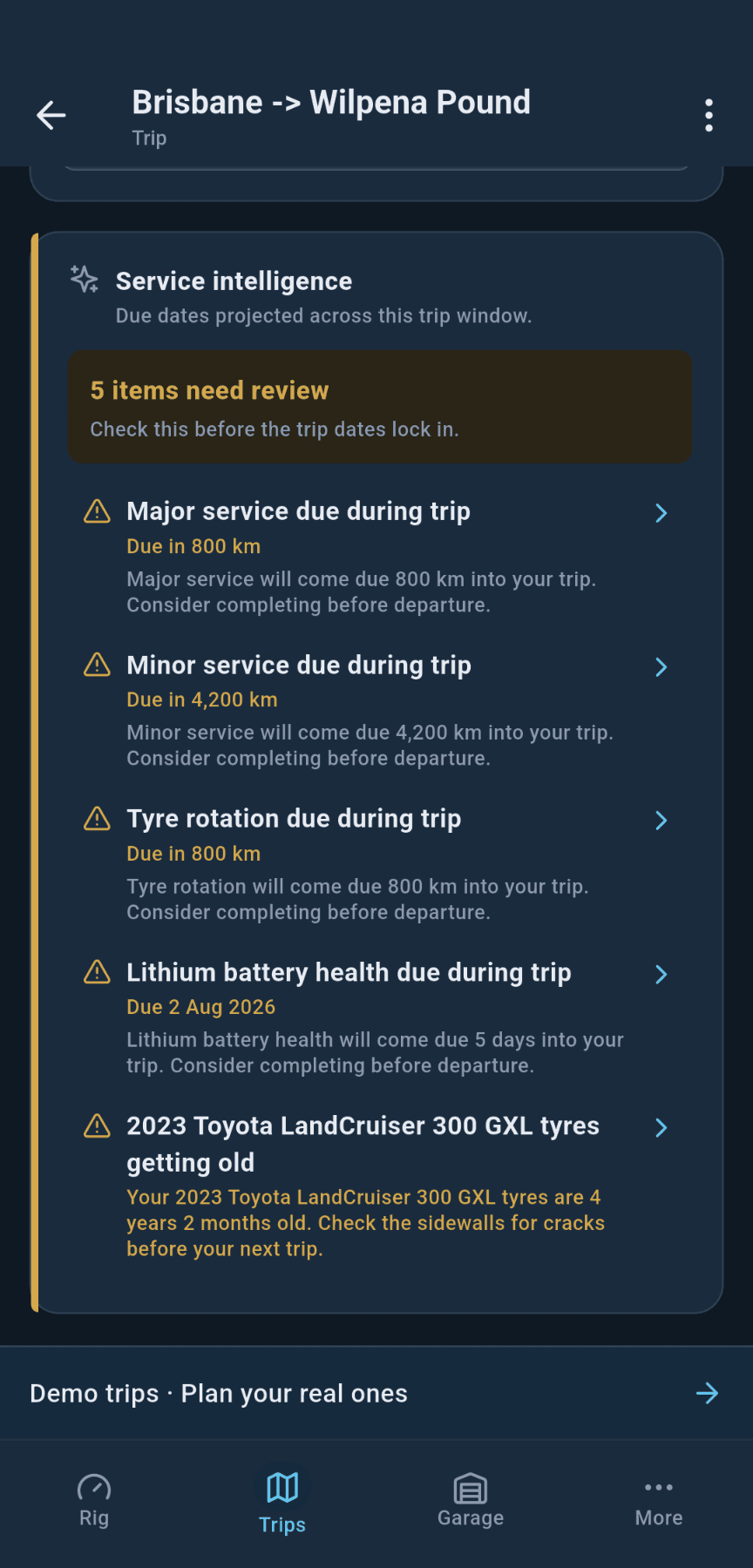
RAM's current Hurricane table publishes 450 or 420 kg ball limits, then adds a combined tub-and-ball cap. At maximum ball, only 20–70 kg remains for the tub across the five grades. loadmate can project service intervals, tyre dates, the hitch setup and the age of the last weigh-in across a planned trip, while that factory tub cap stays an explicit grade-specific check. Explore the checks together on the app’s populated demo rig.


Common questions
- How much can a RAM 1500 tow in Australia?
Current Express Black, Laramie Sport, Laramie Night and Rebel Hurricane grades are rated to 4,500 kg braked on a 70 mm ball. Limited High Output is 4,200 kg. RAM's current-listed Big Horn HEMI is also rated to 4,500 kg, but uses a separate specification and fitted-label ball check.
- What is the RAM 1500 maximum towball weight?
RAM's July 2026 Hurricane specification publishes 450 kg for Express Black, Laramie Sport, Laramie Night and Rebel, and 420 kg for Limited High Output. Big Horn's separate embedded table does not publish a ball maximum, so read its driver-door or towbar label rather than borrowing the Hurricane value.
- How much payload remains while towing 4,500 kg?
Using RAM's maximum 450 kg ball and the house GVM/GCM formula, Express retains 564 kg above kerb, Laramie Sport 413 kg, Laramie Night 349 kg and Rebel 431 kg for people, accessories and cargo. Their separate combined tub-and-ball caps leave only 70, 30, 20 and 50 kg in the tub.
- Why can a RAM have payload left but almost no tub capacity?
Payload is the broad GVM-minus-kerb allowance. RAM additionally publishes a maximum combined tub and towball load for each Hurricane grade. At maximum ball, that sub-limit leaves only 20–70 kg for actual tub load even though some broad payload remains available for occupants and equipment elsewhere in the truck.
- Does a RAM 1500 come with both 50 mm and 70 mm tow balls?
Do not assume so. The current Hurricane specification lists both mount sizes as accessories. The 50 mm setup carries the lower 3,500 kg tier; the higher grade-specific tier requires the approved 70 mm setup. Inspect the truck, invoice, labels and every trailer-side component before relying on either rating.
- Can a GVM upgrade increase RAM 1500 towing capacity?
Only within the exact second-stage approval. Published RAM 1500 packages can raise GVM, GCM or rear-axle ratings but retain the original 4,500 kg towing ceiling. Obtain written treatment of RAM's combined tub-and-ball cap too; a revised GVM plate does not automatically cancel that separate factory limit.
Understand the weight limits
Every figure above is governed by a manufacturer-set limit. These guides explain what each term means and how they fit together.
- Caravan & towing weights explainedThe master glossary: GVM, ATM, GTM, TBM and GCM in one place.
- Gross Combination Mass (GCM)The combined vehicle-plus-trailer ceiling that usually bites first.
- Aggregate Trailer Mass (ATM)What your caravan is legally allowed to weigh, fully loaded.
- Braked towing capacityWhy a 3,500 kg rating rarely means you can tow 3,500 kg.
Sources and review
Specifications checked
Page reviewed
- RAM Trucks Australia — live Australian 1500 range (read 10 August 2026)
The current six-product 1500 listing: Big Horn HEMI V8, Express Black Hurricane, Rebel Hurricane, Laramie Sport Hurricane, Laramie Night Hurricane and Limited Hurricane High Output. This is the range-completeness authority; Big Horn links to a separate HEMI table
- RAM Trucks Australia — current RAM 1500 Hurricane Specifications (July 2026)
Every live Hurricane model page exposes this same document through View Specifications (iframe G721pSoDK690ZyYH). PDF metadata records creation 26 June and modification 1 July 2026. Its exact five-column table publishes GVM, GCM, kerb, payload, 4,500/450 kg on Express/Laramie Sport/Laramie Night/Rebel, 4,200/420 kg on Limited, common 1,770/1,860 kg axle maxima, 3,672 mm wheelbase, and combined tub-and-ball limits 520/480/470/500/460; it has no rear-overhang row
- RAM Trucks Australia — Express Black Hurricane
Current Australian grade identity and official provenance route for the shared July 2026 View Specifications document; the page also publishes 1,014 kg payload and the 520 kg combined tub-and-ball cap
- RAM Trucks Australia — Laramie Sport Hurricane
Current Australian grade identity and official provenance route for the shared July 2026 View Specifications document
- RAM Trucks Australia — Laramie Night Hurricane
Current Australian grade identity and official provenance route for the shared July 2026 View Specifications document
- RAM Trucks Australia — Rebel Hurricane
Current Australian grade identity and official provenance route for the shared July 2026 View Specifications document
- RAM Trucks Australia — Limited Hurricane High Output
Current Australian grade identity and official provenance route for the shared July 2026 View Specifications document
- RAM Trucks Australia — RAM 1500 Specifications - 2023 (current-listed Big Horn embedded document)
The separate 5'7 and 6'4 Big Horn rows: kerb 2,519/2,572, payload 931/878, GVM 3,450, GCM 7,713, tow 4,500, axles 1,770/1,860, length 5,916/6,142 and wheelbase 3,672/3,898. The table has no ball-downweight or rear-overhang row
- ROVER — RAM 1500 Hurricane DT Specialist and Enthusiast Vehicle eligibility, NA
The federal NA-category eligibility record for Hurricane-powered DT vehicles, with build range from February 2024. It establishes pathway and scope only, not grade masses
- ROVER — RAM 1500 Hurricane DT Specialist and Enthusiast Vehicle eligibility, NB1
The federal NB1-category eligibility record for Hurricane-powered DT vehicles, with build range from February 2024. It establishes pathway and scope only, not grade masses
- RAM Trucks Australia — Hurricane turbo six-cylinder power arrives Down Under (21 March 2025)
Historical launch context: both certified trailer tiers by ball size, Hurricane engine outputs and the statement that the first Hurricane grades went on sale alongside HEMI stock. Its launch mass set is superseded by the current July 2026 embedded specification wherever the figures differ
- RAM Trucks Australia — 1500 Big Horn Crew Cab model page (read 10 August 2026)
The current-listed MY23 Big Horn identity, fitment warning for the 4,500 kg maximum and official provenance route for its separate embedded specification. That table supplies both 5-foot-7 and 6-foot-4 mass sets while omitting a ball maximum
- RAM Trucks Australia — current 1500 Rebel Hurricane accessories, tow ball mount kits (read 10 August 2026)
The current genuine part identities and trailer tiers: RAM-15L-205503 is the 50 mm / 3.5-tonne kit and RAM-15L-205504 the 70 mm / 4.5-tonne kit. The current Hurricane specification separately supplies the vehicle-side 450/420 kg ball limits; fitted labels and coupling compatibility still govern the individual setup
- RAM Trucks Australia — Key Precautions, Payload & Towing Guide and Towing FAQ (read 9 August 2026)
RAM Australia's instruction to check the towbar label for maximum braked and unbraked towing weights and ball weight; its definition of payload as including towball download; and its instruction that the loaded vehicle and trailer must stay within GCM. The current AU/NZ supplement supplies the fuller label-authority rule
- RAM Trucks Australia — owner's manuals hub
The current manufacturer provenance route for the Australian/New Zealand supplement and the 2025 owner manual
- RAM Trucks Australia — Australian/New Zealand owner's supplement
The Australian-specific instruction that installed driver-door and towbar labels control payload and towing, and that the generic US hitch and maximum-trailer table does not apply to Australian vehicles. It is the individual-vehicle check beside, not a substitute for, RAM's current Hurricane grade table
- National Heavy Vehicle Regulator — Vehicle Standards Guide 16: 50 mm ball couplings (3 July 2024)
The regulatory mechanism behind the two tiers: under ADR 62, 50 mm ball couplings for trailers up to 3,500 kg ATM must comply with Australian Standard AS 4177, and a 50 mm ball coupling is designed to a D-value based on a maximum towing vehicle mass of 5,000 kg and a maximum trailer mass of 3,500 kg — a rating computed from two masses rather than one vehicle's
- Transport WA — driver licence classes
Primary state-regulator example that class C covers a motor vehicle up to 4.5 tonnes GVM; the article asks readers to confirm local conditions after any re-rating
- CarExpert — 2025 RAM 1500 price and specs (William Stopford, 24 August 2025)
The historical 2025 launch-set cross-check: 2,642 kg Laramie Sport kerb and the earlier 2,722 kg / 782.5 kg Limited mass pair. The release article explicitly records that RAM's July 2026 table supersedes the earlier Limited values
- CarsGuide — RAM 1500 Laramie Sport GVM test (Mark Oastler, 19 May 2025)
Independent confirmation of the 2,642 kg Laramie Sport kerb and both trailer tiers. Its measured load test put 650 kg in the tub plus the driver and recorded 60 mm rear-spring compression with bump-stop clearance remaining; that observation is used in the article's weigh-first axle advice
- CarsGuide — RAM 1500 Laramie towing test at 4,475 kg (Matt Campbell, 2 June 2022)
CarsGuide's June 2022 HEMI test used a 4,475 kg load, about 9 metres long and 4.5 metres tall, recording 30.0 L/100 km at the pump below 80 km/h against 13.8 solo, with no reported drivetrain struggle. It is an older HEMI test, not Hurricane proof
- Outback Travel Australia — RAM 1500 buyers guide (Allan Whiting, 5 June 2025)
The dated Australian rear-suspension observation used as supporting detail — about 100 mm of rear settle at a 200 kg caravan ball weight, with reduced rear spring travel and ride quality, and weight distribution bars called essential above roughly 150 kg on the ball — and towing fuel consumption of 17.5 to 19 L/100 km
- RV Daily — should 200 Series owners be trading for a RAM 1500? (6 March 2022)
A real Australian caravan tow at 2,900 kg on a 320 kg ball — 21.7 L/100 km towing against 9.7 solo on the freeway — and the stability read that passing trucks and uneven surfaces do not upset the combination
- Caravaners Forum — towing over 3.5 tonnes
March 2019 community discussion that raises the component-by-component marking issue; regulator and manufacturer sources carry the rule
- Caravaners Forum — RAM owner axle weigh
One 27 April 2021 older-DS owner example: roughly 369 kg rear-axle effect from 260 kg ball; not current-Hurricane headroom
- Caravaners Forum — DS/DT axle discussion
April–May 2021 generation-confusion pattern; the current RAM table, not the forum, supplies the limits
- Check Weight — RAM 1500 axle example
Dated older-DS scale example: 290 kg ball moved rear load from 1,220 to 1,650 kg and front from 1,530 to 1,410 kg; used only for the paired-weigh method
- 4X4 Australia — RAM 1500 Express Black Edition MY26 (Tristan Tancredi, 15 May 2026)
Independent corroboration of Express Black's 1,014 kg payload, 3,505 kg GVM, 7,711 kg GCM, two trailer tiers and 520 kg combined tub-and-ball cap. RAM's July 2026 table is the primary source and publishes the corresponding cap for every Hurricane grade
- CarExpert — RAM rules out Hemi V8 comeback as Australia commits to the new Hurricane era (Alborz Fallah, 31 October 2025)
RAM Trucks Australia's dated position that there is no plan to reintroduce the 5.7 Hemi to Australia even though the engine returned globally for MY26 — the currency peg for treating the Big Horn V8 as run-out stock rather than a current model
- CarExpert — final V8-powered RAM 1500 rolls off the Australian production line (Jordan Mulach, 10 December 2024)
The 6 December 2024 date on which the last V8 RAM 1500 was remanufactured in Australia, and the fact that it was the 28,495th and final Hemi V8 model built here
- Touring Solutions Australia — RAM 1500 GVM and GCM upgrades (read 9 August 2026)
A second-stage manufacturer's own published upgrade ladder for the 1500 — 3,650 kg GVM with an 8,150 kg GCM, rising through staged kits to 3,999 kg GVM and 8,499 kg GCM with the rear axle re-rated to 2,229 kg — scoped as federally approved for pre-registration fitment to American Special Vehicles imports, and, critically, leaving the braked towing figure at 4,500 kg through every stage. Commercially motivated vendor figures, named and dated on the page and treated as Medium confidence
- Vehicle Recalls Australia — REC-006127, RAM 1500 (DT) ABS control module
The recall covering 13,343 Australian RAM 1500 DT vehicles built 2023-2024 whose ABS control module software fault may cause the electronic stability control to fail, with a possible loss of vehicle control, and the free software update remedy
- Department of Infrastructure — VSB 1 Revision 6 (July 2025)
Current federal trailer-construction guidance retained for reference: above 750 kg GTM requires service brakes; over-run activation is permitted only through 2,000 kg GTM; above 2,000 kg GTM brakes operate on every wheel and breakaway applies immediately for at least 15 minutes. Except for over-run systems, activation uses a control signal generated by the tow vehicle. The RAM article makes no separate trailer-brake-law claim.