How much can the Ford F-150 tow?
| Variant | Braked towing capacity | GVM | GCM | Kerb weight | Payload at full tow | Tow ball rating | Rear axle limit |
|---|---|---|---|---|---|---|---|
| XLT SWB 3.5 EcoBoostMY26Med | 4,500 kg | 3,315 kg | 7,365 kg | 2,462 kg | 403 kg | 450 kg | 1,882 kg |
| Lariat SWB 3.5 EcoBoostMY26Med | 4,500 kg | 3,315 kg | 7,365 kg | 2,546 kg | 319 kg | 450 kg | 1,882 kg |
| XLT LWB 3.5 EcoBoostMY26Med | 4,500 kg | 3,360 kg | 7,410 kg | 2,482 kg | 428 kg | 450 kg | 1,882 kg |
| Lariat LWB 3.5 EcoBoostMY26Med | 4,500 kg | 3,360 kg | 7,410 kg | 2,566 kg | 344 kg | 450 kg | 1,882 kg |
| Platinum SWB 3.5 EcoBoostMY26Med | 4,500 kg | 3,315 kg | 7,365 kg | 2,611 kg | 254 kg | 450 kg | 1,882 kg |
| Platinum LWB 3.5 EcoBoostMY26Med | 4,500 kg | 3,360 kg | 7,410 kg | 2,636 kg | 274 kg | 450 kg | 1,882 kg |
6 variants
| Braked towing capacity | 4,500 kg |
|---|---|
| GCM | 7,365 kg |
| GVM | 3,315 kg |
| Kerb weight | 2,462 kg |
| Front axle limit | 1,565 kg |
| Rear axle limit | 1,882 kg |
| Tow ball rating | 450 kg |
| ATM planning ceiling | 3,500 kg |
| Wheelbase | 3,697 mm |
The current Australian range has six F-150 configurations
Ford Australia currently sells XLT, Lariat and Platinum in short- and long-wheelbase SuperCrew 4x4 form. Every one uses the 3.5-litre twin-turbo EcoBoost V6 at 298 kW and 678 Nm with a 10-speed automatic. US-market V8, PowerBoost hybrid and Lightning figures do not belong on this page. Platinum joined the local range with the October 2025 update, so pages describing Lariat as the flagship or a two-grade range are stale.
The federal record provides a strong current anchor. ROVER lists Ford Australia's VTA-062561 as in force, most recently issued in January 2026, with all six variants. The RVD gives 3,315 kg GVM on short-wheelbase models, 3,360 kg on long, and 4,500 kg braked/750 kg unbraked throughout. It also confirms overall lengths of 5,908 and 6,208 mm on wheelbases of 3,697 and 3,997 mm, which is why the long truck is not merely a trim package.
ROVER publishes tare masses from 2,368 kg for an XLT SWB to 2,542 kg for a Platinum LWB. Do not substitute them for the retail kerb table: tare and kerb use different fuel/load conventions. The October 2025 Australian update supplies the coherent kerb/payload set used for touring calculations—2,462/2,482 kg XLT, 2,546/2,566 kg Lariat and 2,611/2,636 kg Platinum, short then long.
Why the current GCM is 7,365 kg or 7,410 kg—not 7,720 kg
Three Australian combined-mass sets circulate. The launch trucks were advertised at 7,720 kg SWB and 7,765 kg LWB. On 24 September 2024 Ford Australia reduced both by 450 kg—to 7,270/7,315 kg—to account for maximum towball downforce, defined in its statement as ten per cent of trailer ATM. Ford said GVM, payload and maximum braked towing were unchanged. In October 2025, GVM and GCM each rose 95 kg, creating today's 3,315/7,365 kg and 3,360/7,410 kg pairs.
The arithmetic left by those announcements is consistent: current GCM equals GVM plus 4,050 kg on both wheelbases. At a 4,500 kg trailer and 450 kg maximum ball load, the vehicle-side allowance is GVM less 450 and the combined side is GCM less 4,500; both arrive at exactly 2,865 kg SWB or 2,910 kg LWB. That equality is an inference from Ford's published numbers, not a claim that GCM ceases to matter.
At full trailer mass, a lighter measured ball does not create extra vehicle allowance in this model because the GCM side stays fixed at 2,865/2,910 kg. It may change axle loading and trailer balance, which remain critical. At lighter trailer masses the GVM side usually takes over: an XLT SWB at 3,500 kg ATM with a planning ball of 350 kg keeps 503 kg, while 3,000/300 kg keeps 553 kg. Use actual loaded ATM and ball mass rather than forcing ten per cent.
XLT carries the most at full tow; Platinum carries the least
Subtract each kerb mass from the equal full-tow vehicle allowance and the grade ladder runs opposite the price list. XLT leaves 403 kg SWB and 428 kg LWB. Lariat leaves 319/344 kg. Platinum leaves 254/274 kg. Every remainder covers all occupants, fitted accessories and tub cargo; none sits on top of the brochure payload.
The long wheelbase gains 45 kg of GVM and GCM. Its extra body mass consumes 20 kg in XLT and Lariat or 25 kg in Platinum, leaving a net full-tow advantage of 25, 25 or 20 kg. That 20–25 kg is the entire extra full-tow headroom created by choosing the long wheelbase after its additional body mass is counted. The 319–344 kg Lariat and 254–274 kg Platinum allowances must cover the occupants' and accessories' actual measured masses before any tub load is added; no generic family or accessory weight is assumed.
The 450 kg towball figure and 70 mm/4,500 kg setup come from Ford-attributed Australian conversion specifications and repeated local specifications; Ford's live overview now says only up to 4,500 kg. Dated Ford material says the optional 50 mm ball reduces towing to 3,500 kg. Inspect the individual towbar and ball labels before relying on either tier, especially after hardware replacement.
Ford's current official pages and RVD do not publish a complete maximum-axle table or an as-delivered front/rear split. A secondary Australian specification database lists 1,565 kg front and 1,882 kg rear for short-wheelbase trucks, with different front limits on long models. Those values remain Medium confidence. The plate and a split weighbridge ticket outrank the database wherever the margin is close.
The cited Australian tow tests stop at 3,500 kg, below the badge
Caravan World's October 2024 test paired a Lariat SWB with a Wonderland caravan rated at 3,500 kg ATM and about 180 kg on the ball. It covered roughly 3,000 km over 12 days from Adelaide through the Flinders Ranges to Melbourne. The reviewer said the truck never fussed and traction was not an issue, while fuel sat in the early-to-mid 20s L/100 km on open roads and higher on dirt and hills. That is substantial testing, but still a tonne below the headline rating.
Two other measured records show how conditions change the result. Caravan World recorded 20.6 L/100 km over 602 km behind a 2,806 kg Jayco with roughly 200 kg on the ball in August 2024. carsales used a 3,100 kg van the following month, returned 24.5 L/100 km, measured only 5 mm front rise and 10 mm rear drop, yet described a firm ride and a slight sense of the caravan pushing the truck without swaying. One dissenting March 2024 report described about 100 mm of rear settlement from a 180 kg ball behind a 2-tonne van. The methods differ, so the honest conclusion is to measure the real setup rather than choose the nicer observation.
A May 2026 updated-truck assessment adds the payload warning. Caravan World put a roughly 3-tonne horsebox behind a Platinum and recorded about 18 L/100 km. Its author also worked through a 400 kg ball example at a 4.5-tonne van and described only about 300 kg remaining, close to the 254–274 kg result from the current maximum-load inputs. No cited Australian test measured a full 4,500 kg caravan behind the current truck.
Those dated reviewer rows provide context, not a universal recommendation. They show stable behaviour in several combinations, the cited May 2026 assessment's payload warning, fuel in roughly the high teens to mid-20s and conflicting rear-settlement observations. The 2,500 kg and 3,500 kg XLT calculations are transparent comparison points: at an exact 10 per cent ball assumption they leave 603/503 kg SWB and 628/528 kg LWB. A certified rating permits a configuration; it does not reproduce a road test for the actual van.
Trailer brakes are standard—and a current recall concerns their module
Australian F-150s carry an integrated trailer-brake controller, a 12-pin connection and trailer-assist functions. Australia's braked-towing rules set the trailer-side baseline in GTM: above 750 kg a trailer needs service brakes; over-run activation is permitted only through 2,000 kg; and above 2,000 kg the brakes must act on every wheel, with breakaway applying immediately and holding for at least 15 minutes. Except for over-run systems, the braking signal comes from the tow vehicle. GTM is the mass carried by the trailer wheels, not ATM. A caravan in either worked example needs a compatible, working system.
Recall REC-006590, campaign 26C10, was published on 22 April 2026 and covers 6,832 Australian F-150s across model years 2021–26. The regulator says a software defect can make the Trailer Module lose communication while a trailer is connected, potentially causing loss of trailer braking performance and turn indicators. Ford's remedy is a free software update. Check the VIN rather than assuming model year alone proves completion.
A second used-buyer check is REC-006408, published in August 2025 for 6,415 vehicles from 2023–25. Rear hub bolts may loosen or break, damaging axle or hub splines and potentially causing loss of motive power or vehicle movement while in park; the Australian record says all variants. Neither recall changes the certified masses after remedy. Both belong in a pre-trip ownership check because one concerns the factory trailer module and the other load-bearing rear hardware.
A GVM upgrade can add payload, but its own certification governs
Several Australian second-stage suppliers advertise F-150 GVM/GCM packages. BAW's published ORI stages include 3,700 kg GVM with 8,200 kg GCM and a higher 4,300/8,800 kg stage, certified under the supplier's VTA and retaining towing up to 4.5 tonnes. These are vendor figures and do not describe an unmodified Ford.
On the vendor's first stage, the XLT SWB full-tow calculation becomes min(3,700 − 450, 8,200 − 4,500) less 2,462, or 788 kg. On the 4,300/8,800 stage it is 1,388 kg. Both assume the base kerb has not changed, which a real suspension, wheel and tyre package will disprove by some amount; use the upgraded vehicle's measured mass and revised plate. No example raises the 4,500 kg coupling ceiling.
Licensing remains a plate question. Transport WA describes class C as covering a motor vehicle up to 4,500 kg GVM, matching the national licence-class framework. Every factory F-150 is well below that point. A 4,300 kg vendor stage is also below it, but leaves little room for a later re-rating; confirm the local licence and registration treatment rather than carrying a generic state claim across jurisdictions.
The useful F-150 decision is grade and tub load, not engine choice
There is one local engine, one maximum tow rating and six payload outcomes. For a buyer who needs a loaded tub, XLT LWB is the strongest factory starting point at 428 kg behind a full trailer. The same caravan behind a Platinum SWB has 174 kg less room. If the build includes a canopy, drawers and auxiliary battery before people, calculate those permanent items before choosing the grade.
An F-150's occupants, tub load and accessories still share a finite payload with the van's ball mass. Get the loadmate app to bring those recorded loads and your truck's ratings together, then see what changes when you pack differently. The next step is a split weigh in travel trim: front axle, rear axle and trailer axle group, with the same occupants, water and tub load used on the trip. That resolves the Medium-confidence axle-data gap and catches the load transfer a total-only ticket hides.
After that baseline, loadmate keeps the grade's 254–428 kg allowance beside each change to people and tub load, recalculating the vehicle and combination ceilings together. It does not turn Ford's badge into legal evidence or certify a vendor upgrade. Read how the Live Rig Score is built and the safety disclaimer; the compliance plate and certified weighbridge ticket remain authoritative, and towing remains the driver's responsibility.
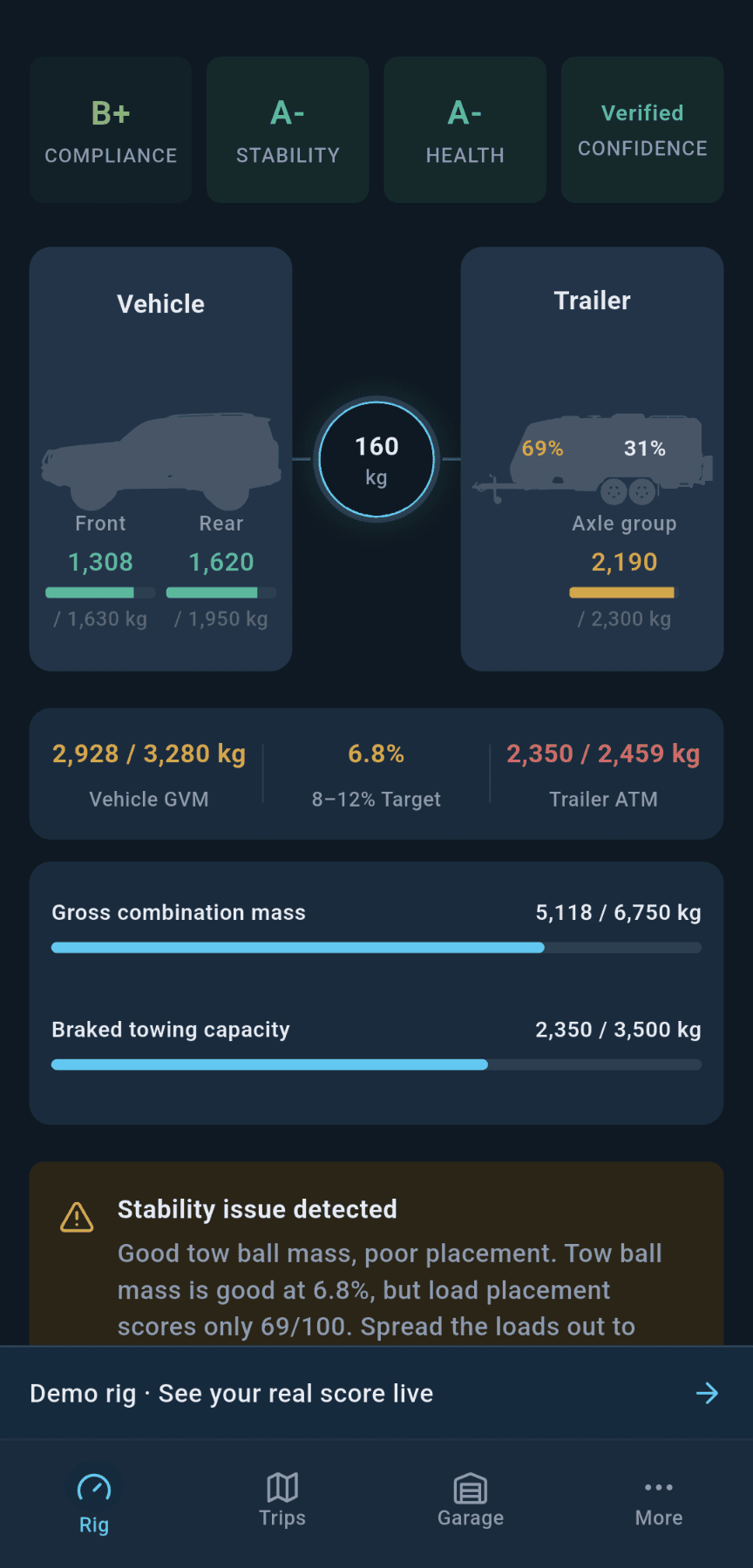
Start from the plate on your own F-150
Payload at full tow runs from 254 kg to 428 kg across the six F-150s on sale here, so the only starting figure worth loading against is the one certified on the truck you own. loadmate keeps gross vehicle mass, the combined figure and the rear axle updating together as weight goes in, which is when a 174 kg spread between grades stops being trivia and starts deciding what fits in the tub. Record the accessories and gear you add, then see which margin tightens first.


Common questions
- Does an Australian Ford F-150 tow 4,500 kg or 3,500 kg?
Ford's current range is rated up to 4,500 kg braked and 750 kg unbraked. Dated Ford-attributed Australian specifications pair 4,500 kg with the 70 mm ball and a 450 kg maximum towball load, while the optional 50 mm ball is 3,500 kg. Inspect the fitted towbar and ball labels on the individual truck.
- How much payload is left when an F-150 tows 4,500 kg?
XLT leaves 403 kg SWB or 428 kg LWB. Lariat leaves 319/344 kg and Platinum 254/274 kg. Those figures use the current 3,315/3,360 kg GVM, 7,365/7,410 kg GCM, 450 kg ball limit and October 2025 kerb table, and must cover everyone, accessories and tub cargo.
- Why did Ford reduce the F-150 GCM by 450 kg?
Ford Australia said in September 2024 that the change accounted for maximum towball downforce—ten per cent of trailer ATM—and that GVM, payload and maximum braked towing stayed unchanged. The October 2025 update then added 95 kg to both GVM and GCM. Current figures are 7,365 kg SWB and 7,410 kg LWB.
- Which F-150 is best for towing a caravan?
XLT LWB has the largest current factory full-tow allowance at 428 kg, followed by XLT SWB at 403 kg. Grade equipment makes Lariat and Platinum heavier. Choose from actual people, permanent tub build and axle weights; wheelbase adds only 20–25 kg of net full-tow room within each grade.
- Is my F-150 in the trailer-brake recall?
Check the VIN against REC-006590. The April 2026 recall lists 6,832 Australian vehicles across model years 2021–26 for Trailer Module software that may cause loss of trailer braking performance and turn signals while connected. The remedy is a free Ford dealer software update.
- Do I need a truck licence for a Ford F-150?
A factory F-150 at 3,315 or 3,360 kg GVM is within the Australian class C ceiling of 4.5 tonnes GVM. Re-check the revised plate after any GVM upgrade and confirm local licence conditions. Trailer ATM, braking and registration requirements are separate from the tow vehicle's licence class.
Understand the weight limits
Every figure above is governed by a manufacturer-set limit. These guides explain what each term means and how they fit together.
- Caravan & towing weights explainedThe master glossary: GVM, ATM, GTM, TBM and GCM in one place.
- Gross Combination Mass (GCM)The combined vehicle-plus-trailer ceiling that usually bites first.
- Aggregate Trailer Mass (ATM)What your caravan is legally allowed to weigh, fully loaded.
- Braked towing capacityWhy a 3,500 kg rating rarely means you can tow 3,500 kg.
Sources and review
Specifications checked
Page reviewed
- Ford Australia — current F-150 model page (read 10 August 2026)
Current primary confirmation of up to 4,500 kg braked towing, the XLT/Lariat/Platinum range and the 3.5-litre EcoBoost at 298 kW and 678 Nm. The page omits the complete GVM/GCM/kerb/ball table and the optional 50 mm / 3,500 kg field, so it does not upgrade those detailed claims
- Ford Australia — owner-manual sitemap
The live manufacturer route to Australian F-150 owner-manual pages, disproving the former claim that Ford publishes no local documentation
- Ford Australia — 2024 F-150 owner manuals
Public Australian owner-manual availability for the earlier local model; useful for operating instructions but not treated as the current MY26 mass table
- Ford Australia — body-equipment manuals
The official route to Ford's Australian F-150 body-builder layout book and body-equipment specification sheet; these are dated engineering references, not current MY26 mass proof
- Australian Government ROVER — current Ford F-150 approval VTA-062561
The in-force Australian approval issued 22 January 2026 and its current category and holder
- Australian Government ROVER — VTA-062561 current RVD variants
All six current Australian XLT, Lariat and Platinum wheelbase variants, 3,315/3,360 kg GVM, 4,500/750 kg tow, engine and geometry. ROVER tare is an approval convention and is not substituted for the coherent kerb table used in the article's payload arithmetic
- CarExpert — Ford F-150 hauling figures cut to prevent overloading (Jordan Mulach, 24 September 2024)
The documentary anchor for this page: Ford Australia's own statement that it reduced the published gross combination mass of the F-150 line-up to account for the maximum tow-ball downforce weight, defined as a tenth of the trailer's aggregate trailer mass, together with its statement that the vehicle itself and every other weight — gross vehicle mass, payload and maximum braked towing capacity — were unchanged. Also the two revised figures: short wheelbase 7,720 to 7,270 kg and long wheelbase 7,765 to 7,315 kg, dated 24 September 2024
- carsales — Updated 2026 Ford F-150 pricing and specs announced (Callum Hunter, 23 October 2025)
The October 2025 table publishes the complete coherent mass set for all six current configurations: GVM 3,315 kg short wheelbase and 3,360 kg long, GCM 7,365 kg and 7,410 kg, kerb weights 2,462 / 2,482 / 2,546 / 2,566 / 2,611 / 2,636 kg and payloads 853 / 878 / 769 / 794 / 704 / 724 kg across XLT, Lariat and Platinum. It also records that GVM and GCM each rose 95 kg and Platinum joined the range
- CarExpert — 2026 Ford F-150 price and specs (Damion Smy, 26 October 2025)
Independent same-week confirmation of the updated GVM and GCM ranges and of the three-grade, six-configuration line-up, published three days after the carsales table
- CarExpert — 2026 Ford F-150 review (James Wong, 26 March 2026)
Independent publication of the current Australian mass set — GVM 3,315-3,360 kg, GCM 7,365-7,410 kg, kerb 2,462-2,636 kg and payload 704-878 kg — plus the 3.5-litre EcoBoost's 298 kW and 678 Nm
- CarExpert — Ford F-150 XLT and Lariat specification database, exterior and dimensions (read 10 August 2026)
The secondary database publishes the Australian F-150 axle-limit ladder: 1,565 kg front on any short wheelbase, 1,633 kg on the XLT long wheelbase, 1,701 kg on the Lariat and Platinum long wheelbase, and 1,882 kg rear on all six. It labels the fields Front/Rear Axle Weight rather than maximum permissible axle mass, so the article keeps these Medium confidence and requires an individual plate and split weigh
- Caravan World — Tow test: Ford F-150 Lariat SWB, over 3,000 km (Tim van Duyl, 11 October 2024)
Caravan World's October 2024 test used a Wonderland RV Amaroo 2100 at 3,500 kg ATM and 8.6 metres, about 180 kg on the ball, driven Adelaide to the Flinders Ranges to Melbourne over 12 days. It records towing consumption in the early-to-mid 20s L/100 km on open roads and mid-to-high 20s on dirt and hills, with no traction issue reported
- Caravan World — Tow test: Ford Australia F-150 XLT LWB (Tony O'Kane, 14 August 2024)
A measured 20.6 L/100 km over 602 km towing a 2,806 kg Jayco at about a 200 kg ball weight, against roughly 9.5 L/100 km unladen on the highway, and the pre-update XLT LWB spec box carrying a 450 kg maximum tow ball
- Caravan World — REVIEW: 2026 Ford F-150 update and first drive (John Ford, 1 May 2026)
Caravan World's May 2026 updated-truck assessment says a 400 kg ball weight from a 4.5-tonne van leaves a Platinum about 300 kg to play with. It also records 18 L/100 km behind a 3-tonne horsebox and the standard towing hardware list — integrated trailer brake controller, Pro Trailer Backup Assist, trailer light check and a 12-pin socket
- carsales — Ford F-150 XLT 2024 tow test (Philip Lord, 15 September 2024)
A measured tow at 3,100 kg behind an XLT SWB: 24.5 L/100 km, 5 mm of front-axle lift and 10 mm of rear drop when hitched (both far inside the 30 mm the tester flags as a concern), a ride on the firm side with the van on, and a sense of the caravan pushing the truck around a little without swaying. Also the pre-revision spec table, and the tow-ball mass of up to 450 kg. Published nine days before the GCM revision, which is why its combined-mass figures are the superseded ones
- Vehicle Recalls Australia — REC-006590, Ford F-150 Trailer Module software (campaign 26C10, published 22 April 2026)
The register's own record, read in full: 6,832 affected Australian vehicles across model years 2021 to 2026, identified by VIN list; a software defect that may cause the Trailer Module to lose communication with the vehicle when a trailer is connected, which can result in a loss of trailer braking performance and the turn signal lights not operating as intended; the hazard stated as a loss of trailer control while driving; and the remedy, a free Trailer Module software update at an authorised Ford dealer with owners contacted in writing. The Australian press headline rounded the count to 7,000; the register's figure is the one used here
- Vehicle Recalls Australia — REC-006408, Ford F-150 rear wheel hub bolts (campaign 25S82, published 22 August 2025)
The register record for the second load-bearing recall: 6,415 Australian vehicles from 2023 to 2025, all variants within the model, whose rear wheel hub bolts may loosen or break and damage the wheel axle and axle hub splines over time, with the register noting that a broken bolt will not cause wheel separation, and a free inspection and rectification remedy
- CarExpert — How the Ford F-150 is remanufactured for right-hand drive (Jack Quick, 27 September 2023)
The dated 27 September 2023 Ford-attributed conversion specification: RMA Automotive's Mickleham programme and the Australian-engineered tow bar rated to 4,500 kg on the standard 70 mm ball, with an optional 50 mm ball reducing it to 3,500 kg. Ford's current model page omits the 50 mm field, so preserve this as dated Ford-attributed equipment information rather than a current-primary claim
- carsales — Ford F-150: what you need to know (Mark Higgins, 30 July 2024)
The statement that maximum braked towing capacity on all models is 4,500 kg when using a 70 mm tow ball, and that an integrated trailer brake controller is standard equipment on every Australian F-150 — which is why the April 2026 Trailer Module recall lands on factory hardware rather than an accessory
- trucksales — New Ford F-150 towing, payload and pricing revealed (21 September 2023)
An independent Australian statement of the two-calculation method this page and loadmate both use: towing payload is set by the lower of gross combination mass less kerb and trailer weight, and payload less the down-ball weight. Also the September 2023 launch mass table
- BAW Automotive — Ford F-150 GVM upgrade, all six ORI stages explained (read 10 August 2026)
A second-stage manufacturer's own published upgrade ladder — 3,700 kg GVM with an 8,200 kg GCM, 4,300 kg with 8,800 kg, 4,000 kg with 8,000 kg and 3,700 kg with 7,800 kg — federally approved under VTA-064837, certified for towing up to 4.5 tonnes, available pre- and post-registration, with the braked figure staying at 4,500 kg through every stage. Also an independent cross-check of the factory 3,315 / 3,360 kg GVM pair. Vendor figures, attributed as such and treated as Medium confidence
- Outback Travel Australia — Ford F-150 buyers guide (Allan Whiting, 10 March 2024)
The dissenting rear-suspension observation this page reports alongside the carsales measurement rather than arbitrating between them: a 180 kg ball load behind a 2-tonne van dropping rear ride height by around 100 mm. Neither source states the other's conditions, and the two disagree by an order of magnitude
- National Heavy Vehicle Regulator — Vehicle Standards Guide 16: 50 mm ball couplings (3 July 2024)
The regulatory context for the optional 50 mm ball's 3,500 kg ceiling: under ADR 62, 50 mm ball couplings for trailers up to 3,500 kg ATM must comply with Australian Standard AS 4177
- Transport WA — driver licence classes
Primary state-regulator example that class C covers a motor vehicle up to 4.5 tonnes GVM; the article asks readers to confirm local conditions after any re-rating
- Department of Infrastructure — VSB 1 Revision 6 (July 2025)
Current federal trailer-construction guidance used in the article: above 750 kg GTM requires service brakes; over-run activation is permitted only through 2,000 kg GTM; above 2,000 kg GTM brakes operate on every wheel and breakaway applies immediately for at least 15 minutes. Except for over-run systems, activation uses a control signal generated by the tow vehicle.