How much can the Chevrolet Silverado 1500 tow?
| Variant | Braked towing capacity | GVM | GCM | Kerb weight | Payload at full tow | Tow ball rating | Rear axle limit |
|---|---|---|---|---|---|---|---|
| LTZ Premium 6.2 V8MY26 | 4,500 kg | 3,505 kg | 7,160 kg | 2,563 kg | 97 kg | 422 kg | 1,866 kg |
| ZR2 6.2 V8MY26Med | 4,200 kg | 3,505 kg | 6,851 kg | 2,583 kg | 68 kg | 400 kg | 1,866 kg |
2 variants
| Braked towing capacity | 4,500 kg |
|---|---|
| GCM | 7,160 kg |
| GVM | 3,505 kg |
| Kerb weight | 2,563 kg |
| Front axle limit | 1,724 kg |
| Rear axle limit | 1,866 kg |
| Tow ball rating | 422 kg |
| ATM planning ceiling | 4,000 kg |
| Wheelbase | 3,745 mm |
The MY26i Silverado 1500 range has two grades, not three
GMSV's current Australian range is unusually simple. The Silverado 1500 LTZ Premium and Silverado 1500 ZR2 are the only 1500 grades listed, and both use the 6.2-litre V8 with a 10-speed automatic. The separate Silverado 2500 HD is a different vehicle. There is no current Australian 5.3-litre LT Trail Boss; Trail Boss material is historical and the grade is absent from the live range.
The confusion comes from GMSV's generic trailering page, which still carries historical Trail Boss material alongside newer trucks. That page remains useful as a dated record, but the live range and model pages decide what is on sale now. They show LTZ Premium at up to 4,500 kg braked and ZR2 at up to 4,200 kg, with MY26i figures applying to both. If a dealer page or search result offers a current Australian Trail Boss, a 5.3-litre engine or a third Silverado 1500 grade, it is mixing markets or model years.
The powertrain detail matters for the same reason. Both current GMSV pages still list Dynamic Fuel Management. The cylinder-deactivation system has not disappeared from the MY26i Australian specification, despite some older reporting saying otherwise. New MY26i trucks therefore still carry DFM.
MY26i added 205 kg of GVM, while GCM stayed at 7,160 or 6,851 kg
GMSV announced the MY26i change on 17 July 2026. Recertification from vehicle category NA to NB1 raised GVM from 3,300 to 3,505 kg on both grades. Headline payload became 942 kg for LTZ Premium and 922 kg for ZR2, and GMSV said local right-hand-drive remanufacturing of the updated trucks would begin from 1 August. Those are meaningful gains for a truck carrying people, a canopy, tools or recovery gear.
For MY26i, LTZ Premium has a 2,563 kg kerb mass and 7,160 kg GCM; ZR2 has 2,583 kg and 6,851 kg. Both list 1,724 kg at the front axle and 1,866 kg at the rear. That axle pair matters because the two limits are different; a repeated 1,724/1,724 figure does not describe the current MY26i truck.
GVM and GCM buy different things. GVM limits the loaded truck, including the load pressing on the towball. GCM limits the truck and trailer together. Raising GVM without raising GCM creates more room when the trailer is moderate, then the combination ceiling takes over as trailer mass rises. Load an LTZ Premium to its full 3,505 kg GVM and only 3,655 kg remains under its 7,160 kg GCM. A fully loaded ZR2 has 3,346 kg left. The 4,500 and 4,200 kg badges therefore depend on the truck being well below GVM.
LTZ Premium: the 4,500 kg calculation ends at 97 kg
The full-tow calculation has two sides. The vehicle side is 3,505 kg GVM less 2,563 kg kerb and 422 kg maximum towball mass, leaving 520 kg. The combination side is 7,160 kg GCM less a 4,500 kg trailer and 2,563 kg kerb, leaving 97 kg. The smaller answer governs, so 97 kg is the allowance for the driver, passengers, fitted accessories and anything in the cab or tub. As a transparent example, a 75 kg driver would leave 22 kg before a toolbox, fridge, canopy or fuel can is counted.
GMSV publishes two coupling tiers on the LTZ page. A 50 mm ball carries a 3,500 kg braked ceiling and a 350 kg towball limit; the 70 mm ball is required for the 4,500 kg ceiling and is limited to 422 kg on the ball. The RAM 1500 towing page explains the Australian coupling split in detail. On the Silverado, the practical instruction is shorter: match the fitted ball and towbar label to the tier you intend to use, and do not transfer the 422 kg figure to a different coupling.
Below the maximum, the GVM lift is useful. At 3,000 kg ATM with about 300 kg on the ball, an otherwise standard LTZ has roughly 642 kg available. At 3,500 kg and 350 kg on the ball it has 592 kg. At 4,000 kg with 400 kg on the ball it has 542 kg, with the vehicle side narrowly governing. By 4,200 kg the combination side has taken over and the remainder is 397 kg. The last 300 kg of trailer then removes 300 kg of cabin-and-tub allowance, leaving the 97 kg result at the badge.
ZR2: check the 400 kg figure on the labels; GCM still leaves only 68 kg
ZR2 starts 20 kg heavier and carries a lower combination ceiling. At its 4,200 kg trailer rating and 400 kg planning limit, the vehicle side leaves 522 kg, while 6,851 kg less 4,200 kg less 2,583 kg leaves just 68 kg on the GCM side. GCM therefore binds. With a transparent 10 per cent planning assumption, the same truck has about 572 kg at 3,500 kg and 268 kg at 4,000 kg before its axle split is checked.
The 400 kg figure needs context. GMSV Australia's current MY26i ZR2 page publishes the new GVM, GCM, kerb, payload and axle figures but leaves the towball row blank; the current federal descriptor confirms 4,200 kg braked towing but has no towball field. GMSV's official Australian MY26 service and warranty booklet lists ZR2 at 4,200/400 kg, although its mass table predates the MY26i GVM update. GMSV New Zealand's current MY26i page repeats 4,200/400 kg against the identical 3,505 kg GVM, 6,851 kg GCM and 2,583 kg kerb set. Until GMSV Australia republishes the field, treat 400 kg as the best available planning limit and check the individual vehicle and fitted towbar labels before loading to it.
Compared with LTZ Premium, ZR2 has 300 kg less trailer rating and 309 kg less GCM, alongside Multimatic DSSV dampers, a factory lift, locking differentials and 33-inch tyres. Those features may matter on rough access tracks, but the buying decision is the trade: compare their off-road value with the lower combination margin and the route, trailer and measured axle loads you will actually run. The 922 kg headline payload does not cancel the 68 kg GCM ceiling.
The cited independent reviewer tow tests stop below the 4,500 kg badge
The local test record is useful because it shows where reviewers have actually operated the truck. Caravan World towed a caravan rated to 3,500 kg ATM behind an MY23 LTZ Premium and recorded about 22 L/100 km, with confident braking and a ten-speed transmission that shifted cleanly; it reported the van's 2,880 kg tare but not a test-scale ATM. A 2025 caravancampingsales test used a roughly 2,900 kg van with about 300 kg on the ball, measured around 30 mm of rear suspension settlement and 10 mm of front rise, and returned 21.7 L/100 km while towing. Neither report tested the Silverado at 4,500 kg.
The same reviewer record is not uniformly flattering. Caravan World described the LTZ's nose floating over larger dips with the 3,500 kg-ATM van, while a separate MY23 test at roughly 2,800 kg described floaty damping over bumps. The 2025 test called the truck stable overall but noted slight movement in crosswinds. Those pre-MY26i observations used different trailers and do not establish a current defect; they are reasons to test the loaded combination on the roads it will use.
Owner comments put scale around that trade-off without replacing a measured test. In a January 2026 Australian caravanning thread, one Silverado 1500 owner nearing the end of a lap reported towing about 4.2 tonnes through remote routes without major issues, while another towing 2.2 tonnes praised the smoothness but said the truck's width demanded more care on bush tracks. They are single-owner anecdotes, not proof of maximum-tow behaviour, but they show why trailer mass and route belong beside the badge.
That difference matters. A measured test around 2,900 kg, or a test with a van rated to 3,500 kg ATM, can tell you about ride, braking feel, fuel use and stability in those conditions. It cannot prove how a particular truck and caravan will behave at the certified maximum. The arithmetic also changes sharply across the gap to 4,500 kg: an LTZ has about 592 kg for people and gear at a measured 3,500 kg ATM, versus 97 kg at 4,500 kg.
Start with the caravan's real loaded ATM and measured towball mass, then add the occupants and everything fitted or carried by the truck. Check GVM, GCM and both axle loads on the same loading. GMSV publishes the 1,724/1,866 kg axle limits but not the truck's axle split at kerb, so a brochure-only rear-axle remainder would be guesswork. Use a weighbridge split across the front axle, rear axle and trailer axle group. Where the vehicle, towbar and hitch manufacturers permit it, a correctly specified and adjusted weight-distribution hitch may restore front-axle load; it does not raise GVM, GCM, either axle limit or towball rating. The GVM guide covers the truck-side check, and the ATM guide keeps the trailer basis consistent.
The engine recall covers MY21–MY24, and GMSV has a recall page
The Australian Government recall register lists REC-006344 for 9,468 Silverado 1500 vehicles from model years 2021 to 2024. Manufacturing defects in connecting rods or crankshafts can damage the engine and cause a loss of propulsion; the listed remedy is inspection, repair and engine replacement where required. That model-year range does not include the current MY26i truck, but it matters to used buyers and should be checked by VIN rather than assumed from a registration year.
GMSV also maintains an Australian recall page for the Silverado and directs owners to contact GMSV or an authorised dealer. Use the manufacturer page for the current campaign instructions and the government register for the formal affected-vehicle record. A completed recall does not change the truck's certified towing, axle or combination limits.
MY26i LTZ Premium and ZR2 still list the 6.2-litre V8, ten-speed automatic and Dynamic Fuel Management. Older reports that say cylinder deactivation was removed do not match the current Australian specification. Used MY21–MY24 vehicles need the VIN recall check; a new MY26i truck needs the current payload-and-combination calculation. One does not answer the other.
Silverado 1500 vs RAM 1500: choose the margin you can live with
The factory rating permits an LTZ Premium to tow up to 4,500 kg in the specified configuration, subject to every other limit. It does not reserve seats or tub space. With a 3,000–4,000 kg caravan, the MY26i LTZ Premium retains roughly 642–542 kg before real accessories and loading are counted. Someone who genuinely needs a 4,500 kg ATM van should begin with the 97 kg result and work backwards from actual people, towball mass and accessories rather than treating the factory payload as available on top.
The comparison with the other full-size pickups is revealing. A Ford F-150 and a RAM 1500 can share the same headline rating while arriving at it through different GVM, GCM and coupling relationships. None is chosen responsibly from the tow number alone. The useful shortlist is the truck whose loaded margins still suit the family, van and equipment you will actually take.
GMSV lists a factory GCM alert. GM's 2026 trailering supplement says it estimates combined weight from vehicle data after enough driving; it does not measure the loaded rig or check GVM, rear-axle, trailer and towball limits. A scale establishes the baseline. When people, water or gear change after that weigh, recording the changes in loadmate updates the compliance and loaded-behaviour picture while keeping maintenance with the same rig. Read how the Live Rig Score is built and the safety disclaimer before using it for a towing decision.
loadmate provides decision support for towing safety, not legal weight certification. Score, compliance checks, and trip readiness are based on the data you enter and the regulator information current at the time of release. For legal weight evidence, use a certified weighbridge. Towing remains the operator's responsibility.
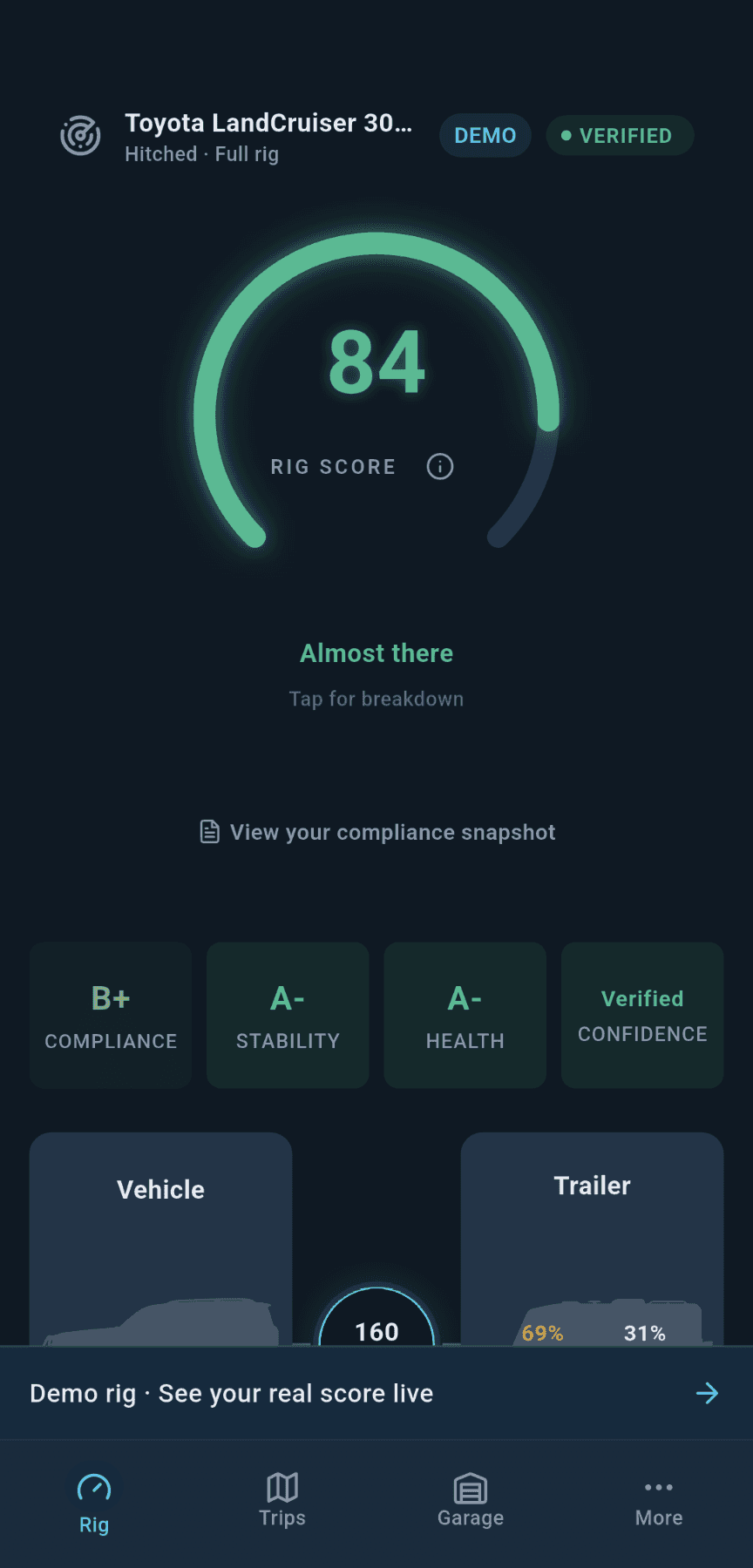
Start from the Silverado you own
At maximum tow, LTZ Premium has 97 kg left; ZR2 has 68 kg using the 400 kg planning figure that GMSV Australia does not print on its current MY26i page. A factory GCM alert estimates only one ceiling. The Live Rig Score recombines compliance, stability and maintenance in one 0–100 reading as you record people, water or gear. Explore how those recorded changes affect the picture on the app’s populated demo rig.


Common questions
- Does the Australian Silverado 1500 tow 4,500 kg or 4,200 kg?
The current MY26i LTZ Premium is rated to 4,500 kg braked with the 70 mm ball, or 3,500 kg with the 50 mm ball. ZR2 is advertised at up to 4,200 kg. The current Australian range contains those two 6.2-litre V8 grades only; LT Trail Boss is historical and Silverado 2500 HD is a separate model.
- How much payload is left when an LTZ Premium tows 4,500 kg?
Ninety-seven kilograms on the current official figures: 7,160 kg GCM less 4,500 kg trailer mass less 2,563 kg kerb mass. That allowance must cover occupants, accessories and cargo. The separate GVM-and-towball calculation leaves 520 kg, so GCM is the limit that controls the answer.
- How much payload is left when a Silverado ZR2 tows 4,200 kg?
Sixty-eight kilograms: the GCM side is 6,851 kg less 4,200 kg trailer mass less 2,583 kg kerb mass, versus 522 kg on the GVM side using a 400 kg towball limit. GMSV's current Australian MY26i page omits that field; the 400 kg value comes from its official Australian MY26 booklet and identical current New Zealand MY26i specification. Check the fitted labels.
- Which is better for towing, a RAM 1500 or Silverado 1500?
Neither can be chosen from the shared 4,500 kg badge alone. A current Silverado LTZ Premium has 97 kg left at maximum tow; ZR2 has 68 kg using the 400 kg planning value explained above. RAM margins depend on the certified grade and coupling. Compare real people, accessories, measured ball mass, GVM, GCM and axles on the RAM 1500 towing page.
- Did MY26i increase the Silverado's towing capacity?
The headline tow ratings remain 4,500 kg for LTZ Premium and 4,200 kg for ZR2. MY26i raised GVM to 3,505 kg and headline payload to 942 or 922 kg. Because GCM remains 7,160 and 6,851 kg, the extra GVM does not increase LTZ's 97 kg full-tow residual or ZR2's 68 kg GCM-side ceiling.
- Which Silverado 1500 model years are covered by the engine recall?
Australian recall REC-006344 lists 9,468 Silverado 1500 vehicles from model years 2021 to 2024 for connecting-rod or crankshaft defects that can damage the engine. Check the VIN through GMSV or an authorised dealer and use the government recall register for the formal campaign record.
Understand the weight limits
Every figure above is governed by a manufacturer-set limit. These guides explain what each term means and how they fit together.
- Caravan & towing weights explainedThe master glossary: GVM, ATM, GTM, TBM and GCM in one place.
- Gross Combination Mass (GCM)The combined vehicle-plus-trailer ceiling that usually bites first.
- Aggregate Trailer Mass (ATM)What your caravan is legally allowed to weigh, fully loaded.
- Braked towing capacityWhy a 3,500 kg rating rarely means you can tow 3,500 kg.
Sources and review
Specifications checked
Page reviewed
- GMSV — current Chevrolet truck range (read 10 August 2026)
Current Australian range authority: Silverado 1500 LTZ Premium and Silverado 1500 ZR2 are the only 1500 grades shown, both with the 6.2-litre V8. Silverado 2500 HD is listed separately. The page states up to 4.5 tonnes for LTZ Premium and 4.2 tonnes for ZR2
- GMSV — Silverado 1500 LTZ Premium MY26i specifications (read 10 August 2026)
Current primary specification: GVM 3,505 kg, GCM 7,160 kg, kerb 2,563 kg, payload 942 kg, braked towing 3,500 kg on a 50 mm ball and 4,500 kg on a 70 mm ball, towball limits 350/422 kg, and front/rear axle limits 1,724/1,866 kg. Also confirms the 6.2-litre V8 and Dynamic Fuel Management
- GMSV — Silverado 1500 ZR2 MY26i specifications (read 10 August 2026)
Current Australian primary specification: GVM 3,505 kg, GCM 6,851 kg, kerb 2,583 kg, payload 922 kg and front/rear axle limits 1,724/1,866 kg, with a 4.2-tonne headline and Dynamic Fuel Management. Its HTML leaves the braked-tow and towball rows blank; the current federal RVD confirms 4,200 kg braked towing but likewise publishes no vehicle-side towball limit
- GMSV New Zealand — Silverado 1500 ZR2 MY26i coupling specifications (read 10 August 2026)
Current manufacturer cross-check for the founder-approved Medium-confidence figure: the New Zealand page is labelled MY26i and publishes the identical ZR2 mass set plus 3,500/350 kg for the 50 mm coupling and 4,200/400 kg for the 70 mm coupling. The article discloses that the current Australian MY26i page omits towball download and directs owners to the fitted labels
- GMSV Australia — MY26 Silverado 1500 LD Service and Warranty Booklet (PDF created 9 January 2026)
Official Australian manufacturer record: printed page 46 lists the 50 mm coupling at 3,500/350 kg and the 70 mm coupling at LTZ 4,500/422 kg and ZR2 4,200/400 kg. Its preceding mass table carries the superseded pre-MY26i 3,300 kg GVM set, so it supplies the last Australian ZR2 towball value only; current MY26i masses come from the live Australian pages and ROVER
- GMSV Australia — Silverado 1500 ZR2 accessory guide (June 2026)
Current Australian hardware cross-check: Tow Hitch 50 mm Ball Kit rated 3,500 kg and Tow Hitch 70 mm Ball Kit rated 4,200 kg. The guide does not state vertical download and is paired with the current GMSV New Zealand MY26i table and Australian towing guide rather than stretched into a 400 kg claim by itself
- GMSV Australia — Silverado 1500 ZR2 MY26 flyer (accurate March 2026; superseded by MY26i)
Dated Australian corroboration for the 400 kg ZR2 towball value. Its 3,300 kg GVM and 2,587 kg kerb belong to the superseded pre-MY26i mass set, so it is not used for current MY26i masses
- ROVER — Chevrolet Silverado VTA-066300 approval detail (current approval issued 24 July 2026)
Current in-force Australian type approval for Chevrolet T1XCF_N2 Silverado, category NB1, held by General Motors Australia and New Zealand. The approval notice and linked descriptor contain no towball or vertical-download field
- ROVER — Chevrolet Silverado VTA-066300 current variants (24 July 2026)
Applicant-supplied current Australian descriptor: LTZ tare 2,503 kg, GVM 3,505 kg, braked tow 4,500 kg and wheelbase 3,745 mm; ZR2 tare 2,523 kg, GVM 3,505 kg, braked tow 4,200 kg and wheelbase 3,754 mm. It publishes no towball or vertical-download value
- GMSV newsroom — Silverado 1500 GVM and trim upgrade for MY26i (17 July 2026)
Official MY26i announcement: NA-to-NB1 recertification, GVM rising from 3,300 to 3,505 kg, payload rising to 942 kg on LTZ Premium and 922 kg on ZR2, two-grade 6.2-litre V8 range, and GMSV's statement that production would begin from 1 August 2026
- GMSV Australia — generic trailering and towing guide (mixed-currency material, read 10 August 2026)
Australian manufacturer corroboration for the 400 kg ZR2 towball figure. It also carries stale pre-MY26i masses and historical Trail Boss material, so it is not used for current range or mass claims
- CarsGuide — Chevrolet Silverado 1500 ZR2 2026 review (Mark Oastler, 7 January 2026)
Dated expert evidence for the factory GCM alert, the 50/70 mm towing tiers and a 655 kg load test with about 35 mm rear spring compression and 16.8 L/100 km laden. Its 64 kg full-tow calculation used the superseded 2,587 kg kerb; the current official 2,583 kg kerb produces 68 kg
- CarsGuide — Chevrolet Silverado LTZ Premium 2024 review (Mark Oastler, 27 July 2024)
Dated expert load-test evidence from the pre-MY26i truck: a 650 kg load compressed the rear springs by about 50 mm, and the vehicle climbed a 13 per cent grade without apparent strain. Its 108 kg full-tow result used the superseded 2,552 kg kerb; the current official 2,563 kg kerb produces 97 kg
- Caravan World — Tow test: MY23 Silverado 1500 LTZ Premium (Tim van Duyl, 4 May 2023)
Independent Australian tow with a Kokoda Force 8 rated to 3,500 kg ATM and listed at 2,880 kg tare; the article does not report a test-scale ATM. It recorded about 22 L/100 km on a short loop, a 10-speed that shifted crisply, confident brake feel and the LTZ nose floating over larger dips. Its historical 117 kg payload-at-full-tow figure used a superseded 2,543 kg kerb
- 4X4 Australia — MY23 Silverado LTZ Premium and ZR2 review (Matt Raudonikis, 28 October 2023)
Independent pre-MY26i towing observation at roughly 2,800 kg, including strong performance and floaty damping over bumps. It is used as dated reviewer character, not as a current mass source or a defect claim
- caravancampingsales — Chevrolet Silverado 2025 tow test (Philip Lord, 29 April 2025)
The measured suspension and consumption evidence behind this page's loading section: an LTZ Premium towing a 2,900 kg van at about 300 kg on the ball settled roughly 30 mm at the rear and rose about 10 mm at the front, both inside spec; 21.7 L/100 km towing against 8.7 L/100 km unladen on the highway; and a 90 km/h climb held easily at 4,200 rpm in third on about half throttle, with stability described as very good and slight fidgeting in cross winds. Also an independent publication of 398 kg as what the pre-update truck kept behind a 3,500 kg van, which is the same arithmetic on the old plate
- 4X4 Australia — American ute towing: Ford F-150 v Chevrolet Silverado v RAM 1500 (Alex Inwood, 19 October 2023)
Independent Australian statement of the two-budget method. Its ZR2 row uses the same 2,583 kg kerb as the current GMSV page and independently reproduces the 68 kg GCM-side arithmetic; it does not resolve the missing current-AU towball limit
- GM — 2026 Silverado/Sierra 1500 trailering supplement (June 2025)
Primary feature-behaviour source used alongside GMSV's confirmation that the Australian truck has a GCM alert. GM says the alert estimates combined weight from vehicle data after enough driving, does not measure loaded vehicle or trailer mass, and does not assess GVM, rear-axle, trailer or towball limits. It is not used for Australian mass ratings
- Queensland Government — towing equipment guidance (updated 8 November 2023; read 10 August 2026)
Regulator guidance for the conditional weight-distribution-hitch paragraph: a WDH transfers some towball load through the vehicle suspension and can maintain ride height and steering control; heavy-duty hardware and manufacturer or dealer advice are required because the device may overload towbar components. It does not establish Silverado-specific permission or alter any certified limit
- Vehicle Recalls Australia — REC-006344, Chevrolet Silverado 1500 engine connecting rod and crankshaft (published 6 May 2025)
The register's own record, and the figure this page uses: 9,468 affected Australian vehicles, model years 2021 to 2024, identified by VIN; connecting rod and crankshaft manufacturing defects that can damage the engine and cause it to fail, with an abnormal knocking noise, no-start, hesitation, abnormal shifting or reduced propulsion as the warning signs; and a free remedy of inspection, repair and, where required, engine replacement. CarExpert reported 9,451 vehicles on 2 May 2025 and that number propagated widely; the register's 9,468 is the one used here
- GMSV — Australian Silverado recalls (read 10 August 2026)
Current manufacturer recall page for Australian Silverado owners, including the L87 engine campaign and instructions to contact GMSV or an authorised dealer. This directly disproves the abandoned draft's claim that GMSV has no recall page
- r/CaravanningAustralia — Silverado 1500 owner towing 4.2 tonnes (7 January 2026; read 10 August 2026)
Low-confidence owner texture only: an Australian Silverado 1500 owner nearing the end of a lap while towing about 4.2 tonnes reported remote-route experience, comfort and no major issues. It is not used to establish a specification, reliability pattern or universal maximum-tow verdict
- r/CaravanningAustralia — Silverado 1500 owner towing 2.2 tonnes (7 January 2026; read 10 August 2026)
Low-confidence owner texture only: a second Australian Silverado 1500 owner towing a 2.2-tonne van praised smooth acceleration and braking confidence but noted that the truck's width requires more care on bush tracks. It is not a measured test or current specification source
- CarExpert — GM will replace faulty Chevrolet Silverado V8s in Australia (William Stopford, 2 May 2025)
Contemporary reporting on the L87 connecting-rod and crankshaft campaign and its repair process. Current powertrain equipment is taken from GMSV's live MY26i model pages, which continue to list Dynamic Fuel Management