By loadmate Editorial · Towing & compliance desk
How much can the Toyota LandCruiser 300 tow?
| Variant | Braked towing capacity | GVM | GCM | Kerb weight | Payload at full tow | Tow ball rating | Rear axle limit |
|---|---|---|---|---|---|---|---|
| GXMY25 | 3,500 kg | 3,280 kg | 6,750 kg | 2,480 kg | 450 kg | 350 kg | 1,930 kg |
| GXLMY25 | 3,500 kg | 3,280 kg | 6,750 kg | 2,545 kg | 385 kg | 350 kg | 1,930 kg |
| VXMY25 | 3,500 kg | 3,280 kg | 6,750 kg | 2,620 kg | 310 kg | 350 kg | 1,930 kg |
| SaharaMY25 | 3,500 kg | 3,280 kg | 6,750 kg | 2,620 kg | 310 kg | 350 kg | 1,930 kg |
4 variants
| Braked towing capacity | 3,500 kg |
|---|---|
| GCM | 6,750 kg |
| GVM | 3,280 kg |
| Kerb weight | 2,620 kg |
| Front axle limit | 1,630 kg |
| Rear axle limit | 1,930 kg |
| Tow ball rating | 350 kg |
| ATM planning ceiling | 3,300 kg |
| Wheelbase | 2,850 mm |
| Rear overhang | 1,210 mm |
The trap the 300 mostly doesn't have
Almost every 3,500 kg tow vehicle on the market hides the same trap. Add the gross vehicle mass and the full braked tow rating together and the total sits well above the gross combination mass, so you cannot be at full GVM and tow the maximum at the same time. A Mitsubishi Triton is short 450 kg. A Ford Ranger is short 450 kg. A HiLux is short 320 kg. The combined-mass ceiling, not the tow rating, is what runs out first on those utes, and it runs out before you've finished packing.
The Toyota LandCruiser 300 is the rare near-exception. Its gross combination mass is 6,750 kg, while its 3,280 kg GVM plus a 3,500 kg trailer comes to 6,780 kg. That is a shortfall of just 30 kg, near enough to nothing in towing terms — but it is not zero, so the 300 is not in the exact-zero club. That club, across the heavy wagons we compare on the towing-capacity hub, is the LandCruiser 70/79 and the Patrol Y62 only; the 300 sits a hair behind them. Even so, the headline question for a 300 is not the one you ask of a ute. The combined-mass villain that defines those pages barely shows up here.
Which raises a more useful question. If the GCM isn't the limit that bites, what is? On a seven-seat VX, the answer is lower down the spec sheet, and it is the rear axle and the payload.
Generous up front, tight at the back
The 300 is generous where buyers look and tight-fisted where they don't. The 6,750 kg GCM is generous. The 3,500 kg braked rating is generous. The 700 Nm from the 3.3-litre V6 twin-turbo diesel makes the towing feel generous on the road. But the seven-seat VX kerbs at about 2,620 kg against a 3,280 kg GVM, which leaves roughly 660 kg of payload for everything you add — people, fuel, water, accessories and the tow ball.
That 660 kg is the number the brochure quietly walks past, and it is the one that decides your load. A bare GX or GXL is lighter, kerbing between about 2,480 and 2,545 kg, so it keeps 735 to 800 kg of payload. Stepping up to the seven-seat VX or Sahara trades 75 to 140 kg of that payload for the third row and the extra trim. The capability you pay more for is partly capability you give back at the weighbridge. The smaller Toyota Prado shows where this leads: short 80 kg on GCM and tighter again on payload, so the trap the 300 dodges still partly applies to its stablemate.
Where the 660 kg actually goes
Hitch a genuine 3,500 kg van and the tow-ball weight lands first, and it lands heavy. A van loaded to around 10% on the ball puts 350 kg straight onto the back of the 300, and that single line item is more than half of your 660 kg payload before a single person climbs in. Caravan World's Sahara tow test put real usable payload at roughly 300 kg once a heavy van's ball weight is on the hitch — and 300 kg does not go far across two or three adults, a tank of fuel, water and a packed boot.
This is why the 300's payload, not its tow rating, runs out first. Two adults and a modest fit-out can take you to the edge of GVM with the van still parked. Add the third row in use and the maths gets tighter again. The engine will pull 3,500 kg all day; the seven-seat body simply does not leave much mass to play with once the ball weight has claimed its share.
The 1,930 kg rear axle is the real ceiling
Payload is the headline limit, but on a loaded 300 the rear axle is usually the first rating to tip over, and it has a lower number than people expect: 1,930 kg. The reason is where the ball weight sits. A tow ball doesn't just add its weight to the rig — it hangs off the back, behind the rear axle, so it presses down on the rear and lifts a little off the front. With the 300's 2,850 mm wheelbase and a hitch about 1,360 mm behind the rear axle, a 350 kg ball loads roughly 515 kg onto the rear axle and takes around 165 kg off the front.
Now stack the rest of the rig on the same axle. Drawers, a fridge, recovery gear, a second spare and rear passengers all sit at or behind the rear wheels, right where the ball weight is already pressing. A towing analysis worked a typical GXL at full van weight — two adults, a bull bar and luggage on top of a 315 kg ball download — and found barely 70 kg of margin before the 3,280 kg GVM, with the rear axle the first limit to go. The reviewer's blunt read was that the 300 will pull 3.5 tonnes all day, but on a weighbridge it is the rear axle, not the engine or the GCM, that ends the conversation.
That is the difference between the 300 and a vehicle like the Nissan Patrol, which carries a true zero GCM shortfall where the 300 is still 30 kg short: both run out of rear axle and payload before combined mass, but they get there from different kerb weights and chassis layouts. Read the 300's story on its own numbers, not a borrowed one.
The diesel doesn't sip when it's working
One trope worth correcting: the 300 is not especially thirsty around town. The current MY25 diesel returns roughly 12.3 L/100km unladen on a real-world run, modestly above Toyota's 8.9 L/100km combined claim — normal for a 2.6-tonne wagon. Empty, it is fine.
Loaded is a different story, and it is the load that spikes the figure, not the driving. A GR Sport tow test recorded 18.2 L/100km towing 2,600 kg, against 10.2 L/100km unladen on the same test. A Sahara towing 2,750 kg drank about 23 L/100km. So the honest framing is that fuel use roughly doubles under a heavy van, which matters for range planning on remote trips — and a long-range tank is more weight on the same payload and rear axle you are already watching.
Why GVM upgrades are almost standard kit
Because the factory payload is tight for a seven-seat tourer with a heavy van, GVM upgrades to around 4,200 kg have become close to default on serious 300 Series tow rigs. Several second-stage manufacturers offer them, and the demand exists for one reason: it is the most direct way to buy back the payload and rear axle margin the seven-seat body costs you. Treat the specific upgraded figure as a vendor number to confirm against the engineering certificate — the pattern is well established, but the exact GVM, GCM and axle ratings on an upgrade vary by kit.
A GVM upgrade is not a magic fix, though. It can lift the gross vehicle mass and sometimes the rear axle rating, but it does not always raise GCM, and it does nothing for tyre load ratings unless you also address them. The upgrade should solve the measured problem — usually rear axle and GVM — not just sit the vehicle higher. If you are budgeting a 300 for genuine heavy touring, budget the upgrade alongside it rather than discovering you need it on the first weighbridge visit.
Known traits worth checking before you buy
Two recalls sit against the 300 and both are worth a VIN check on the national recalls register before purchase. An exhaust after-treatment campaign covers about 40,693 vehicles built between July 2021 and February 2025: a fuel-addition injector in the after-treatment system can clog and trigger an engine-maintenance dash warning, with the remedy a clean, a retainer and an ECU reflash. A separate transmission recall covers roughly 11,019 MY25 vehicles built across 2025, where a transmission control fault can let the gearbox over-rev with a fire risk, remedied by reprogramming the control unit. Both are dated 2025-2026; confirm the status of any specific car.
The diesel also has a known oil-consumption trait — owners report using up to around 1.7 litres between services, which Toyota classes as within spec and addresses with shorter service intervals. It is a maintenance-awareness point, not a failure, and it is worth a habit: check the dipstick when you're towing hard, because that is when consumption is highest. One thing you can stop worrying about is the cabin. The MY25 VX runs a 12.3-inch wireless CarPlay and Android Auto setup with physical climate buttons retained, so any old 'dated screen' line about the 300 is simply wrong today.
Buy the proven diesel now, or wait?
There are two live forks for a buyer right now. The first is the incoming Y63 Patrol, with a new twin-turbo V6 — the MY25 300 update is partly Toyota's answer to it. The honest read is that the 300 is available today, it has factory trailer sway control and strong low-end diesel torque for heavy towing, and it is a known quantity, while the Y63 is still unproven in Australian conditions.
The second fork is the petrol-electric Performance Hybrid, a 3.5-litre V6 making around 341 kW, now delayed to about Q3 2026. It is more powerful, but it is roughly a five-seat, $150k-plus Sahara ZX and GR Sport proposition, and it keeps the 3,500 kg rating rather than raising it. It does not replace the seven-seat diesel VX in scope here. For a seven-seat family tow rig today, the diesel VX is the rational pick. But the decision that actually matters isn't the engine or the badge: it is whether your loaded rig fits under the rear axle and GVM, which usually means budgeting a GVM upgrade rather than waiting for a new model. The LC300's bullbar, second battery and rear drawers take their share before seven seats are filled. Get the loadmate app to put those accessories, passengers and towball load against your measured baseline and see which margin needs attention as you record changes.
Watch the limit that bites, as you load it
Here is the trap the spec sheet sets. The 300's 6,750 kg GCM is so generous that it lulls you into reading it as the headroom you have, when the rear axle and GVM are quietly filling far ahead of it. The ball weight lands, the boot fills, the third row goes up, and the rear axle creeps toward 1,930 kg while that big GCM number still looks miles away. You don't feel it happen, and a roadside intercept or a weighbridge ticket is a poor way to find out.
loadmate's live axle, GVM and GCM tracking is built for exactly this gap. As you load the 300, it watches the rear axle (1,930 kg) and GVM (3,280 kg) tightening before the 6,750 kg GCM, so the limit that bites is the one you're watching — not the one you discover on the scales. It updates as the tow-ball mass climbs and gear goes in over the back, which is precisely where a careful 300 tow quietly tips over its rear axle. A certified weighbridge in travel trim is still the next step; this is the decision support that tells you where the margin went before you get there.
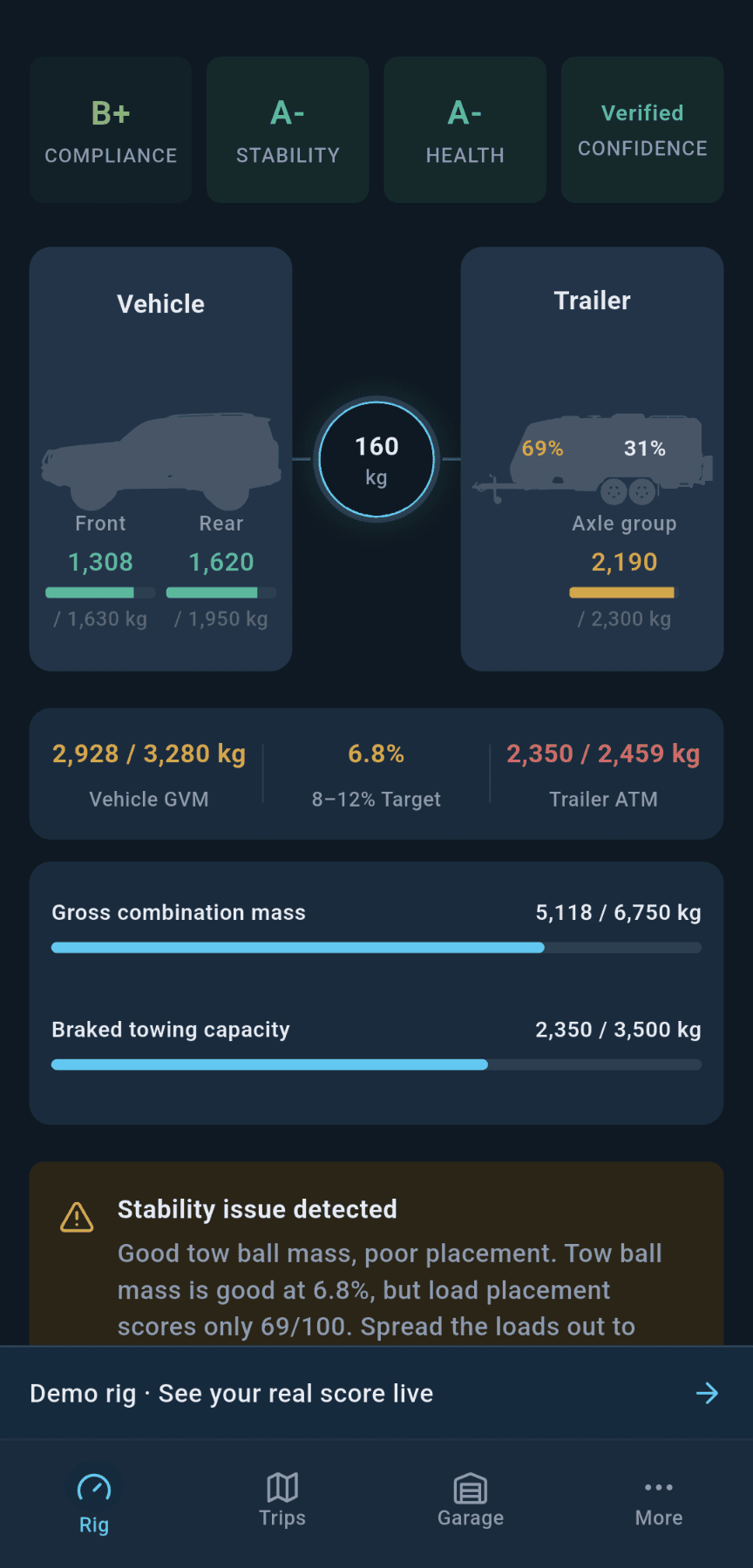
Build the trip around your actual 300 Series
Add the equipment you carry and use a weigh-in that separates the axles. loadmate helps you see what changes when you move a load, add an accessory or pack the caravan differently.


Common questions
- Can a LandCruiser 300 tow a 3.5-tonne van with seven people and gear, or do I run out of payload first?
You run out of payload first on a seven-seat VX. The 3,500 kg tow rating is real and the GCM is barely a constraint, but with about 660 kg of payload, a 350 kg tow ball leaves roughly 310 kg for people, fuel, water and gear. Seven adults plus luggage plus that ball weight will reach GVM and the rear axle before the engine or combined mass is troubled.
- How much payload is really left on a VX once a heavy van's tow-ball weight is on the hitch?
Around 300 kg, on the figures from a Sahara tow test. The VX starts with roughly 660 kg of payload, and a heavy van's 350 kg ball weight claims more than half of it straight away. That remaining 300 kg has to cover everyone in the vehicle, a full fuel tank, water and any accessories, which is why two or three adults can take it to GVM.
- Do I need a GVM upgrade on a 300 Series to tow legally, or is the factory enough?
Factory ratings are legal, but the factory payload is tight for a seven-seat tourer with a heavy van, which is why GVM upgrades to about 4,200 kg are near-standard on serious tow rigs. Whether you need one depends on your measured weights. Weigh the loaded rig first; if the rear axle or GVM is the limit you keep hitting, an upgrade that lifts those ratings is the direct fix. Confirm the exact upgraded figures against the engineering certificate.
- Is the rear axle the thing that bites when towing, and what is its limit?
Yes. The rear axle limit is 1,930 kg, and it is usually the first rating to tip over on a loaded 300. A 350 kg tow ball levers about 515 kg onto the rear axle once the hitch overhang is counted, then drawers, a fridge, recovery gear and rear passengers stack on top of that. The vehicle can still be under GVM while the rear axle is over its limit, so weigh it specifically.
- Is the V6 diesel's oil consumption and the recalls a reason to avoid the 300?
Not on their own. The diesel can use up to around 1.7 litres of oil between services, which Toyota classes as within spec and manages with shorter intervals — a maintenance-awareness point, not a failure. Two recalls (an exhaust after-treatment injector campaign and a MY25 transmission fix) are worth a VIN check on the national recalls register before buying, but both have defined remedies. None of them changes the core towing story, which is rear axle and payload.
Understand the weight limits
Every figure above is governed by a manufacturer-set limit. These guides explain what each term means and how they fit together.
- Caravan & towing weights explainedThe master glossary: GVM, ATM, GTM, TBM and GCM in one place.
- Gross Combination Mass (GCM)The combined vehicle-plus-trailer ceiling that usually bites first.
- Aggregate Trailer Mass (ATM)What your caravan is legally allowed to weigh, fully loaded.
- Braked towing capacityWhy a 3,500 kg rating rarely means you can tow 3,500 kg.
Sources and review
Specifications checked
Page reviewed
- Toyota Australia — LandCruiser 300 range and specifications
GVM, GCM, kerb, braked towing and tow ball mass
- Toyota Australia — vehicle payload policy
Payload and tow ball mass guidance
- 4X4 Australia — LandCruiser 300 towing capacity
Real-world payload and rear-axle context by variant
- CarsGuide — 2025 LandCruiser 300 transmission recall
2025 transmission control module recall (11,019 vehicles)
- carsales — LandCruiser 300 after-treatment service campaign
2021-2025 exhaust after-treatment fuel-addition injector campaign