How much can the KGM Musso tow?
| Variant | Braked towing capacity | GVM | GCM | Kerb weight | Payload at full tow | Tow ball rating | Rear axle limit |
|---|---|---|---|---|---|---|---|
| ELX SWBMY26Med | 3,500 kg | 2,880 kg | 6,380 kg | 2,090 kg | 440 kg | 350 kg | Not published |
| ELX XLV (LWB)MY26Med | 3,500 kg | 3,220 kg | 6,720 kg | 2,210 kg | 660 kg | 350 kg | Not published |
| Ultimate SWBMY26Med | 3,500 kg | 2,880 kg | 6,380 kg | 2,090 kg | 440 kg | 350 kg | Not published |
| Advance/Ultimate XLVMY26Med | 3,500 kg | 2,980 kg | 6,480 kg | 2,100 kg | 530 kg | 350 kg | Not published |
4 variants
| Braked towing capacity | 3,500 kg |
|---|---|
| GCM | 6,380 kg |
| GVM | 2,880 kg |
| Kerb weight | 2,090 kg |
| Tow ball rating | 350 kg |
| ATM planning ceiling | 2,800 kg |
| Wheelbase | 3,100 mm |
| Rear overhang | 1,105 mm |
The one row that splits the range: leaf springs on the XLV ELX, coil springs on every other Musso
KGM publishes rear suspension as a spec row that changes down the Musso range. On the MY26 specification sheet the front is a double wishbone with coil springs and a stabiliser bar on everything. The rear reads multi-link with coil spring for the short-wheelbase Musso, and on the XLV it splits: leaf spring against ELX, multi-link with coil spring against Advance and Ultimate. KGM's own model page puts it plainer again — coil spring as standard, leaf spring on the ELX with the XLV Pack.
The two rear ends carry a tow ball's load by different routes. A leaf pack is a stack of steel plates mounted to the frame, and the pack both carries the mass and locates the axle. A five-link coil rear separates those jobs: five links locate the axle and coil springs carry the mass, allowing the location geometry and spring rate to be designed separately. Both are answers to the same question, and each is what its own published mass set reflects.
A third-party-hosted global left-hand-drive manual dated May 2023 provides supporting context for the mechanical split: its maximum-load tables are separately headed MUSSO, MUSSO GRAND (5-Link) and MUSSO GRAND (Leaf). That copy has not been verified as the AU/RHD manual supplied with an Australian vehicle, so none of its masses or operating instructions is applied here.
The calculations below use the current 2.2-litre diesel Musso. KGM's current Musso EV page separately lists 1,800 kg braked for the 2WD and 2,300 kg for the AWD, with a 180 kg maximum ball load on both.
Two Musso XLVs and 240 kg between their plated masses
An XLV ELX and an XLV Ultimate share a 3,210 mm wheelbase, a 1,600 mm tub, 133 kW and 420 Nm from the 2.2-litre turbo-diesel, a six-speed automatic, a 3,500 kg braked rating and a 350 kg maximum ball load. Two published rows differ at the back: the spring type, and hydraulic steering on the leaf ELX versus electric steering on the coil Advance and Ultimate.
Then read the mass columns. KGM certifies the leaf-sprung XLV ELX at a 3,220 kg GVM and a 6,720 kg combined mass, on a 2,210 kg kerb weight, for 1,010 kg of payload. It certifies the coil-sprung XLV in Advance and Ultimate trim at a 2,980 kg GVM and a 6,480 kg combined mass, on a 2,100 kg kerb weight, for 880 kg. Both columns reconcile — kerb plus payload equals GVM on each — and they sit 240 kg apart at the top and 130 kg apart at the payload line. Move up this trim ladder and the equipment arrives while 130 kg of carrying capacity leaves with the spring pack.
On the short wheelbase the trim ladder stops mattering at all. KGM publishes one weight column for all three short-wheelbase trims: a 2,090 kg kerb weight, a 2,880 kg GVM, a 6,380 kg combined mass and 790 kg of payload, whether the ute is a base ELX or a fully optioned Ultimate with the sunroof, ventilated seats and 360-degree camera. What the XLV Pack buys is 110 mm more wheelbase, 200 mm more rear overhang and a 300 mm longer tub — and, on the ELX, the leaf rear that carries the higher certificate. How that column reads beside the rest of the segment is on the towing-capacity comparison chart.
Where a Musso's payload goes once a caravan is hitched: 440 kg, 530 kg or 660 kg
What a tow vehicle may carry with a trailer on is the lower of two ceilings, less what the vehicle already weighs. The first ceiling is the GVM less the mass the coupling puts on the ute. The second is the combined mass less the whole loaded trailer. The ball is deducted on the vehicle side only, because the trailer's rated mass on the other side of the sum already carries it, and taking it twice would charge the same kilograms against the rig in both halves. If that two-ceiling shape is the part that never quite sticks, the gross combination mass guide builds it up one limit at a time.
Take the kerb weight off first and each Musso resolves in two steps. A short-wheelbase car starts 2,090 kg into its own 2,880 kg GVM, which is where the 790 kg payload comes from; hitch the maximum ball and 350 kg of that is spoken for, leaving 440 kg. Check the other ceiling and it never gets a say — 6,380 less a 3,500 kg trailer is 2,880 kg, the GVM figure to the kilogram, so the vehicle side is what runs out. The coil XLV runs the same two steps from 2,100 kg against a 2,980 kg GVM, for 880 kg and then 530 kg; the leaf XLV runs them from 2,210 kg against 3,220 kg, for 1,010 kg and then 660 kg. Three spec groups, one deduction, and the ball is the whole of it, one kilogram for one kilogram.
KGM sets combined mass at GVM plus the braked rating on all three groups. In the published total-mass arithmetic, a Musso may therefore sit at full GVM with the whole 3,500 kg behind it because there is no GCM gap underneath. Axle limits still apply.
On the short-wheelbase car those 440 kg cover everything beyond brochure kerb weight. A fitted towbar, occupants, brake controller, canopy, bull bar, load-assist equipment and cargo all use the same budget. KGM rates the roof rails to 100 kg, so a roof load can consume nearly a quarter of the conditional full-tow remainder before its high placement is considered.
The leaf-sprung XLV ELX has the highest published mass allowance and retains 660 kg at a 350 kg ball; that makes it the first variant to investigate for a heavier van or working tub, not an automatic recommendation. CarsGuide's load test bottomed one leaf car while its test load remained below published payload, and KGM's public axle limits are absent. The short-wheelbase coil car retains 440 kg and is 310 mm shorter overall; the coil XLV retains 530 kg and adds the longer tub. Choose from measured ball, occupants, accessories and cargo, then verify axle limits rather than treating spring type as a clearance certificate.
What 650 kg in the tub did to a leaf-sprung SsangYong Musso's rear end
A dated load test shows why plated payload and suspension travel are separate checks. In December 2021, when the badge still read SsangYong, CarsGuide put 650 kg in an XLV ELX's tub — about 750 kg of payload aboard, still 275 kg below that test vehicle's stated 1,025 kg payload. The leaf pack compressed more than 60 mm, left about 30 mm to the bump stops and bottomed over larger bumps. That result describes one older test vehicle under one load; use today's sheet for current masses and a loaded inspection for the individual ute.
The coil rear has one measured figure of its own, and it belongs beside those: hitched to a 2,933 kg caravan on a 265 kg ball, a short-wheelbase Ultimate dropped 35 mm at the rear and lifted 8 mm at the nose, which is a settle, not a collapse. Unladen, the coil cars read the softer way in the same reviewers' hands. CarsGuide found the coil-sprung Advance XLV firm and mostly controlled in October 2025, and jittery over irregular surfaces; CarExpert, driving the coil Ultimate the same month, described a ute that feels more SUV-like than others in the segment. ReDriven's used-buyer summary of 22 October 2025 puts the trade in a line: the leaf car carries more and is less settled empty, the coil car is the more composed and easier to manage.
A separate tow test measured 21 mm rear settle on an XLV ELX with 200 kg at the coupling behind a 2,800 kg van, versus 35 mm on the short-wheelbase Ultimate with 265 kg behind a 2,933 kg van. Different vehicles and loads make those observations useful texture, not a controlled spring comparison.
Supporting a spring does not itself change GVM, GCM or an axle rating. Inspect the loaded vehicle, follow the vehicle and suspension makers' instructions, and keep using the approved masses. The Kia Tasman is another ute whose loaded rear-settle figures are public.
From 350 kg on the ball to about 490 kg at an unrated rear axle
350 kg is the maximum coupling load on every Musso — short or long, leaf or coil — and it takes a larger share of this ute's budget than the round number suggests: 44 per cent of a short-wheelbase Musso's 790 kg payload, 40 per cent of a coil XLV's 880 kg, and 35 per cent of the leaf XLV's 1,010 kg. Because the two ceilings sit level on all three, that share is also the complete bill for hitching up.
The coupling sits behind the rear axle, so it acts through a lever. Using KGM's 1,105 mm SWB rear overhang or 1,305 mm XLV overhang plus a stated 150 mm hitch-extension assumption gives arms of 1,255 mm and 1,455 mm. Against 3,100 mm and 3,210 mm wheelbases, the multipliers are 1.405 and 1.453. A 350 kg ball therefore adds about 492 kg at the SWB rear axle and 509 kg at the XLV rear, while unloading the front by about 142 kg and 159 kg. The generated display rounds those to about 490 and 510 kg.
KGM's MY24 and MY26 sheets, live model page and current ROVER RVD publish no front or rear axle limits. 4X4 Australia's April 2026 long-term XLV Ultimate article reports 1,400 kg front and 1,850 kg rear for that test vehicle, but it is a secondary figure for one coil XLV, not manufacturer evidence for the range. Do not transfer it to another body, suspension or VIN.
A weight-distribution hitch is sometimes considered where the makers permit one. Correctly tensioned bars can transfer some rear-axle load forward to the steer axle and back to the trailer axles, while ball mass, vehicle GVM, GCM and trailer ATM remain unchanged. Do not configure one by feel. Check the vehicle plate and supplied manual, obtain KGM's written axle limits and hitch instructions for the VIN, confirm the towbar and trailer makers permit the setup, then weigh both axles. loadmate can store an approved setting and model its effects; it cannot supply missing ratings or certify the rig. The weight-distribution hitch guide explains the mechanism.
Which caravan a Musso is sized for: 2,000 to 2,800 kg ATM
Two dated Australian tow tests show behaviour near the top of this planning band, not support for its 2,000 kg lower bound. One took a leaf XLV behind a 2,800 kg van and recorded 16.1 L/100 km against 9.5 solo, slowing from 90 to 72 km/h on its test climb. The other took a short-wheelbase Ultimate behind a 2,933 kg caravan at 18.3 L/100 km and reported a stable combination. Both ran in 2019, so use them for dated behaviour rather than current certification. The lower bound is conservative planning space below those tests, not a tested threshold. At 2,800 kg ATM with an actual 280 kg ball, today's sheet leaves about 510 kg in a short Musso, 600 kg in a coil XLV and 730 kg in a leaf XLV.
CarExpert reports that an all-new generation is due in October 2026. The current ROVER applicant record lists 3,500 kg braked and 750 kg unbraked, with tare/GVM pairs of 2,037/2,940 kg on SWB Advance/Ultimate, 2,167/3,290 kg on LWB base/ELX and 2,077/2,990 kg on LWB Advance/Ultimate. Those differences are 903 kg, 1,123 kg and 913 kg; CarExpert reports the new range's published payload as 903 to 1,123 kg. The approval record leaves GCM, ball and axle limits blank, so do not transfer the current MY26 mass sets or calculations to the incoming generation.
One legal detail sits underneath any van in that band, and its steps are set by GTM — the trailer's loaded mass carried on its own wheels, which is ATM less the load resting on the ball. VSB1 requires service brakes once GTM passes 750 kg and permits over-run operation only through 2,000 kg. Beyond 2,000 kg GTM, braking must act on every wheel and an emergency breakaway must apply immediately for at least 15 minutes. Loaded near a tenth on the ball, a van crosses that upper step at roughly 2,200 kg ATM. Above the stated GTM thresholds, an electric-braked caravan needs compatible control equipment installed in the Musso. The braked towing capacity guide explains the requirements.
Then weigh it axle by axle in travel trim, both unhitched and hitched, and run the whole rig across for combination mass. Current GVM, GCM and maximum ball load are published. Public approval records do not supply the missing axle limits, so check the vehicle plate and supplied manual and request KGM's written VIN-specific values before heavy towing. A scale reading without its ceiling cannot clear an axle.
The Musso's long tub invites another tool box or piece of camping gear, but its load still needs to fit the approved limits. Get the loadmate app to put your measured weights and recorded loads together and see where the margins tighten. The app cannot certify a rig or supply an unpublished axle limit. A loading assessment remains provisional until written axle limits and measured loads agree; the safety disclaimer states the boundary.
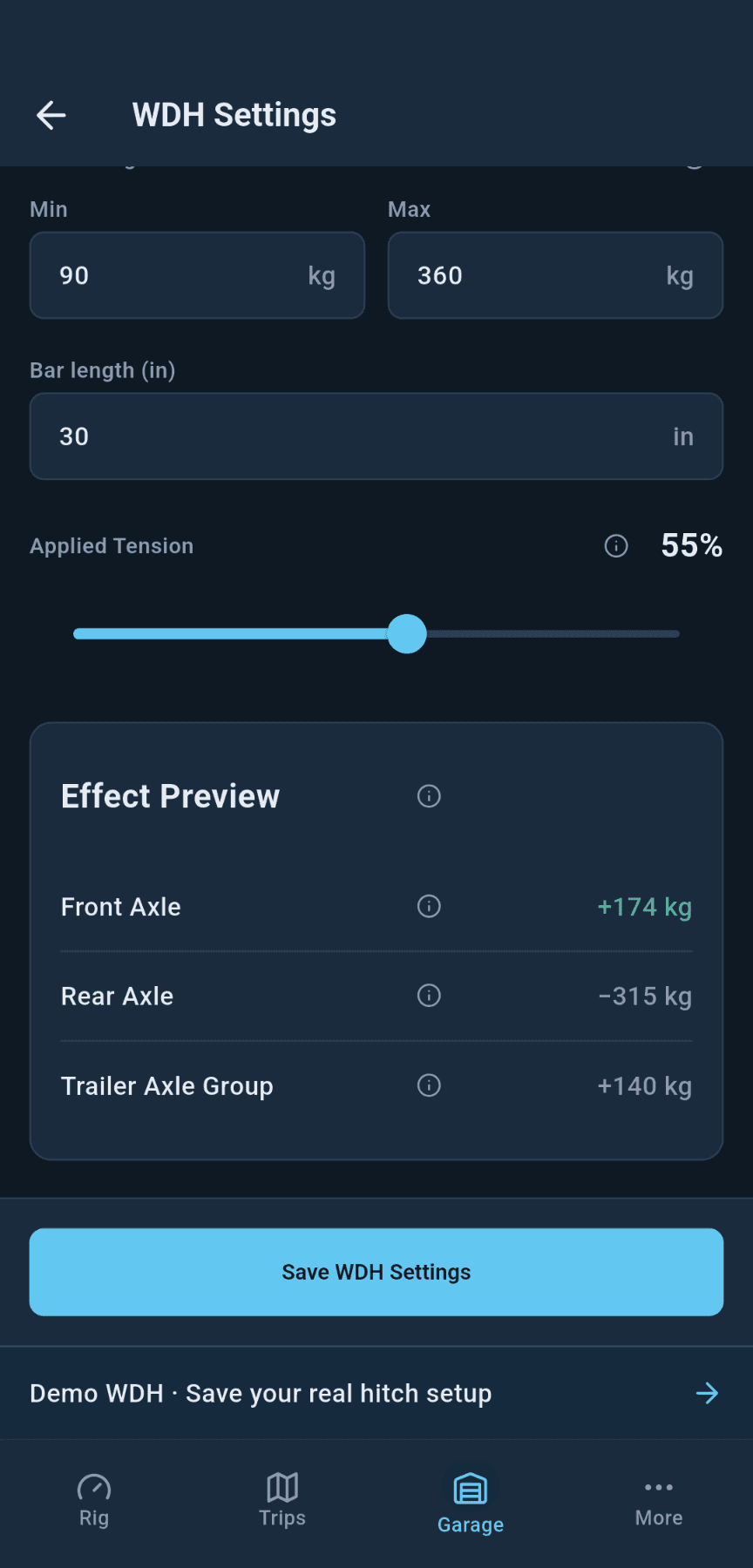
Obtain the axle limits before modelling the hitch
KGM's public sheets omit the Musso's front and rear axle limits. Check the vehicle plate and supplied manual, then request KGM's written VIN-specific axle limits; without them, do not treat a modelled result as axle clearance. Confirm that the vehicle, towbar and trailer makers permit a weight-distribution hitch, and configure it to their instructions before comparing measured axle loads. loadmate can store that approved setting and model its axle effects between trips; it cannot supply the missing ratings or certify the rig. Explore the axle effects on the app’s populated demo rig.


Common questions
- Can a KGM Musso tow a 3,500 kg caravan with the family aboard?
The headline arithmetic does not establish that every loaded combination passes. Each current Musso's GCM equals its GVM plus the 3,500 kg rating, and at a 350 kg ball the calculated payload remaining is 440 kg on a short Musso, 530 kg on a coil XLV and 660 kg on the leaf XLV ELX. KGM's MY26 sheet and current ROVER RVD omit axle limits, so obtain written VIN-specific values and clear both axles before treating the family-and-caravan load as suitable.
- Is the KGM Musso the same as the SsangYong Musso?
The current vehicle continues the same Q200 generation sold under the SsangYong name, and SsangYong Australia officially rebranded to KGM in September 2024. That does not make a 2019 vehicle's certification identical to MY26: published GCM changed during the generation. Older tow tests remain dated evidence about their test vehicles, while the plate, supplied manual and approved record govern a used example. CarExpert reports that the all-new generation due in October 2026 is separate again.
- Why does a Musso manual online say 3,000 kg when the AU sheet says 3,500 kg?
The provenance of the 3,000 kg document is unresolved for Australia. The cited copy is a third-party-hosted global left-hand-drive manual dated May 2023; it has not been verified as the AU/RHD manual supplied with an Australian Musso. KGM Australia's MY26 specification sheet publishes 3,500 kg braked and 350 kg maximum ball load, subject to towbar design and state regulations. Do not apply the global copy's 3,000 kg, 120 kg, speed, loading, maintenance or running-in instructions to an Australian vehicle without confirmation. Check the manual supplied with the VIN and ask KGM or the dealer in writing which limits and instructions apply. Because the applicable manual is unverified, no warranty or legal conclusion follows from the conflict.
- Can you get a GVM upgrade for a KGM Musso?
Keep using the vehicle's approved GVM unless its VIN has second-stage approval documented by a replacement plate: 2,880 kg on a current short-wheelbase car, 2,980 kg on a coil-sprung XLV and 3,220 kg on the leaf-sprung XLV ELX. Supporting a spring does not itself change an approved mass. Before modifying the suspension, get written confirmation from KGM and the installer about approval, instructions and warranty treatment for the VIN rather than assuming a general warranty outcome.
- What are the common KGM Musso problems that affect towing?
Recall REC-006327, published 8 April 2025, covers 15,284 Musso and Rexton vehicles built from 2020 to 2024. A defective engine-cooling-fan fuse can cause overheating and loss of motive power; the regulator says dealers replace the fuse free. Run the VIN through the national register. Separately, ReDriven's 22 October 2025 aggregated used-buyer review reports transmission heat under tow and rear-suspension concerns. Those reports identify inspection questions, not prevalence or a diagnosis for every vehicle.
Understand the weight limits
Every figure above is governed by a manufacturer-set limit. These guides explain what each term means and how they fit together.
- Caravan & towing weights explainedThe master glossary: GVM, ATM, GTM, TBM and GCM in one place.
- Gross Combination Mass (GCM)The combined vehicle-plus-trailer ceiling that usually bites first.
- Aggregate Trailer Mass (ATM)What your caravan is legally allowed to weigh, fully loaded.
- Braked towing capacityWhy a 3,500 kg rating rarely means you can tow 3,500 kg.
Sources and review
Specifications checked
Page reviewed
- KGM Australia — MUSSO MY26 Technical Specifications & Features (PDF, 17 October 2025)
Kerb weight, GVM, GCM, payload, braked and unbraked towing, maximum tow-ball load, roof-rail load, wheelbase, front and rear overhang, tub dimensions, engine outputs, steering and the per-variant rear-suspension row for all three Musso spec groups — and the absence of any front or rear axle limit in the same table
- KGM Australia — Musso model page
The current MY26 range structure (ELX, Advance and Ultimate, each orderable with the XLV Pack), payload by variant, and KGM's plain-language statement of the rear suspension split: coil spring as standard, leaf spring on the ELX with XLV Pack
- KGM Australia — SsangYong Australia rebrands to KGM (2 September 2024)
Primary dated confirmation that SsangYong Australia adopted the KGM brand in September 2024; the article keeps model-generation certification separate from the badge change
- KGM Australia — current Musso EV model page
The separate battery-electric Musso EV's current Australian towing split: 1,800 kg braked for 2WD, 2,300 kg braked for AWD and a 180 kg maximum towball load for both. These figures are kept separate from the diesel Musso's 3,500/350 kg ratings
- StartMyCar-hosted MUSSO & MUSSO GRAND manual (global LHD, 1 May 2023, part no. Q261OM2305E; AU provenance unresolved)
Research context only: separate table headings for MUSSO GRAND (5-Link) and MUSSO GRAND (Leaf). The copy is global, left-hand-drive and third-party-hosted; it is not verified as the AU/RHD manual supplied with an Australian vehicle, so none of its masses or operating instructions is applied
- KGM Australia — new vehicle warranty terms
The 7-year unlimited-kilometre warranty terms and their references to limits in the applicable owner's manual and authorised modifications. Because the AU/RHD manual provenance is unresolved, this source does not support a blanket towing or modification warranty conclusion
- CarExpert — 2027 KGM Musso specs: new ute nears Australian launch (25 June 2026)
The incoming October 2026 generation's published payload of 903 kg for the short-wheelbase body and 1,123 kg for the long-wheelbase body, plus the continuing absence in the preview of GVM, GCM, kerb, tow-ball and axle limits
- Vehicle Recalls Australia — REC-006327, SsangYong Musso and Rexton engine cooling fan fuse (8 April 2025)
The recall covering 15,284 Musso and Rexton vehicles built 2020-2024, the cooling-fan fuse failure mode leading to engine overheating and loss of motive power, and the free cooling-fan-fuse replacement
- Australian Government ROVER — current KGM Musso approval
The current Australian vehicle approval and provenance route for the incoming-generation RVD
- Australian Government ROVER — Musso RVD issued 24 June 2026
Incoming-generation tare/GVM pairs of 2,037/2,940 kg for SWB Advance/Ultimate, 2,167/3,290 kg for LWB base/ELX and 2,077/2,990 kg for LWB Advance/Ultimate, all at 3,500/750 kg towing. GCM, ball and axle fields remain blank
- Australian Government — Vehicle Standards Bulletin 1, Revision 6 (July 2025)
Current national trailer-brake baseline used in the article: no service brake required at 750 kg GTM or less; service braking above 750 kg GTM; over-run operation only up to 2,000 kg GTM; and every-wheel service brakes plus an immediate breakaway held for at least 15 minutes above 2,000 kg GTM
- CarsGuide — SsangYong Musso XLV ELX GVM test (Mark Oastler, 10 December 2021)
A published load measurement of the leaf-sprung XLV: 650 kg in the tub compressing the rear springs more than 60 mm to about 30 mm of bump-stop clearance, bottoming out over larger bumps, plus the GCM and kerb weight certified at the time
- CarExpert — 2026 KGM Musso review (Matt Campbell, 26 October 2025)
Independent confirmation of all three spec groups' kerb, GVM, GCM and payload figures, the leaf-on-ELX-XLV and coil-elsewhere split, and the unladen ride verdict on the coil-sprung Ultimate
- CarsGuide — KGM Musso Advance review (Marcus Craft, 24 October 2025)
The multi-link coil rear on the Advance XLV, the unladen ride verdict, the engine's response under load and measured fuel consumption against the claim
- ReDriven — used SsangYong Musso review (22 October 2025)
An aggregated used-buyer source reporting transmission-temperature warnings under tow and rear-suspension concerns. The article uses those as attributed inspection signals only, with no prevalence or reliability inference
- carsales — SsangYong Musso XLV ELX 2019 tow test (Philip Lord, 11 August 2019)
A measured tow test of the leaf-sprung XLV behind a 2,800 kg tandem van at 200 kg of ball load: 21 mm of rear droop, 16.1 L/100 km towing against 9.5 solo, and the hill-climb speed loss
- caravancampingsales — SsangYong Musso 2019 tow test (Phil Lord, 14 March 2019)
A measured tow test behind a 2,933 kg caravan at 265 kg of ball load: 35 mm of rear drop and 8 mm of front rise when hitched, 18.3 L/100 km towing, and the stability observations under provocation
- 4X4 Australia — 2026 KGM Musso Ultimate long-term review (Tristan Tancredi, 4 April 2026)
A secondary front/rear axle pair found for one coil-sprung XLV test vehicle, alongside that vehicle's GVM, payload and long-tub tie-down layout; it is not transferred across the range