How much can the Isuzu D-Max tow?
| Variant | Braked towing capacity | GVM | GCM | Kerb weight | Payload at full tow | Tow ball rating | Rear axle limit |
|---|---|---|---|---|---|---|---|
| SX 3.0MY25.5 | 3,500 kg | 3,100 kg | 6,000 kg | 2,035 kg | 465 kg | 350 kg | 1,910 kg |
| LS-U 3.0MY25.5 | 3,500 kg | 3,100 kg | 6,000 kg | 2,105 kg | 395 kg | 350 kg | 1,910 kg |
| LS-U+ 3.0MY25.5 | 3,500 kg | 3,100 kg | 6,000 kg | 2,105 kg | 395 kg | 350 kg | 1,910 kg |
| X-Terrain 3.0MY25.5 | 3,500 kg | 3,100 kg | 6,000 kg | 2,170 kg | 330 kg | 350 kg | 1,910 kg |
4 variants
| Braked towing capacity | 3,500 kg |
|---|---|
| GCM | 6,000 kg |
| GVM | 3,100 kg |
| Kerb weight | 2,170 kg |
| Front axle limit | 1,450 kg |
| Rear axle limit | 1,910 kg |
| Tow ball rating | 350 kg |
| ATM planning ceiling | 3,000 kg |
| Wheelbase | 3,125 mm |
| Rear overhang | 1,255 mm |
The ticket reads 5,930 kg, with 70 kg to spare
Start in the middle of the weigh, because that is where this ute's two proudest numbers finally meet. On the platform: a current X-Terrain with the genuine Isuzu tow bar receiver fitted, a family of four aboard, a canopy-and-drawers build in the tray, hitched to a tandem caravan loaded to its full 3,250 kg ATM. The combination ticket prints 5,930 kg. The D-Max's gross combination mass — the legal cap on ute and van together — is 6,000 kg. This rig, with nothing exotic about it, has 70 kg in hand. Two full jerry cans and a bag of firewood would finish it.
Nothing on that ticket touched the 3,500 kg badge, and the tray — rated to carry 930 kg in this trim — held barely half that in people and gear. Both selling points came in under their ratings, and the rig still nearly filled the combined cap. That is the D-Max's towing story in a single ticket: the one-tonne-class tray and the 3,500 kg rating are both real, and they subtract from each other. The rest of this page rewinds the same rig to the driveway and walks it back to the scales one number at a time, so you can see exactly where the margin went.
Rewind: the brochure's two proudest numbers subtract
Every 3.0-litre 4x4 D-Max on the 25.5MY spec sheet carries the same four ratings: a 3,100 kg gross vehicle mass, 3,500 kg of braked towing, a 350 kg tow-ball maximum and a 6,000 kg gross combination mass. Add the first two together and you get 6,600 kg — 600 kg more than the combination cap permits. Most utes carry some version of this gap, as the towing-capacity hub shows — about 450 kg in a Ranger, roughly 320 kg in the new HiLux — but 600 kg is the deepest in the mainstream class, and the only other ute carrying it is the D-Max's own twin, built on the same line wearing a Mazda grille.
The 600 kg hole shows a different face depending on which selling point you spend first. Spend the tray: take the ute to its full 3,100 kg GVM — the work trims are rated for a tonne and more of payload, 1,065 kg in an SX — and the combination cap has 2,900 kg left, which is the heaviest van you may then legally hitch. The tailgate badge says 3,500; above a full tray, only 2,900 of it is usable. Spend the badge instead: hitch a van grossing the full 3,500 kg and the entire ute, occupants included, must come in at 2,500 kg, which is 600 kg below the GVM it was sold on. You can fill the famous tray or use the famous tow rating, and the brochure never mentions that you must choose.
A 3,500 kg badge that arrives in a box
Before the packing starts, the scenario rig has to qualify for its own badge, because the 3,500 kg figure is conditional in Isuzu's fine print. The official towing page rates every current D-Max at 3,500 kg braked only with a genuine Isuzu tow bar kit or tow tongue kit fitted together with an electronic brake controller, and even the 350 kg ball maximum is published 'when fitted with genuine Isuzu UTE tow kit'. There is no lower factory rating offered without the hardware — the headline number simply arrives with a parts list attached. An aftermarket bar tows to whatever its own component plate says, and any van over 2 tonnes needs electric brakes and a breakaway system under Australian trailer rules regardless.
The badge is also younger than it looks. Until 1 October 2025 the cheaper 1.9-litre engine was rated to 3,000 kg, so a uniform 3,500 kg across the range dates only from the 2.2-litre's arrival — the same day the last manual gearboxes left the price list. Our X-Terrain clears the hardware test with the genuine tow bar receiver on the back and the brake controller added at the build. One dated note on that controller from Caravan World's August 2024 tow test: the factory-integrated CURT unit braked the trailer less progressively than an aftermarket REDARC unit the testers preferred — worth knowing when the hardware is what the rating legally hangs on.
Packing day: 510 kg of people and gear on a 2,170 kg kerb
Packing starts from 2,170 kg, the X-Terrain's kerb weight on the current 25.5MY sheet. Two adults and two kids add 240 kg. The tray build — a 90 kg canopy, 65 kg of drawers, a 30 kg fridge and about 85 kg of recovery and camp gear — adds another 270 kg. Uncoupled, the ute now weighs 2,680 kg. A side note while the gear goes in: kerb weight is the only number on this page that moves with trim, so an SX at 2,035 kg would start the same packing day 135 kg better off, and every rating above it stays put.
Here is the accounting rule that keeps the rest of this page straight. A caravan's ATM already includes its nose load, so the combination total is the uncoupled ute plus the van's full weight — the ball is never counted twice. It does land on the ute for GVM purposes once you hitch; it just never gets added again on top of the van. Run that convention against a van at the full 3,500 kg and the 6,000 kg GCM leaves 2,500 kg for the whole ute: 465 kg above an SX's kerb, 395 kg above an LS-U or LS-U+ at 2,105 kg, and 330 kg above our X-Terrain's. The scenario ute already weighs 2,680 kg, which is the quiet reason its van grosses 3,250 kg rather than the number on the badge — at the full rating, this family would be 180 kg over before the engine turned.
Hitching up: 320 kg on the ball, 465 kg on the rear axle
The van's nose settles onto the ball with 320 kg — just under 10% of its 3,250 kg, the band most tandem vans tow calmly in. The rear axle receives more than 320, though. On an X-Terrain the coupling rides about 1,405 mm behind the axle line — 1,255 mm of body overhang plus roughly 150 mm of hitch — and on a 3,125 mm wheelbase that geometry works the nose load like a long spanner: each kilogram on the coupling lands on the rear axle as about 1.45 kg, with the difference levered off the front. So 320 kg of ball becomes roughly 465 kg pressing toward the 1,910 kg rear axle rating while about 145 kg lifts off the steering end. At the full 350 kg ball, those figures grow to about 505 kg on and 155 kg off.
What you will not see is the ute telling you any of this. The reflex learned on other utes — the back sags, so you fit airbags — does not transplant to the D-Max: when carsales ran an instrumented X-Terrain tow test in October 2024 with about 3.1 tonnes behind it and 300 kg on the ball, the rear settled just 8 mm and the nose rose 4 mm. A near-level stance is good engineering and a poor warning system. The rig in this scenario looks exactly as composed at 5,930 kg combined as it would 200 kg past legal, which is why the next stop is the weighbridge rather than a glance along the sills.
Back across the scales: reading every line on the ticket
Now the opening scene in full. A proper weigh takes three readings: the hitched ute on its own, the van's axles on their own, then the lot together. The ute, carrying its 320 kg of nose load, weighs 3,000 kg — 100 kg inside its 3,100 kg GVM. The van's own axles carry 2,930 kg. Together the combination stands at 5,930 kg against the 6,000 kg GCM, the 70 kg margin the opening ticket showed. The line deserving the longest look is the rear axle figure, because roughly 465 kg of levered ball load plus a tray build sitting at or behind the axle is exactly how a ute reads fine on GVM while one axle quietly runs out — 1,910 kg is the number that line must stay under.
Notice how little of either brochure promise this legal rig actually used. Its 510 kg of people and gear looks like barely half the 930 kg payload rating, yet once the ball joined them the ute stood 100 kg from full. The van, at 3,250 kg, runs 250 kg under the badge — and still only 70 kg of combined margin remains. Tip the maths either way and the ticket turns against you: the same family in the same ute behind a full 3,500 kg van would be 180 kg over the combination cap, and the same van behind a tray loaded to the GVM would be 350 kg over. The tray and the badge draw on the same 6,000 kg pool, and every kilogram you hand one is taken from the other.
The drive home at 3 tonnes, measured
What does the trip home cost? The same October 2024 carsales test that measured the stance measured the rest: 16.7 L/100km with about 3.1 tonnes on, mild yawing in the bow wave of overtaking trucks, and a 6-speed automatic that kept dropping out of fifth on moderate inclines. Its conclusion was that the D-Max is 'best suited to up to 3000kg towing' — a working ceiling 500 kg under the badge. Owners in that band say much the same in plainer words: across an ExplorOz thread of D-Max van-towers, an owner who stepped out of a LandCruiser 200 called the ute 'adequate for the job' with a 3-tonne 21-footer, several had fitted transmission coolers and temperature gauges for hilly touring, and 16-17 L/100km was the recurring economy figure at around 3 tonnes.
Three running traits are worth dating precisely. The 3.0-litre is still a vocal worker — CarExpert's June 2025 review found it coarse and audible when worked hard, and carsales noted the clatter is most obvious under tow — but it settles at a cruise. The DPF wants open-road heat: suburban-only running brings burn-off warnings forward, and Outback Travel Australia's February 2025 buyer's guide recommends 10,000 km oil changes for short-trip or dusty work. And the reason touring buyers keep choosing the 4JJ3 anyway is what it does not need — no AdBlue tank at all, which removes a whole category of emissions-hardware complaints its rivals collect. The one genuinely current gap is towing tech: carsales noted the D-Max offers none of the trailer-reversing assistance rivals have started fitting.
Which engine for this van: the 2.2 has no towing record yet
Since 1 October 2025 the range has run two engines, and both wear the same 3,500 kg badge. The new 2.2-litre turbo-diesel makes 120 kW and 400 Nm through an 8-speed automatic and lives in the SX and X-RIDER; the 3.0-litre 4JJ3 carries on with 140 kW and 450 Nm and a 6-speed, and is the only engine offered in LS-U, LS-U+ and X-Terrain — which is why the scenario rig never had a choice to make. The combined-mass arithmetic ignores the engine entirely: GVM, GCM, ball and axle ratings are identical, so the 600 kg hole is the same size behind either.
What differs is the evidence. The 3.0 has years of loaded-van records behind it; the 2.2 has none yet — on sale only since October 2025, with no owner-community towing reports at real weights, so every judgement on it is expert-tier for now. Those early expert reads split sharply: Chasing Cars scored an X-Rider 2.2 at 6.5 out of 10, finding it short of torque with a transmission that flares on upshifts, while carsales found the same engine smooth and quiet at a cruise, and CarExpert heard enough cabin noise under load to joke about snorkels. Until owners weigh in, treat the 2.2 as the urban and fleet engine. For a van past about 2,500 kg, the 3.0's extra 50 Nm and its decade of records make it the tow pick.
Checks before the money changes hands
Two checks belong on any used or demo D-Max before money moves. The first is the VIN: the national vehicle recalls register lists campaign REC-006052 across 149,049 D-Max and MU-X vehicles built from 2020 to 2024, for engine control module software that can stall the engine while driving — reported in detail by CarExpert on 9 August 2024, with a free software update as the remedy. A 2020-24 build that missed the fix is one booking away from sorted; just confirm it before the handover, not after.
The second check is a long test drive with the driver aids, because the complaint pattern here is specific and dated. Owners on ProductReview describe the emergency braking grabbing 'when there is simply nothing around', an expert off-road test recorded the same on shade-dappled tracks in February 2025, and the gripe was still live on Whirlpool in March 2025. The fix folklore, though, is stale: the slow menu sequence for the lane aids died with a December 2021 firmware update, every current variant carries a press-and-hold lane-support switch on the wheel, and the emergency braking cannot legally be disabled for good under ADR 98/00 — so meet the systems before you buy rather than planning to silence them. The remaining paperwork is short: a 6-year/150,000 km warranty — if you are weighing that shape against the BT-50's, the twin comparison settles that exact decision — plus a flat-price program covering the first 5 services over 5 years or 75,000 km. And if this page reads right but you need 7 seats, the Isuzu MU-X runs the same driveline and much the same arithmetic in a wagon body.
The band this rig proves, and winning the front axle back
So what should a D-Max be matched to? The scenario answers better than the badge does. A van between 2,500 and 3,000 kg ATM keeps the arithmetic working from both directions: it sits inside the 2,900 kg the combination cap allows above a genuinely loaded ute, and inside the 3,000 kg working ceiling the instrumented testing and the owner record arrived at independently. The full 3,500 kg remains legal, but only with the whole ute held to 2,500 kg, which on an X-Terrain leaves 330 kg above kerb: two adults and their gear, with the tray staying empty. That is a recovery mission's configuration, not a holiday's. A canopy, tools and recovery gear can use the D-Max's remaining carrying capacity before the holiday load goes in. Get the loadmate app to see how those recorded loads and your chosen van fit together, then follow the margins as your setup changes.
One job remains before this rig tows well rather than merely legally. The ticket confirmed about 145 kg has left the steer axle — weight that was doing the steering and part of the braking — and a heavy tandem van on a 320 kg nose is the rig weight distribution hitches were built around. Setting one is normally the least measured step in the whole process, and that is the gap loadmate's WDH modelling closes: describe the hitch in its own terms, as spring-bar tension or as the percentage of front-axle load you want returned, and it shows where the weight ends up — what the steer axle recovers, what stays on the 1,910 kg rear, and what shifts back onto the trailer's axle group. None of it changes the 5,930 kg on the combination line, because a WDH moves weight between axles and takes none of it off the rig; what changes is that the bars get set against figures from this page instead of by eye.
Last word, and the opening scene already made it: everything above is ratings plus a worked example, and your rig's truth is whatever the platform under it reports on the day. Drive the loaded combination across a certified weighbridge before the first big trip and keep the per-axle ticket — legal weight evidence comes from that platform and nowhere else. The modelling, the margins and the band on this page are decision support for loading the rig right ahead of that visit; the towing, and the weights it happens at, remain the operator's responsibility.
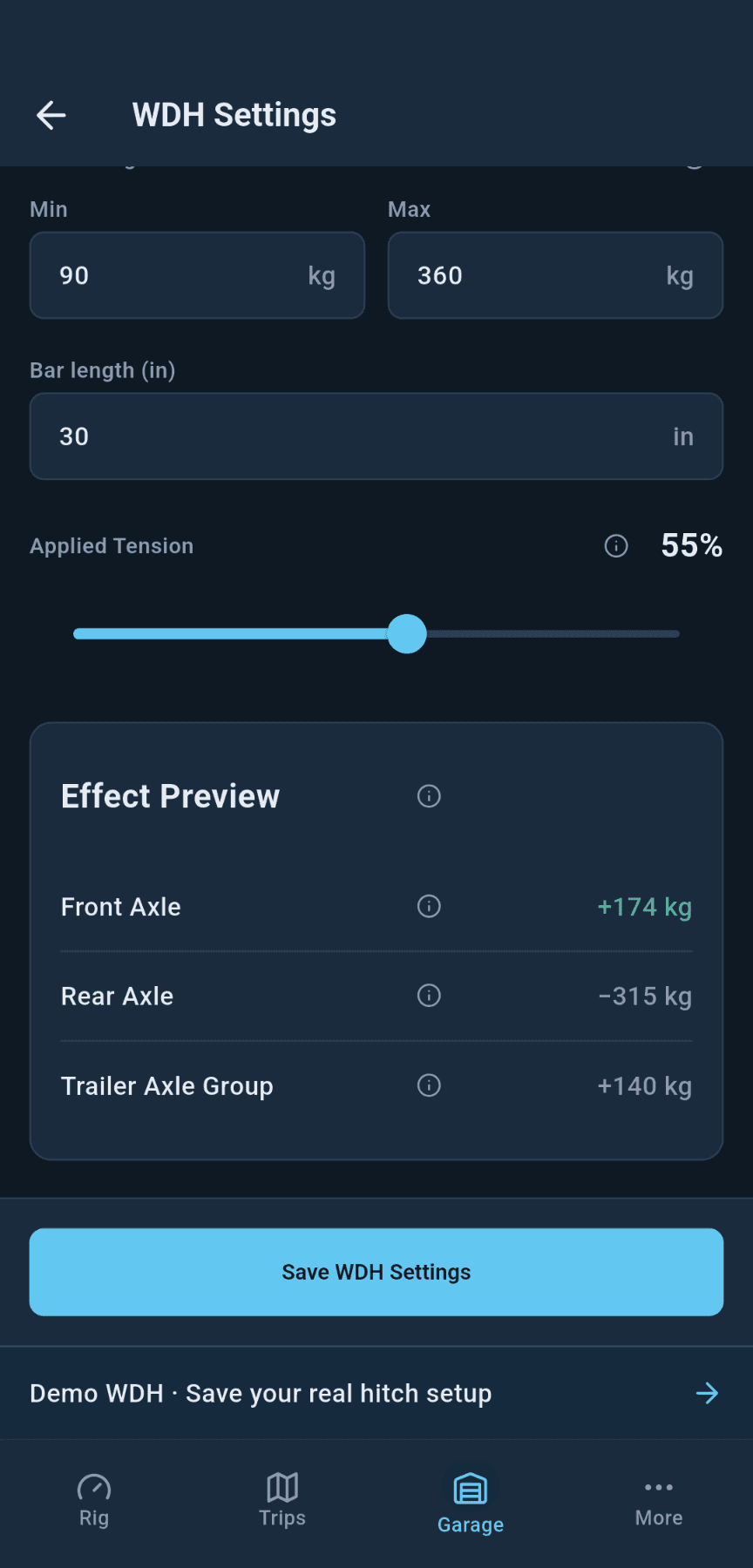
Tune the hitch for this load
loadmate models your weight distribution hitch, spring-bar or FALR, and shows the load coming back onto the steer axle. A tension set for one load is wrong for the next, so the model moves when the load does. Create a free account to explore it on a populated demo rig in the app.


Common questions
- For those towing a van with a D-Max — did you look at the Ranger first?
Plenty of owners did, and at least one ExplorOz tower chose the Isuzu after running exactly the maths on this page. The honest split: the Ranger's 6,400 kg GCM makes its combined-mass gap 450 kg against the D-Max's 600 kg, so at a full-rated tow the Ford keeps more of its ute usable. The D-Max answers with a 6-year/150,000 km warranty, no AdBlue system, and the 4JJ3's long record of plain reliability. Under about 3,000 kg of van the difference rarely decides a trip; at the heavy end, the Ranger's arithmetic is simply easier.
- How do I turn off the hazard features — the lane assist and the emergency braking?
The lane aids have a dedicated answer on every current D-Max: press and hold the lane-support switch on the steering wheel for about 2 seconds. The old 20-30 second menu sequence died with a December 2021 firmware update, so any guide describing it is out of date. The emergency braking is different — ADR 98/00 requires that AEB cannot be permanently disabled, so no factory or dealer setting removes it. One towing-specific detail from the spec sheet: blind-spot monitoring and rear cross-traffic alert switch themselves off automatically when the genuine tow harness is connected.
- If the van weighs 3,500 kg, what's actually left for the family and the gear?
Less than most buyers expect, and it depends on trim. The 6,000 kg GCM caps the uncoupled ute at 2,500 kg during a full-rated tow, and because a van's ATM already includes its ball weight, nothing is counted twice. Above kerb, that leaves 465 kg in an SX, 395 kg in an LS-U or LS-U+, and 330 kg in an X-Terrain — Caravan World's August 2024 tow test printed the same arithmetic at about 350 kg. A bull bar, a canopy and two adults can use up the X-Terrain's figure on their own, which is why most owners run lighter vans instead.
- The DPF light keeps coming on around town — is a D-Max wrong for short trips?
The pattern owners describe is real: the filter cleans itself roughly every 500 km, but only at sustained temperature, so suburban-only running brings the warnings forward. Outback Travel Australia's February 2025 guide recommends two habits for short-trip or dusty use — oil changes at 10,000 km rather than the full 15,000 km interval, and a proper highway run every month or so to let the burn-off finish. The consolation is that the 4JJ3 carries no AdBlue system at all, so it starts with half the emissions plumbing of some rivals.
- 2.2 or 3.0 — is the new engine enough for towing?
Both carry the 3,500 kg rating and identical GVM, GCM and ball limits, so the legal arithmetic is the same. The difference is margin and evidence: the 3.0 makes 450 Nm through a 6-speed and has years of loaded-van records, while the 2.2 makes 400 Nm through an 8-speed and has been on sale only since 1 October 2025 — no owner towing record at real weights exists yet, so every read on it is an expert's. Early reviews split — one found it short of torque with a tendency to flare on upshifts, another found it smooth and quiet at a cruise. Past about 2,500 kg of van, take the 3.0.
- Do I need the genuine Isuzu tow bar to get the 3,500 kg rating?
On Isuzu's published wording, yes: the 3,500 kg figure applies with a genuine tow bar kit or tow tongue kit plus an electronic brake controller, and the 350 kg ball maximum is published on the same genuine-kit condition. Isuzu lists no lower alternative rating without them; an aftermarket bar tows to its own component rating — possibly the same number, but it is the bar maker's, not Isuzu's. In practice the controller costs you nothing extra, because any van heavy enough to matter here needs electric brakes and a breakaway system under trailer law anyway. Check the hardware on the vehicle itself rather than assuming the trim level settles it — the rating follows the genuine kit and the controller, not the badge.
Understand the weight limits
Every figure above is governed by a manufacturer-set limit. These guides explain what each term means and how they fit together.
- Caravan & towing weights explainedThe master glossary: GVM, ATM, GTM, TBM and GCM in one place.
- Gross Combination Mass (GCM)The combined vehicle-plus-trailer ceiling that usually bites first.
- Aggregate Trailer Mass (ATM)What your caravan is legally allowed to weigh, fully loaded.
- Braked towing capacityWhy a 3,500 kg rating rarely means you can tow 3,500 kg.
Sources and review
Specifications checked
Page reviewed
- Isuzu UTE Australia — 25.5MY D-MAX vehicle specifications (PDF)
GVM, GCM, braked/unbraked towing, towball, per-variant kerb, axle capacities, wheelbase and overhang
- Isuzu UTE Australia — D-MAX towing
3,500 kg condition: genuine tow bar or tow tongue kit plus electronic brake controller
- Isuzu UTE Australia — new 2.2-litre engine for D-MAX and MU-X (25 Sep 2025)
MY25.5 range change: 2.2L replaces 1.9L from 1 Oct 2025 with 3,500 kg rating; manuals discontinued
- Isuzu UTE Australia — 2024 D-MAX facelift announcement
MY24 update content: ADAS revisions and equipment changes