How much can the Kia Tasman tow?
| Variant | Braked towing capacity | GVM | GCM | Kerb weight | Payload at full tow | Tow ball rating | Rear axle limit |
|---|---|---|---|---|---|---|---|
| S 4x4MY26 | 3,500 kg | 3,250 kg | 6,200 kg | 2,225 kg | 475 kg | 350 kg | 2,040 kg |
| SXMY26 | 3,500 kg | 3,250 kg | 6,200 kg | 2,225 kg | 475 kg | 350 kg | 2,040 kg |
| SX+MY26 | 3,500 kg | 3,250 kg | 6,200 kg | 2,225 kg | 475 kg | 350 kg | 2,040 kg |
| X-ProMY26 | 3,500 kg | 3,250 kg | 6,200 kg | 2,237 kg | 463 kg | 350 kg | 2,002 kg |
| S 4x2MY26 | 3,500 kg | 3,250 kg | 6,200 kg | 2,126 kg | 574 kg | 350 kg | 2,040 kg |
| X-Line 4x4MY26 | 3,500 kg | 3,250 kg | 6,200 kg | 2,223 kg | 477 kg | 350 kg | 2,040 kg |
6 variants
| Braked towing capacity | 3,500 kg |
|---|---|
| GCM | 6,200 kg |
| GVM | 3,250 kg |
| Kerb weight | 2,225 kg |
| Front axle limit | 1,450 kg |
| Rear axle limit | 2,040 kg |
| Tow ball rating | 350 kg |
| ATM planning ceiling | 2,500 kg |
| Wheelbase | 3,270 mm |
| Rear overhang | 1,285 mm |
What the Kia Tasman can tow, and what it can carry while towing
Kia rates the Tasman at 3,250 kg GVM and 3,500 kg braked, a 6,750 kg sum against 6,200 kg GCM. At full GVM, only 2,950 kg of trailer fits. A full 3,500 kg van caps the ute, occupants and cargo at 2,700 kg. The towing-capacity comparison chart shows where that 550 kg gap sits in the class.
Two payload figures fall out of that and they are easy to confuse, so label them. Taken on its own, the GVM side leaves 675 kg on an S, SX or SX+ (3,250 kg less the 2,225 kg brochure kerb and the 350 kg ball) and 663 kg on the X-Pro's 2,237 kg. The combined-mass side is tighter, and it is the side that governs at the rating: with 2,700 kg of ute permitted, payload at full tow is 475 kg on an S, SX or SX+, 477 kg on an X-Line at 2,223 kg of brochure kerb, and 463 kg on an X-Pro. About 200 kg of the GVM-side figure is claimed by the combined ceiling, and the ball is never subtracted twice because its mass already rides inside the van's ATM. Every payload number here uses the brochure kerb for the named grade; the gross combination mass guide works the subtraction through in full.
The complaint: a new ute already sitting on its bump stops
The Tasman had been in Australian showrooms about three months when tow tests began recording rear settlement. caravancampingsales put a number on it in October 2025: 55 mm of rear-axle dip with a 1,695 kg trailer and roughly 170 kg sitting on the tow ball. The Tasman is rated to carry 350 kg there. So the ute had spent under half its tow-ball allowance and had already dropped more than five centimetres, with delivery plates still on it.
At 170 kg of ball, caravancampingsales described comfort-biased roll yet no trailer sway or porpoising. Eight months later, carsales found its 3,000 kg combination unsettled until a fifth leaf flattened the stance. Kia's local suspension engineer has answered the complaint on the record, and his explanation changes how the measurements should be read.
Kia's answer: the bump stop is designed to carry load
The Tasman's rear end is a rigid axle on leaf springs, and Kia's Australian calibration gives it three stages instead of one. Stage one is a four-leaf variable-rate pack tuned for an unladen ute. Stage two is progressive leaf engagement with polymer dampers as load comes on. Stage three is the bump stop, which Graeme Gambold, the engineer behind the local tune, has described to AutoExpert as a tertiary spring first and a bump stop second. On his account a 2.3-tonne trailer at about 260 kg of ball sits squarely inside the design intent, and an unladen Tasman leaves roughly three fingers of clearance above the stop. That interview is the maker's whole defence, and AutoExpert prints it with a 19 March dateline and no year against it, so treat the account as current and undated.
Read that way, the settling is a working spring stage, not unused clearance. Gambold's advice is to stay inside the ball and GVM limits and accept a firmer laden ride; he gives no factory airbag or GVM-upgrade prescription. CarsGuide's October 2025 load test found the rear rubbers meeting the rails early and removing hard thuds from a fully laden tub.
The case against: a 3,000 kg van and a fifth leaf spring
carsales then spent six months and 10,000 km towing with an X-Pro and published the result in June 2026. Behind a van at 3,000 kg ATM, the standard four-leaf pack was found wanting: the rear dipped far enough that the tertiary spring was into the chassis rail, the nose of the ute rose in sympathy, and the combination turned unsettled with it. The test team inserted one extra leaf into the pack, which lifted rear ride height about 30 mm and left that Tasman sitting flat and stable behind the same van.
The detail that matters is that none of the reported vehicle limits was over. Weighed on test, the combination read 5,476 kg against the 6,200 kg ceiling, the X-Pro's rear axle carried 1,814 kg against its 2,002 kg rating, and the ball sat at 319 kg of a permitted 350 kg. That setup still wanted a fifth leaf before it behaved. The same test recorded 21.773 L/100 km at its worst into gradients and headwinds, mid-to-high teens at 92 km/h, and rated the Tasman's towing acceptable rather than great.
The number that settles it: 1,435 mm of arm on a 3,270 mm wheelbase
Both accounts describe the same physics from opposite ends, and the geometry reconciles them. Rear overhang on every Tasman dual cab is 1,285 mm. The house method places the coupling about 150 mm beyond that published body dimension, producing a working arm of roughly 1,435 mm. Set that against the 3,270 mm wheelbase and the multiplier is about 1.44. Every kilogram on the coupling therefore presses on the rear axle harder than it weighs, and lifts a smaller share off the front. Kia does not publish a ball-to-axle dimension, so the arm is a documented approximation and every figure below is stated as about.
Put the full 350 kg on the coupling and about 505 kg arrives at the rear axle, while about 155 kg lifts off the front, and a steer axle carrying less has less grip to steer with. The axle has the headroom on paper: 2,040 kg on the S, SX, SX+ and X-Line, and 2,002 kg on the X-Pro, the one grade Kia certifies lower. That 2,040 kg equals the headline rear-axle rating the Mitsubishi Triton carries. What decides how the ute behaves is how much spring travel is left once the arm has multiplied the load. Run 170 kg of ball through the same multiplier and about 245 kg lands at the axle, well inside the range where stages two and three of the pack are already working. That is your 55 mm.
Where the 6,200 kg ceiling goes once the accessories are on
Kia's current payload tool lists the tow bar kit at 45 kg, full-hoop bull bar at 102 kg, sports bars at 23 or 29 kg and side steps at 55 or 60 kg. The tow bar plus full-hoop bull bar total 147 kg, leaving 328 kg of an S, SX or SX+'s 475 kg full-tow allowance before occupants or luggage.
Kia publishes a payload and towing tool on the Tasman's model page, and it does the combination arithmetic instead of restating each limit on its own. When caravancampingsales ran a 3,200 kg camper trailer through it in October 2025, the tool came back 117 kg over the 6,200 kg ceiling. Feed the same tool a compliant pairing and the picture is workable but tight: on the configuration that reviewer settled on, about 303 kg of payload remained once spares, tools, two occupants and luggage were aboard.
One paperwork wrinkle is worth knowing about. Kia also sells lower-plated 0.9T versions: its live payload-calculator data gives the S 4x2 a 3,100 kg GVM and the S 4x4, SX, SX+, X-Line and X-Pro 3,200 kg. Each retains the 6,200 kg GCM, 3,500 kg braked rating and 350 kg ball limit. The ATO defines a car for fringe-benefits purposes as a road vehicle designed to carry less than one tonne and fewer than nine passengers, but the tax treatment of a particular arrangement still belongs with an adviser. At full 3,500 kg tow, GCM already caps the ute at 2,700 kg, below either plate, so the lower GVM changes no full-tow payload figure. Read the actual compliance plate before calculating.
What four dated tow tests actually towed
Start light. Exhaust Notes Australia hitched a 1,750 kg ATM Jayco Swan with 140 kg on the ball in May 2026 and reported the Tasman planted under load, without porpoising or a nervous shimmy through the steering; the locally tuned dampers kept the trailer settled even over patchy coastal roads. Payload after occupants and cargo came to 366 kg and the whole combination weighed 4,232 kg of the 6,200 kg allowed. Under 2 tonnes, the verdict was a drama-free tow.
The middle of the range is where opinions start to separate. Caravan World towed a 2,200 kg twin-axle Jayco in September 2025 at about 16 L/100 km, worked through three tow-mode levels that alter shift patterns and an integrated brake controller with 20 levels of adjustment, and then set the reviewer's own recommended ceiling at 2,200 to 2,500 kg once a bull bar, a winch, the tow bar and cargo are accounted for. caravancampingsales, with only 1,695 kg behind it, reported the ute holding 80 km/h up Mount Ousley with nothing left in reserve, at 15.4 L/100 km against a claimed 7.6. And carsales, at 3,000 kg, reached for the extra leaf. Four tests, four different trailers, one shape of conclusion: untroubled to about 2 tonnes, competent to about 2.5, and asking for help beyond 3.
Carrying is a different story from towing. CarsGuide loaded a rear-drive S with 890 kg in the tub plus about 180 kg of crew in October 2025, roughly 50 kg under that test vehicle's published payload allowance, and the ute made light work of a 2 km climb at 13 per cent and 60 km/h — same springs, same bump stops, no complaints. A tub load sits over and ahead of the rear axle; a tow ball sits 1,435 mm behind it. What finds the Tasman's limits is the arm behind the axle.
The ruling on the sag, and the loading decision it changes
On this evidence the early bump-stop contact is deliberate, not proof of a defect. Kia's engineer describes it as the third spring stage, and independent load testing found it working early. The caveat is behaviour: 170 kg on the ball produced 55 mm of squat, while a 319 kg ball on the 3,000 kg test rig preceded the extra-leaf change that made that combination sit flat. A plated limit and a comfortable setup are separate questions.
Ball weight changes with where the van carries gear. A generator or jerry can in a front boot usually adds coupling load, but the amount depends on its distance from the trailer axle group; do not assume every kilogram becomes a kilogram on the ball. Measure the loaded coupling and follow the caravan maker's loading instructions.
loadmate maps a proposed item across the ute, van and coupling, so the projected ball and axle effects move together before you repack. Use that to compare positions the caravan maker permits, then remeasure after a material change. On a Tasman whose third spring stage works early, the location of heavy gear matters more than the 350 kg maximum alone reveals.
Extra leaf springs, weight distribution hitches and GVM upgrades
The test team's extra leaf lifted the rear about 30 mm and made its 3,000 kg combination sit flat. That is one tested setup, not a universal prescription. A weight-distribution hitch has a different job: it redistributes coupling load but removes no mass, and its use and adjustment must be approved by both vehicle and trailer makers.
Aftermarket GVM upgrades for the Tasman are advertised as high as 3,800 kg, but Pedders' public product page does not publish a matching GCM or towing re-rating. The 2,400 kg trailer figure sometimes attached to that upgrade is therefore conditional, not a kit specification: it follows only if the vehicle's exact approval leaves GCM at Kia's 6,200 kg, because 6,200 less a 3,800 kg GVM is 2,400 kg. Read the approval and certificate for the actual variant, then have the engineer confirm every resulting limit before committing.
Choose the van against the combined ceiling, then weigh the loaded rig axle by axle. Check this Tasman's VIN in the national recall register as well: REC-006557 was published on 6 March 2026 and covers a possible blank or slow instrument cluster on 2025-build Tasmans, with a free software update. The Tasman's tow rating also has to work with the accessories and load you carry. Get the loadmate app to add your canopy, passengers and gear to a measured baseline and see what they leave under the combined ceiling. Use the compliance plate and approved modification documents for ratings, and a certified weighbridge ticket for the masses on the day.
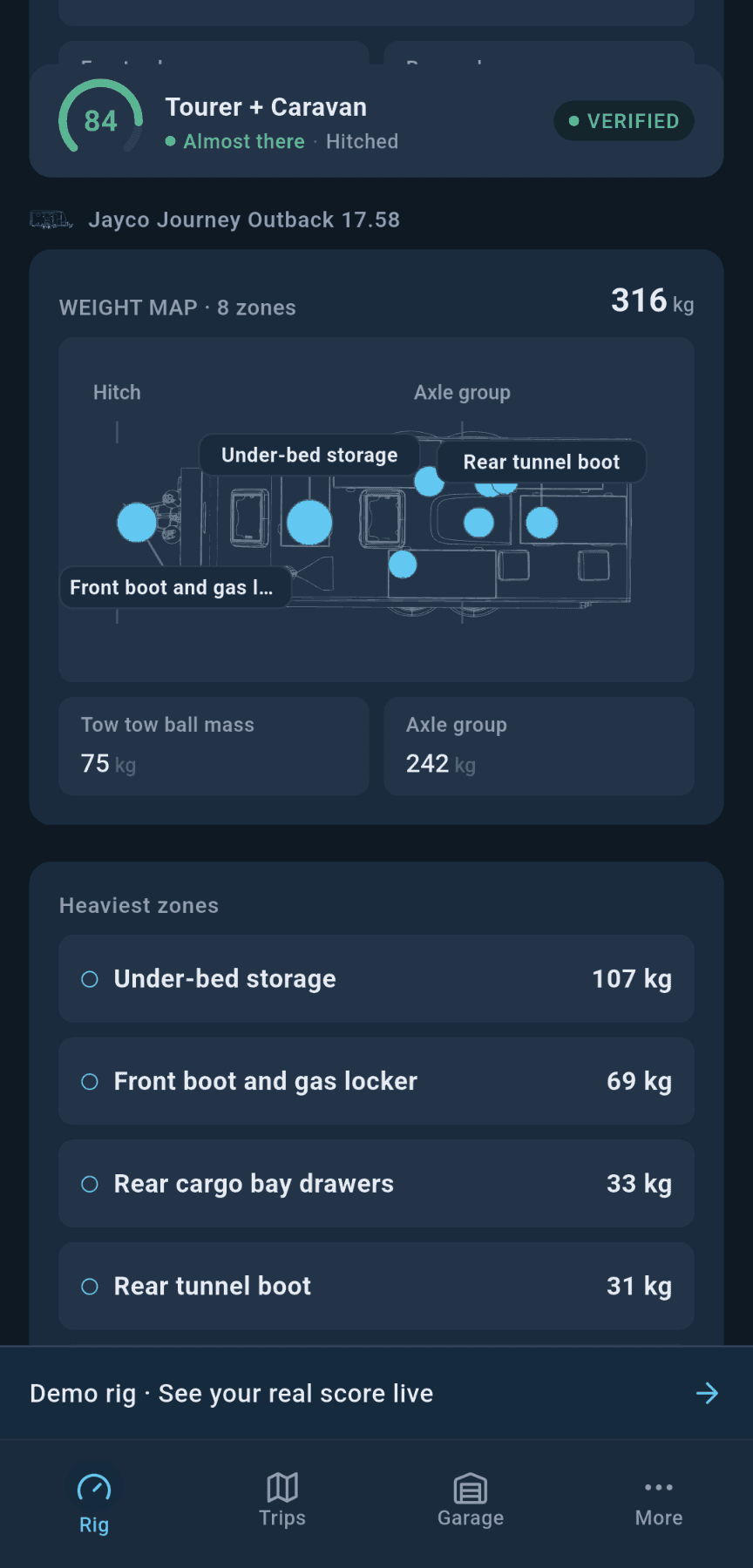
Move the load before changing the hitch
The Tasman's published 1,285 mm overhang makes front-boot weight especially visible at its axles. Start with measured ball and axle loads; loadmate models how moving a generator or water changes the projected distribution, while the vehicle and trailer makers decide whether any WDH is permitted. Create a free account to explore the worked demo, and reweigh after a material setup change.


Common questions
- Can a Kia Tasman tow 3,500 kg?
Yes on the rating, and the useful answer is what is left over. The 6,200 kg gross combination mass caps the ute at 2,700 kg while a full 3,500 kg van is on the ball, which leaves 475 kg for people and gear on an S, SX or SX+ (2,225 kg kerb), 477 kg on an X-Line and 463 kg on an X-Pro (2,237 kg kerb). The rear-drive S starts lighter, at 2,126 kg, and CarsGuide worked the same sum to 574 kg for that variant in October 2025. Kia lists 45 kg for the towbar kit and 102 kg for the full-hoop bull bar: 147 kg before occupants or luggage.
- What is the Kia Tasman's towing capacity for a 3 t van?
Within Kia's published tow, GVM and GCM limits on those assumptions, but near the edge of what the standard suspension is happy with. A 3,000 kg van leaves 3,200 kg of ute under GCM. With about 300 kg on the coupling, GVM caps the pre-ball vehicle load at 2,950 kg, so a 2,225 kg kerb leaves roughly 725 kg for people and gear; GVM is the tighter of those two totals. In carsales' setup, the rear dipped far enough to raise the nose and unsettle the combination until a fifth leaf went into the spring pack. Independent reviewers towing 2,200 kg and below reported no such trouble, which is why 2,500 kg is the safer planning ceiling unless suspension work is already in the budget. Measure the loaded ball and both axles, and verify the towbar, coupling and trailer ratings before treating a setup as suitable.
- Does the Kia Tasman come with a tow bar?
No. On every grade the tow bar is an accessory, and the kit adds about 45 kg to kerb weight, which comes straight out of payload before anything else is loaded. The electronics are the part Kia fits as standard: an integrated trailer brake controller with 20 levels of adjustment, trailer stability assist and a tow drive mode are on every grade including the base S, so a caravan's brakes are wired and tuned from the dash with no aftermarket controller under it. The 350 kg tow-ball maximum is the vehicle's rating; a tow bar carries its own rated capacity, and the pairing is only as strong as the lower of the two, so read the plate on the bar as well as the one on the ute.
- What changes on a Kia Tasman 0.9T?
The GVM drops to 3,100 kg on the S 4x2 and 3,200 kg on the S 4x4, SX, SX+, X-Line and X-Pro. Kia's live calculator retains 6,200 kg GCM, 3,500 kg braked tow and a 350 kg ball limit on each. That reduction cuts unhitched payload, but not payload at the full tow rating: a 3,500 kg trailer already limits the ute to 2,700 kg through GCM. Check the compliance plate because it decides which GVM applies.
- What is the best Kia for towing a caravan?
The Tasman is Kia Australia's only current model rated to 3,500 kg braked with a 350 kg ball. Its dual-cab grades share the headline tow, GVM and GCM figures, so compare kerb and rear axle: S, SX and SX+ are 2,225 kg with a 2,040 kg rear maximum; X-Line is 2,223/2,040 kg; X-Pro is 2,237/2,002 kg.
Understand the weight limits
Every figure above is governed by a manufacturer-set limit. These guides explain what each term means and how they fit together.
- Caravan & towing weights explainedThe master glossary: GVM, ATM, GTM, TBM and GCM in one place.
- Gross Combination Mass (GCM)The combined vehicle-plus-trailer ceiling that usually bites first.
- Aggregate Trailer Mass (ATM)What your caravan is legally allowed to weigh, fully loaded.
- Braked towing capacityWhy a 3,500 kg rating rarely means you can tow 3,500 kg.
Sources and review
Specifications checked
Page reviewed
- Kia Australia — Tasman MY26 brochure and specifications (PDF)
Per-grade kerb, GVM, GCM, payload, front and rear axle ratings, braked and unbraked towing, tow-ball maximum, wheelbase, rear overhang and standard towing hardware
- Kia Australia — Tasman features and specifications page
Current AU range structure, GVM and GCM statements, engine outputs
- Kia Australia — Tasman payload and towing tool
Kia's own combined-mass tool, its 1 Tonne Standard / 0.9 Tonne selection, and current accessory masses: towbar kit 45 kg, full-hoop bull bar 102 kg, single-hoop bull bar 92 kg, sports bars 23/29 kg and side steps 55/60 kg
- Kia Australia — live Tasman trim API
The current 0.9-tonne mass sets: 3,100 kg GVM for S 4x2 and 3,200 kg for S 4x4, SX, SX+, X-Line and X-Pro, all retaining 6,200 kg GCM, 3,500 kg braked tow and 350 kg ball
- Australian Taxation Office — fringe benefits tax guide for employers
The under-one-tonne designed-load threshold and fewer-than-nine-occupants definition; individual tax treatment still depends on use and circumstances
- Vehicle Recalls Australia — REC-006557, Kia instrument cluster software
The recall originally published 6 March 2026 covering 11,567 Kia vehicles across nine models including all MY25 TK1 Tasman variants, the blank/slow instrument-cluster risk and free software-update remedy
- carsales — 2026 Kia Tasman X-Pro tow test (30 Jun 2026)
Six-month 10,000 km tow programme: measured combined mass, rear-axle load and tow-ball mass behind a 3,000 kg van, the fifth-leaf modification, fuel use under tow
- caravancampingsales — What is the Kia Tasman like for towing? (3 Oct 2025)
Measured 55 mm rear-axle dip at about 170 kg of tow ball, Mount Ousley observations, and combined-mass overshoot run through Kia's own tool
- Caravan World — Tow test: 2026 Kia Tasman X-Pro (1 Sep 2025)
2,200 kg tow test, tow modes, integrated trailer brake controller adjustment, recommended working ceiling once accessories are fitted
- CarsGuide — Kia Tasman S (4X2) dual cab GVM test (29 Oct 2025)
Loaded payload test near GVM, early bump-stop engagement under load, payload cap at the full braked rating
- Exhaust Notes Australia — 2026 Kia Tasman X-Pro 4x4 tow test (7 May 2026)
1,750 kg tow test stability observations, measured payload and combined mass
- AutoExpert — Kia Tasman towing on bump stops
Kia suspension engineer Graeme Gambold's account of the three-stage rear suspension and the bump stop as a tertiary spring
- Pedders — Kia Tasman GVM upgrade kits
Advertised 3,490 kg, 3,500 kg and 3,800 kg GVM options; the public page does not publish matching GCM, towing re-rating or approval-certificate conditions, so those remain certificate-dependent