How much can the GWM Cannon tow?
| Variant | Braked towing capacity | GVM | GCM | Kerb weight | Payload at full tow | Tow ball rating | Rear axle limit |
|---|---|---|---|---|---|---|---|
| Ultra DieselMY25 | 3,500 kg | 3,225 kg | 6,200 kg | 2,230 kg | 470 kg | 350 kg | 1,950 kg |
| Alpha Ultra Hybrid (discontinued Jul 2025)MY25 | 3,500 kg | 3,310 kg | 6,555 kg | 2,575 kg | 385 kg | 350 kg | 2,250 kg |
| Alpha Ultra PHEVMY25 | 3,500 kg | 3,495 kg | 6,745 kg | 2,810 kg | 335 kg | 350 kg | 2,250 kg |
| Alpha Lux Turbo DieselMY25 | 3,500 kg | 3,310 kg | 6,555 kg | 2,489 kg | 471 kg | 350 kg | 2,250 kg |
| Alpha Ultra Turbo DieselMY25 | 3,500 kg | 3,310 kg | 6,555 kg | 2,550 kg | 410 kg | 350 kg | 2,250 kg |
| Premium Single Cab Chassis 2.0TD 4x2MY25 | 3,200 kg | 3,050 kg | 5,590 kg | 1,900 kg | 490 kg | 320 kg | 1,915 kg |
| Premium Dual Cab 2.0TD 4x4MY25 | 3,200 kg | 3,135 kg | 5,830 kg | 2,140 kg | 490 kg | 320 kg | 1,915 kg |
| XSR DieselMY25 | 3,500 kg | 3,205 kg | 6,300 kg | 2,330 kg | 470 kg | 350 kg | 1,850 kg |
8 variants
| Braked towing capacity | 3,500 kg |
|---|---|
| GCM | 6,200 kg |
| GVM | 3,225 kg |
| Kerb weight | 2,230 kg |
| Front axle limit | 1,500 kg |
| Rear axle limit | 1,950 kg |
| Tow ball rating | 350 kg |
| ATM planning ceiling | 2,900 kg |
| Wheelbase | 3,230 mm |
Two GWM utes, and two payload figures one kilogram apart
A Cannon Alpha Lux diesel has 120 mm more wheelbase and 259 kg more kerb than Cannon Lux, but a different ceiling stops it. Cannon's GCM leaves 2,700 kg of ute at full tow; Alpha's GVM less ball leaves 2,960 kg. Alpha gains 260 kg of budget and brings 259 kg more kerb, leaving one kilogram more payload: 471 against 470.
Across the six Cannon and four Alpha columns in GWM's April and May 2026 brochures, GCM binds every Cannon and GVM binds every Alpha. The brochures contain the weight tables; the model pages do not show all the GVM, GCM, kerb and axle inputs. The current Alpha model page presents three grade/powertrain cards while the May brochure retains four mass columns, so availability must be confirmed by exact grade. Neither brochure carries a model year: identify the engine and plate rather than inventing one.
The subtraction that decides which limit bites, and why it answers differently on each truck
Add the GVM to the braked tow rating, subtract the gross combination mass, and you have the shortfall: the amount by which a fully loaded ute and a fully loaded van together exceed what the pair may legally weigh. Compare that shortfall with the tow-ball rating. Bigger than the ball, and combined mass is the ceiling you meet first, with the shortfall as the price of hitching up. Smaller than the ball, and the GVM gets there first, so hitching costs exactly the ball. The ball is subtracted once, and on the GVM side, because the 3,500 kg of trailer already sitting in the sum includes it. The gross combination mass guide has the long version of that comparison.
Run it on a Cannon Lux or Ultra. A 3,225 kg GVM plus 3,500 kg of trailer is 6,725 kg against a certified 6,200 kg: a shortfall of 525 kg, comfortably more than the 350 kg allowed on the ball. Combined mass binds, so the brochure's 995 kg of payload drops to 470 kg with a full van on. Now a Cannon Alpha Lux Turbo Diesel: a 3,310 kg GVM plus the same 3,500 kg is 6,810 kg against 6,555 kg, a shortfall of 255 kg, 95 kg under the ball. The GVM binds, so the 821 kg brochure payload falls by the 350 kg on the coupling and no further, landing on 471 kg.
At full tow, hitching costs an Alpha exactly its 350 kg ball allowance across the brochure columns and discontinued Hybrid. It costs a Cannon 405 to 660 kg at that variant's own maximum because GCM can claim more than the ball. The GWM-specific point is one article covering both governing-limit patterns.
The Cannon's ledger: GVM, GCM and payload across six variants
GWM's April 2026 Cannon brochure has six spec columns, and towing splits at the engine. Its 2.0-litre 4x2 single cab chassis and 4x4 dual cab are 3,200 kg braked on a 320 kg ball. The 3,500/350 kg figures begin at the 2.4-litre Lux and continue through Lux cab chassis, Ultra, Vanta and XSR. Chasing Cars reported the February 2025 update introducing the 135 kW, 480 Nm 2.4-litre and nine-speed auto on Lux and above, lifting their braked rating from 3,000 kg.
The combined ceilings split further again, into six different figures across the two ranges. The table on this page now carries every current figure through seven representative mass groups; the extremes are 5,590 kg on the 2.0-litre single cab chassis and 6,745 kg on an Alpha PHEV, and in between the Lux, Lux cab chassis, Ultra and Vanta share 6,200 kg while the XSR sits alone on 6,300 kg. So a bare 6,200 kg quoted for the Cannon describes four of the ten brochure columns and none of the other six. What each keeps at full tow follows: 490 kg on both 2.0-litre variants, 470 kg on the Lux, Lux cab chassis, Ultra, Vanta and XSR alike. At full GVM the 2.0-litre single cab chassis may hitch 2,540 kg, the 2.0-litre dual cab 2,695 kg, a Lux, Ultra or Vanta 2,975 kg, and an XSR 3,095 kg.
The XSR is the interesting column: the highest combined ceiling in the range at 6,300 kg, the lowest maximum rear axle load at 1,850 kg against 1,950 kg on a Lux or Ultra, and 100 kg more kerb weight pulling its brochure payload to 875 kg. The toughest-looking Cannon has the least room at the axle that carries the tow ball. The Vanta needs no arithmetic of its own: GWM prints it in the Ultra's column.
The Cannon Alpha's ledger: more of everything, and 350 kg is the whole bill
The May 2026 Cannon Alpha brochure lists Lux and Ultra diesel columns plus Lux and Ultra PHEV columns. Each is 3,500 kg braked on a 350 kg maximum downball weight, with 1,680 kg front and 2,250 kg rear axle maxima. The diesels share 3,310 kg GVM and 6,555 kg GCM: Lux is 2,489 kg at kerb for 821 kg payload, Ultra 2,550 kg for 760 kg. Both PHEV columns print 3,495 kg GVM, 6,745 kg GCM, 2,810 kg kerb and 685 kg payload. The current model page presents three cards, so do not infer orderability solely from the four-column brochure.
All four shortfalls come in under the ball, at 255 kg on the diesels and 250 kg on the PHEVs, so an Alpha's payload at full tow is its brochure payload minus 350 kg every time: 471 kg on a Lux Turbo Diesel, 410 kg on an Ultra Turbo Diesel, 335 kg on either PHEV. Read from the trailer end, an Alpha at full GVM may hitch 3,245 kg as a diesel and 3,250 kg as a PHEV, which is where its extra combined-mass budget becomes something a buyer can spend.
One table row is historical. CarsGuide reported GWM dropped the Cannon Alpha Ultra Hybrid in July 2025 when the PHEV arrived. Its last brochure figures — 3,310 kg GVM, 6,555 kg GCM and 2,575 kg kerb — leave 385 kg at full tow. For the PHEV, a carsales research page prints 3,480 kg GVM against GWM's 3,495 kg; use the manufacturer's figure.
The axle number the brochure gives, and the one it cannot
GWM's Cannon brochure prints axle loads at kerb: 1,295 kg front and 935 kg rear on Lux, Ultra and Vanta, and 1,345/985 kg on XSR. Their rear maxima are 1,950 kg and 1,850 kg respectively. Those pairs describe the unhitched brochure condition and the absolute ceiling; they do not reveal the loaded margin after a caravan is connected.
GWM publishes no rear overhang or ball-to-axle dimension for either ute, and no per-axle kerb split for Alpha. Public data therefore cannot support hitch-load-transfer or remaining-axle arithmetic. Load the actual vehicle and caravan, then obtain front- and rear-axle weighbridge readings with the combination hitched.
What a GWM Cannon Alpha PHEV tows, and what the tow costs it
The plug-in is where the Alpha's arithmetic gets argued over, so it is worth walking. 4X4 Australia put the practical half plainly in June 2025: a 685 kg brochure payload asks owners to watch what goes in, particularly near the full 350 kg on the towbar.
A larger figure than 335 kg is in circulation and is worth understanding. CarsGuide's August 2025 test of the Ultra PHEV works the sum on the combined-mass side alone: 6,745 kg less a 3,500 kg van less the kerb weight leaves 435 kg, which is right as far as it goes. The ball is the missing step, because it counts against the ute's own GVM instead of sitting on top of the trailer. The vehicle side therefore allows 3,495 kg less 350 kg, and taking the kerb weight off that leaves 335 kg. The lower of the two is the figure to work to.
The plug-in half of the drivetrain does less for a towing trip than for a commute. The same test recorded 72 km of electric running from a 90 per cent charge unladen, and 16 L/100 km with a 2.5 tonne caravan behind and the battery depleted. It found the ute comfortable where that counts: a 13 per cent gradient climbed for 2 km at 60 km/h under tow, engine braking holding the limit coming back down. The BYD Shark 6 reaches the same rating with its two ceilings running out together rather than 250 kg apart.
The PHEV Alpha uses a multi-link coil-spring rear end; the diesels and old Hybrid use leaves. CarsGuide measured roughly 50 mm of rear compression with about 600 kg aboard the PHEV, versus 17 mm with about 650 kg in the Hybrid, while its 220 kg-ball PHEV drive produced a firmer ride without excessive compression. GWM's current site now labels a smaller Cannon PHEV and an Alpha 3.0-litre diesel as upcoming and accepts registrations, but publishes no mass tables for either. Do not transfer the existing ratings to them.
17.2 L/100 km behind a Cannon Ultra, 40 mm of droop, and the hardware at the tow ball
In a measured Australian tow test, carsales hitched a 2,900 kg caravan with 240 kg on the coupling to a Cannon Ultra in November 2025 and recorded 17.2 L/100 km towing, against 6.8 L/100 km unladen on the highway and a claimed 8.4. The rear dropped 40 mm and the nose lifted 5 mm. At 100 km/h the nine-speed sat in seventh, and engine braking held the pair to 70 to 75 km/h downhill. The reviewer noticed sway moments in crosswinds and behind truck wash, and put them partly down to the factory coupling sitting "a little too high in this set-up". He ran the combined-mass sum too: a 3,250 kg trailer would put that rig 275 kg over its ceiling.
CarsGuide loaded a Cannon Ultra to about 990 kg, within 5 kg of its payload limit, in June 2025. It measured about 60 mm of rear compression with roughly 40 mm of bump-stop clearance remaining, and 9.7 L/100 km against the 8.4 claim. Compare those measurements only as two tested setups; GWM's current brochures publish no rear-overhang or ball-to-axle dimension that could turn either into an axle-load calculation.
Then there is the hardware between the two vehicles. No integrated trailer brake controller appears on either equipment list, and the carsales test car ran an aftermarket one; trailer sway mitigation is listed as standard on the Cannon Alpha. Coupling height is a ball-mount job: select or adjust the mount so the loaded caravan sits at the height its maker specifies. A weight distribution hitch has a different role, redistributing part of the tow-ball-induced axle load toward the steer axle and trailer group. It does not turn the wrong ball-mount height into the right one, so measure and set the two separately.
Matching a van to the right GWM ledger, new or used
A Cannon Lux, Ultra or Vanta covers the 2,000 to 2,900 kg band, whose upper end matches the November 2025 measured tow test. At a 2,500 kg van, about 645 kg remains in a Lux or Ultra if the full 350 kg ball allowance is reserved. The 470 kg figure belongs to a full 3,500 kg van. Alpha allows 3,245 kg behind a diesel at full GVM and 3,250 kg behind a PHEV, with 471 kg left in diesel Lux, 410 kg in diesel Ultra and 335 kg in PHEV at full tow.
On a used Lux-or-higher Cannon from before the February 2025 update, verify the plate: Chasing Cars reported the old 2.0-litre versions at 3,000 kg and the updated 2.4 at 3,500 kg. Cannon Alpha Hybrid is used-only and leaves 385 kg at full tow. Plan from the plate unless a supplier can show the exact approval, certificate and conditions for that vehicle and variant.
The first limit you reach changes with the Cannon variant and the way it is loaded. Put the truck's plate and weighbridge figures alongside the accessories you carry in loadmate, and GVM, GCM and axle margins stay connected to the same rig. Recording the next load change shows which of those margins it uses.
A Cannon's canopy and work gear can still be aboard when the caravan is hitched. Get the loadmate app to see how those recorded loads use your variant's remaining margins. For the measurement terms, the caravan weights guide unpicks ATM, GTM and ball mass. Then obtain an axle-by-axle ticket on the packed, hitched rig. This is loading support, not certification; use the plates, approvals and measured masses, as the safety disclaimer explains.
Find the cell that runs out first
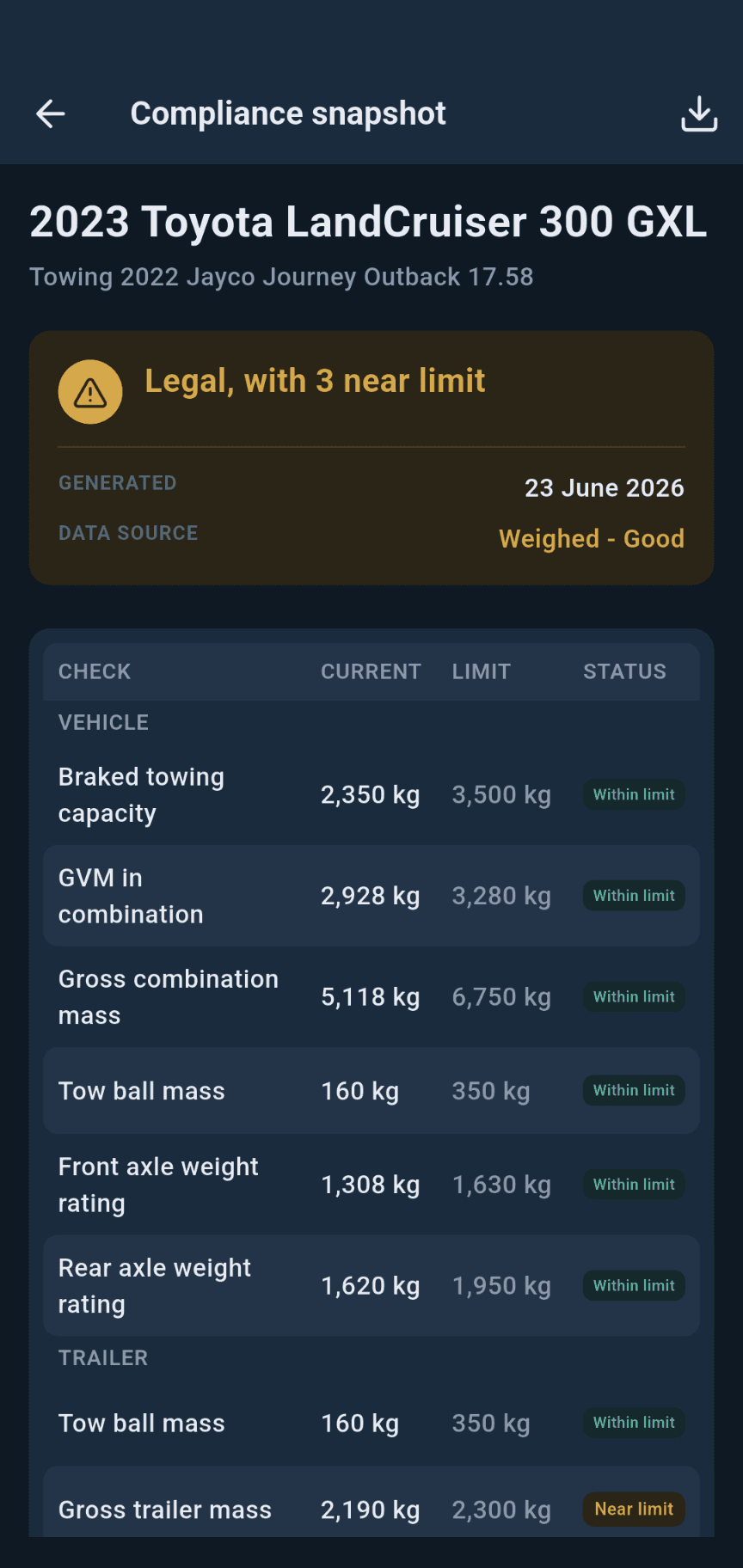
On GWM's April and May brochure figures, a Cannon meets its combined-mass limit first and a listed Cannon Alpha meets its GVM first, so loadmate grades each limit on its own line: GVM, combined mass, both axle ratings and tow ball mass, every one showing the kilograms it still has spare. Create a free account to explore it on a populated demo rig in the app; the grades stay readable whether or not a subscription is running.


Common questions
- What is the difference between a GWM Cannon and a Cannon Alpha for towing?
The current ratings split by engine. The two 2.0-litre Cannon variants stop at 3,200 kg braked on a 320 kg tow ball; the 2.4-litre Cannon Lux and above, plus the four May-brochure Cannon Alpha columns, are rated to 3,500 kg on a 350 kg ball. Among those 3,500 kg variants, a Cannon meets its gross combination mass first and a Lux or Ultra keeps 470 kg at full tow. A brochure-listed Cannon Alpha meets its GVM first, leaving 471 kg on a Lux Turbo Diesel, 410 kg on an Ultra Turbo Diesel and 335 kg on either PHEV. Those Alphas may also hitch about 3,250 kg at full GVM against 2,975 kg for a Cannon Lux or Ultra; no rating is transferred to the upcoming 3.0-litre Alpha.
- Can a GWM Cannon tow a 3.5 tonne caravan?
Yes on a 2.4-litre Lux and above, which are rated to 3,500 kg braked with 350 kg on the ball, and no on the two 2.0-litre variants, which stop at 3,200 kg on a 320 kg ball. The cost of doing it is the number to check. At the full rating a Cannon Lux, Ultra, Vanta or XSR has 470 kg left for people, tools and anything in the tray, because the combined ceiling claims 525 kg of the brochure's 995 kg payload. For a Cannon Ultra, an unhitched 2,530 kg measurement is 300 kg above its 2,230 kg brochure kerb and leaves 170 kg; 2,680 kg has used 450 kg and leaves 20 kg.
- What are the common problems with the GWM Cannon when towing?
Dated tests flag three checks. A November 2025 reviewer felt sway in crosswinds and truck wash and suspected the ball mount sat high for that rig; it also dropped 40 mm at the rear with 240 kg on the ball. A June load test measured about 60 mm of rear compression near payload. For a used Lux-or-higher Cannon around the February 2025 change, read the plate: the older 2.0-litre version was reported at 3,000 kg, the updated 2.4 at 3,500 kg.
- Do the GWM Cannon and Cannon Alpha come with a trailer brake controller?
Neither brochure equipment list shows an integrated trailer brake controller, and the November 2025 Cannon test used an aftermarket one. Trailer sway mitigation is listed on Alpha. VSB 1 Revision 6 says trailers over 750 kg GTM need efficient service brakes. Except for over-run brakes, activation comes from a control signal generated by the tow vehicle; over-run is permitted only up to 2,000 kg GTM. Above 2,000 kg, brakes must operate on every wheel and breakaway must apply immediately and hold for at least 15 minutes. State road-use rules also apply, so confirm controller and towbar compatibility.
- What is a GWM Cannon XSR rated to tow, and what does it keep?
3,500 kg braked on a 350 kg ball, with 470 kg of payload left at full tow. XSR has a 6,300 kg GCM, so it may hitch 3,095 kg at full GVM, but its 1,850 kg rear-axle maximum is 100 kg lower than Lux or Ultra. Its extra 100 kg of kerb weight reduces brochure payload to 875 kg. GWM publishes no hitch dimension, so determine the remaining rear-axle margin from a hitched weighbridge ticket, not a geometric estimate.
- Is there a GVM upgrade for the GWM Cannon or Cannon Alpha?
Do not assume a GVM-upgrade figure for a current 2.4-litre Cannon or Cannon Alpha. If offered a kit, read the exact approval, certificate and registration-jurisdiction rules for that variant. Federal guidance requires ADR evidence for towing above the original maximum, while GCM changes may face separate state or territory requirements. Recalculate only from what the approval certifies.
Understand the weight limits
Every figure above is governed by a manufacturer-set limit. These guides explain what each term means and how they fit together.
- Caravan & towing weights explainedThe master glossary: GVM, ATM, GTM, TBM and GCM in one place.
- Gross Combination Mass (GCM)The combined vehicle-plus-trailer ceiling that usually bites first.
- Aggregate Trailer Mass (ATM)What your caravan is legally allowed to weigh, fully loaded.
- Braked towing capacityWhy a 3,500 kg rating rarely means you can tow 3,500 kg.
Sources and review
Specifications checked
Page reviewed
- GWM Australia — Cannon brochure (PDF, revised 28 April 2026)
Per-variant kerb weight, front and rear axle load at kerb, maximum front and rear axle loads, GVM, GCM, payload, tare, braked and unbraked towing, maximum downball weight, wheelbase, length and fuel capacity across all six Cannon spec columns
- GWM Australia — Cannon Alpha brochure (PDF, revised 7 May 2026)
Per-variant kerb weight, maximum front and rear axle loads, GVM, GCM, payload, tare, braked and unbraked towing, maximum downball weight, rear suspension type and wheelbase across the four columns in the May 2026 brochure; it does not establish the later upcoming 3.0-litre diesel's masses
- GWM Australia and New Zealand — warranty statement (PDF)
Written exclusion of damage caused by exceeding the load limits or towing limits stated in the owner's manual
- Australian Government — Guide to Vehicle Type Approvals (December 2025, PDF)
Federal light-vehicle approval scope: GCM is not assessed or endorsed by the Commonwealth, state or territory law may govern changes, and towing above the OEM maximum requires ADR evidence for towing equipment and vehicle structure
- carsales — GWM Cannon Ultra 2025 tow test (3 Nov 2025)
Measured 17.2 L/100 km towing a 2,900 kg caravan at 240 kg of tow-ball mass, 40 mm rear droop and 5 mm front lift, sway moments attributed partly to coupling height, the aftermarket brake controller fitted to the test car, and the combined-mass sum at a 3,250 kg trailer
- CarsGuide — GWM Cannon Ultra GVM test (22 Jun 2025)
Kerb, GVM, GCM, payload and braked rating confirmed independently, plus about 60 mm of rear spring compression at the payload limit with roughly 40 mm of bump-stop clearance left
- CarsGuide — GWM Cannon Alpha Ultra PHEV GVM test (21 Aug 2025)
Kerb 2,810, GVM 3,495, GCM 6,745 and payload 685 confirmed independently; about 50 mm of coil-spring rear compression at 600 kg aboard, 16 L/100 km towing 2.5 tonnes on a depleted battery, a 220 kg tow-ball observation, and a 13 per cent two-kilometre climb
- CarsGuide — GWM Cannon Alpha Ultra Hybrid GVM test (18 Mar 2025)
The now-discontinued Hybrid's kerb 2,575 and GVM 3,310 (the figure the workbook row had transcribed as 3,225), and 17 mm of leaf-spring rear compression at 650 kg aboard
- CarsGuide — Australia's only hybrid mid-size ute axed (4 Jul 2025)
GWM Australia dropping the Cannon Alpha Hybrid from the range, and its share of Cannon Alpha sales before the PHEV arrived
- Chasing Cars — GWM Cannon 2025 review
The February 2025 update to a 2.4-litre turbo-diesel and nine-speed automatic, and braked towing rising from 3,000 kg to 3,500 kg
- CarExpert — 2026 GWM Cannon Hi4-T PHEV ute detailed (26 Apr 2026)
A dated April 2026 preview of the Cannon Hi4-T PHEV. Its former third-quarter timing is superseded by GWM's current model page, which labels the vehicle Upcoming and publishes no mass table
- 4X4 Australia — 2025 GWM Cannon Alpha PHEV review (22 Jun 2025)
Independent statement that the 685 kg payload requires care once the tow ball is near its 350 kg maximum
- GWM Australia — current Cannon model page
Current range status: the Cannon PHEV is labelled Upcoming with registrations open, but no public mass table is supplied, so existing diesel or Alpha ratings are not transferred
- GWM Australia — current Cannon Alpha model page
Current range status: the Cannon Alpha 3.0-litre diesel is labelled Upcoming with registrations open, but no public mass table is supplied, so no residual is calculated for it
- Australian Government — Vehicle Standards Bulletin 1, Revision 6
Current national trailer-construction thresholds: efficient service brakes above 750 kg GTM; except for over-run brakes, activation by a control signal generated by the tow vehicle; over-run permitted only through 2,000 kg GTM; above 2,000 kg, braking on every wheel plus immediate breakaway application held for at least 15 minutes