4Runner towing at a glance
- The one towing figure Toyota prints
- 6,000 lb (2,720 kg) on every published row, 2WD and 4WD, SR5 through Limited, each rated by the SAE J2807 method
- Load capacity, set by seat count
- 895 lb (405 kg) without third seats and 1,160 lb (525 kg) with them, from the manual's Specifications section and the tire and loading information label
- Where the two figures split
- GVWR minus published curb weight runs 1,005 to 1,550 lb across the lineup; the door label reads 895 lb or 1,160 lb and nothing else
- GCWR, seven published rows
- 10,970 lb on a 2WD SR5 up to 11,485 lb on a 4WD Limited
- Toyota's tongue instruction
- Tongue weight at 9 to 11% of gross trailer weight. Toyota publishes no maximum tongue weight in pounds for this vehicle
- Four thresholds under the rating
- Trailer brakes above 1,655 lb, sway control above 2,000 lb, two or more trailer axles recommended above 3,000 lb, a weight distributing hitch above 5,000 lb
- What port and dealer options take
- A separate load carrying capacity modification label, with owner-reported reductions of 7 to 66 lb on 2025 trucks
- The first 500 miles, then the next 500
- Toyota recommends no towing, then towing below 45 mph with no full-throttle acceleration
- The grades the towing table skips
- Platinum, TRD Pro and Trailhunter have no row in the manual's GCWR table; Toyota's 2026 release states one 6,000 lb maximum and names no powertrain
- The two figures Toyota routes elsewhere
- GVWR and GAWR. The manual sends both to the Certification Label in your own driver's door frame
In February 2025, new sixth-generation owners started photographing the yellow label in their door frames and posting the load line off it. A 2WD SR5 read 895 lb. A four-wheel-drive TRD Sport read 895 lb, and so did a TRD Off-Road Premium and a preproduction Trailhunter. The trucks behind those labels are more than 1,000 lb apart at the curb, and the figure did not move once.
The thread ran for a year without settling it. One owner wanted to know how the sticker could read lower than Toyota's own website; by March 2025 the running conclusion was that Toyota applies an 895 lb sticker regardless of trim, GVWR and curb weight, and nobody could say why.
The answer was already in a book each of them owns, more than 400 pages behind the towing section that started the argument. Toyota defines both figures there, and the definitions say plainly that they measure different things. One is a subtraction. The other is a specification Toyota sets from the seat count rather than from the weight of the truck. Which of the two a loaded 4Runner is living under is a question a scale answers and no document can.
How much can a Toyota 4Runner tow?
A 2026 Toyota 4Runner is rated to tow 6,000 lb, and that figure is the same on every row Toyota publishes: 2WD and 4WD, SR5, TRD Sport, TRD Off-Road and Limited alike. The towing table in the 2026 owner's manual carries seven rows, and the trailer column reads 6,000 lb (2,720 kg) on all seven. What changes down the table is the combined rating.
| 2026 4Runner (i-FORCE gas) | GCWR | Trailer Weight Rating |
|---|---|---|
| 2WD SR5 | 10,970 lb (4,975 kg) | 6,000 lb |
| 2WD TRD Sport | 11,025 lb (5,000 kg) | 6,000 lb |
| 2WD Limited | 11,245 lb (5,100 kg) | 6,000 lb |
| 4WD SR5 | 11,235 lb (5,095 kg) | 6,000 lb |
| 4WD TRD Off-Road | 11,265 lb (5,110 kg) | 6,000 lb |
| 4WD TRD Sport | 11,285 lb (5,115 kg) | 6,000 lb |
| 4WD Limited | 11,485 lb (5,210 kg) | 6,000 lb |
The table's own asterisk states that these models meet the tow-vehicle trailering requirement of SAE International per SAE J2807, so the figure was earned the same way a rival's was. Unbraked, the rating drops to 1,655 lb (750 kg); above that the trailer needs service brakes of its own. Toyota's 2026 press release states a 6,000 lb maximum for the 4Runner and does not differentiate by powertrain.
Three figures in circulation do not match those documents, and they turn up at the top of a search. A 5,800 lb figure attached to the Platinum, TRD Pro and Trailhunter appears in a Google AI Overview served on the head term in August 2026 and on several dealer pages, and a full-text search of the manual and both releases returns nothing for it. A claim that 6,000 lb is hybrid-only, with the gas trims still at 5,000 lb, is contradicted by the manual's own table. And a flat 5,000 lb was correct for the fifth generation, which ended after 2024. The towing capacity chart holds the 4Runner's 6,000 lb against the rest of the midsize SUV field.
Because the trailer column never moves, which row you bought settles very little here. The live question is what the truck has left once the trailer is on it.
Why does the door sticker read 895 lb on every 2-row 4Runner?
Because Toyota builds that figure from a rated cargo load plus a nominal 150 lb for each designated seat, so it follows the seating layout; the weight of the truck never enters it. The 2026 manual prints the definition in its Specifications section: vehicle capacity weight, which it also calls total load capacity, is the rated cargo and luggage load plus 150 lb (68 kg) times the vehicle's designated seating capacity. On a five-seat 4Runner that puts 750 lb of nominal occupants inside the 895 lb and leaves 145 lb described as rated cargo and luggage. On a seven-seat truck the same formula gives 1,050 lb of occupants and 110 lb of cargo, and the label reads 1,160 lb.
A few lines further on, the manual defines the other number owners were computing: maximum loaded vehicle weight is curb weight plus accessory weight plus vehicle capacity weight plus production options weight. GVWR minus curb weight is that arithmetic run backwards, and it returns a different quantity. One figure is what is left when you subtract; the other is a fixed figure Toyota attaches to the seating layout, and the gap between them is widest on the lightest truck.
| 2026 4Runner | Curb weight (forum chart) | GVWR (forum chart, owner-confirmed where noted) | GVWR minus curb | The door label reads |
|---|---|---|---|---|
| 2WD SR5 | 4,455 lb | 6,005 lb (owner label, February 11, 2025) | 1,550 lb | 895 lb |
| 4WD SR5 | 4,685 lb | 6,075 lb (owner label, February 3, 2025) | 1,390 lb | 1,160 lb (3-row) |
| 4WD TRD Sport | 4,850 lb | 6,395 lb (owner label, February 3, 2025) | 1,545 lb | 895 lb |
| 4WD TRD Off-Road | 4,850 lb | 6,240 lb | 1,390 lb | 895 lb |
| i-FORCE MAX grades | 5,225 to 5,500 lb | 6,505 lb | 1,005 to 1,280 lb | 895 lb |
Take the top row on its own. A 2WD SR5 whose owner photographed a 6,005 lb GVWR sits on a chart curb weight of 4,455 lb, so the subtraction gives 1,550 lb. The label in the same door frame gives 895 lb. Those two Toyota-derived figures for one truck are 655 lb apart, and neither is a misprint: Toyota defines both, four pages apart, and they were never built to agree. The same 895 lb is printed on a truck the chart puts at 4,455 lb and on hybrid grades it puts as high as 5,500 lb, roughly 1,045 lb of curb weight apart, because seat count is what the formula reads and curb weight is not in it.
Toyota supplies only half of that table. The manual routes GVWR and GAWR to the Certification Label and publishes neither, and neither press release carries a curb weight, a GVWR or a payload. Subaru's paperwork does the same to Outback owners, whose GVWR also lives only on the car. The curb weights and GVWRs above come from a spec chart posted to a 4Runner owner forum on December 17, 2024, a week after the launch release, and mirrored on a second site. Its poster cited a source document he did not name, and the two reproductions disagree on the order of the hybrid trims. Three owner door-label photographs match it on GVWR, and that corroboration is the only reason the chart is quotable here.
Two nearby vehicles do something that looks similar and is not. Ford's printed Maverick payload also sits below its own GVWR minus curb weight, by 60 to 111 lb, with no published explanation, which is why the Maverick page tells owners to take Ford's figure as Ford's. Toyota's gap is several times larger and Toyota prints the reason for it. Honda moves a Pilot's applicable trailer and tongue ratings as passengers get in, so its numbers change during a weekend. Toyota's 895 lb does not move once the truck is built; the seat count set it at the factory.
One thing reduces it before delivery. Port and dealer accessories come off on a separate load carrying capacity modification label, and 2025 owners posted reductions of 7 lb for running boards alone, 23 lb, 47 lb for a roof rack, 61 lb and 66 lb. On that TRD Off-Road Premium the 895 lb was 848 lb before its owner put anything in it.
What does a 6,000 lb trailer leave inside that 895 lb?
Between 235 lb and 355 lb, because the tongue weight is carried by the truck and comes out of the same allowance the people do. Toyota's manual asks for tongue weight at 9 to 11% of gross trailer weight for conventional towing, stated only as a formula, and Toyota publishes no maximum tongue weight in pounds for the 4Runner at all. Run that band against a trailer loaded to the rating.
| At Toyota's band | Tongue weight on the ball | Left of 895 lb |
|---|---|---|
| 9% | 540 lb | 355 lb |
| 10% | 600 lb | 295 lb |
| 11% | 660 lb | 235 lb |
At the top of Toyota's own band, a five-seat 4Runner towing at its rating has 235 lb left for every person aboard and everything they brought. That is one adult and a bag. Where those pounds land, and why a figure on the hitch ball is spent twice over, is the subject of tongue weight vs payload.
Owners reached the same arithmetic without the table. In April 2024, days after the sixth generation was revealed, one asked how a Trailhunter with 895 lb of payload was supposed to carry people and gear and tow a small camper with a 410 lb hitch weight. Another put a two-adult load against it and got about 555 lb. The overland reaction ran both ways inside one thread: an owner calling the hybrid payload figures hugely disappointing against marketing that names the Trailhunter the model for hauling heavy loads, and another saying 895 lb is more than enough for him, since it is usually just him 90% of the time. Both are reading the same label, and the difference is who else is in the truck. Toyota makes the point in one line of its own: even if the number of occupants is within the seating capacity, do not exceed the total load capacity.
Which of a 4Runner's limits runs out first?
Load capacity, and on a 2-row truck it closes roughly 220 lb before the combined rating does on the tightest published row. The tow rating is the last of the three to have anything to say. The gas rows run like this against the 2-row label, with one caveat carried over: the curb column is the forum chart's rather than Toyota's.
| 2026 4Runner (gas) | GCWR left after 6,000 lb of trailer | 2-row load capacity left after 600 lb of tongue | Which closes first |
|---|---|---|---|
| 2WD SR5 | 515 lb | 295 lb | Load capacity, by 220 lb |
| 4WD SR5 | 550 lb | 295 lb | Load capacity, by 255 lb |
| 4WD Limited | 515 lb | 295 lb | Load capacity, by 220 lb |
The first column is GCWR minus the chart's curb weight minus a 6,000 lb trailer, which is what the truck may gain in people and gear. The second is the 895 lb label minus 600 lb of tongue at the middle of Toyota's band. Both columns describe the same pounds, and the shorter one governs. A 3-row truck reads 1,160 lb instead, which moves the crossing point: 1,160 minus 600 leaves 560 lb, so on a 4WD SR5 with third-row seats the combined rating closes first, by 10 lb. That a headline rating can be entirely real and never the binding number is the argument payload vs towing capacity works through in full.
Two more figures come off the same allowance. A weight distributing hitch is required above 5,000 lb of gross trailer weight, 1,000 lb below the rating, and the hardware itself has weight; the weight distribution guide shows where those pounds land. And the manual's roof carrier limit, 125 lb (57 kg) on 2WD and 135 lb (62 kg) on 4WD, sits outside all of it, and the Forester page covers how roof load behaves.
Every figure in that table starts from a curb weight somebody else published.
What does a 4Runner weigh once it is built up?
Nothing in Toyota's documents answers that, and the manual says so by sending owners to a scale. Its weight-distributing setup instruction reads that gross trailer weight, gross axle weight and tongue weight can be measured with platform scales found at a highway weighing station, building supply company, trucking company or junk yard, and that the front axle should be returned to the weight it carried before the trailer was connected. Toyota is not treating the truck's own weight as a known quantity.
One 2026 TRD Off-Road Premium owner took his to a CAT scale on March 16, 2026, driver only, full tank, running five 35-inch tires and wheels and a hitch-mounted spare carrier. What he reported afterward was that the reading came in a lot less than he had estimated. That is the ordinary result of a first weigh: the estimate was wrong, and only the platform said by how much.
A fifth-generation owner found the other kind of surprise. In August 2020 he put his 2016 SR5 across a CAT scale and came back with 5,640 lb gross, 3,000 lb on the front axle and 2,640 lb on the rear, against a 3,000 lb front GAWR printed on his own label. His note on the ticket was that he was maxed out up front without a full bumper, dual batteries or monster tires, on a build totaling roughly 552 lb. Different generation, different ratings, and what carries over is that the axle line reached its rating before anything else did, and only the scale showed it. A dated fifth-generation build walkthrough shows why the pounds arrive so fast: steel skid plates at 150 lb, a steel front bumper at 175 lb, a drawer system at 150 lb, and a worked example landing 500 lb over that truck's GVWR before anyone gets in.
So the reconciliation has a measurement in the middle of it, with Toyota's two printed figures on either side. The 4WD SR5 starts with a 6,000 lb Trailer Weight Rating and an 11,235 lb GCWR; the 2WD SR5's combined rating is 10,970 lb. Bring the limits for your configuration together with its measured weight and the trailer's own figures. Explore loadmate in the app to see how racks, sliders, drawers and trip gear change the room left behind those ratings.
What you bring is exactly what this article has been circling. The Certification Label in the driver's door frame holds the GVWR Toyota never publishes. Compare the loaded truck, including its tongue load, with that figure. Check the trailer's loaded weight against the 6,000 lb rating and truck plus trailer against GCWR. Toyota states tongue guidance as a percentage, so use the applicable guidance and measured load rather than inventing a separate pound limit.
The vehicle's measured weight is where the whole reconciliation lands. A printed curb weight leaves the margins resting on an estimate. A CAT scale ticket gives the baseline a real figure. If the truck has never been across a platform, the weigh-in walkthrough and the ticket explainer take the mystery out of the visit.
loadmate provides decision support for towing safety, not legal weight certification. Score, compliance checks, and trip readiness are based on the data you enter and the regulator information current at the time of release. For legal weight evidence, use a certified truck scale / CAT scale. Towing remains the operator's responsibility. See /safety-disclaimer.
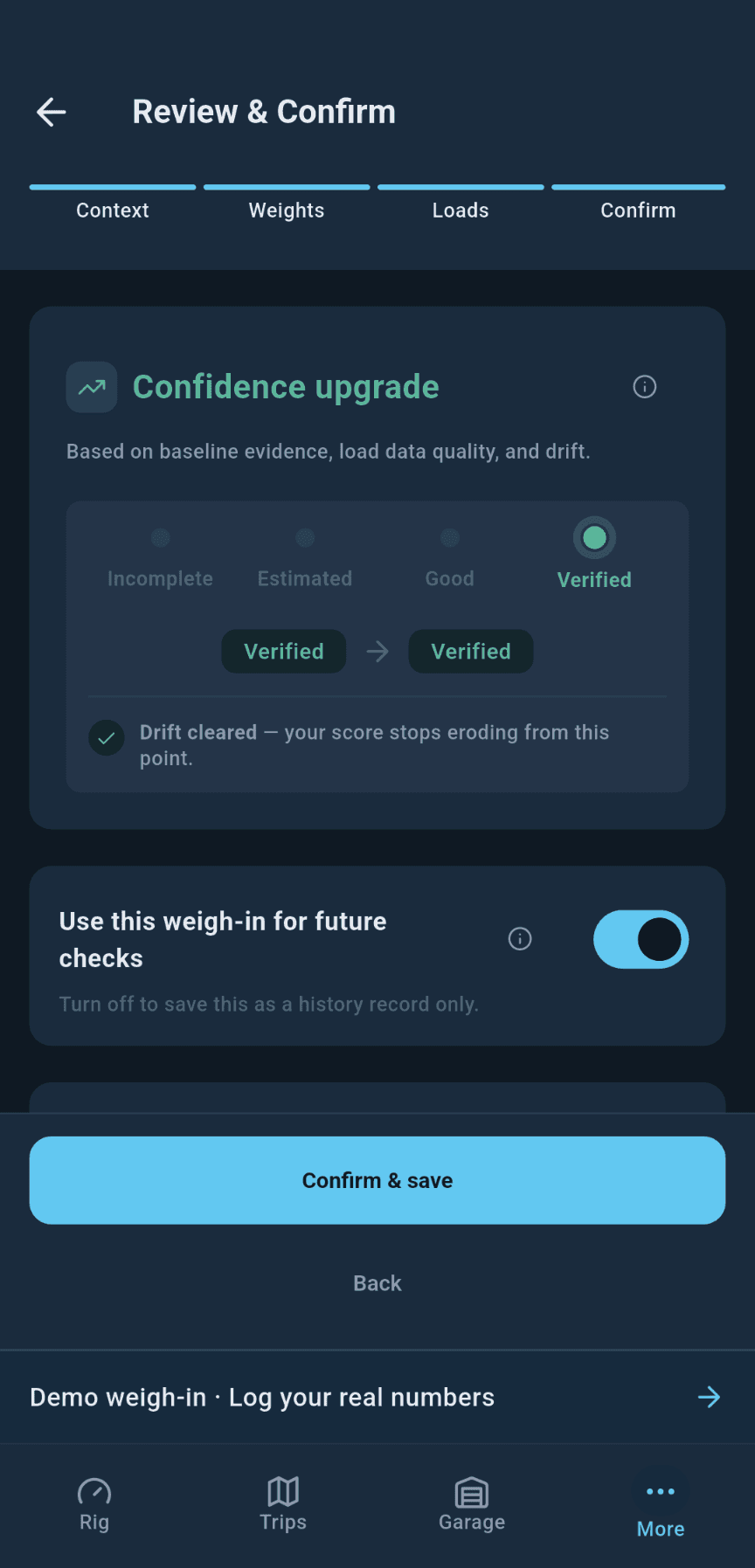
Margins that know when they were measured
Every margin stands on a weight somebody supplied. loadmate logs each CAT scale ticket against your saved 4Runner, recalculates the margins from what the platform read, and keeps each figure's measured-or-assumed standing in view, so still-inside-every-limit gets asked of real pounds after every build stage.


Does the i-FORCE MAX hybrid tow less than the gas 4Runner?
Toyota's 2026 release, dated November 5, 2025, states one 6,000 lb maximum for the 4Runner and names no powertrain, and no Toyota document carries a lower figure for any grade. The document trail behind the hybrid is thinner, and it is worth knowing precisely.
The 2026 owner's manual behind the figures above is the gas book. Its engine specification names the T24A-FTS and nothing else, a full-text search of its 711 pages returns no hits for i-FORCE MAX or traction battery, and its GCWR table carries seven gas rows with no Platinum, TRD Pro or Trailhunter among them. The hybrid runs on a separate owner's manual of its own. So the record splits: the lineup-wide 6,000 lb comes from the release, and the published GCWR rows belong to the gas grades. Owners hit the same wall. In July 2025 one posted about conflicting dealer information on hybrid towing capacity against what the manual's table prints, and he was reading the same seven rows.
The hybrid does carry more weight. The forum chart puts the i-FORCE MAX grades between 5,225 lb and 5,500 lb at the curb against 4,455 lb to 4,970 lb for the gas trims, on a GVWR of 6,505 lb. The hybrids owners have photographed so far, a TRD Pro and a preproduction Trailhunter, still get the same 895 lb on the door label, which is the formula working as written: it never saw the curb weight.
How much can a used 4Runner tow?
5,000 lb across the fifth generation, 2010 through 2024, and the 7,000 lb figures that circulate belong to a fourth-generation V8 that stopped being built in 2009. Generation is the first thing to settle on any used 4Runner, because every towing number that matters changed at the 2025 changeover.
| Generation | Powertrain | Towing capacity |
|---|---|---|
| Fourth, 2004 to 2009 | 4.7L V8, rear-wheel drive | Up to about 7,000 to 7,300 lb |
| Fifth, 2010 to 2024 | 4.0L V6, 5-speed automatic | 5,000 lb |
| Sixth, 2025 onward | 2.4L turbo i-FORCE / i-FORCE MAX, 8-speed automatic | 6,000 lb |
The sixth generation added 1,000 lb, or 20%, over the fifth, and dropped the V6 and the 5-speed doing it. Fifth-generation GVWR and payload figures still quoted in owner threads, commonly a 6,300 lb GVWR and 1,550 lb of payload, describe those trucks; the sixth generation's owner-photographed GVWRs run 6,005 to 6,395 lb, and the forum chart's span reaches 6,505 lb on the hybrid grades. Any 4Runner figure needs its generation attached, including the ones above.
Two NHTSA campaigns sit against the current trucks. Campaign 25V595000, reported November 9, 2025, covers an instrument-panel software error at startup that may leave the speedometer and the brake and tire-pressure warning lights undisplayed, with an over-the-air remedy and owner letters mailed from December 5, 2025. And on April 5, 2026, NHTSA recorded campaign 26V282000, in which Gulf States Toyota reported that certain 2026 4Runners carry a load carrying capacity modification label stating the incorrect capacity, a non-compliance with Federal Motor Vehicle Safety Standard 110; the remedy is a new label, mailed to owners from June 18, 2026. A VIN check on NHTSA.gov settles both in a minute. Toyota's capacity-label record over a longer run is covered on the Tundra page.
Toyota's break-in recommendation belongs on the same list: it asks owners not to tow at all in the first 500 miles of a new vehicle or a new powertrain component, then towing below 45 mph with no full-throttle acceleration for the next 500. So does the manual's instruction to retighten the towing ball and bracket fixing bolts after roughly 600 miles of towing.
How long does one scale reading stay true?
On a truck that gets built up, until the next thing is bolted on. The owner who weighed his 2026 TRD Off-Road Premium in March came back to the scale on July 20, 2026, four months later. In between, the truck gained full skid plate protection, a full-length roof rack, rock sliders, a rear swing-out carrying two jerry cans, an off-road jack and a full-length sleeping platform, and lost its rear seat. With his wife and the filled cans added he puts it at just around 6,050 lb. The forum chart's gas TRD Off-Road row reads 6,240 lb of GVWR and carries no separate Premium line, so his own Certification Label is the only thing that settles what margin he has left.
Nothing about that truck's ratings changed between March and July. The 6,000 lb stayed 6,000 lb and the door label stayed 895 lb. What changed is the number both of those are measured against, and almost everything on that list stays on the truck. A build like that does not add weight once; it adds weight in stages, and each stage retires the last reading.
That is where a second ticket earns its place, and a third. After the rack, after the sliders, after the drawers, the truck you tow with weighs something different. loadmate connects recorded weigh-ins with the changes you add between them, keeping the basis of the weight picture visible. Explore loadmate in the app to see how the next stage of your build affects the next trip.
Related guides
Every number above has a longer story on this site, and two of them belong to other Toyotas.
- What can I tow?: the three-way check itself, and the trailer classes each capacity tier reaches
- Towing weight ratings explained: what a GVWR, a GAWR and a combined rating each restrain, and why none is derived from the others
- Payload vs towing capacity: the column that closes 220 lb before GCWR does above, and where its pounds go
- Tongue weight vs payload: the 600 lb on the ball that the cabin's allowance also has to hold
- Weigh a travel trailer at a CAT scale: the trip Toyota's own setup instruction sends owners on
- How to read a CAT scale ticket: what each printed line on the ticket answers, one rating at a time
- Weight distribution hitch and front axle load: the hardware Toyota requires above 5,000 lb of trailer, explained from the axles up
- How much can a Toyota Tacoma tow?: the Toyota where cab and engine move the rating instead of leaving it flat
- How much can a Toyota Tundra tow?: the full-size Toyota, and what a reissued capacity label does to an owner
- How much can a Toyota Highlander tow?: the three-row Toyota, where a rental counter's arithmetic can turn the lineup's order over
- Towing capacity chart: the 4Runner's row beside every other midsize SUV's
Frequently asked questions
- How much can a 2026 Toyota 4Runner tow?
6,000 lb (2,720 kg), and the figure is the same on every row Toyota's 2026 owner's manual publishes: 2WD and 4WD, SR5, TRD Sport, TRD Off-Road and Limited. The combined rating is what varies, from 10,970 lb on a 2WD SR5 to 11,485 lb on a 4WD Limited. Unbraked, the rating falls to 1,655 lb. Toyota's November 5, 2025 release states the 6,000 lb maximum without naming a powertrain, and the manual's GCWR table lists only the gas grades.
- Can a Toyota 4Runner pull a camper?
Yes, sized by the load line rather than by the 6,000 lb rating. Toyota asks for tongue weight at 9 to 11% of gross trailer weight, so a trailer loaded to 6,000 lb lands 540 to 660 lb on the ball, weight the 895 lb on a 2-row door label has to absorb before anyone boards. That leaves 235 to 355 lb for the people and the gear. A smaller trailer leaves proportionally more, which is why the practical question is what the tongue weighs when the trailer is packed, not what the trailer weighs dry.
- Why is the payload on my door sticker hundreds of pounds lower than GVWR minus curb weight?
Because they are two different quantities and Toyota defines both in the same manual. Vehicle capacity weight, the door-label figure, is the rated cargo and luggage load plus 150 lb times the vehicle's designated seating capacity, so it follows the seat count and reads 895 lb on every 2-row 4Runner and 1,160 lb on every 3-row. GVWR minus curb weight is a subtraction, and it runs 1,005 to 1,550 lb across the lineup. On a 2WD SR5 the two land 655 lb apart. Load to the label, and put the truck on a scale to learn how much of the figure is left.
- What 4Runner can tow 7000 lbs?
A fourth-generation truck, 2004 to 2009, with the 4.7-liter V8 and rear-wheel drive. No current 4Runner is rated for it: the sixth generation, 2025 onward, is rated 6,000 lb on every published row, and the fifth generation, 2010 to 2024, was rated 5,000 lb. A 7,000 lb trailer would also put roughly 630 to 770 lb on the ball at Toyota's own 9 to 11% band, which is more than the entire 895 lb load capacity a 2-row 4Runner is given for people and cargo.
- What is the towing capacity of the 4Runner hybrid?
Toyota's 2026 release states one 6,000 lb maximum for the lineup and does not differentiate by powertrain. The 5,800 lb figure attached to the Platinum, TRD Pro and Trailhunter on several dealer pages and in a Google AI Overview appears in no Toyota document: not the manual, not either release. The manual's published GCWR table covers the gas grades only, and the hybrid has a separate owner's manual, so a hybrid owner should read the combined rating out of their own book. The hybrid grades carry roughly 375 to 400 lb of extra curb weight on matched trims, and their door labels still read 895 lb.
- Do I need a weight distributing hitch on a 4Runner?
Above 5,000 lb of gross trailer weight, Toyota requires one, which is 1,000 lb below the 6,000 lb rating. Three other thresholds sit under it in the same manual: trailer service brakes above 1,655 lb, a sway control device above 2,000 lb, and two or more trailer axles recommended above 3,000 lb. Toyota's setup instruction is to restore the front axle to the weight it carried before the trailer was connected, measured at a scale, or to match the front fender height above the axle if the axle weight cannot be measured directly, and never to lower that height below the original measurement.
- How do you carry people and gear and tow a small camper on 895 lb?
By choosing the trailer from the tongue end, which is what owners in the forums keep concluding. A camper with a 410 lb hitch weight leaves 485 lb of the label for everyone in the truck, and packing that camper raises the hitch weight rather than lowering it. Three levers help: a lighter trailer, a trailer that carries its nose light within Toyota's 9 to 11% band, and a 3-row 4Runner, whose label reads 1,160 lb. Port and dealer accessories have already taken 7 to 66 lb off the printed figure on the 2025 trucks owners photographed, so read your own label rather than the brochure.
- Are 4Runners good for towing?
Inside its own figures it is well regarded, and the complaints cluster on the load line rather than on the towing. One sixth-generation owner reported towing a 5,700 lb boat 40 miles in 95-degree heat in August 2025 and called the truck's towing capacity excellent. The dissent is about payload: overland owners have said flatly that 895 lb does not cover the build they wanted, while other owners in the same threads say it is more than enough for the way they use the truck. Toyota's own conditions are worth planning around too: 65 mph maximum while towing, and a warning that the engine may overheat on long or steep grades above 85 degrees Fahrenheit.