How much can a Toyota Highlander tow?
Every 2026 gas Highlander is rated at 5,000 lb; every 2026 Highlander Hybrid is rated at 3,500 lb. The gas range is XLE, XSE, Limited and Platinum. The hybrid range is XLE, Limited and Platinum. All-wheel drive is standard across both ranges for 2026.
| 2026 Highlander | Grades | Maximum trailer weight | GVWR |
|---|---|---|---|
| 2.4L turbo gas, AWD | XLE, XSE, Limited, Platinum | 5,000 lb | 5,970 lb |
| 2.5L hybrid, AWD | XLE, Limited, Platinum | 3,500 lb | 6,000 lb |
These figures come from Toyota's 2026 gas Product Information, hybrid Product Information and model-year announcement. They apply to the regular Highlander. The larger Grand Highlander has its own ratings, including a different Hybrid MAX powertrain.
A trailer's loaded weight is what matters against the rating. A 3,500 lb dry trailer will exceed the Highlander Hybrid's limit once gear and supplies are added. For alternatives, the US towing capacity chart compares gas and hybrid SUVs and their required equipment.
Does the 2026 Highlander need a tow package?
Toyota lists the 5,000 lb gas and 3,500 lb hybrid ratings by powertrain, without a tow-package upgrade in the 2026 product sheets. You still need a suitable hitch, ball mount, ball, wiring and the equipment required for the trailer. The owner's manual directs hitch-installation questions to a Toyota dealer and says to check the hitch assembly's own rating.
The 2026 gas owner's manual, pages 184–188, adds these conditions:
| Gas Highlander condition | Toyota's instruction |
|---|---|
| Trailer without service brakes | Maximum 1,000 lb loaded trailer weight |
| Loaded trailer above 1,000 lb | Adequate trailer service brakes required |
| Loaded trailer above 2,000 lb | Sway-control device with sufficient capacity required |
| Loaded trailer above 3,000 lb | Two or more trailer axles recommended |
| Tongue weight | 9% to 11% of loaded trailer weight, within the hitch and vehicle limits |
| Combined vehicle and trailer weight | Maximum 10,600 lb |
The gas model's electronic Trailer Sway Control does not establish that the separately specified sway-control device is fitted. Ask about compatible equipment for your trailer. The hybrid has its own owner's manual; this guide does not transfer the gas model's unbraked or combined-weight limit to it.
Highlander curb weight and the room left for passengers
The 2026 gas Highlander has a published AWD curb weight of 4,376 to 4,453 lb. The hybrid is heavier, at 4,515 to 4,595 lb. These base weights exclude your passengers, luggage and added equipment.
| 2026 Highlander grade | Published AWD curb weight |
|---|---|
| Gas XLE | 4,376 lb |
| Gas XSE | 4,420 lb |
| Gas Limited | 4,453 lb |
| Gas Platinum | 4,453 lb |
| Hybrid XLE | 4,515 lb |
| Hybrid Limited | 4,595 lb |
| Hybrid Platinum | 4,595 lb |
Use the certification label in the driver's door area for your vehicle's GVWR and front and rear axle ratings. The tire and loading information label gives the combined occupant-and-cargo allowance. Tongue load uses that allowance alongside the people and bags inside. Accessories fitted after manufacture also use carrying room.
Toyota's gas Product Information sheet retains a FWD/AWD curb-weight heading, even though the 2026 lineup is AWD only. The table above uses the AWD figures. A base curb-weight subtraction is a useful estimate; the labels and a loaded weighing establish what applies to your own Highlander. The tongue weight and payload guide explains the shared allowance.
The gas or hybrid rating is fixed, but the people, luggage and tongue load change with each trip. Keep those loads together in loadmate so a recorded weigh-in stays connected to what you add or remove afterward.
How do you check the Highlander's combined weight?
Count the trailer's tongue load once when checking the 10,600 lb gas GCWR. You can add the unhitched loaded vehicle to the complete loaded trailer, or add all the axle readings from the hitched combination. Adding the hitched vehicle weight to the full trailer weight counts the tongue load twice.
For an illustrative gas Highlander with an ordinary ball hitch and no weight-distribution transfer:
| Item | Weight |
|---|---|
| Hitched Highlander, including tongue load | 5,970 lb |
| Complete loaded trailer | 5,000 lb |
| Tongue load already carried by the Highlander | 500 lb |
| Combined weight: 5,970 + 5,000 − 500 | 10,470 lb |
| Margin below the 10,600 lb GCWR | 130 lb |
Here the vehicle and trailer are at their respective maximum weights, while combined weight is 130 lb below GCWR. That arithmetic alone does not approve the setup: the vehicle's loading label, each axle rating and the hitch limits still apply. Use actual axle readings for a travel-ready combination; reading a CAT scale ticket explains what each line measures.
Can a Highlander tow a U-Haul trailer?
Check equipment compatibility before using the weight comparisons below to choose a rental. Toyota's gas manual requires a suitably rated sway-control device above 2,000 lb of loaded trailer weight. U-Haul's trailer instructions say weight-distributing or sway-control devices are not used with its trailers. Ask Toyota and U-Haul about the exact vehicle, trailer and equipment before proceeding. The Highlander's electronic Trailer Sway Control does not by itself satisfy the separate device requirement.
U-Haul's reservation guidance explains that its validation system uses your towing vehicle information to recommend compatible trailers and show a cargo allowance. It also directs you to check the vehicle owner's manual. The tables here illustrate the published weight comparisons; they are not a reservation result or approval of the equipment combination.
U-Haul's published trailer instructions give two curb-weight comparisons. For occasional towing, a properly equipped vehicle can tow any recommended U-Haul trailer if the loaded weight of the trailer does not exceed the vehicle's curb weight. And it can tow any U-Haul trailer with brakes provided the curb weight of the tow vehicle is at least 80% of the loaded weight of the braked trailer. Check whether the particular trailer has service brakes; the examples below list the equipment page's brake provision.
The following equipment figures were checked on U-Haul's published pages on August 7, 2026. They compare its strict curb-weight rule with a 2026 gas Limited at 4,453 lb. Passing that comparison alone does not establish rental eligibility or compliance with Toyota's limits.
| U-Haul equipment | Empty | Loaded to its maximum | Trailer brakes | Against the curb-weight rule |
|---|---|---|---|---|
| 4x8 cargo | 850 lb | 2,500 lb | none listed | clears by 1,953 lb |
| 5x8 utility | 1,000 lb | 2,890 lb | none listed | clears by 1,563 lb |
| 5x9 utility with ramp | 1,240 lb | 2,890 lb | none listed | clears by 1,563 lb |
| 6x12 cargo | 1,920 lb | 4,400 lb | surge brake | clears by 53 lb |
| 6x12 utility with ramp | 2,290 lb | 6,000 lb | surge brake | 1,547 lb short |
| Auto transport | 2,210 lb | 7,500 lb | surge brake | 3,047 lb short |
For a gas Highlander, the top three clear that curb-weight comparison and run into Toyota's unbraked limit instead. A 5x8 utility trailer weighs 1,000 lb empty, which is the entire unbraked rating with nothing on the deck, and the 5x9 with a ramp is 240 lb past it in the same state. Loaded anywhere near their own capacities, every unbraked trailer in that list is well outside the gas Highlander's 1,000 lb unbraked limit.
The 4,400 lb 6x12 examples show why both checks matter. Every hybrid below clears the strict curb-weight comparison, but its 3,500 lb Toyota trailer rating rules out towing the trailer loaded to 4,400 lb.
| 2026 Highlander | Toyota's braked rating | Curb weight | Against a 4,400 lb loaded 6x12 |
|---|---|---|---|
| Gas XLE | 5,000 lb | 4,376 lb | 24 lb short |
| Gas XSE | 5,000 lb | 4,420 lb | clears by 20 lb |
| Gas Limited, Platinum | 5,000 lb | 4,453 lb | clears by 53 lb |
| Hybrid XLE | 3,500 lb | 4,515 lb | clears by 115 lb |
| Hybrid Limited, Platinum | 3,500 lb | 4,595 lb | clears by 195 lb |
The hybrid Limited clears the strict curb-weight comparison by 195 lb, but the 4,400 lb trailer exceeds its Toyota rating by 900 lb. The gas XLE is 24 lb short under that curb-weight comparison even though the trailer is 600 lb below its Toyota rating. The 1,500 lb difference between the powertrains' tow ratings still applies when comparing rental trailers.
For the gas XLE, U-Haul's published comparisons produce different results. Applying the 80% braked-trailer allowance to its 4,376 lb curb weight gives 5,470 lb, or 1,070 lb above the 4,400 lb 6x12. The stricter equipment-page wording puts the same vehicle 24 lb short. Confirm the exact vehicle and trailer through the reservation process; the gas Highlander's 5,000 lb tow rating remains a separate limit.
Why is the tow capacity lower than the curb weight?
A tow rating limits trailer weight; curb weight describes the vehicle itself. A trailer weight rating describes what the driveline, brakes and cooling were tested to pull, with a base vehicle, one driver and one front passenger assumed. Curb weight describes what the vehicle itself weighs standing empty. A hybrid Limited weighs 142 lb more than the gas Limited and 219 lb more than the gas XLE, while its trailer rating is 1,500 lb lower.
Making all-wheel drive standard on gas models for 2026 added weight without changing the trailer ratings: a 2025 front-drive XLE was 4,199 lb against this year's 4,376 lb, and a 2025 front-drive Limited was 4,265 lb against this year's 4,453 lb. GVWR rose from 5,870 to 5,970 lb for those grades, covering 100 lb of it. At a rental counter the same 188 lb moves a Limited from 135 lb short of the 4,400 lb 6x12 to 53 lb clear of it. The extra curb weight changes that one rental comparison; the Toyota limits still apply.
When reading Toyota's 2026 gas Product Information sheet, use the AWD curb weights. Its FWD/AWD rows still include the older 4,199 lb XLE and 4,265 lb Limited figures; those FWD entries do not describe the 2026 AWD-only lineup.
For a hybrid owner, a 6x12 cargo trailer weighing 1,920 lb empty leaves 1,580 lb for trailer cargo under Toyota's 3,500 lb rating. Its full 4,400 lb trailer weight would be 900 lb over that rating. Carrying less can bring trailer weight within the rating; the loaded Highlander, hitch, tongue load and rental requirements still need checking. Explore loadmate in the app to see how the load you choose changes the combination.
A 4,400 lb rental example for the gas Highlander
A gas Limited's 4,453 lb base curb weight is only 53 lb above a 6x12 cargo trailer loaded to 4,400 lb. That is a curb-weight comparison, not the remaining room for passengers. The illustration below uses a 440 lb tongue load, or 10% of trailer weight, with an ordinary ball hitch and no weight-distribution transfer. It is before people, bags and added equipment are included in the Highlander.
| The check | The arithmetic | What is left |
|---|---|---|
| Trailer against Toyota's braked rating | 4,400 lb against 5,000 lb | 600 lb |
| Tongue weight against Toyota's stated share | 440 lb, or 10.0% of the loaded trailer | inside the band |
| Loaded vehicle against GVWR | 4,453 + 440 = 4,893 against 5,970 lb | 1,077 lb |
| Vehicle and trailer against the combined rating | 4,893 + 3,960 = 8,853 against 10,600 lb | 1,747 lb |
| Loaded trailer against U-Haul's strict rule | 4,400 lb against 4,453 lb of curb weight | 53 lb |
| Loaded trailer against U-Haul's braked allowance | 4,400 lb against 5,566 lb | 1,166 lb |
Passengers, bags and added equipment reduce the vehicle and combined-weight margins in this illustration. The 53 lb curb-weight comparison stays the same because it uses published curb weight. Weigh the loaded setup and check the actual vehicle labels before treating any of the other margins as available.
This example remains subject to the equipment conflict explained before the rental tables. The 6x12 cargo trailer weighs 1,920 lb empty, so just over 80 lb of cargo takes it above Toyota's 2,000 lb sway-control-device threshold. A positive weight margin does not resolve that condition. The Jeep Wrangler guide explains why meeting weight limits alone does not establish stability.
What to check before a rental tow
Check the hitch connection, tires, lights, load and visibility before towing. Toyota's 2026 gas manual, pages 182–183, lists these checks:
- Set the vehicle's tire pressures, and set the trailer's tires to the trailer maker's figure.
- Check that every trailer light works, and check them again each time the trailer is reconnected.
- Match the ball height to the coupler, and confirm the trailer sits level once it is hitched.
- Secure the cargo, and fit mirrors that comply with the rules where you are driving.
- Stop after a short distance and re-check the lights, the tires and the connections.
The manual also prohibits towing for the first 500 miles of a new Highlander. For the next 500 miles, stay below 50 mph and avoid full throttle. Retighten the hitch ball and its bracket bolts after about 600 miles of towing. Do not tow with the compact T165/90D18 spare fitted; check which spare your vehicle carries. Toyota also lists driver-assistance systems to switch off while towing, including full-speed-range radar cruise, lane tracing, the pre-collision system, blind spot monitoring and rear cross traffic alert.
Toyota limits the current in the trailer-light circuits and cuts them off automatically above these thresholds: 4.5 A on the tail lights, 7.8 A on the right stop and turn circuit, 4.5 A on the left. When the cut-off fires the light stays dark until the relevant switch is turned off and back on, and if that does not restore it the manual sends you to a dealer. U-Haul's own rule is that tow vehicle and trailer lighting must be operational at all times, day and night.
U-Haul recommends a maximum of 55 mph, loading 60% of the cargo weight in the front half of the trailer box, and using only the tow vehicle listed on the rental contract. Toyota's gas manual calls for tongue weight of 9% to 11% of the loaded trailer. Check both the load placement and the resulting tongue weight. Read the trailer and tongue ratings on the fitted hitch, ball and ball mount; the lowest-rated component limits the hitch assembly.
For your own Highlander, start with its powertrain's trailer rating and the labels on the vehicle, then record the loaded trailer, tongue weight, people and bags. In the gas Limited example, the 4,400 lb trailer is below the 5,000 lb rating, but its 440 lb tongue load still uses vehicle carrying room before the family packs. A hybrid starts from a different 3,500 lb trailer limit. Explore loadmate in the app to keep your Highlander's recorded weights and later loading changes connected to those limits. The article's example figures do not transfer into the app.
loadmate provides decision support for towing safety, not legal weight certification. Score, compliance checks, and trip readiness are based on the data you enter and the regulator information current at the time of release. For legal weight evidence, use a certified truck scale / CAT scale. Towing remains the operator's responsibility. See /safety-disclaimer.
What changed for 2026, and what an older Highlander tows
The 2026 gas and hybrid tow ratings stayed at 5,000 lb and 3,500 lb respectively, while AWD became standard across the lineup. Toyota's September 5, 2025 release made all-wheel drive standard on gas models and simplified the grade structure; the LE grade and every front-drive gas Highlander are gone. Gas towing stayed at 5,000 lb, hybrid towing stayed at 3,500 lb, and gas GVWR settled on one figure, 5,970 lb, where 2025 had two.
Toyota replaced the 3.5-liter V6 with the 2.4-liter turbo four for the 2023 model year and the towing figure did not change; the hybrid has been rated 3,500 lb throughout. So a used shopper reading 5,000 lb against a 2023, 2024 or 2025 gas Highlander is reading a current number, and what is worth checking on the individual car is its curb weight and its drivetrain, since front-wheel-drive gas Highlanders were sold through 2025 and weigh roughly 180 lb less.
Check recalls by VIN when considering a used Highlander. The August 7, 2026 NHTSA lookup returned no campaigns for the 2026 model. It does list campaign 25V872000, reported December 17, 2025, covering 2024 and 2025 Highlander and Highlander Hybrid vehicles whose third-row center seat belt roof anchor was installed at an incorrect angle, with owner letters mailed January 27, 2026 and reinstallation with a new bolt as the remedy.
Related guides
- What can I tow?: the general form of the check, for whatever else is on the driveway
- Towing capacity chart: the Highlander's two rows against the rest of the three-row field
- Towing weight ratings explained: what GVWR, GCWR and GAWR each restrain, before a rental company adds a rule of its own
- Payload vs towing capacity: how people, luggage and tongue load share the vehicle's carrying allowance
- Tongue weight vs payload: where the 440 lb on the ball is charged, and how often
- Weigh a travel trailer at a CAT scale: how to replace a published trailer weight with a measured one
- How to read a CAT scale ticket: what the axle lines say about the back of the car
- How much can a Toyota 4Runner tow?: the other Toyota whose door label reads a specification instead of a subtraction
- How much can a Honda Pilot tow?: a three-row rival rated seat count by seat count
- How much can a Ford Explorer tow?: where recalls and a road-check list build the pre-trip list
- How much can a Jeep Gladiator tow?: where U-Haul's configuration requirements land, on a truck whose owner changes its configuration in a driveway
Sources and review scope
The 2026 powertrain ratings, AWD curb weights, gas towing-equipment conditions and combined-weight examples were reviewed on September 24, 2026 against Toyota's product sheets, model-year announcement and gas owner's manual OM0E310U, pages 185–188. Find the manual through Toyota's 2026 Highlander owner resources. On September 26, the equipment qualification was moved before the rental comparisons and rechecked against the gas manual, U-Haul's trailer instructions, reservation guidance and 6x12 cargo page. The remaining rental equipment table, historical models and recall information retain their August 7, 2026 research date. Confirm current rental requirements for your booking and check recalls by VIN.
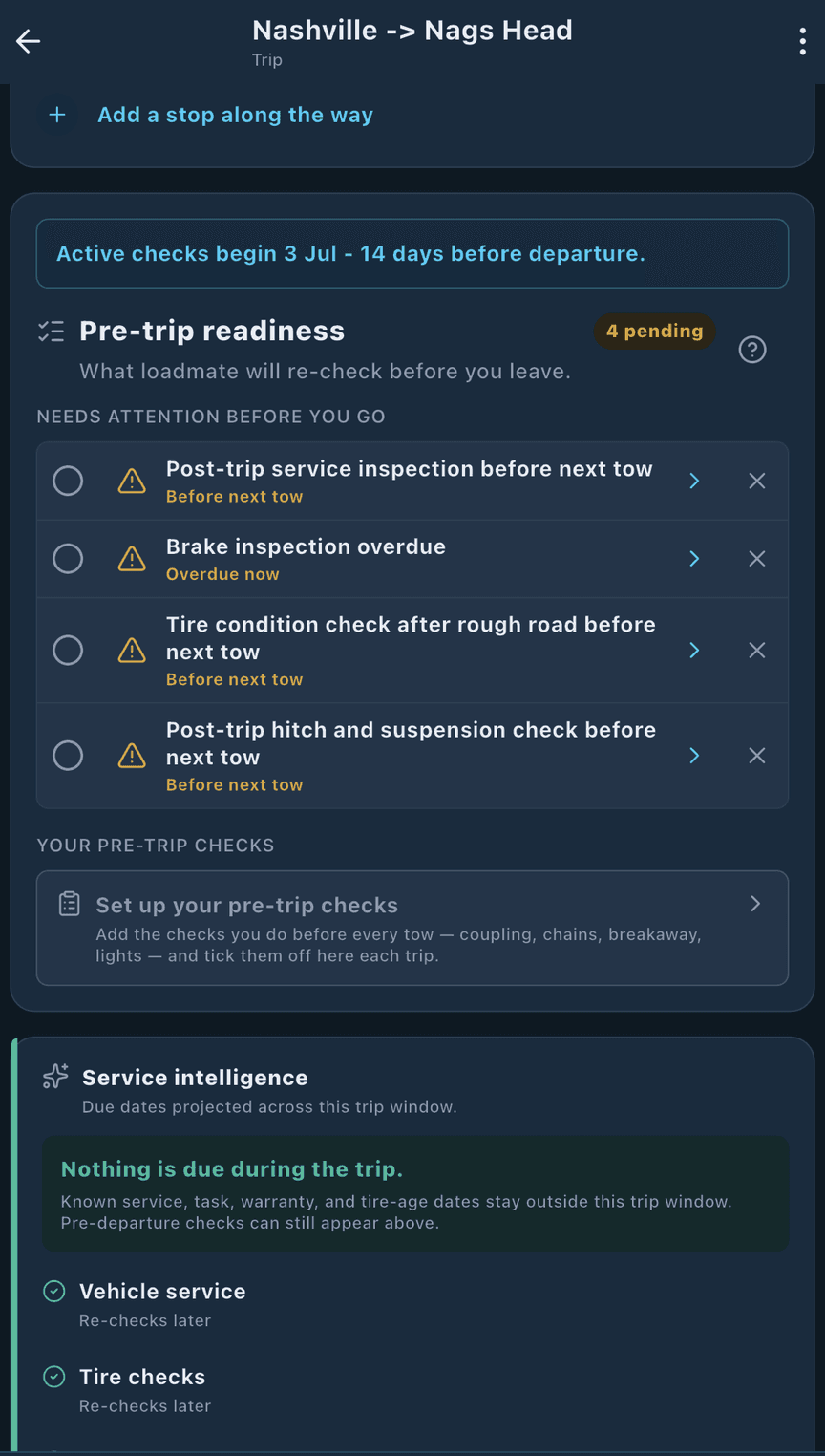
Know what has actually been checked
A rental tow is one pass down a list, on hardware you met an hour ago. loadmate holds that list against the rig itself, service, tire condition, the hitch check and the last weigh-in, each carrying the date it was last done, so whether this thing is ready to leave is something you can look at instead of something you have to remember.


Frequently asked questions
- Can a Toyota Highlander really tow 5000 lbs?
Yes. Every 2026 2.4L turbo gas grade is rated at 5,000 lb, with AWD standard. The gas manual requires trailer brakes above 1,000 lb and a sway-control device with sufficient capacity above 2,000 lb. The loaded vehicle, axles, hitch and combination must also stay within their limits. Count tongue load once when checking the 10,600 lb GCWR: a 5,970 lb hitched vehicle plus a 5,000 lb trailer with 500 lb of tongue load totals 10,470 lb. The Highlander Hybrid is rated at 3,500 lb.
- Can a Highlander tow a U-Haul trailer?
The exact combination must meet both Toyota's limits and U-Haul's equipment requirements. For a gas Highlander towing above 2,000 lb, resolve Toyota's sway-control-device requirement against U-Haul's instruction not to use those devices with its trailers before booking. U-Haul's published curb-weight comparisons are one check, not approval to exceed the tow rating. For example, a 4,400 lb loaded trailer exceeds the Highlander Hybrid's 3,500 lb rating even though the hybrid's curb weight is greater. On the gas model, a trailer without service brakes must stay within Toyota's 1,000 lb unbraked limit. Confirm the particular trailer and vehicle through U-Haul's reservation process and your owner's manual.
- Why is the tow capacity lower than the curb weight?
Because the two numbers measure different things. A trailer weight rating is what the driveline, brakes and cooling were tested to pull, with a base vehicle and two people assumed; curb weight is what the vehicle weighs standing empty. A 2026 Highlander Hybrid Limited weighs 4,595 lb and carries a 3,500 lb trailer rating, and nothing about those figures is in conflict. Rental rules can use curb weight as a separate comparison, where the hybrid Limited's extra 142 lb changes the result. Toyota's 3,500 lb trailer rating still applies.
- Do I need a tow package to tow with a Highlander?
Toyota's 2026 product sheets list 5,000 lb for every gas grade and 3,500 lb for every hybrid grade, without a tow-package rating upgrade. You need a suitably rated hitch assembly, wiring and the required trailer equipment. The gas manual requires trailer service brakes above 1,000 lb and a sway-control device with sufficient capacity above 2,000 lb. Ask a Toyota dealer about equipment for the particular vehicle and trailer.
- Which is better for towing, a Highlander or a Pilot?
They publish their figures in different shapes, so the answer depends on how many people are riding. Toyota rates a 2026 Highlander at 5,000 lb on gas and 3,500 lb on hybrid, flat across grades. Its gas manual recommends tongue weight of 9% to 11% of the loaded trailer. Honda publishes the 2026 Pilot's maximums as tables indexed to occupant count: 5,000 lb of trailer and 500 lb of tongue with all-wheel drive and two people aboard, 4,500 lb and 450 lb with four, and 3,500 lb with front-wheel drive. Two people in an all-wheel-drive Pilot get the same trailer figure as a gas Highlander; four people get 500 lb less. The Honda Pilot page works through how those rows move.
- Is the Grand Highlander the same as a Highlander for towing?
No. The Grand Highlander is a separate, larger model with its own owner's manual and its own entry in NHTSA's vehicle database, and it offers a Hybrid MAX powertrain rated at 5,000 lb where the regular Highlander Hybrid is rated at 3,500 lb. Tow tests, owner reports and capacity figures for a Grand Highlander describe a different vehicle, so none of them transfers to a Highlander.
- Does the Highlander Hybrid tow less because of the battery?
The published specifications do not establish the battery as the reason. They show that the 2026 hybrid is rated at 3,500 lb against the gas car's 5,000 lb, carries a 6,000 lb GVWR against the gas car's 5,970 lb, and weighs 4,595 lb at the Limited grade against 4,453 lb for the gas Limited. The hybrid Limited is 142 lb heavier but has 1,500 lb less trailer capacity. Use its own 3,500 lb rating when choosing and loading a trailer.