How much can the Volkswagen Amarok tow?
| Variant | Braked towing capacity | GVM | GCM | Kerb weight | Payload at full tow | Tow ball rating | Rear axle limit |
|---|---|---|---|---|---|---|---|
| Core TDI405MY25 | 3,500 kg | 3,250 kg | 6,200 kg | 2,276 kg | 424 kg | 350 kg | 1,959 kg |
| Life TDI500MY25 | 3,500 kg | 3,230 kg | 6,350 kg | 2,310 kg | 540 kg | 350 kg | 1,959 kg |
| Style TDI600MY25 | 3,500 kg | 3,350 kg | 6,400 kg | 2,386 kg | 514 kg | 350 kg | 1,959 kg |
| PanAmericana TDI600MY25 | 3,500 kg | 3,350 kg | 6,400 kg | 2,387 kg | 513 kg | 350 kg | 1,959 kg |
| Aventura TDI600MY25 | 3,500 kg | 3,190 kg | 6,300 kg | 2,399 kg | 401 kg | 350 kg | 1,785 kg |
5 variants
| Braked towing capacity | 3,500 kg |
|---|---|
| GCM | 6,400 kg |
| GVM | 3,350 kg |
| Kerb weight | 2,386 kg |
| Front axle limit | 1,490 kg |
| Rear axle limit | 1,959 kg |
| Tow ball rating | 350 kg |
| ATM planning ceiling | 3,200 kg |
| Wheelbase | 3,270 mm |
| Rear overhang | 1,215 mm |
Two Amaroks, one weighbridge, 200 kg between them
Park a Style TDI600 and a Core TDI405 over the same weighbridge and the tow badges agree: 3,500 kg braked, 350 kg on the ball, on both tailgates. The certified ceilings behind those badges do not agree. The Style and its trailer may legally gross 6,400 kg together; the Core and its trailer may gross 6,200 kg. Two identical ratings, 200 kg of legal difference, printed a few rows apart on page 35 of the same September 2025 brochure.
That scene is the whole Amarok towing story. Volkswagen certifies the masses underneath the tow rating trim by trim, so the MY25 spec sheet reads as a ladder: 6,200 kg of gross combination mass over the Core, 6,350 kg over the Life, 6,400 kg over the Style TDI600 and PanAmericana, and — the rung nobody expects — 6,300 kg over the flagship Aventura, whose rear axle is also rated 174 kg below every other Amarok's. The badge never moves, but the ceiling under it does. So this page climbs the range rung by rung, because on an Amarok the box you tick on the order form decides how much the law lets you carry while you tow.
One badge, four ceilings: reading VW's fine print
Two definitions carry the climb. GVM is the most the loaded ute alone may weigh (the gross vehicle mass guide unpacks it); GCM is the most the ute and trailer may weigh together, moving, as one combination. Most utes on the towing-capacity hub hold one GCM across their range — a Ranger V6 is 6,400 kg whichever trim you order. VW instead certifies each Amarok variant against its own driveline, axle and tyre package, with the result that a trim upgrade can move your legal ceilings in either direction.
None of the rungs lets you have everything at once. Add full GVM to a full 3,500 kg trailer and every variant overshoots its own ceiling: by 550 kg on the Core, 380 kg on the Life, 450 kg on the Style and PanAmericana, and 390 kg on the Aventura. Throughout this page, payload-at-full-tow is the room left in the ute when a full 3,500 kg trailer is hitched: the GCM minus 3,500 kg, minus that variant's brochure kerb, with the towball mass riding inside the trailer's 3,500 kg and the GVM side (GVM minus the 350 kg ball minus kerb) checked as the cap. The kerb basis is the brochure kerb for each variant, every time. Those conventions matter here more than on any rival, because the answer swings by 139 kg depending on the rung.
First rung: the Core's 6,200 kg ceiling
The climb starts at the work end. The Core TDI405 — the 125 kW/405 Nm single-turbo four with the 6-speed auto — kerbs at 2,276 kg under a 3,250 kg GVM, which gives it the biggest solo payload of any Amarok at 974 kg. Then the fine print lands: its GCM is 6,200 kg, the lowest on the ladder. At a full 3,500 kg trailer the Core keeps 424 kg of payload-at-full-tow; run the maths the other way and a Core at its full 3,250 kg GVM may legally tow 2,950 kg, not 3,500. Its 550 kg shortfall is the largest in the range. The trim built for carrying is certified tightest for carrying-while-towing.
What the entry ute does not give up is hardware. The September 2025 brochure lists the full towing kit on every grade, Core included: a 3.5-tonne-rated towbar, an integrated trailer brake controller, a 12-pin plug, trailer sway control, and a towing drive mode that keeps engine braking available in every forward gear. Volkswagen's own pitch — full towing kit across the range — holds up against the spec table, and a 2024 tow test confirmed the brake controller as standard fit range-wide. On the Core, only the masses are entry level.
Second rung: the Life quietly carries the most
One rung up, the maths turns in the buyer's favour. The Life TDI500 — 154 kW and 500 Nm from the bi-turbo four, with the 10-speed auto — kerbs at 2,310 kg under the lowest GVM in the diesel range at 3,230 kg, but its GCM climbs to 6,350 kg. That combination makes it the roomiest tow spec on the ladder: 540 kg of payload-at-full-tow, the most of any Amarok, and 3,120 kg of legal trailer at full GVM, also the most. The shortfall shrinks to 380 kg, the smallest in the range. Nobody orders the mid-spec bi-turbo as the towing hero, which is exactly why the ladder is worth reading: the second rung out-carries every V6 above it once the trailer reaches the rating.
It is also the rung with a clock on it. In December 2025 Volkswagen confirmed the TDI500 is gone for MY26 — a call made in parallel with Ford retiring its related bi-turbo — with the Core moving to fleet-only orders and the V6-led MY26 range reaching showrooms in the second half of 2026. The figures here describe the September 2025 MY25 sheet, the stock in runout as that changeover lands. A tow-first buyer who finds a runout Life has found the quietest bargain on the ladder; a keep-it-a-decade buyer should weigh the fact that the next generation walked away from this engine.
Top rung: the V6 pair at 6,400 kg
The top of the ladder is a pair, and they sit level. The Style TDI600 (2,386 kg kerb) and PanAmericana TDI600 (2,387 kg) carry the range's best certified set: 3,350 kg GVM, 6,400 kg GCM, a 450 kg shortfall, and payload-at-full-tow of 514 kg and 513 kg — one kilogram apart. The engine is the 184 kW/600 Nm 3.0-litre V6 turbo-diesel, identical in output to the Ford Ranger V6, and not by coincidence: Ford builds every Australian-market Amarok at Silverton in South Africa on the Ranger's platform. One footnote from the same page proves the ladder follows the mechanical package rather than the trim name: the Style was also sold as a TDI500, and that version carries the Life's 6,350 kg ceiling, not the V6's 6,400 kg.
The dated towing evidence backs the paper. carsales hitched roughly 3,000 kg of 24-foot Jayco Silverline behind both engines in May 2024, with 270-310 kg on the ball, and found the ute planted and stable with little sway or pitching; the V6 held about 397 kg of payload and 525 kg of combined-mass margin at that trailer weight, used about 17 L/100km against the bi-turbo's 15, and let the 10-speed cruise near 2,000 rpm. Chasing Cars ran a PanAmericana for three months and 8,000 km, towed a 2.5-tonne van without drama, and concluded most buyers should save the spend and take the Style V6 — advice the spec table supports, since the PanAmericana's extra kilogram of kerb buys nothing certified.
The flagship steps back down: the Aventura's 174 kg derate
Then the ladder turns where the price list says it should keep climbing. The Aventura TDI600 is the heaviest Amarok at 2,399 kg kerb, yet VW certifies it to a 3,190 kg GVM — 60 kg under the Core's — a 6,300 kg GCM, 791 kg of solo payload, and 401 kg of payload-at-full-tow, the least of any diesel in the range. And the line that matters most sits in the axle column: the Aventura's rear axle is rated 1,785 kg, where every other Amarok carries 1,959 kg. The flagship gives up 174 kg of certified rear axle, on VW's own table.
VW does not publish the reason. The likely mechanism is the Aventura's 21-inch wheels and low-profile rubber: a tyre's load rating caps what its axle may legally carry, and the derated GVM and GCM follow the axle down. Read the lower numbers as fact — they are printed — and the tyre explanation as probable rather than confirmed. The petrol Aventura TSI452 sat tighter still, on a 6,200 kg GCM at flagship trim, until the December 2025 MY26 announcement dropped it from the range; used examples carry those masses with them. One quirk survives the derate: because its GVM is 160 kg lower, an Aventura at full GVM leaves 3,110 kg of legal trailer — 60 kg more than a Style at its own full GVM — but it arrives at that GVM carrying 173 kg less in the tub.
A 350 kg ball, a 1.42 lever, and the axle that shrank
Why fuss over an axle column? Because towball mass does not arrive at the rear axle at face value. The Amarok's coupling sits about 1,365 mm behind the rear axle — 1,215 mm of body overhang plus roughly 150 mm of hitch reach — on a 3,270 mm wheelbase, and that geometry works as a lever that multiplies the load by about 1.42. Load the coupling to its full 350 kg and the rear axle wears roughly 495 kg of it, while the front axle — and the steering it serves — sheds about 145 kg. Every variant shares this geometry, because every variant shares the body.
What they do not share is the axle that takes it. On the 1,959 kg rear axle fitted to four of the five rungs, that 495 kg of lever load leaves 1,464 kg for everything else the axle carries — the ute's own rear weight first, then the tub. On the Aventura's 1,785 kg axle, the same ball leaves 1,290 kg, a slice 174 kg thinner, under the heaviest kerb in the range. A loaded tub over a full ball is precisely the combination that finds that difference. The standard sway control and brake controller manage how the trailer behaves; they do not move one certified kilogram of it. If a heavy-ball van is the plan, the Aventura is the rung where the rear axle is most likely to be the first number to fill — weigh it axle by axle, not as a single total.
Same factory, same V6: sharp buy or orphan risk?
Strip the badges and the cross-shop turns strange: the Amarok and the Ranger come down the same Silverton line, ride the same ladder frame, and share the 600 Nm V6 to the newton-metre. The argument that runs through every Australian owners' thread is whether buying the VW is smart shopping or buying the orphan. The hardware half of that argument is settled. Every grade tows 3,500 kg on a 350 kg ball with the full kit standard; 4x4 Australia's 2023 comparison rated the Amarok's ride and body control clearly ahead of the Ranger Platinum it ran against; and cross-shoppers on Whirlpool through 2023-24 reported driveaway deals that at times put a Style V6 about $5,000 under an equivalent Ranger Sport V6 while carrying more standard equipment. The old money-pit reputation is dead and datable, too: the NF services for $329 to $414 a visit on 15,000 km/12-month intervals — over five years that is cheaper than a HiLux and within about $700 of Ford's pre-paid plan — where the previous-generation Amarok ran past $4,000. The 2017-era forum warnings about a 300 kg ball and a 3,000 kg limit describe that old ute as well; every NF has been rated 3,500/350 from launch.
The ownership-network half is the real argument. The Amarok sells at roughly one for every ten Rangers, so the aftermarket is thinner, owners report slow waits for even basic parts, and owner reviews repeatedly land on the same split — a truck they love driving, and dealer support they fight with when something breaks; one Queensland owner logged six months off the road over a steering fault. Resale gets flagged on the same volume logic: a mechanism to price in, not a measured result. The current-generation gripes are smaller but real — assists that default on with every restart, a stop-start system that takes three screen taps to disable each drive, a back seat too tight for a rear-facing child seat. The national recall register lists two campaigns against the NF: REC-006190 (November 2024) for a driver's seatbelt anchorage fault on 716 utes, and REC-006441 (September 2025) for brake servo control software on 646 — run any used example's VIN through the register before money changes hands.
The tow-first position: for a mostly-stock buyer the Amarok is the rational pick whenever the deal is sharp, because its towing hardware is standard on every rung and its certified numbers are printed; a modifier or remote-area tourer is right to pay for Ford's parts reach instead. Your chosen Amarok trim still has to carry the canopy, accessories and people you travel with. Get the loadmate app to bring that load together with the van and measured weights, then see which margins change as you record the next addition.
Score the rung you ticked, not the badge
Walk back down the ladder and the order-form advice writes itself. The tow rating cannot help you choose — it is 3,500 kg on every rung — so the real choice is between certified sets: the biggest tray payload (974 kg) on the Core, the roomiest full-tow maths (540 kg) on the Life, the 6,400 kg ceiling on the Style and PanAmericana, and the 1,785 kg rear axle that shadows the Aventura. Whichever rung you tick, those numbers travel with the ute, and every trip's load has to live inside them.
That per-trim certification is also why a single live number earns its keep on an Amarok. loadmate's Rig Score reads 0-100 for how the rig stands right now, computed against the certified set of the trim you actually ticked: a Life is scored against 3,230 kg of GVM and 6,350 kg of GCM, an Aventura against 3,190 kg, 6,300 kg and the 1,785 kg rear axle. Hitch the same van to both and the scores part ways, because the ceilings underneath differ — and the score recombines every time gear goes in or a tank fills, so the rung you bought is the rung you are measured on.
Use that as decision support for choosing the van and packing the tub, not as a legal weight record. The figures that stand up at a roadside stop come from the compliance plates and a certified weighbridge, so weigh the loaded rig in travel trim — axle by axle — before the first long run.
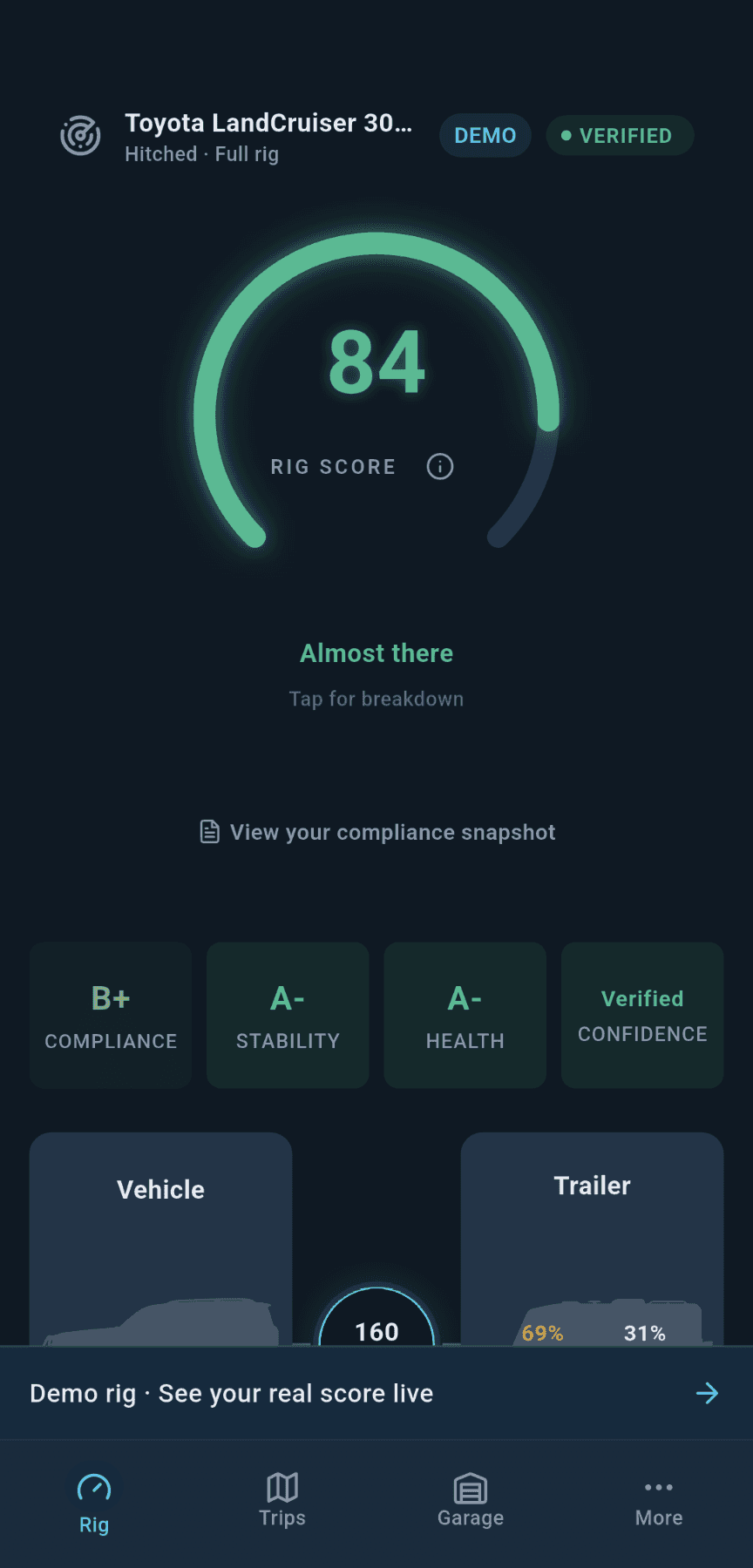
The whole rig, scored in one number
An extra battery or a full water tank changes more than the total weight. The loadmate rig score updates as you record those changes, bringing weight limits and stability into the same picture. Create a free account to explore it on a populated demo rig in the app.


Common questions
- Which would tow a 2.8-tonne caravan better — a Ford Ranger, an Isuzu D-Max or a VW Amarok?
At 2.8 tonnes every MY25 Amarok clears the job with margin: all trims are rated 3,500 kg braked with a 350 kg ball, and even the Core may legally tow 2,950 kg while sitting at its full 3,250 kg GVM. The V6's 184 kW/600 Nm is identical to the Ranger V6's, so the engines cannot split them. What splits them is the certified fine print — the Amarok's GCM ladders from 6,200 kg to 6,400 kg by trim where the Ranger V6 carries a flat 6,400 kg — so compare the exact trim you would buy, not the nameplates.
- Can the Amarok really tow 3,500 kg with the family on board — what's left once the van is hooked up?
It depends on the rung. At a full 3,500 kg trailer, payload-at-full-tow runs 540 kg on a Life, 514 kg on a Style TDI600, 513 kg on a PanAmericana, 424 kg on a Core and 401 kg on an Aventura, each against its brochure kerb. Two adults, two kids, a canopy and a packed tub spend the smaller of those figures quickly. The May 2024 carsales test is the real-world cross-check: a V6 towing about 3,000 kg still held roughly 397 kg of payload and 525 kg of combined-mass margin.
- Is the new Amarok just a rebadged Ranger?
Mechanically they are siblings: the same South African Silverton line, the same ladder frame, an identical 184 kW/600 Nm V6. The certified paperwork is VW's own, though — the Amarok's GCM ladders from 6,200 kg to 6,400 kg by trim where the Ranger V6 is a flat 6,400 kg, the kerb weights differ, the full towing kit (3.5 t towbar, integrated brake controller, 12-pin plug, sway control) is standard on every Amarok grade, and VW runs its own suspension tune, which 4x4 Australia's 2023 comparison rated clearly ahead of a Ranger Platinum's for ride.
- Why can't I turn off the lane assist? It's a bit of a nightmare on country roads.
The assists default back on with every restart, so they need switching off per drive through the assist menu — owner posts describe exactly this frustration, and the three-month PanAmericana press test logged the same pattern with stop-start, which took three screen taps to disable each trip. It is an annoyance rather than a towing limit: the assist that matters with a van on, trailer sway control, is standard on every grade.
- Can I get a GVM upgrade for the 2023-on Amarok?
Aftermarket kits exist — Ironman 4x4 lists GVM upgrades for the 2023-on Amarok and Pedders advertises GVM+ packages to about 3,800 kg on selected variants — but confirm each kit's approval status and the exact NF variants covered before paying, because some kits suit the 4-cylinder utes only. The bigger caveat is arithmetic: a GVM upgrade does not raise the GCM, so on a 6,200-6,400 kg ladder the payload you may carry while towing a full 3,500 kg trailer does not improve just because the solo GVM went up.
Understand the weight limits
Every figure above is governed by a manufacturer-set limit. These guides explain what each term means and how they fit together.
- Caravan & towing weights explainedThe master glossary: GVM, ATM, GTM, TBM and GCM in one place.
- Gross Combination Mass (GCM)The combined vehicle-plus-trailer ceiling that usually bites first.
- Aggregate Trailer Mass (ATM)What your caravan is legally allowed to weigh, fully loaded.
- Braked towing capacityWhy a 3,500 kg rating rarely means you can tow 3,500 kg.
Sources and review
Specifications checked
Page reviewed
- Volkswagen Australia — Amarok MY25 brochure and specifications (Sep 2025)
Per-variant kerb, GVM, GCM, payload, axle loads, towing ratings and standard towing kit
- Volkswagen Australia — Amarok model page
Current AU range structure and variant naming
- CarExpert — 2025 Volkswagen Amarok price and specs (2 Jul 2025)
MY25 range changes and engine outputs
- CarExpert — 2026 Volkswagen Amarok range changes (5 Dec 2025)
MY26 outlook: TDI500 discontinued, V6-led range from H2 2026