By loadmate Editorial · Towing & compliance desk
How much can the Ford Ranger tow?
| Variant | Braked towing capacity | GVM | GCM | Kerb weight | Payload at full tow | Tow ball rating | Rear axle limit |
|---|---|---|---|---|---|---|---|
| XLT V6MY26.50 | 3,500 kg | 3,350 kg | 6,400 kg | 2,251 kg | 649 kg | 350 kg | 1,959 kg |
| Wildtrak V6MY26.50Med | 3,500 kg | 3,350 kg | 6,400 kg | 2,388 kg | 512 kg | 350 kg | 1,959 kg |
| PHEV Stormtrak/WildtrakMY25.75 | 3,500 kg | 3,500 kg | 6,580 kg | 2,615 kg | 465 kg | 350 kg | 2,100 kg |
3 variants
| Braked towing capacity | 3,500 kg |
|---|---|
| GCM | 6,400 kg |
| GVM | 3,350 kg |
| Kerb weight | 2,251 kg |
| Front axle limit | 1,490 kg |
| Rear axle limit | 1,959 kg |
| Tow ball rating | 350 kg |
| ATM planning ceiling | 3,200 kg |
| Wheelbase | 3,270 mm |
| Rear overhang | 1,215 mm |
The order page just got simpler, and the maths underneath did not
Spec a Ranger in the MY26.50 range and one decision has quietly been made for you. The 2.0-litre bi-turbo diesel that buyers used to agonise over is gone, dropped in the November 2025 update. The single-turbo 2.0 (125 kW / 405 Nm) stays on as the base engine, and the 3.0-litre V6 turbo-diesel (184 kW / 600 Nm) is now offered right across the range, including the base XL for the first time. For anyone shopping for a tow ute, the V6 is now the default answer rather than a debate.
So the engine choice is easy. The harder choice is the one the configurator never shows you: how much van, and how much load in the ute, you can run at the same time. Tick the V6 and you get one fixed payload envelope to share between the tray and the trailer, and it is smaller than the headline numbers suggest. The 3,500 kg tow rating and the 3,350 kg GVM are both real and both reachable, but a third number, the 6,400 kg gross combination mass (GCM), runs out before you can have both of them.
Start with the number the brochure buries: 6,400 kg GCM
GCM is the most a Ranger and its trailer are allowed to weigh together, fully loaded, on the road at once. For the V6 it is 6,400 kg. Now do the subtraction the order page never puts in front of you: a Ranger at its full 3,350 kg GVM, towing a van at the full 3,500 kg rating, weighs 6,850 kg as a combination. That is about 450 kg over the 6,400 kg ceiling.
There is no setting that fixes this, because the envelope shape is doing its job, not failing at it. To tow the maximum 3,500 kg van you hold the ute about 100 kg under its GVM; to use the ute's full GVM you tow a lighter van. The 3,500 kg sticker and the 3,350 kg GVM are each honest on their own; they simply cannot both be true in the same trip. The GCM is the number that decides which one gives way, and it bites before either headline figure does.
What 450 kg actually costs you at a full van
Turn the GCM into the number you care about, the payload. If the van on the back is a true 3,500 kg, take its full ATM off the 6,400 kg GCM and the 2,900 kg left over is the budget for the Ranger's kerb weight plus everything you load into it. The 350 kg on the tow ball is already inside the van's 3,500, counted once on the trailer's side of the ledger, so it does not come off the ute's 2,900 kg as well.
An XLT V6 has a kerb weight around 2,251 kg, so its payload-at-full-tow is 649 kg. A Wildtrak is the heavier trim at about 2,388 kg kerb (the Wildtrak kerb is not OEM-confirmed, so treat it as indicative), so it gets 512 kg. Against the XLT's 1,099 kg solo payload, hitching the maximum van costs 450 kg: 350 kg is the ball the ute wears inside its own 3,350 kg GVM, and the GCM squeeze takes the last 100 kg. Now spend what is left the way a touring Ranger actually gets loaded: a steel canopy and drawers can be 150 kg before anything goes in them, a full tank of diesel is most of 60 kg, and a second battery, a fridge and recovery gear add another 100-odd. On a built-up Wildtrak that leaves about 200 kg for people, room for two adults but not a family of four. The Caravan World tow testers have made the same point for years: load the ute toward its GVM with a max van on the back and the payload that is left over will not carry a small family.
XLT or Wildtrak: the lighter trim is the better tow truck
Here the configurator hides a real trade. The Ranger you are tempted by, the Wildtrak with the Ignite Orange paint, the 18-inch alloys, the matrix LED headlights and the 10-speaker B&O stereo that MY26.50 made standard, is also the heaviest mainstream V6 in the line-up. Every kilogram of that equipment is a kilogram off the same 2,900 kg combination budget when a full van is on the back.
An XLT V6 carries the same 3,350 kg GVM, 6,400 kg GCM and 3,500 kg tow rating as the Wildtrak, but it gets to them about 137 kg lighter at the kerb. That 137 kg is pure payload you keep. For a buyer choosing a tow truck rather than a daily-driver feature list, the leaner XLT, or the cab-chassis, is the more capable tug on paper, and MY26.50 even gives the XLT double-cab/chassis standard heavy-duty suspension. The badge that looks like the more serious choice is the one with less left to carry.
The PHEV moves the GVM, not the combined-mass problem
There is one Ranger that rewrites the payload story, and it is the MY25.75 PHEV in Stormtrak and Wildtrak trim. It carries a 3,500 kg GVM, 150 kg above the V6, and a higher 2,100 kg rear axle limit, which is the heaviest-duty back end in the mainstream range. It still tows 3,500 kg on a 350 kg ball, so on paper it looks like the answer to the V6's squeeze.
It is not, quite. The PHEV's GCM is 6,580 kg, only 180 kg up on the V6, while its kerb weight climbs to about 2,615 kg with the battery and motor on board. Run the same subtraction: full GVM (3,500) plus a 3,500 kg van is 7,000 kg, about 420 kg over the 6,580 kg ceiling, so the can't-have-both trade is still there, just slightly smaller. At a true 3,500 kg van the ute's kerb weight plus payload has to live inside 6,580 minus 3,500, or 3,080 kg, and with the 350 kg ball already counted inside the van's ATM, the 2,615 kg kerb leaves 465 kg of payload-at-full-tow, the smallest figure of the three tow-spec Rangers. The extra GVM buys real solo-load and rear-axle headroom, which matters if you carry a heavy tray and tow a lighter van; it does not buy you a full van plus a full load at once.
The rear axle is the next limit down, and the tow ball loads it for you
Say the GCM works for your numbers. The next limit waiting is the rear axle, rated at 1,959 kg, and the tow ball loads it harder than its own weight suggests. The hitch sits behind the rear axle on a 3,270 mm wheelbase, and once you add the coupling reach to the 1,215 mm overhang the load arm is about 1,365 mm, so it acts as a lever: roughly 1 plus 1,365 over 3,270, or about 1.42 times. A 350 kg tow ball therefore presses about 500 kg down onto the rear axle, not 350 kg, while lifting roughly 145 kg off the front.
The rear axle already carries most of a parked Ranger, a little over 1,000 kg of its own kerb weight before you touch it. Add the 500 kg the full tow ball levers onto it and you are near 1,500 kg, which leaves something like 400 to 450 kg of rear axle headroom for a canopy, drawers, a second spare, tools and rear-seat passengers. A heavy steel canopy build can use most of that on its own. This is why a Ranger can pass GCM and still tip its rear axle over, and why a single total on the weighbridge ticket can read fine while the back axle is the number actually over the line.
The owner fix that works: drop the van, not upgrade the ute
There is a clean way out of the 450 kg squeeze, and it is the one experienced Ranger tourers reach for. Drop the van's ATM to about 3,000 kg and the combination at full GVM becomes 3,350 plus 3,000, or 6,350 kg, which slips under the 6,400 kg GCM. In one move you stop having to choose: the Ranger can now sit at its full 3,350 kg GVM and still be legal. The payload swing is smaller than the 450 kg shortfall suggests, because 350 kg of that gap is the ball the ute wears under either limit: XLT payload-at-full-tow climbs from 649 kg at the maximum van to about 750 kg on a full 350 kg ball, and a 3,000 kg van usually needs nearer a 300 kg ball, which pushes it toward 800 kg. The bigger win is margin: the GCM drops out of the loading maths, the GVM and the rear axle become the numbers you manage, and that extra 100 to 150 kg is the difference between draining tanks to scrape under a limit and packing the ute for the trip you actually planned.
It reframes the whole purchase. The 3,500 kg rating is a legal maximum, not a practical touring target. A Ranger V6 is a genuinely excellent tug for a van in the high-2-tonne to low-3-tonne range, where there is real payload margin in the ute. If your van shopping has drifted up toward a 3,500 kg off-road tourer, the cheaper and safer fix is usually a slightly lighter van, not a heavier truck. The same trade shows up in the Toyota HiLux, which is about 320 kg short on GCM, and the Mitsubishi Triton, which carries the identical 450 kg gap; this is a class trait, not a Ranger flaw.
A GVM upgrade moves one number and not the other
The instinct when the ute runs out of room is to fit a GVM upgrade, and for some Ranger owners it is the right call, but only if you understand which number it moves. A certified second-stage GVM upgrade raises what the vehicle alone may weigh, often to around 3,700 kg, and the engineered packages that go with it can lift the GCM and braked tow capacity too, sometimes to roughly 7,200 to 7,800 kg combined and a 4,000 kg trailer rating. Those vendor figures vary by package and state approval, so confirm the exact certified numbers and whether the rear axle rating rises with them before paying.
What does not help is the half-measure. Airbags and heavier springs level a sagging rear end and improve the ride, but they do not raise the GVM, GCM or axle ratings one kilogram. A Ranger sitting dead level on airbags can still be over its rear axle or over GCM. If the combined limit has not legally moved, the van has not become lighter, whatever the stance in the driveway says. And if you genuinely need a true 3,500 kg van plus a family load, Ford now sells the answer itself: the Ranger Super Duty, with a factory 4,500 kg GVM and 8,000 kg GCM, is built precisely because the standard truck's combined mass does not stretch that far.
A weight distribution hitch helps the steering, not the GCM
A weight distribution hitch (WDH) earns its place on a Ranger towing a heavy van, but for what it does, not what owners hope it does. By tensioning spring bars between the ute and the trailer, it shifts some of that 500 kg of rear-axle load forward, returning weight to the steer axle and settling the headlight aim and steering feel. On a heavy tandem van it is the difference between a planted front end and a vague, light one.
What it cannot do is change a single one of the limits above. The tow ball is still 350 kg, the combination still weighs what it weighs, so GCM and the rear axle rating still decide the outcome. Set the bars from measured axle weights, not by winding them up until the ute looks level, because a Ranger can sit level and still be over its rear axle. If the rig only behaves with the bars cranked hard and the water tanks run dry, that is the van telling you it is too heavy, not a setup to chase.
Two worked Rangers, opposite answers
Take a base-ish XLT V6 with a light alloy canopy, a tourer who travels with two people and packs with discipline, hooked to a 2,900 kg van carrying about 290 kg on the ball. The combination sits around 6,000 kg, comfortably under the 6,400 kg GCM, the rear axle has room, and there is real payload left for water and gear. That is the Ranger working the way the reputation promises, and it is the band most owners should be shopping in.
Now take a fully built Wildtrak V6, steel canopy, drawers, second battery, long-range tank, four up, hitched to a 3,500 kg off-road van with a 350 kg ball. On paper the engine will pull it without complaint. On the scales the ute is near or over its GVM, the combination is past 6,400 kg GCM, and the rear axle is the first thing over the line once the canopy and ball stack up. Same badge, same engine, opposite verdict. The difference is never the brochure; it is which limit your particular load lands on first.
Watch the gauges that actually run out: temperature and combined mass
Two real-world Ranger habits come straight out of owner experience. The first is the transmission temperature. A Caravan World tester towing a mid-weight van up through the Blue Mountains could not keep the 10-speed auto's gearbox temperature out of the top of its range, even easing off and using Tow/Haul, and signed off telling buyers to watch that gauge on long sustained climbs. The early next-gen teething has largely been worked through and the later software and hardware revisions are reported as improved, but it remains a sensible thing to watch with a heavy van behind you on a hot, long grade.
The second habit is the one the GCM teaches: the combined weight, not the tow rating, is the number that quietly runs out. The fuel story reinforces how easily the ute creeps up in weight on a long trip. The V6 is thirsty, officially 8.4 L/100km but nearer 12 in daily use and 16 to 20 when towing, so a long-range tank is tempting, and a long-range tank full of diesel is another 60-odd kilograms riding on the same envelope. The Ranger does not warn you when the combination crosses 6,400 kg. You either weigh for it or you carry the margin on purpose.
Watch the 6,400 ceiling tighten before the 3,500 sticker does
The trouble with the Ranger's envelope is that the limit that bites, the GCM, is invisible from the driver's seat and invisible on a single weighbridge total. As the tray fills with the canopy, the fuel, the camping load and then the tow ball download, the combined mass climbs toward 6,400 kg while the 3,350 kg GVM and the 3,500 kg sticker still look like they have room. Get the loadmate app to put your Ranger's accessories, van and travel load against those limits. Start with measured weights, then record additions and where they sit to see which margin tightens first. That makes the next canopy accessory or heavier van a decision you can work through before buying. The same combined-mass trap runs through most one-tonne utes, so it is worth reading the Ranger against its rivals on the towing capacity hub before you commit.
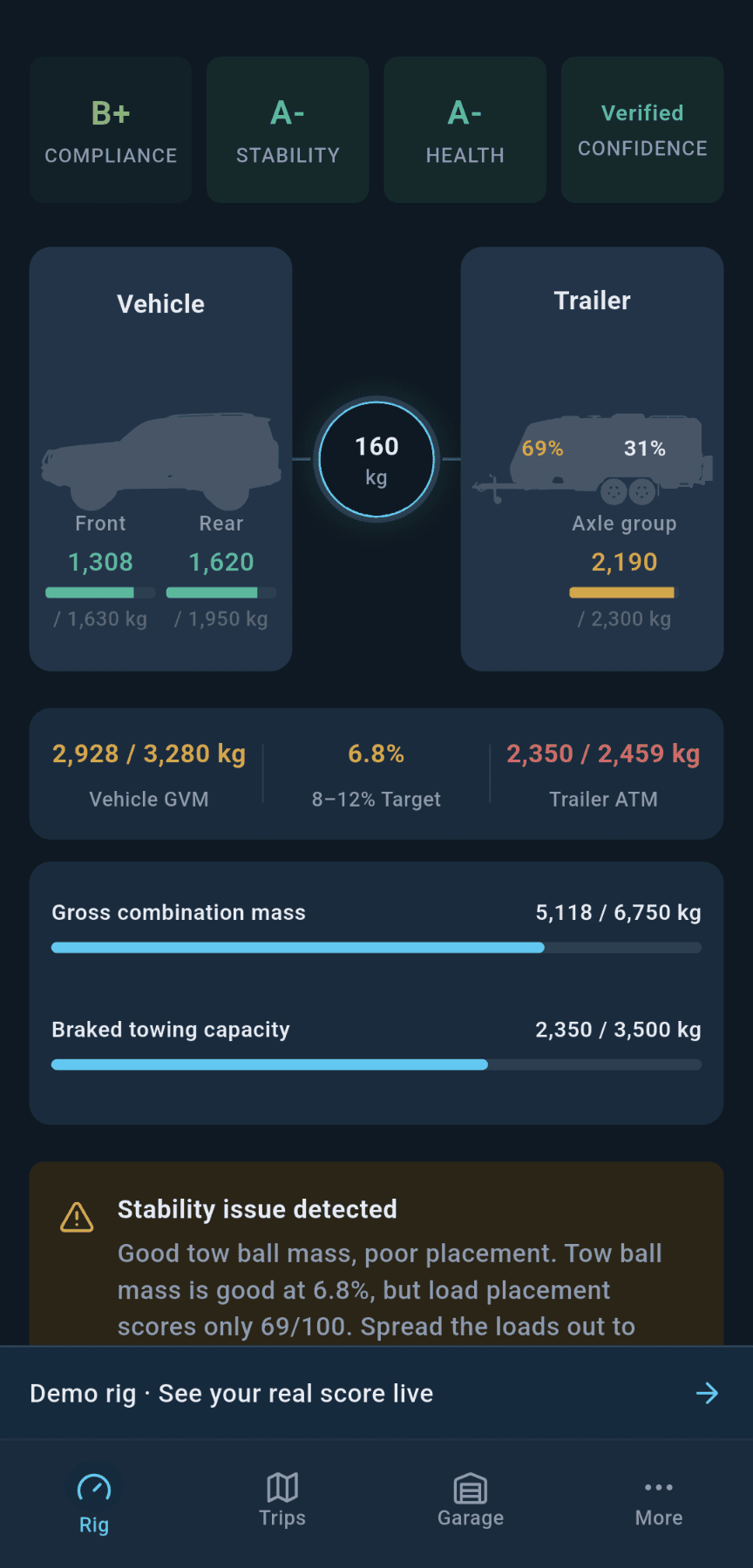
Make room for the trip you actually take
Keep the canopy and permanent equipment in your setup, then adjust the loads around each trip. loadmate helps you see how those changes affect carrying capacity and weight distribution across your Ranger and caravan.


Common questions
- Can the Ranger V6 actually tow 3,500 kg with the family and the camping gear on board?
Not at the same time as a full vehicle load. The 6,400 kg GCM is about 450 kg short of full GVM plus a 3,500 kg van, so at a maxed-out trailer the ute's kerb weight plus payload must fit inside 2,900 kg, with the 350 kg ball already counted inside the van's 3,500 kg ATM. That makes payload-at-full-tow 649 kg on an XLT and 512 kg on a Wildtrak, and a canopy, drawers, a full tank and a second battery claim around 300 kg of it before anyone boards, so a family of four squeezes onto an XLT with little margin and does not fit on a built-up Wildtrak. For a family load, a van nearer 2,800-3,200 kg is the realistic match.
- What real payload is left on a Wildtrak V6 towing a 3,500 kg van?
Start from 6,400 kg GCM minus the 3,500 kg trailer, which leaves 2,900 kg for the ute's kerb weight plus payload; the 350 kg ball is already part of the van's 3,500 kg ATM, so it is not deducted again. A Wildtrak's kerb weight is about 2,388 kg (not OEM-confirmed, so treat it as indicative), which makes payload-at-full-tow 512 kg. A steel canopy and drawers, a full tank and a second battery can claim around 300 kg of that before anyone boards, leaving about 200 kg for people, enough for two adults but short of a family plus gear.
- Should I drop my caravan's ATM to 3,000 kg, or get a GVM upgrade?
Drop the van first; it is cheaper and it works. At 3,000 kg ATM the combination at full GVM is 6,350 kg, under the 6,400 kg GCM, so the GVM becomes the working limit and XLT payload-at-full-tow climbs from 649 kg to about 750-800 kg depending on the ball weight. A certified GVM upgrade is the answer only if you genuinely need both a true 3,500 kg van and a heavy vehicle load, and only the engineered packages that also raise GCM and the rear axle actually buy back the combined-mass problem. Airbags alone change nothing legal.
- Now the bi-turbo is gone, is the V6 the only sensible tow engine in the MY26.50 range?
For towing, effectively yes. MY26.50 dropped the 2.0 bi-turbo and put the 3.0 V6 across the range, including the base XL, so the V6 is the default tug. The single-turbo 2.0 remains as the base engine and can tow a lighter van when correctly rated, but the V6's torque suits a heavy caravan and rolling hills. The Raptor is a separate case: it tows only 2,500 kg, not 3,500.
- Does the 10-speed auto overheat when you tow up long hills?
Owner and reviewer reports flag transmission temperature on sustained climbs with a heavy van; a Caravan World tester could not keep the 10-speed's temperature out of the top of its range up the Blue Mountains. The early next-gen issues have largely been worked through and later revisions are reported as improved, but it is still worth watching the gauge on long, hot grades and using Tow/Haul. On a used buy, check the valve-body recall history by VIN.
Understand the weight limits
Every figure above is governed by a manufacturer-set limit. These guides explain what each term means and how they fit together.
- Caravan & towing weights explainedThe master glossary: GVM, ATM, GTM, TBM and GCM in one place.
- Gross Combination Mass (GCM)The combined vehicle-plus-trailer ceiling that usually bites first.
- Aggregate Trailer Mass (ATM)What your caravan is legally allowed to weigh, fully loaded.
- Braked towing capacityWhy a 3,500 kg rating rarely means you can tow 3,500 kg.
Sources and review
Specifications checked
Page reviewed
- Ford Australia — Ranger 2026.50MY spec brochure
GVM, GCM, kerb, axle limits and braked towing
- Ford Australia — towing guidance
Tow pack requirement and tow ball mass