How much can the Nissan Navara tow?
| Variant | Braked towing capacity | GVM | GCM | Kerb weight | Payload at full tow | Tow ball rating | Rear axle limit |
|---|---|---|---|---|---|---|---|
| SLMY26 | 3,500 kg | 3,190 kg | 6,250 kg | 2,126 kg | 624 kg | 350 kg | 2,040 kg |
| STMY26 | 3,500 kg | 3,190 kg | 6,250 kg | 2,143 kg | 607 kg | 350 kg | 2,040 kg |
| ST-XMY26 | 3,500 kg | 3,190 kg | 6,250 kg | 2,171 kg | 579 kg | 350 kg | 2,040 kg |
| PRO-4XMY26 | 3,500 kg | 3,190 kg | 6,250 kg | 2,226 kg | 524 kg | 350 kg | 2,040 kg |
4 variants
| Braked towing capacity | 3,500 kg |
|---|---|
| GCM | 6,250 kg |
| GVM | 3,190 kg |
| Kerb weight | 2,226 kg |
| Front axle limit | 1,580 kg |
| Rear axle limit | 2,040 kg |
| Tow ball rating | 350 kg |
| ATM planning ceiling | 2,800 kg |
| Wheelbase | 3,130 mm |
| Rear overhang | 1,300 mm |
The record still says 140 kW and coil springs
Search the Navara's towing numbers in mid 2026 and the top of the results describes a ute you can no longer buy new. Nissan's own legacy engine page, still live in June 2026, lists the 2.3-litre twin-turbo at 140 kW and 450 Nm as the Navara's powerplant — figures that belong to the superseded D23, replaced in showrooms in March 2026. A major classifieds towing page pairs '2026' with that same dead engine. A popular towing table runs 2018 to 2026 as one unchanged 3,500 kg line, and a 2015 launch review quoting a 300 kg tow-ball limit still ranks for new-Navara searches.
None of those pages describes the ute on sale today. The D27 is, mechanically, a different truck: different engine, different gearbox, different rear suspension, different factory, and a gross combination mass 340 kg higher than the figure the old pages were built around. It is a brand-new truck wearing a dead truck's reputation, and the reputation survived because the one number that would have flagged the change — 3,500 kg braked — is the one number that carried over untouched.
So treat what follows as an audit: each claim the public record still makes about Navara towing, held against Nissan's published D27 figures and the first wave of 2026 tow tests. Fewer claims survive than the unchanged badge suggests.
Same 3,500 kg badge, new arithmetic underneath
Start with the claim that is technically true and thoroughly misleading: the Navara tows 3,500 kg, same as ever. It has claimed that figure since the NP300 arrived in 2015, and the D27 carries it on every grade, with 750 kg unbraked. What changed is everything the badge sits on. The gross combination mass — the most the ute and the loaded trailer may weigh together — rose 340 kg to 6,250 kg. The rear axle rating rose 190 kg to 2,040 kg. GVM crept up 40 kg to 3,190 kg, a limit whose mechanics are unpacked in the gross vehicle mass guide.
Here is what the 340 kg means at the hitch. At a full 3,500 kg of trailer, the GCM caps the whole vehicle — kerb, people, fuel, tub load — at the GCM minus 3,500 kg. One counting note: that 3,500 kg is the van's full ATM with its ball mass inside it, so the ball is not subtracted a second time from the ute's share. On the late D23 the ceiling was 5,910 kg minus 3,500 kg: a 2,410 kg allowance, against a 2,146 kg kerb on a PRO-4X. The flagship of the old range towed its headline figure with 264 kg left for every person and item aboard; the ST-X kept 284 kg. A couple and a full tank, and the ceiling was close. The D27's allowance is 2,750 kg, so the same sum now reads SL 624 kg, ST 607 kg, ST-X 579 kg and PRO-4X 524 kg on Nissan's brochure kerbs. Grade for grade, the extra GCM roughly doubles what the ute may carry at full tow — the old margin was a couple of adults deep, the new one carries a family and its gear.
One coincidence makes the correction unusually clean. The new SL kerbs at 2,126 kg, exactly what the old ST-X weighed. Same kerb, same 3,500 kg badge, and the margin at full tow goes from 284 kg to 624 kg — a gain of exactly the 340 kg the GCM moved. Strike one launch-season line while we are here, though: the D27 did not finally deliver over a tonne of payload. D23 dual-cabs went past that mark in 2021, and the D27's brochure payloads of 964 kg to 1,064 kg sit slightly below the old ute's. The generation story is combined mass, not payload.
The entry that survives the audit: 440 kg of combined shortfall
Not every old caveat gets struck through. Add the D27's 3,190 kg GVM to a 3,500 kg trailer and you get 6,690 kg, which is 440 kg over the 6,250 kg GCM. A full ute and a full van still cannot both be true at once. Tow the rated maximum and the vehicle must stay 440 kg under its own GVM; load the ute to its full 3,190 kg and the trailer may weigh no more than 3,060 kg. The trade is smaller than it was — the old ute at full GVM was capped at 2,760 kg of trailer — but it has not gone away, and no Navara generation has ever escaped it. It is also the side of the maths that binds: at full tow, the GVM minus the 350 kg ball and the kerb would allow an SL 714 kg, but the combined limit stops it at 624 kg, and the GCM is the tighter ceiling on every grade.
Nor is it a Nissan quirk. The Mitsubishi Triton this ute is built alongside carries the identical 6,250 kg GCM with a 3,200 kg GVM, for a 450 kg version of the same squeeze, and most of the dual-cab class is short somewhere between 320 kg and 450 kg — the pattern runs right across the towing-capacity hub. The D27's 440 kg is mid-pack honesty, not a black mark. It earns its place in this audit because plenty of the stale pages never mention combined mass at all, and it is the number that decides how you load.
The sag stories are history now, with a date on them
The most repeated Navara towing claim of the past decade is the sagging rear, and it was earned. From 2015 to 2025 the D23 was the segment's coil-sprung exception, a 5-link rear that rode well empty and dropped its tail under ball weight reliably enough that an aftermarket of helper-airbag kits was built specifically for that coil rear. Its rear axle was rated to 1,850 kg. Every word of that belongs to a ute that is no longer made.
The D27 runs leaf springs on every grade, and the first independent tow test dated the correction. In March 2026, carsales hitched a 2.6 tonne caravan to the base SL and reported it 'sat level and towed with confidence' at 100 km/h in strengthening wind. The rear axle rating climbed to 2,040 kg — the donor Triton's hardware, since the spring packs themselves carry over. The sag trope is the clearest case in this audit of a true claim with an expiry date: quote it about a used D23 and you are right; quote it about the ute in showrooms and you are a generation out of date.
The grief over the coils is the genuine debate here, and the D23 faithful are right about what they lost. Motoring press asked openly whether buyers would lament the coil-sprung rear, and the long-running forum preference for its unladen comfort is real. The towing answer is that the coils came bundled with the 1,850 kg axle, the sag and the airbag aftermarket — while the unladen ride the loyalists defend is precisely what Premcar's damper-only program was hired to protect, and 2026 reviewers rate the D27's ride above the donor ute it shares springs with. For a tower, the leaf swap retired the asterisk that followed every D23 towing conversation rather than costing the ute its character.
What 350 kg on the ball does to a longer tail
The tow-ball maximum is 350 kg, and one caveat belongs in print before the maths. Nissan's D27 specs page does not state the figure itself — it notes towing is subject to the towbar and tow ball fitted — while RACV's 2026 specifications article lists 350 kg and the late D23 carried the same number from 2021 on. Treat 350 kg as manufacturer-corroborated rather than manufacturer-printed, and read the rating plate on the towbar before you plan a van around it. The D23's spec sheets also tied the permitted download to the vehicle's laden mass; whether the D27 repeats that condition is not yet published either way, so check the plate and the handbook rather than assuming.
With the caveat logged, the lever maths runs like this. The D27's rear overhang grew to 1,300 mm — 75 mm longer than the old ute's — and a towbar puts the coupling roughly 150 mm further back again, so the ball rides about 1,450 mm behind the rear axle on a 3,130 mm wheelbase. That geometry multiplies a download by about 1.46 by the time it reaches the axle: a full 350 kg ball lands as roughly 510 kg on the 2,040 kg rear axle and lifts about 160 kg off the steer axle (itself rated to 1,580 kg) at the same moment. The longer tail is part of why the stronger axle matters — the lever it feeds got longer in the same redesign.
The range inverts at the hitch: the cheapest Navara carries the most
Here is the entry no stale page could have predicted, because it did not exist before March 2026. The GCM and the ball limit are identical across the D27 range, but kerb weight climbs from 2,126 kg on the SL to 2,226 kg on the PRO-4X — and with the full-tow allowance fixed at 2,750 kg, every kilogram of trim comes straight out of the margin. The $53,348 SL keeps 624 kg at full tow. The $68,418 PRO-4X keeps 524 kg. The $15,070 walk up the range buys 100 kg less capacity at the hitch.
The spring hardware moves the same direction. The SL and ST carry the heavy-duty four-leaf rear pack with Premcar's load-focused damper calibration; the ST-X and PRO-4X ride on a three-leaf pack with tunes aimed at comfort and off-road work respectively. The grade walk softens the springs as it adds the weight. The sharpest twist sits at the top: the PRO-4X is the only grade with a 3,500 kg-rated towbar as standard equipment, so the variant sold hardest on towing kit is the one with the least margin to use it.
Caravan media's early pick is the ST-X as the all-rounder, with the SL and ST recommended where the ute runs consistently loaded — and a touring rig with a van on the back is exactly that case. The arithmetic agrees: an SL or ST keeps 607 kg to 624 kg at full tow on the four-leaf pack, and the SL is the grade carsales used for the 2.6 tonne test that sat level. If towing is the job, the cheapest seat in this range is the best one.
Built by Mitsubishi, tuned by Premcar: what's still Nissan
The build story needs stating plainly, because it reframes several old assumptions at once. The D27 is built by Mitsubishi at its Laem Chabang plant in Thailand, with production running since 20 December 2025, ending a roughly 70-year run of in-house Nissan ute development. The engine is Mitsubishi's 2.4-litre bi-turbo diesel — 150 kW and 470 Nm through a 6-speed automatic — and the old Nissan-built 2.3 went with its 7-speed, one ratio and all. The ladder frame, the 6,250 kg GCM and the 2,040 kg rear axle are shared with the Triton built on the same line.
What Nissan adds is narrower than the badge implies, but it is the part a tower feels. Premcar re-tuned the dampers for Australia on every grade — not a Warrior special this time — working through 137 damper codes and around 18,500 km of local development while leaving the Triton-derived springs untouched, and reviewers found the result rides flatter than the donor ute. Nissan also backs the D27 with a conditional 10-year, 300,000 km warranty against the Triton's 10-year, 200,000 km, and carsales measured the ST-X at $5,200 more than the equivalent Triton and judged the gap defensible. Early forum sentiment is harsher on the value question; three months in, neither side has ownership data to settle it.
The 2.4 above 2,500 kg: where the new record runs out of pages
Now for the honest gap in the corrected record. Three independent 2026 tests towed between 2.3 and 2.8 tonnes behind the D27, and they agree on the shape of the thing: composed and stable through the chassis, adequate rather than effortless from the engine. CarExpert, towing 2.3 tonnes, found that flattening the throttle at freeway speed produced revs and noise but 'not much forward momentum'. NRMA, at roughly 2.8 tonnes — the heaviest published test so far — said the 2.4 has to build revs to find its sweet spot. Nobody has published a test at the full 3,500 kg, so how it behaves at the rating is, for now, an extrapolation rather than a record.
The fuel question deserves its dated context too. Grey-nomad scepticism about small-capacity diesels doubling their consumption under tow predates this ute by years, and a tourer running the same-family 2.4 in another body reported 18 to 20 L/100km hauling 2.7 tonnes. Against the D27's official combined figure of 7.7 L/100km, that is the realistic shape of a loaded trip. None of it is disqualifying; all of it says the comfortable band sits below the badge.
Put the engine evidence and the GCM maths together and the planning band is 2,400 kg to 2,800 kg ATM. That is the range the 2026 tests actually covered, the ball sits near 240 kg to 280 kg, and an SL or ST holds 600 kg or more of full-tow margin with the four-leaf pack underneath. The full 3,500 kg is legal on every grade for the first time in the nameplate's history. That correction stands, but legal and relaxed are different claims, and only the first is proven. A canopy and work gear can stay in the Navara when the caravan goes on for the weekend. Get the loadmate app to include those loads with your measured weights and see how the family and touring gear change the margins before you leave.
A three-month-old ute has no owner record yet
One last strike-through, this time against a number that looks like evidence. The Navara's listing on Australia's main owner-review site shows 3.3 stars across 507 reviews — and as of June 2026, not one of them describes a D27. Every entry, including the towing-era complaints about gearbox and clutch failures at 110,000 to 120,000 km under caravan load, belongs to earlier generations and a drivetrain this ute no longer uses. Hold those against a used D23 by all means; against the D27 they are someone else's record. What exists for the new ute is Nissan's published figures, five expert tests from launch season and three months of early impressions, so the D27's owner record starts now.
The first useful record is the one you build on your own rig, and it starts with where the kilograms ride, not just how many there are. A full-tow margin is one number — 624 kg on an SL — but it cannot say whether that mass sits ahead of the rear axle or out on the 1,450 mm lever behind it. A fridge at the tailgate end of the tub stacks onto the same overhang as the 350 kg ball; the family in the cab pulls the other way. loadmate maps the load left to right, nose to tail, and by height, so you can see whether the four-leaf rear is carrying its share where Premcar tuned it to, or hanging everything off the tail, before the van goes on.
Then let a certified weighbridge write the entry that counts. The mapping and the margins are decision support — they tell you what to move and which grade suits the job before money changes hands — but legal weight evidence comes off the scales, with the van hitched and the tub packed the way you will actually travel. A ute this new deserves better than inherited lore in either direction: weigh it, and give it a record of its own.
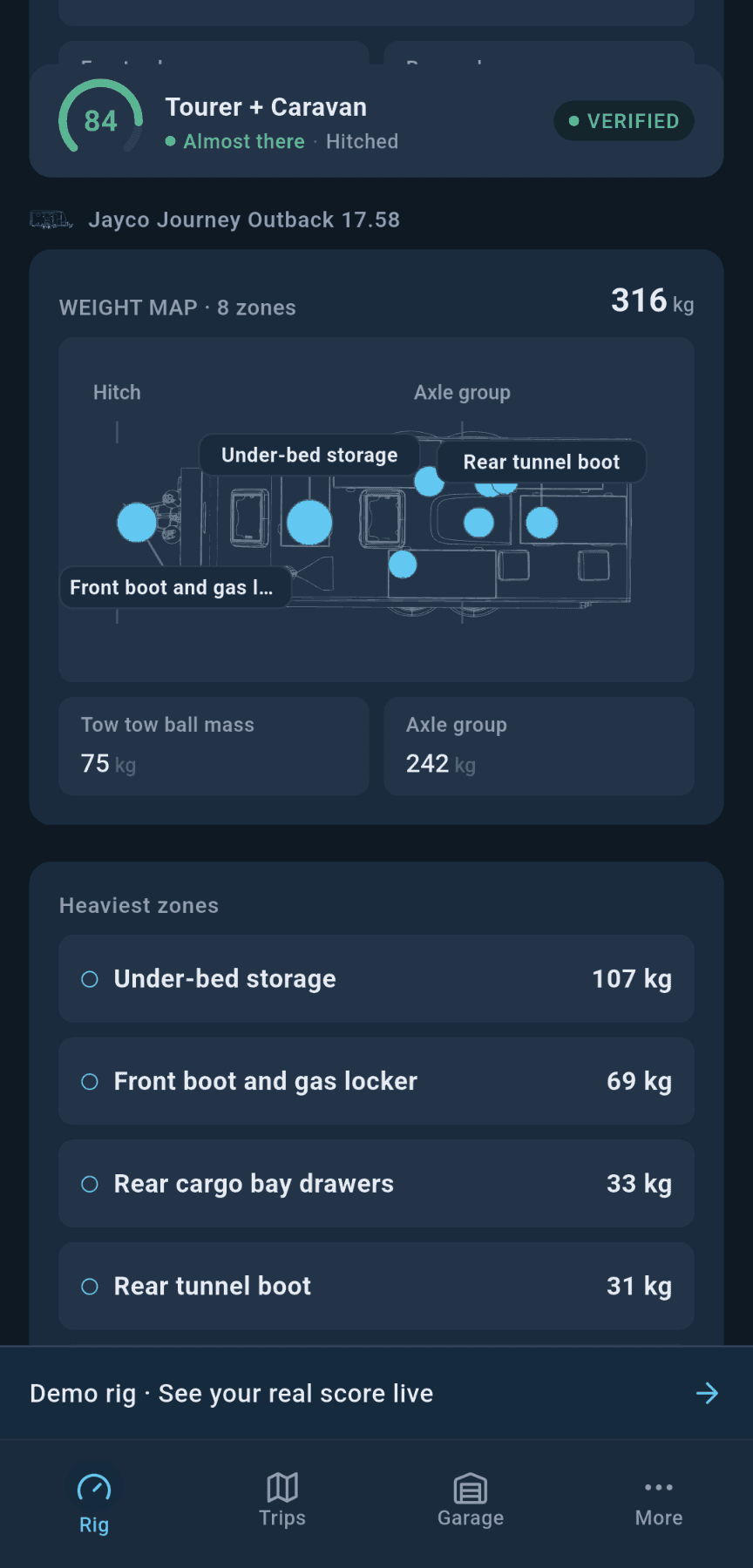
See where the weight really sits
loadmate maps the load side to side, front to back, and how high it stacks, because a legal rig can still sit wrong. Create a free account to explore it on a populated demo rig in the app.


Common questions
- Is the new Navara just a Mitsubishi Triton with a Nissan badge — and is it worth paying more for?
Mechanically the overlap is large: both utes come off Mitsubishi's Laem Chabang line and share the 2.4-litre bi-turbo (150 kW/470 Nm), the 6-speed auto, the 6,250 kg GCM and the 2,040 kg rear axle. The Nissan differences are Premcar's damper tune on every grade (reviewers found it rides flatter than the Triton), a conditional 10-year/300,000 km warranty against Mitsubishi's 10-year/200,000 km, and a price gap carsales measured at $5,200 on the ST-X and judged fair. Whether that gap is worth paying is the live argument; for towing specifically, the damper tune is the difference you can feel.
- Can the new Navara really tow 3,500 kg with the family and gear on board?
For the first time in the nameplate's history, the arithmetic works on every grade. At a full 3,500 kg the 6,250 kg GCM caps the whole vehicle at 2,750 kg, which leaves 624 kg above kerb on an SL down to 524 kg on a PRO-4X for every person, accessory and item in the tub — a family of four and touring gear fits inside that on the lower grades. Two caveats: the 440 kg GCM shortfall means the ute cannot also be at its 3,190 kg GVM, and the heaviest published tow test is about 2,800 kg, so the engine's behaviour at the full rating is unverified.
- Which 2026 Navara is best for towing — SL, ST, ST-X or PRO-4X?
On the numbers, the SL or ST. They carry the heavy-duty four-leaf rear springs and Premcar's load-focused damper tune, and their lighter kerbs keep 624 kg and 607 kg respectively at full tow, against 579 kg on the ST-X and 524 kg on the PRO-4X, which both ride on a softer three-leaf pack. Caravan media leans to the ST-X for ride comfort, and the PRO-4X is the only grade with a 3,500 kg towbar as standard — but kit and capacity point in opposite directions here. carsales' 2.6 tonne tow test used the base SL, and it sat level.
- Did the new Navara really ditch the coil springs — and is that worse for towing?
The coils are gone, and towing is better for it. The D23's 5-link coil rear (2015-2025) is replaced by leaf packs on every D27: four-leaf on SL/ST, three-leaf on ST-X/PRO-4X. The rear axle rating rose from 1,850 kg to 2,040 kg, and the first independent test had a 2.6 tonne van sitting level behind the base SL — the loaded behaviour the D23's helper-airbag aftermarket existed to fix. What the coils did better was unladen ride, which is what Premcar's damper tune was brought in to protect; 2026 reviews rate the D27's ride above the Triton it shares springs with.
- Is the 2.4-litre bi-turbo enough to tow a big van, or should I wait for the Warrior?
The 2.4 (150 kW/470 Nm) towed 2.3 to 2.8 tonnes competently in three 2026 tests, staying stable through the chassis but needing revs above roughly 2,500 kg — at 2.3 tonnes, CarExpert found little response to a flattened throttle at freeway speed. Below about 2,800 kg ATM it is a comfortable tow; at the full 3,500 kg nobody has published a test. On the Warrior: a Premcar-developed concept was shown on 19 November 2025 and a production version is tracking for late 2026, but no specifications or GVM/GCM changes have been published, so there is nothing concrete to wait for yet.
Understand the weight limits
Every figure above is governed by a manufacturer-set limit. These guides explain what each term means and how they fit together.
- Caravan & towing weights explainedThe master glossary: GVM, ATM, GTM, TBM and GCM in one place.
- Gross Combination Mass (GCM)The combined vehicle-plus-trailer ceiling that usually bites first.
- Aggregate Trailer Mass (ATM)What your caravan is legally allowed to weigh, fully loaded.
- Braked towing capacityWhy a 3,500 kg rating rarely means you can tow 3,500 kg.
Sources and review
Specifications checked
Page reviewed
- Nissan Australia — All-New Navara specs and pricing
GVM, GCM, braked/unbraked towing, per-variant kerb and payload, axle capacities, dimensions
- Nissan Australia — All-New Navara pricing and specifications release (5 Feb 2026)
March 2026 on-sale, engine and transmission, range pricing, conditional 10-year warranty
- Nissan Australia — MY24 Navara dual cab spec sheet (D23 baseline)
Superseded D23 figures for the generation comparison: GCM 5,910, rear axle 1,850, coil rear
- RACV — 2026 Nissan Navara price, specs and towing (25 Nov 2025)
350 kg maximum towball download and launch timing