How much can the Toyota Tundra tow?
| Variant | Braked towing capacity | GVM | GCM | Kerb weight | Payload at full tow | Tow ball rating | Rear axle limit | Unbraked towing | Front axle limit |
|---|---|---|---|---|---|---|---|---|---|
| Limited hybrid 4WDDec25-current manualMed | 4,500 kg | 3,536 kg | 8,030 kg | 2,792 kg | Unconfirmed | Unconfirmed | 1,850 kg | 750 kg | 1,850 kg |
| Platinum hybrid 4WDDec25-current manualMed | 4,500 kg | 3,536 kg | 7,980 kg | 2,834 kg | Unconfirmed | Unconfirmed | 1,850 kg | 750 kg | 1,850 kg |
2 variants
| Braked towing capacity | 4,500 kg |
|---|---|
| GCM | 8,030 kg |
| GVM | 3,536 kg |
| Kerb weight | 2,792 kg |
| Front axle limit | 1,850 kg |
| Rear axle limit | 1,850 kg |
Before collecting the caravan, inspect the connection
The caravan pickup is a bad time to learn that the truck's rating and its fitted connection have different limits. Toyota's May 2026 Tundra brochure describes a supplied 3.5-tonne tongue and ball, with a separate 4.5-tonne towing kit. The vehicle can be rated to 4,500 kg while the gear on the back holds that particular combination to 3,500 kg.
The current Australian manual, document TSO2601_00 for Dec25-on vehicles, spells out the ball sizes: 50 mm for an ATM up to 3,500 kg, and 70 mm from 3,501 to 4,500 kg. The trailer coupling has to match the ball, and the hitch assembly's own rating is still a limit. Swapping only the visible ball leaves the tongue, receiver, fasteners and installation as they were, so each needs checking.
Toyota Australia's official range is right-hand-drive Limited and Platinum hybrids. Private conversions, older V8 Tundras and US trims need their own documents, so an overseas spec sheet or a local ad with the same badge won't tell you about the truck in front of you.
The 4.5t kit has a 450 kg component ceiling
The May 2026 Toyota brochure sets out the supplied and optional towing tiers. Nunawading Toyota lists genuine kit 15L0001873 with a 70 mm ball. The Toyota Australia packaging label identifies it as the Tundra-specific kit, rated for 4,500 kg braked towing and a 450 kg maximum vertical ball load, and keeps the vehicle, towbar and equipment limits in force. So 450 kg is that kit's ceiling; any other Tundra installation needs its own figure.
Use whichever vehicle, towbar, tongue, ball or coupling limit is lowest. The manual asks for conventional trailer loading at 9-11% download, and the published towing pages we checked don't give a separate vehicle-side ball maximum. That's why the 450 kg examples here need that kit fitted, matching vehicle paperwork and no lower label on the truck. A 4,500 kg trailer is no reason to aim for 450 kg on the ball.
At 4,500 kg, 9-11% spans 405-495 kg, and the kit's 450 kg ceiling cuts off the top of that range. Weigh the loaded trailer and follow the trailer maker's distribution instructions as well as Toyota's. Shoving heavy gear to the back just to bring the ball reading down can create a different loading problem; the caravan weights guide explains why the distribution and total need checking together.
Limited keeps 42 kg more room than Platinum
Toyota's May 2026 specification table lists maximum kerb masses of 2,792 kg for the Limited and 2,834 kg for the Platinum. Both have a 3,536 kg GVM, so their payloads are 744 kg and 702 kg. The 758 kg figure from older launch discussions doesn't come from this current set of masses.
GCM is 8,030 kg in the Limited and 7,980 kg in the Platinum. With a 4,500 kg trailer and 450 kg on the kit's ball, the Limited leaves min(3,536 - 450, 8,030 - 4,500) - 2,792 = 294 kg for everything else. The Platinum leaves min(3,536 - 450, 7,980 - 4,500) - 2,834 = 252 kg. GVM is the tighter limit in both, so the flagship's 42 kg heavier maximum kerb mass comes straight off its allowance.
That allowance covers the driver, passengers, accessories, tub gear and any towing hardware beyond the spec baseline. Fill all five seats and there's far less than 294 kg or 252 kg left for luggage. Weigh an accessorised truck before you trust those paper figures for a trip.
For the combination, add the unhitched loaded truck to the whole loaded trailer, or add every axle reading while coupled, so the ball is counted once. Our GCM guide shows both methods.
Compare the same trailer before comparing maximum badges
In a 14 October 2024 Australian discussion, one participant asked for the trucks to be compared at the same 3.5 or 4-tonne load instead of each one's maximum. That's the better test of whether a replacement truck suits the caravan you already own. The thread's ratings are old and its passenger weights guessed, so the figures below use Toyota's current documents.
With a 3,500 kg trailer and 350 kg on the ball, the Limited keeps 394 kg for other loads and the Platinum 352 kg. At 4,000/400 kg, those fall to 344 kg and 302 kg, provided the installed gear and the vehicle allow those ball loads. A 4,000 kg trailer is already beyond the manual's 50 mm tier, however much GCM the truck has spare.
Now load a Limited with example figures (assumed, so replace them with yours): 180 kg of people and 90 kg of added gear beyond the maximum-kerb baseline, for an unhitched mass of 3,062 kg. A load distribution hitch would shift some of this between the axles without changing the totals. The 3,500/350 kg trailer puts the truck at 3,412 kg with 124 kg of GVM room. The 4,500/450 kg trailer takes it to 3,512 kg with only 24 kg left. Combined mass in that case is 7,562 kg, still 468 kg under GCM, and all that spare GCM won't help once an extra load pushes the truck over GVM.
To compare an Australian F-150 fairly, keep the same people, gear and weighed trailer and change only the vehicle.
Check the 1,850 kg rear axle separately
Both front and rear axles are rated at 1,850 kg in the specification table and current manual. In a May 2025 caravan-community discussion, one participant pointed to the rear axle as the gap in a full-tow payload argument. Fair point: a forum sum or the total payload figure can't tell you what your truck's rear axle is actually carrying.
The ball sits behind the rear axle and shifts load at both ends of the truck, tub gear has its own position, and a load distribution hitch changes the readings again. Without a verified as-delivered front/rear split or ball lever dimension, any rear-axle figure here would be a guess.
Get front, rear and trailer-axle readings in travel trim, with the people, gear, fuel and hitch setup you'll actually use, and check each limit as well as the vehicle and combination totals. Adding the two 1,850 kg axle ratings doesn't lift the truck's 3,536 kg GVM, and a suspension change that alters how it sits doesn't give it new mass ratings either.
Separate Toyota's hitch recommendation from its requirements
Toyota recommends a load distribution hitch above 2,200 kg, and the brochure ties that recommendation to road suitability. The current manual sets one up by returning the front axle to its pre-coupling mass; where you can't measure that directly, it describes restoring the original front fender height without going below it. Follow the full Toyota and hitch-maker instructions for your equipment.
The manual also requires a suitably rated sway-control device above a trailer-mass threshold, and gives two figures for it: printed page 189 says above 900 kg, while page 193 says above 907 kg. Work to the lower figure, and have Toyota confirm the right system for your trailer, including how it works with the fitted hitch and the truck's driver-assist systems.
The same manual says the truck comes with a Toyota genuine trailer brake controller, and describes choosing electric or electric-over-hydraulic brakes and setting gain through the 12-pin connection. It advises against adding a third-party controller alongside it. On a used or modified truck, check what's actually fitted and that it works.
Make the collection list part of every departure
An Australian buyer posting in October 2024 had ordered the coming upper grade and was asking what options to specify before the local details were settled. Today you can inspect the connection tier on the truck itself. Photograph its labels, record the fitted equipment and weigh the loaded truck before you collect a trailer that needs the 4.5t setup.
Plan the route and your puncture response around the towing instructions too. Printed pages 189-190 of the current Australian manual cap towing speed at 100 km/h, or the lower posted towing or trailer-manual limit, and rule out towing on the temporary spare. The current spec sheet lists an 18-inch space-saver spare, so a puncture can stop the trip even when every mass is within its limit.
The Limited example had only 24 kg of GVM room, so recovery gear added after pickup can change the answer. A pre-trip checklist in the loadmate app brings the recorded truck, caravan and loads into the next trip's preparation. Review additions against the last weigh-in, and keep the fitted connection on both the pickup and departure lists.
Add a VIN recall check while you're at it. The regulator's May 2025 REC-006350 record covers reverse-lamp moisture and possible camera activation on listed vehicles. Toyota's current recall notice describes a broader production range through March 2025. Check whether your VIN is covered and the fix has been done; a year badge or a lamp that works today won't tell you.
A familiar Toyota badge still needs this truck's documents
An April 2026 Australian buyer discussion asked whether Hilux and LandCruiser reliability carries over to the Tundra. Impressions like that say nothing about this truck's towing limits or recall status; its build, current manual, fitted towing gear and load do.
On the factory mass ratings, a trailer over 4,500 kg is out. Between 3,501 and 4,500 kg you need the manual's higher connection tier, and the people, tub load and axles still have to fit. The examples here are sums; they can't tell you how the rig drives at the maximum. Specs were checked on 16 October 2026; keep the truck's labels and its weighed travel setup with your record. See the safety disclaimer for the limits of decision support.
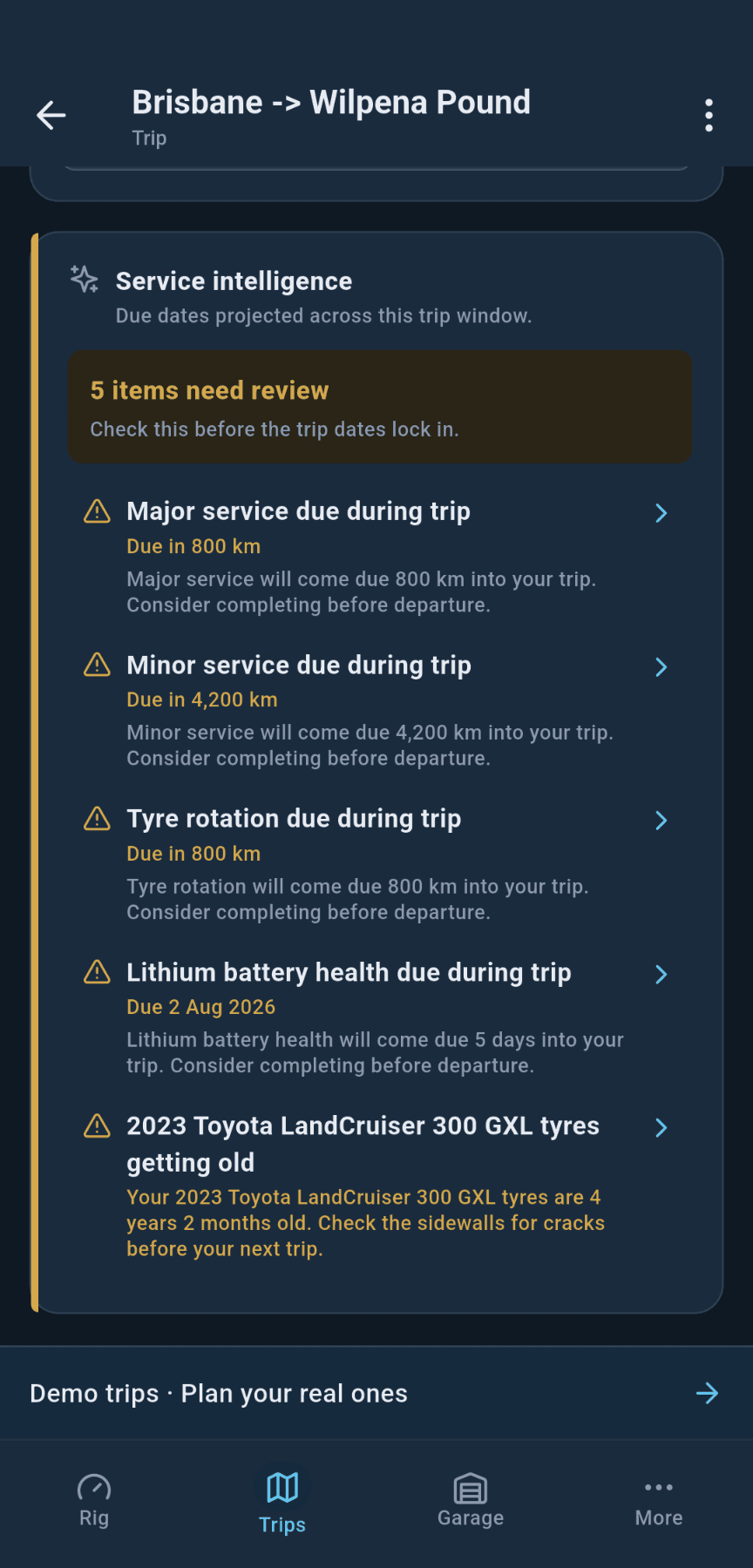
Keep the Tundra's fitted connection on the departure list
The supplied 50 mm connection and the optional 4.5-tonne setup need different equipment checks. Build the loadmate pre-trip review around your fitted truck, caravan and recovery gear, and inspect the actual coupling and its labels before you leave. The screen shows a demo readiness view.


Common questions
- Does an Australian Tundra tow 3,500 kg or 4,500 kg?
Both, depending on the kit. Toyota rates the truck to tow 4,500 kg braked, but the brochure says it comes with a 3.5t tongue and ball. The current manual specifies 50 mm up to 3,500 kg ATM and 70 mm for 3,501-4,500 kg. Above 3,500 kg, the truck and every fitted component have to be rated for the trailer.
- What extra towing equipment should I check before collection?
Check the trailer coupling matches the ball, and inspect the towbar, tongue, ball and receiver labels. Find out which towing kit is fitted and its vertical-load limit, how the brake controller is set up, and what Toyota says about sway control and load-distribution hitches. A higher-rated ball on its own doesn't approve the whole installation.
- How much payload remains at 4,500 kg towing?
With the genuine 4.5t kit and its 450 kg ball limit, current maximum-kerb figures leave 294 kg in the Limited or 252 kg in the Platinum for people, accessories and cargo. The 450 kg comes from the kit label, so check the vehicle and kit labels on your truck, and weigh the axles separately.
- Does the Tundra require a weight distribution hitch?
Toyota recommends a load distribution hitch above 2,200 kg, depending on road suitability. The manual separately requires a sway-control device, giving 900 kg on one page and 907 kg on another. Have Toyota confirm the right system and follow the full setup instructions.
- Does a larger GCM mean I can fill the tub at maximum tow?
No. In the 4,500/450 kg example, GVM is the tighter limit and leaves 294 kg in the Limited or 252 kg in the Platinum, and that has to cover the people and everything beyond the kerb baseline. Both 1,850 kg axle limits need weighing too.
- Can I use US Tundra or privately converted V8 figures?
No. Toyota Australia's May 2026 specification sheet and Dec25-on manual cover its official right-hand-drive hybrid Limited and Platinum. US trims, older V8s and private conversions need their own approvals and labels, and their figures belong to those trucks only.
Understand the weight limits
Every figure above is governed by a manufacturer-set limit. These guides explain what each term means and how they fit together.
- Caravan & towing weights explainedThe master glossary: GVM, ATM, GTM, TBM and GCM in one place.
- Gross Combination Mass (GCM)The combined vehicle-plus-trailer ceiling that usually bites first.
- Aggregate Trailer Mass (ATM)What your caravan is legally allowed to weigh, fully loaded.
- Braked towing capacityWhy a 3,500 kg rating rarely means you can tow 3,500 kg.
Sources and review
Specifications checked
Page reviewed