By loadmate Editorial · Towing & compliance desk
How much can the Toyota Prado tow?
| Variant | Braked towing capacity | GVM | GCM | Kerb weight | Payload at full tow | Tow ball rating | Rear axle limit |
|---|---|---|---|---|---|---|---|
| GXMY25 | 3,500 kg | 3,100 kg | 6,600 kg | 2,495 kg | 255 kg | 350 kg | 1,730 kg |
| GXLMY25 | 3,500 kg | 3,150 kg | 6,600 kg | 2,535 kg | 265 kg | 350 kg | 1,730 kg |
| VXMY25 | 3,500 kg | 3,180 kg | 6,600 kg | 2,570 kg | 260 kg | 350 kg | 1,730 kg |
| KakaduMY25 | 3,500 kg | 3,200 kg | 6,600 kg | 2,595 kg | 255 kg | 350 kg | 1,730 kg |
4 variants
| Braked towing capacity | 3,500 kg |
|---|---|
| GCM | 6,600 kg |
| GVM | 3,180 kg |
| Kerb weight | 2,570 kg |
| Front axle limit | 1,450 kg |
| Rear axle limit | 1,730 kg |
| Tow ball rating | 350 kg |
| ATM planning ceiling | 2,800 kg |
| Wheelbase | 2,850 mm |
| Rear overhang | 1,205 mm |
Two numbers, side by side
Put the old Prado's tow rating next to the new one and the upgrade looks settled. The 150 Series was rated to tow 3,000 kg braked. The 250 Series that replaced it in 2024 tows 3,500 kg. The combined limit moved the same way: the old auto wagon ran a Gross Combination Mass (GCM) of roughly 5,990 kg, and the 250 lists 6,600 kg. On the showroom card, every figure that matters got bigger.
Both of those gains are real, and the rest of this guide will give Toyota full credit for them. But there is a number the card does not put next to the tow rating, and it is the one that decides whether the bigger trailer figure is any use to you. Payload, the weight the Prado can actually carry, went the other way. The 250 GX lists a Gross Vehicle Mass (GVM) of 3,100 kg against a kerb weight near 2,495 kg, which is about 605 kg of payload. The 150 routinely had 640-750 kg. The bigger braked number was stamped onto much the same set of scales, and on a couple of measures those scales now read lighter.
What actually changed from 150 to 250
The 250 is not a facelift. It moved to Toyota's TNGA-F ladder frame, gained an eight-speed automatic in place of the old six-speed, and switched the 2.8 L turbo-diesel to a 48V mild-hybrid in Australia. That last point matters for buyers comparing brochures: the AU Prado 250 is the 2.8 diesel with 48V assistance, not the 2.4 L turbo-petrol hybrid that Toyota sells in some overseas markets. The 48V system adds a small motor-generator (about 8.4 kW and 65 Nm) but the headline outputs are unchanged at 150 kW and 500 Nm.
Alongside the tow and GCM lifts, GVM rose from around 2,990 kg to 3,100-3,200 kg depending on variant. One change cuts the other way, though: the fuel tank shrank from 150 L to 110 L. So the wagon that gained towing headroom lost touring range at the same time, which is its own kind of payload conversation once you are carrying jerry cans to make up the difference.
Where the 6,600 kg combined limit runs out
The 250 genuinely tows better than the 150, and a 2025 tow test made that concrete: a GX hauling 3,000 kg climbed the test grade at 81 km/h where the old 150 managed 70 km/h on the same hill. The extra torque-fill from the 48V system and the new gearbox do real work. If your van sits in the 2-2.5 t range, this is a relaxed tourer, and plenty of owners report exactly that, including one who crossed the Nullarbor at 2.2 t and rarely touched the Tow/Haul mode.
The catch arrives at the top of the rating. GCM is the ceiling on vehicle and trailer added together, and the 250's is 6,600 kg. Hitch a fully loaded 3,500 kg van, a rating that is the van's ATM with the ball mass already counted inside it, and that leaves 3,100 kg of the combined budget for the Prado itself, which is exactly the GX's GVM, with no slack in the sum. The limit that bites on the road, though, is the GVM with the ball aboard: 350 kg pressing on the hitch comes straight out of the wagon's payload, so the GX has roughly 255 kg left for driver, passengers, fuel, fridge and gear. The plusher trims carry higher GVMs that roughly cancel their heavier kerbs, so the spread stays narrow: about 265 kg in the GXL, 260 kg in the VX, and 255 kg in the Kakadu with its kerb weight near 2,595 kg. Two adults and a packed esky and you are done.
The payload went backwards, and here is why that stings
This is the part that catches owners who traded up expecting more capability across the board. A 250 carries roughly 605-615 kg of payload. The Toyota Prado 150 Series it replaced carried 640-750 kg. So the newer, heavier, more expensive wagon with the bigger tow sticker will quietly let you put less into it. Toyota bought the extra trailer rating with a stronger frame and more mass, and mass on the vehicle is mass you cannot spend on the family.
Part of that loss has a visible cause. The 48V battery lives under the boot floor, which raises the load floor and means the seven-seat third row no longer folds flat into the body the way the 150's did. Several owners called this out at launch, and some cancelled orders over it. It is a small thing until you are trying to load a trip's worth of gear over a higher lip with a row of seats that sits proud of the floor instead of sinking into it. The 48V system also delivers little real fuel saving in practice, with owners reporting around 10.2 L/100km against a 7.6 claim, and roughly 16 L/100km towing, so the practicality you give up does not come back as economy.
Rear axle and tow ball: the same physics, a heavier starting point
The Prado's rear axle is rated to about 1,730 kg across the GX, GXL, VX and Kakadu, a secondary figure worth confirming against the compliance plate. That number did not get the upgrade the tow rating did. A 350 kg tow ball sits behind the rear axle and levers down on it, so the load it adds to the axle is larger than 350 kg once the wheelbase and overhang do their work. On a wagon that may also be carrying third-row passengers and cargo near the back, the rear axle is one of the first limits to tighten as you load.
Toyota's owner's manual sets the rule that turns this from theory into a buying decision: above 2,200 kg of trailer, a weight distribution hitch (WDH) is required, not merely suggested. Most caravans worth taking touring sit well above 2,200 kg, so for the typical Prado buyer the WDH is not optional kit. Reviewers towing the 250 also note a soft front end that bobs under load, which is the steer axle going light as the ball mass loads the rear, exactly the condition a correctly set WDH is meant to address by pushing load back onto the front wheels and the trailer's own axles.
How the variants split the difference
The four diesel variants share the 6,600 kg GCM, the 3,500 kg tow rating, the 1,730 kg rear axle and the 350 kg ball limit, but they step up in GVM as they step up in kerb weight: 3,100 kg for the GX, 3,150 kg for the GXL, 3,180 kg for the VX and 3,200 kg for the Kakadu. Those lifts roughly cover the extra trim mass, so the residual payload at full tow barely moves across the range. The GX, lightest at about 2,495 kg, has near 255 kg left at full noise; the volume-selling GXL, near 2,535 kg, holds about 265 kg; the VX, near 2,570 kg, lands close to 260 kg; and the Kakadu at about 2,595 kg sits near 255 kg. Where the trims really separate is the GVM-plus-trailer sum: the GX fits exactly inside the 6,600 kg GCM, while the GXL carries a 50 kg shortfall, the VX 80 kg and the Kakadu 100 kg, so at full GVM the heavier wagons can tow 3,400-3,450 kg rather than the full 3,500 kg.
The practical reading is that trim choice buys you almost nothing at the maximum: the spread from the tightest variant to the roomiest is about 10 kg, less than a full jerry can. The cheapest GX keeps one real edge, as the only trim whose full GVM and full tow rating fit inside the GCM at the same time; the plusher wagons must give up 50-100 kg of trailer once the wagon itself is loaded to its limit. None of them are heavy haulers at 3.5 t, so pick the trim on equipment and price, then size the van to the roughly 255-265 kg every one of them leaves you.
A worked family example
Picture a GX loaded for a school-holiday run: two adults at about 160 kg combined, two kids at 90 kg, a full 110 L tank near 90 kg, a fridge, a drawer system, recovery gear, camp chairs and a roof platform. That is an ordinary family load, and it is already pressing 500-550 kg of the GX's roughly 605 kg payload before the van is even hitched.
Now connect a van that puts a measured 300 kg on the ball. That ball mass counts against the vehicle's payload too, so the maths stops working some distance below the 350 kg the hitch is rated for. This is why the honest planning figure is a 2,500-2,800 kg van rather than the 3,500 kg on the brochure. A lighter van keeps the ball mass down, keeps the rear axle off its limit, and leaves the Prado free to carry the people it has seven seats for. Chase the maximum and the family becomes the thing you have to leave behind, the same trade the Ford Everest faces, though the Everest tends to leave a little more in hand at 3.5 t.
Set the hitch to numbers, then model it before you tow
Because the manual requires a WDH above 2,200 kg, the Prado 250 is a wagon where the hitch setup is part of the rig, not an accessory. A WDH works by transferring some of the tow ball load off the Prado's rear axle and pushing it forward onto the steer axle and back onto the van's axles, which settles that soft, bobbing front end and restores braking and steering feel. Set too loose, the front stays light; set too tight, you unload the rear and create a different problem. The right setting is the one the scales confirm, not the one that looks level in the driveway.
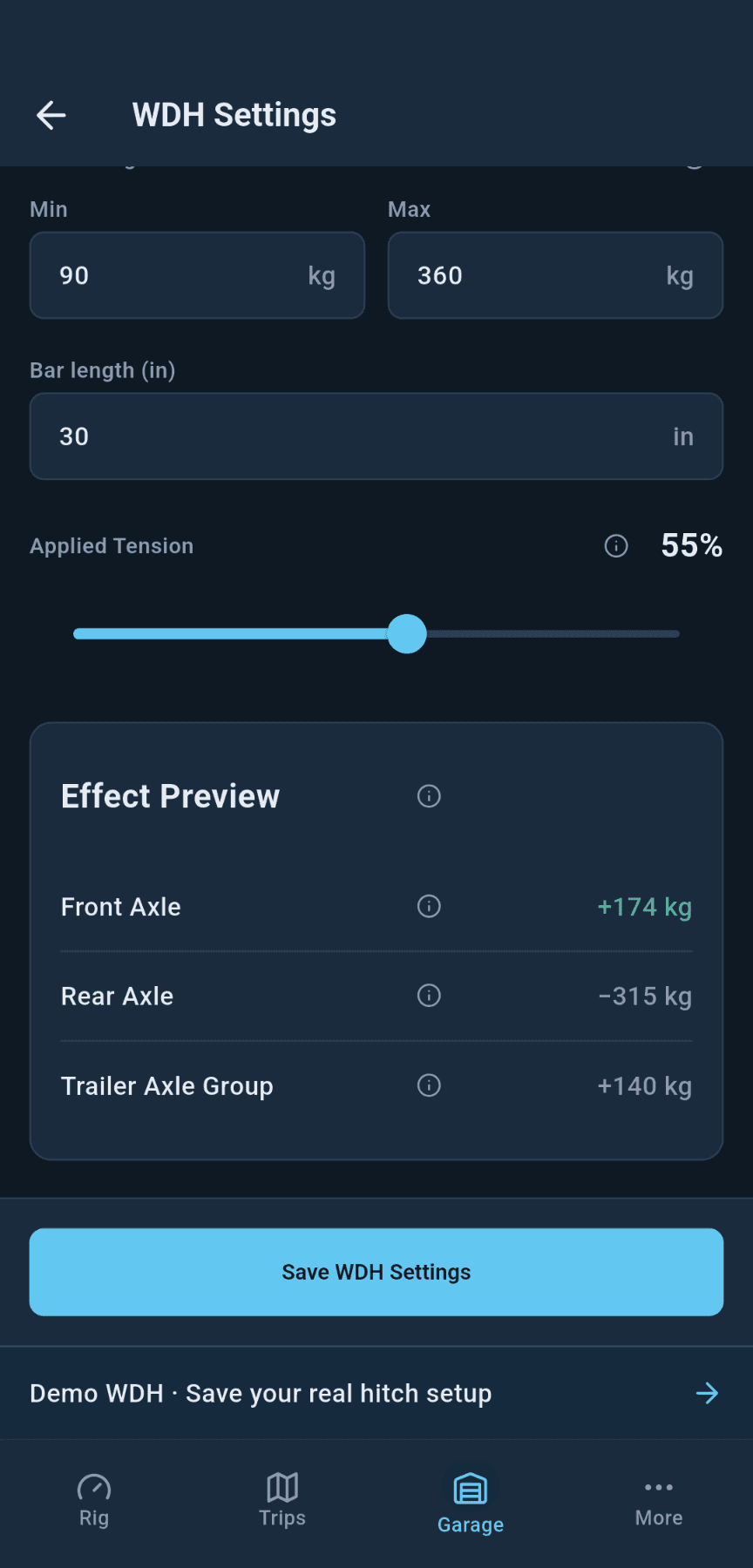
loadmate's WDH modelling lets you enter the hitch the way you actually run it, by spring-bar tension or by a front-axle restoration percentage, and then shows the effect on the front axle, the rear axle and the trailer's axles before you leave home. Paired with the live tracking of GCM and rear axle as you load the van's front boot, it means you tune the Prado's residual 255 kg and its 1,730 kg rear axle against real figures, and see the front-axle load coming back rather than guessing at chain links on the ramp. It is decision support to take to the weighbridge, not a substitute for the weighbridge ticket.
Recalls a used 250 buyer should check
Two recalls during the 250's run are worth a VIN check if you are buying used. A combination-meter software fault covered roughly 13,042 VX, Altitude and Kakadu vehicles built between 24 June 2024 and 21 June 2025, where warning lights might not display, addressed by an over-the-air update or a dealer fix. There has also been an electric brake controller recall, which is directly relevant to anyone towing. Confirm the specific VIN against the record on vehiclerecalls.gov.au before you commit.
The other current-ownership note is the 48V system itself. Owners have reported a 48V battery malfunction message, and in the worst documented case a near-new car shut down at around 550 km and faced a multi-week wait for the part, with Toyota Australia publicly responding to a separate stranding. This is not a fleet-wide failure and the Prado's reliability reputation is otherwise intact, but it is the new thing 250 owners watch for, and it is worth knowing the warranty position before a long remote trip.
The verdict: a better tug, sized for a smaller van than the badge claims
Run the Prado 250 against a sensibly loaded 2,500-2,800 kg van and the Can I Tow It? answer is a pass (well matched): the engine has headroom, the GCM has slack, and the family still gets to come. Push it to a fully loaded 3,500 kg van with everyone aboard and the same check tips to caution (careful) or worse, because the residual payload of roughly 255-265 kg means someone or something is getting left at home, whichever trim you pick. The upgrade from the 150 is honest about what it improved, towing and combined mass, and silent about what it cost you, payload and a flat-folding third row.
A bullbar, drawers and the family's gear all share the Prado 250's remaining payload with the van's ball weight. Get the loadmate app to put those loads beside your measured weights and see what is left for the trip as you record each change. The towing-capacity comparisons show where heavier wagons leave more in hand. If your van fits inside the 250's real envelope, it is an improved tourer over the 150, just one you size to its payload rather than its tow sticker.
Make the next trip fit your Prado
From a weekend away to a longer lap, loadmate helps you plan around the vehicle you have. Record your fit-out, use measured weights and see what changes when the passenger list or packing does.


Common questions
- Can the Prado 250 really tow 3.5 tonnes with the family and gear on board, or just on paper?
On paper, yes; in practice, rarely. A fully loaded 3,500 kg van puts 350 kg on the ball, and that ball mass comes straight out of the Prado's GVM payload, leaving only about 255-265 kg for driver, passengers, fuel and gear on every variant. That is enough for two adults travelling light, not a loaded family. Plan around a 2,500-2,800 kg van for real family touring.
- Did the 250 actually get better than the 150 for towing, or did I lose payload moving to the new model?
Both are true. The 250 tows 3,500 kg against the 150's 3,000 kg, its GCM rose from about 5,990 kg to 6,600 kg, and a tow-test 250 climbed a grade 11 km/h faster than the 150. But payload fell from the 150's 640-750 kg to roughly 605-615 kg. You gained trailer rating and lost carrying capacity.
- Do I need a weight distribution hitch, and at what trailer weight?
Toyota's owner's manual requires a weight distribution hitch on trailers above 2,200 kg. Most touring caravans cross that threshold, so for the typical Prado buyer a WDH is required equipment, not an option. Set it to measured axle weights, since reviewers note the 250's front end goes light under a heavy ball.
- Why is the boot floor so high and why won't the third-row seats fold flat in the new Prado?
The 48V mild-hybrid battery sits under the boot floor, which raises the load floor. As a result the seven-seat third row sits on top of the floor rather than folding flat into it, unlike the 150. Several owners flagged this at launch as a step backwards in practicality.
- Is the 2.8 diesel with 48V underpowered for towing a heavy caravan?
It depends on the load. Up to about 2.5 t the 150 kW / 500 Nm engine tows comfortably and owners describe a relaxed tourer. At the rated 3,500 kg it feels laboured on grades and needs planning for overtakes. The deciding factor is mass, not opinion: under 2.5 t there is headroom; at 3.5 t there is not.
Understand the weight limits
Every figure above is governed by a manufacturer-set limit. These guides explain what each term means and how they fit together.
- Caravan & towing weights explainedThe master glossary: GVM, ATM, GTM, TBM and GCM in one place.
- Gross Combination Mass (GCM)The combined vehicle-plus-trailer ceiling that usually bites first.
- Aggregate Trailer Mass (ATM)What your caravan is legally allowed to weigh, fully loaded.
- Braked towing capacityWhy a 3,500 kg rating rarely means you can tow 3,500 kg.
Sources and review
Specifications checked
Page reviewed
- Toyota Australia - LandCruiser Prado spec table (June 2026)
GVM, kerb and braked towing
- Toyota Australia - vehicle payload policy
Payload and tow ball mass guidance
- CarExpert - 2026 Toyota LandCruiser Prado review
Public GCM reference