By loadmate Editorial · Towing & compliance desk
How much can the Ford Everest tow?
| Variant | Braked towing capacity | GVM | GCM | Kerb weight | Payload at full tow | Tow ball rating | Rear axle limit |
|---|---|---|---|---|---|---|---|
| Sport 2.0 BiT 4x4MY26.50 | 3,500 kg | 3,100 kg | 6,250 kg | 2,304 kg | 446 kg | 350 kg | 1,770 kg |
| Sport 3.0 V6 4WDMY26.50 | 3,500 kg | 3,150 kg | 6,250 kg | 2,416 kg | 334 kg | 350 kg | 1,770 kg |
| Tremor 3.0 V6 4WDMY26.50 | 3,500 kg | 3,240 kg | 6,350 kg | 2,480 kg | 370 kg | 350 kg | 1,770 kg |
| Platinum 3.0 V6 4WDMY26.50 | 3,500 kg | 3,150 kg | 6,250 kg | 2,465 kg | 285 kg | 350 kg | 1,770 kg |
4 variants
| Braked towing capacity | 3,500 kg |
|---|---|
| GCM | 6,250 kg |
| GVM | 3,150 kg |
| Kerb weight | 2,465 kg |
| Front axle limit | 1,470 kg |
| Rear axle limit | 1,770 kg |
| Tow ball rating | 350 kg |
| ATM planning ceiling | 2,900 kg |
| Wheelbase | 2,900 mm |
| Rear overhang | 1,143 mm |
Two engines, one badge, and a question most buyers get backwards
The Everest gives you two diesels to choose between, and on the showroom floor the choice looks obvious. There is the 2.0-litre bi-turbo four, and there is the 3.0-litre V6 with more power, more torque and the badge that says towing. Both are rated to tow 3,500 kg braked. So the V6 is the towing engine, and that is that.
Hold that thought, because the engine you buy for towing is not automatically the engine that tows your family best. The two share a tow rating, but they do not share a kerb weight, and that single difference decides how much of the family, the fridge and the gear you can still carry once the van is on the back. Which one wins is not the answer most buyers expect.
The number that decides it: the combined limit, not the tow rating
Start with the limit that governs every loaded Everest. The Gross Combination Mass (GCM), the most the vehicle and trailer are allowed to weigh together, is 6,250 kg on the Sport, Platinum and other mainstream V6 trims. The Gross Vehicle Mass (GVM), the most the loaded wagon alone may weigh, sits at 3,150 kg on the V6 (3,100 kg on the bi-turbo).
Subtract the two and the real ceiling appears. 6,250 kg combined minus a 3,150 kg loaded vehicle leaves 3,100 kg for the trailer. That is the honest figure, and it is 400 kg short of the 3,500 kg on the brochure. You can tow 3,500 kg or you can run the wagon at full GVM, but the GCM will not let you do both at once. The V6's combined shortfall, about 400 kg, is one of the largest in the seven-seat class.
So the 3,500 kg badge is true, with a catch the brochure never prints: tow that much and the combined limit caps the wagon's payload at 334 kg in a Sport V6, the wagon itself held 50 kg short of its own GVM. The moment you load a family wagon for a trip, the combined limit, not the tow rating, is the wall you meet first.
Where the V6 quietly loses: it weighs more before you load a thing
Here is the mechanism the showroom never mentions. The V6 is the heavier engine. A Sport V6 starts at about 2,416 kg at the kerb, and the Platinum V6 climbs to around 2,465 kg with its extra equipment. The 2.0 bi-turbo Sport sits at 2,304 kg. Every one of those kilograms is spent before a single passenger, esky or jerry can goes aboard.
The V6 does carry a 50 kg higher GVM (3,150 kg against the bi-turbo's 3,100 kg), which claws some of that kerb weight back, but not all of it. Net out the two and the heavier engine still leaves you less: the V6 carries about 62 kg less usable payload than the bi-turbo in the Sport, stretching to about 111 kg less in the Platinum, depending on trim. The badge you buy for capability is the one that gives back the most capacity. It is the variant choice equivalent of writing a cheque the payload account cannot cash.
This is the Everest's signature trade, and it does not transfer to its rivals. Cross-shop the Toyota Prado and you get one engine and a different, tighter GCM story; there is no V6-versus-four payload split inside the range to get wrong. On the Everest, the engine badge is the payload decision.
What's actually left for the family at 3,500 kg
Put real numbers on it. Hitch a van loaded to a true 3,500 kg and you will be carrying around 350 kg of that on the tow ball. That 350 kg lands on the wagon and counts against its GVM, but it is already inside the van's 3,500 kg ATM, so on the combined side it is counted once, with the trailer. Now do the combined sum: 6,250 kg GCM minus the 3,500 kg van leaves 2,750 kg for the wagon and its load, and the Sport V6's 2,416 kg kerb weight takes all but 334 kg of it. At a true 3,500 kg the combined limit, not GVM, is what stops you, and it stops you at 334 kg of people and gear.
Easing the van back buys less relief than the 400 kg gap suggests. Cap the trailer at 3,100 kg and the wagon can run to its full 3,150 kg GVM, and after kerb and a 350 kg ball you keep about 385 kg for people and luggage in a Sport V6, roughly 50 kg more than at the full rating. Two adults and a couple of kids can eat that before the boot is packed; a 90-litre water tank, a fridge, recovery gear, camp chairs and an awning do not fit inside what is left. An honest Everest tow plan starts at payload and works backwards to the van.
It is also why the lighter bi-turbo, still sold alongside the V6, makes the better family tug if you are going to run near the rating: same 3,500 kg badge, and because its GVM is 50 kg lower its loaded trailer ceiling is actually marginally higher at 3,150 kg against the V6's 3,100 kg. At the full 3,500 kg the bi-turbo keeps 446 kg of payload against the Sport V6's 334 kg, more left over to carry the people the wagon was bought for.
Both diesels are still on sale, so the choice is yours to get right
If you are reading this as a new-car buyer in 2026, the good news is that the escape from the payload squeeze is still on the showroom floor. For the MY26.50 range the 2.0 bi-turbo Sport carries forward rated to the full 3,500 kg braked, sitting alongside the 3.0 V6 in Sport, Platinum and Tremor trims. You are not forced into the heavier engine to get the badge.
So the choice is a real one rather than a foregone conclusion. A buyer chasing the most usable payload takes the lighter bi-turbo and keeps roughly 60 to 110 kg more to carry; a buyer chasing power, torque and the easiest hill-towing manners takes the V6 and accepts the smaller payload. Both tow 3,500 kg, and once loaded the bi-turbo's combined ceiling is marginally higher at 3,150 kg against the V6's 3,100 kg, with the variant badge the payload decision either way.
One due-diligence note for V6 buyers shopping used: a May 2025 recall (25S39 / REC-006341) covered roughly 13,490 V6 Ranger and Everest models built 2022 to 2025, for a left-hand camshaft sprocket that could fracture and cause a stall. The fix is a free dealer remedy. Run the VIN through the recall record before you hand over money.
The rear axle bites before GVM does
Payload is only half the squeeze. The other half is where that payload lands, because the tow ball does not sit over the rear axle, it sits behind it. That overhang turns the coupling into a lever, and a lever multiplies.
Work a real example. An owner pencilling a heavy off-road van against an Everest found that about 278 kg on the ball transferred close to 400 kg onto the rear axle once the lever effect of the overhang was counted. With a 1,143 mm rear overhang and a 2,900 mm wheelbase, the hitch sits far enough behind the axle that the ball lands on the rear at roughly 1.45 times its mass. The Everest's rear axle is rated to 1,770 kg. Add that amplified ball load to the rear's share of the kerb weight and you can push the back axle toward its limit before a single passenger or drawer goes in over the boot.
That is the trap. You can be comfortably under GVM on the total and still be over the rear axle rating, because the maths bites at the axle, not the badge. A loaded combined weight that reads fine on paper can hide a rear axle that is already full.
The ride change is real; the dramatic squat mostly isn't
Owner forums talk about the Everest sagging under a heavy ball, and it is worth being precise, because the reputation overshoots the reality. A measured tow test saw the rear compress about 10 cm under ball load, with no nose-in-the-air, praying-mantis lift. The squat is modest.
What changes more is the ride. Loaded, the wagon firms up and can porpoise over country undulations, and the effect is worse, not better, with only one or two people aboard to settle the rear. So the honest picture is a settled rear that does not collapse, paired with a busier ride you will feel on a long highway leg. Plan for the ride, not for a collapsing back end.
Inside, the current Everest gives you nothing to apologise for. The 12-inch portrait screen reads as class-leading, wireless CarPlay is standard, and Ford kept physical volume and climate knobs you can find without looking down. Any old line about a dated Everest cabin is simply out of date.
Does it need a weight-distribution hitch? Both sides are right
This is the live debate among heavy-towing Everest owners, and the two camps are arguing about different things. Ford's official position is that the Everest is engineered to tow to its maximum without a weight-distribution hitch (WDH), and that fitting an aftermarket one may affect durability, ride and the stability control. Taken as a statement about structural capability, that is correct.
Owners towing near the rating push back, and they are also correct, because they are talking about axle balance and ride rather than whether the towbar will hold. With a soft rear and a real ball weight, they fit a WDH or airbags to shift load off the rear axle and back onto the front, taming the porpoising and restoring steering feel.
The resolution is in your loaded numbers, not the brochure. If your measured front and rear axle weights are comfortably inside their limits, a WDH is optional. If the ball weight is pushing the rear axle toward 1,770 kg and lifting the steer axle light, a WDH is doing real work that the blanket no-WDH advice glosses over. The only way to know which case you are in is to weigh it.
Everest specifications at a glance (2026, AU)
These are the figures that drive every limit above. The V6 trims share a 1,770 kg rear axle rating and a 6,250 kg GCM (the Tremor runs a slightly higher 6,350 kg); what moves between them is kerb weight, and therefore payload.
Sport 2.0 bi-turbo: GVM 3,100 kg, GCM 6,250 kg, braked tow 3,500 kg, kerb 2,304 kg, tow ball 350 kg, combined shortfall about 350 kg. Sport 3.0 V6: GVM 3,150 kg, GCM 6,250 kg, braked tow 3,500 kg, kerb 2,416 kg, tow ball 350 kg, combined shortfall about 400 kg. Platinum 3.0 V6: GVM 3,150 kg, GCM 6,250 kg, braked tow 3,500 kg, kerb 2,465 kg, tow ball 350 kg, combined shortfall about 400 kg. Tremor 3.0 V6: GVM 3,240 kg, GCM 6,350 kg, kerb 2,480 kg, raised front axle 1,530 kg, rear axle 1,770 kg, combined shortfall about 390 kg.
Figures are from the 2026 (MY26.50) Ford Australia specification data compiled in our towing reference; confirm the exact variant on the compliance plate of the car you buy, since equipment moves the kerb weight between trims.
Weigh it, then choose the van around the answer
Before you commit to a van, get the loaded rig onto a weighbridge and read five numbers: front axle, rear axle, total vehicle, trailer axle group and combined mass. Treat the weighbridge ticket as decision support for which limit bites first, because the brochure cannot tell you where your gear actually sits.
If the wagon is under GVM but close on the rear axle, the fix is placement: move some load forward in the van or set up a WDH to measured numbers. If the combined figure is over GCM, no shuffling helps; the total has to come down through a lighter van, less water or fewer permanent accessories. Knowing which case you are in turns a flat no into a specific, fixable problem.
The point of all this is to size the van to the loaded Everest, not the badge. The two limits that decide a real Everest tow are usable payload and the rear axle, and both are easiest to read where the family and the ball weight actually land, side to side and front to back. The kids in the back seat, drawers and fridge in the boot, and ball mass on the hitch all use that remaining margin. Get the loadmate app to start from measured weights and see how the loads you record affect the Everest's rear axle and the rig's stability guidance. You can work through the next packing change before leaving home. For how the Everest sits against the rest of the field, see the towing capacity hub.
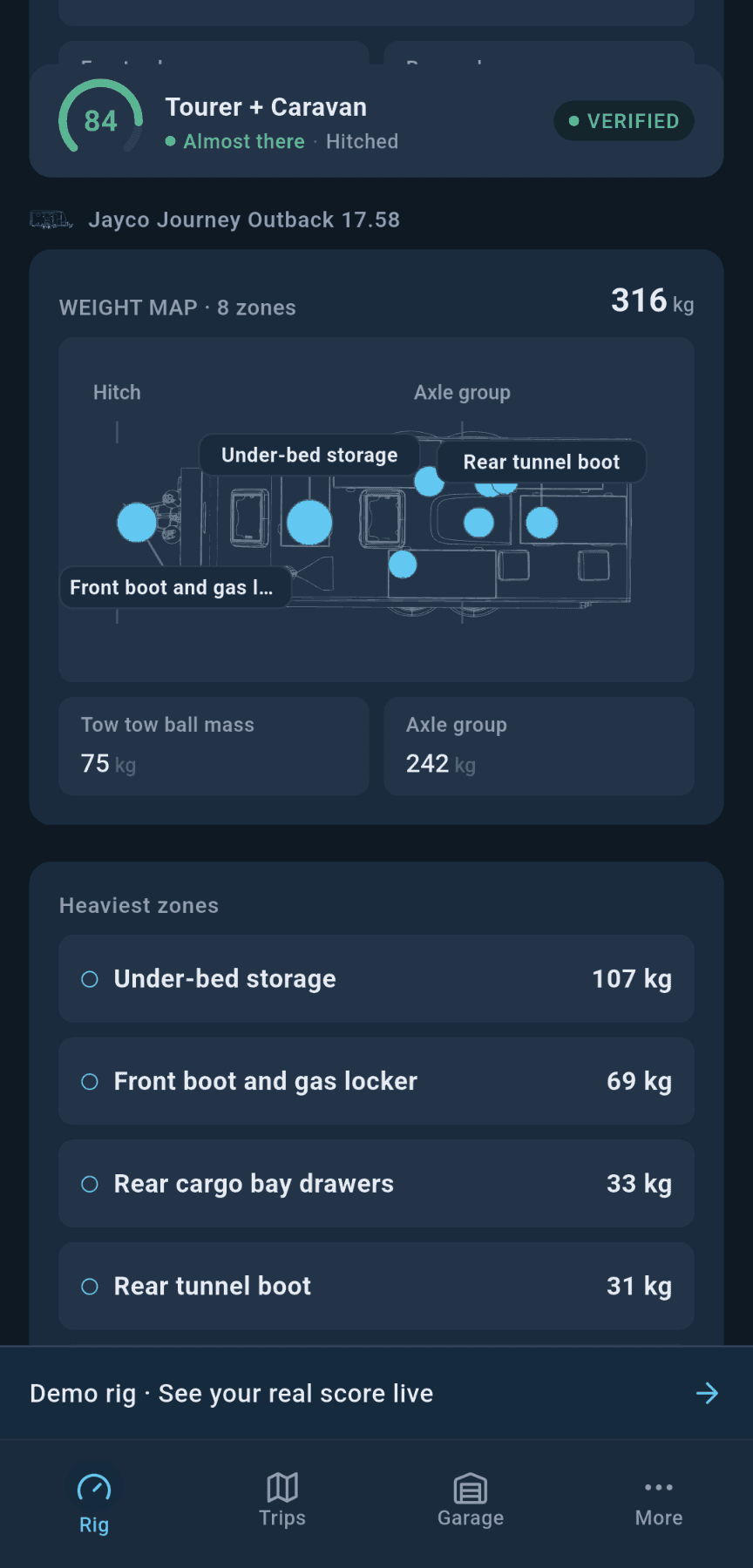
Same Everest. Different trip. Different load.
Two people for a weekend and a full family for school holidays ask different things of your wagon. loadmate helps you see the effect of those changes across the vehicle and caravan, using your recorded setup and weigh-ins.


Common questions
- Can the Everest V6 actually tow 3.5 tonnes with the family and gear aboard, or only on paper?
It can, but the GCM writes the payload budget. The V6 is rated to 3,500 kg braked, and at that weight the 6,250 kg GCM minus the van leaves 2,750 kg for the wagon; after the Sport V6's 2,416 kg kerb weight that is 334 kg for everyone and everything aboard, with the 350 kg ball already counted inside the van's ATM. Bring the trailer back to 3,100 kg and the wagon can use its full 3,150 kg GVM, keeping about 385 kg, which a family still fills quickly.
- Bi-turbo or V6 for towing a caravan, which one leaves me more to carry?
The bi-turbo. It is lighter at the kerb (2,304 kg versus 2,416 to 2,465 kg for the V6), and even though the V6's GVM is 50 kg higher and claws some of that back, the bi-turbo still carries about 62 to 111 kg more usable payload at the same 3,500 kg tow rating. Both engines stay on sale for MY26.50 and both are rated to the full 3,500 kg, so the choice is yours: the bi-turbo for the most payload, the V6 for more power and torque at the cost of that headroom.
- Will I overload the rear axle before I hit GVM when the van's ball weight is on the towbar?
You can. The tow ball sits behind the rear axle, so it levers onto it: about 278 kg on the ball can transfer close to 400 kg to the rear axle. Against a 1,770 kg rear axle limit, that can push the back axle to its rating before you reach GVM on the total, especially with third-row passengers or a packed boot also sitting over the rear.
- Does the Everest need a weight-distribution hitch, or do I just fit airbags for the rear sag?
Ford says the Everest is engineered to tow to its maximum without a WDH and that fitting one may affect durability, ride and stability control. Owners towing near the rating often fit a WDH or airbags anyway to move load off the rear axle and tame the ride. Both can be right: if your measured axle weights are inside their limits a WDH is optional, but if the ball weight is pushing the rear axle toward its limit, it is doing real work. Weigh the loaded rig to decide.
- Is the four-cylinder Everest still a 3,500 kg tow car in 2026?
Yes. The 2.0 bi-turbo Sport carries forward for MY26.50 and is still rated to the full 3,500 kg braked, sitting alongside the 3.0 V6. You do not have to step up to the heavier V6 to get the badge; the bi-turbo holds the same 3,500 kg rating and hands back more payload, which is exactly why the engine choice is the payload decision.
Understand the weight limits
Every figure above is governed by a manufacturer-set limit. These guides explain what each term means and how they fit together.
- Caravan & towing weights explainedThe master glossary: GVM, ATM, GTM, TBM and GCM in one place.
- Gross Combination Mass (GCM)The combined vehicle-plus-trailer ceiling that usually bites first.
- Aggregate Trailer Mass (ATM)What your caravan is legally allowed to weigh, fully loaded.
- Braked towing capacityWhy a 3,500 kg rating rarely means you can tow 3,500 kg.
Sources and review
Specifications checked
Page reviewed
- Ford Australia — Everest 2026.50MY spec sheet
GVM, GCM, kerb, axle limits and braked towing
- Ford Australia — Everest showroom
Variant range and towing positioning