How much can the Toyota Prado 150 Series tow?
| Variant | Braked towing capacity | GVM | GCM | Kerb weight | Payload at full tow | Tow ball rating | Rear axle limit |
|---|---|---|---|---|---|---|---|
| VX (final 150 Series)2024Med | 3,000 kg | 2,990 kg | 5,990 kg | 2,335 kg | 355 kg | 300 kg | 1,730 kg |
1 variant
| Braked towing capacity | 3,000 kg |
|---|---|
| GCM | 5,990 kg |
| GVM | 2,990 kg |
| Kerb weight | 2,335 kg |
| Front axle limit | 1,450 kg |
| Rear axle limit | 1,730 kg |
| Tow ball rating | 300 kg |
| ATM planning ceiling | 2,500 kg |
| Wheelbase | 2,790 mm |
| Rear overhang | 1,250 mm |
Read the lot, not the brochure
Walk a used 4x4 yard and the 150 Series Prado is the one already dressed for the trip: steel bull bar, a winch peeking through it, side rails, a long-range tank under the back, drawers in the boot and a snorkel up the A-pillar. It looks like the answer to a touring question. The catch is that almost none of that weight is on the compliance plate, and the plate is the only number the previous three owners ever had to work from.
So before you ask what a 150 tows, ask what this one weighs. The plate says a kerb around 2,335 kg and a GVM of 2,990 kg, which reads as roughly 655 kg of payload. That figure described the car the day it left Altona. It has not described any heavily accessorised example on a yard in years. These are medium-confidence, RedBook-sourced numbers for the final VX, so treat them as a guide and read the plate on the specific car.
This guide treats the 150 the way a careful used buyer should: as a known platform with a real but modest 3,000 kg tow rating, sitting under a kerb weight that a decade of bolt-ons quietly rewrote. Get the weight right and the rest of the maths follows. Guess it, and every limit below is guessed too.
It tows 3,000 kg, not 3,500
Start by deleting the number people reach for. The 150 is not a 3,500 kg tow vehicle. The later diesel auto, from the September 2017 facelift on, is rated to 3,000 kg braked. The early 3.0L and the 4.0L petrol cars are 2,500 kg. The 3,500 kg figure belongs to the 250 Series that replaced it, and it gets attached to the 150 by people who never read the older spec sheet.
That matters because 3,000 kg is only just competitive. When the 150 finally reached 3,000 kg it drew level with an Everest or an MU-X rather than leading them, and it did so on a platform that was always more touring wagon than heavy hauler. A van that a Ranger swallows at 3,200 kg is simply off the table here.
For a real-world planning band, a built 150 is happiest under a 2,500 kg caravan and genuinely comfortable around 2,200-2,400 kg. Push past 2,500 kg and you are not really leaning on the tow rating or the gross combination limit, both of which still have room on paper. You are leaning on payload, the limit that a decade of accessories quietly spends, which the next section gets to.
A decade of bolt-ons quietly rewrote the kerb weight
Here is the pattern that defines the used 150 and almost nothing else in its class. The most common owner complaint, repeated across Pradopoint suspension and GVM threads, is not that it lacks power or tows badly. It is that the payload disappears. A steel bull bar, a winch, a drawer system, a long-range tank, a second battery and a roof platform between them can add 180-250 kg of permanent weight, and the factory never put any of it on the plate.
Run the subtraction. Start from roughly 655 kg of plate payload. Take 200 kg back for a moderate touring fit-out and you are down near 455 kg, before anyone sits in a seat or a litre of fuel goes in. Add four adults and luggage and the wagon can be brushing its 2,990 kg GVM with a half-empty boot. Then hitch the van. The 300 kg tow ball counts inside GVM too, so a heavy ball pushes the vehicle toward its own gross limit before the caravan has done anything except sit on the coupling.
This is why the plate kerb is the least trustworthy number on a ten-year-old 150. It was true once. Every accessory since has moved it, and unlike a fresh car off the showroom floor, you have no way of knowing by how much without putting the thing on a scale.
What the 5,990 kg GCM actually leaves you
The 150's gross combination mass is the number that decides whether a tow rating is real or just printed on the towbar, so it is worth doing the arithmetic. The later diesel auto carries a 5,990 kg GCM against the 2,990 kg GVM. Subtract one from the other and there is room for the full 3,000 kg trailer at full GVM, with nothing left over. In other words the GCM and the tow rating line up exactly: the 150 can sit at its own gross limit and still legally pull its rated maximum, which is more than several rivals manage.
That sounds like good news, and on paper it is, but it quietly relocates the problem. Because the GCM is not the limit that bites first, payload is. Loading the vehicle to 2,990 kg GVM is the easy part on an accessorised 150; you can hit it with people, fuel and gear before the van is even hitched. So the trailer ceiling the GCM permits, the full 3,000 kg, assumes a vehicle that is not already over its own GVM, and on a built used 150 that assumption rarely holds.
Two cautions for a used buyer. First, these are medium-confidence, RedBook-sourced figures for the final VX; earlier and lower 150 grades, and the petrol and 3.0L cars at 2,500 kg braked, do not all share them, so read the compliance plate and the owner's manual on the actual car. Second, the manual's GCM is the legal number, not the badge, so confirm the wording for your build and model year and subtract your weighed kerb from there.
Which engine, and which years to avoid
The 150 spans two very different diesels, and the split decides which used car is the safer buy. From 2009 to mid-2015 it ran the 3.0L 1KD-FTV. From mid-2015 it switched to the 2.8L 1GD-FTV, bumped to 150 kW and 500 Nm in August 2020.
The 3.0L is the one to be careful with. Toyota acknowledged a cracked-piston problem in a technical service bulletin (EG-008T-0112, September 2014), with cracks typically showing between 100,000 and 150,000 km. It was a bulletin, not a recall, so owners wear the repair cost, and although a 2014 production change improved injectors and pistons, cracks were still reported afterwards. If you are looking at a 2009-2015 3.0L, factor that risk in. Do not, however, attach piston-cracking to the 2.8L; its weaknesses are different.
The 2.8L is a competent tourer but a modest tug. Reviewers towing 2,800 kg describe it running out of puff on inclines, with the six-speed auto hunting and refusing to hold overdrive under load, dropping to Sport and fourth at around 2,600 rpm, for roughly 20.2 L/100 km. Pre-2020 cars are the underdone ones here; the August 2020 power lift fixed most of that complaint, which is why 2020-on is the watershed model year for both grunt and the resolved GCM spec.
DPF, fuel pumps and the recalls to VIN-check
The 2.8L brought the diesel particulate filter, and on short town runs it can clog and trigger limp mode, sometimes mid-tow. The failure window runs roughly 60,000-200,000 km depending on how the car was driven, and a replacement is at least a couple of grand. A loose airbox seal can also dust the mass-airflow sensor and produce the same limp-mode symptom, so a 2.8L that has lived in suburbia is a different proposition to one that did regular highway kilometres.
Before money changes hands, run the VIN through toyota.com.au and vehiclerecalls.gov.au. The 150 is covered by a fuel-pump recall affecting builds from September 2013 to June 2015 and September 2017 to July 2019, where the pump can stop and cause a stall, and by the Takata airbag recall on non-desiccated inflators. Both are free fixes, but you want them confirmed as completed, not pending, on the car you are buying.
If it leans to one side, walk away
The 150's kinetic dynamic suspension system, KDSS, links the front and rear sway bars hydraulically to keep the car flat on-road and let the wheels droop off-road. When it works it is excellent. When it leaks or air gets into it, the car sits visibly lower on one side, and that lean is the single most useful walk-away signal on a used inspection.
Most leans are fixed by bleeding the system and fitting a spacer, but the worst cases are ugly. One 2014 Kakadu sat 70 mm out and Toyota could not resolve it over five months. Repairs run into the thousands. On a yard, a 150 that is not sitting level is telling you something the salesperson may not have noticed, and the cheapest response is to look at the next one.
GVM upgrades, and the limit they do not lift
Because payload is the 150's chronic problem, GVM upgrades are a common owner fix. Certified kits from the usual second-stage suppliers lift GVM to 3,500 kg and quote a GCM up around 6,500 kg, which on paper hands back the room a touring fit-out ate. Treat those upgraded numbers as vendor figures to verify against the engineering certificate, not gospel, and note that some popular kits explicitly do not suit the Kakadu.
There is a sting in the tail worth saying plainly. A post-registration GVM upgrade does not lift the manufacturer's tow rating, and a GVM upgrade alone does not automatically raise the tow-ball or rear-axle ratings unless the approval says so. So you can spend the new payload on the bull bar and drawers you already have, and still find the rear axle or the manual's GCM is the number stopping you. The upgrade question is not whether a higher GVM exists; it is whether the approved package leaves enough rear axle and GCM for the van you actually want to tow.
The weighbridge is the only honest number
There is a recurring ritual among 150 owners that tells you everything. They build the truck to tour-ready, feel pleased with it, then drive it to a public weighbridge out of curiosity, one Brisbane regular uses the Willawong transfer-station scales, and watch the loaded-but-empty wagon come up brushing its 2,990 kg GVM with the boot still half empty. The plate kerb was the lie. The weighbridge ticket is the truth, and it is usually a less comfortable read.
So the buying routine writes itself. Before you commit, take the car as it sits, accessories and all, over a weighbridge and get the real kerb. Subtract that from 2,990 kg for your honest payload. Read your own manual's GCM and subtract the weighed kerb for your real trailer ceiling. Then measure the loaded ball weight of any van you are matching, because it lands inside GVM and on the rear axle at the same time. Your used Prado's bullbar, drawers and roof gear are already using payload before you pack. Get the loadmate app to build from those measured weights and see how the next load changes your remaining margins. If you are still narrowing the field, the towing capacity hub lets you line the 150 up against the rest of the used field, and a used Toyota Prado 250 Series makes a fair cross-shop if the van you have chosen is closer to three tonnes than two.
Why people still pay 150 money
With all of that against it, the 150 still commands strong used prices, and the reason is earned. Over 175 owner reviews it sits around 3.7 out of 5, with 200,000-plus km treated as routine, parts available in every regional town, and value retention near 60-70 percent at five years where rivals struggle to hold half. For a buyer who tours remote and wants the truck to start every morning a long way from a dealer, that reputation is the whole pitch, and it is mostly true.
Mostly, not absolutely, and the date matters. Recent reviews are less unconditional: a 2021 VX with an engine failure around 90,000 km left unresolved for years, and 2020-on owners reporting a 1,500-1,700 rpm vibration the dealer calls normal. The reputation was built by the 2009-2018 cars more than it is guaranteed on every example. Buy on the weighed numbers and the service history, not on the badge's old promise.
Where a built 150 leaves you, and the next move
Put the platform back together. A used 150 Series Prado tows 3,000 kg on the later diesel, carries roughly 655 kg of factory payload that a touring fit-out has already spent most of, and lives under a 5,990 kg GCM that leaves room for the full 3,000 kg trailer at full GVM on paper. The trailer ceiling is not what bites first; payload is, because the 300 kg ball and an accessorised kerb spend the GVM long before the GCM runs out. As a planning band, a built example is well matched to a 2,200-2,500 kg caravan and a careful, weigh-everything match above that. Verdict: pass (well matched) under 2,500 kg, caution (careful) above it, and only on a car whose real weight you have actually read.
Which is where the trustworthy-number problem becomes the buying decision. On a ten-year-old build, the plate kerb is the figure you can least rely on, and every margin above sits on top of it. loadmate handles that by letting you link a weighbridge or mobile-weigher result straight into the rig, so the estimate becomes a measured baseline, accessory drift resets to zero, and the rear-axle, GVM and GCM margins are calculated from what the Prado weighs now rather than what it weighed leaving the factory. For an accreted used 4x4, that is the difference between a plausible number and a real one.
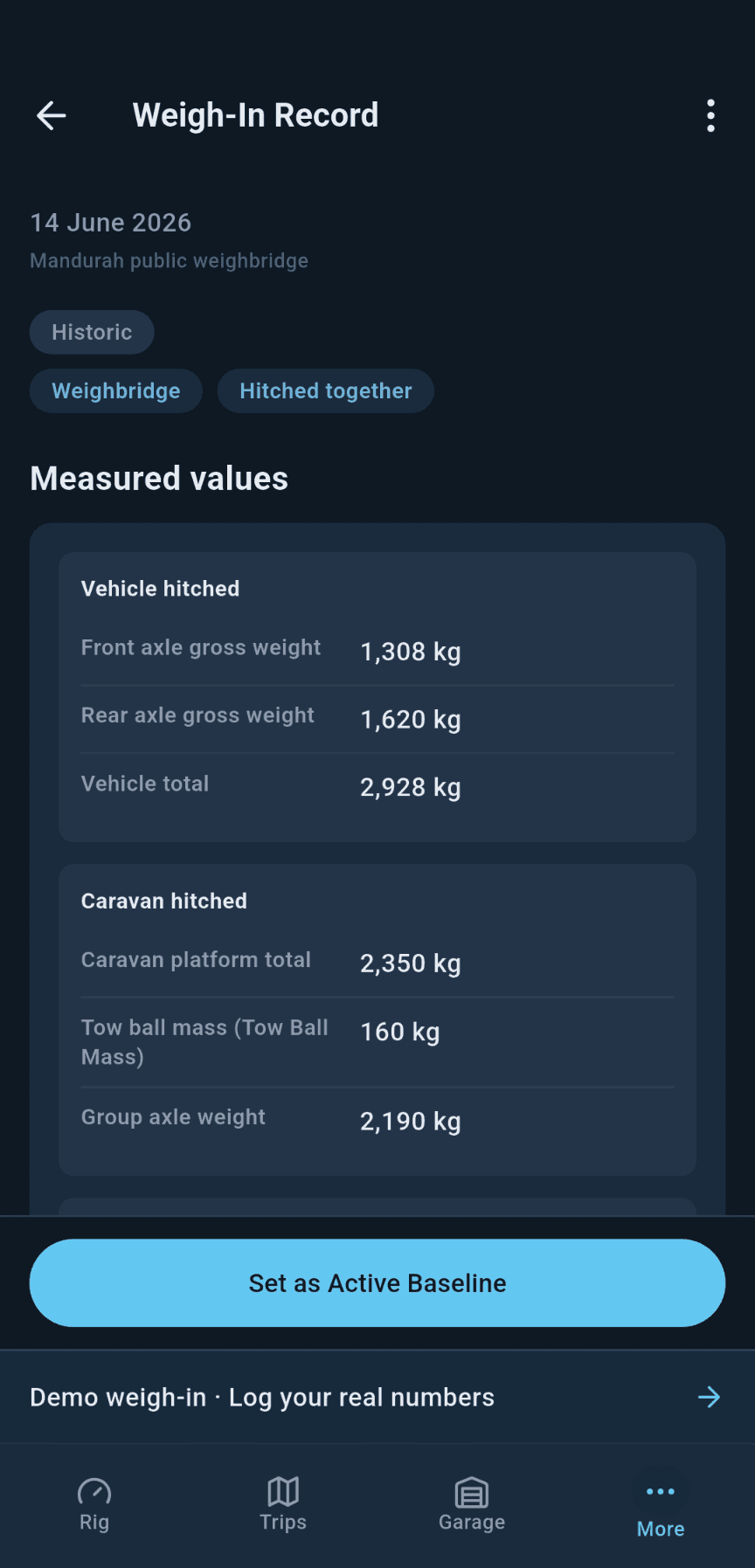
Build on what it really weighs
loadmate links a weighbridge or mobile-weigher result straight into your rig, so every margin sits on measured weight, not a decade-old plate. Free to explore in the app.


Common questions
- Can a Prado 150 actually tow a 2.5 tonne caravan, or will the 2.8 run out of puff?
It can, but it is near the comfortable ceiling, especially before the August 2020 update. Owners towing 2.5-2.7 tonne vans describe the 2.8L hunting through the gears on hills and holding fourth to keep transmission temperatures under control; some fit an auxiliary transmission cooler for exactly that reason. A 2020-on car with 150 kW and 500 Nm handles it noticeably better. Below about 2,400 kg the 150 is genuinely relaxed; at 2,500 kg it is working.
- How much payload have I really got left after a bull bar, drawers, a long-range tank and a second battery?
Less than the plate suggests. Start from roughly 655 kg of factory payload against the 2,990 kg GVM, then subtract 180-250 kg for a typical touring fit-out. That can leave around 405-475 kg before passengers, fuel and the caravan's ball weight, and the ball download counts inside GVM, up to the 300 kg coupling limit. The only way to know your number is to weigh the car as it sits, then subtract from 2,990 kg. These are medium-confidence RedBook figures for the final VX, so confirm the plate on the actual car.
- Is the 3.0L or the 2.8L the better used buy, and which years do I avoid?
The 2.8L (mid-2015 on) is the safer buy, and a 2020-on example is best for the power lift to 150 kW/500 Nm. The 3.0L 1KD (2009 to mid-2015) carries a known cracked-piston risk flagged in a 2014 Toyota service bulletin, with cracks typically at 100,000-150,000 km and no recall to cover the cost. The 2.8L's own watch items are the DPF and mass-airflow sensor, not pistons.
- What is this KDSS thing, and should I walk away if the car is leaning to one side?
KDSS is the hydraulic sway-bar system that keeps the 150 flat on-road and lets it flex off-road. A visible lean to one side means it is leaking or has air in it. Many cases are fixed by bleeding and a spacer, but the worst can sit dozens of millimetres out and resist repair, with bills into the thousands. As a used-buyer rule, if it leans, walk away unless the seller has a recent, documented fix.
- Do I need a GVM upgrade, and will it actually let me tow more?
A certified GVM upgrade can hand back the payload a touring build ate, with kits quoting up to 3,500 kg GVM and around 6,500 kg GCM. But a post-registration upgrade does not lift the manufacturer's tow rating, and it does not automatically raise the tow-ball or rear-axle ratings. So it solves the payload squeeze, not the trailer ceiling. Check what the specific approval actually changes, and that the kit suits your variant, before assuming it lets you tow a heavier van.
Understand the weight limits
Every figure above is governed by a manufacturer-set limit. These guides explain what each term means and how they fit together.
- Caravan & towing weights explainedThe master glossary: GVM, ATM, GTM, TBM and GCM in one place.
- Gross Combination Mass (GCM)The combined vehicle-plus-trailer ceiling that usually bites first.
- Aggregate Trailer Mass (ATM)What your caravan is legally allowed to weigh, fully loaded.
- Braked towing capacityWhy a 3,500 kg rating rarely means you can tow 3,500 kg.
Sources and review
Specifications checked
Page reviewed
- CarsGuide — Toyota LandCruiser Prado towing capacity (RedBook data)
Braked towing, GCM and kerb across 150 Series
- WhichCar — 2024 Toyota LandCruiser Prado 150 review
Final 150 Series range and towing context