How much can the Toyota LandCruiser 79 tow?
| Variant | Braked towing capacity | GVM | GCM | Kerb weight | Payload at full tow | Tow ball rating | Rear axle limit |
|---|---|---|---|---|---|---|---|
| Workmate Dual CabMY25 | 3,500 kg | 3,510 kg | 7,010 kg | 2,200 kg | 960 kg | 350 kg | 2,300 kg |
| GXL Dual CabMY25 | 3,500 kg | 3,510 kg | 7,010 kg | 2,185 kg | 975 kg | 350 kg | 2,300 kg |
| 76 WorkMate Wagon AutoMY25 | 3,500 kg | 3,510 kg | 7,010 kg | 2,320 kg | 840 kg | 350 kg | 2,180 kg |
| 76 GXL Wagon ManualMY25 | 3,500 kg | 3,510 kg | 7,010 kg | 2,300 kg | 860 kg | 350 kg | 2,180 kg |
4 variants
| Braked towing capacity | 3,500 kg |
|---|---|
| GCM | 7,010 kg |
| GVM | 3,510 kg |
| Kerb weight | 2,185 kg |
| Front axle limit | 1,480 kg |
| Rear axle limit | 2,300 kg |
| Tow ball rating | 350 kg |
| ATM planning ceiling | 3,500 kg |
| Wheelbase | 3,180 mm |
Why the GVM says 3,510 and not 3,500
Spec-sheet numbers usually come from engineering. The LandCruiser 79's gross vehicle mass — GVM, the most the loaded truck may legally weigh — comes from a rulebook. In September 2022 Toyota lifted every 70 Series variant to a 3,510 kg GVM, 10 kg above the 3,500 kg line that separates light vehicles from heavy ones in Australian design rules. The move was widely reported at the time as a way to step around ADR 85, the pole-side-impact standard a body engineered in the 1980s was never going to meet; above 3,500 kg GVM, that rule stops applying. Ten kilograms on paper, and the old body stayed on sale.
For buyers, the lift was real money. Before September 2022 a 79 dual cab was a 3,300 kg GVM truck with a 6,800 kg GCM; the new plates added about 210 kg of payload overnight and moved the combined limit to 7,010 kg while the 3,500 kg tow rating stayed put. Used buyers should check the build date before trusting anything on this page. A pre-September-2022 dual cab runs the older 3,300/6,800 pair, a sum that also balanced exactly: 3,300 plus 3,500 is 6,800. The re-engineered single cab sold from late 2016 carried a 3,400 kg GVM, which left it 100 kg short under the old combined limit.
The sum that balances to the kilogram
Here is what makes that 3,510 figure unusual. On almost every vehicle across the towing-capacity hub, adding full GVM to the full braked rating overshoots the GCM — a Ford Ranger by about 450 kg, the new HiLux by about 320 kg — so a loaded truck must give back trailer, or a full trailer must empty the truck. Run the 79's numbers and there is nothing to give back: add 3,500 kg of trailer to a truck at its 3,510 kg GVM and you get 7,010 kg, which is the GCM in Toyota's October 2025 specification table, to the kilogram. At full GVM the legal trailer is still the full 3,500 kg.
That puts the 70 Series in rare company. Three current vehicles close this sum exactly: the 79, its 76 wagon stablemate — both at 7,010 kg — and the Nissan Patrol Y62 at 7,000 kg. The LandCruiser 300 misses membership by 30 kg. CarsGuide's 2026 review of the 76 made the point in plain terms: the maximum trailer and the maximum payload can travel together on this platform.
Two conditions hold the sum together. The 350 kg towball download has to fit inside the GVM, not ride on top of it, and Toyota's towing guide asks for ball weight at 9-11% of the trailer's mass. At a full 3,500 kg van, 10% is exactly 350 kg — the towbar's ceiling — and 11% would be 385 kg, over the plaque. So the truck that can legally tow 3,500 kg at full GVM still needs a van loaded so its nose sits at 10% or under, and a rear axle with room left, which is where the next sections go.
What the same 10 kg cost: eight months of stopped production
The regulatory line cut the other way on 1 November 2025, when ADR 80/04 extended Euro 6-grade heavy-vehicle emissions rules to vehicles with a GVM above 3,500 kg — exactly the side Toyota had moved the 70 Series to. Meeting it means selective catalytic reduction and an AdBlue tank, hardware the 2.8-litre diesel did not carry, so Toyota stopped 70 Series production in September 2025 for a reported eight months, with AdBlue-equipped trucks expected from around mid-2026. The 10 kg that earned the 79 its perfectly balanced sum is the same 10 kg that parked the production line.
What this means at a dealership is messier than a simple drought. Toyota stockpiled ahead of the stop and was quoting two-to-four-month delivery on most variants in July 2025, so stock kept moving through the pause. Whether the restart lands on schedule or slips, the sums above describe the current truck; when AdBlue-equipped examples arrive, read their plates fresh rather than assuming every figure carried over, and confirm order status with a dealer rather than a forum thread.
The kerb weight describes a truck with no back half
The spec table is quietly telling you something else: the 79 dual cab's kerb weights describe a bare cab-chassis. The figures are 2,200 kg for a WorkMate, 2,185 kg for a GXL auto, and a 2,185-2,240 kg range for the GXL manual. Toyota's own dimensions drawing gives up on the back of the truck; the caption reads 'Length dependent upon tray body fitted'. Its towing guide defines kerb weight as fluids and a full tank but no accessories, and on a cab-chassis the load bed itself counts as an accessory. The headline figure of roughly 1,310 kg of payload on a WorkMate dual cab belongs to a truck that cannot yet carry anything.
Call it the tray tax. The lightest quality alloy dual-cab tray runs about 233 kg on Norweld's own specification — 265 kg for the 300 mm-extended version — and steel trays take more, before any canopy. Run the at-full-tow sum the honest way: 3,510 kg GVM minus the 350 kg ball minus the 2,185 kg GXL auto kerb leaves about 975 kg (a WorkMate's 2,200 kg kerb leaves 960 kg). Strictly, the GCM side would allow more: 7,010 kg minus a 3,500 kg van minus that kerb is 1,325 kg. But the GVM gets there first, and the lower number wins. The 79 is the only vehicle in this set of articles where the GVM, not the GCM, is the side that binds at full tow. Fit the lightest tray and the 975 kg becomes roughly 740 kg. Then the touring build starts: community build ledgers run a bull bar near 80 kg, a canopy with drawers around 200 kg, then water, recovery gear and an awning, and many finished rigs land near 300 kg of headroom before anyone climbs in.
That arithmetic explains a market pattern: a deep pre-registration GVM-upgrade trade exists around this truck, with kits typically advertised in the 3,950-4,200 kg range, treated by tourers as a standard line item. Treat any upgraded figure as the engineering certificate's number, not a brochure's. And note the asterisk no rival carries — a Ranger or HiLux kerb weight includes the tub it ships with. The 79 is the only vehicle on the hub whose advertised payload excludes its own load bed.
A lever Toyota cannot draw for you
Two numbers in this story never appear in Toyota's public spec table, and both deserve plain attribution. The 350 kg towball maximum lives on the towbar's ID plaque and in the owner's manual rather than the brochure; every source that carries it converges on 350 kg against a 3,500 kg-rated towbar, but read the plaque on your own bar. The axle capacities — 1,480 kg front, 2,300 kg rear — are compliance-plate figures that Toyota does not publish, so verify the pair on your own truck's plate before building around them.
On other pages in this series the towball lever is worked through in millimetres: ball weight multiplied by a factor set by the rear overhang and the wheelbase, landing as extra load on the rear axle while the steer axle goes light. The 79's version of that diagram cannot be drawn, because the truck has no factory rear end — the tray decides where the load sits and where the towbar hangs, so Toyota publishes no rear overhang to plug in. What stays true qualitatively: everything aft of the cab is owner-fitted mass cantilevered behind a 3,180 mm wheelbase, and the dual cab even carries its fuel tank behind the rear axle. The further back the tray load, the canopy and finally the ball sit, the harder they press on the 2,300 kg rear plate figure and the more they unload the steering.
Owner folklore adds a sharper edge, and it has a real mechanism under it. A suspension tradesman on a caravanning forum reports dual cabs bending chassis rails, but only under extreme towing or overloading carried behind the rear axle. Industry explainers describe the same class-wide bending mechanism: cantilevered load plus ball download, hinging at the gap between cab and tray. The lesson is about placement rather than fear: on a cab-chassis, where the load sits is a structural decision. Heavy items go forward on the tray against the headboard, water rides as low and as far forward as the build allows, and the ball weight gets measured, not guessed.
The rear wheels sit 95 mm inside the fronts
One stability quirk is printed in Toyota's own table: the GXL's front track is 1,555 mm and its rear track 1,460 mm, so the rear wheels run 95 mm narrower than the fronts. Owners connect it to towing manners. Among ProductReview's 68 reviews, which average 4.0 stars, one owner blames the narrower rear track for nearly losing a caravan. carsales' June 2024 tow test logged sway when road trains overtook and concluded the 70 Series is 'not a complete towing natural'.
The mitigations are unglamorous and they stack: a measured ball weight near 10% of the van, a speed margin around big trucks, and a load-distribution hitch — which on this vehicle is not an enthusiast add-on, because Toyota's own range-page footnote recommends one for trailers over 2.2 t. While correcting old reputations, retire the brakes one too: every current variant runs ventilated discs at all four corners per the October 2025 table, the rear drums belong to the pre-update truck, and at least one ProductReview owner singles out the four-wheel discs as a towing strength.
The engine argument ended in the order books
The current range is one engine: the 2.8-litre four-cylinder turbo-diesel making 150 kW, with 500 Nm behind the 6-speed automatic but 450 Nm behind the 5-speed manual. The 50 Nm derate is printed in Toyota's own table, most comparisons miss it, and it is reason enough to call the auto the towing pick. The V8 is gone: final orders closed long ago, most production ended in September 2024, and the last 79 GXL V8s were delivered in the final quarter of 2025.
The dated tests settled what the comment sections still argue. carsales towed 2,800 kg behind the 2.8 auto in June 2024, recorded 16.1 L/100km, sat at 2,100 rpm in fifth at 100 km/h, and found it easier to tow with than the manual V8. The V8 had returned 15.9 L/100km behind a lighter 2,500 kg van. 4x4 Australia's 2024 back-to-back with a van around 3,100 kg went the same way. The four-cylinder makes 70 Nm more than the V8's 430 Nm and delivers it through a gearbox the V8 never got.
What survives of the V8 case is real but narrow: heat margin on long climbs under sustained load — the owner who holds 80 km/h up the Toowoomba Range with 3 t hooked on — and the pull of mechanical simplicity. The market has priced the sentiment: late V8 79s have drawn asking prices to $330,000 for a 2023 GXL manual that listed near $85,000, which makes the V8 a collector decision rather than a towing one. The four-cylinder carries its own caveat from owner forums: anyone living near the 7,010 kg GCM should shorten oil and transmission fluid intervals. For running-cost context, CarExpert's March 2026 review measured 12.1 L/100km unladen against the 9.6 L/100km claim, and put servicing at about $5,450 over five years. The reviewer still finished besotted, which tells you most of what you need to know about this nameplate's owners.
The 76 wagon runs the same sums from a higher kerb
The 76 wagon shares every plate that matters — 3,510 kg GVM, 7,010 kg GCM, 3,500 kg braked, 350 kg ball — but starts heavier because its body is already on: 2,320 kg kerb for the WorkMate auto, 2,300 kg for the GXL manual. At full tow that leaves about 840 kg and 860 kg of payload respectively. Smaller numbers than the 79's paper figure, but with no tray to buy, what the table promises is much closer to what you can actually load. The wagon's rear axle plate figure is lower at 2,180 kg on its shorter 2,730 mm wheelbase, worth respecting when the drawers, fridge and water all ride inside over the back.
The GXL Wagon automatic's order book has been closed since 17 July 2025 and was still shut when CarsGuide checked in April 2026, so the wagon conversation is partly a stock conversation. The safety paperwork differs across the family too. The 79 single and double cabs built from January 2024 carry ANCAP's commercial-vehicle SILVER grading at 55%; the old 2016 five-star applied only to the single cab and expired at the end of 2023. The 76 wagon holds no current rating at all.
Setting the band, and keeping it true between fuel stops
So where does a sensible 79 land? With no GCM margin to hand back, the band follows the build. A genuine 3,500 kg van is a legitimate match for this truck; one Caravaners Forum owner has towed a 3.5 t van for four years and 180,000 km and would buy the same truck again. The match holds only with the nose at 10% or under, a load-distribution hitch fitted as Toyota's over-2.2 t footnote asks, and a weighbridge ticket showing the loaded rear axle under its 2,300 kg plate figure. A heavily built tourer with a steel tray, loaded canopy and full water should plan the van at 2,800-3,200 kg ATM instead, because the build has already spent the margin the plates offer. The 79's steel tray, canopy and water system stay aboard between trips. Get the loadmate app to start with that built-up truck's measured weights, then see how the van and each recorded load change affect its remaining margins.
A touring 79's load never stops moving. Out of the last town you take on 150 kg of water and a full tank; three days later most of both are gone; jerry cans empty mid-leg; gear gets dropped at a station for the run home. Every change moves the rear-axle and GVM picture on a tray-and-canopy build that left with perhaps 300 kg of headroom. loadmate keeps that picture current across the trip: the score sparkline shows the rig's score moving leg by leg, and the during-trip change log records each refill, drop and repack, so the margin you proved at the start is still readable in week three.
Everything above is decision support for that ongoing judgement, built from the figures you enter and the rules current at release, not a substitute for the legal numbers. The plates on the truck and a certified weighbridge ticket in full travel trim — tray on, canopy loaded, water in, van hitched — are the figures that count when it matters, and the tow remains the driver's call. Weigh the rig before the first big leg, and weigh it again whenever the build changes.
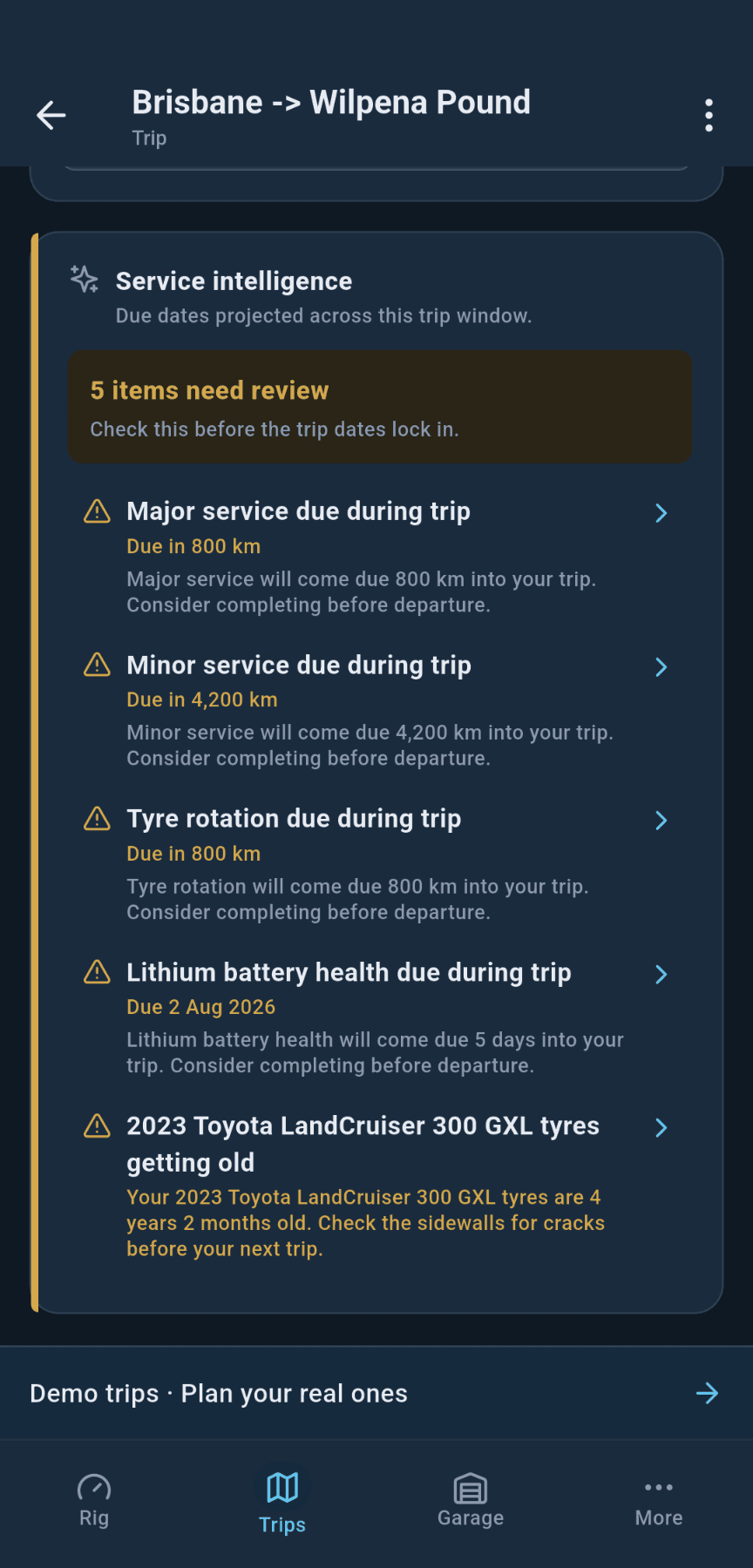
Leave with nothing overdue
loadmate checks the service dates, tyres, hitch and last weigh-in against the trip you are planning. See what needs attention while you still have time to deal with it. Explore the checks on the app’s populated demo rig.


Common questions
- Can the 79 really tow 3,500 kg with the tray loaded right up, or is there a GCM catch like every other ute?
There is no GCM catch, which is the rarest thing about this truck. Toyota's October 2025 spec table lists a 3,510 kg GVM, 3,500 kg of braked towing and a 7,010 kg GCM, and the sum balances exactly, so full payload and a full trailer can legally travel together. The limits that do the work here are different ones: the 350 kg towball download must fit inside the GVM, the loaded rear axle must clear its 2,300 kg compliance-plate figure, and Toyota recommends a load-distribution hitch above 2.2 t of trailer.
- Is the 4-cylinder really up to towing 3 tonnes, or should I hunt down a V8 while I still can?
On the towing evidence the four-cylinder auto is the better tool: 500 Nm against the V8's 430 Nm, and the dated tests agree — carsales towed 2,800 kg at 16.1 L/100km in June 2024 and found it easier than the manual V8, and 4x4 Australia's 2024 back-to-back at about 3,100 kg reached the same conclusion. The V8's surviving advantages are heat margin on long climbs and simplicity, and the market now prices it as a collectible, with late examples advertised to $330,000 against an $85,000 list price. One owner-forum caveat for the 2.8: if the rig regularly runs near the 7,010 kg GCM, shorten oil and transmission fluid intervals.
- How much payload do I actually have left once the tray and canopy go on?
Start from the GVM side. A GXL auto at full tow has about 975 kg inside the GVM after the 350 kg ball (a WorkMate about 960 kg), but that is a tray-less cab-chassis. The lightest alloy dual-cab tray takes about 233 kg, leaving roughly 740 kg. Community build ledgers then show a bull bar near 80 kg and a canopy with drawers around 200 kg, plus water and recovery gear, landing many touring builds near 300 kg of headroom before passengers. That is why pre-registration GVM upgrades in the 3,950-4,200 kg range are treated as a standard line item on touring 79s.
- Why does the 79 feel nervous when a road train comes past — is it true the back wheels sit narrower than the fronts?
It is true and Toyota publishes it: front track 1,555 mm, rear track 1,460 mm on the GXL, a 95 mm difference. One ProductReview owner links the narrower rear track to nearly losing a caravan, and carsales' June 2024 tow test recorded sway as road trains overtook. The working answers are a measured ball weight near 10% of the van, a load-distribution hitch (Toyota recommends one above 2.2 t), and holding a speed margin around big trucks.
- Can I actually buy one in 2026, or am I joining a years-long queue?
The years-long-waitlist story is stale. Toyota stockpiled stock ahead of the September 2025 production stop and was quoting two-to-four-month delivery on most variants in July 2025. The live constraints are narrower: the GXL Wagon automatic's order book has been closed since 17 July 2025 (still shut at CarsGuide's April 2026 check), and the production restart — expected with AdBlue around mid-2026 — had no dated confirmation as of June 2026, so confirm order status with a dealer. On a used 79 dual cab, check the build date: pre-September-2022 trucks carry the older 3,300 kg GVM and 6,800 kg GCM.
Understand the weight limits
Every figure above is governed by a manufacturer-set limit. These guides explain what each term means and how they fit together.
- Caravan & towing weights explainedThe master glossary: GVM, ATM, GTM, TBM and GCM in one place.
- Gross Combination Mass (GCM)The combined vehicle-plus-trailer ceiling that usually bites first.
- Aggregate Trailer Mass (ATM)What your caravan is legally allowed to weigh, fully loaded.
- Braked towing capacityWhy a 3,500 kg rating rarely means you can tow 3,500 kg.
Sources and review
Specifications checked
Page reviewed
- Toyota Australia — LandCruiser 70 specification table (October 2025, GTO-009454)
GVM 3,510, GCM 7,010, braked towing 3,500, per-variant cab-chassis kerb weights, wheelbase
- Toyota Australia — basic towing guide (TSO1004)
Kerb-excludes-accessories definition, towball-inside-GVM rule, ball mass guidance
- Toyota Australia — LandCruiser 70 range page
Current variant availability and towing footnotes
- ANCAP — LandCruiser 70 cab-chassis commercial vehicle grading (2025)
SILVER commercial grading for Jan 2024-onward builds; prior 5-star rating expired end-2023