By loadmate Editorial · Towing & compliance desk
How much can the Nissan Patrol tow?
| Variant | Braked towing capacity | GVM | GCM | Kerb weight | Payload at full tow | Tow ball rating | Rear axle limit |
|---|---|---|---|---|---|---|---|
| TiMY25 | 3,500 kg | 3,500 kg | 7,000 kg | 2,786 kg | 364 kg | 350 kg | 2,030 kg |
| Ti-LMY25 | 3,500 kg | 3,500 kg | 7,000 kg | 2,847 kg | 303 kg | 350 kg | 2,030 kg |
2 variants
| Braked towing capacity | 3,500 kg |
|---|---|
| GCM | 7,000 kg |
| GVM | 3,500 kg |
| Kerb weight | 2,786 kg |
| Front axle limit | 1,650 kg |
| Rear axle limit | 2,030 kg |
| Tow ball rating | 350 kg |
| ATM planning ceiling | 3,300 kg |
| Wheelbase | 3,075 mm |
| Rear overhang | 1,140 mm |
First, give the Patrol the credit it has earned
Start with what the forums and the spec sheet agree on, because the Patrol earns it honestly. The Y62 in current MY25 trim runs a 5.6-litre petrol V8, a 3,075 mm wheelbase and a kerb weight near 2,847 kg on the Ti-L. That mass and that wheelbase make it a genuinely steady thing to tow with; owners towing 2.5 to 2.8-tonne vans describe it as planted and relaxed where a lighter wagon gets shoved around. It is one of the most stable platforms in this class, and that is not marketing, it is physics.
Then there is the number that actually sets it apart. Almost every modern tow vehicle hides the same trap: add the full vehicle weight to the full trailer rating and the total sails past the gross combination mass, so you can have one or the other but not both. A Ford Ranger is about 450 kg short on that sum, an Everest V6 about 400 kg. The Patrol is one of the few nameplates with no GCM shortfall, alongside the LandCruiser 70 and 79 Series: 3,500 kg of vehicle at GVM plus a 3,500 kg trailer comes to exactly 7,000 kg, and the Patrol's GCM is exactly 7,000 kg. On paper, you can be at full weight and tow your full rating at the same moment. That freedom is real, and it is rare.
Where the freedom turns into a trap
Here is the turn. A big engine and a clean GCM line tell you the Patrol can pull 3,500 kg while sitting at its own 3,500 kg limit. Neither tells you what is left to put inside the car while it does. That is a different sum, and it is the one that decides whether the trip works.
The Patrol spends its weight budget twice over in a way no diesel LandCruiser does — first on the mass of a 5.6-litre V8 and a long-travel body, then again on the tow-ball derate Nissan builds into the Y62 (more on that next). A Ti-L weighs 2,847 kg empty against a 3,500 kg GVM, which leaves about 653 kg of payload before a single bag goes in. The Ti, with its lighter trim, starts nearer 714 kg, roughly 61 kg better off, which is worth knowing if you are choosing between them for towing. Either way, 653 kg sounds generous until you remember everything it has to cover: the driver, the family, a full tank of fuel for a thirsty V8, water, recovery gear, the towbar itself, and the load the tow ball presses down. The GCM says yes. The payload says how much.
The tow-ball derate that quietly eats the payload
This is the part most Patrol buyers do not see coming, and it is the single most important number on the page. Nissan does not let you simply add 350 kg of tow-ball mass to the car for free. Only the first 250 kg or so of ball weight sits inside the kerb-to-GVM gap without penalty. Above that, the ball weight starts eating into payload faster than its own mass: by owner accounts and Nissan's own withdrawn tow-ball tables, a 300 kg ball costs roughly 70 kg of payload, and a full 350 kg ball costs about 130 kg.
Run the arithmetic on a Ti-L and the generous 653 kg shrinks fast. Take off the 350 kg the ball presses down, take off the derate penalty, then add a couple of jerry cans of fuel and the towbar hardware, and several buyer's guides put the practical payload left for people and gear at around 205 kg. That is two adults and not much else. The tow rating never moved; the room to use it did.
Tellingly, Nissan has been withdrawing those tow-ball tables, describing them as open to misinterpretation, and pointing owners to a weighbridge instead. When the manufacturer finds its own derate maths confusing enough to pull the chart, that is the clearest possible signal to weigh the rig rather than trust a brochure subtraction. The honest position: the Patrol's GCM headroom is genuine and worth buying, but the limit that bites first is payload and the rear axle, so prove the full-weight case before you commit a 3,500 kg van to it.
The soft rear end is real, and it is measured
The Patrol's rear sags under tow. This is not a forum rumour; it is a measured, current pattern. An RV Daily tow test recorded a 32 mm rear drop hitching a 2,476 kg Nova Vita van, and noted enough movement at the back to suggest a weight distribution hitch was warranted. Across multiple patrol4x4 threads, owners describe the back as super saggy from the factory the moment a real ball weight goes on.
The reason is geometry. The tow ball sits about 1,290 mm behind the rear axle on a 3,075 mm wheelbase, so the coupling works as a lever: a 350 kg ball presses closer to 500 kg straight down onto the rear axle and lifts about 145 kg off the front. That is why the nose comes up and the tail drops, why the steering can feel light, and why the standard fix among Patrol tourers is a set of airbags, often paired with heavy-duty springs because bags alone do not always level a heavily loaded Y62. One owner fitted Kevlar-sleeved bags, still dropped, and ended up on Lovells HD springs to settle it. A correctly approved weight distribution hitch, set to measured axle weights rather than guessed at by chain links, is the other half of the answer for a heavy tandem van.
The V8 is thirsty, but not the way the cliche says
Yes, the 5.6 V8 drinks. Owners report around 14 L/100km around town empty and closer to 12.5 on the highway. Where the usual put-down gets it wrong is the tow penalty. Multiple owners, backed by the RV Daily test, find the V8 barely drinks more once a van is on the back: around 21 L/100km mixed towing 2.5 tonnes, rising to about 25.6 L/100km grinding up mountains. A couple touring full-time with a 2.8-tonne van averaged 21.2 L/100km over two years against a 14.4 figure empty.
The point is the gap, not the headline number. A loaded turbo-diesel often jumps a long way under tow; the big petrol V8, already working at modest revs, does not spike nearly as much. So budget for a thirsty tug in absolute terms, fit the long-range fuel that remote travel needs anyway, and remember that the extra fuel you carry lands straight back on the GVM and rear-axle sums from the sections above. Thirst is a running-cost question, not a reason to write the Patrol off as a tow vehicle.
The cabin: divisive, dated, but no longer the old joke
If you have read older Patrol reviews, set one trope aside. The line about Atari-grade infotainment is no longer true: since the MY24 update the Patrol runs a 10.1-inch touchscreen with wireless Apple CarPlay and Android Auto, a colour driver display, and a 13-speaker Bose system on the Ti-L. That was the biggest interior change since the Y62 launched in 2012, and it quietly retired the cabin's worst criticism.
What survives the currency check is the woodgrain. The MY25 update actually added new woodgrain trim and a Chestnut Brown leather option, and reviewers still describe the result as closer to a 1990s Verada than a circa-$100k SUV. Some owners love it, some find the wood-look trim cheap, and a few grumble about USB and HDMI ports sitting where the middle rear passenger's feet go. It is genuinely divisive taste rather than a flat fault, and it has nothing to do with how the thing tows. Mention it only so you walk in knowing the cabin is dated by design, not broken.
Should you buy the last V8 now, or wait for the Y63?
This is the live buying question for 2026, and the timing is unusual. Nissan has confirmed the Y62 5.6 V8 bows out this year, with an all-new Y63 Patrol arriving in Australia around Q4 2026 powered by a 3.5-litre twin-turbo V6 making 317 kW and 700 Nm. Australia is the first right-hand-drive market to get it. Nissan's own local boss has gone as far as framing the current V8 as the car to buy now.
Treat the Y63 as a clean break, not a facelift. It is a new generation on a new platform, which means its towing and payload story has to be measured fresh when it lands, and nothing on this page should be carried forward to it. The V8 you can buy today is a known quantity with the zero-shortfall GCM and the payload catch spelled out above. If you want the last of the simple, stable petrol V8 tug, buy it with the derate maths understood; if you can wait, judge the V6 on its own numbers, not on the V8's reputation.
The GVM upgrade that can cost you tow capacity
The obvious fix for the payload squeeze is a GVM upgrade, and for a Patrol it is a double-edged one worth understanding before you spend. Several vendors offer a 4,200 kg GVM package that lifts what the car can legally carry, which directly addresses the 653 kg problem and the rear sag in one move.
The catch is what it does to the other end. Done post-registration, a 4,200 kg GVM upgrade can drop the braked tow rating to around 2,800 kg at the full upgraded weight, because the combined limit does not rise to match. Done pre-registration, the 3,500 kg tow rating is generally retained. The OEM wheels also lack a published load rating for the higher mass, so a compliant wheel and tyre package usually comes with it. These figures are vendor-sourced, so confirm them against the specific engineer's approval for your state and registration timing before you buy. The upgrade that cures the sag can quietly cost you the tow rating you bought the Patrol for, so make sure it solves your measured problem rather than just sitting the car higher.
A realistic loaded Patrol, weighed not guessed
Put it together with a typical touring fit-out. A steel bullbar, a winch, a second battery, rear drawers, a fridge, a roof platform, recovery gear and the long-range fuel a remote V8 wants can absorb a large slice of that 653 kg before the family climbs in. Most of that gear lives in the cargo area, behind or over the rear axle, stacking with the roughly 500 kg the tow ball already presses down. The Patrol can sit under its GVM while the rear axle is the number quietly running out.
So the routine is the same one Nissan now recommends by withdrawing its own tables: weigh it. Record the vehicle alone in full travel trim first, then the connected combination, capturing front axle, rear axle, total vehicle, trailer axle group and combined mass. If the rear axle is the problem, start with the cargo area and the van's ball weight before anything else. If GCM is the problem, the rig is simply too heavy overall and shuffling gear between car and van will not save it. For a planning range before you reach the scales, treat a loaded family Patrol as a 3,000-3,300 kg ATM tug; the full 3,500 kg is a legitimate match only once the payload, ball weight and rear axle are measured rather than assumed. The Patrol's size makes it easy to keep adding drawers, recovery gear and supplies. Get the loadmate app to keep that weighbridge result useful: record the changes and their positions to see what they do to your weight margins and stability guidance.
How the Patrol compares, and what to take to the weighbridge
Cross-shopped honestly against the rest of the towing-capacity set, the Patrol's nearest rival is the Toyota LandCruiser 300, which is only about 30 kg short on GCM and tells a very similar rear-axle-and-payload story from a diesel starting point. The difference is character and running cost: the Patrol gives you a simpler, cheaper, petrol V8 with a slightly thirstier town figure but a smaller tow-fuel penalty, while the 300 trades that for diesel range. A lighter, smaller alternative is the Toyota Prado, which gives up outright stability and capability for a lower price and an easier fuel bill, and suits a smaller van.
Whichever way you lean, the Patrol rewards the same discipline. Its size and stability genuinely earn it a place towing heavy, and its GCM headroom is the real thing the marketing claims. The bite is simply somewhere else than the brochure points: in the payload, the tow-ball derate and the soft rear axle. Get those three measured and the Patrol is one of the few wagons that can sit at full weight and tow its full rating without bending the rules. Trust the badge instead, and it is exactly the kind of rig that looks fine on the highway and tips over a rear-axle limit it never told you about.
Readiness, not just numbers, for a remote Patrol trip
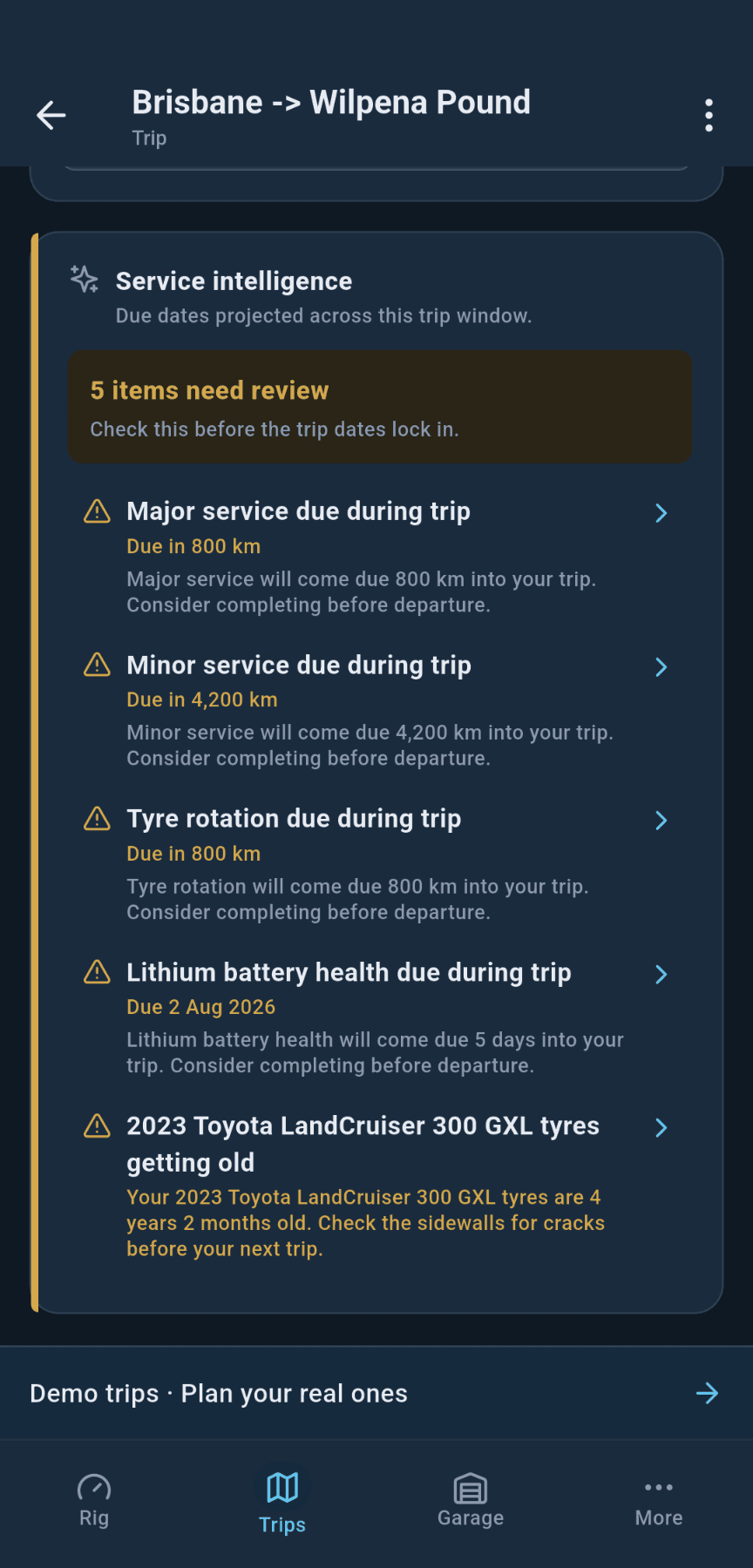
The Patrol's real risk lives off the highway rather than on it. A Patrol is bought to go a long way from a town, so the thing that catches people out is leaving with something overdue or overloaded and not finding out until they are days from help. The payload maths above is only safe if the weigh-in behind it is still current, the airbags and HD springs are doing their job, the tyres are rated for the loaded mass you actually carry, and a service is not quietly due in the middle of nowhere. loadmate's pre-trip checklist runs against the exact rig you are taking, not as generic reminders: it checks service due dates, tyre age, the hitch and weight-distribution setup, and whether your last weigh-in is still fresh enough to trust, then reports it against this trip so the Patrol leaves the driveway sorted rather than hopeful.
Keep the adventure. Know what you’re carrying.
Your Patrol’s touring setup rarely stands still. Record its measured weights in loadmate, then follow the effect of a new accessory, different supplies or a repacked caravan before the next long drive.


Common questions
- Can the Patrol really tow 3,500 kg and carry the family at full GVM, or is the 7,000 kg GCM a con?
The GCM is genuine: at 3,500 kg GVM plus a 3,500 kg trailer the total is exactly 7,000 kg, and the Patrol's combined limit is exactly 7,000 kg, so unlike most utes it has no shortfall. The con, if there is one, is payload, not GCM. A Ti-L only has about 653 kg over its kerb weight, and the tow-ball derate eats a large chunk of that, so you can be legal on combined mass and still out of room to carry people and gear.
- How much payload is actually left once I hitch a 3.5-tonne van with full tow-ball weight?
On a Ti-L, very little. The car starts with about 653 kg of payload. A full 350 kg tow ball plus Nissan's derate penalty of around 130 kg, plus fuel and the towbar, leaves roughly 205 kg for people and gear by common buyer's-guide arithmetic. The Ti starts about 61 kg better at 714 kg. Either way, weigh the loaded rig rather than trusting the subtraction.
- Does the Y62 rear end sag under tow, and do I need airbags or HD springs?
Yes, the rear sags under a real ball weight, and it is measured, not just talked about: an RV Daily test recorded a 32 mm drop behind a 2,476 kg van. The near-universal owner fix is airbags, often paired with heavy-duty springs because bags alone do not always level a heavily loaded Patrol. A correctly approved weight distribution hitch, set to measured axle weights, is the other part of the answer for a heavy tandem van.
- Is the V8 too thirsty to live with, and does it get much worse towing a caravan?
It is thirsty in absolute terms, around 14 L/100km in town empty, but the tow penalty is smaller than the cliche suggests. Owners and a measured RV Daily test put it near 21 L/100km towing 2.5 tonnes, rising to about 25.6 climbing mountains. A loaded diesel often jumps more under tow than the Patrol's V8 does, so the empty-versus-towing gap is narrower than the headline economy implies.
- Should I buy the last V8 Y62 now, or wait for the Y63 twin-turbo V6 in late 2026?
If you want the simple, stable petrol V8 with the zero-shortfall GCM, buy the current Y62 now with the payload and derate maths understood; Nissan has confirmed the V8 ends in 2026. The Y63, due in Australia around Q4 2026 with a 3.5-litre twin-turbo V6 making 317 kW and 700 Nm, is a new generation on a new platform, so its towing and payload story will need measuring fresh and should not be assumed from the V8's figures.
Understand the weight limits
Every figure above is governed by a manufacturer-set limit. These guides explain what each term means and how they fit together.
- Caravan & towing weights explainedThe master glossary: GVM, ATM, GTM, TBM and GCM in one place.
- Gross Combination Mass (GCM)The combined vehicle-plus-trailer ceiling that usually bites first.
- Aggregate Trailer Mass (ATM)What your caravan is legally allowed to weigh, fully loaded.
- Braked towing capacityWhy a 3,500 kg rating rarely means you can tow 3,500 kg.
Sources and review
Specifications checked
Page reviewed
- Nissan Australia — MY26 Patrol spec sheet
GVM, GCM, kerb, axle limits and braked towing
- Nissan Australia — Patrol towing
Towing positioning and tow ball mass