How much can the Mazda BT-50 tow?
| Variant | Braked towing capacity | GVM | GCM | Kerb weight | Payload at full tow | Tow ball rating | Rear axle limit |
|---|---|---|---|---|---|---|---|
| XT 3.0MY25 | 3,500 kg | 3,100 kg | 6,000 kg | 2,015 kg | 485 kg | 350 kg | 1,910 kg |
| XTR 3.0MY25 | 3,500 kg | 3,100 kg | 6,000 kg | 2,098 kg | 402 kg | 350 kg | 1,910 kg |
| GT 3.0MY25 | 3,500 kg | 3,100 kg | 6,000 kg | 2,102 kg | 398 kg | 350 kg | 1,910 kg |
| SP 3.0MY25 | 3,500 kg | 3,100 kg | 6,000 kg | 2,176 kg | 324 kg | 350 kg | 1,910 kg |
4 variants
| Braked towing capacity | 3,500 kg |
|---|---|
| GCM | 6,000 kg |
| GVM | 3,100 kg |
| Kerb weight | 2,176 kg |
| Front axle limit | 1,450 kg |
| Rear axle limit | 1,910 kg |
| Tow ball rating | 350 kg |
| ATM planning ceiling | 2,800 kg |
| Wheelbase | 3,125 mm |
| Rear overhang | 1,250 mm |
Two spec sheets side by side, no differences that tow
Line the BT-50's current spec sheet up against the Isuzu D-Max's and check every figure that matters to a tow. Braked rating: 3,500 kg on both, 750 kg unbraked. Tow-ball maximum: 350 kg on both. Gross vehicle mass 3,100 kg, gross combination mass 6,000 kg, front axle 1,450 kg, rear axle 1,910 kg, wheelbase 3,125 mm — all shared. The comparison comes back empty, line after line. That is no accident of convergent engineering: the BT-50 shares everything under the skin with the Isuzu D-Max, and Unsealed 4X4's twin test, updated March 2025, put it flatly — everything beneath the Mazda bodywork is Isuzu, with no Mazda input into the chassis, driveline, suspension or steering tune.
Owners worked this out early. Grey-nomad forums called the pair 'one and the same' back in October 2020 and reduced the choice to looks and service, and five years of updates have not opened a mechanical gap. The old line that Mazda gave the BT-50 a softer, more SUV-like tune was launch-day marketing; no published test has measured a tune difference on this generation. So a towing comparison between these two is a tie by construction, and what is left to compare is everything the spec sheet does not print: warranty terms, servicing money, the price walk and the badge. Same truck, different paperwork — and for a towing buyer, the paperwork turns out to contain real arithmetic.
The ceiling both badges share: 6,000 kg of GCM
Start with the problem both badges share. The BT-50's 3,100 kg GVM plus its full 3,500 kg tow rating comes to 6,600 kg, but the gross combination mass — the most the ute and trailer may total together — is 6,000 kg. That is a 600 kg gap, the deepest of any mainstream ute in this guide: a Ranger runs 450 kg short, the new HiLux about 320 kg. Only the D-Max matches it, because the D-Max is the same chassis wearing the other grille.
Here is how the ceiling works in practice. Hook up a van grossing its full 3,500 kg — the 350 kg of ball mass counted inside that figure, the way ATM counts it — and what the 6,000 kg GCM leaves for the ute itself is 2,500 kg: kerb weight, occupants, fuel and tray load, all of it. On Mazda's February 2026 brochure kerbs for the 3.0 4x4 dual cab pickup, an XT (2,015 kg) keeps 485 kg of margin inside that cap, an XTR (2,098 kg) keeps 402 kg, a GT (2,102 kg) keeps 398 kg and the SP (2,176 kg) keeps 324 kg. Run the squeeze the other way and it is just as blunt: load the ute to its full 3,100 kg GVM and the 6,000 kg ceiling leaves 2,900 kg of trailer, 600 kg short of the badge. All of that is 4x4 arithmetic, too — a 4x2 BT-50 carries a lower 3,000 kg GVM and a 5,850 kg GCM, so its margins land in different places.
The facelift you can weigh
Those margins used to be better, and the reason is a styling update. The MY25 facelift went on sale on 29 January 2025 with a new bumper, grille and LED lighting, an easier tailgate, bigger screens — and heavier trucks. Mazda's published kerb weights rose with it: the XT barely moved at +5 kg, but the XTR gained 68 kg, the GT 67 kg and the SP 61 kg. None of the ratings moved with them. GVM stayed 3,100 kg, GCM stayed 6,000 kg, tow and ball stayed 3,500 kg and 350 kg — so every kilogram the facelift added to the kerb came straight out of the only margin the GCM maths leaves.
Walk it through on the SP, the trim the tow tests keep picking on. The pre-facelift SP kerbed at 2,115 kg and kept 385 kg at a full-rated tow; the current 2,176 kg car keeps 324 kg. A cosmetic update cost it a passenger's worth of capacity, and CarsGuide's April 2025 SP review lists the same 2,176 kg kerb, so this is no brochure misprint. The trim walk makes the pattern blunt: the $57,720 XT keeps 485 kg at full tow, the $73,490 SP keeps 324 kg, and the returned Thunder — heaviest of all at 2,213 kg and $78,400 — keeps 287 kg. On this chassis, the more you spend, the less the truck may carry while it tows.
Two tow tests, three years apart, draw the same envelope
What do the shared mechanicals feel like with a trailer on? Two tow tests, both on the record, bracket it. In 2022, 4x4 Australia ran a long-term BT-50 with a 1,700 kg boat behind it and found the job relaxed: plenty of low-down torque from the 3.0-litre, no hunting between gears, no sag at the back, and 15.5 L/100km towing around the suburbs against 9.7 unladen. Below two tonnes, this drivetrain barely registers the trailer.
In February 2025, carsales took the SP Pro — the SP wearing Mazda's accessory Old Man Emu Nitrocharger suspension and roughly a 40 mm lift — out with about 3,000 kg of caravan, and the same drivetrain ran out of composure. The ute pitched on truck-rutted highways, yawed in crosswinds badly enough to force the speed down to 70 km/h, hunted between fourth gear at 2,500 rpm and third at 3,000 rpm on mild grades, and drank 16.3 L/100km, which turns the 76 L tank into roughly 450 km of range. The test's advice was to keep the van under about 2,500 kg — and the twist is that the suspension pack sold through Mazda's own accessory catalogue made the towing manners worse, not better.
That 2,500 kg figure has a history. Experienced towers on the grey-nomad forums settled on the same number back in October 2020, warning that mates towing 3,000 kg without a second thought were closer to their limits than they knew. A folk limit that survives a facelift and gets re-measured to the same value five years on deserves respect, which is why the honest planning band for either twin is 2,300 to 2,800 kg of ATM, with the 3,500 kg badge treated as the legal ceiling it is. The 2,800 kg top comes from the other end of the maths — at full 3,100 kg GVM the 6,000 kg GCM allows 2,900 kg of trailer, and 2,800 sits a working margin under that ceiling — and it belongs only to a rig with a measured ball mass and the rear suspension sorted. The 2,300 kg floor needs less argument: below it the truck stops being the limit at all, as the 2022 test's easy 1,700 kg tow showed — which puts the 2,500 kg folk limit mid-band, where the comfortable half of the band ends and the conditional half begins.
The towbar lever Mazda prints on its own dimensions sheet
Mazda is unusually candid about where the coupling sits: the dimensions sheet prints the dual cab's rear overhang twice, 1,250 mm bare and 1,400 mm with the towbar tongue fitted. Take the second figure seriously, because it is a lever arm. A coupling hanging 1,400 mm behind the rear axle on a 3,125 mm wheelbase multiplies whatever the van puts on the ball by about 1.45 before the axle feels it. Load the ball to its full 350 kg and the rear axle — rated at 1,910 kg — picks up roughly 505 kg, while the front axle sheds about 155 kg, which is steering grip leaving the front tyres. The hitch is a see-saw with the rear axle as the pivot, and the nose of the ute is the light end.
Owners feel that arithmetic before they measure it. The recurring current-generation complaint on ProductReview is rear sag under load — one owner called the factory suspension a disgrace and reported spending $3,500 on replacement springs — and an experienced tower warned at launch that the three-leaf rear pack would not carry a tonne of tray load in standard form. The leaf pack is a comfort-versus-capacity compromise Isuzu chose for both badges, so an aftermarket spring set levels the stance on either truck. What it cannot move is the 1,910 kg rear axle rating or the 350 kg ball ceiling: springs change how the load rides, never what is allowed.
The warranty shapes, and the odometer that chooses between them
Now the differences, and the first one is the decision. Mazda warrants the BT-50 for 5 years with unlimited kilometres. Isuzu warrants the D-Max for 6 years or 150,000 km, whichever arrives first. The showroom shorthand — Isuzu's is longer — holds only for some odometers, and the arithmetic that splits them is short. To use all 6 of Isuzu's years you must average 25,000 km a year or less, because 150,000 divided by 6 is 25,000. At exactly 30,000 km a year the two offers expire at the same moment: 5 years in, 150,000 km up. Above 30,000 km a year, the Isuzu cap arrives before the Mazda clock does.
The cap counts total kilometres, so one big-lap year does not flip the maths on its own — it is the owner who strings big years together, the full-time tourer or the ute that works between trips, who runs out of 150,000 km early. At a sustained 35,000 km a year the D-Max's cover is finished about 4 years and 3 months in, while the BT-50 is still warranted at the 5-year mark with any number on the odometer; for owners at that pace the 'shorter' Mazda warranty protects them the better part of a year longer. Plenty of towing buyers live there, and plenty more do one lap and settle back under 15,000 km a year — for them, and for anyone averaging under 25,000 km, Isuzu's sixth year is real. The right badge is genuinely a function of your annual kilometres, which is not how either showroom sells it.
The rest of the paperwork: prices, servicing, badge
The other line items are smaller. On the MY26 price list CarExpert walked through in March 2026, the 3.0 4x4 dual cab range runs XT $57,720, the new Boss grade $60,220, XTR $64,740, GT $68,160, SP $73,490 and the returned Thunder $78,400 before on-road costs — rises of $500 over MY25, or $1,540 on XTR, GT and SP, where a surround-view camera became standard. Servicing is the softer number: Mazda prices its services through a per-vehicle lookup, so there is no flat published schedule to quote, and third-party tallies put a BT-50 anywhere from roughly $2,300 to $2,500 over 5 years depending on trim, against Isuzu's published flat $449 a service — $2,245 over the same 5 years. A few hundred dollars across the whole term at worst, noise next to the warranty question. Isuzu counters with roadside assistance renewable to 7 years through dealer servicing; Mazda bundles roadside with its warranty term.
Then there is the badge itself, which the market prices openly: the D-Max outsells the BT-50 roughly two to one on 2025 VFACTS figures despite identical foundations, CarsGuide's 2025 verdict was that the Isuzu's 'rough charm' under the Mazda's sheetmetal is the BT-50's most appealing quality, and a 2023 Whirlpool thread's cross-shoppers found the pre-facelift SP solid and dependable but nothing to get excited about next to a Ranger. None of that tows a kilogram differently. And despite confident forum opinion running in both directions, no published resale figures separate the twins, so treat any claimed resale gap as folklore until someone puts numbers on it.
Owner reality on the current truck, plus one weld to check
Owner sentiment on the current generation runs lukewarm but specific: 3.3 out of 5 across the 47 owner reviews on ProductReview's BT-50 listing as checked in June 2026, with 29% of them negative. Towing is rarely the complaint — owners report the truck tows effortlessly at real weights — and the gripes cluster on the driver-assist tuning instead. Multiple owners describe the AEB jamming the brakes on with nothing ahead and the lane-keep fighting a deliberately chosen line through corners, and the complaint is current: 2025 and 2026 expert reviews found the lane-centring inaccurate enough to discourage using it, and a 2025 long-term test logged the over-active warning chimes while noting a one-touch disable softens, without fixing, the behaviour. For a towing buyer the practical step is a test drive long enough to meet the systems, and learning that one-touch disable before the first trip.
One recall is directly towing-relevant, and CarExpert's report of 4 March 2025 carries the detail: Mazda recalled 912 BT-50s built during 2024 because the bracket for the left rear leaf spring may be insufficiently welded and could crack, with a risk of losing control — and the rear leaf pack is exactly the hardware a loaded tray and a 350 kg ball lean on. The remedy is a free inspection and replacement. If you are buying a 2024-build truck, run the VIN through the national vehicle recalls register before money changes hands; earlier campaigns covering fuel hoses and an engine control module on 2020-24 builds are worth the same check.
October 2020 is the line for used buyers
Nothing on this page applies to a BT-50 built before October 2020. The second-generation truck (2011 to 2020) was a Ford Ranger twin with a 3.2-litre five-cylinder — different chassis, different engine, different everything — so a used listing from that era belongs to a different article, its old transmission-cooling folklore included. The Isuzu-twin generation starts in October 2020, with the 3.0-litre 4JJ3 making 140 kW and 450 Nm and the full current rating set in place from day one.
Inside the current generation, the calendar still matters. Manual gearboxes left the range with the January 2025 facelift. In October 2025 a 2.2-litre turbo-diesel (120 kW, 400 Nm, 8-speed auto) replaced the old 1.9 as the second engine and carries the same 3,500 kg braked rating, so the 1.9's lower 3,000 kg figure no longer applies to anything on a new-car lot. The MY26 update of March 2026 added the Boss grade and brought back the Thunder, leaving the mid-2026 range at 7 variants: XS, XT, Boss, XTR, GT, SP and Thunder.
Which twin for towing, then
As tow vehicles the two trucks are the same machine, so buy the paperwork that fits your odometer. If your towing life runs above about 30,000 km a year (the big-lap cohort), the BT-50's unlimited-kilometre cover protects exactly the years the D-Max's 150,000 km cap surrenders, and that is worth more than the servicing gap (a few hundred dollars at most over 5 years) and the styling combined. Under about 25,000 km a year, take the D-Max and its genuine sixth year. Between those marks it is a dealer-and-grille decision, and either answer is sound. Whichever brochure you sign, the van plan is identical: 2,300 to 2,800 kg of ATM, ball mass measured rather than assumed, and the 600 kg GCM gap respected. The BT-50 you take touring also carries its canopy, drawers and recovery gear. Get the loadmate app to put those accessories and the family's load beside your measured weights, so the remaining margin reflects what you plan to take.
The same BT-50 can leave home with a different load each trip. Once your weighbridge figures are in loadmate, recording a new canopy accessory, extra passenger or changed water load updates the weight margins and stability guidance for that truck and van. You can see what needs attention while there is still time to change the packing.
Two closing cautions. The numbers above are the ratings; your rig's reality is whatever it weighs on the day, so before any long trip put the loaded truck and van over a certified weighbridge and collect the axle-by-axle figures, because that ticket is the only legal evidence of weight there is. Treat everything here — the margins, the bands, the snapshot — as decision support for choosing and loading the rig, never as certification of it: the weighbridge reads the same on either badge.
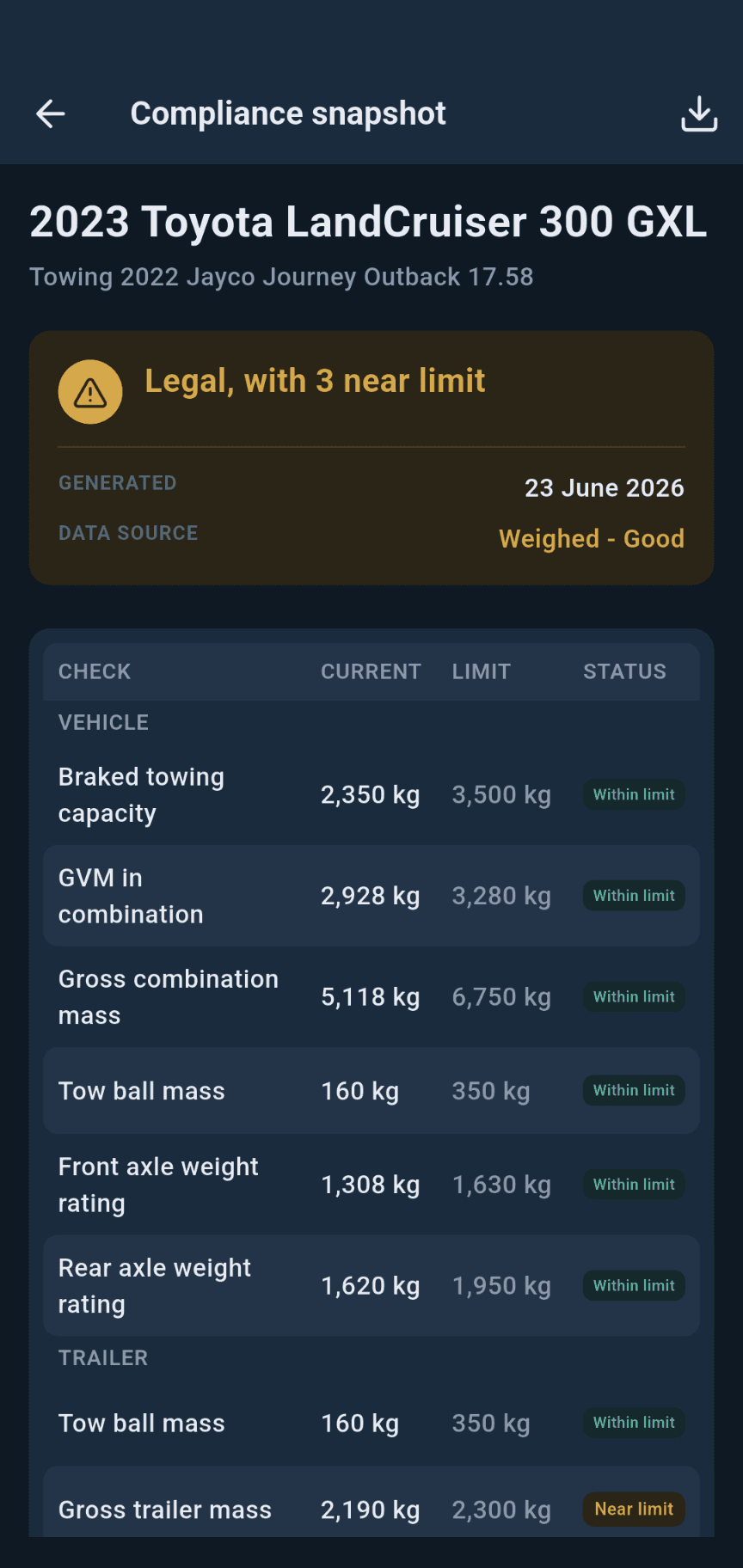
See what is left at every limit
loadmate lays out the full legal breakdown: GVM, GCM, ATM, axle and tow-ball mass, each graded against its margin. Create a free account to explore it on a populated demo rig in the app.


Common questions
- Isuzu D-Max or Mazda BT-50?
Mechanically it is a tie: the BT-50's chassis, driveline, suspension and steering tune are Isuzu-developed, and every towing figure is identical — 3,500 kg braked, 350 kg ball, 3,100 kg GVM, 6,000 kg GCM, 1,910 kg rear axle. Decide on the paper instead. Mazda gives 5 years with unlimited kilometres, Isuzu 6 years or 150,000 km, so above about 30,000 km a year the Mazda covers longer and below 25,000 km a year the Isuzu does. Servicing differs by a few hundred dollars at most across 5 years on third-party tallies; the rest is styling, dealers and the price walk.
- Are the new D-Max and the new BT-50 really one and the same?
For towing, yes, and not loosely: GVM 3,100 kg, GCM 6,000 kg, 3,500 kg braked and 750 kg unbraked, 350 kg of ball, 1,450 kg front and 1,910 kg rear axle ratings, the same 3,125 mm wheelbase and the same Isuzu-developed suspension and steering tune. The genuine differences are commercial — warranty shape, capped-price servicing totals, variant packaging, styling and dealer networks. No test anyone has published has measured a mechanical difference between them on this generation.
- How much can I tow with my Mazda BT-50?
Every current variant is rated 3,500 kg braked and 750 kg unbraked with a 350 kg tow-ball maximum, conditional on a Mazda Genuine Towing Kit, and the law adds an electric brake controller and breakaway system for trailers over 2,000 kg. The working limit is the 6,000 kg GCM: at a full 3,500 kg of van the entire ute must weigh no more than 2,500 kg, which leaves an XT 485 kg for occupants and gear and an SP just 324 kg on current brochure kerbs.
- Thinking of towing a caravan with the BT-50 — is it actually up to it?
Up to about 2,500 kg it is one of the easier utes to tow with: at 1,700 kg a 2022 long-term test found no gear-hunting, no rear sag and 15.5 L/100km. Push toward 3,000 kg and a February 2025 test recorded crosswind yaw that forced 70 km/h, gear-hunting on mild grades and 16.3 L/100km — about 450 km from the 76 L tank. The ceiling is the 6,000 kg GCM and the rear suspension, not the engine. Plan 2,300 to 2,800 kg of ATM.
- Is the SP any good for towing a big van?
It is the wrong trim for that job. The SP carries the heaviest kerb of the core range at 2,176 kg, so it keeps just 324 kg of margin during a full-rated tow — the least of the four mainstream trims — and the February 2025 tow test of the SP Pro found Mazda's accessory Nitrocharger suspension made stability with about 3,000 kg of van worse, with advice to stay near a 2,500 kg ceiling. If the budget is SP money, a lighter XTR or GT tows the same and keeps about 75 kg more margin; the SP's case is styling, and it has no towing edge.
Understand the weight limits
Every figure above is governed by a manufacturer-set limit. These guides explain what each term means and how they fit together.
- Caravan & towing weights explainedThe master glossary: GVM, ATM, GTM, TBM and GCM in one place.
- Gross Combination Mass (GCM)The combined vehicle-plus-trailer ceiling that usually bites first.
- Aggregate Trailer Mass (ATM)What your caravan is legally allowed to weigh, fully loaded.
- Braked towing capacityWhy a 3,500 kg rating rarely means you can tow 3,500 kg.
Sources and review
Specifications checked
Page reviewed
- Mazda Australia — BT-50 digital brochure (February 2026, AU41-P00004982)
Braked/unbraked towing, towball 350 kg, GVM, GCM, per-trim kerb weights, axle capacities, wheelbase and overhang
- Mazda Australia — towing with Mazda BT-50 guide
Mazda Genuine Towing Kit condition for the rated capacity
- Mazda Australia — new vehicle warranty
5-year unlimited-kilometre warranty
- Isuzu UTE Australia — Service Plus warranty terms
D-Max 6-year/150,000 km warranty for the twin comparison
- CarExpert — 2026 Mazda BT-50 prices (13 Mar 2026)
MY26 range composition and per-trim pricing
- CarExpert — BT-50 leaf-spring bracket recall REC-006284 (4 Mar 2025)
Recall scope (912 vehicles, 2024 build) and remedy