By loadmate Editorial · Towing & compliance desk
How much can the Toyota HiLux tow?
| Variant | Braked towing capacity | GVM | GCM | Kerb weight | Payload at full tow | Tow ball rating | Rear axle limit |
|---|---|---|---|---|---|---|---|
| SR5 2.8 diesel 48VMY26 | 3,500 kg | 3,120 kg | 6,300 kg | 2,020 kg | 750 kg | 350 kg | 1,700 kg |
| Rogue 2.8 diesel 48VMY26 | 3,500 kg | 3,120 kg | 6,300 kg | 2,342 kg | 428 kg | 350 kg | 1,700 kg |
2 variants
| Braked towing capacity | 3,500 kg |
|---|---|
| GCM | 6,300 kg |
| GVM | 3,120 kg |
| Kerb weight | 2,020 kg |
| Front axle limit | 1,490 kg |
| Rear axle limit | 1,700 kg |
| Tow ball rating | 350 kg |
| ATM planning ceiling | 3,200 kg |
| Wheelbase | 3,085 mm |
| Rear overhang | 1,245 mm |
The clean sheet that mattered most was a number, not a panel
Toyota put the 9th-generation HiLux on sale in Australia on 9 December 2025 and called it all-new. For a tow buyer, the headline is not the Australian-led exterior or the 12.3-inch screens. It is one figure on the spec sheet: gross combination mass (GCM), the most weight the ute and trailer are allowed to total, rose from 5,850 to 6,300 kg on the 4x4. That 450 kg is the whole story of why this ute tows differently from the one it replaced.
Think of it as a new ute that moved the goalposts but kept the goal. The tow rating is still 3,500 kg braked, the GVM is still in the same band, the 2.8 diesel is the same engine. What moved is the combined-mass ceiling that decides whether you can use the tow rating and carry a real load at the same time. On the old HiLux you could not. On this one, mostly, you can.
What the +450 kg of GCM actually buys you
The maths is worth doing slowly because it is the reason the new HiLux earns the upgrade. On the previous generation, an SR5 hitched to a 3,500 kg van had to stay under a 5,850 kg GCM, which capped the loaded ute at 2,350 kg. The tow ball rides inside the van's 3,500 kg, so the only thing still to come out is the same 2,020 kg kerb, which left about 330 kg for everything else, including passengers, the canopy, the fridge and you. That is why owners of the old ute talked about running out of payload the moment they hitched up and loaded for a real trip.
Raise the ceiling to 6,300 kg and the same SR5 towing the same 3,500 kg van is allowed 2,800 kg under the GCM, about 780 kg of headroom over the 2,020 kg kerb. The lift is big enough that the combined ceiling no longer bites first: the 350 kg ball download counts against the 3,120 kg GVM instead, capping the ute at 2,770 kg, so you keep about 750 kg of payload for the canopy, the gear and the people. carsales, reporting the December 2025 launch, framed that jump as taking the HiLux from a tail-ender to one of the more competitive 4x4 utes for the tow-and-load problem. The squeeze that defined the 8th-gen is largely gone. That is the single most useful thing this generation did, and it is why carrying over the old put-down would be wrong.
How Toyota engineered the ceiling higher
A GCM does not rise because a marketer decides it should. It rises because the chassis can take more. On the 9th-gen, Toyota extended and reinforced the side rails with thicker-gauge steel, fitted thicker front suspension towers, redesigned the cabin-mount brackets, added spot welds and reworked the powertrain cooling. Those are the parts that let a heavier combined mass run down the highway without overworking the frame or the driveline.
This is also where the genuine debate sits. The HiLux rides on the IMV platform that dates to 2004, keeps the 3,085 mm wheelbase, and reuses the cabin cell, doors and the 2.8 diesel itself, which is why Chasing Cars cheerfully called it the eighth-and-a-half generation for the skeptics. Badge-wise, they have a point. But for a tow buyer the parts that count, the chassis reinforcement, the +450 kg GCM, the +50 kg tow ball, disc brakes and the retuned suspension, are a real engineering step. It behaves like a new tow vehicle even where the marketing oversells the all-new line.
The tow ball moved too: 300 to 350 kg
Alongside the GCM lift, the 4WD HiLux now allows a 350 kg tow-ball download, up from 300 kg on the prior generation, per the Toyota towing guide and CarsGuide's towing-capacity page. The 4x2 sits at 250 kg and the Pre-Runner at 280 kg, so check the variant. The extra 50 kg on the hitch matters because a heavy touring van loaded with water and gear at the front commonly puts 280 to 350 kg of tow-ball mass on the hitch, and the old 300 kg limit could be the first thing you exceeded.
The catch is that tow-ball mass does not sit politely on the hitch. It levers down on the rear axle, sitting behind the wheels, and lifts a little load off the steer axle at the front. So the 350 kg you are now allowed to put on the ball also presses the rear axle toward its limit, because it acts on the end of a lever behind the wheels, which is exactly where the next section goes.
The limit the clean sheet did not move: a 1,700 kg rear axle
Here is what the new HiLux kept. The rear axle is still rated 1,700 kg, the same as the ute it replaced. That figure comes from the compliance plate and GVM-upgrade vendors rather than a headline Toyota spec, so treat it as well-supported but worth confirming against your own plate. On a 3,085 mm wheelbase with the tub and most of the load sitting behind the back wheels, the rear axle is the part that quietly fills first when you build a touring ute. The ball load sits at the very back, the canopy sits over the tub, the drawers and fridge sit in the canopy, and all of it piles onto those two rear tyres.
Put rough numbers on it. An SR5 carries a meaningful share of its 2,020 kg kerb weight over the rear before you add anything, and a 350 kg ball load adds more than its own weight to the rear axle once the lever effect of the wheelbase is counted: with the hitch sitting roughly 1,395 mm behind the rear axle on a 3,085 mm wheelbase, that 350 kg presses about 510 kg onto the rear axle and lifts about 160 kg off the front. Stack a steel canopy, a drawer system, a fridge, two batteries and a full water tank on top, and the 1,700 kg rear-axle rating can run out while the total vehicle weight is still comfortably under GVM. A single weighbridge ticket for the whole rig will not catch that, because it tells you the total without splitting the axles.
Why you still cannot max both ends at once
Even with the bigger ceiling, the HiLux's GCM of 6,300 kg is less than the sum of a full 3,120 kg GVM and a full 3,500 kg trailer, which would be 6,620 kg. That leaves the HiLux about 320 kg short. It is a smaller shortfall than the Ford Ranger's 450 kg or the Triton's 450 kg, but it is still a shortfall, and it means the same rule applies: if the van is at 3,500 kg, the ute cannot also be at full GVM. If the ute is loaded to GVM for a long remote trip, the van has to come down.
CarsGuide's GVM test of the SR put real figures to it. That ute started with 965 kg of payload, but towing 3,500 kg caps the loaded vehicle at 2,800 kg under the 6,300 kg GCM, so it has to give back roughly 320 kg, leaving about 645 kg. Loaded close to GVM, the reviewer found the rear leaf springs compressed about 50 mm with clear bump-stop room, and noted the ute actually felt more planted laden than empty, because the suspension is tuned for weight. That is the quiet tell behind the owner split: the people who run it light complain about the bounce, and the people who run it heavy do not.
The 48V mild hybrid is real, but it changes refinement, not towing
The SR auto and above now carry a 48V V-Active mild-hybrid system: an 8.5 kW, 65 Nm motor-generator and a small lithium battery bolted to the same 2.8 diesel, which still makes 150 kW and 500 Nm in auto form. It smooths the low-down delivery and tidies up the idle-stop, and reviewers driving the 2026 ute generally said it feels much like the regular 2.8 rather than a stronger engine.
So treat it as a refinement, not a towing change. It does not raise torque, it does not raise the tow rating, and the fuel gain is modest: claimed figures around 7.1 to 7.6 L/100km gave way to real-world numbers nearer 7.9 to 8.9 L/100km in road tests. If you are choosing the HiLux to tow, choose it for the chassis and the GCM, not the mild-hybrid badge. The engine is the same engine, just smoother off the line.
A factory GVM upgrade is coming, and it targets the rear axle
The clearest signal that the rear axle is the real ceiling is that Toyota is fixing it. A factory-backed Australian GVM upgrade is due from August 2026, and what it adds is telling: roughly 372 to 435 kg of payload, taking GVM to about 1,525 kg of capacity, plus around 280 kg of extra rear-axle capacity and 100 kg at the front, with a 10 mm ride-height lift, while the warranty and the 3,500 kg tow rating stay intact. You do not engineer 280 kg of rear-axle capacity for a problem nobody has.
Read the paperwork closely before banking on it, though, and the rule holds for any GVM kit. Some upgrades lift GVM without lifting GCM. If the kit raises what the ute can carry but leaves the 6,300 kg combined ceiling alone, a 3,500 kg van is still constrained by combined mass exactly as before. The factory figures here are corroborated across multiple outlets but should be checked against Toyota's own spec sheet when the kit actually ships. If you are weighing the HiLux against rivals first, the Ford Ranger carries a bigger GCM shortfall, while the Mitsubishi Triton starts with a heavier 2,040 kg rear axle that fills less easily under a canopy.
One early-life recall worth knowing about
If you are buying new or near-new, there is one recall on the books. In April 2026, 13,390 MY2025-26 HiLux utes built between late August 2025 and late February 2026 were recalled because the electric power-steering wire harness ground could be re-installed incorrectly during the fitment of a Toyota Genuine bullbar or nudge bar with a light bar, which could cause a loss of power-steering assist. The fix is free at a dealer, and at the time of the notice only one customer had been affected.
The practical takeaway is narrow: it is tied to accessory fitment, not the base vehicle, and it is the kind of early-life item you would expect on a ute about six months on sale. Ask whether the recall work has been done if the ute wears a genuine bullbar with a light bar. Beyond that, there are no reliability complaints to report on this new drivetrain yet, which is fair for a vehicle this fresh.
Where this leaves a real tow decision
For most touring owners, the sensible plan on a 2026 SR5 is a van around 2,800 to 3,200 kg ATM. That keeps the tow-ball mass and the rear axle in a place where a canopy and drawers still fit, and it stops the GCM subtraction from being the headline of every trip. A 3,500 kg van is now a genuine option on this generation in a way it was not on the last one, but it is still a specialist match that wants confirmed trailer weights, a measured ball load and actual loaded axle weights, not a heroic figure on the brochure. If you are still cross-shopping dual-cabs, the towing-capacity comparisons line the HiLux up against the Ranger, Triton and the rest on the same GCM-and-axle maths.
The honest call for a well-set-up SR5 and a sensibly loaded mid-three-tonne van is pass (well matched) on the numbers, sliding to caution (careful) the moment the van climbs toward 3,500 kg with a heavy touring fit-out on the ute. The canopy, bullbar and drawers have already used part of your HiLux's payload before the family or van arrives. Get the loadmate app to see what those accessories and your trip load leave for towing, then keep the picture current as you record changes. Confirm the loaded combination on a weighbridge that splits the axles before you commit to the match.
The number this generation made it easy to overlook
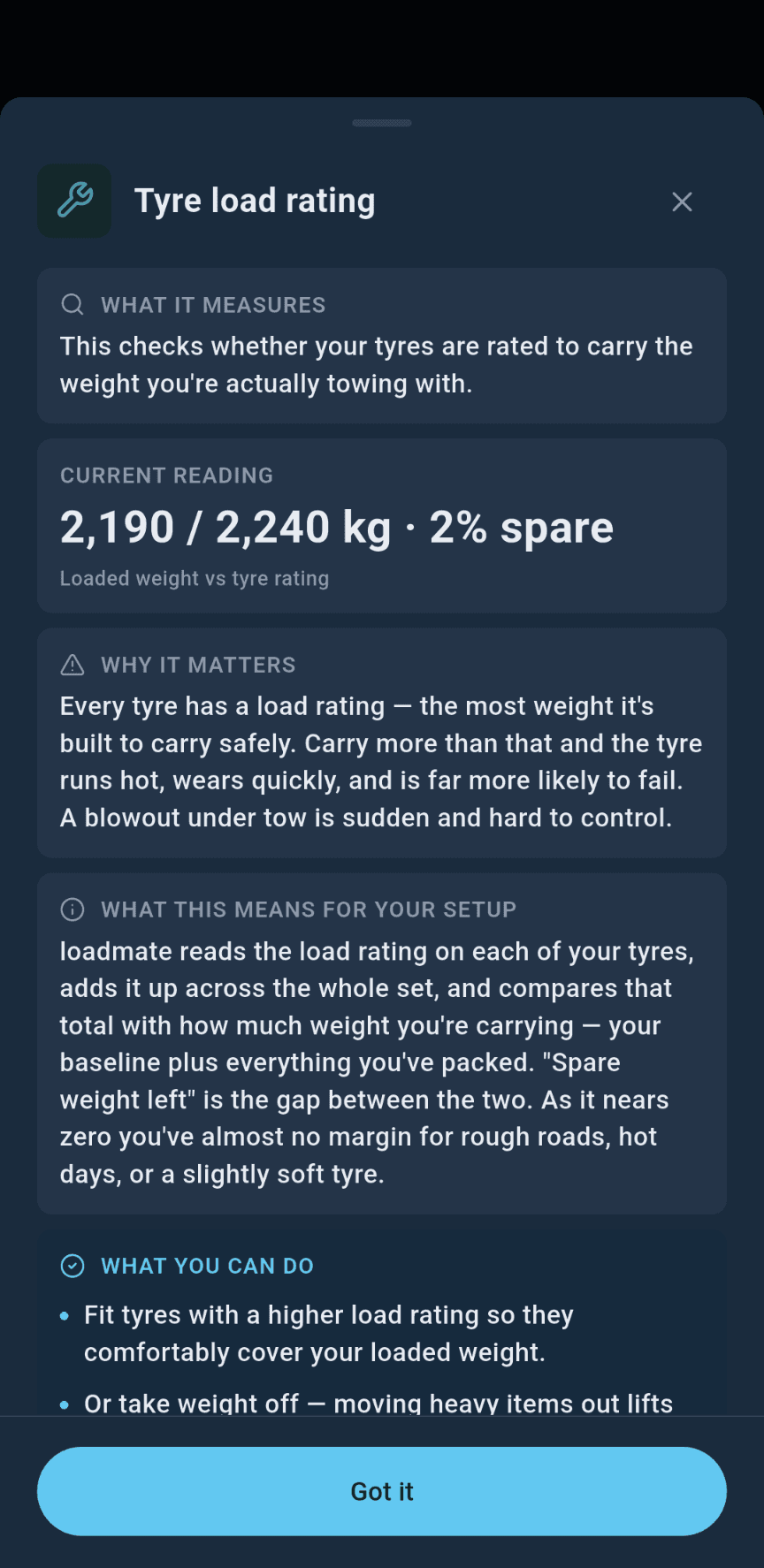
There is one limit the GCM rescue can hide. Load an SR5 near its 1,700 kg rear axle, with a 350 kg ball and a full touring canopy over the tub, then hitch a van loaded near its own limits, and the back tyres can be carrying close to or beyond what they are rated to take. The figure stamped on the tyre sidewall is a load rating, and almost nobody checks it against the weight actually sitting on the axle. loadmate reads that tyre load rating from a single setup entry and cross-references it against your real loaded weight, so the moment the rear tyres are being asked to carry more than they are rated for, it shows up before the trip rather than as a sidewall failure on a hot day. It is the one number this generation's extra payload makes it easiest to spend without noticing.
Keep building the trips, not the guesswork
A new battery, a different fridge or another passenger changes the setup you weighed. loadmate helps you keep track of those changes and plan the next load around your HiLux’s limits.


Common questions
- Is the new HiLux actually all-new, or just a deep facelift of the old one?
Both, depending on what you measure. It keeps the 2004-era IMV platform, the 3,085 mm wheelbase, the cabin cell and the 2.8 diesel, so some reviewers call it an eight-and-a-half-generation update. But for towing it is a real step: reinforced side rails, GCM up 450 kg to 6,300, the tow ball up 50 kg to 350, disc brakes and retuned suspension. It behaves like a new tow vehicle even where the marketing oversells the all-new line.
- Can the 2026 HiLux tow 3,500 kg with the family and gear on board?
Far better than the old one could. With GCM now 6,300 kg, the tighter cap on an SR5 towing 3,500 kg is its own GVM: the 350 kg tow ball counts against the 3,120 kg GVM, and once the 2,020 kg kerb is out you keep about 750 kg of payload. The previous generation, on its 5,850 kg GCM, kept about 330 kg. So 750 kg covers passengers and a proper touring fit-out. The limit is that GCM is still about 320 kg short of full GVM plus full tow, so you cannot be at maximum GVM and tow 3,500 kg at once.
- Has the bigger GCM finally fixed the HiLux payload-when-towing problem?
Mostly, not entirely. The +450 kg GCM lifts the SR5's leftover payload when towing 3,500 kg from about 330 kg to about 750 kg (the 350 kg ball comes off the 3,120 kg GVM, then the 2,020 kg kerb), which removes the worst of the old squeeze. What remains is the 1,700 kg rear axle and the roughly 320 kg GCM shortfall. The ceiling just bites later and more gently than it used to, rather than disappearing.
- Is the 48V mild hybrid worth it for towing?
Not as a towing upgrade. The 8.5 kW, 65 Nm system assists the same 150 kW, 500 Nm 2.8 diesel and smooths low-down delivery, but reviewers say it feels much like the regular engine and the tow rating is unchanged. Real-world fuel landed nearer 7.9 to 8.9 L/100km against claims of 7.1 to 7.6. Choose the HiLux for its chassis and GCM, not the mild-hybrid badge.
- Do I need a GVM upgrade on the new HiLux, and does it cut towing capacity?
You may, if you carry a permanent touring fit-out that eats payload and rear-axle capacity before the van is hitched. A factory-backed Australian GVM upgrade is due from August 2026, adding roughly 372 to 435 kg of payload and around 280 kg of rear-axle capacity while keeping the 3,500 kg tow rating and the warranty. Read the paperwork: some upgrades lift GVM without lifting GCM, which leaves a heavy van just as constrained by combined mass as before.
Understand the weight limits
Every figure above is governed by a manufacturer-set limit. These guides explain what each term means and how they fit together.
- Caravan & towing weights explainedThe master glossary: GVM, ATM, GTM, TBM and GCM in one place.
- Gross Combination Mass (GCM)The combined vehicle-plus-trailer ceiling that usually bites first.
- Aggregate Trailer Mass (ATM)What your caravan is legally allowed to weigh, fully loaded.
- Braked towing capacityWhy a 3,500 kg rating rarely means you can tow 3,500 kg.
Sources and review
Specifications checked
Page reviewed
- Toyota Australia — HiLux spec sheet (May 2026)
GVM, GCM, kerb and braked towing
- Toyota Australia — vehicle payload policy
Payload and tow ball mass guidance